DNA REPLICATION  of  [email_address]
What is Replication?. In replication Two identical daughter DNA molecules are made from a single  DNA molecule. This is an uneque feature in DNA. No other biological molecule do so.
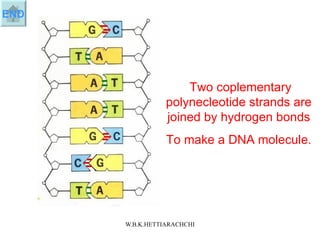
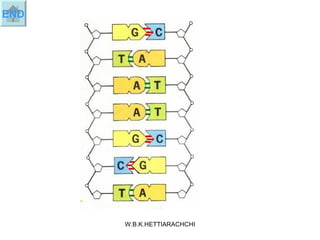
Two coplementary polynecleotide strands are joined by hydrogen bonds To make a DNA molecule.
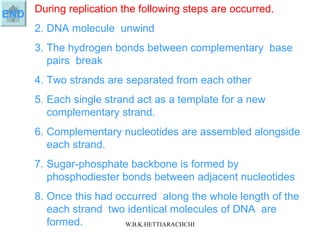
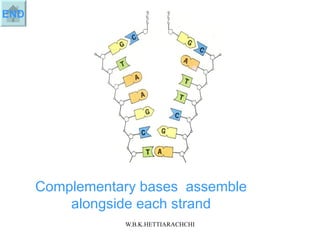
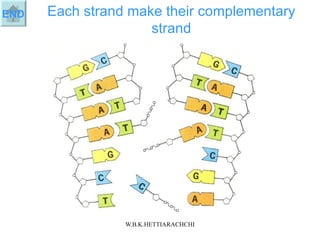
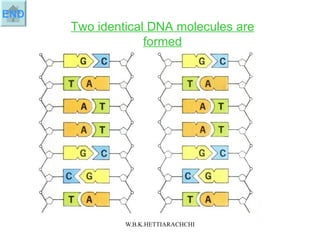
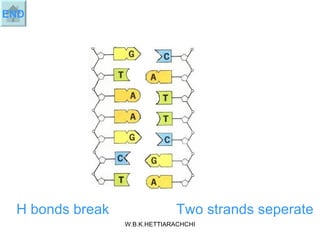
During replication the following steps are occurred. DNA molecule  unwind  The hydrogen bonds between complementary  base pairs  break Two strands are separated from each other Each single strand act as a template for a new complementary strand. Complementary nucleotides are assembled alongside  each strand. Sugar-phosphate backbone is formed by phosphodiester bonds between adjacent nucleotides Once this had occurred  along the whole length of the  each strand  two identical molecules of DNA  are formed.
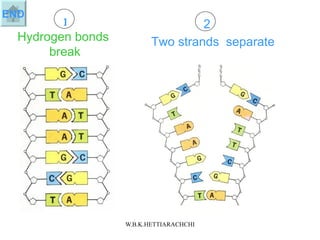
Hydrogen bonds  break Two strands  separate 1 2
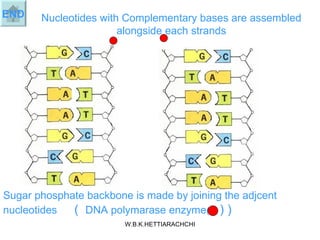
Complementary bases  assemble alongside each strand
Each strand make their complementary strand
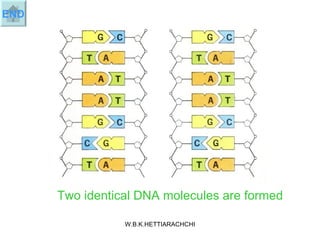
Two identical DNA molecules are formed
Let us animate the process of replication
 
H bonds break  Two strands seperate
Sugar phosphate backbone is made by joining the adjcent nucleotides   (  DNA polymarase enzyme (   ) ) Nucleotides with Complementary bases are assembled alongside each strands
Two identical DNA molecules are formed
THE END [email_address]

Nucleic Acid Replication English Version

  • 1.
    DNA REPLICATION of [email_address]
  • 2.
    What is Replication?.In replication Two identical daughter DNA molecules are made from a single DNA molecule. This is an uneque feature in DNA. No other biological molecule do so.
  • 3.
    Two coplementary polynecleotidestrands are joined by hydrogen bonds To make a DNA molecule.
  • 4.
    During replication thefollowing steps are occurred. DNA molecule unwind The hydrogen bonds between complementary base pairs break Two strands are separated from each other Each single strand act as a template for a new complementary strand. Complementary nucleotides are assembled alongside each strand. Sugar-phosphate backbone is formed by phosphodiester bonds between adjacent nucleotides Once this had occurred along the whole length of the each strand two identical molecules of DNA are formed.
  • 5.
    Hydrogen bonds break Two strands separate 1 2
  • 6.
    Complementary bases assemble alongside each strand
  • 7.
    Each strand maketheir complementary strand
  • 8.
    Two identical DNAmolecules are formed
  • 9.
    Let us animatethe process of replication
  • 10.
  • 11.
    H bonds break Two strands seperate
  • 12.
    Sugar phosphate backboneis made by joining the adjcent nucleotides ( DNA polymarase enzyme ( ) ) Nucleotides with Complementary bases are assembled alongside each strands
  • 13.
    Two identical DNAmolecules are formed
  • 14.