ABDUL BARI
M.Sc. BIO TECH (II SEM)
MOL.BIOLOGY I
505516516021
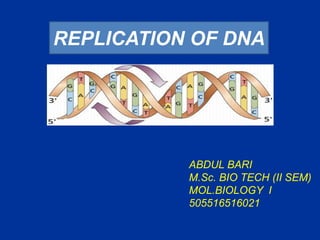
REPLICATION OF DNA
Definition:
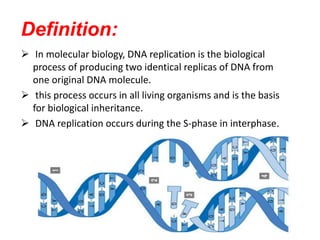
 In molecular biology, DNA replication is the biological
process of producing two identical replicas of DNA from
one original DNA molecule.
 this process occurs in all living organisms and is the basis
for biological inheritance.
 DNA replication occurs during the S-phase in interphase.
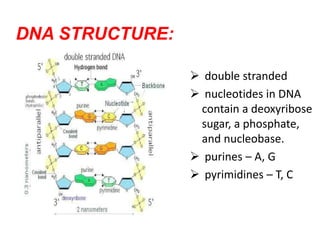
DNA STRUCTURE:
 double stranded
 nucleotides in DNA
contain a deoxyribose
sugar, a phosphate,
and nucleobase.
 purines – A, G
 pyrimidines – T, C
Replication as a Process:
 DNA replication, like biological polymerization
processes, proceed in three enzymatically
catalyzed and co-ordinated steps as follows
1. Initiation
2. Elongation
3. Termination
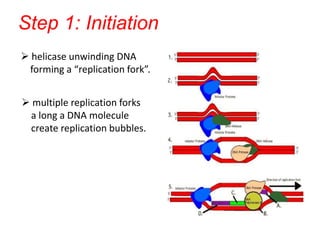
Step 1: Initiation
 helicase unwinding DNA
forming a “replication fork”.
 multiple replication forks
a long a DNA molecule
create replication bubbles.
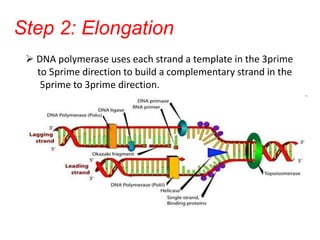
Step 2: Elongation
 DNA polymerase uses each strand a template in the 3prime
to 5prime direction to build a complementary strand in the
5prime to 3prime direction.
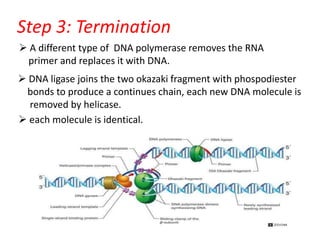
Step 3: Termination
 A different type of DNA polymerase removes the RNA
primer and replaces it with DNA.
 DNA ligase joins the two okazaki fragment with phospodiester
bonds to produce a continues chain, each new DNA molecule is
removed by helicase.
 each molecule is identical.
REFERANCE
• Google
• Wikipedia
THANK Y0U

Dna replication (1)[1]

  • 1.
    ABDUL BARI M.Sc. BIOTECH (II SEM) MOL.BIOLOGY I 505516516021 REPLICATION OF DNA
  • 2.
    Definition:  In molecularbiology, DNA replication is the biological process of producing two identical replicas of DNA from one original DNA molecule.  this process occurs in all living organisms and is the basis for biological inheritance.  DNA replication occurs during the S-phase in interphase.
  • 3.
    DNA STRUCTURE:  doublestranded  nucleotides in DNA contain a deoxyribose sugar, a phosphate, and nucleobase.  purines – A, G  pyrimidines – T, C
  • 4.
    Replication as aProcess:  DNA replication, like biological polymerization processes, proceed in three enzymatically catalyzed and co-ordinated steps as follows 1. Initiation 2. Elongation 3. Termination
  • 5.
    Step 1: Initiation helicase unwinding DNA forming a “replication fork”.  multiple replication forks a long a DNA molecule create replication bubbles.
  • 6.
    Step 2: Elongation DNA polymerase uses each strand a template in the 3prime to 5prime direction to build a complementary strand in the 5prime to 3prime direction.
  • 7.
    Step 3: Termination A different type of DNA polymerase removes the RNA primer and replaces it with DNA.  DNA ligase joins the two okazaki fragment with phospodiester bonds to produce a continues chain, each new DNA molecule is removed by helicase.  each molecule is identical.
  • 8.
  • 9.