Nucleation III:
Phase-field crystal modeling of nucleation processes
aWigner Research Centre for Physics, H-1525 Budapest, P. O. Box 49, Hungary
bBCAST, Brunel University, Uxbridge, Middlesex UB8 3PH, U.K.
L. Gránásy,a,b
Phase Field Workshop “Focus on Nucleation”,
27 Sep 2018, Center for Hierarchical Materials Design HQ, Northwestern
University, Evanston, IL, USA
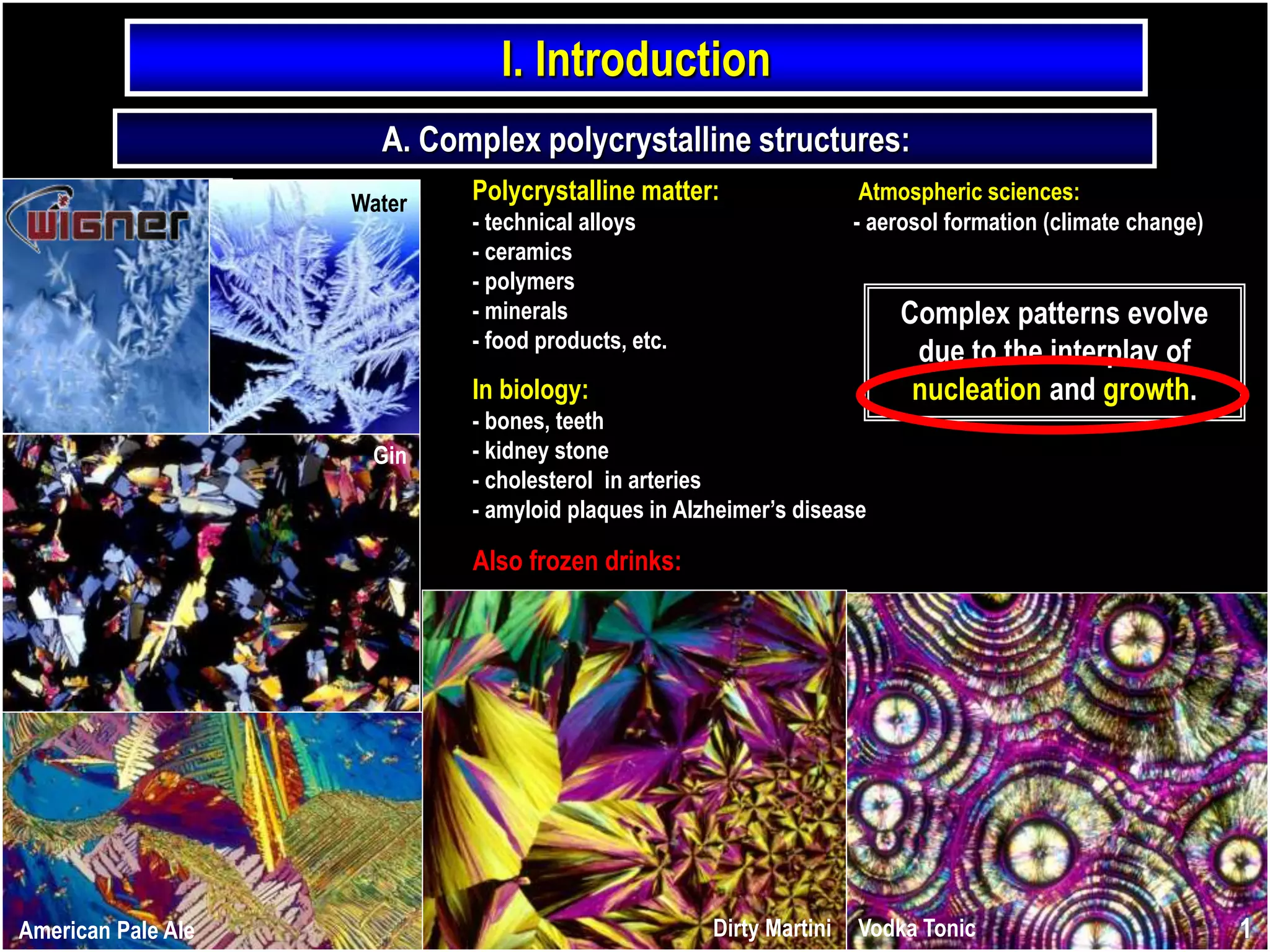
Complex patterns evolve
due to the interplay of
nucleation and growth.
I. Introduction
1American Pale Ale Dirty Martini Vodka Tonic
Gin
Water Polycrystalline matter: Atmospheric sciences:
- technical alloys - aerosol formation (climate change)
- ceramics
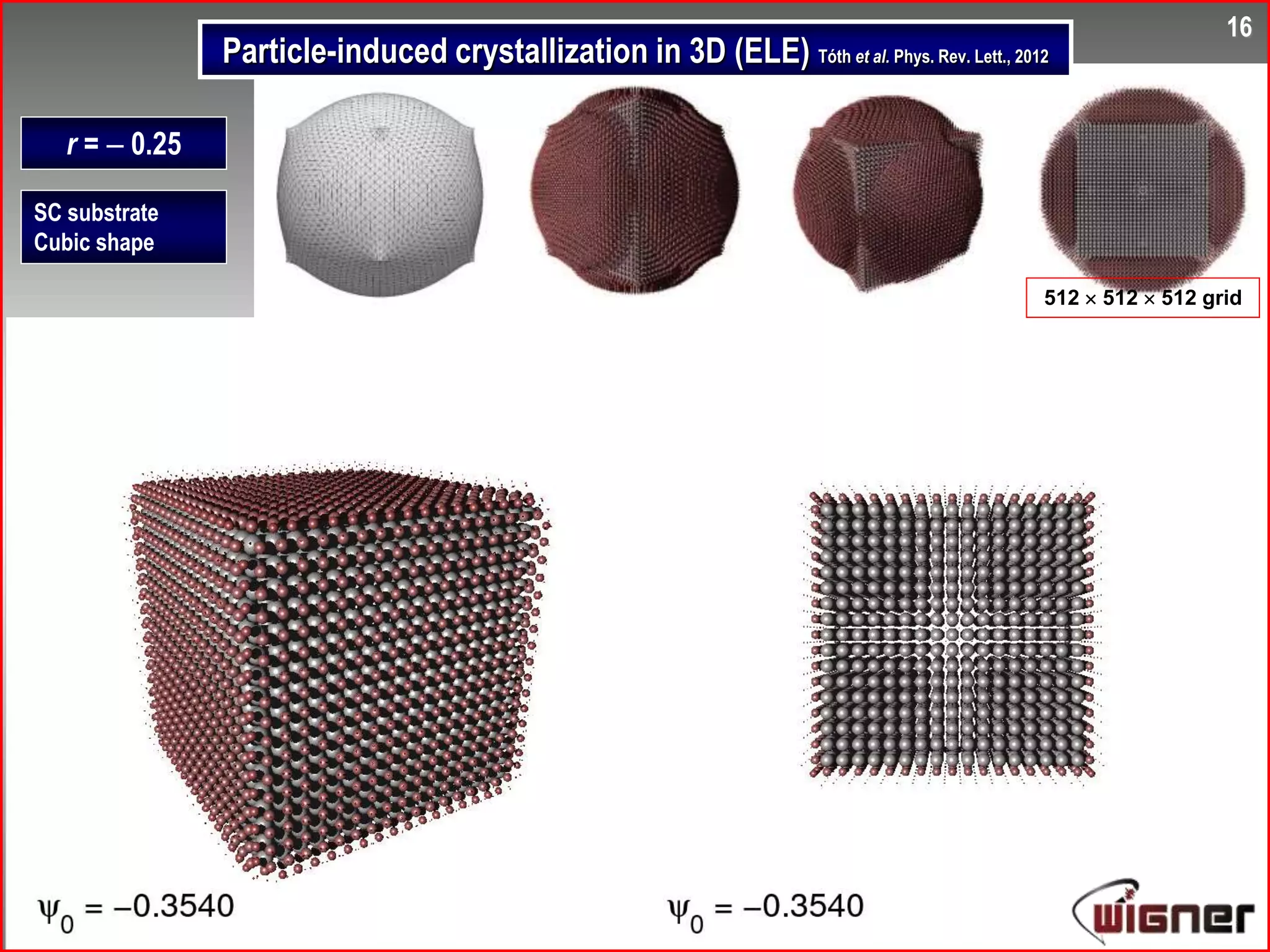
- polymers
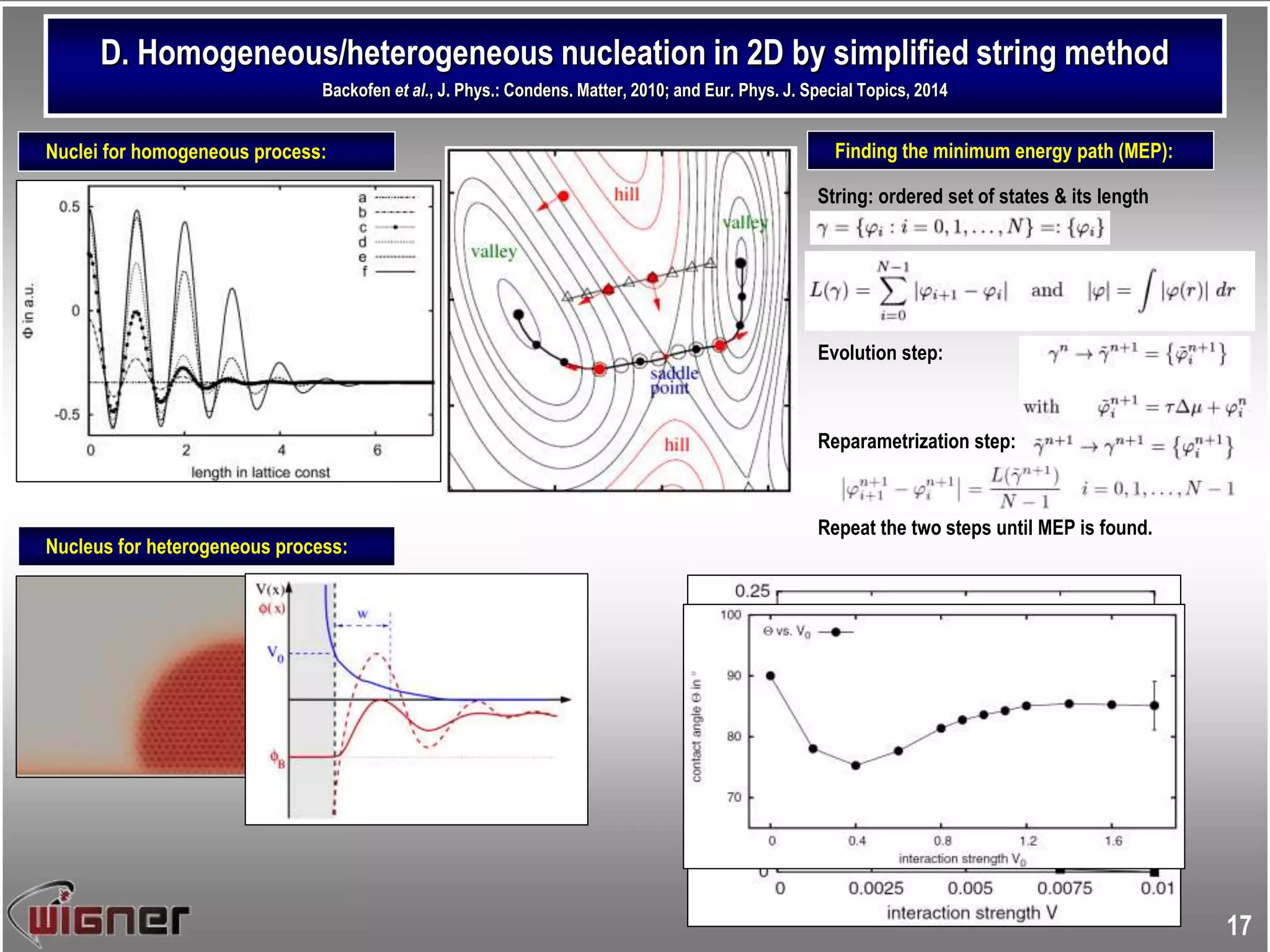
- minerals
- food products, etc.
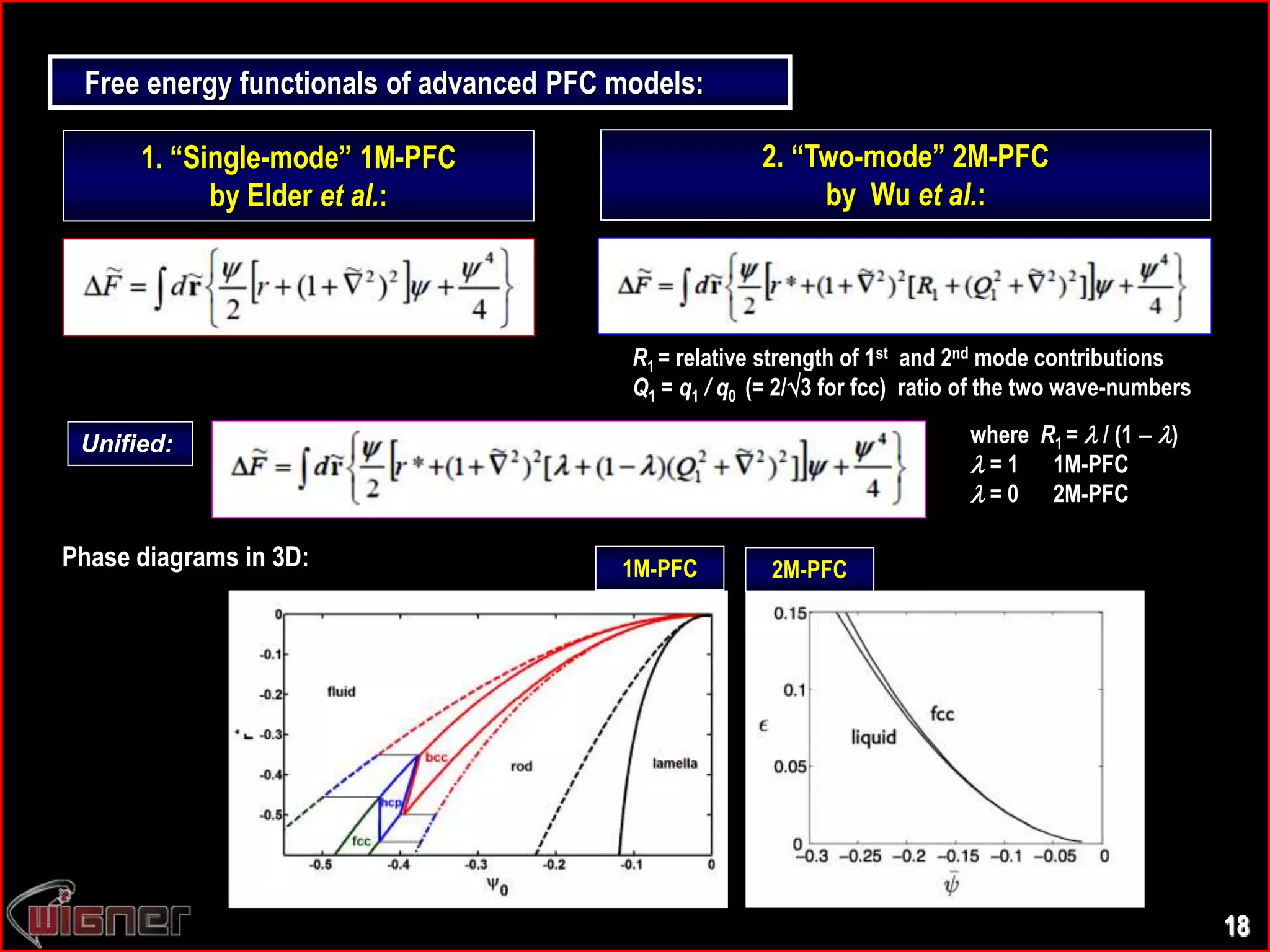
In biology:
- bones, teeth
- kidney stone
- cholesterol in arteries
- amyloid plaques in Alzheimer’s disease
Also frozen drinks:
A. Complex polycrystalline structures:
B. Stages of polycrystalline freezing:
Nucleation, growth, and grain coarsening
2
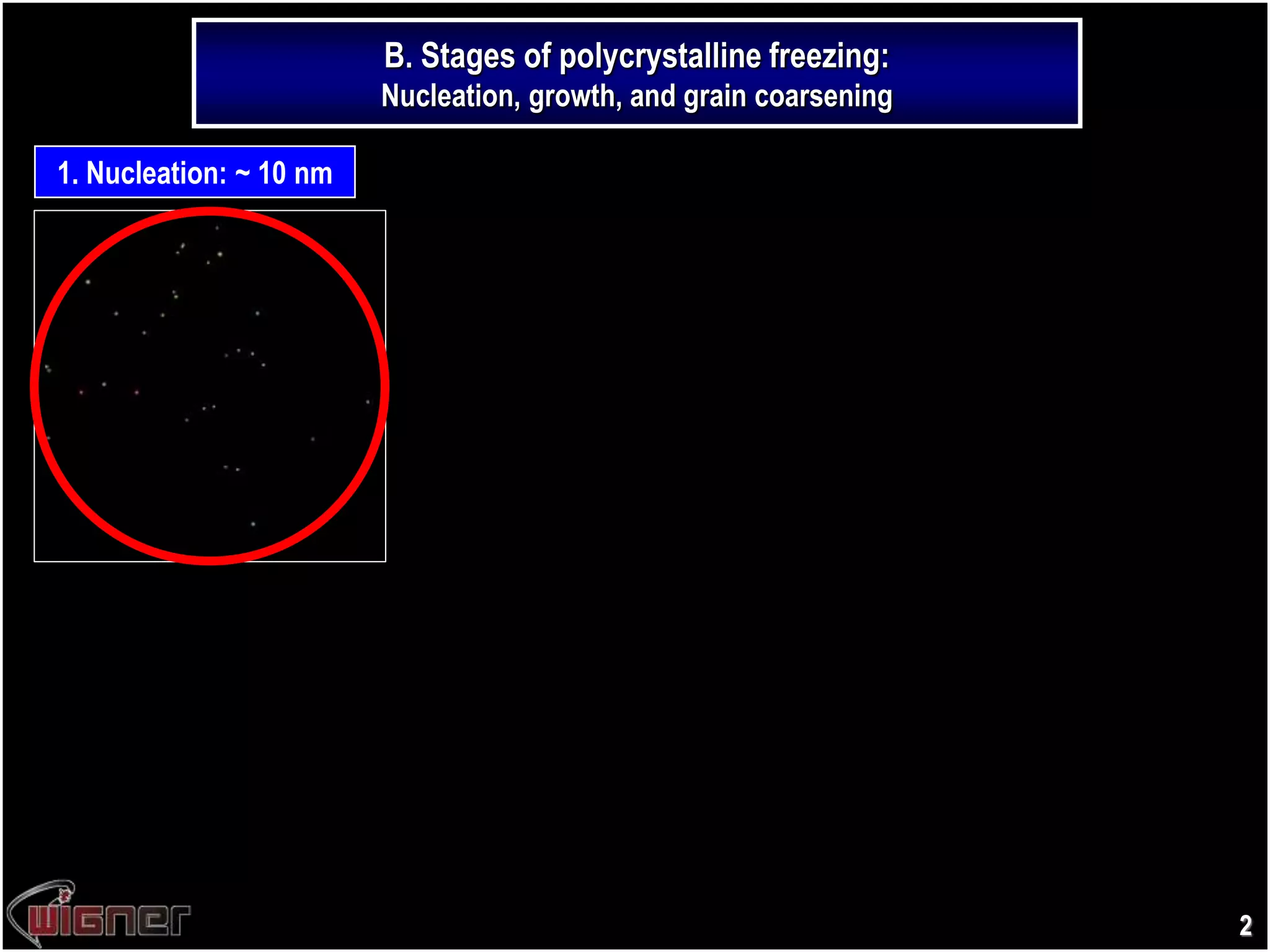
1. Nucleation: ~ 10 nm 2. Growth: 10 nm – mm
Interface controlled: v  1/ e.g., pure metals
Diffusion controlled: v  t -1/2 e.g., colloids
3. Grain coarsening:
10 nm – mm
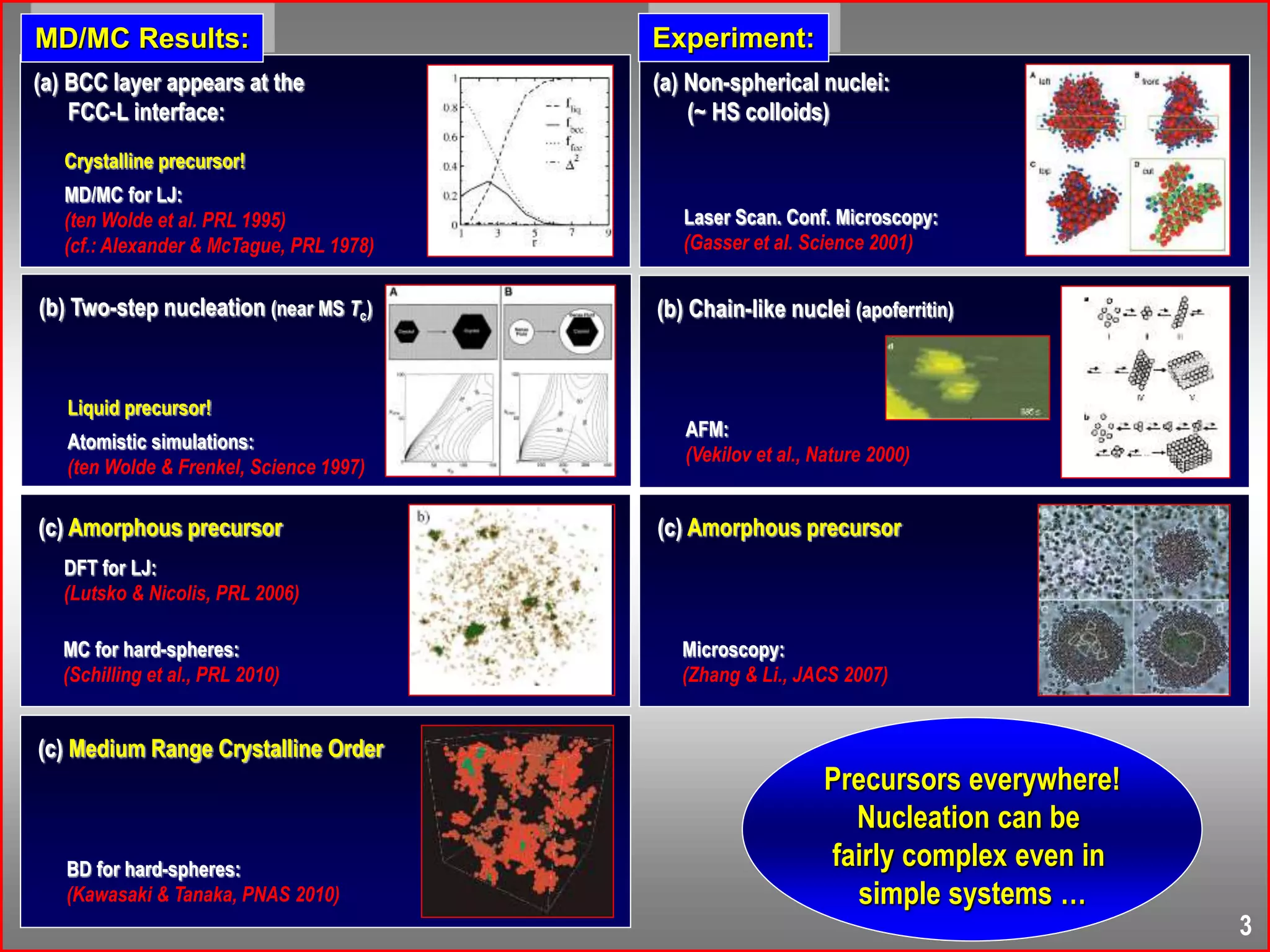
(a) BCC layer appears at the
FCC-L interface:
Crystalline precursor!
MD/MC for LJ:
(ten Wolde et al. PRL 1995)
(cf.: Alexander & McTague, PRL 1978)
Precursors everywhere!
Nucleation can be
fairly complex even in
simple systems …
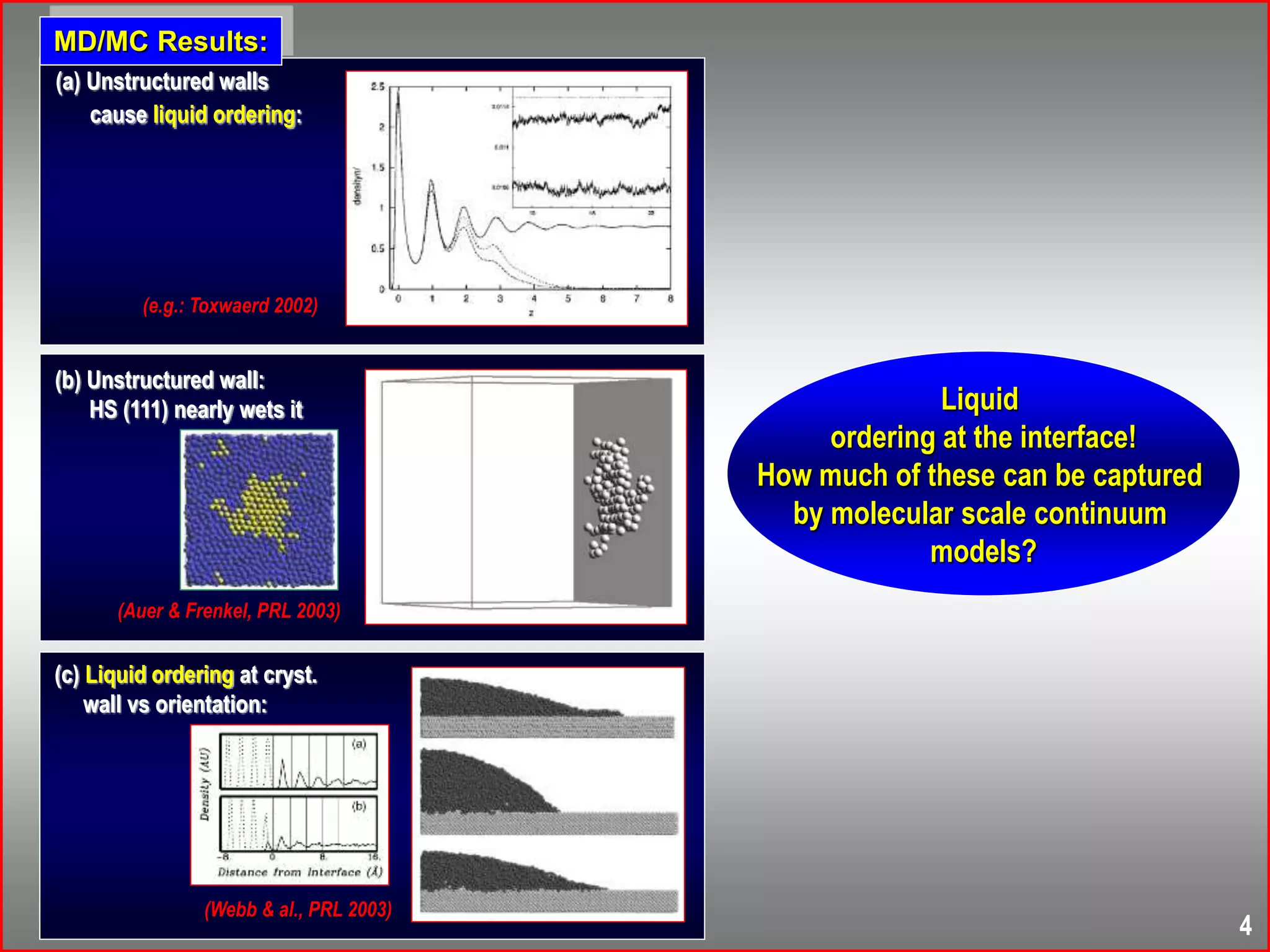
MD/MC Results:
DFT for LJ:
(Lutsko & Nicolis, PRL 2006)
(c) Amorphous precursor
MC for hard-spheres:
(Schilling et al., PRL 2010)
BD for hard-spheres:
(Kawasaki & Tanaka, PNAS 2010)
(c) Medium Range Crystalline Order
Liquid precursor!
Atomistic simulations:
(ten Wolde & Frenkel, Science 1997)
(b) Two-step nucleation (near MS Tc)
(a) Non-spherical nuclei:
(~ HS colloids)
Laser Scan. Conf. Microscopy:
(Gasser et al. Science 2001)
Experiment:
AFM:
(Vekilov et al., Nature 2000)
(b) Chain-like nuclei (apoferritin)
(c) Amorphous precursor
Microscopy:
(Zhang & Li., JACS 2007)
3
Liquid
ordering at the interface!
How much of these can be captured
by molecular scale continuum
models?
(b) Unstructured wall:
HS (111) nearly wets it
(Auer & Frenkel, PRL 2003)
(a) Unstructured walls
cause liquid ordering:
(e.g.: Toxwaerd 2002)
(Webb & al., PRL 2003)
(c) Liquid ordering at cryst.
wall vs orientation:
MD/MC Results:
4
II. The Phase-Field Crystal Approach:
Fundamentals
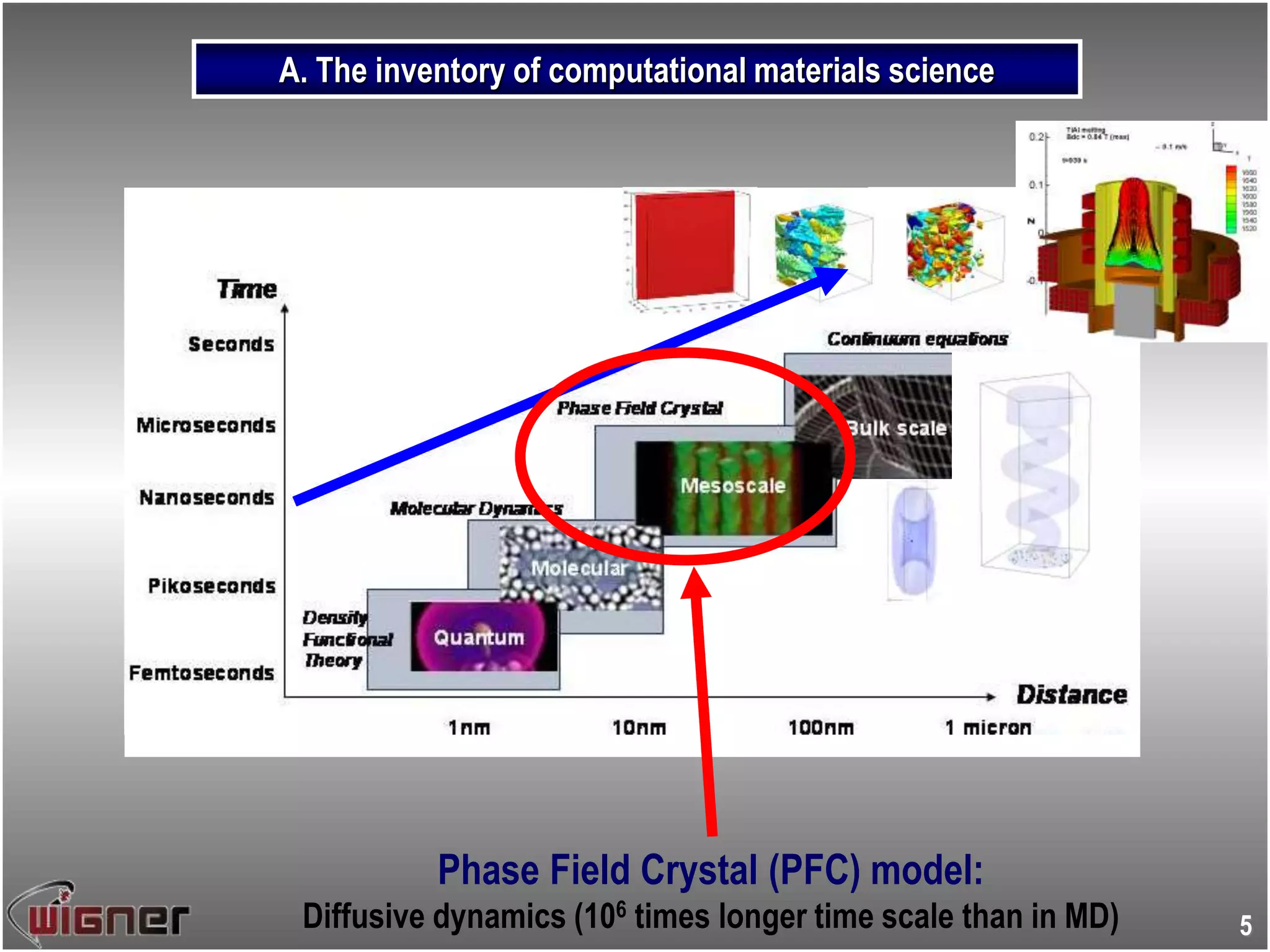
Phase Field Crystal (PFC) model:
Diffusive dynamics (106 times longer time scale than in MD)
A. The inventory of computational materials science
5
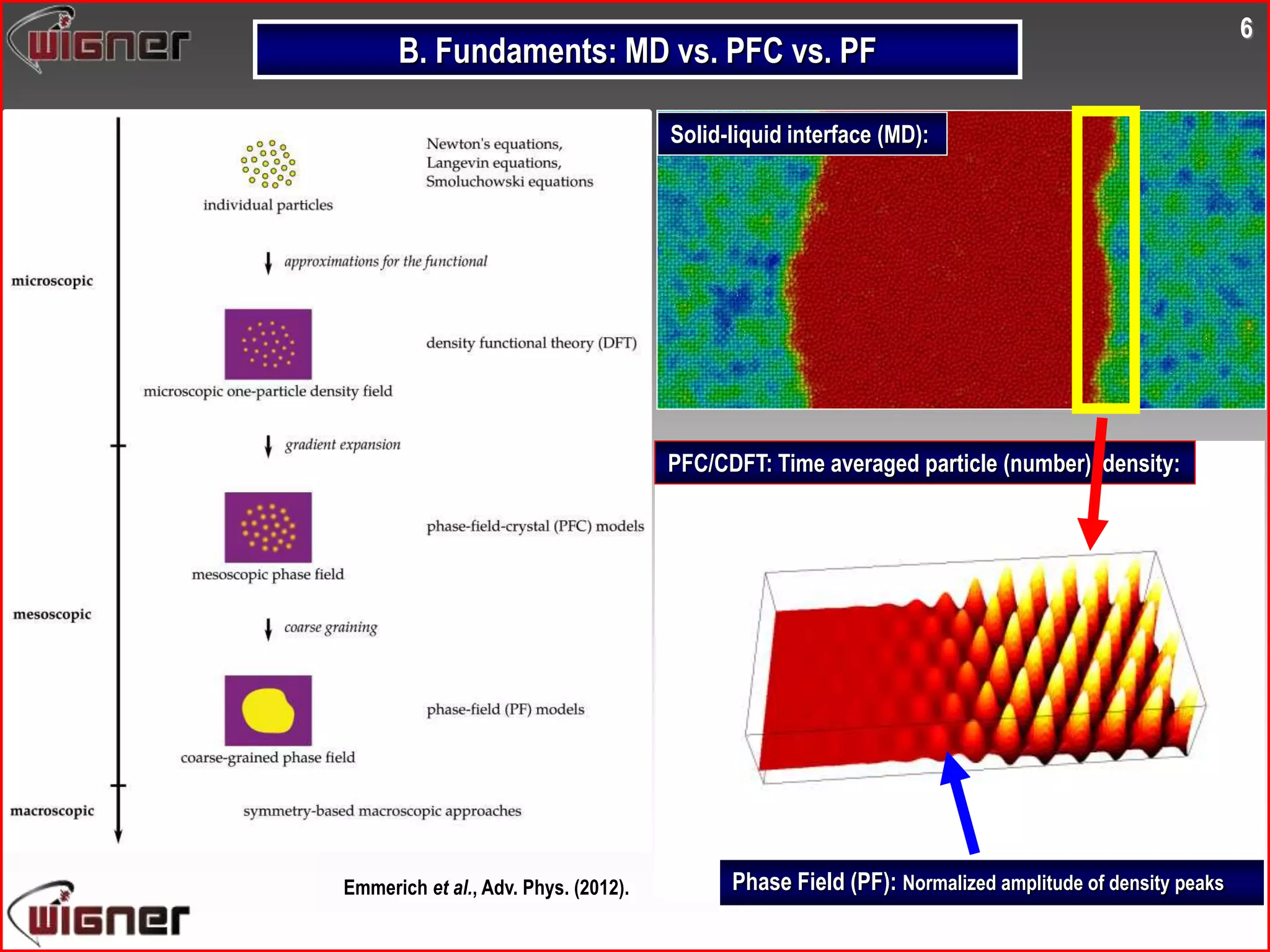
B. Fundaments: MD vs. PFC vs. PF
6
Solid-liquid interface (MD):
Phase Field (PF): Normalized amplitude of density peaks
PFC/CDFT: Time averaged particle (number) density:
Emmerich et al., Adv. Phys. (2012).
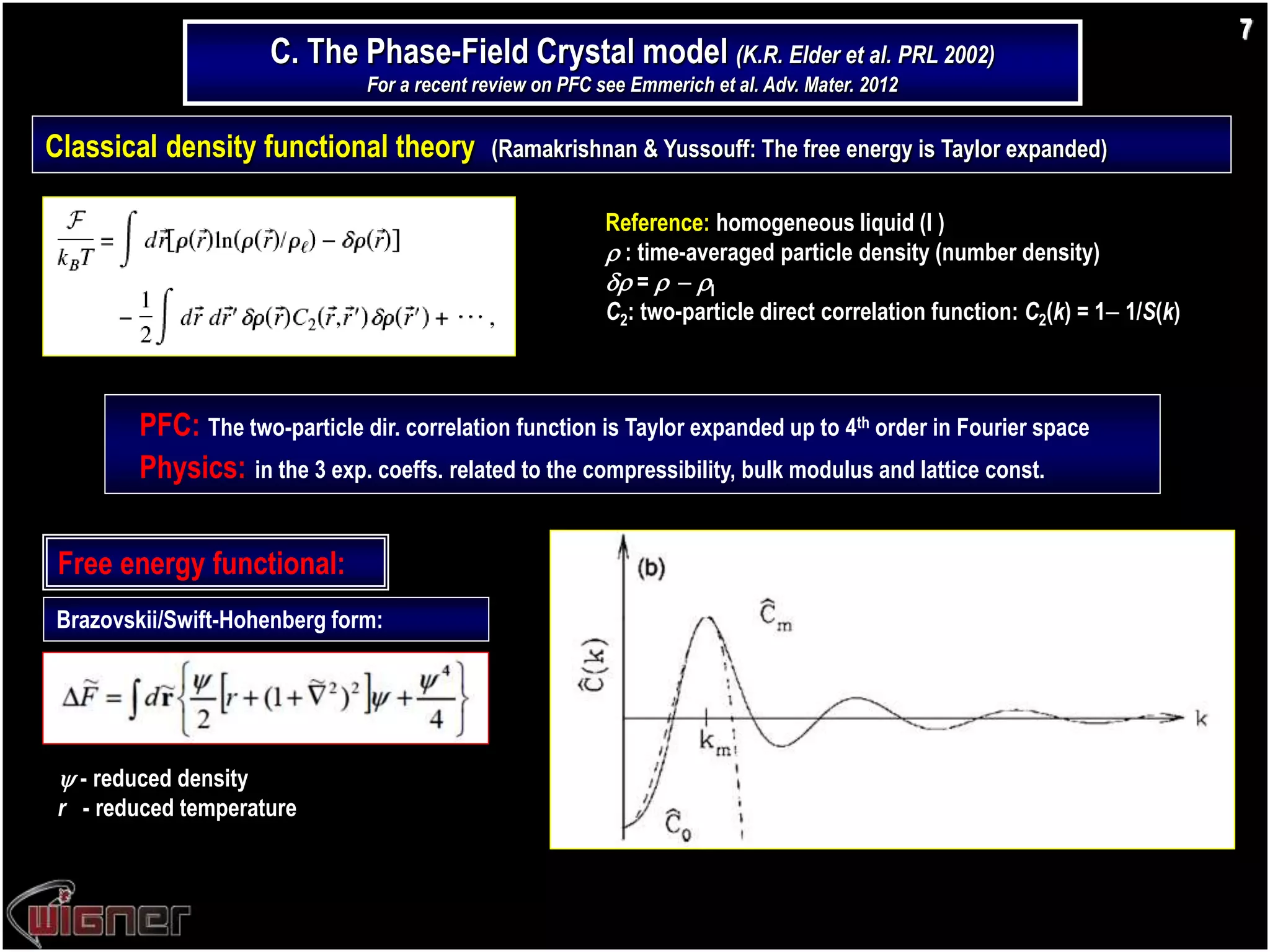
Classical density functional theory (Ramakrishnan & Yussouff: The free energy is Taylor expanded)
PFC: The two-particle dir. correlation function is Taylor expanded up to 4th order in Fourier space
Physics: in the 3 exp. coeffs. related to the compressibility, bulk modulus and lattice const.
Reference: homogeneous liquid (l )
 : time-averaged particle density (number density)
 =   l
C2: two-particle direct correlation function: C2(k) = 1 1/S(k)
Free energy functional:
Brazovskii/Swift-Hohenberg form:
7
C. The Phase-Field Crystal model (K.R. Elder et al. PRL 2002)
For a recent review on PFC see Emmerich et al. Adv. Mater. 2012
 - reduced density
r - reduced temperature
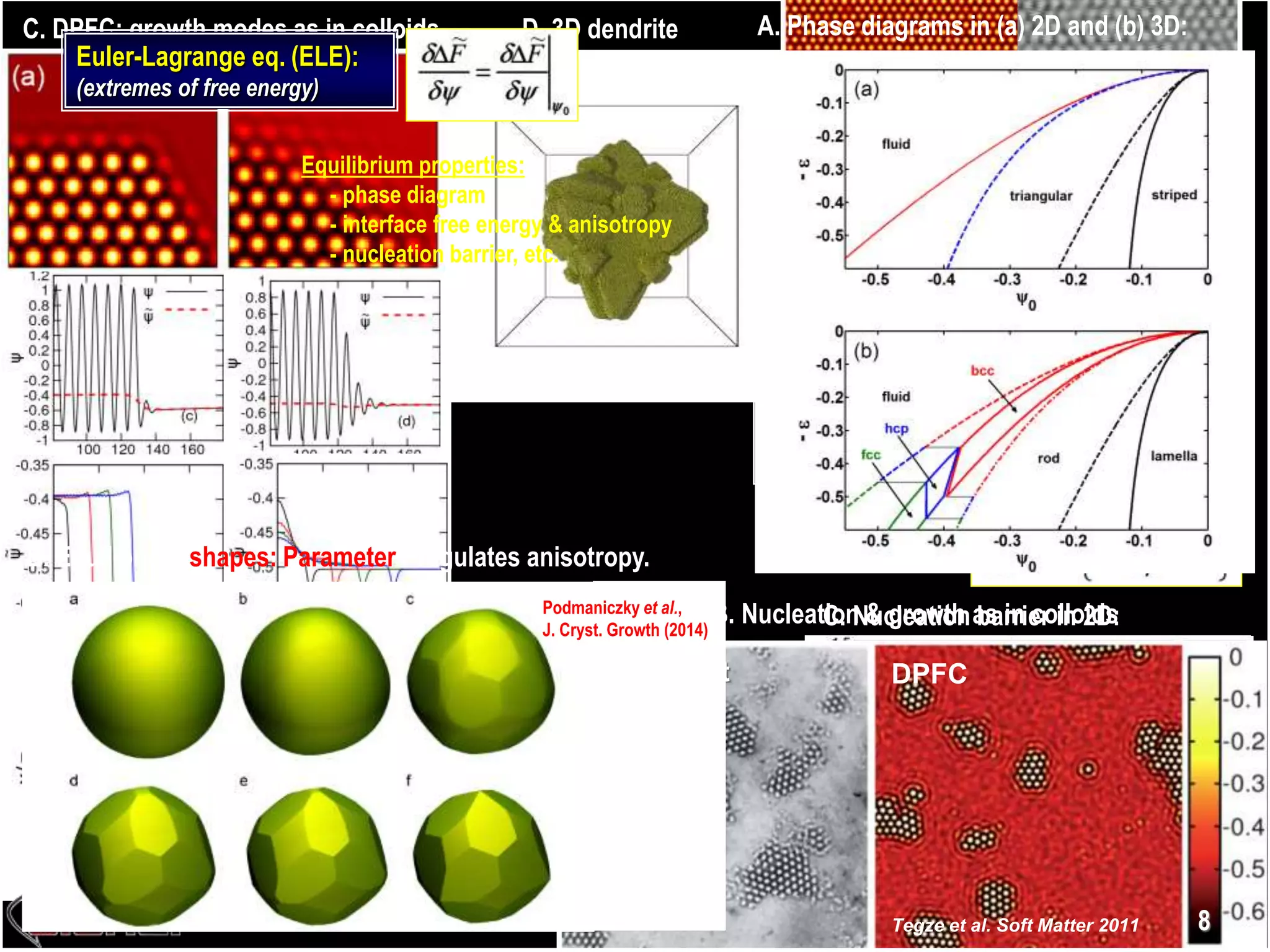
C. Nucleation barrier in 2D:
D. 3D dendrite
B. Nucleation & growth as in colloids
DPFC
Tegze et al. Soft Matter 2011
Experiment
I. Diffusive PFC (DPFC):
Equation of motion (EOM):
diffusive dynamics – colloids
Time evolution:
8
C. DPFC: growth modes as in colloids
Euler-Lagrange eq. (ELE):
(extremes of free energy)
Equilibrium properties:
- phase diagram
- interface free energy & anisotropy
- nucleation barrier, etc.
DPFC
A. Crystal-liquid interface
Experiment
B. Equilibrium shapes: Parameter r regulates anisotropy.
A. Phase diagrams in (a) 2D and (b) 3D:
Podmaniczky et al.,
J. Cryst. Growth (2014)
III. The Phase-Field Crystal (PFC) Approach:
Nucleation and the Euler-Lagrange/
elastic band/string methods
- Homogeneous nucleation
- Heterogeneous nucleation (contact angles, barriers, corners)
- Free growth limited version of particle-induced nucleation
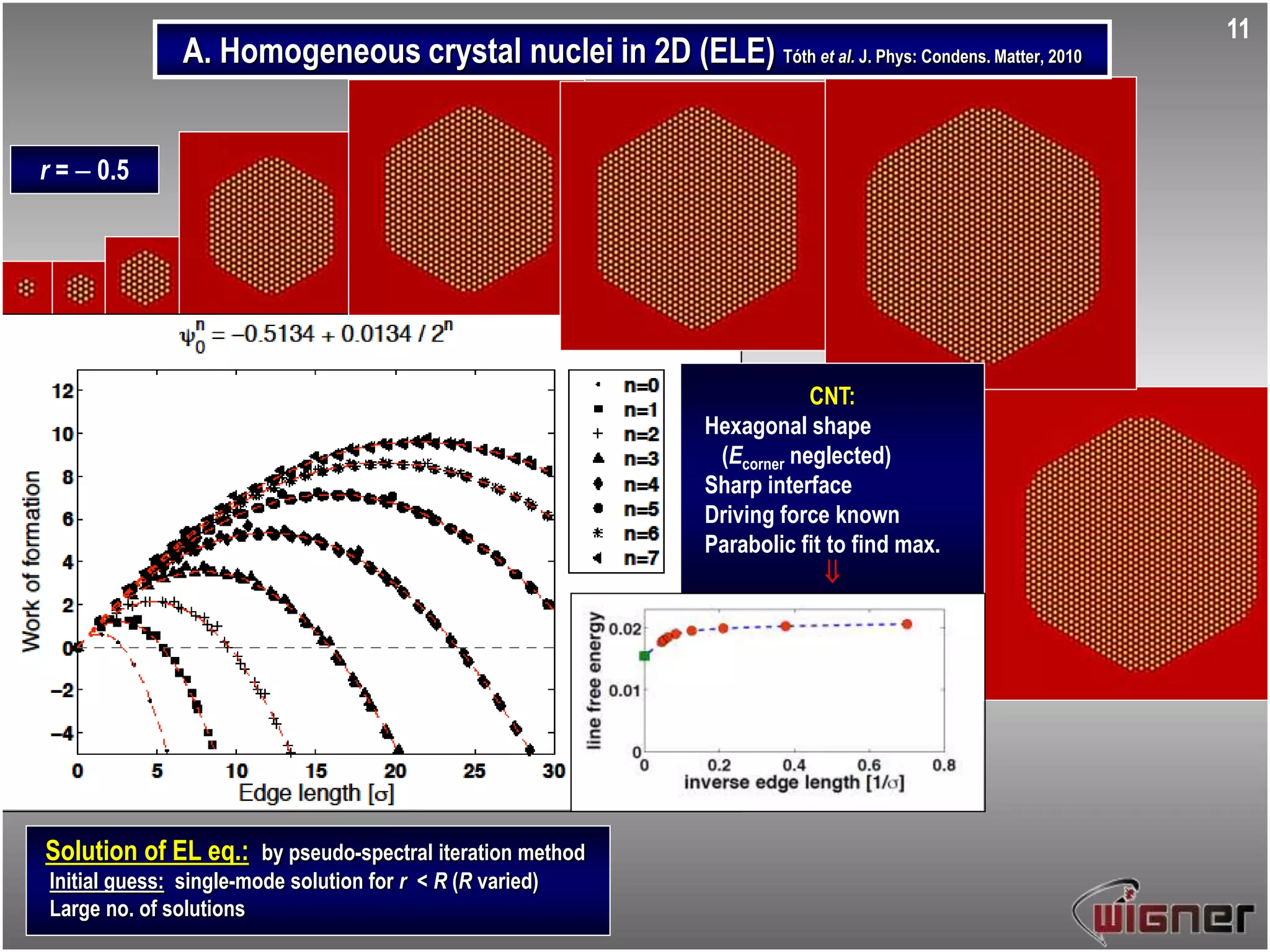
Solution of EL eq.: by pseudo-spectral iteration method
Initial guess: single-mode solution for r < R (R varied)
Large no. of solutions
r =  0.5
CNT:
Hexagonal shape
(Ecorner neglected)
Sharp interface
Driving force known
Parabolic fit to find max.

A. Homogeneous crystal nuclei in 2D (ELE) Tóth et al. J. Phys: Condens. Matter, 2010
11
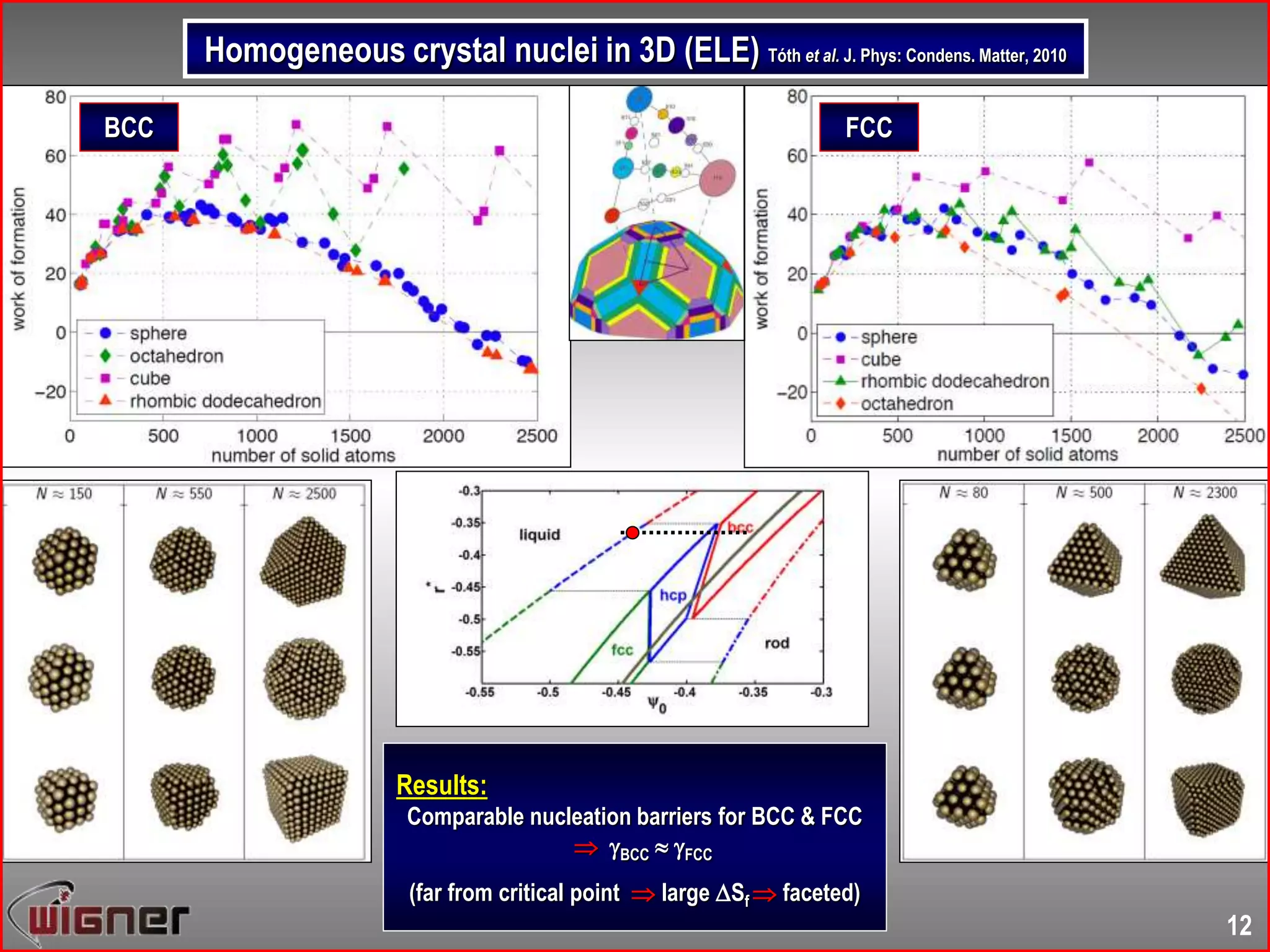
Results:
Comparable nucleation barriers for BCC & FCC
 BCC  FCC
(far from critical point  large Sf  faceted)
BCC FCC
Homogeneous crystal nuclei in 3D (ELE) Tóth et al. J. Phys: Condens. Matter, 2010
12
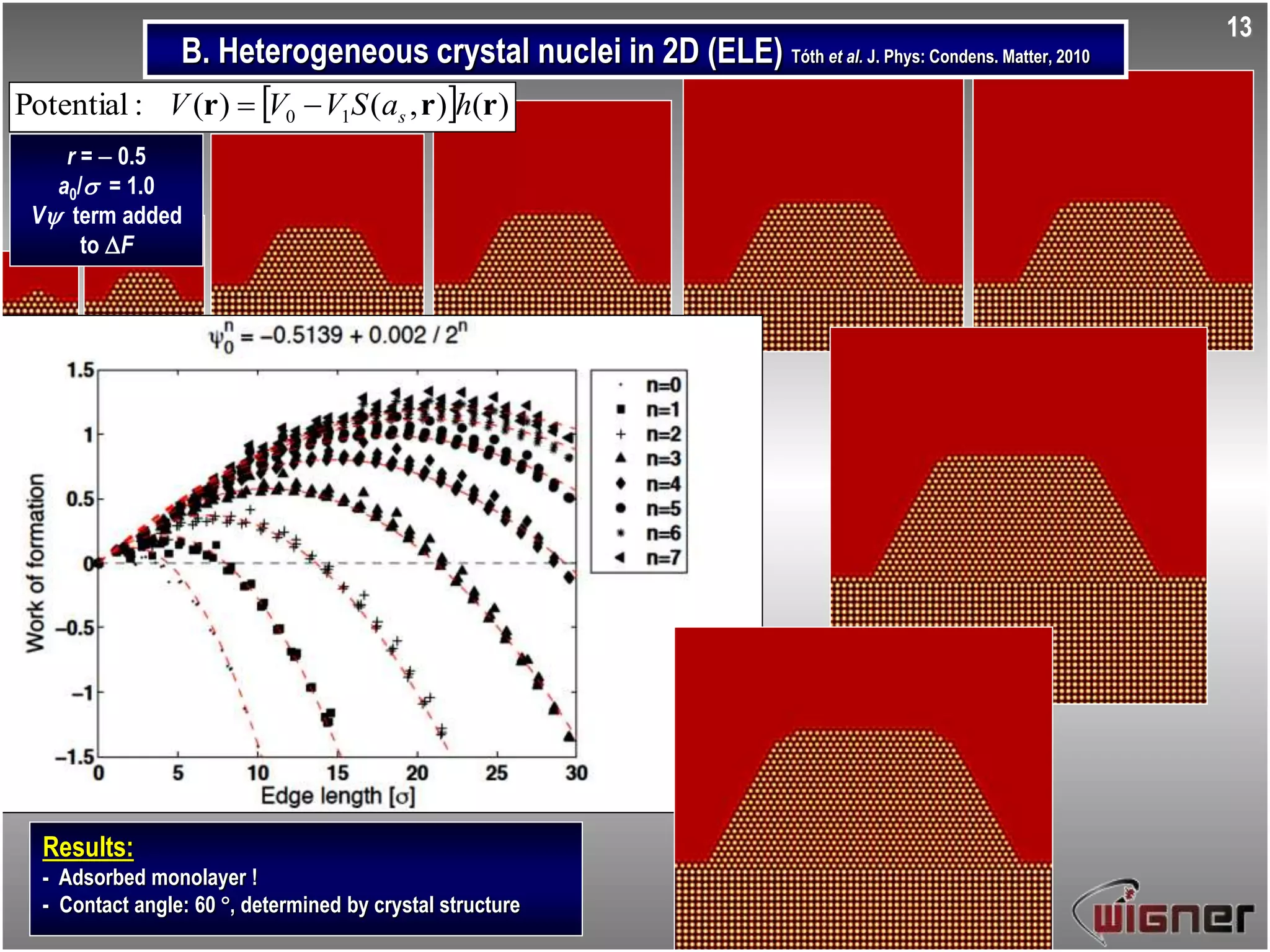
Results:
- Adsorbed monolayer !
- Contact angle: 60 , determined by crystal structure
r =  0.5
a0/ = 1.0
V term added
to F
B. Heterogeneous crystal nuclei in 2D (ELE) Tóth et al. J. Phys: Condens. Matter, 2010
13
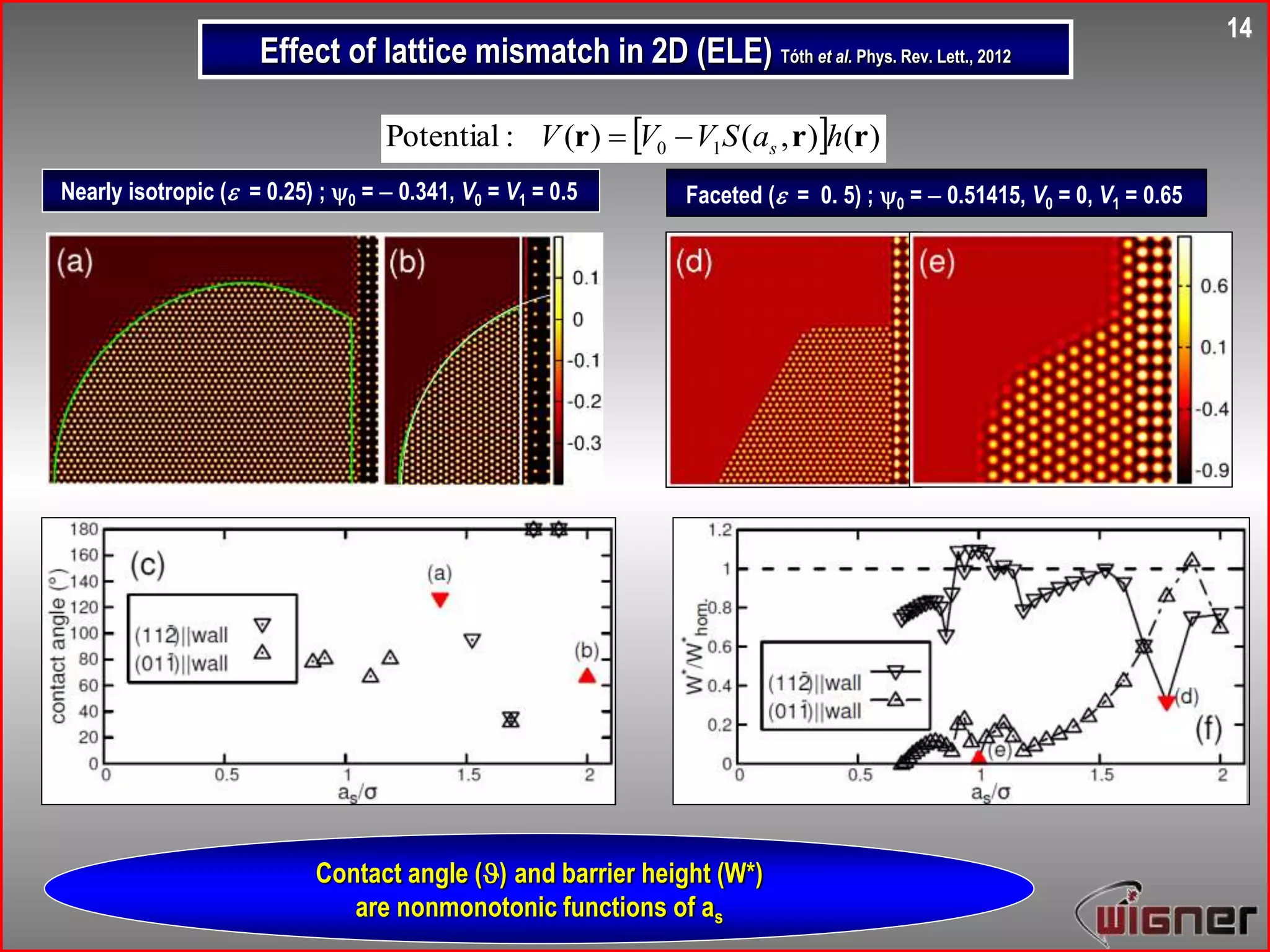
  )(),()(:Potential 10 rrr haSVVV s
Nearly isotropic ( = 0.25) ; 0 =  0.341, V0 = V1 = 0.5 Faceted ( = 0. 5) ; 0 =  0.51415, V0 = 0, V1 = 0.65
Contact angle () and barrier height (W*)
are nonmonotonic functions of as
  )(),()(:Potential 10 rrr haSVVV s
Effect of lattice mismatch in 2D (ELE) Tóth et al. Phys. Rev. Lett., 2012
14
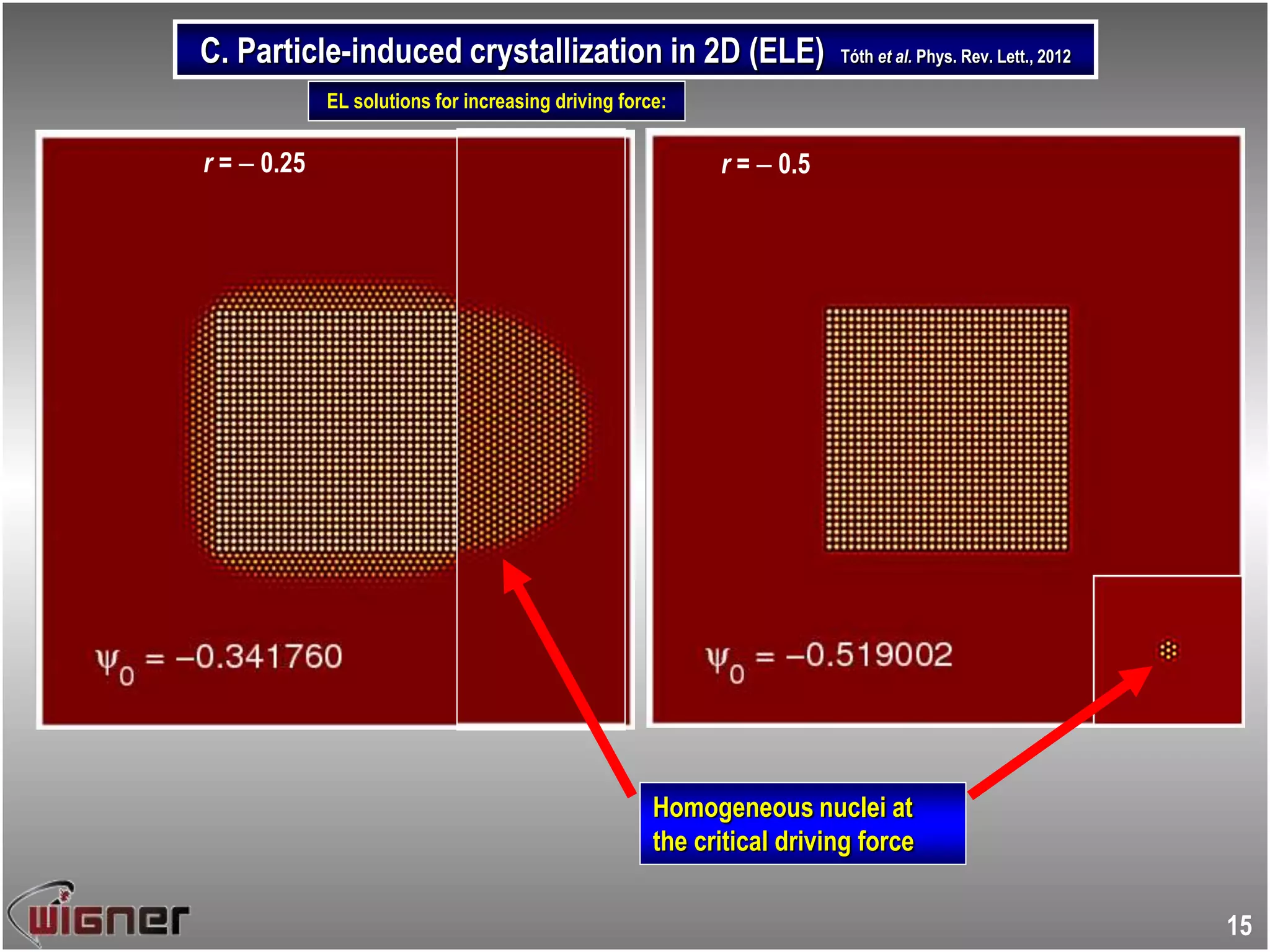
r =  0.25
EL solutions for increasing driving force:
Homogeneous nuclei at
the critical driving force
r =  0.5
C. Particle-induced crystallization in 2D (ELE) Tóth et al. Phys. Rev. Lett., 2012
15
r =  0.25
256  256  256 grid
SC substrate
Cubic shape
512  512  512 grid
Particle-induced crystallization in 3D (ELE) Tóth et al. Phys. Rev. Lett., 2012
16
Nuclei for homogeneous process:
D. Homogeneous/heterogeneous nucleation in 2D by simplified string method
Backofen et al., J. Phys.: Condens. Matter, 2010; and Eur. Phys. J. Special Topics, 2014
17
Nucleus for heterogeneous process:
Finding the minimum energy path (MEP):
String: ordered set of states & its length
Evolution step:
Reparametrization step:
Repeat the two steps until MEP is found.
IV. The Phase-Field Crystal Approach:
Dynamic Equations and Simulating Nucleation
- DPFC: PFC with diffusive dynamics: K. R. Elder et al., PRL, 2002
1. “Single-mode” 1M-PFC
by Elder et al.:
R1 = relative strength of 1st and 2nd mode contributions
Q1 = q1 / q0 (= 2/3 for fcc) ratio of the two wave-numbers
2. “Two-mode” 2M-PFC
by Wu et al.:
Unified: where R1 =  / (1  )
 = 1 1M-PFC
 = 0 2M-PFC
18
Free energy functionals of advanced PFC models:
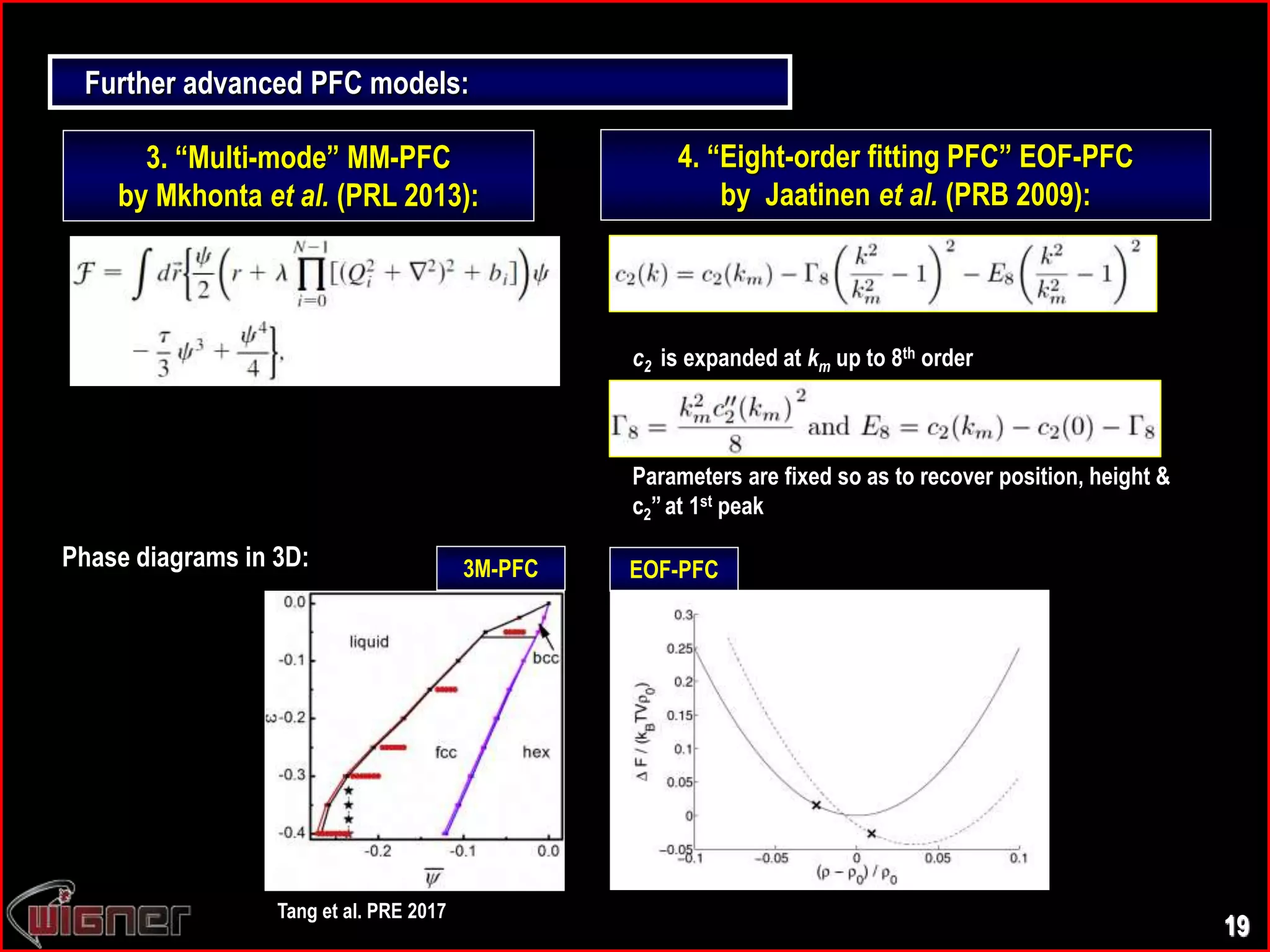
Phase diagrams in 3D: 1M-PFC 2M-PFC
3. “Multi-mode” MM-PFC
by Mkhonta et al. (PRL 2013):
19
Further advanced PFC models:
4. “Eight-order fitting PFC” EOF-PFC
by Jaatinen et al. (PRB 2009):
c2 is expanded at km up to 8th order
Parameters are fixed so as to recover position, height &
c2”at 1st peak
Phase diagrams in 3D: 3M-PFC EOF-PFC
Tang et al. PRE 2017
Two-step homogeneous nucleation
DPFC: G. I. Tóth et al., PRL, 2011
HPFC: F. Podmaniczky, preliminary
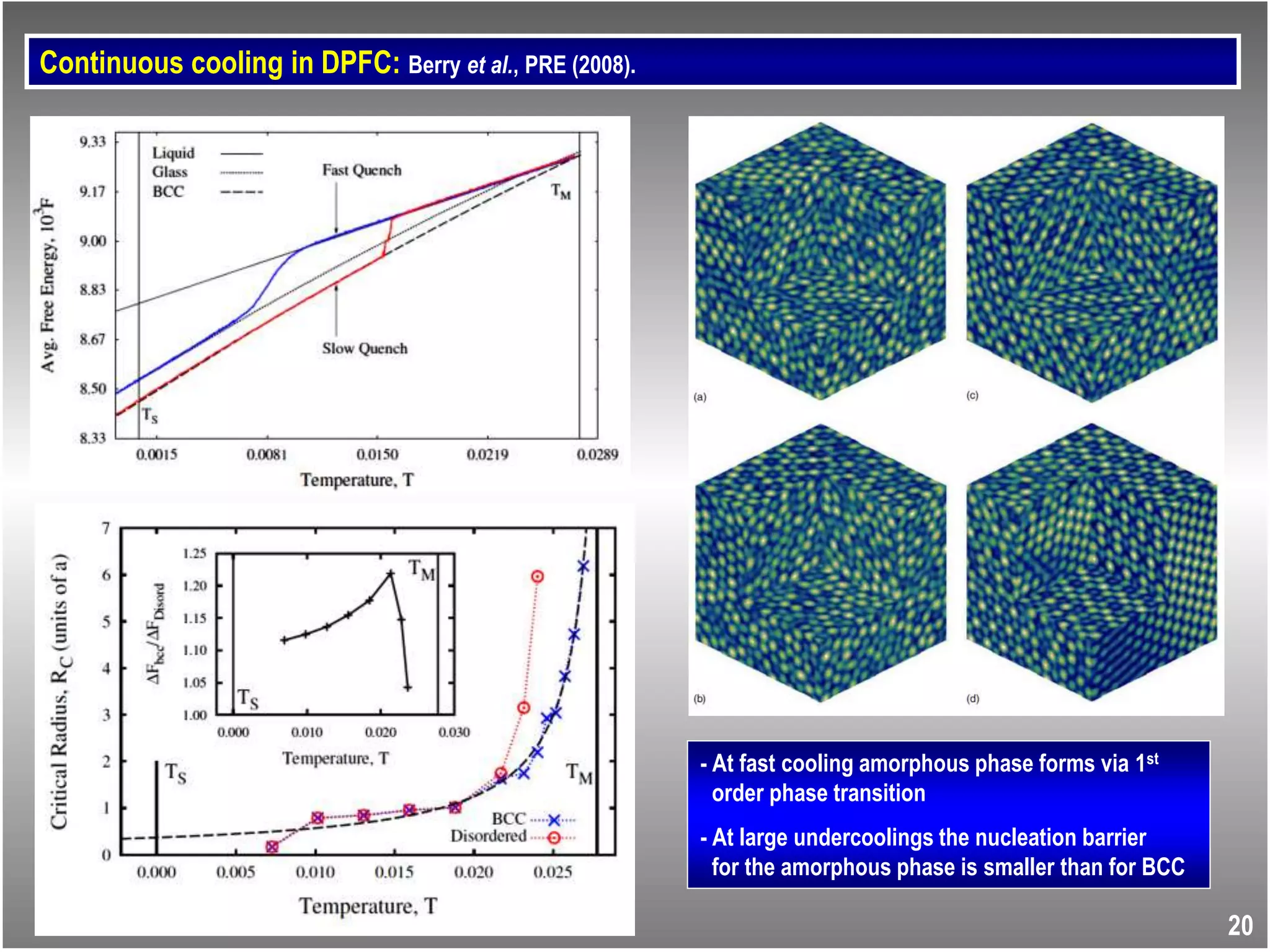
Continuous cooling in DPFC: Berry et al., PRE (2008).
20
- At fast cooling amorphous phase forms via 1st
order phase transition
- At large undercoolings the nucleation barrier
for the amorphous phase is smaller than for BCC
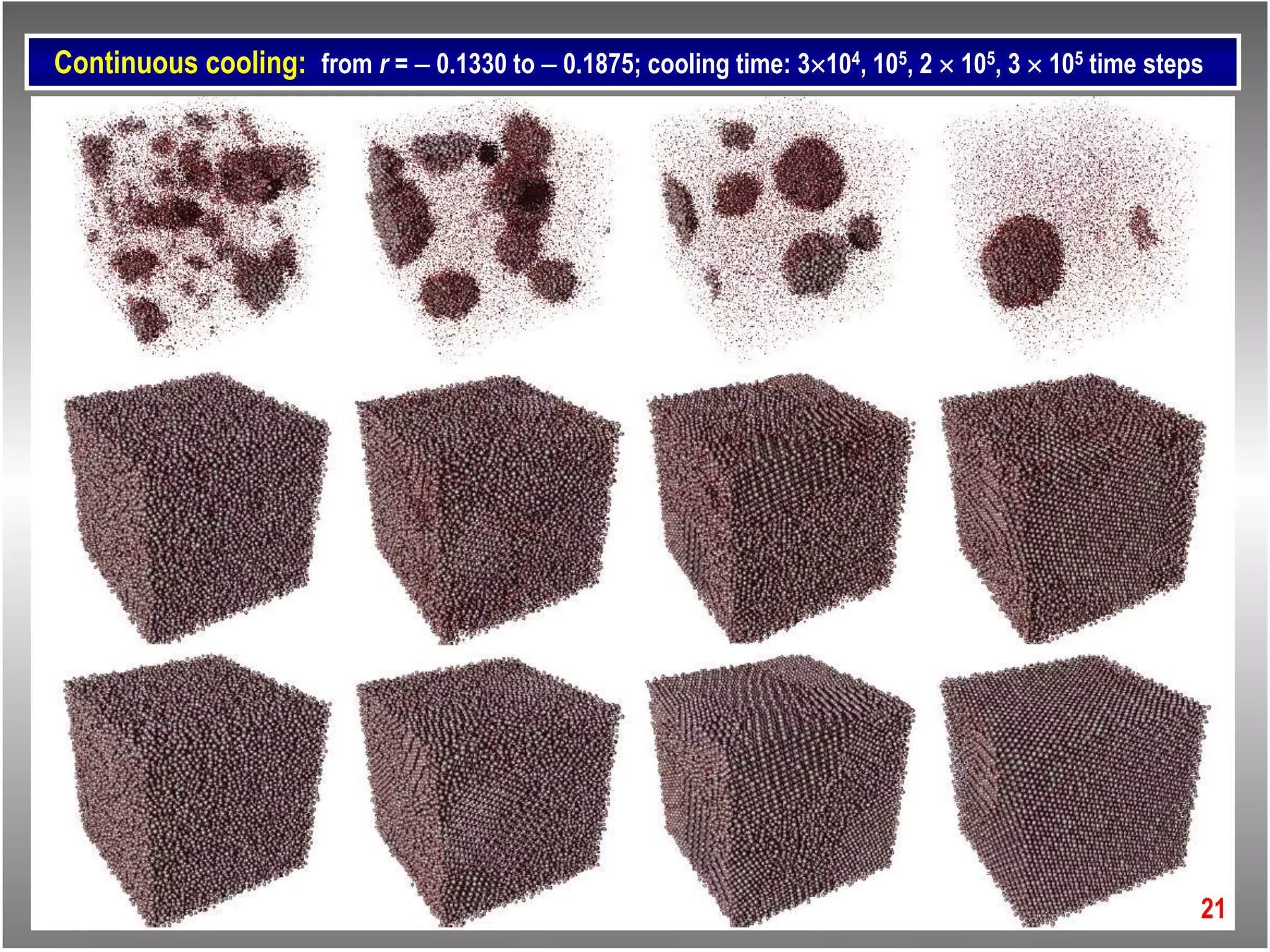
Continuous cooling: from r =  0.1330 to  0.1875; cooling time: 3104, 105, 2  105, 3  105 time steps
21
Zhang & Liu, JACS (2007)
r =  0.1684
0 = 0.25
256256256 grid
req =  0.1330
Tóth et al. PRL (2011).
Red (bcc-like) if
q4  [0.02, 0.07]
q6  [0.48, 0.52]
Steinhardt, Nelson, Ronchetti, PRB (1983)
Starts to solidify as amorphous,
then crystallizes ! A’la 2D & 3D colloids.
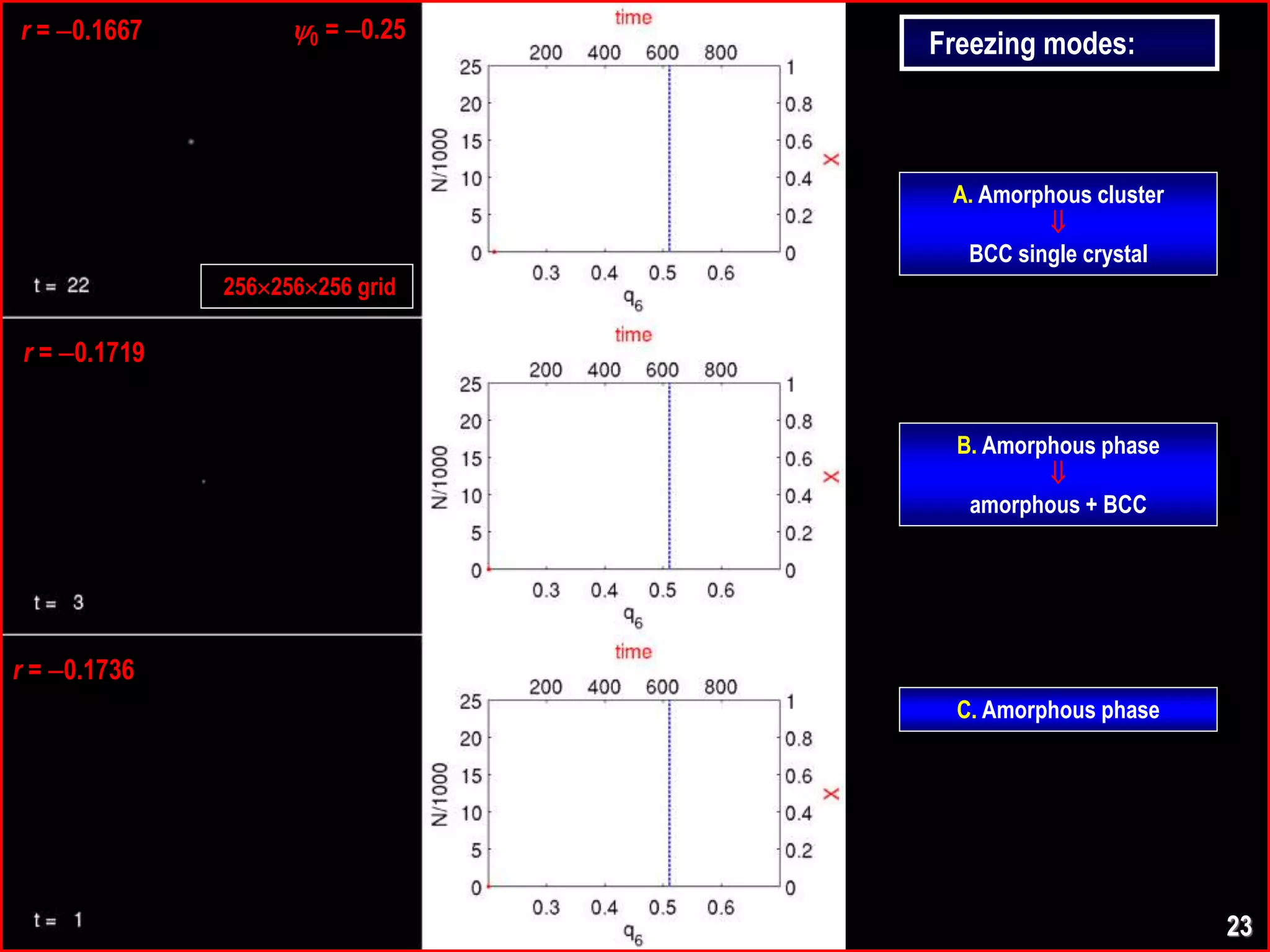
Instantaneous quench in DPFC: 22
r = 0.1667
r = 0.1719
r = 0.1736
256256256 grid
A. Amorphous cluster

BCC single crystal
B. Amorphous phase

amorphous + BCC
C. Amorphous phase
0 = 0.25
Freezing modes:
23
Lechner & Dellago, JCP (2008)
qi of Lechner & Dellago
Black: bcc
Yellow: Icosah.
Green: hcp
Red: fcc
Structural aspects:
Greenq6 > 0.4
Redq6 [0.28, 0.4]
Whiteq6 < 0.28
Red (bcc-like) if
q4  [0.02, 0.07]
q6  [0.48, 0.52]
Observations:
- Am. precursor is structurally like LJ liquid
- MRCO and amorphous domains appear parallel
- Heterogeneous-like bcc nucleation on am. domains
- Literature: LJ, HS, colloids, now PFC. What else?
Kawasaki & Tanaka, PNAS (2010)
MRCO (Brownian Dynamics)
24
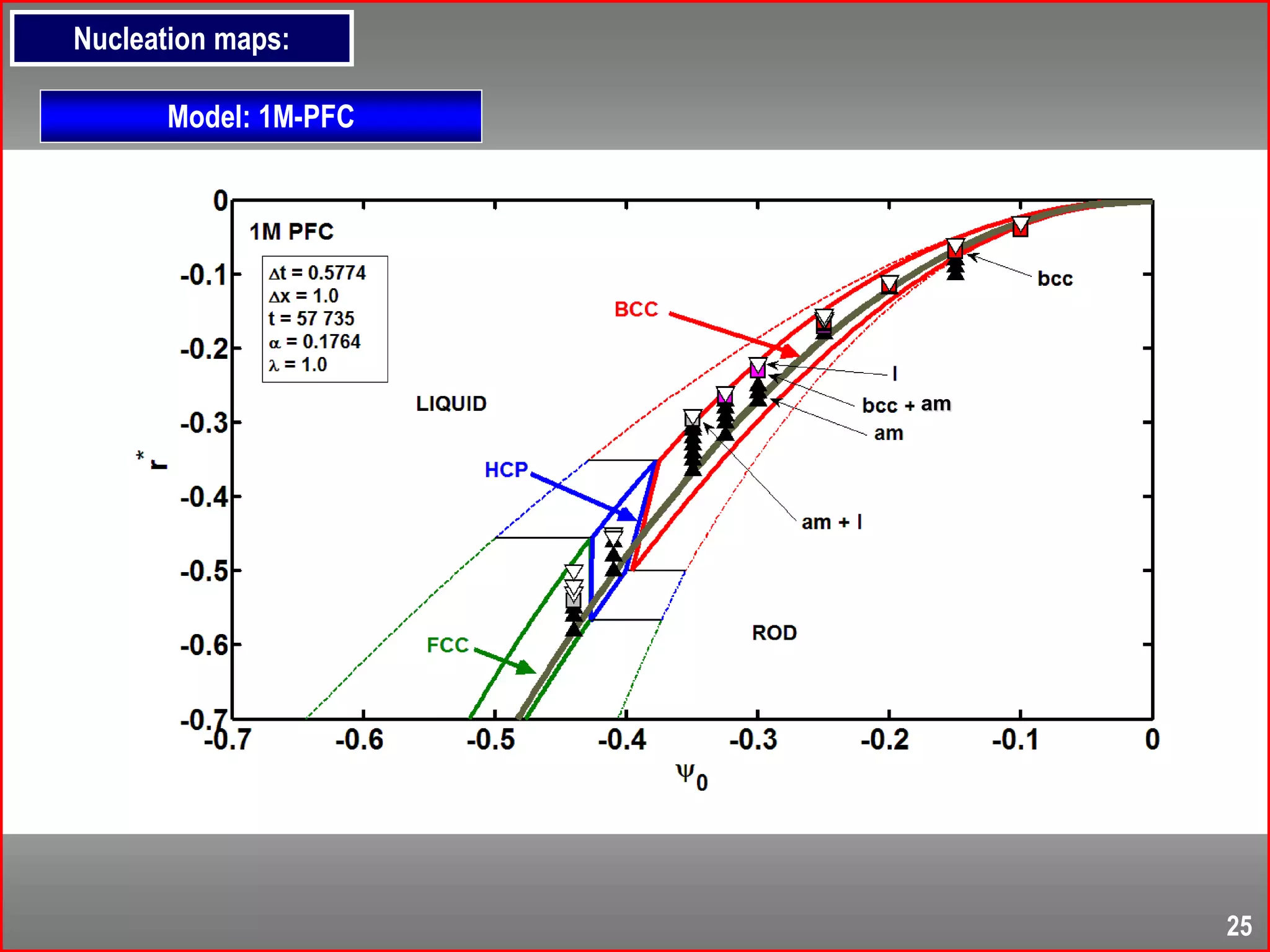
Model: 1M-PFC
am
Nucleation maps:
25
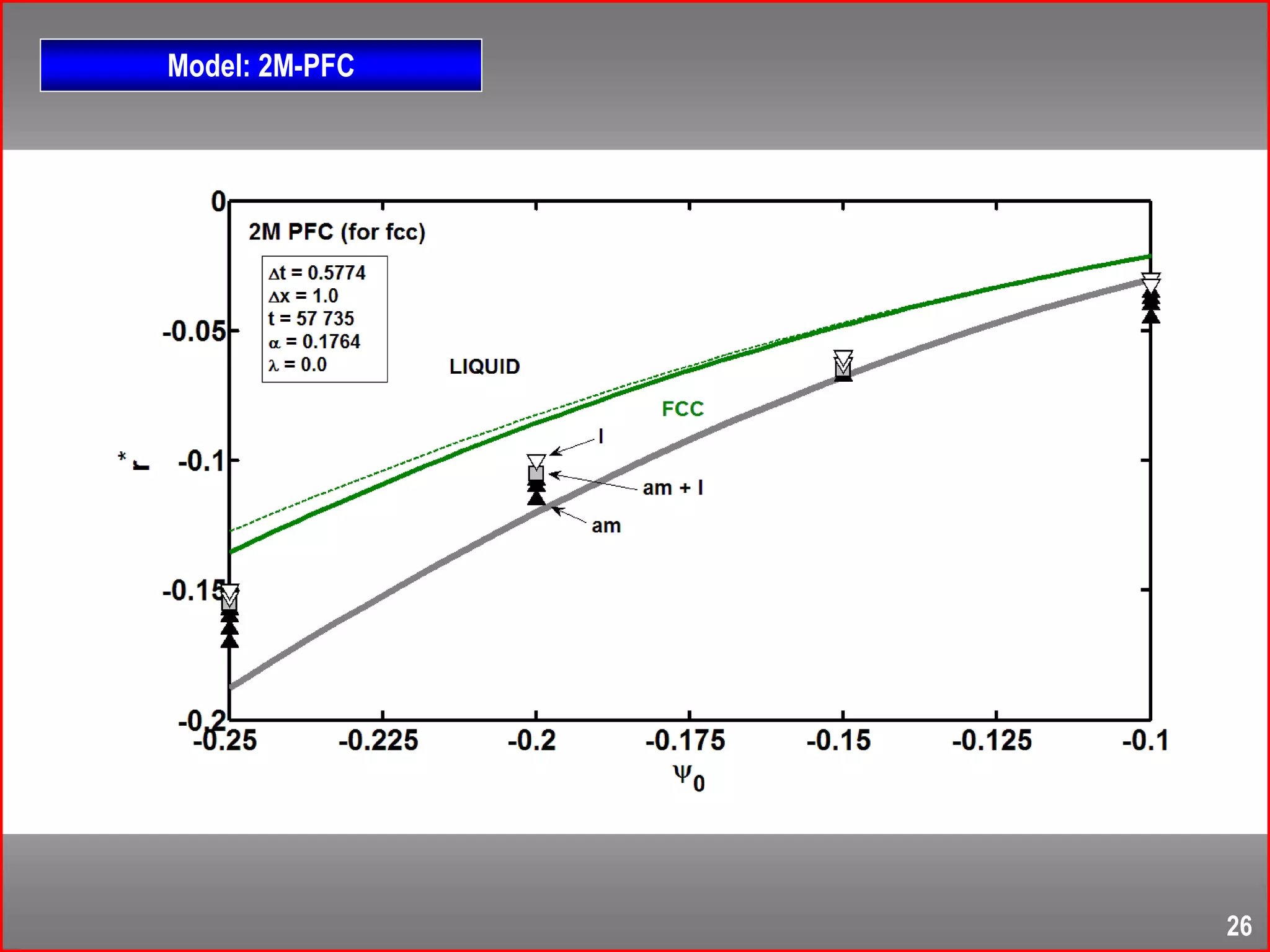
Model: 2M-PFC
26
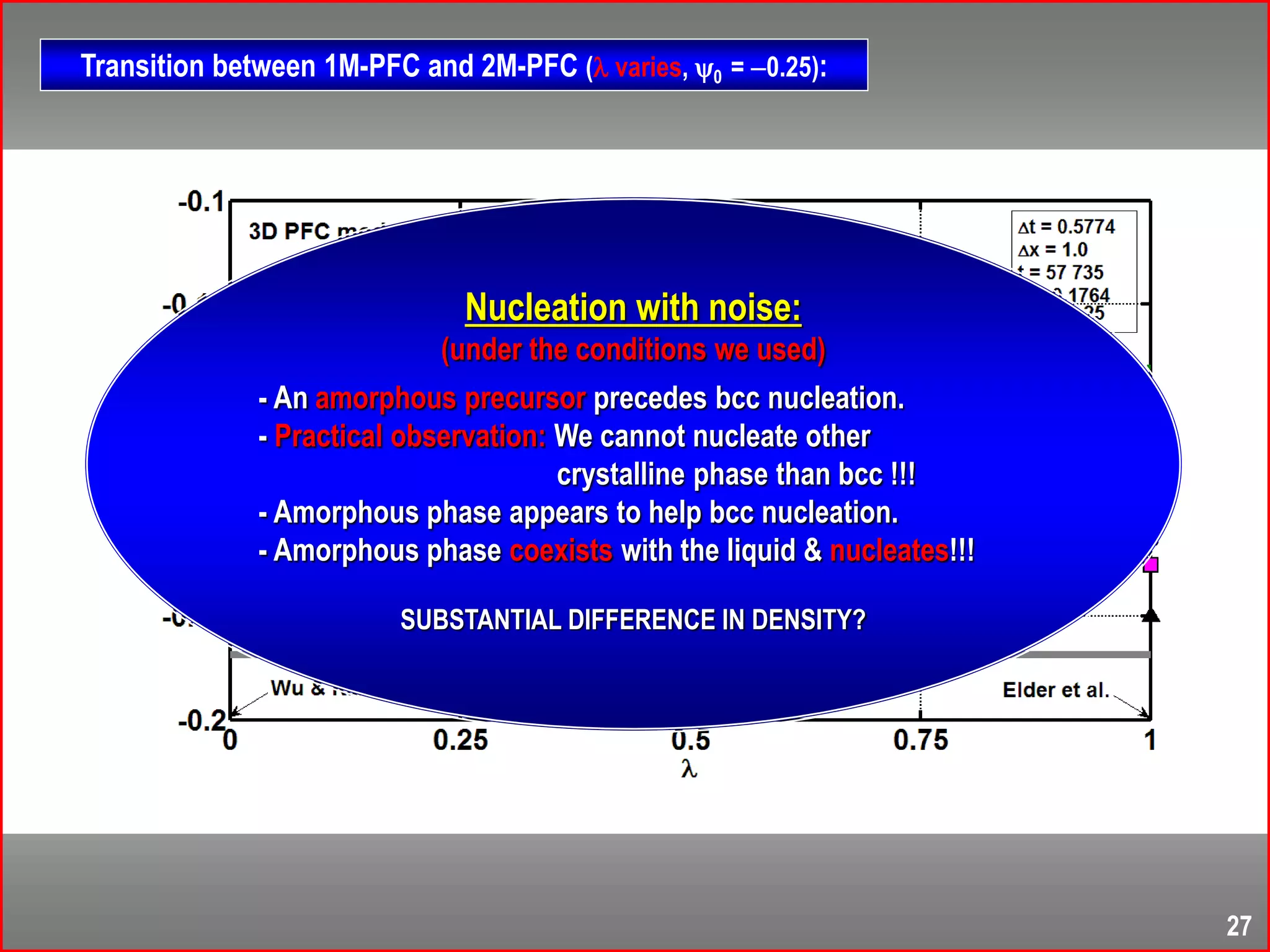
Nucleation with noise:
(under the conditions we used)
- An amorphous precursor precedes bcc nucleation.
- Practical observation: We cannot nucleate other
crystalline phase than bcc !!!
- Amorphous phase appears to help bcc nucleation.
- Amorphous phase coexists with the liquid & nucleates!!!
SUBSTANTIAL DIFFERENCE IN DENSITY?
Transition between 1M-PFC and 2M-PFC ( varies, 0 = 0.25):
27
(MS) liq  amo(S) liq  fcc
The density
difference between
liq. and am. phases
is comparable to
the difference
between liq. and
fcc.
(MS) amo  fcc
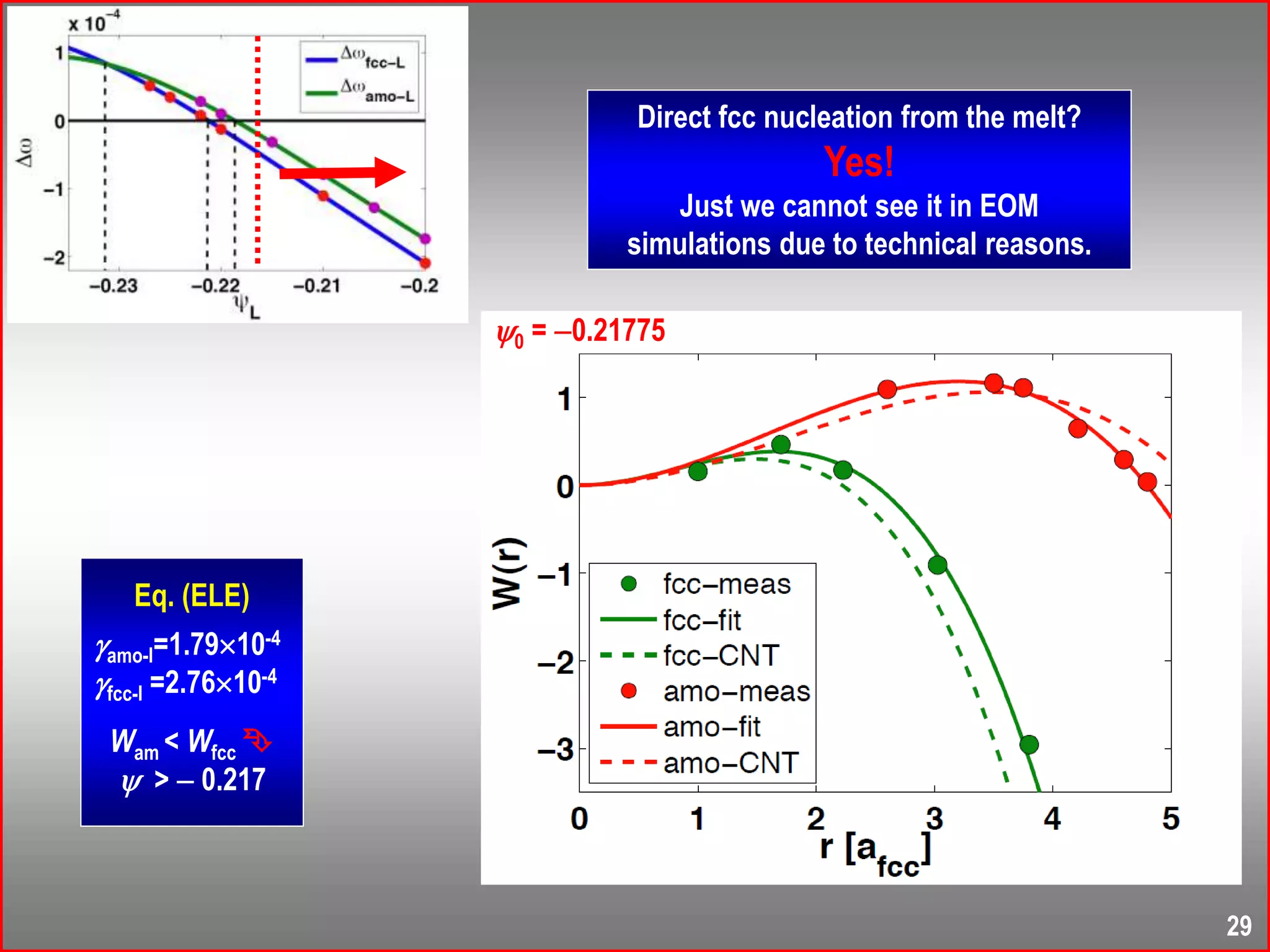
(1) EOM: We do not see (noise-induced) solidification for  <  0.2
(2) EL: From the evaluated data Wamo < Wfcc for  >  0.217; consistent with EOM
(3) FCC nucleation should be seen for  <  0.217; but accessible time is too short
Eq. (ELE)
amo-l=1.7910-4
fcc-l =2.7610-4
Wam < Wfcc 
 >  0.217
Thermodynamics for 2M-PFC at r = 0.1 (from solving the ELE):
28
0 = 0.21775
Eq. (ELE)
amo-l=1.7910-4
fcc-l =2.7610-4
Wam < Wfcc 
 >  0.217
Direct fcc nucleation from the melt?
Yes!
Just we cannot see it in EOM
simulations due to technical reasons.
29
Potential from g(r):
Schommers’ iterative method
- initial guess (potential of mean force)
- MC 4096 particle  g(r)
correction to u(r):
f kT log[gPFC(r)/gsim(r)]
(repeat these steps until convergence)
(Efficient and accurate for one component
fluids, Schommers PRA 1983)
Work done with Gergely Tóth,
Eötvös University, Inst. of Chemistry
Budapest, Hungary
Amorphous structure & eff. pair potential vs. :
PFC models:
Molecular Dynamics:
Am. Fe: Hong,
Nanotech. (2009)
Am. Ni: Yu et al.,
TNMSC (2006)
Like Dzugutov’s potential for
monatomic model glass former:
Peak at ~ 2 rmin
(suppresses fcc, hcp & sc crystals)
Why amorphous precursor?
30
Summarizing the results for LJ, HS, & PFC potentials:
(see Tóth at al. PRL 2011)
- Repulsive core suffices for an amorphous precursor;
- Peak at ~ 2 rmin appears to suppress fcc & hcp;
- Multiple minima  coexisting disordered phases;
(a’la Mishima & Stanley, Nature 1998)
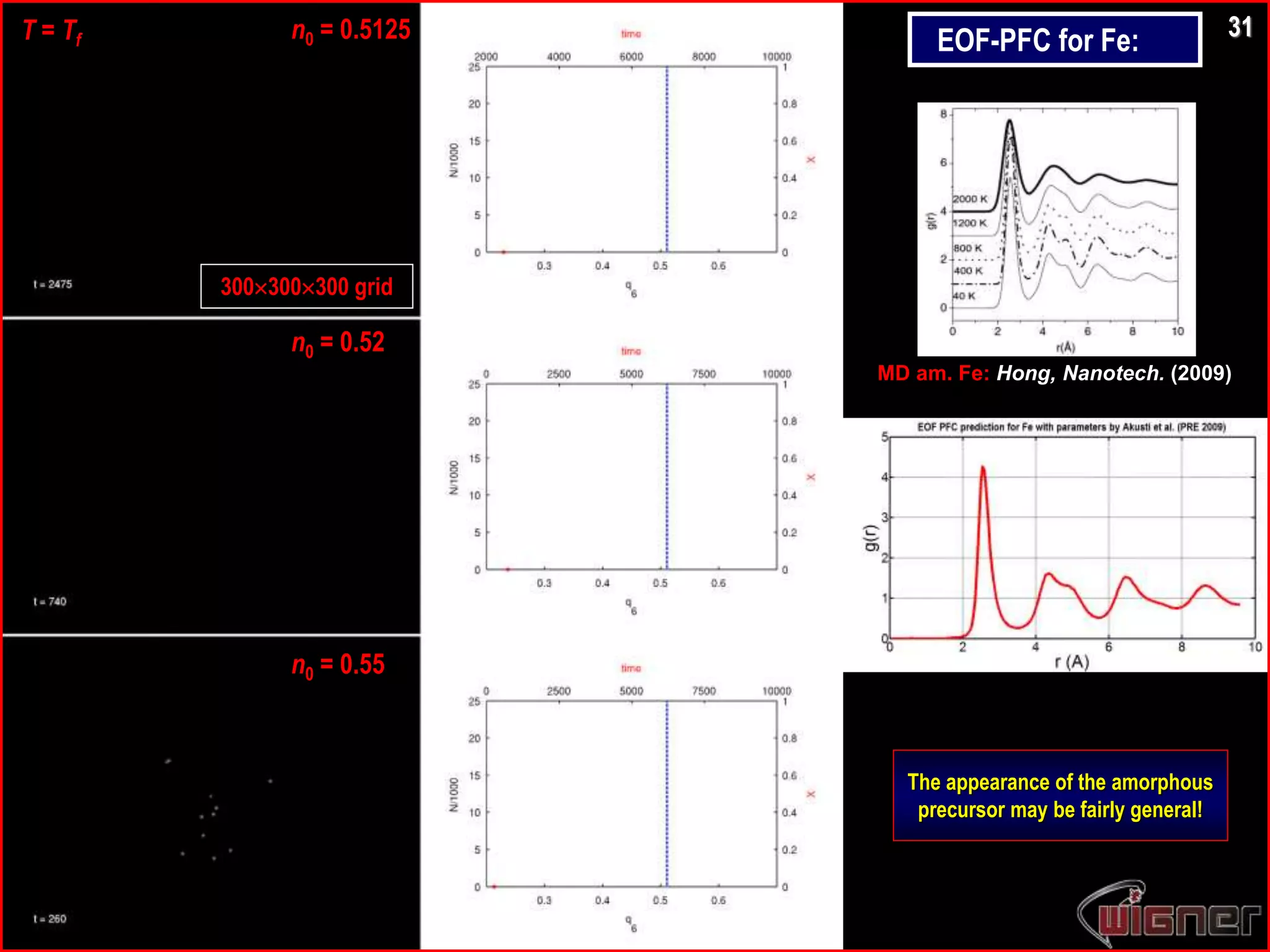
T = Tf
300300300 grid
n0 = 0.5125
n0 = 0.52
n0 = 0.55
MD am. Fe: Hong, Nanotech. (2009)
The appearance of the amorphous
precursor may be fairly general!
31
EOF-PFC for Fe:
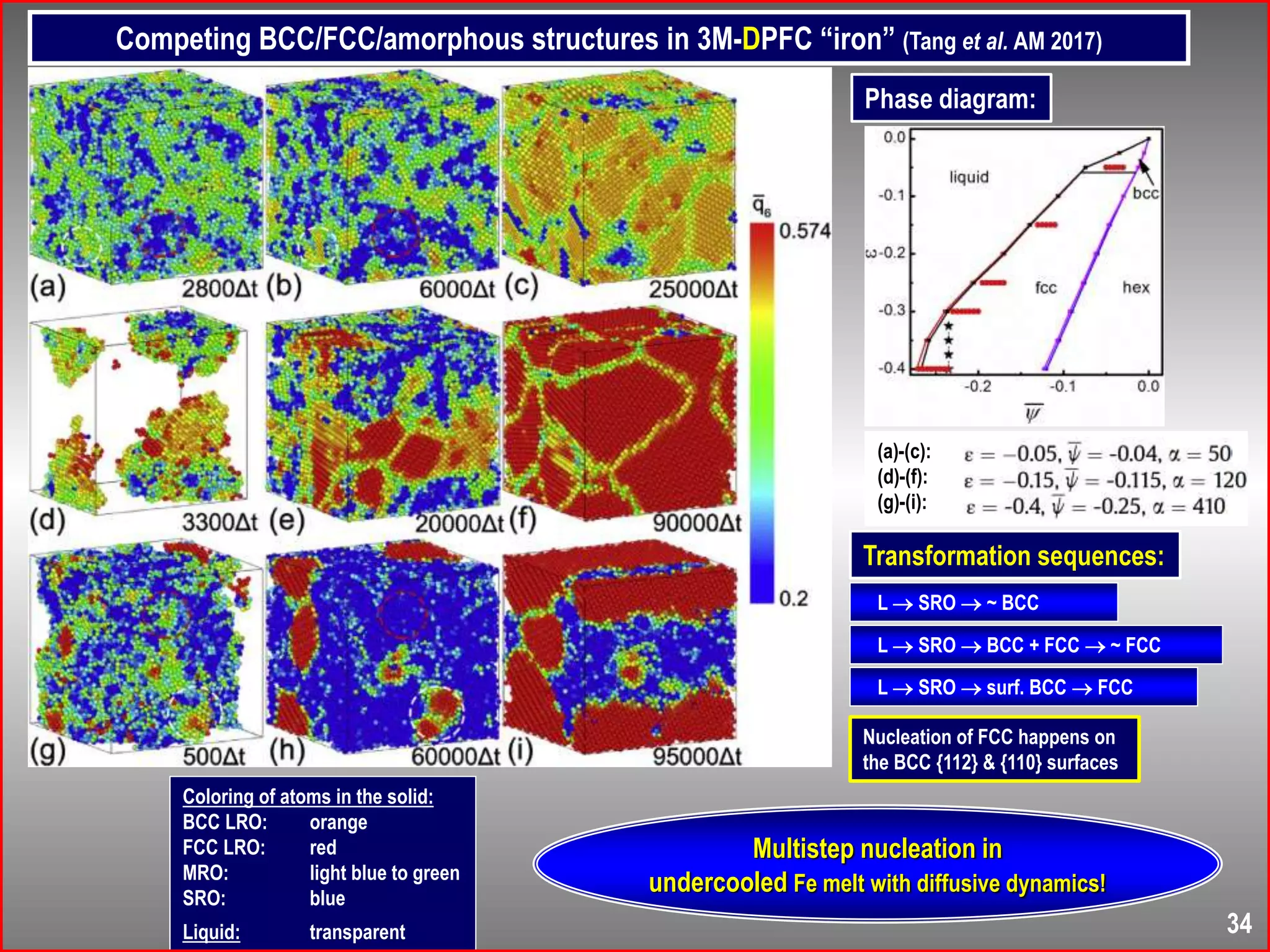
Multistep nucleation in
undercooled Fe melt with diffusive dynamics!
34
Competing BCC/FCC/amorphous structures in 3M-DPFC “iron” (Tang et al. AM 2017)
(a)-(c):
(d)-(f):
(g)-(i):
Coloring of atoms in the solid:
BCC LRO: orange
FCC LRO: red
MRO: light blue to green
SRO: blue
Liquid: transparent
L  SRO  ~ BCC
L  SRO  BCC + FCC  ~ FCC
L  SRO  surf. BCC  FCC
Nucleation of FCC happens on
the BCC {112} & {110} surfaces
Phase diagram:
Transformation sequences:
23p
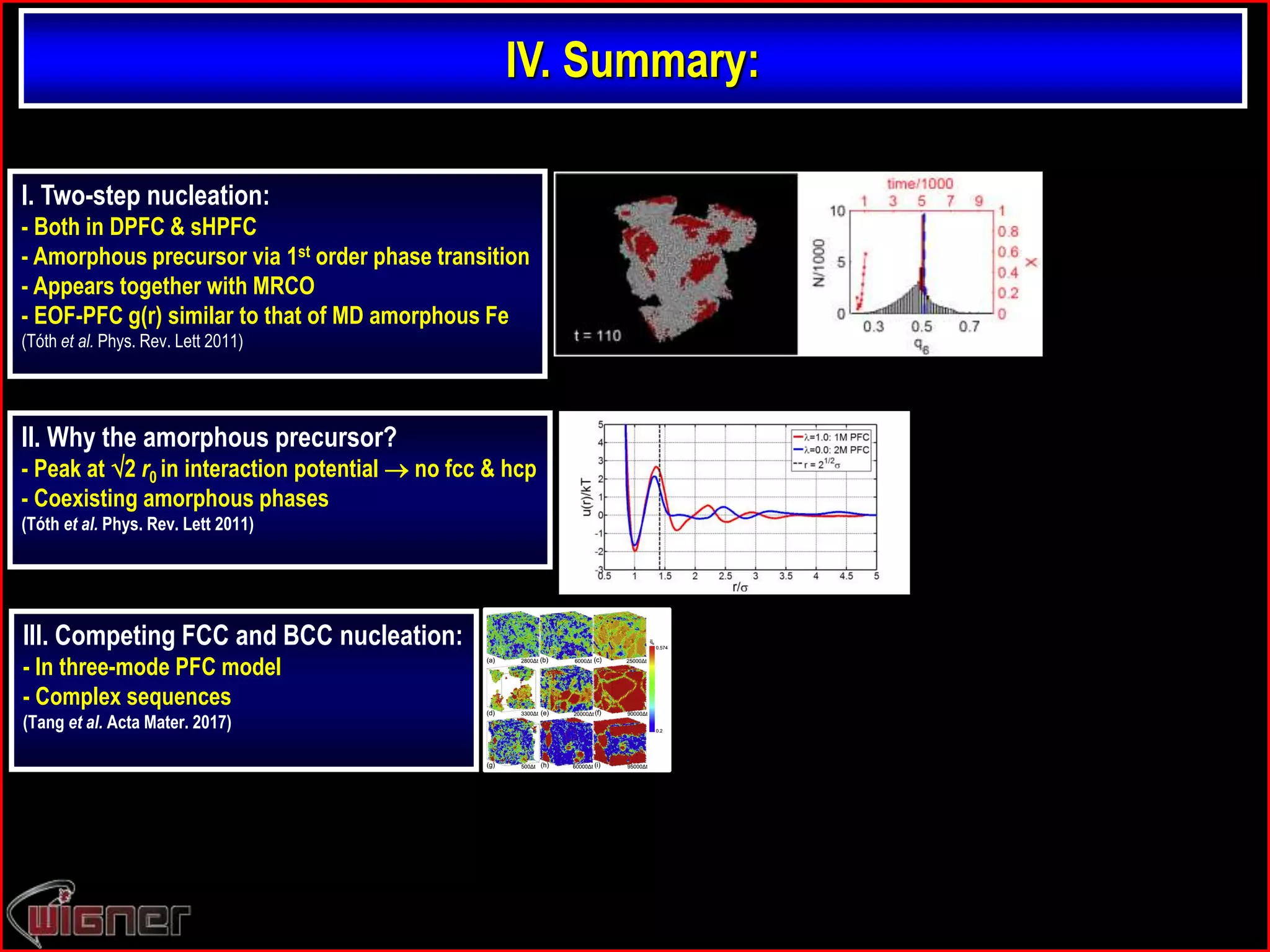
IV. Summary:
I. Two-step nucleation:
- Both in DPFC & sHPFC
- Amorphous precursor via 1st order phase transition
- Appears together with MRCO
- EOF-PFC g(r) similar to that of MD amorphous Fe
(Tóth et al. Phys. Rev. Lett 2011)
III. Competing FCC and BCC nucleation:
- In three-mode PFC model
- Complex sequences
(Tang et al. Acta Mater. 2017)
II. Why the amorphous precursor?
- Peak at 2 r0 in interaction potential  no fcc & hcp
- Coexisting amorphous phases
(Tóth et al. Phys. Rev. Lett 2011)

Nucleation III: Phase-field crystal modeling of nucleation process

  • 1.
    Nucleation III: Phase-field crystalmodeling of nucleation processes aWigner Research Centre for Physics, H-1525 Budapest, P. O. Box 49, Hungary bBCAST, Brunel University, Uxbridge, Middlesex UB8 3PH, U.K. L. Gránásy,a,b Phase Field Workshop “Focus on Nucleation”, 27 Sep 2018, Center for Hierarchical Materials Design HQ, Northwestern University, Evanston, IL, USA
  • 2.
    Complex patterns evolve dueto the interplay of nucleation and growth. I. Introduction 1American Pale Ale Dirty Martini Vodka Tonic Gin Water Polycrystalline matter: Atmospheric sciences: - technical alloys - aerosol formation (climate change) - ceramics - polymers - minerals - food products, etc. In biology: - bones, teeth - kidney stone - cholesterol in arteries - amyloid plaques in Alzheimer’s disease Also frozen drinks: A. Complex polycrystalline structures:
  • 3.
    B. Stages ofpolycrystalline freezing: Nucleation, growth, and grain coarsening 2 1. Nucleation: ~ 10 nm 2. Growth: 10 nm – mm Interface controlled: v  1/ e.g., pure metals Diffusion controlled: v  t -1/2 e.g., colloids 3. Grain coarsening: 10 nm – mm
  • 4.
    (a) BCC layerappears at the FCC-L interface: Crystalline precursor! MD/MC for LJ: (ten Wolde et al. PRL 1995) (cf.: Alexander & McTague, PRL 1978) Precursors everywhere! Nucleation can be fairly complex even in simple systems … MD/MC Results: DFT for LJ: (Lutsko & Nicolis, PRL 2006) (c) Amorphous precursor MC for hard-spheres: (Schilling et al., PRL 2010) BD for hard-spheres: (Kawasaki & Tanaka, PNAS 2010) (c) Medium Range Crystalline Order Liquid precursor! Atomistic simulations: (ten Wolde & Frenkel, Science 1997) (b) Two-step nucleation (near MS Tc) (a) Non-spherical nuclei: (~ HS colloids) Laser Scan. Conf. Microscopy: (Gasser et al. Science 2001) Experiment: AFM: (Vekilov et al., Nature 2000) (b) Chain-like nuclei (apoferritin) (c) Amorphous precursor Microscopy: (Zhang & Li., JACS 2007) 3
  • 5.
    Liquid ordering at theinterface! How much of these can be captured by molecular scale continuum models? (b) Unstructured wall: HS (111) nearly wets it (Auer & Frenkel, PRL 2003) (a) Unstructured walls cause liquid ordering: (e.g.: Toxwaerd 2002) (Webb & al., PRL 2003) (c) Liquid ordering at cryst. wall vs orientation: MD/MC Results: 4
  • 6.
    II. The Phase-FieldCrystal Approach: Fundamentals
  • 7.
    Phase Field Crystal(PFC) model: Diffusive dynamics (106 times longer time scale than in MD) A. The inventory of computational materials science 5
  • 8.
    B. Fundaments: MDvs. PFC vs. PF 6 Solid-liquid interface (MD): Phase Field (PF): Normalized amplitude of density peaks PFC/CDFT: Time averaged particle (number) density: Emmerich et al., Adv. Phys. (2012).
  • 9.
    Classical density functionaltheory (Ramakrishnan & Yussouff: The free energy is Taylor expanded) PFC: The two-particle dir. correlation function is Taylor expanded up to 4th order in Fourier space Physics: in the 3 exp. coeffs. related to the compressibility, bulk modulus and lattice const. Reference: homogeneous liquid (l )  : time-averaged particle density (number density)  =   l C2: two-particle direct correlation function: C2(k) = 1 1/S(k) Free energy functional: Brazovskii/Swift-Hohenberg form: 7 C. The Phase-Field Crystal model (K.R. Elder et al. PRL 2002) For a recent review on PFC see Emmerich et al. Adv. Mater. 2012  - reduced density r - reduced temperature
  • 10.
    C. Nucleation barrierin 2D: D. 3D dendrite B. Nucleation & growth as in colloids DPFC Tegze et al. Soft Matter 2011 Experiment I. Diffusive PFC (DPFC): Equation of motion (EOM): diffusive dynamics – colloids Time evolution: 8 C. DPFC: growth modes as in colloids Euler-Lagrange eq. (ELE): (extremes of free energy) Equilibrium properties: - phase diagram - interface free energy & anisotropy - nucleation barrier, etc. DPFC A. Crystal-liquid interface Experiment B. Equilibrium shapes: Parameter r regulates anisotropy. A. Phase diagrams in (a) 2D and (b) 3D: Podmaniczky et al., J. Cryst. Growth (2014)
  • 11.
    III. The Phase-FieldCrystal (PFC) Approach: Nucleation and the Euler-Lagrange/ elastic band/string methods - Homogeneous nucleation - Heterogeneous nucleation (contact angles, barriers, corners) - Free growth limited version of particle-induced nucleation
  • 12.
    Solution of ELeq.: by pseudo-spectral iteration method Initial guess: single-mode solution for r < R (R varied) Large no. of solutions r =  0.5 CNT: Hexagonal shape (Ecorner neglected) Sharp interface Driving force known Parabolic fit to find max.  A. Homogeneous crystal nuclei in 2D (ELE) Tóth et al. J. Phys: Condens. Matter, 2010 11
  • 13.
    Results: Comparable nucleation barriersfor BCC & FCC  BCC  FCC (far from critical point  large Sf  faceted) BCC FCC Homogeneous crystal nuclei in 3D (ELE) Tóth et al. J. Phys: Condens. Matter, 2010 12
  • 14.
    Results: - Adsorbed monolayer! - Contact angle: 60 , determined by crystal structure r =  0.5 a0/ = 1.0 V term added to F B. Heterogeneous crystal nuclei in 2D (ELE) Tóth et al. J. Phys: Condens. Matter, 2010 13   )(),()(:Potential 10 rrr haSVVV s
  • 15.
    Nearly isotropic (= 0.25) ; 0 =  0.341, V0 = V1 = 0.5 Faceted ( = 0. 5) ; 0 =  0.51415, V0 = 0, V1 = 0.65 Contact angle () and barrier height (W*) are nonmonotonic functions of as   )(),()(:Potential 10 rrr haSVVV s Effect of lattice mismatch in 2D (ELE) Tóth et al. Phys. Rev. Lett., 2012 14
  • 16.
    r = 0.25 EL solutions for increasing driving force: Homogeneous nuclei at the critical driving force r =  0.5 C. Particle-induced crystallization in 2D (ELE) Tóth et al. Phys. Rev. Lett., 2012 15
  • 17.
    r = 0.25 256  256  256 grid SC substrate Cubic shape 512  512  512 grid Particle-induced crystallization in 3D (ELE) Tóth et al. Phys. Rev. Lett., 2012 16
  • 18.
    Nuclei for homogeneousprocess: D. Homogeneous/heterogeneous nucleation in 2D by simplified string method Backofen et al., J. Phys.: Condens. Matter, 2010; and Eur. Phys. J. Special Topics, 2014 17 Nucleus for heterogeneous process: Finding the minimum energy path (MEP): String: ordered set of states & its length Evolution step: Reparametrization step: Repeat the two steps until MEP is found.
  • 19.
    IV. The Phase-FieldCrystal Approach: Dynamic Equations and Simulating Nucleation - DPFC: PFC with diffusive dynamics: K. R. Elder et al., PRL, 2002
  • 20.
    1. “Single-mode” 1M-PFC byElder et al.: R1 = relative strength of 1st and 2nd mode contributions Q1 = q1 / q0 (= 2/3 for fcc) ratio of the two wave-numbers 2. “Two-mode” 2M-PFC by Wu et al.: Unified: where R1 =  / (1  )  = 1 1M-PFC  = 0 2M-PFC 18 Free energy functionals of advanced PFC models: Phase diagrams in 3D: 1M-PFC 2M-PFC
  • 21.
    3. “Multi-mode” MM-PFC byMkhonta et al. (PRL 2013): 19 Further advanced PFC models: 4. “Eight-order fitting PFC” EOF-PFC by Jaatinen et al. (PRB 2009): c2 is expanded at km up to 8th order Parameters are fixed so as to recover position, height & c2”at 1st peak Phase diagrams in 3D: 3M-PFC EOF-PFC Tang et al. PRE 2017
  • 22.
    Two-step homogeneous nucleation DPFC:G. I. Tóth et al., PRL, 2011 HPFC: F. Podmaniczky, preliminary
  • 23.
    Continuous cooling inDPFC: Berry et al., PRE (2008). 20 - At fast cooling amorphous phase forms via 1st order phase transition - At large undercoolings the nucleation barrier for the amorphous phase is smaller than for BCC
  • 24.
    Continuous cooling: fromr =  0.1330 to  0.1875; cooling time: 3104, 105, 2  105, 3  105 time steps 21
  • 25.
    Zhang & Liu,JACS (2007) r =  0.1684 0 = 0.25 256256256 grid req =  0.1330 Tóth et al. PRL (2011). Red (bcc-like) if q4  [0.02, 0.07] q6  [0.48, 0.52] Steinhardt, Nelson, Ronchetti, PRB (1983) Starts to solidify as amorphous, then crystallizes ! A’la 2D & 3D colloids. Instantaneous quench in DPFC: 22
  • 26.
    r = 0.1667 r= 0.1719 r = 0.1736 256256256 grid A. Amorphous cluster  BCC single crystal B. Amorphous phase  amorphous + BCC C. Amorphous phase 0 = 0.25 Freezing modes: 23
  • 27.
    Lechner & Dellago,JCP (2008) qi of Lechner & Dellago Black: bcc Yellow: Icosah. Green: hcp Red: fcc Structural aspects: Greenq6 > 0.4 Redq6 [0.28, 0.4] Whiteq6 < 0.28 Red (bcc-like) if q4  [0.02, 0.07] q6  [0.48, 0.52] Observations: - Am. precursor is structurally like LJ liquid - MRCO and amorphous domains appear parallel - Heterogeneous-like bcc nucleation on am. domains - Literature: LJ, HS, colloids, now PFC. What else? Kawasaki & Tanaka, PNAS (2010) MRCO (Brownian Dynamics) 24
  • 28.
  • 29.
  • 30.
    Nucleation with noise: (underthe conditions we used) - An amorphous precursor precedes bcc nucleation. - Practical observation: We cannot nucleate other crystalline phase than bcc !!! - Amorphous phase appears to help bcc nucleation. - Amorphous phase coexists with the liquid & nucleates!!! SUBSTANTIAL DIFFERENCE IN DENSITY? Transition between 1M-PFC and 2M-PFC ( varies, 0 = 0.25): 27
  • 31.
    (MS) liq amo(S) liq  fcc The density difference between liq. and am. phases is comparable to the difference between liq. and fcc. (MS) amo  fcc (1) EOM: We do not see (noise-induced) solidification for  <  0.2 (2) EL: From the evaluated data Wamo < Wfcc for  >  0.217; consistent with EOM (3) FCC nucleation should be seen for  <  0.217; but accessible time is too short Eq. (ELE) amo-l=1.7910-4 fcc-l =2.7610-4 Wam < Wfcc   >  0.217 Thermodynamics for 2M-PFC at r = 0.1 (from solving the ELE): 28
  • 32.
    0 = 0.21775 Eq.(ELE) amo-l=1.7910-4 fcc-l =2.7610-4 Wam < Wfcc   >  0.217 Direct fcc nucleation from the melt? Yes! Just we cannot see it in EOM simulations due to technical reasons. 29
  • 33.
    Potential from g(r): Schommers’iterative method - initial guess (potential of mean force) - MC 4096 particle  g(r) correction to u(r): f kT log[gPFC(r)/gsim(r)] (repeat these steps until convergence) (Efficient and accurate for one component fluids, Schommers PRA 1983) Work done with Gergely Tóth, Eötvös University, Inst. of Chemistry Budapest, Hungary Amorphous structure & eff. pair potential vs. : PFC models: Molecular Dynamics: Am. Fe: Hong, Nanotech. (2009) Am. Ni: Yu et al., TNMSC (2006) Like Dzugutov’s potential for monatomic model glass former: Peak at ~ 2 rmin (suppresses fcc, hcp & sc crystals) Why amorphous precursor? 30 Summarizing the results for LJ, HS, & PFC potentials: (see Tóth at al. PRL 2011) - Repulsive core suffices for an amorphous precursor; - Peak at ~ 2 rmin appears to suppress fcc & hcp; - Multiple minima  coexisting disordered phases; (a’la Mishima & Stanley, Nature 1998)
  • 34.
    T = Tf 300300300grid n0 = 0.5125 n0 = 0.52 n0 = 0.55 MD am. Fe: Hong, Nanotech. (2009) The appearance of the amorphous precursor may be fairly general! 31 EOF-PFC for Fe:
  • 35.
    Multistep nucleation in undercooledFe melt with diffusive dynamics! 34 Competing BCC/FCC/amorphous structures in 3M-DPFC “iron” (Tang et al. AM 2017) (a)-(c): (d)-(f): (g)-(i): Coloring of atoms in the solid: BCC LRO: orange FCC LRO: red MRO: light blue to green SRO: blue Liquid: transparent L  SRO  ~ BCC L  SRO  BCC + FCC  ~ FCC L  SRO  surf. BCC  FCC Nucleation of FCC happens on the BCC {112} & {110} surfaces Phase diagram: Transformation sequences:
  • 36.
    23p IV. Summary: I. Two-stepnucleation: - Both in DPFC & sHPFC - Amorphous precursor via 1st order phase transition - Appears together with MRCO - EOF-PFC g(r) similar to that of MD amorphous Fe (Tóth et al. Phys. Rev. Lett 2011) III. Competing FCC and BCC nucleation: - In three-mode PFC model - Complex sequences (Tang et al. Acta Mater. 2017) II. Why the amorphous precursor? - Peak at 2 r0 in interaction potential  no fcc & hcp - Coexisting amorphous phases (Tóth et al. Phys. Rev. Lett 2011)