NUCLEAR ROCKET
ENGINE
BY,
MAGESH KUMAR S
INTRODUCTION
 Nuclear rocket system include Nuclear thermal propulsion (“NTP”) systems, nuclear
electric propulsion (“NEP”) systems, hybrid NTP/NEP concepts and nuclear pulse
rockets that are propelled by the force of nuclear explosions.
 Provide thrust through heating of liquid hydrogen propellant by nuclear fission.
 Several designs of nuclear thermal rockets solid, liquid and gas core nuclear rockets.
 Solid core nuclear rockets operate by pumping the liquid hydrogen propellant through
narrow channels in a solid nuclear reactor.
 As liquid hydrogen moves through the channels, it is heated by the reactor into a high
temperature gas and then ejected from the exhaust nozzle of the rocket at high speeds.
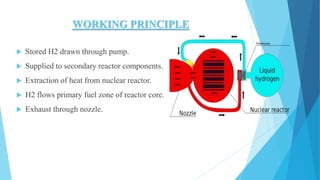
SCHEMATIC DIAGRAM
WORKING PRINCIPLE
 Stored H2 drawn through pump.
 Supplied to secondary reactor components.
 Extraction of heat from nuclear reactor.
 H2 flows primary fuel zone of reactor core.
 Exhaust through nozzle.
TYPES OF NUCLEAR ROCKET ENGINE
 Solid Core
 Pulsed Nuclear Thermal Rocket
 Liquid Core
 Gas Core
ADVANTAGE
 High Isp (2-10% that of chemical system)
 Low Specific Mass (kg/KW)
 High Power allows high thrust
 Use of any propellant
 Reduced radiation for some missions.
DISADVANTAGE
 Social issues
 Low technology readiness level (Maturity)
 Radiation issues (Shielding)
 High Reactor development cost
APPLICATIONS
 Nuclear propulsion in rockets
 Nuclear propulsion in submarines
 Nuclear propulsion in car engine (Ford)
RECENT INNOVATION
 The UK company Applied Fusion Systems are currently filing a
patent for a new nuclear fusion rocket engine, creating by turning
a small fusion reactor into a rocket.
 This technology could be used to run from a compact nuclear
fusion reactor, a development which could pave the way for high
speed, interstellar space travel.

Nuclear rocket engine

  • 1.
  • 2.
    INTRODUCTION  Nuclear rocketsystem include Nuclear thermal propulsion (“NTP”) systems, nuclear electric propulsion (“NEP”) systems, hybrid NTP/NEP concepts and nuclear pulse rockets that are propelled by the force of nuclear explosions.  Provide thrust through heating of liquid hydrogen propellant by nuclear fission.  Several designs of nuclear thermal rockets solid, liquid and gas core nuclear rockets.  Solid core nuclear rockets operate by pumping the liquid hydrogen propellant through narrow channels in a solid nuclear reactor.  As liquid hydrogen moves through the channels, it is heated by the reactor into a high temperature gas and then ejected from the exhaust nozzle of the rocket at high speeds.
  • 3.
  • 4.
    WORKING PRINCIPLE  StoredH2 drawn through pump.  Supplied to secondary reactor components.  Extraction of heat from nuclear reactor.  H2 flows primary fuel zone of reactor core.  Exhaust through nozzle.
  • 5.
    TYPES OF NUCLEARROCKET ENGINE  Solid Core  Pulsed Nuclear Thermal Rocket  Liquid Core  Gas Core
  • 6.
    ADVANTAGE  High Isp(2-10% that of chemical system)  Low Specific Mass (kg/KW)  High Power allows high thrust  Use of any propellant  Reduced radiation for some missions.
  • 7.
    DISADVANTAGE  Social issues Low technology readiness level (Maturity)  Radiation issues (Shielding)  High Reactor development cost
  • 8.
    APPLICATIONS  Nuclear propulsionin rockets  Nuclear propulsion in submarines  Nuclear propulsion in car engine (Ford)
  • 9.
    RECENT INNOVATION  TheUK company Applied Fusion Systems are currently filing a patent for a new nuclear fusion rocket engine, creating by turning a small fusion reactor into a rocket.  This technology could be used to run from a compact nuclear fusion reactor, a development which could pave the way for high speed, interstellar space travel.