TRAVELING WAVE REACTOR

Project guide

Dr.V.Mahesh
Dean(Research)

By
T. Bhargav
AIM:




The goal of the TWR design is to greatly reduce
proliferation risks and create new, affordable
options for converting low-level waste into
energy resources.
Terra Power’s mission is to develop this nuclear
reactor to meet growing global electricity needs.
PRINCIPLE:




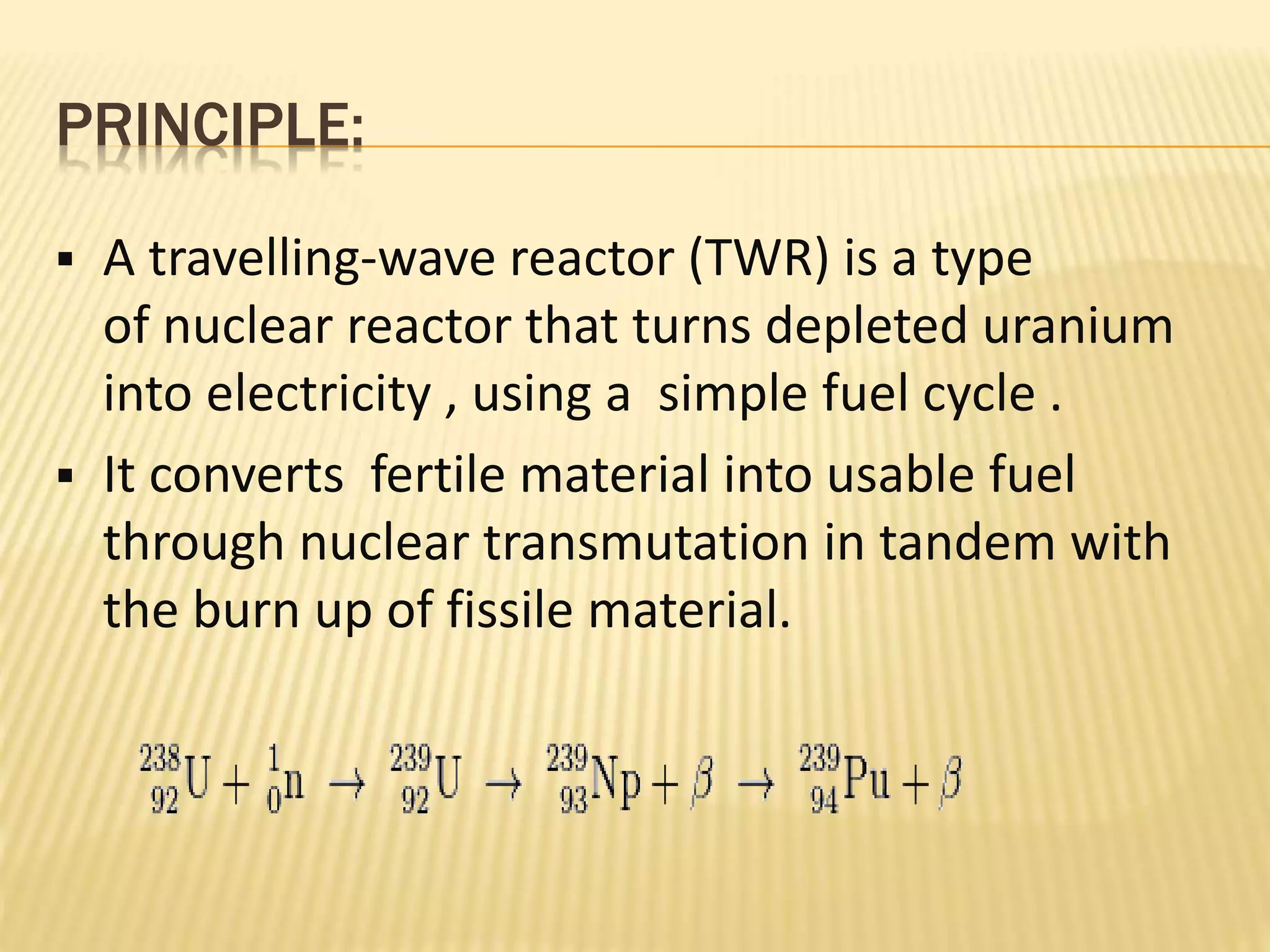
A travelling-wave reactor (TWR) is a type
of nuclear reactor that turns depleted uranium
into electricity , using a simple fuel cycle .
It converts fertile material into usable fuel
through nuclear transmutation in tandem with
the burn up of fissile material.
•The name refers to the fact that fission does not occur
throughout the entire TWR core, but remains confined to a
boundary zone that slowly advances through the core over
time.
•TWRs differ from other kinds of fast-neutron and breeder
reactors in their ability to use fuel efficiently
without uranium enrichment or reprocessing, instead
directly using depleted uranium, natural
uranium, thorium, spent fuel removed from light water
reactors.
•TWRs could theoretically run, self-sustained, for decades
without refuelling or removing any spent fuel from the
reactor and no human being is required.
CHARACTERISTICS:





Terra Power has developed TWR designs for lowto medium- (300 MW e) as well as high-power
(~1000 MW e) generation facilities.
Human intervention is not required.
It uses liquid sodium as a coolant and to carry
away heat .
Prototype design of Travelling Wave Reactor
CONSTRUCTION:
 The main parts of TWR are :
1.
2.

3.
4.
5.
6.

Reactor head
The core
Control rods
Mechanical pumps
Heat exchangers
Guard vessel
WORKING:


It is also called as "breed-and-burn" reactor,
because first it breeds Plutonium from U-238 by
nuclear transmutation and then burns it by
fission reactions .



A small amount of enriched uranium-235 or
other "fissile fuel" is used in this process to
initiate fission.
Initially, the core is loaded with fertile material, with a
few rods of fissile fuel concentrated in the central region.
After the reactor is started, four zones form within the
core:
1. the depleted zone, which contains mostly fission
products and leftover fuel
2. the fission zone, where fission of bred fuel takes place
3. the breeding zone, where fissile material is created by
neutron capture
4. fresh zone, which contains unreacted fertile material
 The energy-generating fission zone steadily

advances through the core, effectively
consuming fertile material in front of it and
leaving spent fuel behind.

 Meanwhile, the heat released by fission is

absorbed by the molten sodium and
subsequently transferred into a closed-cycle
aqueous loop, where electric power is generated
by steam turbines.


TWRs are also capable, in principle, of reusing
their own fuel. In any given cycle of operation, only
20–35% of the fuel gets converted to an unusable
form; the remaining metal constitutes usable
fissile material.



Recast and reclad into new driver pellets without
chemical separations, this recycled fuel can be
used to initiate fission in subsequent cycles of
operation, thus displacing the need to enrich
uranium altogether.
Nature of Wave :
• As the fuel's composition changes through nuclear
transmutation, fuel rods are continually reshuffled within the
core to optimize the neutron flux and fuel usage at any given
point in time.

•Thus, instead of letting the wave propagate through the fuel,
the fuel itself is moved through a largely stationary burn
wave.
•Terra Power's design avoids the problem of cooling a highly
variable burn region By replacing a static core configuration
with an actively managed "standing wave" or "soliton",
ADVANTAGES:




The Terra Power reactor burns the 99.3%
depleted uranium and breeds plutonium at the
same time, within the same 'cylinder'.
Terra Power has estimated that the Paducah
enrichment facility stockpile alone represents an
energy resource equivalent to $100 trillion worth
of electricity
DISADVANTAGES:
TWRs may be prone to radioactive leaks and core
meltdowns.
 Even if reducing the cost of uranium were
possible with TWRs, it would not make nuclear
power cheaper
 Promised delivery dates for TWRs are wildly
unrealistic.

THANK YOU…………..
ANY QUERIES………?????

Travelling wave reactor

  • 1.
    TRAVELING WAVE REACTOR Projectguide Dr.V.Mahesh Dean(Research) By T. Bhargav
  • 3.
    AIM:   The goal ofthe TWR design is to greatly reduce proliferation risks and create new, affordable options for converting low-level waste into energy resources. Terra Power’s mission is to develop this nuclear reactor to meet growing global electricity needs.
  • 4.
    PRINCIPLE:   A travelling-wave reactor(TWR) is a type of nuclear reactor that turns depleted uranium into electricity , using a simple fuel cycle . It converts fertile material into usable fuel through nuclear transmutation in tandem with the burn up of fissile material.
  • 5.
    •The name refersto the fact that fission does not occur throughout the entire TWR core, but remains confined to a boundary zone that slowly advances through the core over time. •TWRs differ from other kinds of fast-neutron and breeder reactors in their ability to use fuel efficiently without uranium enrichment or reprocessing, instead directly using depleted uranium, natural uranium, thorium, spent fuel removed from light water reactors. •TWRs could theoretically run, self-sustained, for decades without refuelling or removing any spent fuel from the reactor and no human being is required.
  • 6.
    CHARACTERISTICS:    Terra Power hasdeveloped TWR designs for lowto medium- (300 MW e) as well as high-power (~1000 MW e) generation facilities. Human intervention is not required. It uses liquid sodium as a coolant and to carry away heat .
  • 7.
    Prototype design ofTravelling Wave Reactor
  • 8.
    CONSTRUCTION:  The mainparts of TWR are : 1. 2. 3. 4. 5. 6. Reactor head The core Control rods Mechanical pumps Heat exchangers Guard vessel
  • 9.
    WORKING:  It is alsocalled as "breed-and-burn" reactor, because first it breeds Plutonium from U-238 by nuclear transmutation and then burns it by fission reactions .  A small amount of enriched uranium-235 or other "fissile fuel" is used in this process to initiate fission.
  • 10.
    Initially, the coreis loaded with fertile material, with a few rods of fissile fuel concentrated in the central region. After the reactor is started, four zones form within the core: 1. the depleted zone, which contains mostly fission products and leftover fuel 2. the fission zone, where fission of bred fuel takes place 3. the breeding zone, where fissile material is created by neutron capture 4. fresh zone, which contains unreacted fertile material
  • 11.
     The energy-generatingfission zone steadily advances through the core, effectively consuming fertile material in front of it and leaving spent fuel behind.  Meanwhile, the heat released by fission is absorbed by the molten sodium and subsequently transferred into a closed-cycle aqueous loop, where electric power is generated by steam turbines.
  • 12.
     TWRs are alsocapable, in principle, of reusing their own fuel. In any given cycle of operation, only 20–35% of the fuel gets converted to an unusable form; the remaining metal constitutes usable fissile material.  Recast and reclad into new driver pellets without chemical separations, this recycled fuel can be used to initiate fission in subsequent cycles of operation, thus displacing the need to enrich uranium altogether.
  • 13.
    Nature of Wave: • As the fuel's composition changes through nuclear transmutation, fuel rods are continually reshuffled within the core to optimize the neutron flux and fuel usage at any given point in time. •Thus, instead of letting the wave propagate through the fuel, the fuel itself is moved through a largely stationary burn wave. •Terra Power's design avoids the problem of cooling a highly variable burn region By replacing a static core configuration with an actively managed "standing wave" or "soliton",
  • 14.
    ADVANTAGES:   The Terra Powerreactor burns the 99.3% depleted uranium and breeds plutonium at the same time, within the same 'cylinder'. Terra Power has estimated that the Paducah enrichment facility stockpile alone represents an energy resource equivalent to $100 trillion worth of electricity
  • 15.
    DISADVANTAGES: TWRs may beprone to radioactive leaks and core meltdowns.  Even if reducing the cost of uranium were possible with TWRs, it would not make nuclear power cheaper  Promised delivery dates for TWRs are wildly unrealistic. 
  • 16.