ROCKET PROPULSION
A propulsion system is a system that produces thrust to push an object forward. Propulsion
systems are found on everything from fireworks, rockets, airplanes to space suites
ROCKET PRINCIPLE
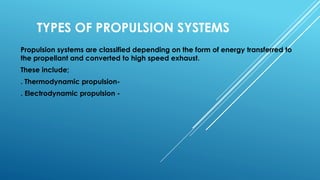
● Rockets operate on the principle of conservation of momentum and Newton’s
third law of motionR
TYPES OF PROPULSION SYSTEMS
Propulsion systems are classified depending on the form of energy transferred to
the propellant and converted to high speed exhaust.
These include;
. Thermodynamic propulsion-
. Electrodynamic propulsion -
THERMODYNAMIC PROPULSION
Thermodynamic systems transfer thermodynamic energy (heat and pressure) to
the propellant and then convert the energized propellant into high speed
exhaust using nozzles.
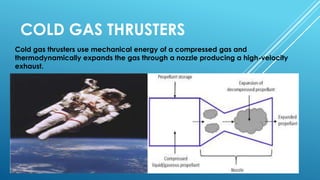
COLD GAS THRUSTERS
Cold gas thrusters use mechanical energy of a compressed gas and
thermodynamically expands the gas through a nozzle producing a high-velocity
exhaust.
CHEMICAL ROCKETS
Chemical energy is produced during combustion of fuel (such as hydrogen) plus the
oxidizer(such as oxygen). The two combine, liberating a huge amount of heat and
creating by-products that form the exhaust. Chemical rockets is further disintegrated
into three categories;
. Liquid
. Solid
. Hybrid
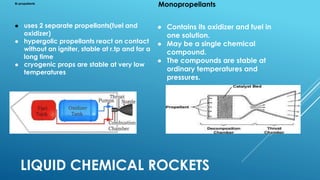
LIQUID CHEMICAL ROCKETS
Bi-propellants
● uses 2 separate propellants(fuel and
oxidizer)
● hypergolic propellants react on contact
without an igniter, stable at r.tp and for a
long time
● cryogenic props are stable at very low
temperatures
Monopropellants
● Contains its oxidizer and fuel in
one solution.
● May be a single chemical
compound.
● The compounds are stable at
ordinary temperatures and
pressures.
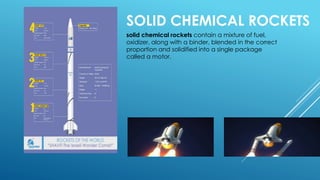
SOLID CHEMICAL ROCKETS
solid chemical rockets contain a mixture of fuel,
oxidizer, along with a binder, blended in the correct
proportion and solidified into a single package
called a motor.
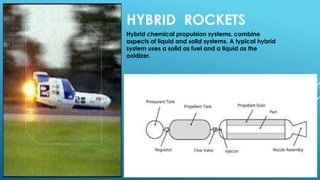
HYBRID ROCKETS
Hybrid chemical propulsion systems, combine
aspects of liquid and solid systems. A typical hybrid
system uses a solid as fuel and a liquid as the
oxidizer.
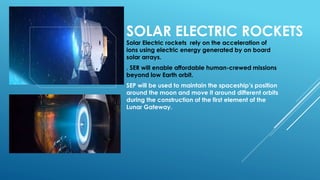
SOLAR ELECTRIC ROCKETS
Solar Electric rockets rely on the acceleration of
ions using electric energy generated by on board
solar arrays.
. SER will enable affordable human-crewed missions
beyond low Earth orbit.
SEP will be used to maintain the spaceship’s position
around the moon and move it around different orbits
during the construction of the first element of the
Lunar Gateway.
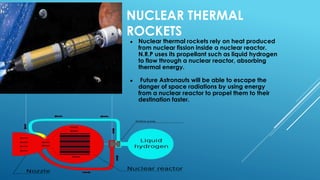
NUCLEAR THERMAL
ROCKETS
● Nuclear thermal rockets rely on heat produced
from nuclear fission inside a nuclear reactor.
N.R.P uses its propellant such as liquid hydrogen
to flow through a nuclear reactor, absorbing
thermal energy.
● Future Astronauts will be able to escape the
danger of space radiations by using energy
from a nuclear reactor to propel them to their
destination faster.
ROCKET USES
● Missiles
● Ejection seats
● Human spacecrafts
● Launch Vehicles
● space exploration
@Africano

Intro to rocket propulsion

  • 1.
    ROCKET PROPULSION A propulsionsystem is a system that produces thrust to push an object forward. Propulsion systems are found on everything from fireworks, rockets, airplanes to space suites
  • 2.
    ROCKET PRINCIPLE ● Rocketsoperate on the principle of conservation of momentum and Newton’s third law of motionR
  • 3.
    TYPES OF PROPULSIONSYSTEMS Propulsion systems are classified depending on the form of energy transferred to the propellant and converted to high speed exhaust. These include; . Thermodynamic propulsion- . Electrodynamic propulsion -
  • 4.
    THERMODYNAMIC PROPULSION Thermodynamic systemstransfer thermodynamic energy (heat and pressure) to the propellant and then convert the energized propellant into high speed exhaust using nozzles.
  • 5.
    COLD GAS THRUSTERS Coldgas thrusters use mechanical energy of a compressed gas and thermodynamically expands the gas through a nozzle producing a high-velocity exhaust.
  • 6.
    CHEMICAL ROCKETS Chemical energyis produced during combustion of fuel (such as hydrogen) plus the oxidizer(such as oxygen). The two combine, liberating a huge amount of heat and creating by-products that form the exhaust. Chemical rockets is further disintegrated into three categories; . Liquid . Solid . Hybrid
  • 7.
    LIQUID CHEMICAL ROCKETS Bi-propellants ●uses 2 separate propellants(fuel and oxidizer) ● hypergolic propellants react on contact without an igniter, stable at r.tp and for a long time ● cryogenic props are stable at very low temperatures Monopropellants ● Contains its oxidizer and fuel in one solution. ● May be a single chemical compound. ● The compounds are stable at ordinary temperatures and pressures.
  • 8.
    SOLID CHEMICAL ROCKETS solidchemical rockets contain a mixture of fuel, oxidizer, along with a binder, blended in the correct proportion and solidified into a single package called a motor.
  • 9.
    HYBRID ROCKETS Hybrid chemicalpropulsion systems, combine aspects of liquid and solid systems. A typical hybrid system uses a solid as fuel and a liquid as the oxidizer.
  • 10.
    SOLAR ELECTRIC ROCKETS SolarElectric rockets rely on the acceleration of ions using electric energy generated by on board solar arrays. . SER will enable affordable human-crewed missions beyond low Earth orbit. SEP will be used to maintain the spaceship’s position around the moon and move it around different orbits during the construction of the first element of the Lunar Gateway.
  • 11.
    NUCLEAR THERMAL ROCKETS ● Nuclearthermal rockets rely on heat produced from nuclear fission inside a nuclear reactor. N.R.P uses its propellant such as liquid hydrogen to flow through a nuclear reactor, absorbing thermal energy. ● Future Astronauts will be able to escape the danger of space radiations by using energy from a nuclear reactor to propel them to their destination faster.
  • 12.
    ROCKET USES ● Missiles ●Ejection seats ● Human spacecrafts ● Launch Vehicles ● space exploration @Africano