


Attacks and DDoS Mitigation
Jérôme Fleury
NetSecure Day
December 2015
NetSecure Day 2015 - CloudFlare - Jérôme Fleury
CloudFlare
2
NetSecure Day 2015 - CloudFlare - Jérôme Fleury
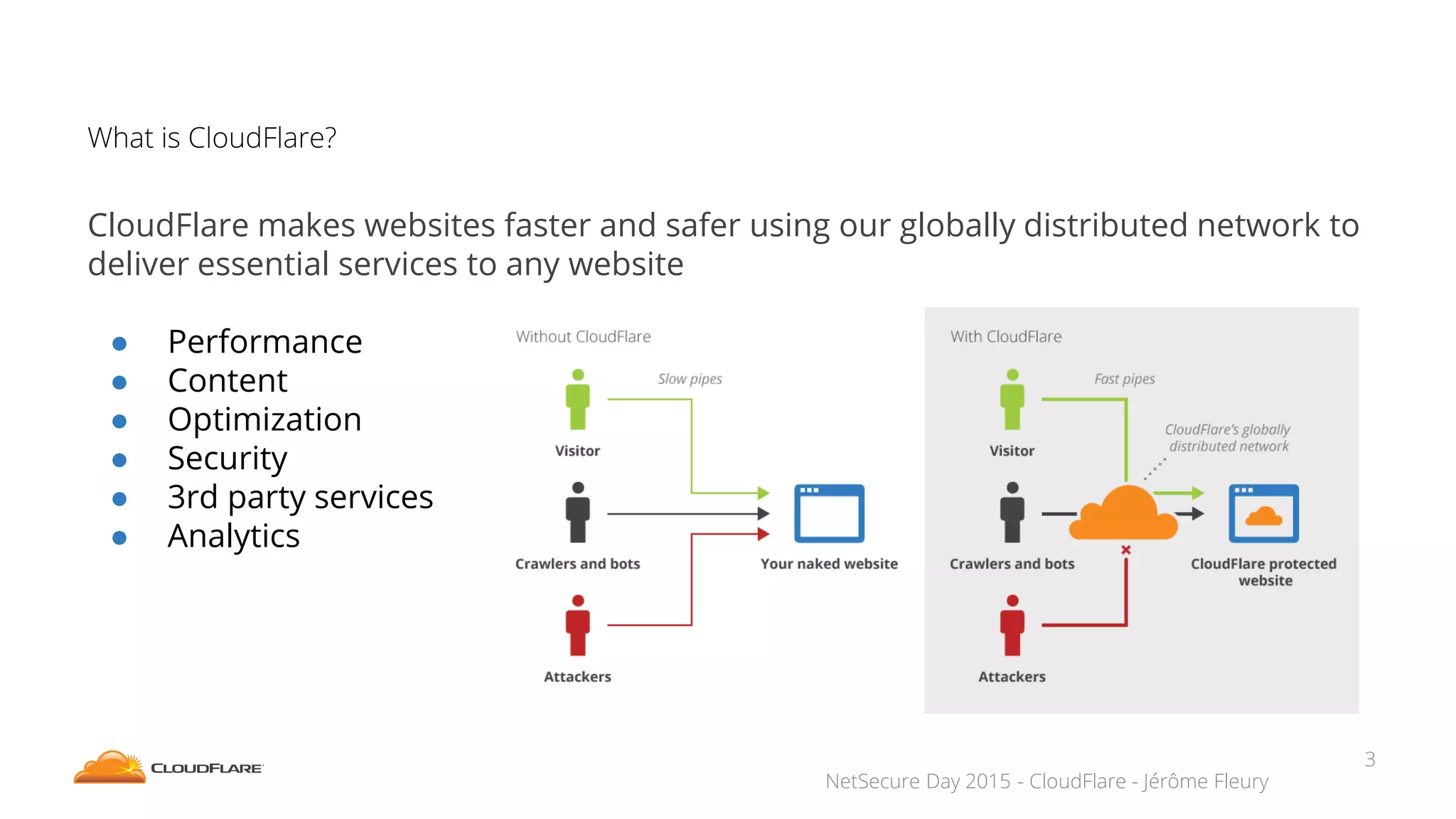
What is CloudFlare?
CloudFlare makes websites faster and safer using our globally distributed network to
deliver essential services to any website
● Performance
● Content
● Optimization
● Security
● 3rd party services
● Analytics
3
NetSecure Day 2015 - CloudFlare - Jérôme Fleury
How does CloudFlare work?
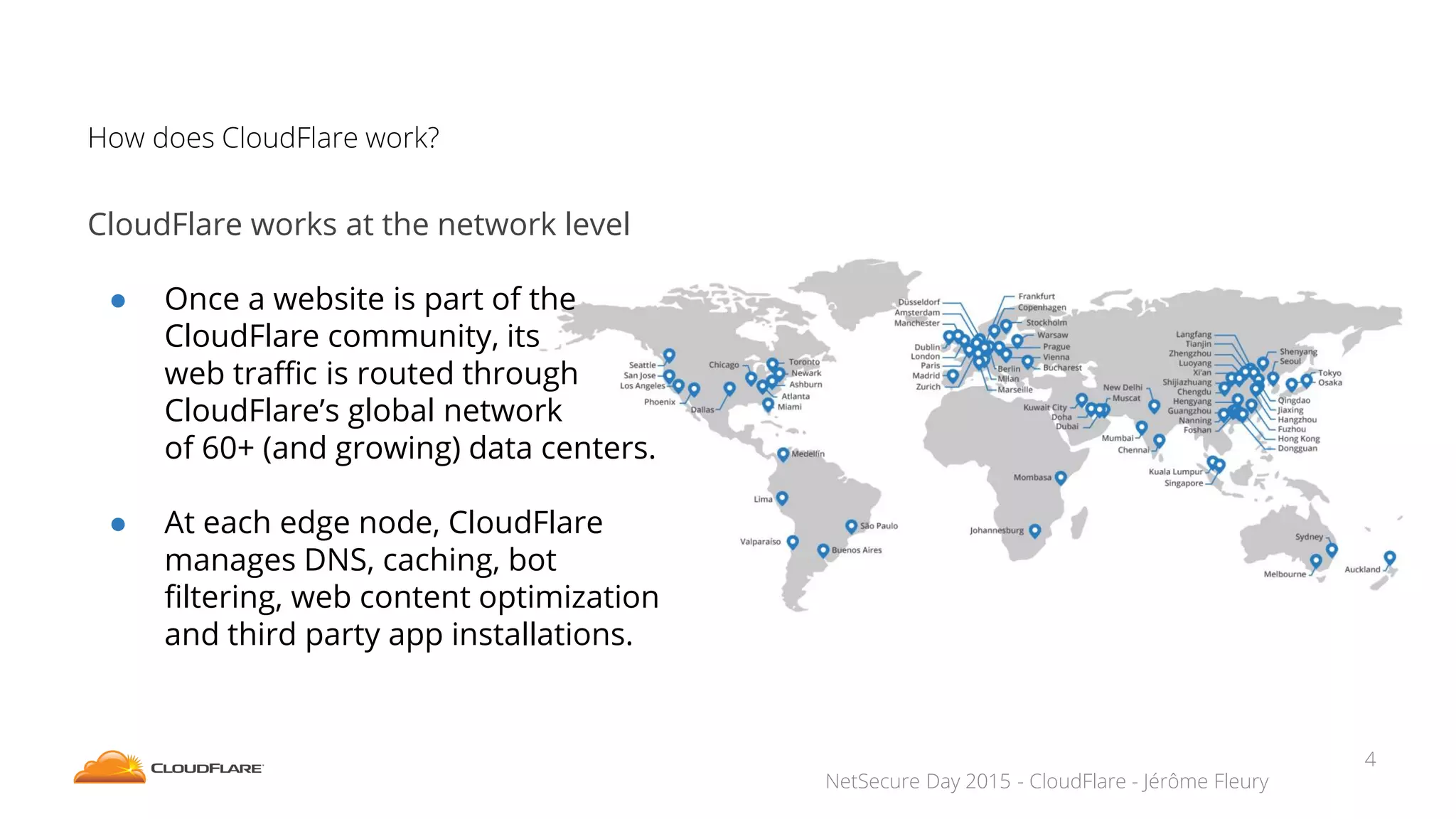
CloudFlare works at the network level
● Once a website is part of the
CloudFlare community, its
web traffic is routed through
CloudFlare’s global network
of 60+ (and growing) data centers.
● At each edge node, CloudFlare
manages DNS, caching, bot
filtering, web content optimization
and third party app installations.
4
NetSecure Day 2015 - CloudFlare - Jérôme Fleury
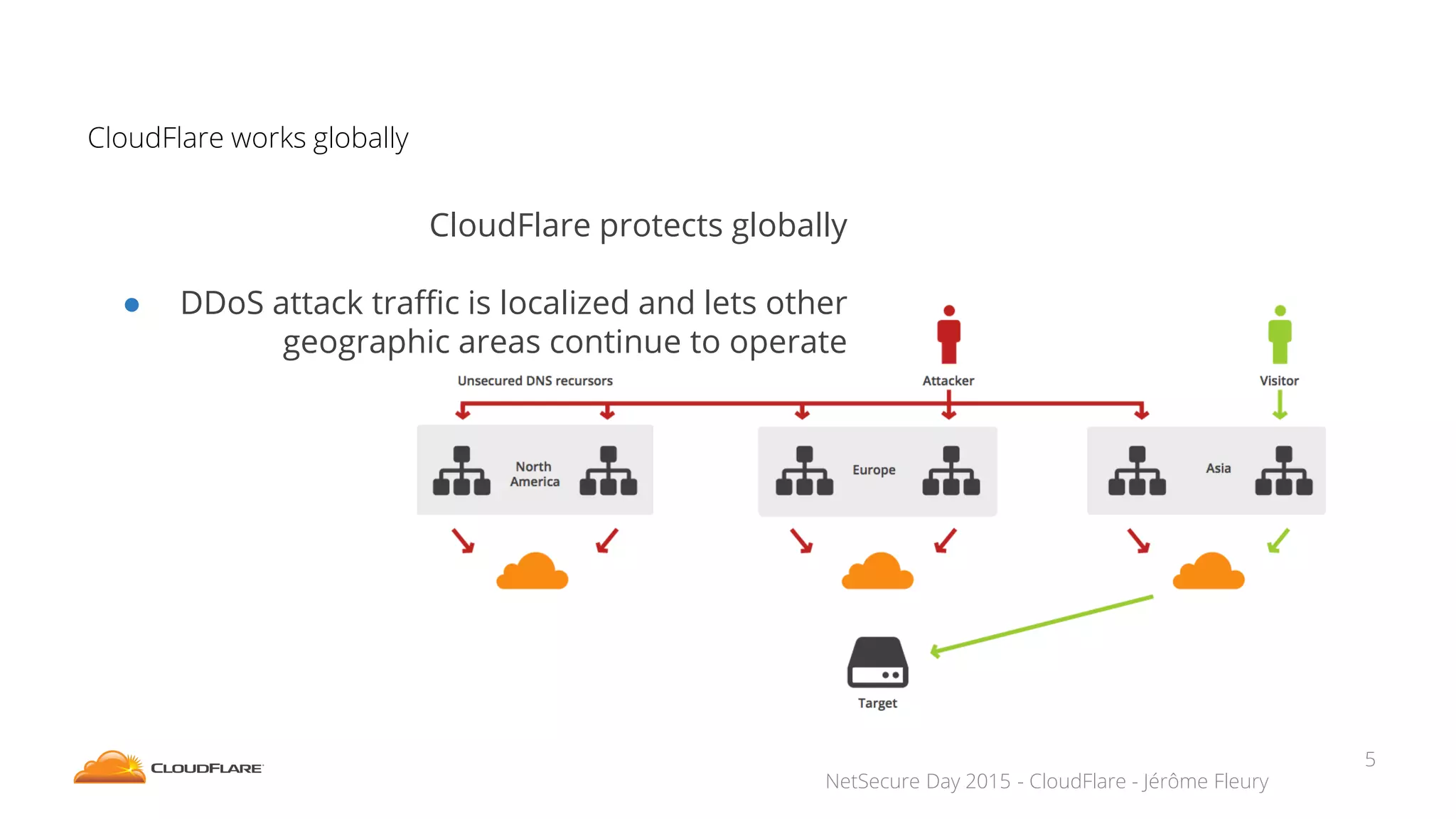
CloudFlare works globally
5
CloudFlare protects globally
● DDoS attack traffic is localized and lets other
geographic areas continue to operate
NetSecure Day 2015 - CloudFlare - Jérôme Fleury
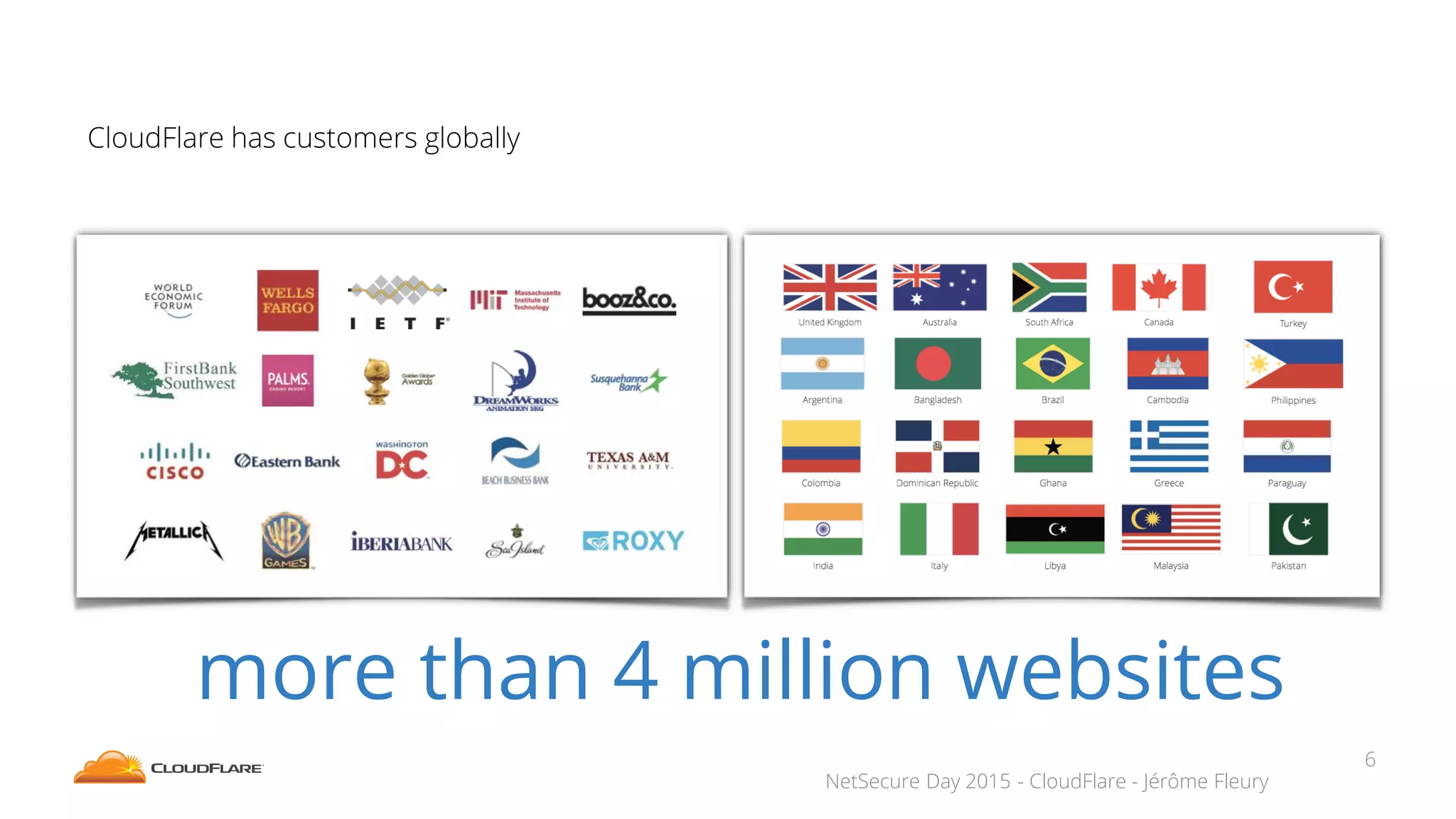
CloudFlare has customers globally
more than 4 million websites
6
NetSecure Day 2015 - CloudFlare - Jérôme Fleury
DDoS Mitigation
7
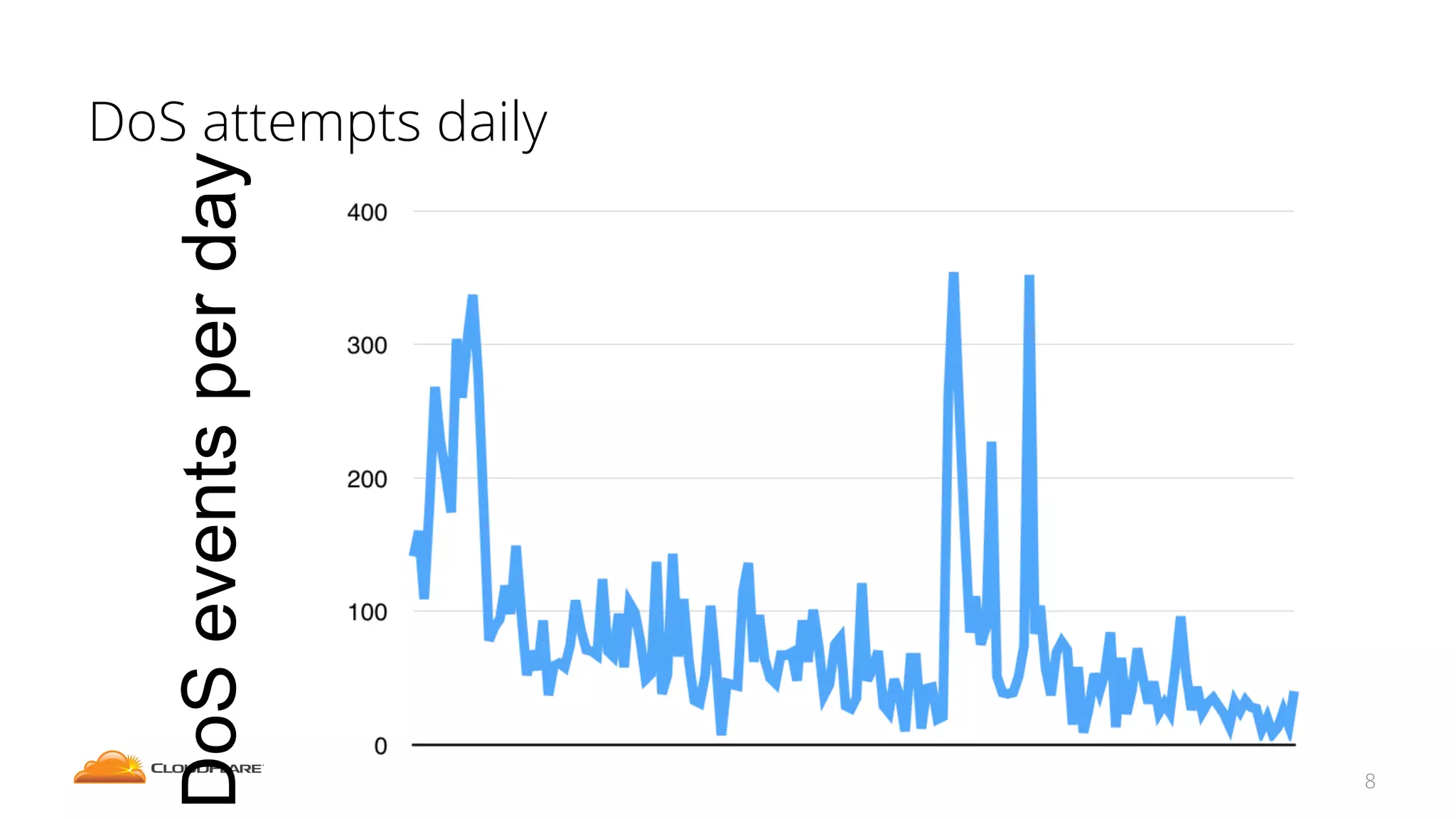
DoS attempts daily
8
DoSeventsperday
NetSecure Day 2015 - CloudFlare - Jérôme Fleury
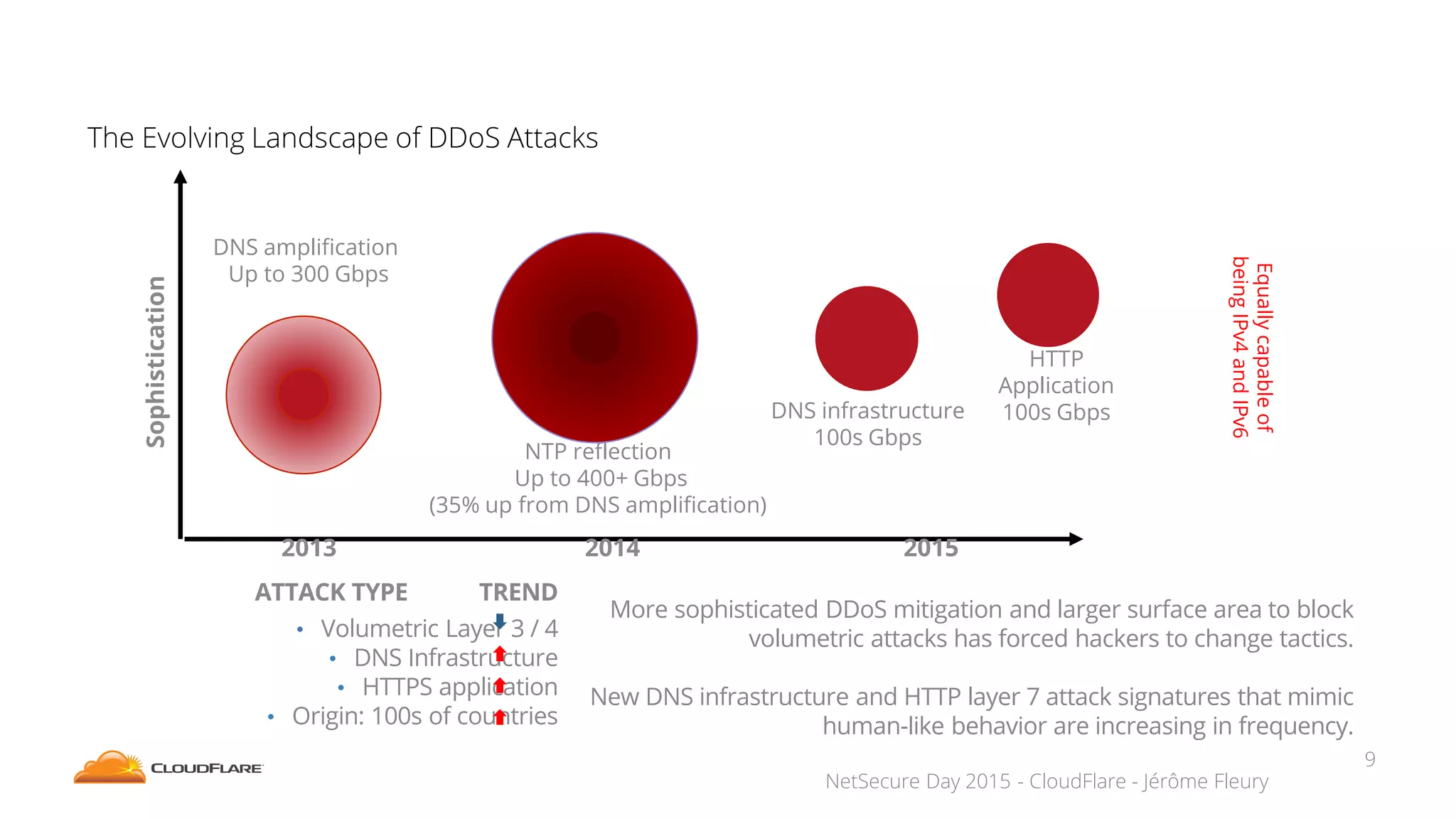
The Evolving Landscape of DDoS Attacks
9
ATTACK TYPE TREND
• Volumetric Layer 3 / 4
• DNS Infrastructure
• HTTPS application
• Origin: 100s of countries
DNS infrastructure
100s Gbps
HTTP
Application
100s Gbps
Sophistication
NTP reflection
Up to 400+ Gbps
(35% up from DNS amplification)
DNS amplification
Up to 300 Gbps
20142013 2015
Equallycapableof
beingIPv4andIPv6
More sophisticated DDoS mitigation and larger surface area to block
volumetric attacks has forced hackers to change tactics.
New DNS infrastructure and HTTP layer 7 attack signatures that mimic
human-like behavior are increasing in frequency.
NetSecure Day 2015 - CloudFlare - Jérôme Fleury
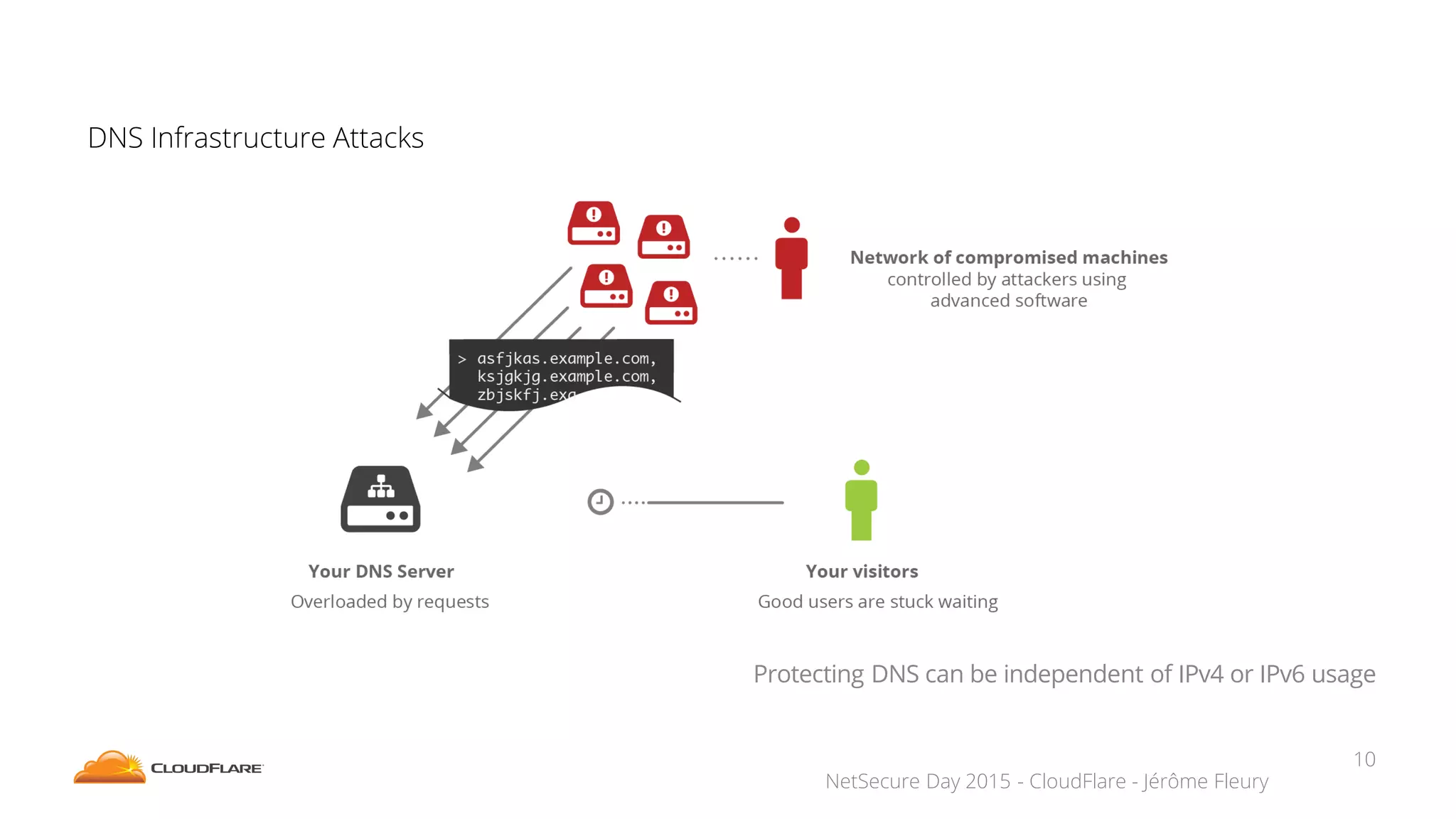
DNS Infrastructure Attacks
10
Protecting DNS can be independent of IPv4 or IPv6 usage
NetSecure Day 2015 - CloudFlare - Jérôme Fleury
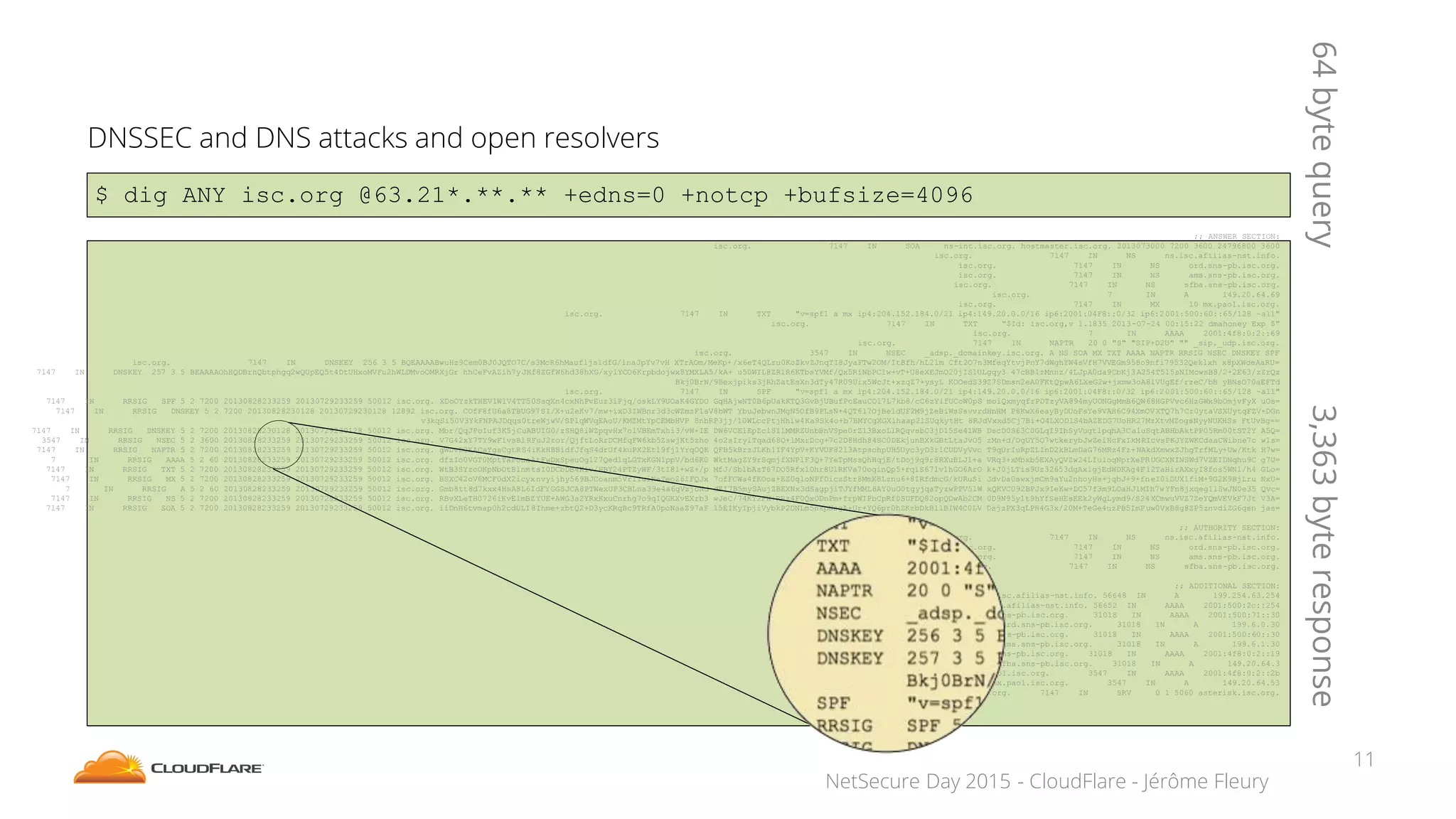
DNSSEC and DNS attacks and open resolvers
$ dig ANY isc.org @63.21*.**.** +edns=0 +notcp +bufsize=4096
64bytequery
;; ANSWER SECTION:
isc.org. 7147 IN SOA ns-int.isc.org. hostmaster.isc.org. 2013073000 7200 3600 24796800 3600
isc.org. 7147 IN NS ns.isc.afilias-nst.info.
isc.org. 7147 IN NS ord.sns-pb.isc.org.
isc.org. 7147 IN NS ams.sns-pb.isc.org.
isc.org. 7147 IN NS sfba.sns-pb.isc.org.
isc.org. 7 IN A 149.20.64.69
isc.org. 7147 IN MX 10 mx.pao1.isc.org.
isc.org. 7147 IN TXT "v=spf1 a mx ip4:204.152.184.0/21 ip4:149.20.0.0/16 ip6:2001:04F8::0/32 ip6:2001:500:60::65/128 ~all"
isc.org. 7147 IN TXT "$Id: isc.org,v 1.1835 2013-07-24 00:15:22 dmahoney Exp $"
isc.org. 7 IN AAAA 2001:4f8:0:2::69
isc.org. 7147 IN NAPTR 20 0 "S" "SIP+D2U" "" _sip._udp.isc.org.
isc.org. 3547 IN NSEC _adsp._domainkey.isc.org. A NS SOA MX TXT AAAA NAPTR RRSIG NSEC DNSKEY SPF
isc.org. 7147 IN DNSKEY 256 3 5 BQEAAAABwuHz9Cem0BJ0JQTO7C/a3McR6hMaufljs1dfG/inaJpYv7vH XTrAOm/MeKp+/x6eT4QLru0KoZkvZJnqTI8JyaFTw2OM/ItBfh/hL2lm Cft2O7n3MfeqYtvjPnY7dWghYW4sVfH7VVEGm958o9nfi79532Qeklxh x8pXWdeAaRU=
7147 IN DNSKEY 257 3 5 BEAAAAOhHQDBrhQbtphgq2wQUpEQ5t4DtUHxoMVFu2hWLDMvoOMRXjGr hhCeFvAZih7yJHf8ZGfW6hd38hXG/xylYCO6Krpbdojwx8YMXLA5/kA+ u50WIL8ZR1R6KTbsYVMf/Qx5RiNbPClw+vT+U8eXEJmO20jIS1ULgqy3 47cBB1zMnnz/4LJpA0da9CbKj3A254T515sNIMcwsB8/2+2E63/zZrQz
Bkj0BrN/9Bexjpiks3jRhZatEsXn3dTy47R09Uix5WcJt+xzqZ7+ysyL KOOedS39Z7SDmsn2eA0FKtQpwA6LXeG2w+jxmw3oA8lVUgEf/rzeC/bB yBNsO70aEFTd
isc.org. 7147 IN SPF "v=spf1 a mx ip4:204.152.184.0/21 ip4:149.20.0.0/16 ip6:2001:04F8::0/32 ip6:2001:500:60::65/128 ~all"
7147 IN RRSIG SPF 5 2 7200 20130828233259 20130729233259 50012 isc.org. XDoOYzkTHEV1W1V4TT50SsqXn4cxNhPvEuz3iFjq/oskLY9UOaK4GYDO GqHAjwNT0B6pUakKTQ3GvBjUBufPcEauCOl7L7kb8/cC6zYifUCoW0pS moiQxmyqfrPDTzyVA894myUONGgMmB6QW68HGPVvc6HzGWx9bOmjvFyX uOs=
7147 IN RRSIG DNSKEY 5 2 7200 20130828230128 20130729230128 12892 isc.org. COfF8fU6a8TBUG97SI/X+u2eKv7/mw+ixD3IWBnr3d3cWZmzF1sV8bWT YbuJebwnJMgN5OfB9PLsN+4QT617OjBe1dUF2M9jZeBiWsSsvvrdHnHM P8KwX6eayByDUoFsYe9VAH6C94XmOVXTQ7h7Cr0ytaVSXUytqFZV+DGn
v3kqSi50V3YkFNPAJDqqs0treWjwV/SPlqWVqEAoU/KMZMtYpCEMbHVP 8nbRP3jj/10WLccPtjHhiw4Ka9Sk4o+b7BMYCgXGXlhaap21SUqkytHt 8RJdVxxd5Cj7Bi+O4LXODlS4bAZEDG7UoHR27MzXtvMZogsNyyNUKHSs FtUvBg==
7147 IN RRSIG DNSKEY 5 2 7200 20130828230128 20130729230128 50012 isc.org. Mbr/QqJPoIuf3K5jCuABUIG0/zSHQ8iWZpqvHx7olVBEmTxhi3/vW+IE DW6VCE1EpZclSIlMMRZUnbBnVSpe0rZ13BxoLlRQqvsbC3jD15Se41WB DscD0S63C0GLqI9IhSyVugtlpqhA3CaluSqtABHbAktPP05Rm00tST2Y A5Q=
3547 IN RRSIG NSEC 5 2 3600 20130828233259 20130729233259 50012 isc.org. V7G42xY7TY9wF1vsBlRFuJ2ror/QjftLoRrDCMfqFW6kb5ZswjKt5zho 4o2sIrylTqad68O+lMxrDcg+7c2D8Hdh84SC0DEkjunBXkGBtLtaJvO5 zMn+d/OgUY5O7wtkerybJwZeiHcFxIkMRIcvsPKJYZWKCdaaCWibne7c w1s=
7147 IN RRSIG NAPTR 5 2 7200 20130828233259 20130729233259 50012 isc.org. gWDvD0KACaYgsCgtRS4iKkHBBidfJfqS4drUf4kuPX2Etl9fj1YrqOQK QFB5kBrzJLKh1IF4YpV+KYVUF82l3AtpsohpUH5Uyc3yD3r1CUDVyVvc T9qUrIuRpZLInD2kBLmDaG76MRz4Fz+NAkdXmwxZJhgTrfMLy+Uw/Ktk H7w=
7 IN RRSIG AAAA 5 2 60 20130828233259 20130729233259 50012 isc.org. dfzIo0VGT0MptTaPoua3tFwDxSpeuOg127QedlqLGTxKGN1ppV/bd6R0 WktMagZY9rSqmjfXNPlF3Q+7YeTpMssQhHqjE/tDoj9q9r8RXuBLJ1+a VRq3+xMbxb5EXAyQVZw24LIuloqNprXePRUGCXNINSWd7VZEIDNqhu9C g7U=
7147 IN RRSIG TXT 5 2 7200 20130828233259 20130729233259 50012 isc.org. WtB3SYzcOKpNbOtBlnmtsI0DCbDB4Kiv/HBY24PTZyWF/3tI8l+wZ+/p MfJ/SblbAzT67DO5RfxlOhr8UlRKVa70oqinQp5+rqiS67lv1hGO6ArO k+J0jLTis9Uz32653dgAxlgjEdWDKAg4F12TaHirAXxyI8fos5WNl/h4 GLo=
7147 IN RRSIG MX 5 2 7200 20130828233259 20130729233259 50012 isc.org. BSXC42oV6MCF0dX2icyxnvyijhy569BJCoanm5VrIIuiNeTeo261FQJx 7ofFCWa4fKOoa+EZ0qloNPfDiczStr8MmK8Lznu6+8IRfdmcG/kURuSi JdvDa0swxjmCm9aYu2nhoyHs+jqbJ+9+fneI0iDUX1fiM+9G2K9BjLru NxU=
7 IN RRSIG A 5 2 60 20130828233259 20130729233259 50012 isc.org. Gmb8tt8d7kxx4HsA8L6IdFYGGSJCA8PTWexUP3CBLna39e4a6gVzjoNd dEI7B5mySAujZBEXNx3dSagpjiTJYfMML8AY0uO0tgyjqaTyzwPPV5lW xQKVC092BPJx9IeKw+DC57f3m9LOaHJlMIh7wYFn8jxqeg1lSwJN0e35 Qvc=
7147 IN RRSIG NS 5 2 7200 20130828233259 20130729233259 50012 isc.org. RBvXLeTH0726iKvElmBZYUE+AWG3s2YRxKxuCnrhg7o9qIQGKXvEXrb3 wJeC/74KY2FW+RRz4F0QxODnPm+frpWIPbCpRf0SUFDQ82opQDwAb2CM 0D9N95y1t9hYfSeHEsEEk2yWgLymd9/S24XCmwuVVZ7ZeYQmVEVkF7Jt V3A=
7147 IN RRSIG SOA 5 2 7200 20130828233259 20130729233259 50012 isc.org. iiDnH6tvmap0h2cdULI8Ihme+zbtQ2+D3ycKRqBc9TRfA0poNaaZ97aF 15EIKyIpjiVybkP2DNLm5nkpNsgA+Ur+YQ6pr0hZKzbDkBllBIW4C0LV DsjzPX3qLPH4G3x/20M+TeGe4uzPB5ImPuw0VxB8g8ZP5znvdiZG6qen jas=
;; AUTHORITY SECTION:
isc.org. 7147 IN NS ns.isc.afilias-nst.info.
isc.org. 7147 IN NS ord.sns-pb.isc.org.
isc.org. 7147 IN NS ams.sns-pb.isc.org.
isc.org. 7147 IN NS sfba.sns-pb.isc.org.
;; ADDITIONAL SECTION:
ns.isc.afilias-nst.info. 56648 IN A 199.254.63.254
ns.isc.afilias-nst.info. 56652 IN AAAA 2001:500:2c::254
ord.sns-pb.isc.org. 31018 IN AAAA 2001:500:71::30
ord.sns-pb.isc.org. 31018 IN A 199.6.0.30
ams.sns-pb.isc.org. 31018 IN AAAA 2001:500:60::30
ams.sns-pb.isc.org. 31018 IN A 199.6.1.30
sfba.sns-pb.isc.org. 31018 IN AAAA 2001:4f8:0:2::19
sfba.sns-pb.isc.org. 31018 IN A 149.20.64.3
mx.pao1.isc.org. 3547 IN AAAA 2001:4f8:0:2::2b
mx.pao1.isc.org. 3547 IN A 149.20.64.53
_sip._udp.isc.org. 7147 IN SRV 0 1 5060 asterisk.isc.org.
3,363byteresponse
11
NetSecure Day 2015 - CloudFlare - Jérôme Fleury
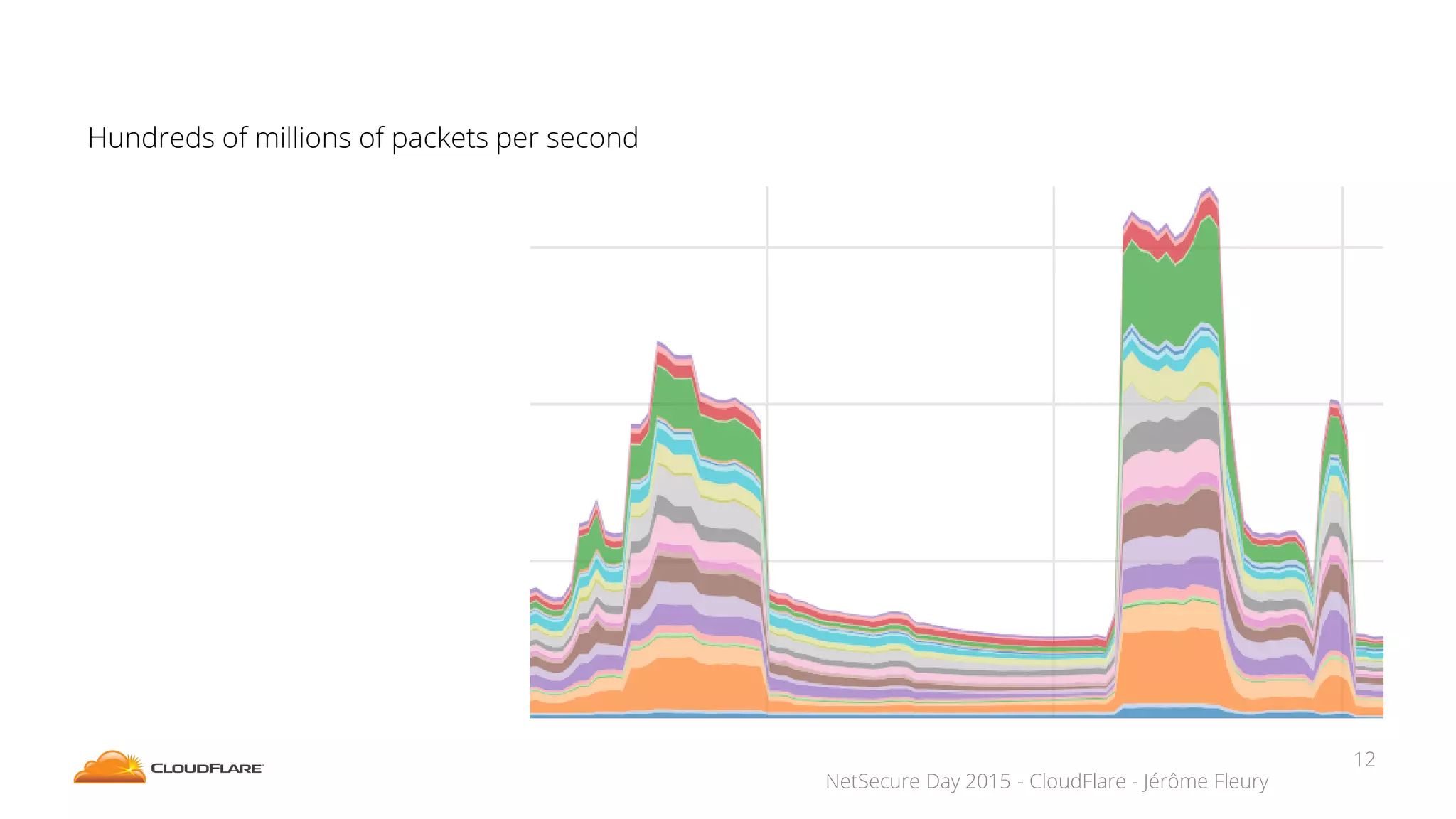
Hundreds of millions of packets per second
12
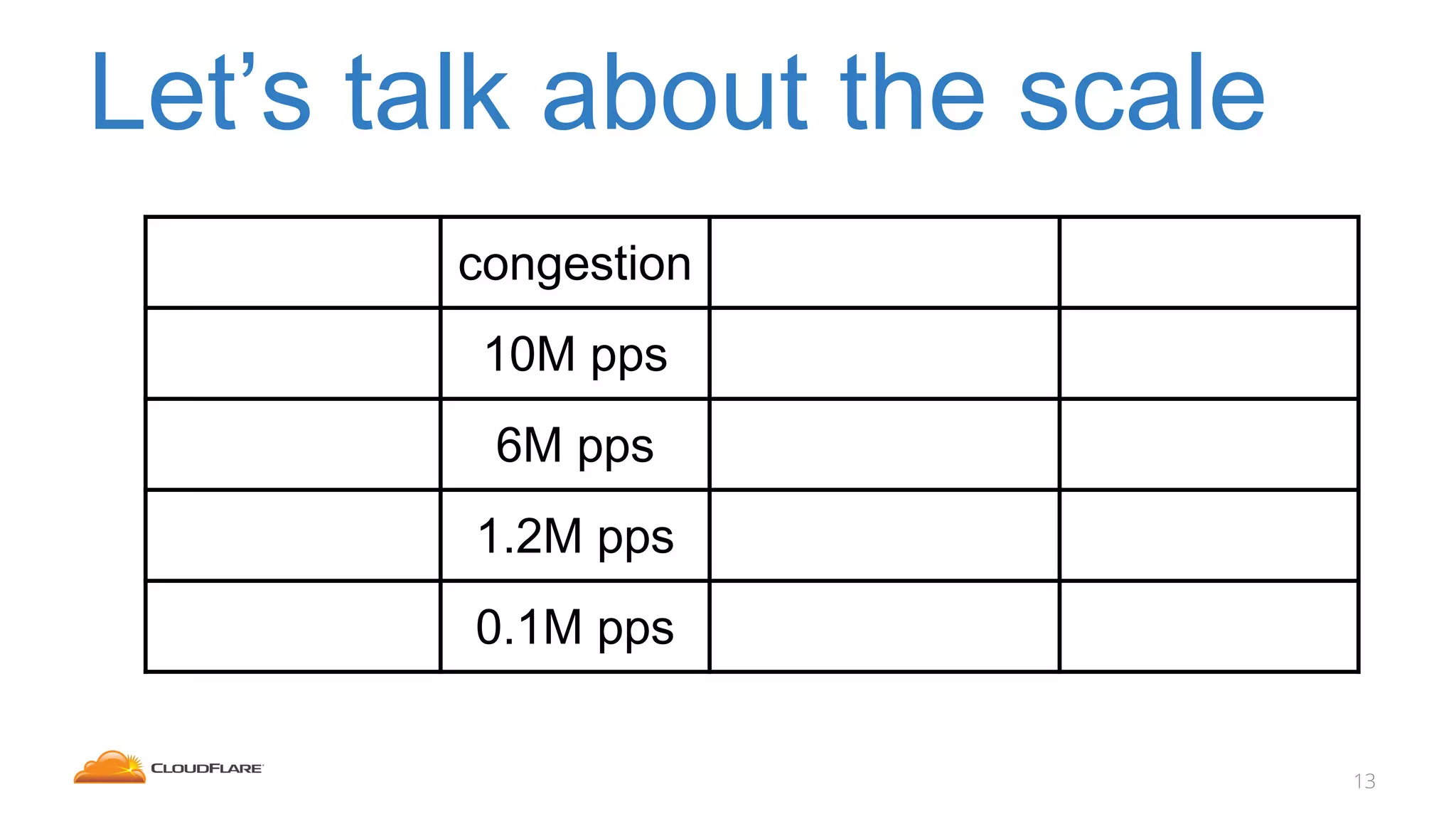
Let’s talk about the scale
13
congestion
10M pps
6M pps
1.2M pps
0.1M pps
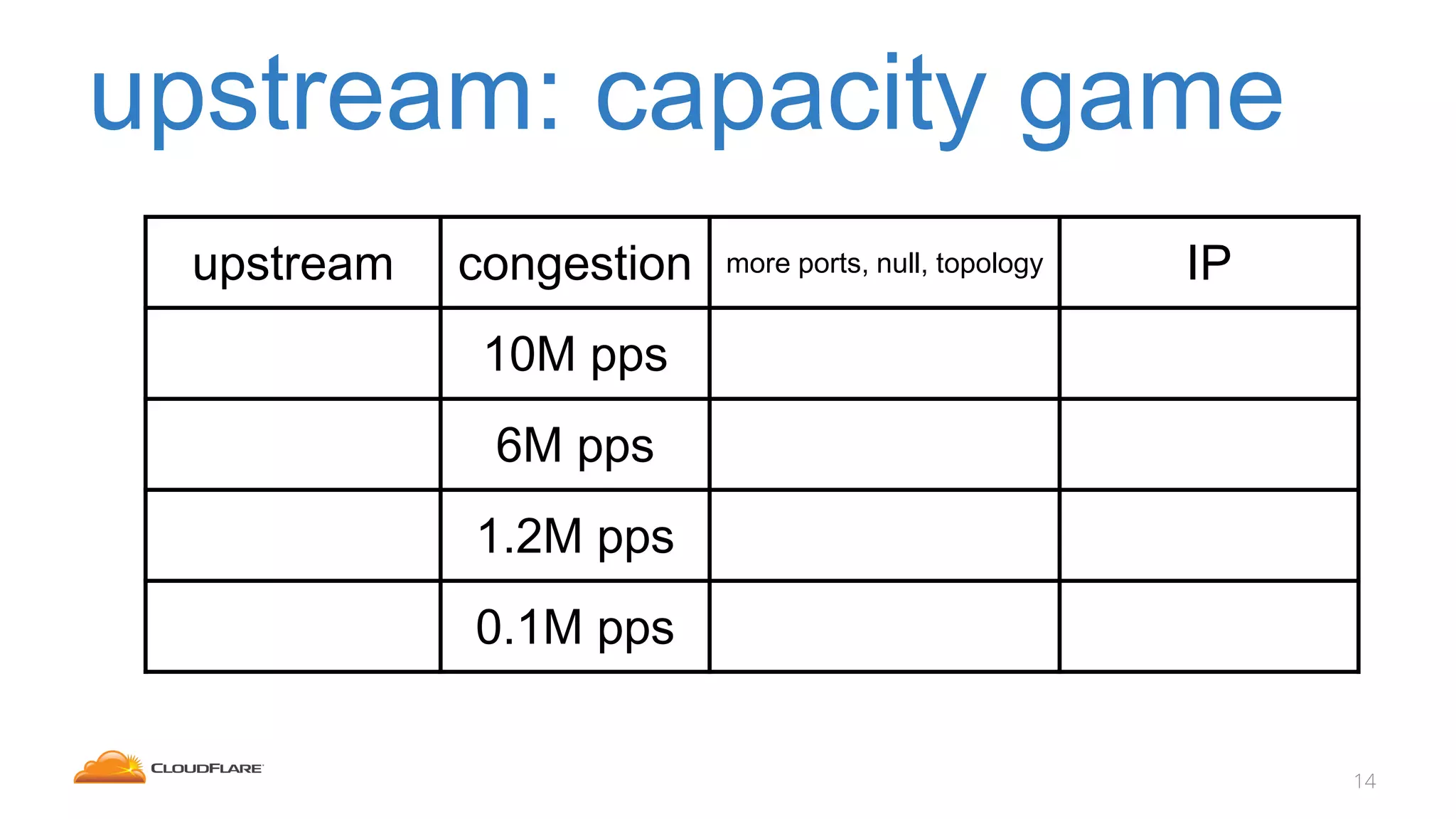
upstream: capacity game
14
upstream congestion more ports, null, topology IP
10M pps
6M pps
1.2M pps
0.1M pps
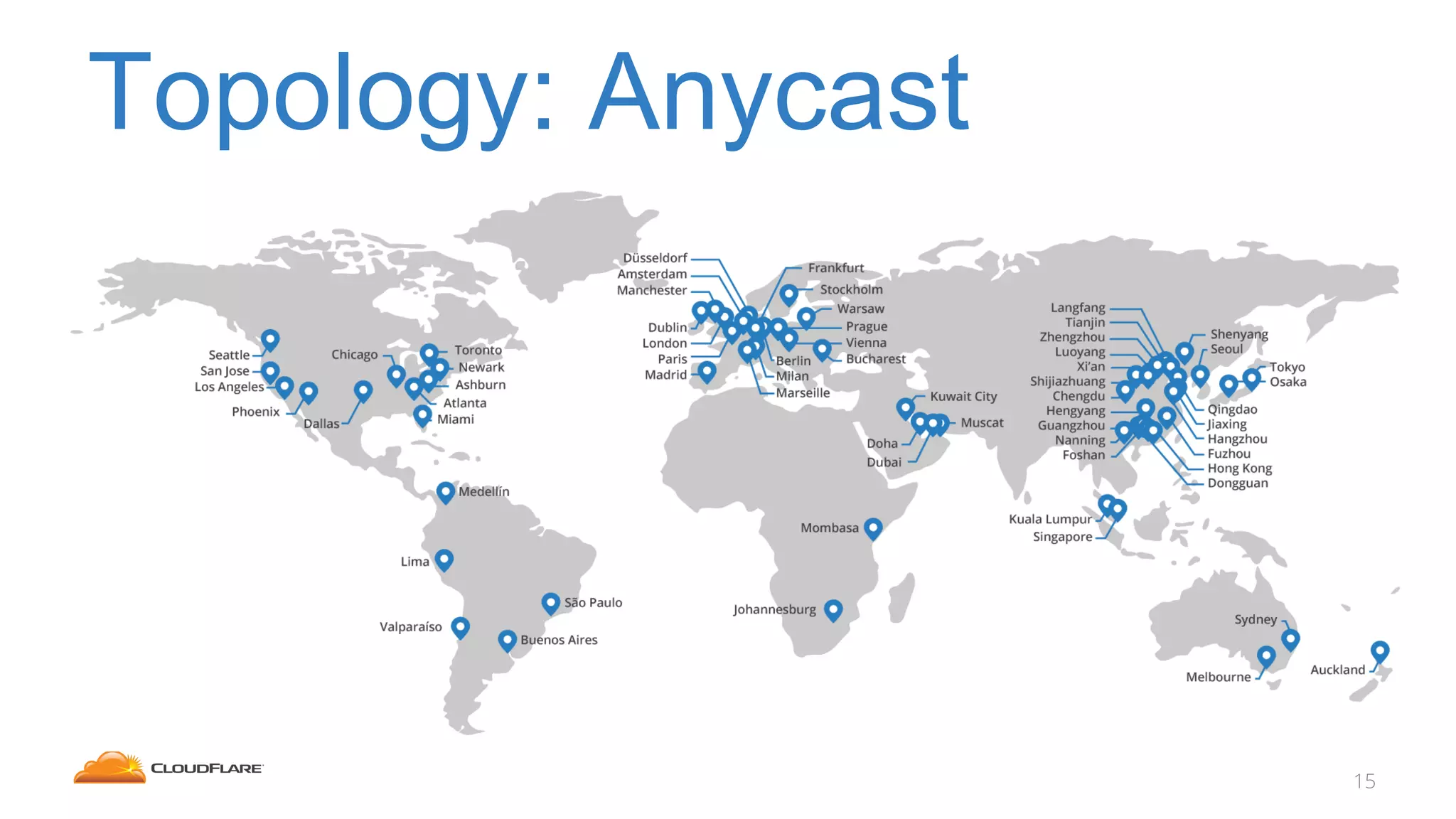
Topology: Anycast
15
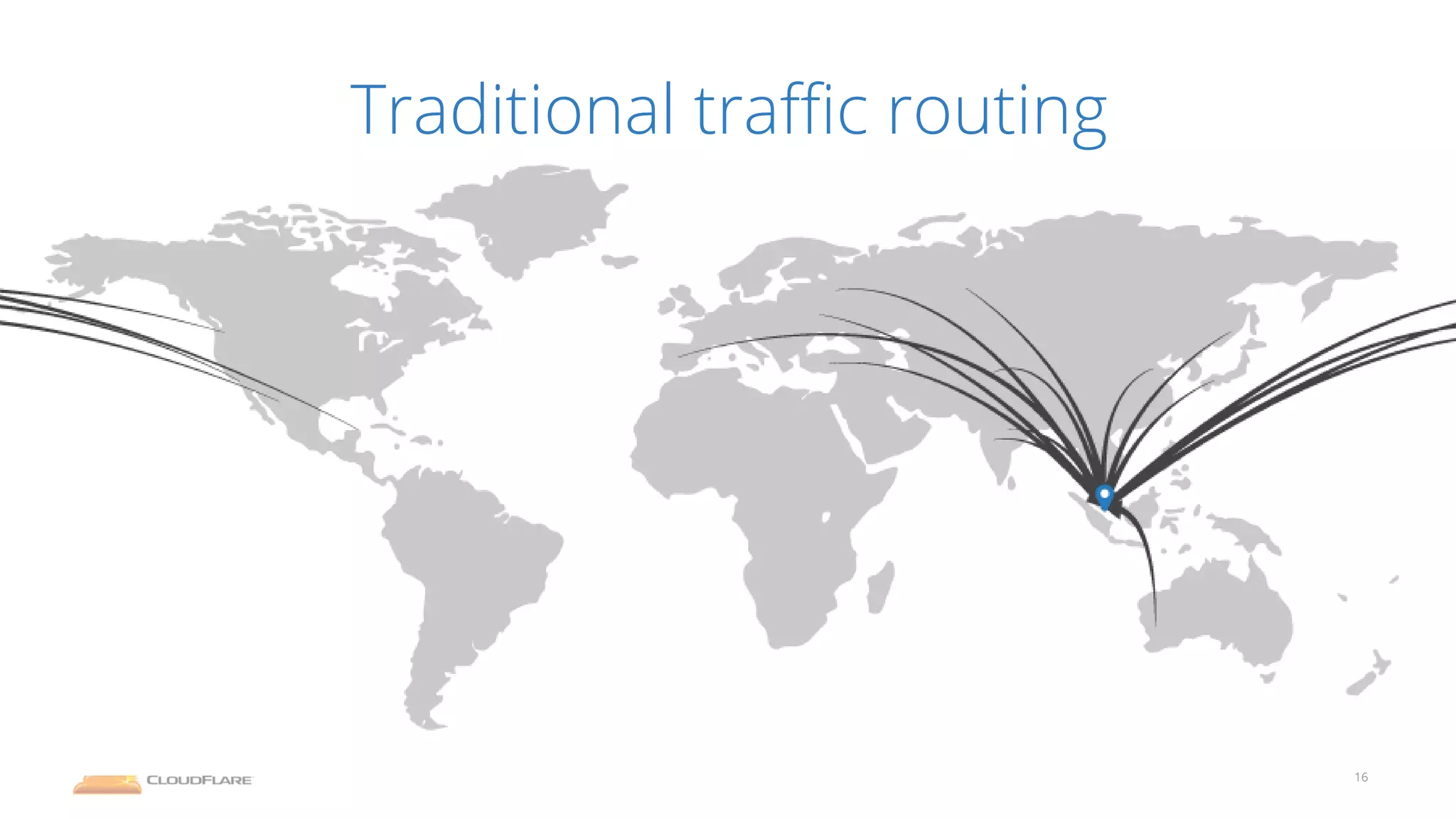
Traditional traffic routing
16
Routing with anycast reverse proxy
17
NetSecure Day 2015 - CloudFlare - Jérôme Fleury
CloudFlare
Amsterdam
CloudFlare
Frankfurt
CloudFlare
London
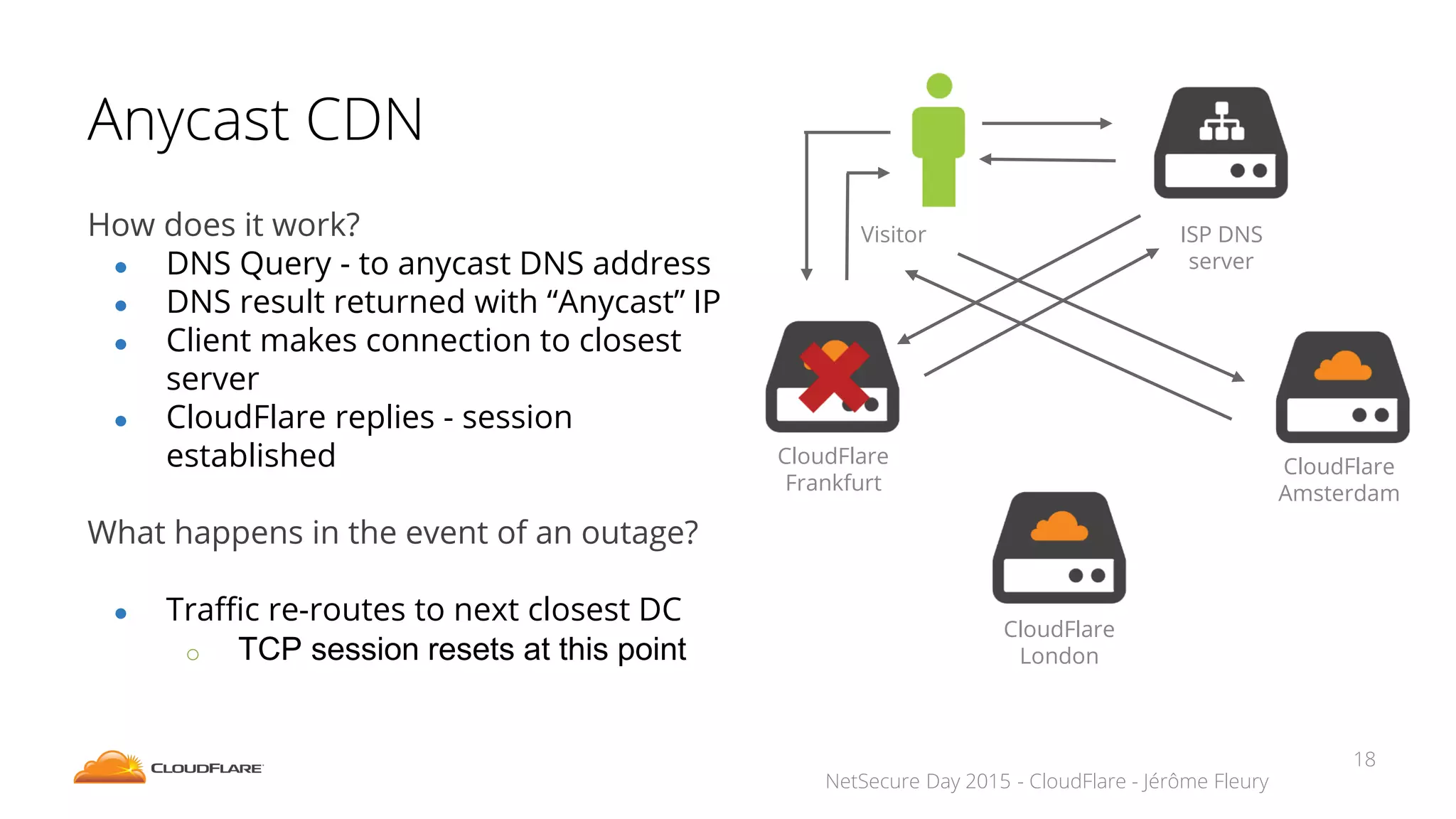
Anycast CDN
How does it work?
● DNS Query - to anycast DNS address
● DNS result returned with “Anycast” IP
● Client makes connection to closest
server
● CloudFlare replies - session
established
What happens in the event of an outage?
● Traffic re-routes to next closest DC
o TCP session resets at this point
ISP DNS
server
Visitor
18
NetSecure Day 2015 - CloudFlare - Jérôme Fleury
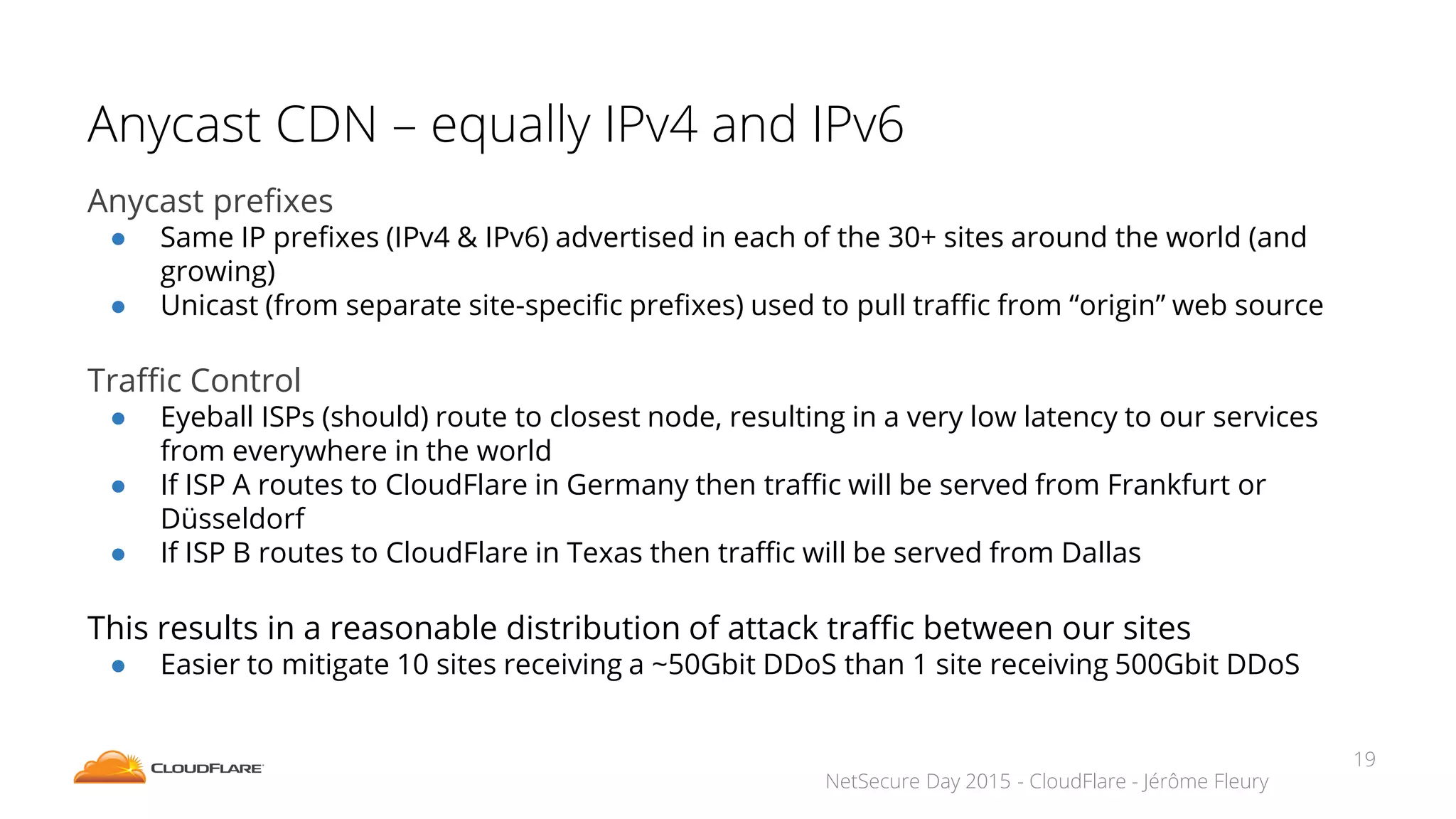
Anycast CDN – equally IPv4 and IPv6
Anycast prefixes
● Same IP prefixes (IPv4 & IPv6) advertised in each of the 30+ sites around the world (and
growing)
● Unicast (from separate site-specific prefixes) used to pull traffic from “origin” web source
Traffic Control
● Eyeball ISPs (should) route to closest node, resulting in a very low latency to our services
from everywhere in the world
● If ISP A routes to CloudFlare in Germany then traffic will be served from Frankfurt or
Düsseldorf
● If ISP B routes to CloudFlare in Texas then traffic will be served from Dallas
This results in a reasonable distribution of attack traffic between our sites
● Easier to mitigate 10 sites receiving a ~50Gbit DDoS than 1 site receiving 500Gbit DDoS
19
NetSecure Day 2015 - CloudFlare - Jérôme Fleury
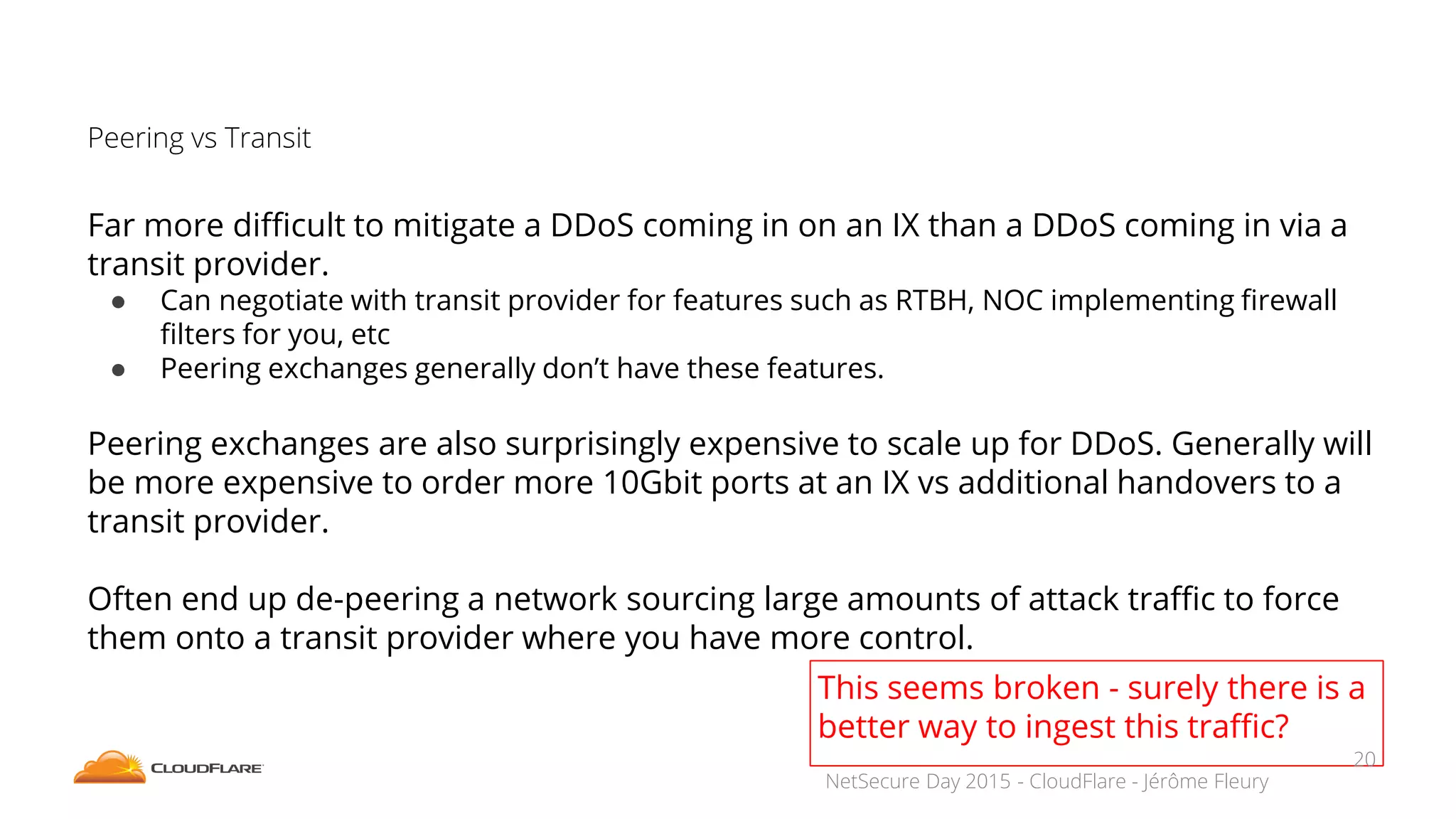
Peering vs Transit
Far more difficult to mitigate a DDoS coming in on an IX than a DDoS coming in via a
transit provider.
● Can negotiate with transit provider for features such as RTBH, NOC implementing firewall
filters for you, etc
● Peering exchanges generally don’t have these features.
Peering exchanges are also surprisingly expensive to scale up for DDoS. Generally will
be more expensive to order more 10Gbit ports at an IX vs additional handovers to a
transit provider.
Often end up de-peering a network sourcing large amounts of attack traffic to force
them onto a transit provider where you have more control.
This seems broken - surely there is a
better way to ingest this traffic?
20
NetSecure Day 2015 - CloudFlare - Jérôme Fleury
Mitigation - in the network
21
NetSecure Day 2015 - CloudFlare - Jérôme Fleury
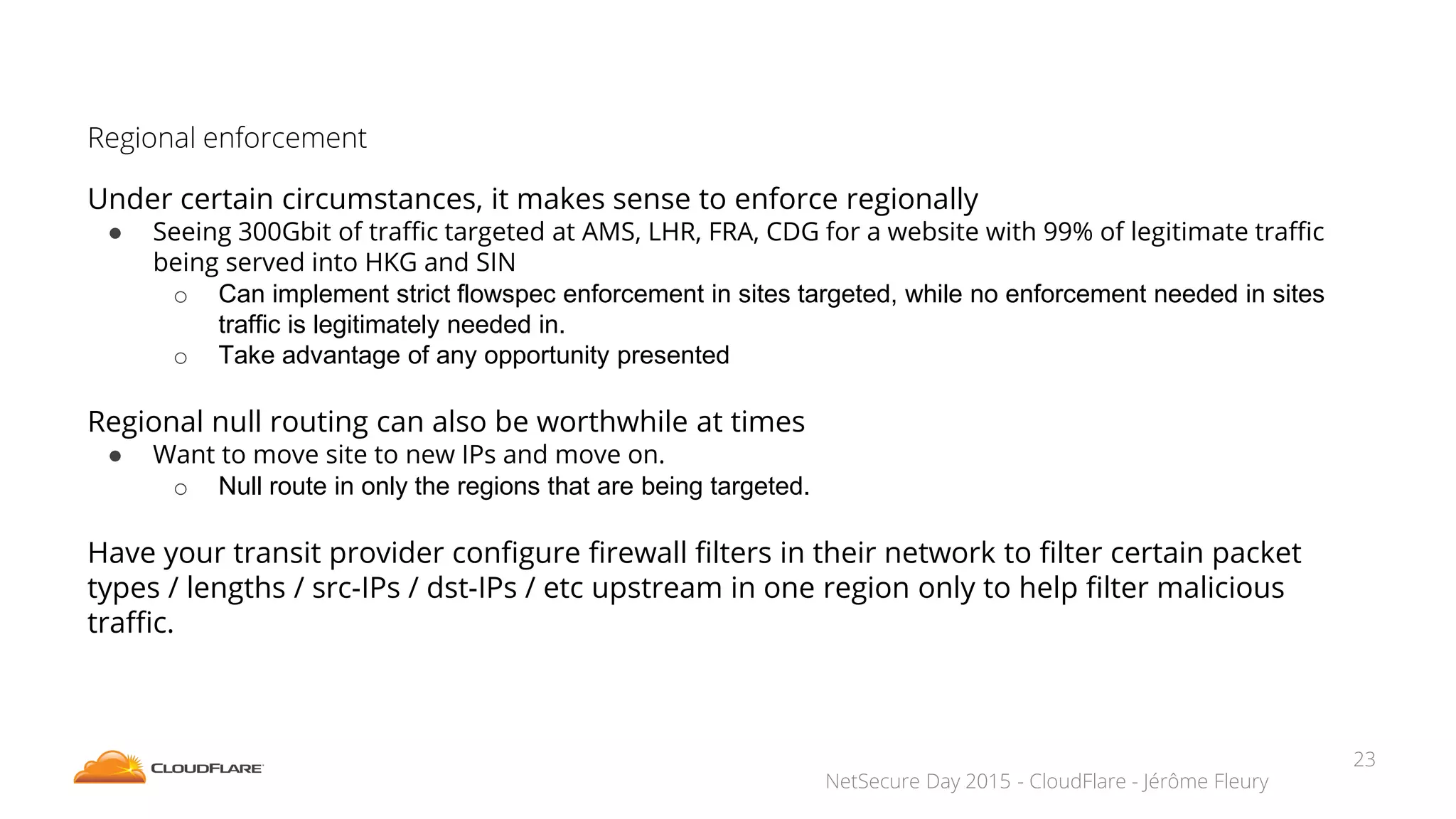
Regional enforcement
Under certain circumstances, it makes sense to enforce regionally
● Seeing 300Gbit of traffic targeted at AMS, LHR, FRA, CDG for a website with 99% of legitimate traffic
being served into HKG and SIN
o Can implement strict flowspec enforcement in sites targeted, while no enforcement needed in sites
traffic is legitimately needed in.
o Take advantage of any opportunity presented
Regional null routing can also be worthwhile at times
● Want to move site to new IPs and move on.
o Null route in only the regions that are being targeted.
Have your transit provider configure firewall filters in their network to filter certain packet
types / lengths / src-IPs / dst-IPs / etc upstream in one region only to help filter malicious
traffic.
23
NetSecure Day 2015 - CloudFlare - Jérôme Fleury
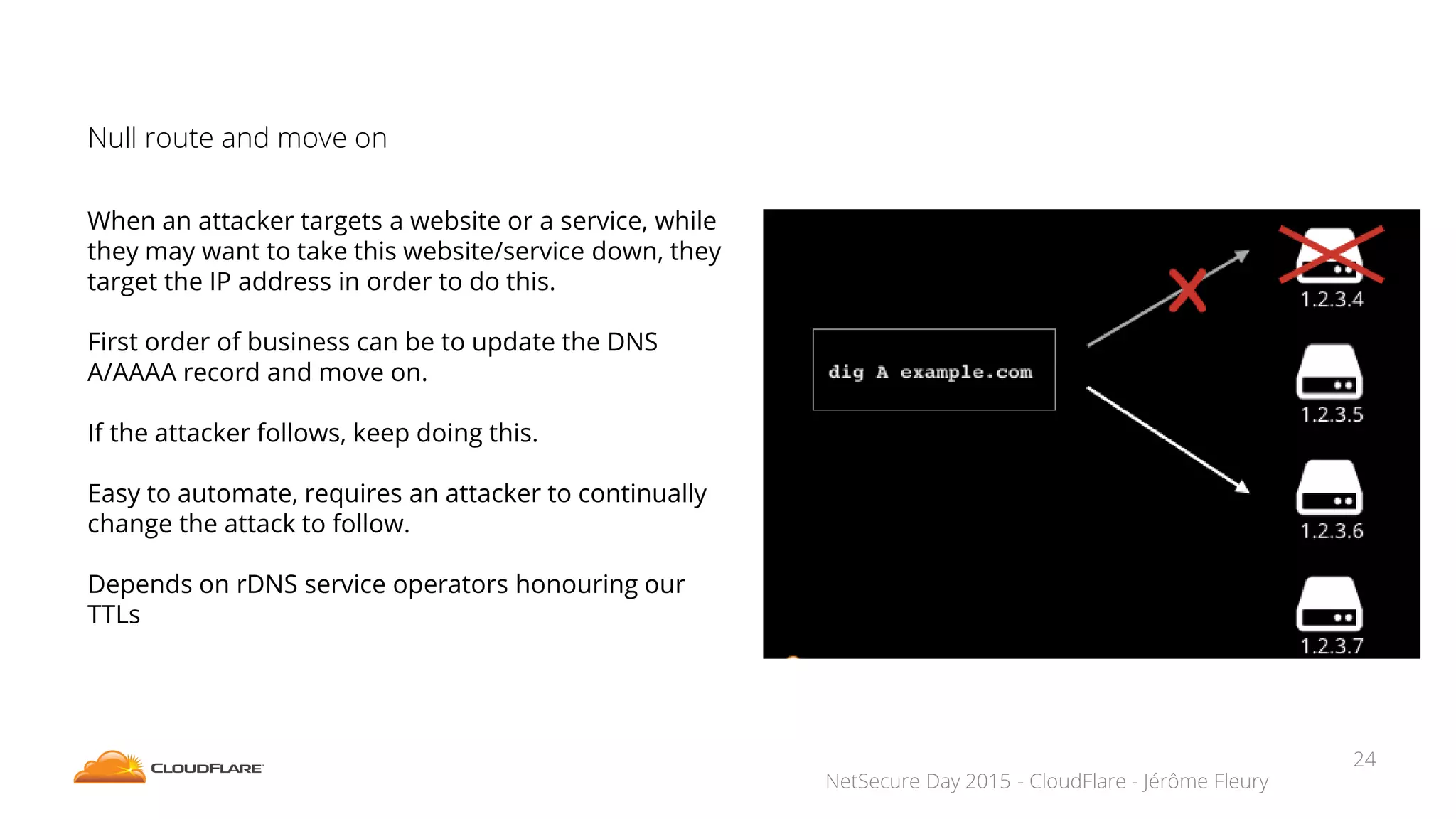
Null route and move on
When an attacker targets a website or a service, while
they may want to take this website/service down, they
target the IP address in order to do this.
First order of business can be to update the DNS
A/AAAA record and move on.
If the attacker follows, keep doing this.
Easy to automate, requires an attacker to continually
change the attack to follow.
Depends on rDNS service operators honouring our
TTLs
24
NetSecure Day 2015 - CloudFlare - Jérôme Fleury
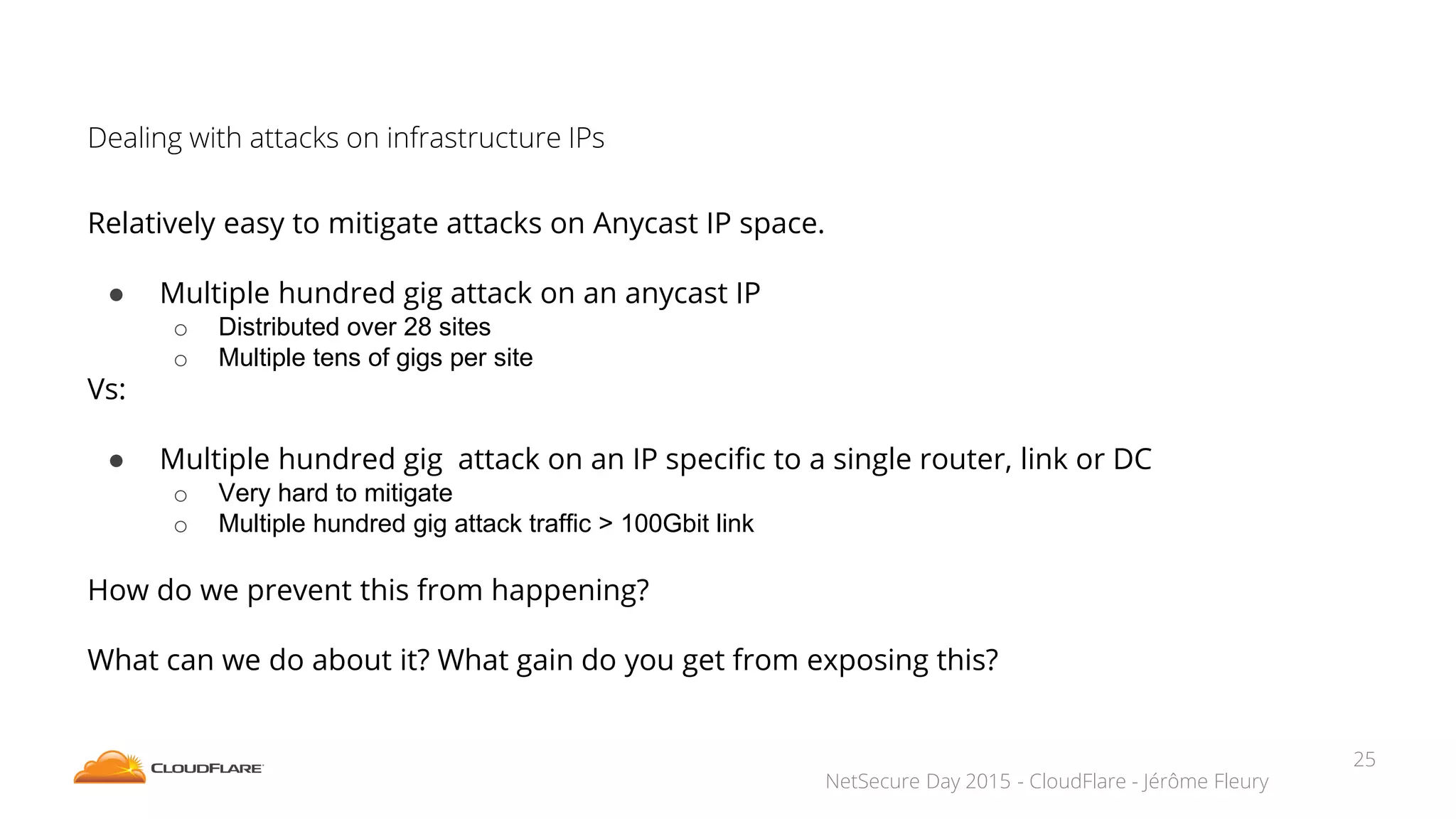
Dealing with attacks on infrastructure IPs
Relatively easy to mitigate attacks on Anycast IP space.
● Multiple hundred gig attack on an anycast IP
o Distributed over 28 sites
o Multiple tens of gigs per site
Vs:
● Multiple hundred gig attack on an IP specific to a single router, link or DC
o Very hard to mitigate
o Multiple hundred gig attack traffic > 100Gbit link
How do we prevent this from happening?
What can we do about it? What gain do you get from exposing this?
25
NetSecure Day 2015 - CloudFlare - Jérôme Fleury
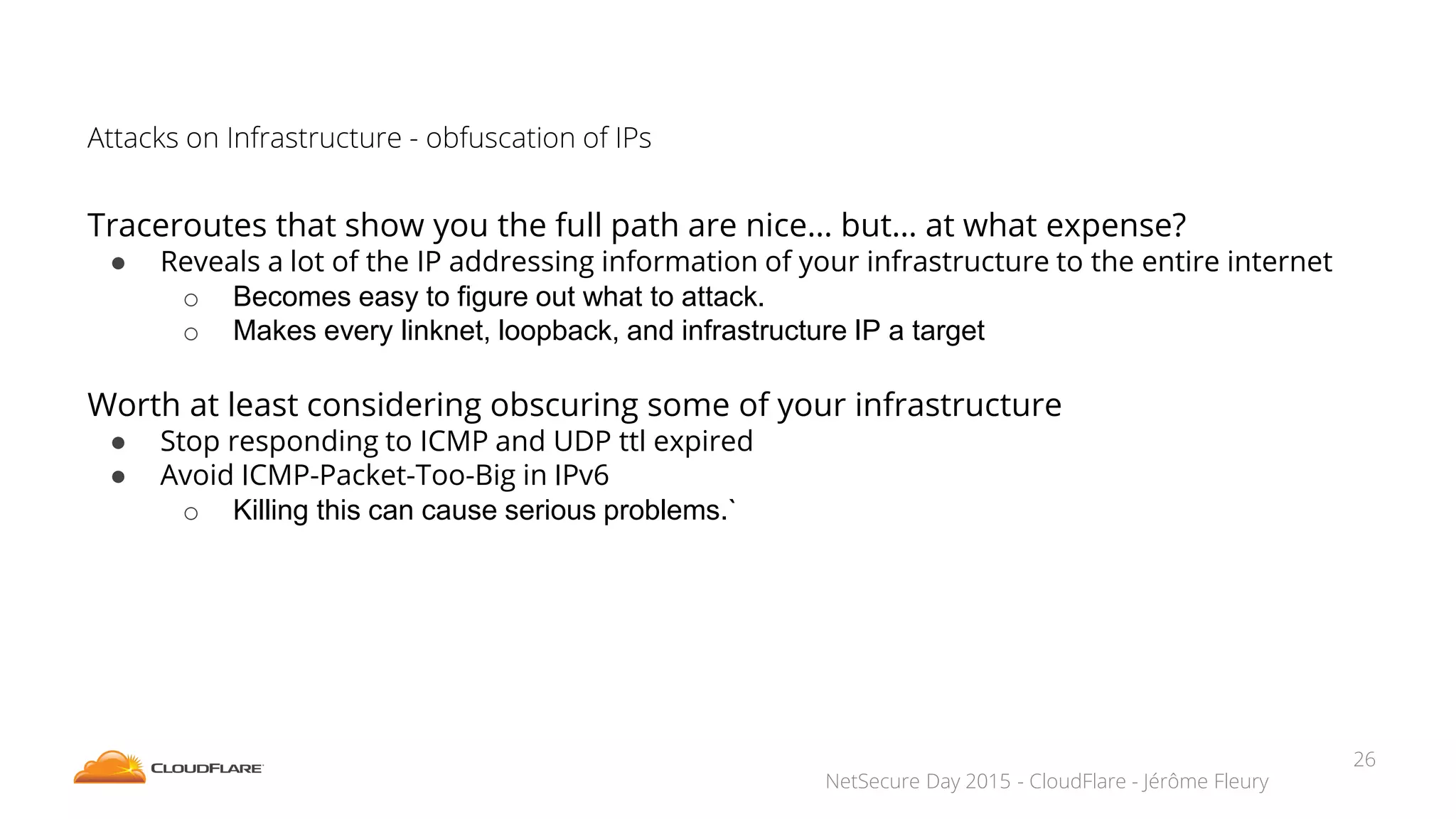
Attacks on Infrastructure - obfuscation of IPs
Traceroutes that show you the full path are nice… but… at what expense?
● Reveals a lot of the IP addressing information of your infrastructure to the entire internet
o Becomes easy to figure out what to attack.
o Makes every linknet, loopback, and infrastructure IP a target
Worth at least considering obscuring some of your infrastructure
● Stop responding to ICMP and UDP ttl expired
● Avoid ICMP-Packet-Too-Big in IPv6
o Killing this can cause serious problems.`
26
NetSecure Day 2015 - CloudFlare - Jérôme Fleury
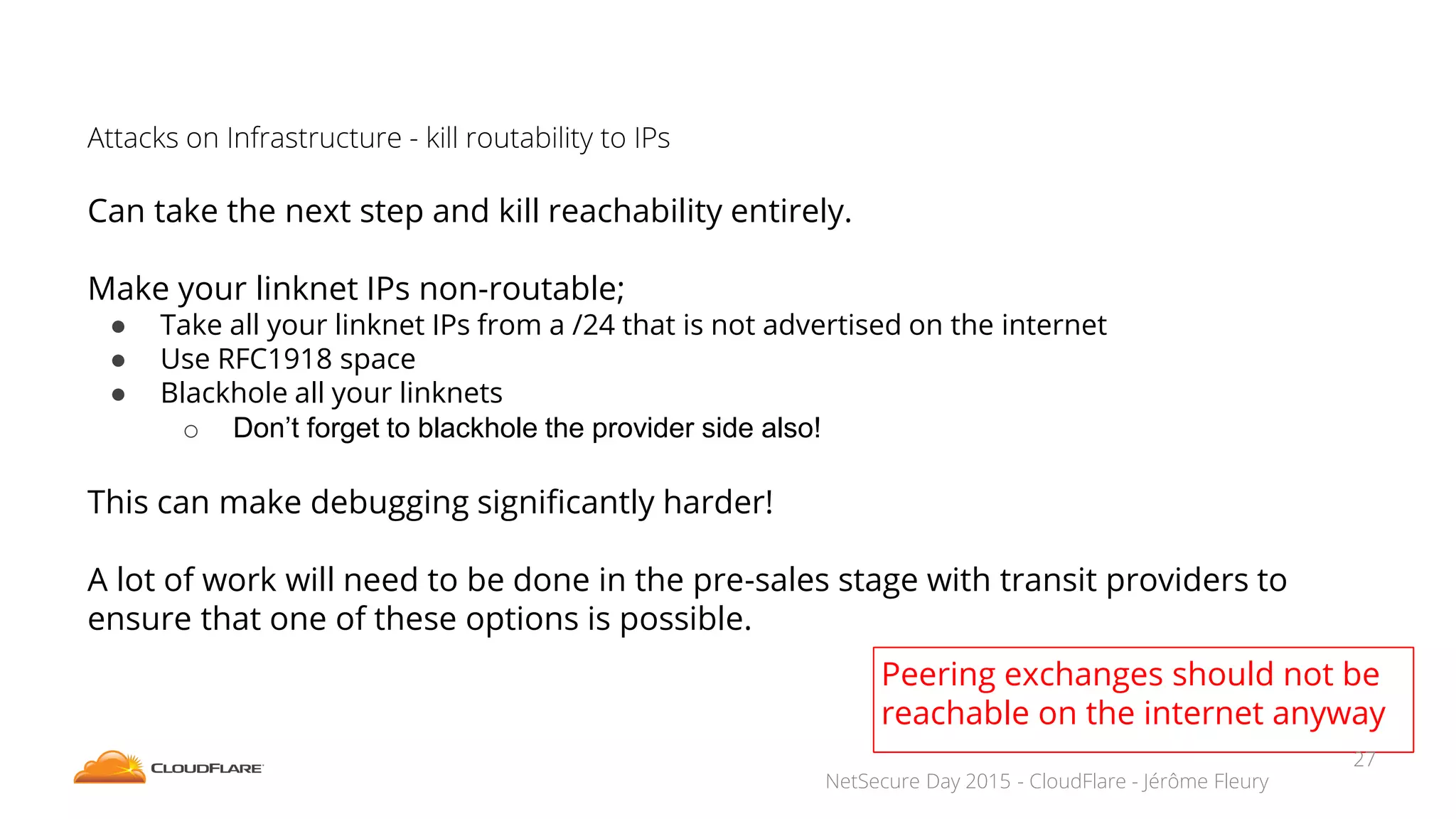
Attacks on Infrastructure - kill routability to IPs
Can take the next step and kill reachability entirely.
Make your linknet IPs non-routable;
● Take all your linknet IPs from a /24 that is not advertised on the internet
● Use RFC1918 space
● Blackhole all your linknets
o Don’t forget to blackhole the provider side also!
This can make debugging significantly harder!
A lot of work will need to be done in the pre-sales stage with transit providers to
ensure that one of these options is possible.
Peering exchanges should not be
reachable on the internet anyway
27
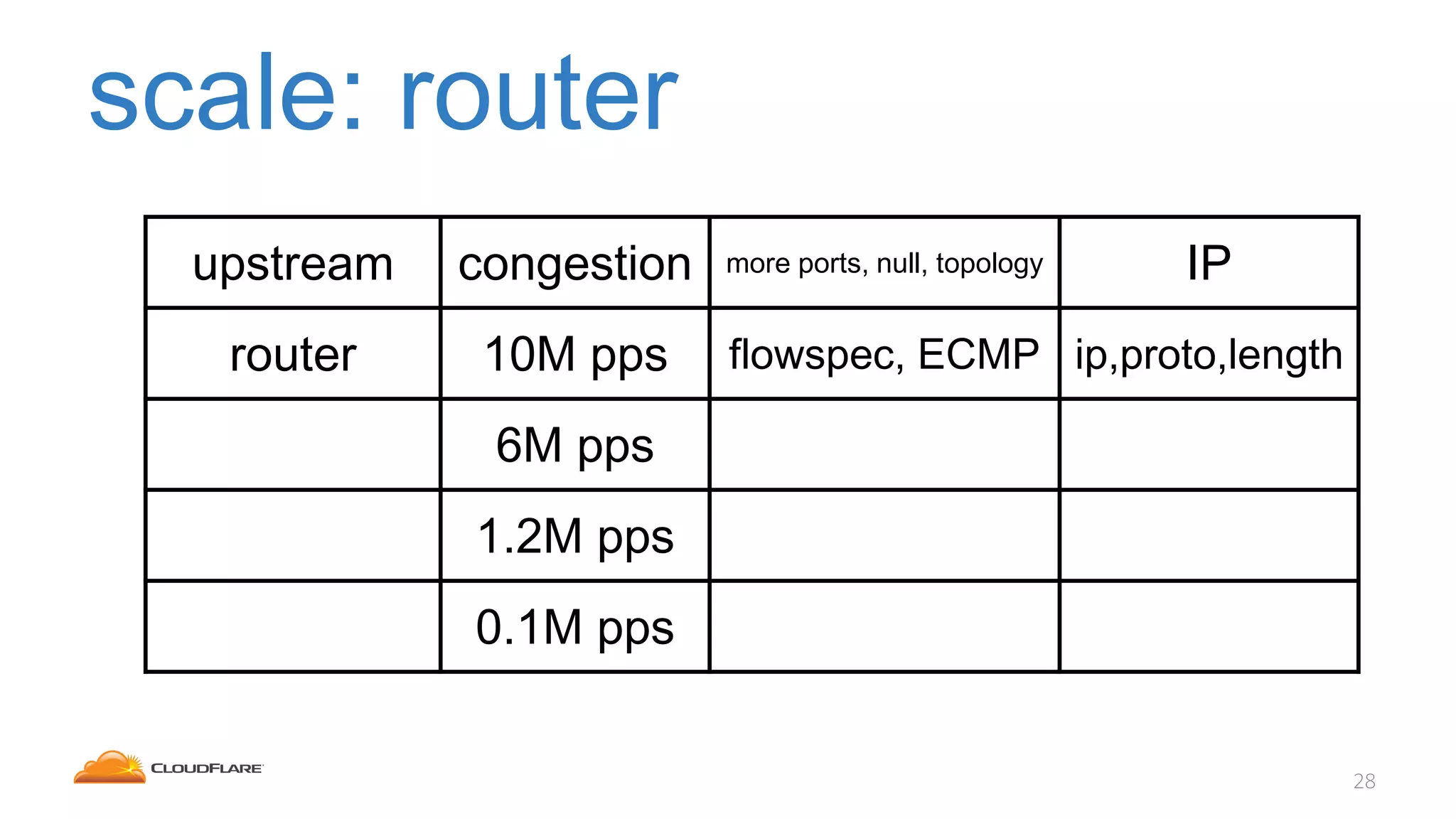
scale: router
28
upstream congestion more ports, null, topology IP
router 10M pps flowspec, ECMP ip,proto,length
6M pps
1.2M pps
0.1M pps
Topology: spread it out with ECMP
29
hash(proto, src ip, src port, dst ip, dst port)
hash % 2
NetSecure Day 2015 - CloudFlare - Jérôme Fleury
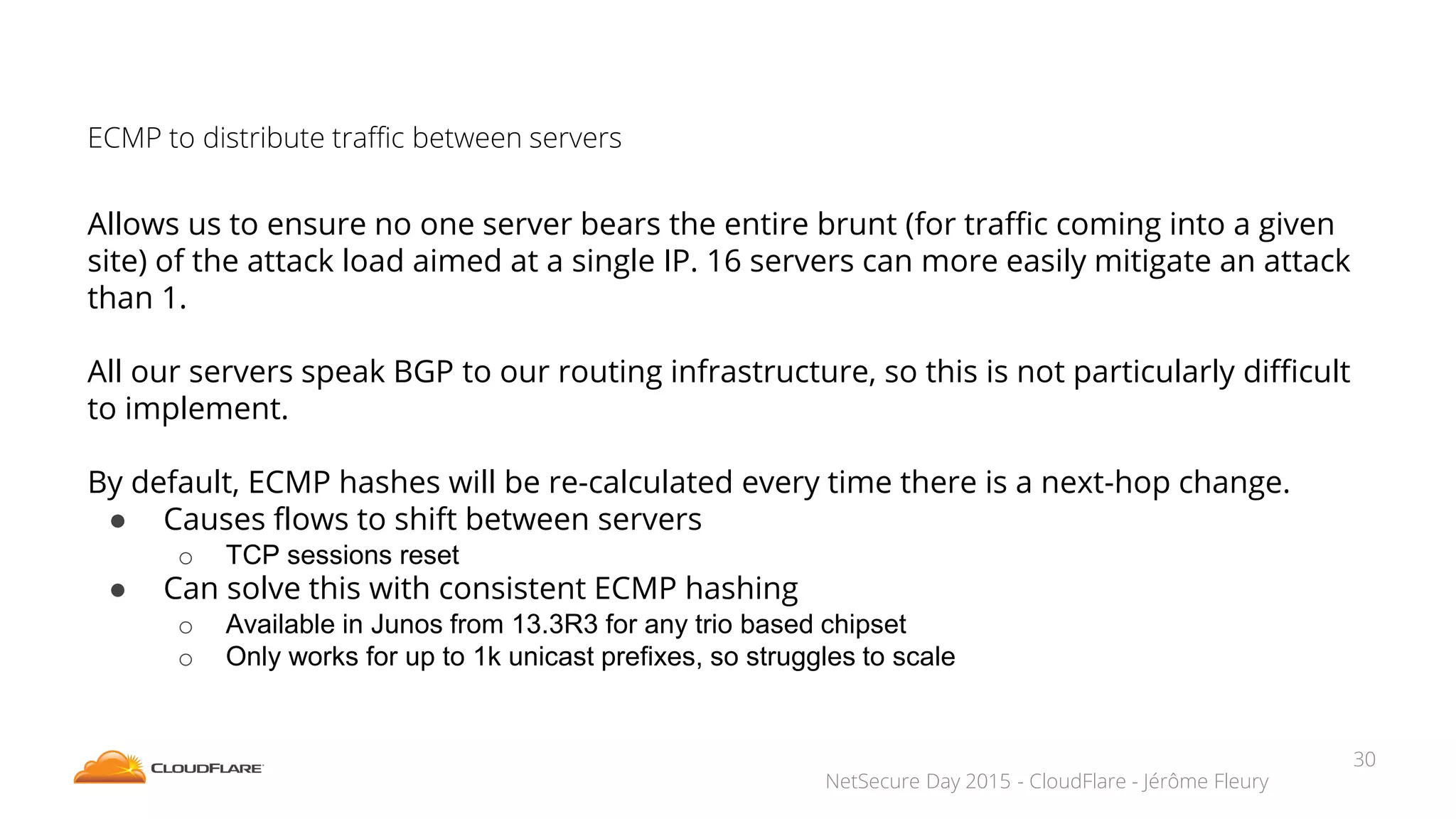
ECMP to distribute traffic between servers
Allows us to ensure no one server bears the entire brunt (for traffic coming into a given
site) of the attack load aimed at a single IP. 16 servers can more easily mitigate an attack
than 1.
All our servers speak BGP to our routing infrastructure, so this is not particularly difficult
to implement.
By default, ECMP hashes will be re-calculated every time there is a next-hop change.
● Causes flows to shift between servers
o TCP sessions reset
● Can solve this with consistent ECMP hashing
o Available in Junos from 13.3R3 for any trio based chipset
o Only works for up to 1k unicast prefixes, so struggles to scale
30
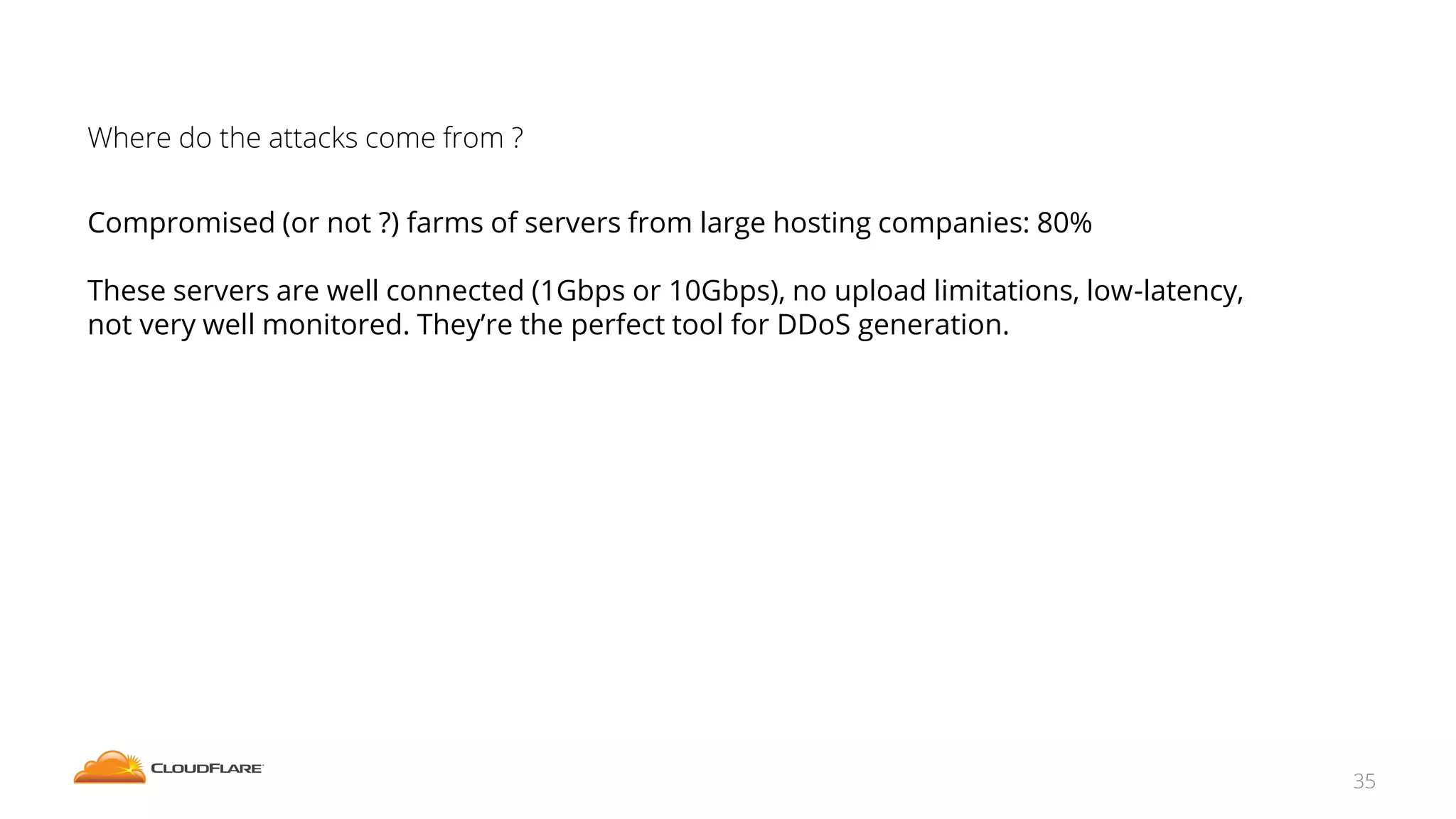
Where do the attacks come from ?
Compromised (or not ?) farms of servers from large hosting companies: 80%
These servers are well connected (1Gbps or 10Gbps), no upload limitations, low-latency,
not very well monitored. They’re the perfect tool for DDoS generation.
35
NetSecure Day 2015 - CloudFlare - Jérôme Fleury
Detection
How do we even work out what to mitigate
39
NetSecure Day 2015 - CloudFlare - Jérôme Fleury
Detection - how do we do it?
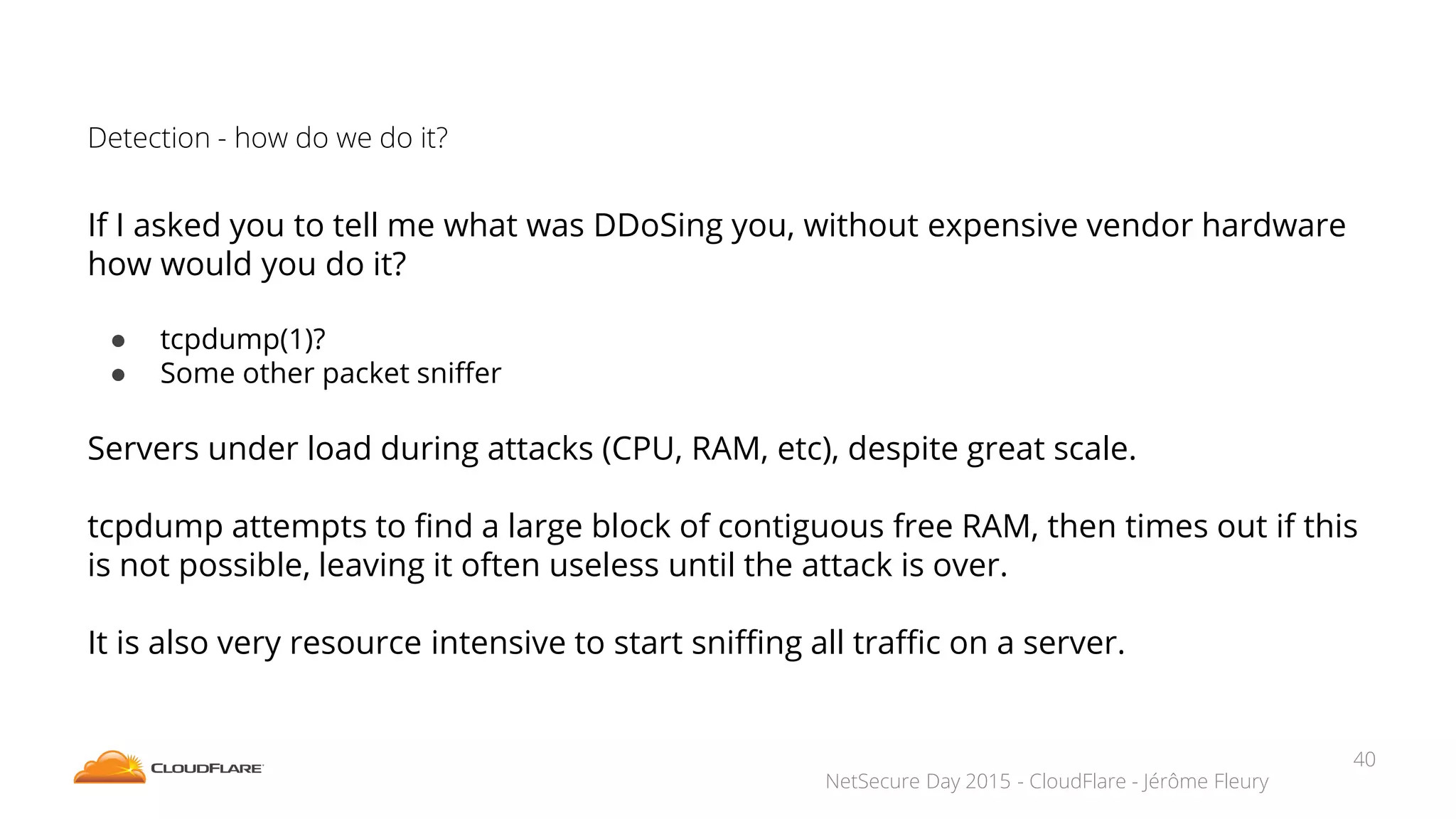
If I asked you to tell me what was DDoSing you, without expensive vendor hardware
how would you do it?
● tcpdump(1)?
● Some other packet sniffer
Servers under load during attacks (CPU, RAM, etc), despite great scale.
tcpdump attempts to find a large block of contiguous free RAM, then times out if this
is not possible, leaving it often useless until the attack is over.
It is also very resource intensive to start sniffing all traffic on a server.
40
NetSecure Day 2015 - CloudFlare - Jérôme Fleury
Detection - how do we do it?
So how do we do this?
● Taking the burden of detection away from the device being attacked can be very helpful
o Export NetFlow records from the edge routers
o Export sFlow from the switches in our datacenters
o Automating this process has helped considerably
● Reading data from the application
o NGINX logs tell you a lot that is useful.
● Sometimes calming the attack down to a manageable level with blunt rules (rate-limit all
traffic from these 5x /16s to this single /32) can help to be able to then do deeper
inspection and fine-tune the rules we implement to mitigate
41
Manual attack handling
42
sflow
pretty analytics
command lineiptables rules
iptables
mgmt
sflow
aggregation
Operator
servers
switch
switch
switch
Automatic attack handling
43
API
Gatebot
sflow
analytics
iptables rules
iptables
mgmt
sflow
aggregation
servers
switch
switch
switch
44
Drop!
Packet characteristics
45
• Packet length
• Payload
• Goal: limit false positives
46
Spoofed?
(source: DaPuglet)
NetSecure Day 2015 - CloudFlare - Jérôme Fleury
Matching on payload in iptables
47
NetSecure Day 2015 - CloudFlare - Jérôme Fleury
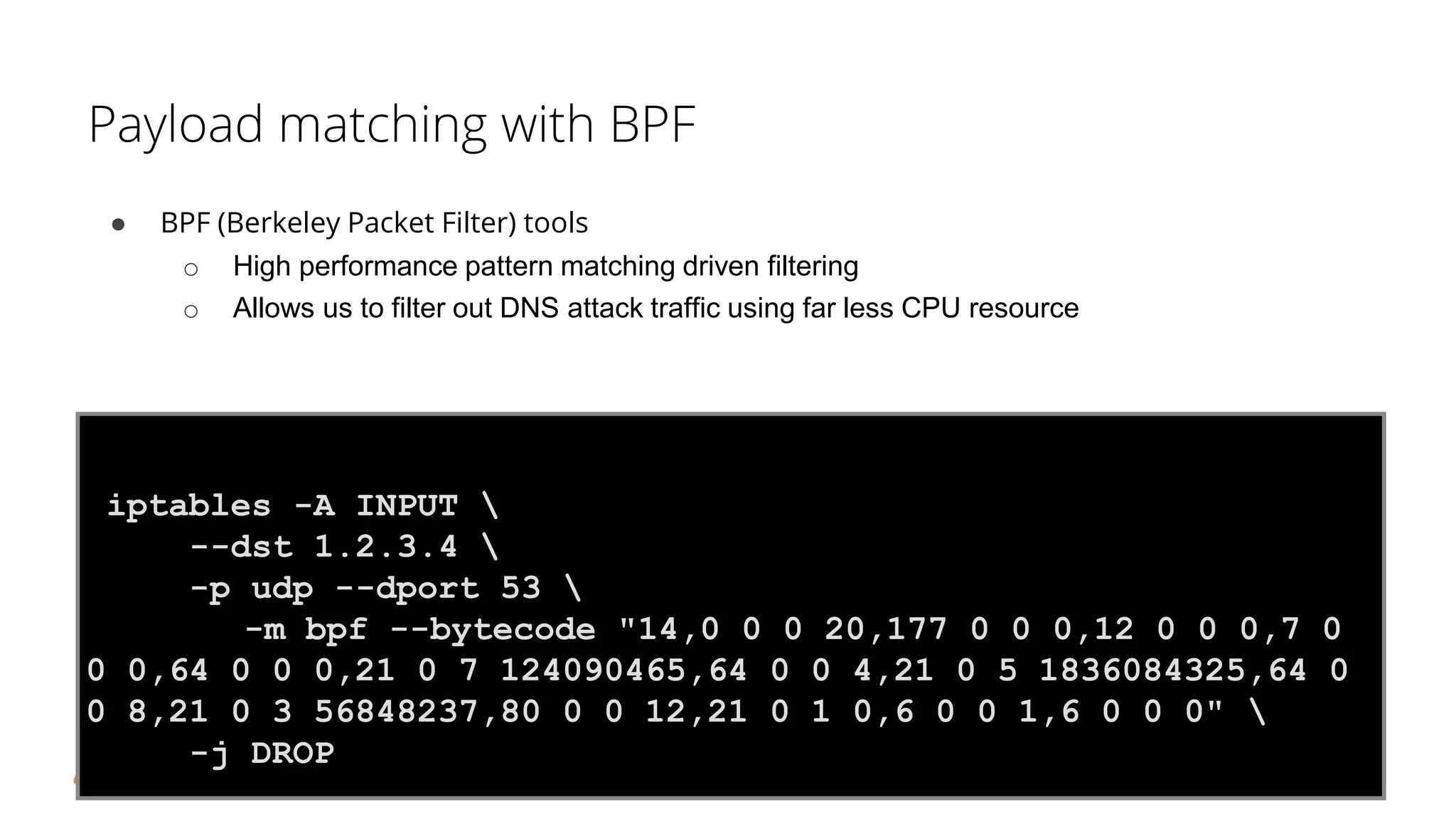
Payload matching with BPF
● BPF (Berkeley Packet Filter) tools
o High performance pattern matching driven filtering
o Allows us to filter out DNS attack traffic using far less CPU resource
48
iptables -A INPUT 
--dst 1.2.3.4 
-p udp --dport 53 
-m bpf --bytecode "14,0 0 0 20,177 0 0 0,12 0 0 0,7 0
0 0,64 0 0 0,21 0 7 124090465,64 0 0 4,21 0 5 1836084325,64 0
0 8,21 0 3 56848237,80 0 0 12,21 0 1 0,6 0 0 1,6 0 0 0" 
-j DROP
BPF bytecode
49
ldx 4*([14]&0xf)
ld #34
add x
tax
lb_0:
ldb [x + 0]
add x
add #1
tax
ld [x + 0]
jneq #0x07657861, lb_1
ld [x + 4]
jneq #0x6d706c65, lb_1
ld [x + 8]
jneq #0x03636f6d, lb_1
ldb [x + 12]
jneq #0x00, lb_1
ret #1
lb_1:
ret #0
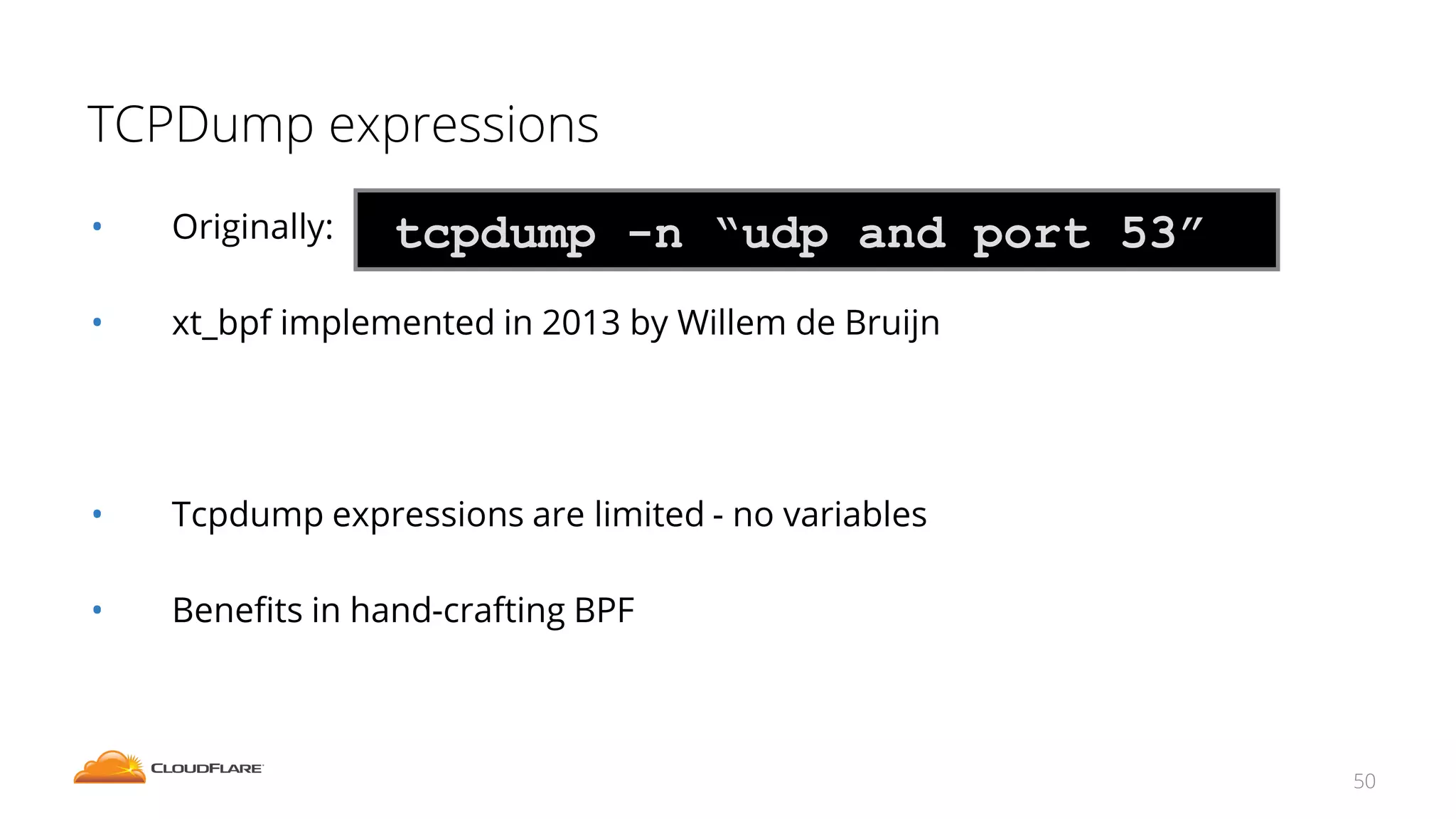
TCPDump expressions
50
• Originally:
• xt_bpf implemented in 2013 by Willem de Bruijn
• Tcpdump expressions are limited - no variables
• Benefits in hand-crafting BPF
tcpdump -n “udp and port 53”
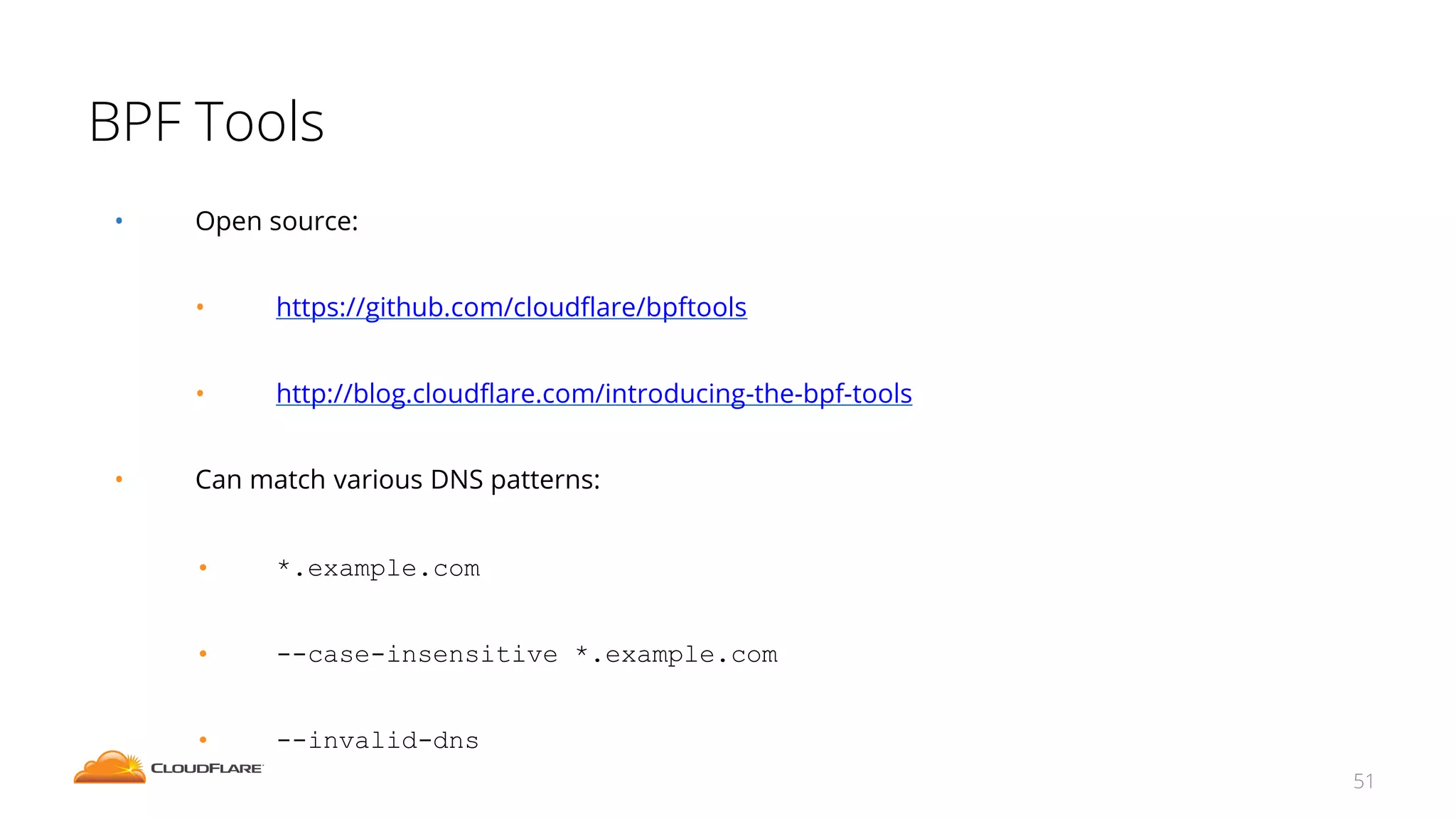
BPF Tools
51
• Open source:
• https://github.com/cloudflare/bpftools
• http://blog.cloudflare.com/introducing-the-bpf-tools
• Can match various DNS patterns:
• *.example.com
• --case-insensitive *.example.com
• --invalid-dns
NetSecure Day 2015 - CloudFlare - Jérôme Fleury
Hashlimits
Enforce “no more than X connection attempts per minute for this hash”, otherwise blacklist
Hash is made up from whatever criterion you want, but for our purposes combo of src +
dest IPs
Fairly effective method of easily detecting “ddos-like” traffic.
Trick is preventing false detections.
● Customer with many millions of users released an application update causing the application to
regularly perform JSON queries against their application.
● Users behind a CG-NAT appeared as if they were coming from a single IP.
● Triggered enforcement on non-malicious traffic.
52
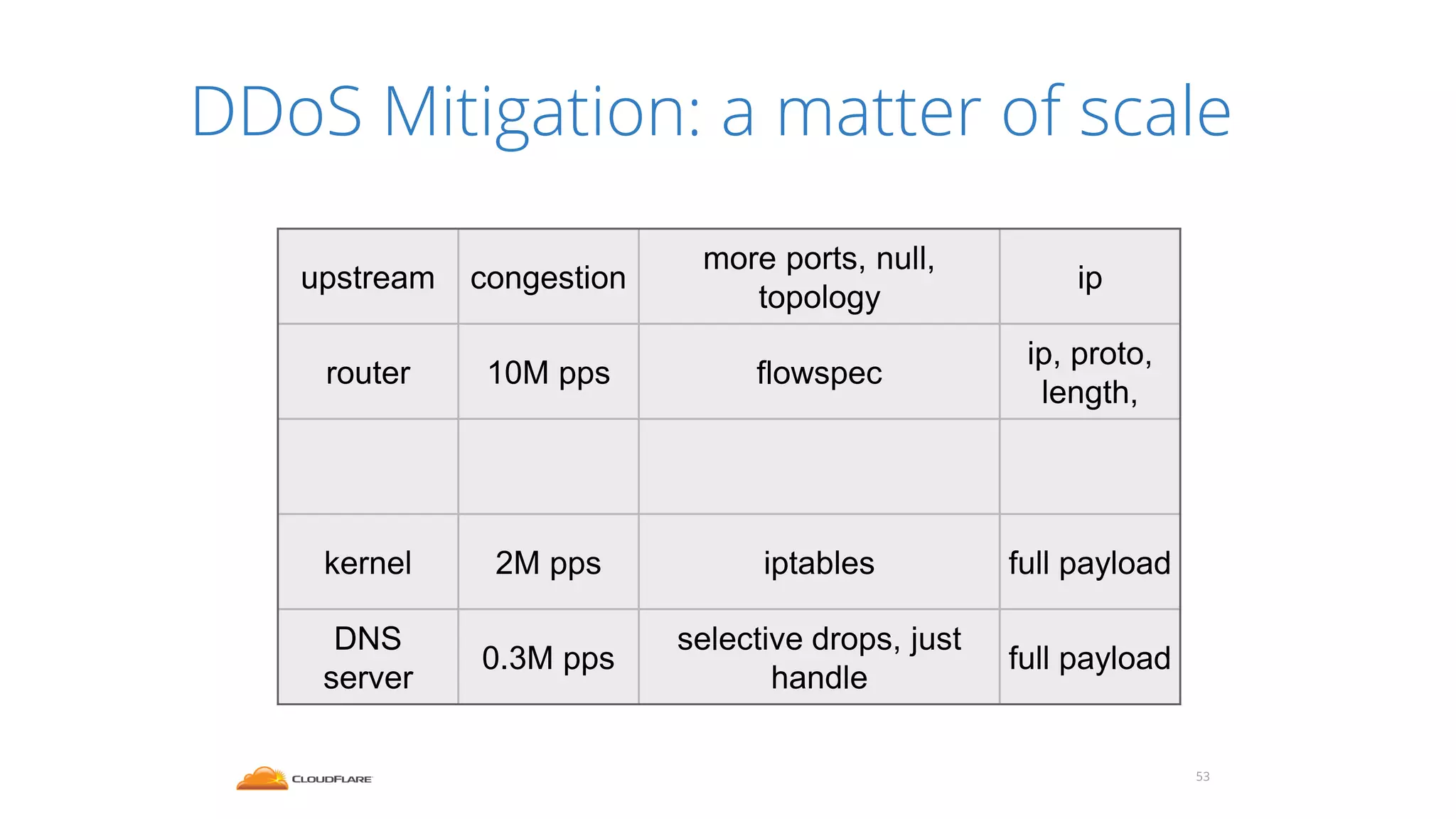
DDoS Mitigation: a matter of scale
53
upstream congestion
more ports, null,
topology
ip
router 10M pps flowspec
ip, proto,
length,
kernel 2M pps iptables full payload
DNS
server
0.3M pps
selective drops, just
handle
full payload
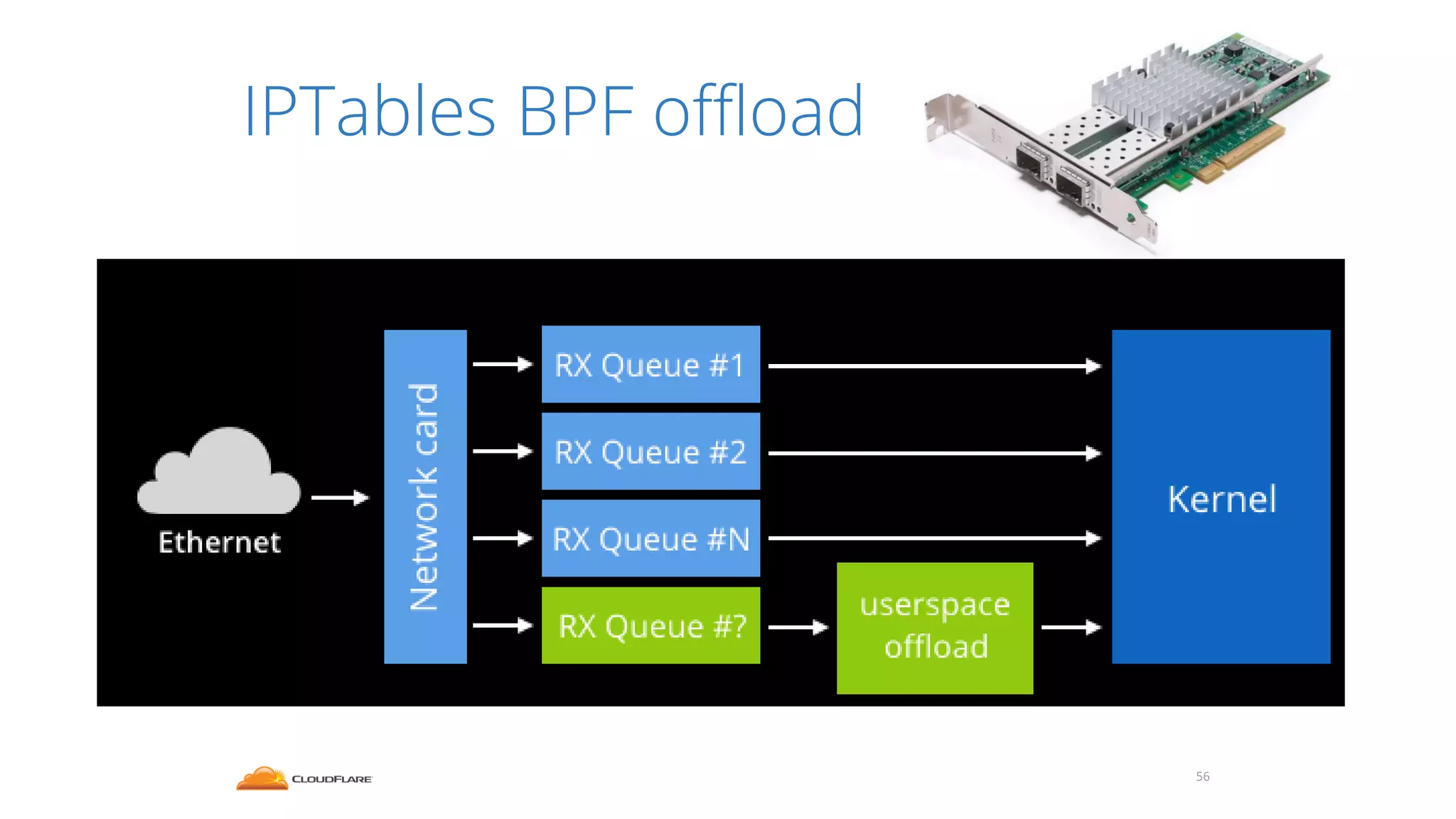
NetSecure Day 2015 - CloudFlare - Jérôme Fleury
Payload matching close to NIC
54
NetSecure Day 2015 - CloudFlare - Jérôme Fleury
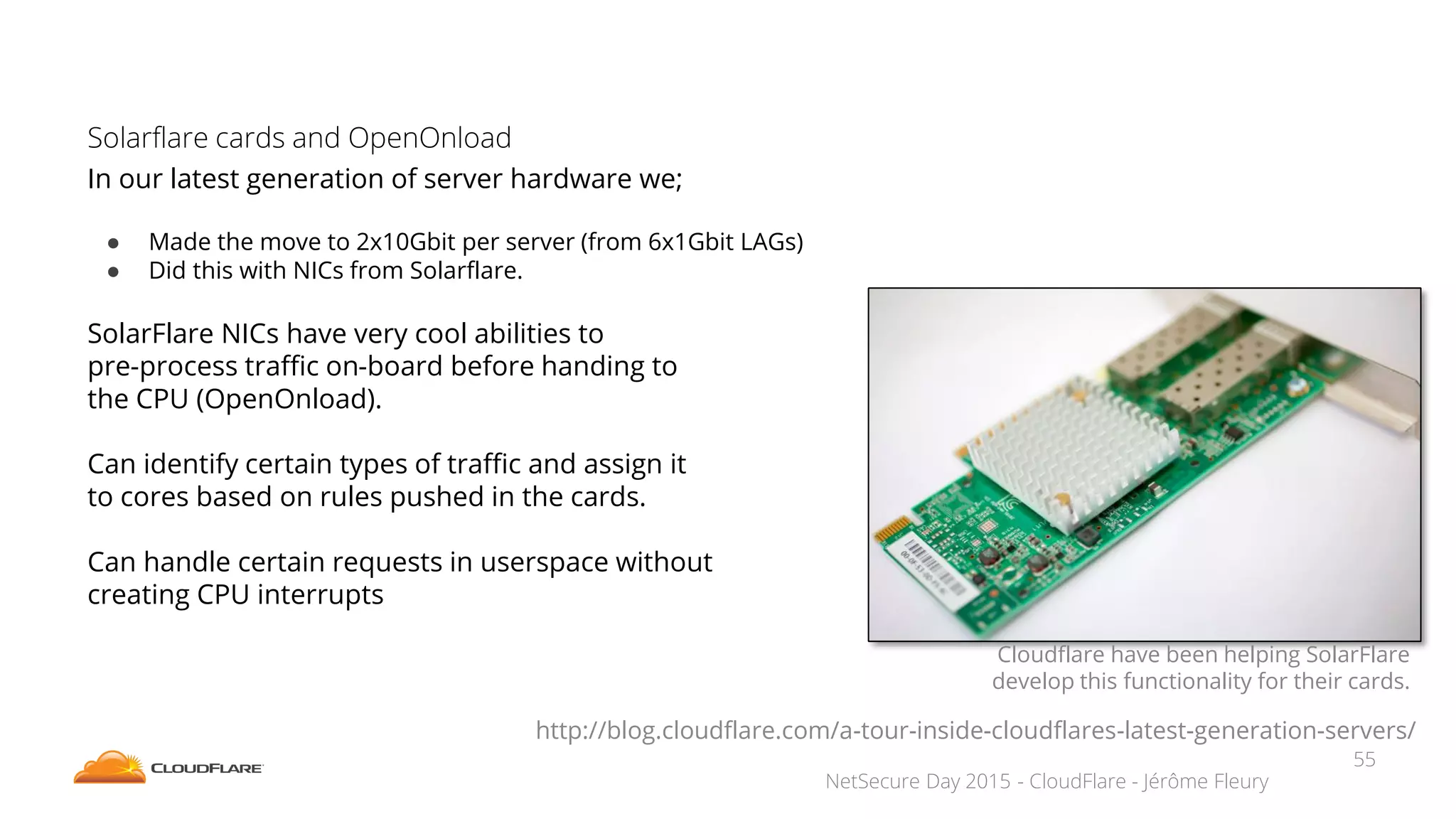
Solarflare cards and OpenOnload
In our latest generation of server hardware we;
● Made the move to 2x10Gbit per server (from 6x1Gbit LAGs)
● Did this with NICs from Solarflare.
SolarFlare NICs have very cool abilities to
pre-process traffic on-board before handing to
the CPU (OpenOnload).
Can identify certain types of traffic and assign it
to cores based on rules pushed in the cards.
Can handle certain requests in userspace without
creating CPU interrupts
Cloudflare have been helping SolarFlare
develop this functionality for their cards.
http://blog.cloudflare.com/a-tour-inside-cloudflares-latest-generation-servers/
55
IPTables BPF offload
56
DDoS Mitigation: a matter of scale
57
upstream congestion
more ports, null,
topology
ip
router 10M pps flowspec
ip, proto,
length,
network
card
6M pps floodgate full payload
kernel 1.2M pps iptables full payload
DNS
server
0.3M pps
selective drops, just
handle
full payload
NetSecure Day 2015 - CloudFlare - Jérôme Fleury
Connections from a botnet (L7)
58
59
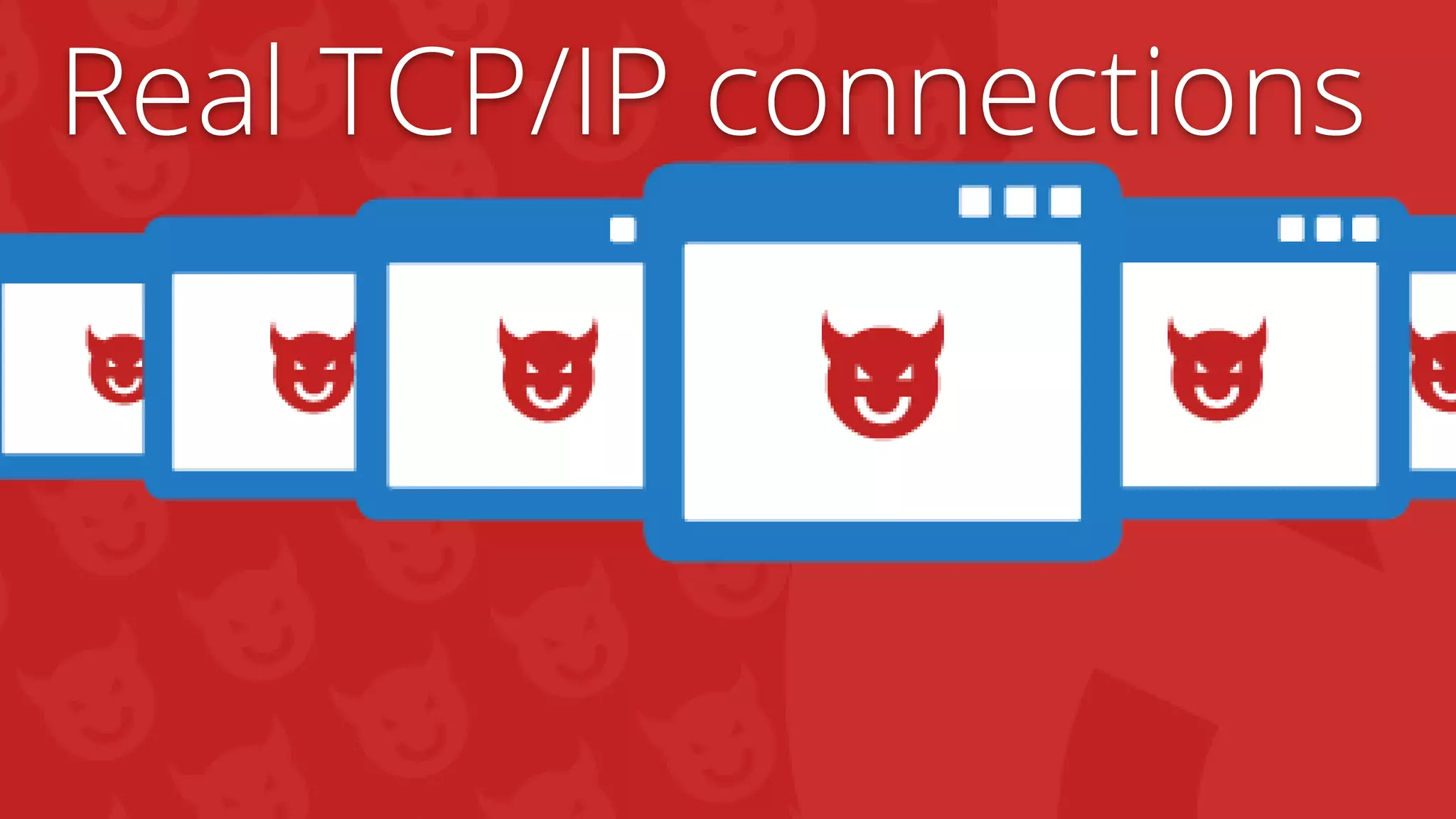
Real TCP/IP connections
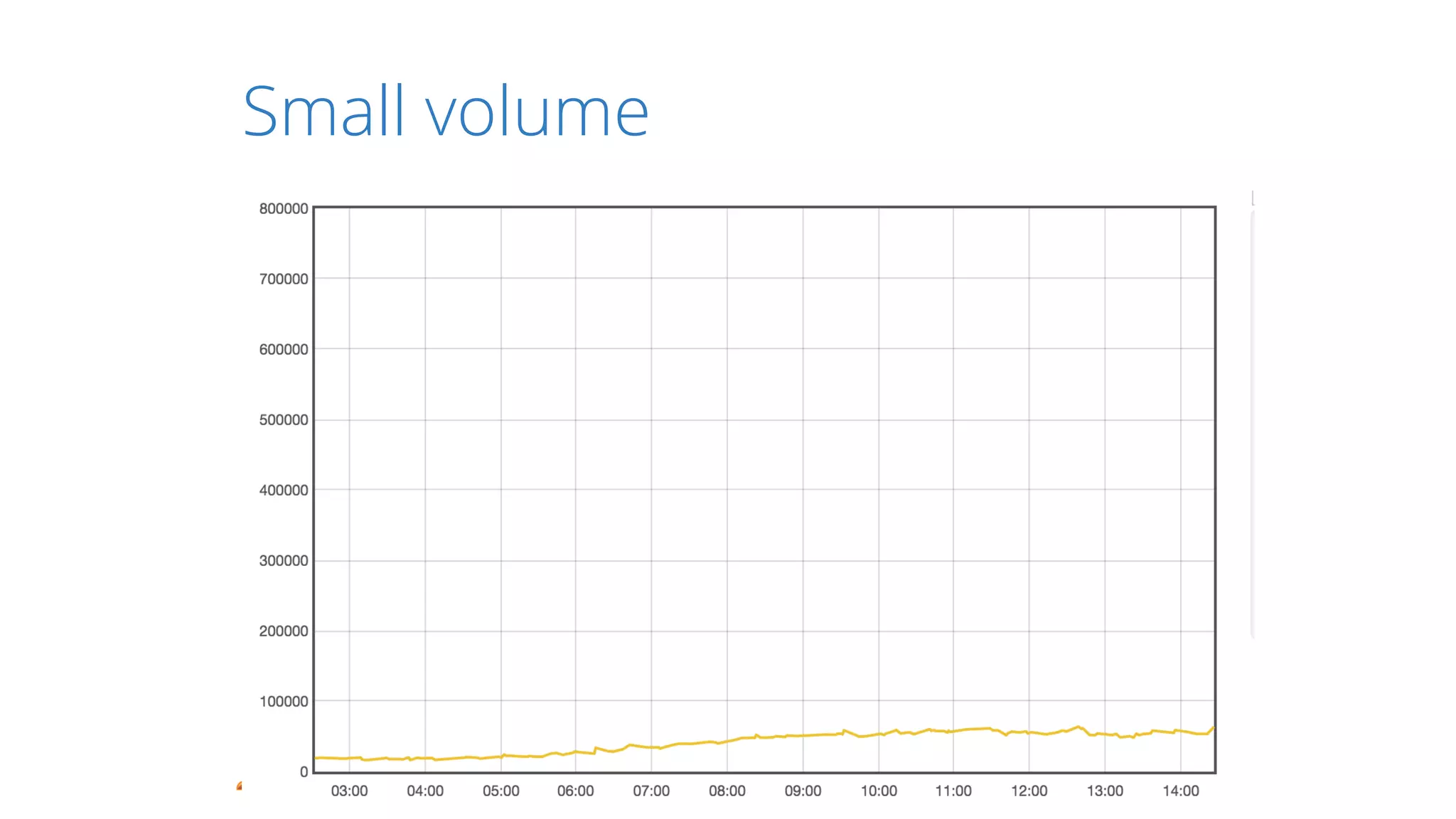
Small volume
60
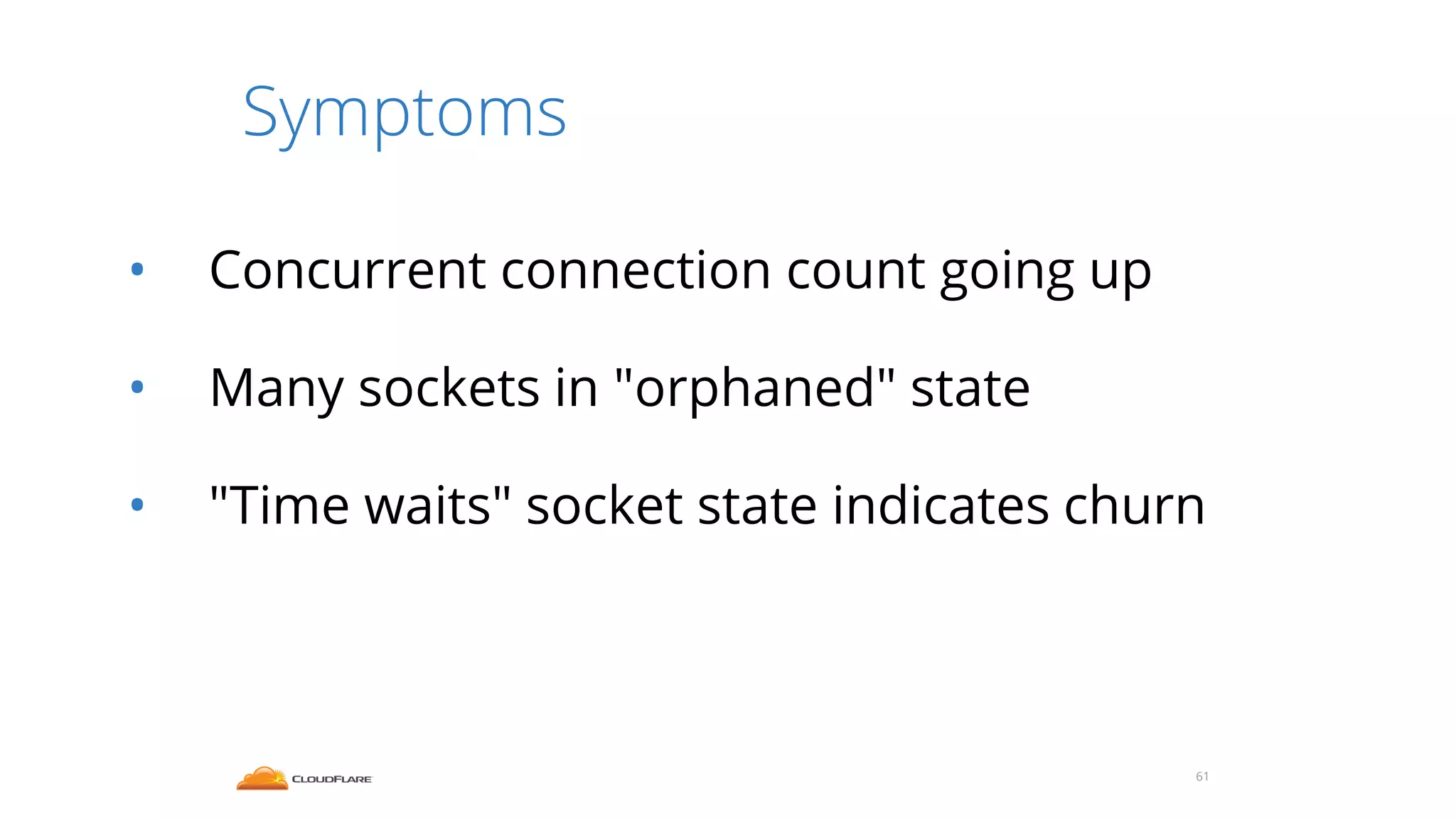
Symptoms
61
• Concurrent connection count going up
• Many sockets in "orphaned" state
• "Time waits" socket state indicates churn
62
IP reputation
(source: the internet)
Reputation in iptables
63
• Contract connlimit
• Hash limits
• Rate limit SYN packets per IP
• IPSet
• Manual blacklisting - feed IP blacklist from HTTP server logs
• Supports subnets, timeouts
Conclusions
• If you have sensitive content and/or customers, you WILL be
DDoSed
• DDoS are not a fatality
• Mitigating them requires investment in hardware,
bandwidth, and most importantly, people.
64
NetSecure Day 2015 - CloudFlare - Jérôme Fleury
Questions?
Jérôme Fleury, Network Engineering
jf@cloudflare.com
http://www.cloudflare.com/
AS13335
Thank you!
75

#NSD15 - Attaques DDoS Internet et comment les arrêter

  • 1.
    Attacks and DDoSMitigation Jérôme Fleury NetSecure Day December 2015
  • 2.
    NetSecure Day 2015- CloudFlare - Jérôme Fleury CloudFlare 2
  • 3.
    NetSecure Day 2015- CloudFlare - Jérôme Fleury What is CloudFlare? CloudFlare makes websites faster and safer using our globally distributed network to deliver essential services to any website ● Performance ● Content ● Optimization ● Security ● 3rd party services ● Analytics 3
  • 4.
    NetSecure Day 2015- CloudFlare - Jérôme Fleury How does CloudFlare work? CloudFlare works at the network level ● Once a website is part of the CloudFlare community, its web traffic is routed through CloudFlare’s global network of 60+ (and growing) data centers. ● At each edge node, CloudFlare manages DNS, caching, bot filtering, web content optimization and third party app installations. 4
  • 5.
    NetSecure Day 2015- CloudFlare - Jérôme Fleury CloudFlare works globally 5 CloudFlare protects globally ● DDoS attack traffic is localized and lets other geographic areas continue to operate
  • 6.
    NetSecure Day 2015- CloudFlare - Jérôme Fleury CloudFlare has customers globally more than 4 million websites 6
  • 7.
    NetSecure Day 2015- CloudFlare - Jérôme Fleury DDoS Mitigation 7
  • 8.
  • 9.
    NetSecure Day 2015- CloudFlare - Jérôme Fleury The Evolving Landscape of DDoS Attacks 9 ATTACK TYPE TREND • Volumetric Layer 3 / 4 • DNS Infrastructure • HTTPS application • Origin: 100s of countries DNS infrastructure 100s Gbps HTTP Application 100s Gbps Sophistication NTP reflection Up to 400+ Gbps (35% up from DNS amplification) DNS amplification Up to 300 Gbps 20142013 2015 Equallycapableof beingIPv4andIPv6 More sophisticated DDoS mitigation and larger surface area to block volumetric attacks has forced hackers to change tactics. New DNS infrastructure and HTTP layer 7 attack signatures that mimic human-like behavior are increasing in frequency.
  • 10.
    NetSecure Day 2015- CloudFlare - Jérôme Fleury DNS Infrastructure Attacks 10 Protecting DNS can be independent of IPv4 or IPv6 usage
  • 11.
    NetSecure Day 2015- CloudFlare - Jérôme Fleury DNSSEC and DNS attacks and open resolvers $ dig ANY isc.org @63.21*.**.** +edns=0 +notcp +bufsize=4096 64bytequery ;; ANSWER SECTION: isc.org. 7147 IN SOA ns-int.isc.org. hostmaster.isc.org. 2013073000 7200 3600 24796800 3600 isc.org. 7147 IN NS ns.isc.afilias-nst.info. isc.org. 7147 IN NS ord.sns-pb.isc.org. isc.org. 7147 IN NS ams.sns-pb.isc.org. isc.org. 7147 IN NS sfba.sns-pb.isc.org. isc.org. 7 IN A 149.20.64.69 isc.org. 7147 IN MX 10 mx.pao1.isc.org. isc.org. 7147 IN TXT "v=spf1 a mx ip4:204.152.184.0/21 ip4:149.20.0.0/16 ip6:2001:04F8::0/32 ip6:2001:500:60::65/128 ~all" isc.org. 7147 IN TXT "$Id: isc.org,v 1.1835 2013-07-24 00:15:22 dmahoney Exp $" isc.org. 7 IN AAAA 2001:4f8:0:2::69 isc.org. 7147 IN NAPTR 20 0 "S" "SIP+D2U" "" _sip._udp.isc.org. isc.org. 3547 IN NSEC _adsp._domainkey.isc.org. A NS SOA MX TXT AAAA NAPTR RRSIG NSEC DNSKEY SPF isc.org. 7147 IN DNSKEY 256 3 5 BQEAAAABwuHz9Cem0BJ0JQTO7C/a3McR6hMaufljs1dfG/inaJpYv7vH XTrAOm/MeKp+/x6eT4QLru0KoZkvZJnqTI8JyaFTw2OM/ItBfh/hL2lm Cft2O7n3MfeqYtvjPnY7dWghYW4sVfH7VVEGm958o9nfi79532Qeklxh x8pXWdeAaRU= 7147 IN DNSKEY 257 3 5 BEAAAAOhHQDBrhQbtphgq2wQUpEQ5t4DtUHxoMVFu2hWLDMvoOMRXjGr hhCeFvAZih7yJHf8ZGfW6hd38hXG/xylYCO6Krpbdojwx8YMXLA5/kA+ u50WIL8ZR1R6KTbsYVMf/Qx5RiNbPClw+vT+U8eXEJmO20jIS1ULgqy3 47cBB1zMnnz/4LJpA0da9CbKj3A254T515sNIMcwsB8/2+2E63/zZrQz Bkj0BrN/9Bexjpiks3jRhZatEsXn3dTy47R09Uix5WcJt+xzqZ7+ysyL KOOedS39Z7SDmsn2eA0FKtQpwA6LXeG2w+jxmw3oA8lVUgEf/rzeC/bB yBNsO70aEFTd isc.org. 7147 IN SPF "v=spf1 a mx ip4:204.152.184.0/21 ip4:149.20.0.0/16 ip6:2001:04F8::0/32 ip6:2001:500:60::65/128 ~all" 7147 IN RRSIG SPF 5 2 7200 20130828233259 20130729233259 50012 isc.org. XDoOYzkTHEV1W1V4TT50SsqXn4cxNhPvEuz3iFjq/oskLY9UOaK4GYDO GqHAjwNT0B6pUakKTQ3GvBjUBufPcEauCOl7L7kb8/cC6zYifUCoW0pS moiQxmyqfrPDTzyVA894myUONGgMmB6QW68HGPVvc6HzGWx9bOmjvFyX uOs= 7147 IN RRSIG DNSKEY 5 2 7200 20130828230128 20130729230128 12892 isc.org. COfF8fU6a8TBUG97SI/X+u2eKv7/mw+ixD3IWBnr3d3cWZmzF1sV8bWT YbuJebwnJMgN5OfB9PLsN+4QT617OjBe1dUF2M9jZeBiWsSsvvrdHnHM P8KwX6eayByDUoFsYe9VAH6C94XmOVXTQ7h7Cr0ytaVSXUytqFZV+DGn v3kqSi50V3YkFNPAJDqqs0treWjwV/SPlqWVqEAoU/KMZMtYpCEMbHVP 8nbRP3jj/10WLccPtjHhiw4Ka9Sk4o+b7BMYCgXGXlhaap21SUqkytHt 8RJdVxxd5Cj7Bi+O4LXODlS4bAZEDG7UoHR27MzXtvMZogsNyyNUKHSs FtUvBg== 7147 IN RRSIG DNSKEY 5 2 7200 20130828230128 20130729230128 50012 isc.org. Mbr/QqJPoIuf3K5jCuABUIG0/zSHQ8iWZpqvHx7olVBEmTxhi3/vW+IE DW6VCE1EpZclSIlMMRZUnbBnVSpe0rZ13BxoLlRQqvsbC3jD15Se41WB DscD0S63C0GLqI9IhSyVugtlpqhA3CaluSqtABHbAktPP05Rm00tST2Y A5Q= 3547 IN RRSIG NSEC 5 2 3600 20130828233259 20130729233259 50012 isc.org. V7G42xY7TY9wF1vsBlRFuJ2ror/QjftLoRrDCMfqFW6kb5ZswjKt5zho 4o2sIrylTqad68O+lMxrDcg+7c2D8Hdh84SC0DEkjunBXkGBtLtaJvO5 zMn+d/OgUY5O7wtkerybJwZeiHcFxIkMRIcvsPKJYZWKCdaaCWibne7c w1s= 7147 IN RRSIG NAPTR 5 2 7200 20130828233259 20130729233259 50012 isc.org. gWDvD0KACaYgsCgtRS4iKkHBBidfJfqS4drUf4kuPX2Etl9fj1YrqOQK QFB5kBrzJLKh1IF4YpV+KYVUF82l3AtpsohpUH5Uyc3yD3r1CUDVyVvc T9qUrIuRpZLInD2kBLmDaG76MRz4Fz+NAkdXmwxZJhgTrfMLy+Uw/Ktk H7w= 7 IN RRSIG AAAA 5 2 60 20130828233259 20130729233259 50012 isc.org. dfzIo0VGT0MptTaPoua3tFwDxSpeuOg127QedlqLGTxKGN1ppV/bd6R0 WktMagZY9rSqmjfXNPlF3Q+7YeTpMssQhHqjE/tDoj9q9r8RXuBLJ1+a VRq3+xMbxb5EXAyQVZw24LIuloqNprXePRUGCXNINSWd7VZEIDNqhu9C g7U= 7147 IN RRSIG TXT 5 2 7200 20130828233259 20130729233259 50012 isc.org. WtB3SYzcOKpNbOtBlnmtsI0DCbDB4Kiv/HBY24PTZyWF/3tI8l+wZ+/p MfJ/SblbAzT67DO5RfxlOhr8UlRKVa70oqinQp5+rqiS67lv1hGO6ArO k+J0jLTis9Uz32653dgAxlgjEdWDKAg4F12TaHirAXxyI8fos5WNl/h4 GLo= 7147 IN RRSIG MX 5 2 7200 20130828233259 20130729233259 50012 isc.org. BSXC42oV6MCF0dX2icyxnvyijhy569BJCoanm5VrIIuiNeTeo261FQJx 7ofFCWa4fKOoa+EZ0qloNPfDiczStr8MmK8Lznu6+8IRfdmcG/kURuSi JdvDa0swxjmCm9aYu2nhoyHs+jqbJ+9+fneI0iDUX1fiM+9G2K9BjLru NxU= 7 IN RRSIG A 5 2 60 20130828233259 20130729233259 50012 isc.org. Gmb8tt8d7kxx4HsA8L6IdFYGGSJCA8PTWexUP3CBLna39e4a6gVzjoNd dEI7B5mySAujZBEXNx3dSagpjiTJYfMML8AY0uO0tgyjqaTyzwPPV5lW xQKVC092BPJx9IeKw+DC57f3m9LOaHJlMIh7wYFn8jxqeg1lSwJN0e35 Qvc= 7147 IN RRSIG NS 5 2 7200 20130828233259 20130729233259 50012 isc.org. RBvXLeTH0726iKvElmBZYUE+AWG3s2YRxKxuCnrhg7o9qIQGKXvEXrb3 wJeC/74KY2FW+RRz4F0QxODnPm+frpWIPbCpRf0SUFDQ82opQDwAb2CM 0D9N95y1t9hYfSeHEsEEk2yWgLymd9/S24XCmwuVVZ7ZeYQmVEVkF7Jt V3A= 7147 IN RRSIG SOA 5 2 7200 20130828233259 20130729233259 50012 isc.org. iiDnH6tvmap0h2cdULI8Ihme+zbtQ2+D3ycKRqBc9TRfA0poNaaZ97aF 15EIKyIpjiVybkP2DNLm5nkpNsgA+Ur+YQ6pr0hZKzbDkBllBIW4C0LV DsjzPX3qLPH4G3x/20M+TeGe4uzPB5ImPuw0VxB8g8ZP5znvdiZG6qen jas= ;; AUTHORITY SECTION: isc.org. 7147 IN NS ns.isc.afilias-nst.info. isc.org. 7147 IN NS ord.sns-pb.isc.org. isc.org. 7147 IN NS ams.sns-pb.isc.org. isc.org. 7147 IN NS sfba.sns-pb.isc.org. ;; ADDITIONAL SECTION: ns.isc.afilias-nst.info. 56648 IN A 199.254.63.254 ns.isc.afilias-nst.info. 56652 IN AAAA 2001:500:2c::254 ord.sns-pb.isc.org. 31018 IN AAAA 2001:500:71::30 ord.sns-pb.isc.org. 31018 IN A 199.6.0.30 ams.sns-pb.isc.org. 31018 IN AAAA 2001:500:60::30 ams.sns-pb.isc.org. 31018 IN A 199.6.1.30 sfba.sns-pb.isc.org. 31018 IN AAAA 2001:4f8:0:2::19 sfba.sns-pb.isc.org. 31018 IN A 149.20.64.3 mx.pao1.isc.org. 3547 IN AAAA 2001:4f8:0:2::2b mx.pao1.isc.org. 3547 IN A 149.20.64.53 _sip._udp.isc.org. 7147 IN SRV 0 1 5060 asterisk.isc.org. 3,363byteresponse 11
  • 12.
    NetSecure Day 2015- CloudFlare - Jérôme Fleury Hundreds of millions of packets per second 12
  • 13.
    Let’s talk aboutthe scale 13 congestion 10M pps 6M pps 1.2M pps 0.1M pps
  • 14.
    upstream: capacity game 14 upstreamcongestion more ports, null, topology IP 10M pps 6M pps 1.2M pps 0.1M pps
  • 15.
  • 16.
  • 17.
    Routing with anycastreverse proxy 17
  • 18.
    NetSecure Day 2015- CloudFlare - Jérôme Fleury CloudFlare Amsterdam CloudFlare Frankfurt CloudFlare London Anycast CDN How does it work? ● DNS Query - to anycast DNS address ● DNS result returned with “Anycast” IP ● Client makes connection to closest server ● CloudFlare replies - session established What happens in the event of an outage? ● Traffic re-routes to next closest DC o TCP session resets at this point ISP DNS server Visitor 18
  • 19.
    NetSecure Day 2015- CloudFlare - Jérôme Fleury Anycast CDN – equally IPv4 and IPv6 Anycast prefixes ● Same IP prefixes (IPv4 & IPv6) advertised in each of the 30+ sites around the world (and growing) ● Unicast (from separate site-specific prefixes) used to pull traffic from “origin” web source Traffic Control ● Eyeball ISPs (should) route to closest node, resulting in a very low latency to our services from everywhere in the world ● If ISP A routes to CloudFlare in Germany then traffic will be served from Frankfurt or Düsseldorf ● If ISP B routes to CloudFlare in Texas then traffic will be served from Dallas This results in a reasonable distribution of attack traffic between our sites ● Easier to mitigate 10 sites receiving a ~50Gbit DDoS than 1 site receiving 500Gbit DDoS 19
  • 20.
    NetSecure Day 2015- CloudFlare - Jérôme Fleury Peering vs Transit Far more difficult to mitigate a DDoS coming in on an IX than a DDoS coming in via a transit provider. ● Can negotiate with transit provider for features such as RTBH, NOC implementing firewall filters for you, etc ● Peering exchanges generally don’t have these features. Peering exchanges are also surprisingly expensive to scale up for DDoS. Generally will be more expensive to order more 10Gbit ports at an IX vs additional handovers to a transit provider. Often end up de-peering a network sourcing large amounts of attack traffic to force them onto a transit provider where you have more control. This seems broken - surely there is a better way to ingest this traffic? 20
  • 21.
    NetSecure Day 2015- CloudFlare - Jérôme Fleury Mitigation - in the network 21
  • 22.
    NetSecure Day 2015- CloudFlare - Jérôme Fleury Regional enforcement Under certain circumstances, it makes sense to enforce regionally ● Seeing 300Gbit of traffic targeted at AMS, LHR, FRA, CDG for a website with 99% of legitimate traffic being served into HKG and SIN o Can implement strict flowspec enforcement in sites targeted, while no enforcement needed in sites traffic is legitimately needed in. o Take advantage of any opportunity presented Regional null routing can also be worthwhile at times ● Want to move site to new IPs and move on. o Null route in only the regions that are being targeted. Have your transit provider configure firewall filters in their network to filter certain packet types / lengths / src-IPs / dst-IPs / etc upstream in one region only to help filter malicious traffic. 23
  • 23.
    NetSecure Day 2015- CloudFlare - Jérôme Fleury Null route and move on When an attacker targets a website or a service, while they may want to take this website/service down, they target the IP address in order to do this. First order of business can be to update the DNS A/AAAA record and move on. If the attacker follows, keep doing this. Easy to automate, requires an attacker to continually change the attack to follow. Depends on rDNS service operators honouring our TTLs 24
  • 24.
    NetSecure Day 2015- CloudFlare - Jérôme Fleury Dealing with attacks on infrastructure IPs Relatively easy to mitigate attacks on Anycast IP space. ● Multiple hundred gig attack on an anycast IP o Distributed over 28 sites o Multiple tens of gigs per site Vs: ● Multiple hundred gig attack on an IP specific to a single router, link or DC o Very hard to mitigate o Multiple hundred gig attack traffic > 100Gbit link How do we prevent this from happening? What can we do about it? What gain do you get from exposing this? 25
  • 25.
    NetSecure Day 2015- CloudFlare - Jérôme Fleury Attacks on Infrastructure - obfuscation of IPs Traceroutes that show you the full path are nice… but… at what expense? ● Reveals a lot of the IP addressing information of your infrastructure to the entire internet o Becomes easy to figure out what to attack. o Makes every linknet, loopback, and infrastructure IP a target Worth at least considering obscuring some of your infrastructure ● Stop responding to ICMP and UDP ttl expired ● Avoid ICMP-Packet-Too-Big in IPv6 o Killing this can cause serious problems.` 26
  • 26.
    NetSecure Day 2015- CloudFlare - Jérôme Fleury Attacks on Infrastructure - kill routability to IPs Can take the next step and kill reachability entirely. Make your linknet IPs non-routable; ● Take all your linknet IPs from a /24 that is not advertised on the internet ● Use RFC1918 space ● Blackhole all your linknets o Don’t forget to blackhole the provider side also! This can make debugging significantly harder! A lot of work will need to be done in the pre-sales stage with transit providers to ensure that one of these options is possible. Peering exchanges should not be reachable on the internet anyway 27
  • 27.
    scale: router 28 upstream congestionmore ports, null, topology IP router 10M pps flowspec, ECMP ip,proto,length 6M pps 1.2M pps 0.1M pps
  • 28.
    Topology: spread itout with ECMP 29 hash(proto, src ip, src port, dst ip, dst port) hash % 2
  • 29.
    NetSecure Day 2015- CloudFlare - Jérôme Fleury ECMP to distribute traffic between servers Allows us to ensure no one server bears the entire brunt (for traffic coming into a given site) of the attack load aimed at a single IP. 16 servers can more easily mitigate an attack than 1. All our servers speak BGP to our routing infrastructure, so this is not particularly difficult to implement. By default, ECMP hashes will be re-calculated every time there is a next-hop change. ● Causes flows to shift between servers o TCP sessions reset ● Can solve this with consistent ECMP hashing o Available in Junos from 13.3R3 for any trio based chipset o Only works for up to 1k unicast prefixes, so struggles to scale 30
  • 30.
    Where do theattacks come from ? Compromised (or not ?) farms of servers from large hosting companies: 80% These servers are well connected (1Gbps or 10Gbps), no upload limitations, low-latency, not very well monitored. They’re the perfect tool for DDoS generation. 35
  • 31.
    NetSecure Day 2015- CloudFlare - Jérôme Fleury Detection How do we even work out what to mitigate 39
  • 32.
    NetSecure Day 2015- CloudFlare - Jérôme Fleury Detection - how do we do it? If I asked you to tell me what was DDoSing you, without expensive vendor hardware how would you do it? ● tcpdump(1)? ● Some other packet sniffer Servers under load during attacks (CPU, RAM, etc), despite great scale. tcpdump attempts to find a large block of contiguous free RAM, then times out if this is not possible, leaving it often useless until the attack is over. It is also very resource intensive to start sniffing all traffic on a server. 40
  • 33.
    NetSecure Day 2015- CloudFlare - Jérôme Fleury Detection - how do we do it? So how do we do this? ● Taking the burden of detection away from the device being attacked can be very helpful o Export NetFlow records from the edge routers o Export sFlow from the switches in our datacenters o Automating this process has helped considerably ● Reading data from the application o NGINX logs tell you a lot that is useful. ● Sometimes calming the attack down to a manageable level with blunt rules (rate-limit all traffic from these 5x /16s to this single /32) can help to be able to then do deeper inspection and fine-tune the rules we implement to mitigate 41
  • 34.
    Manual attack handling 42 sflow prettyanalytics command lineiptables rules iptables mgmt sflow aggregation Operator servers switch switch switch
  • 35.
    Automatic attack handling 43 API Gatebot sflow analytics iptablesrules iptables mgmt sflow aggregation servers switch switch switch
  • 36.
  • 37.
    Packet characteristics 45 • Packetlength • Payload • Goal: limit false positives
  • 38.
  • 39.
    NetSecure Day 2015- CloudFlare - Jérôme Fleury Matching on payload in iptables 47
  • 40.
    NetSecure Day 2015- CloudFlare - Jérôme Fleury Payload matching with BPF ● BPF (Berkeley Packet Filter) tools o High performance pattern matching driven filtering o Allows us to filter out DNS attack traffic using far less CPU resource 48 iptables -A INPUT --dst 1.2.3.4 -p udp --dport 53 -m bpf --bytecode "14,0 0 0 20,177 0 0 0,12 0 0 0,7 0 0 0,64 0 0 0,21 0 7 124090465,64 0 0 4,21 0 5 1836084325,64 0 0 8,21 0 3 56848237,80 0 0 12,21 0 1 0,6 0 0 1,6 0 0 0" -j DROP
  • 41.
    BPF bytecode 49 ldx 4*([14]&0xf) ld#34 add x tax lb_0: ldb [x + 0] add x add #1 tax ld [x + 0] jneq #0x07657861, lb_1 ld [x + 4] jneq #0x6d706c65, lb_1 ld [x + 8] jneq #0x03636f6d, lb_1 ldb [x + 12] jneq #0x00, lb_1 ret #1 lb_1: ret #0
  • 42.
    TCPDump expressions 50 • Originally: •xt_bpf implemented in 2013 by Willem de Bruijn • Tcpdump expressions are limited - no variables • Benefits in hand-crafting BPF tcpdump -n “udp and port 53”
  • 43.
    BPF Tools 51 • Opensource: • https://github.com/cloudflare/bpftools • http://blog.cloudflare.com/introducing-the-bpf-tools • Can match various DNS patterns: • *.example.com • --case-insensitive *.example.com • --invalid-dns
  • 44.
    NetSecure Day 2015- CloudFlare - Jérôme Fleury Hashlimits Enforce “no more than X connection attempts per minute for this hash”, otherwise blacklist Hash is made up from whatever criterion you want, but for our purposes combo of src + dest IPs Fairly effective method of easily detecting “ddos-like” traffic. Trick is preventing false detections. ● Customer with many millions of users released an application update causing the application to regularly perform JSON queries against their application. ● Users behind a CG-NAT appeared as if they were coming from a single IP. ● Triggered enforcement on non-malicious traffic. 52
  • 45.
    DDoS Mitigation: amatter of scale 53 upstream congestion more ports, null, topology ip router 10M pps flowspec ip, proto, length, kernel 2M pps iptables full payload DNS server 0.3M pps selective drops, just handle full payload
  • 46.
    NetSecure Day 2015- CloudFlare - Jérôme Fleury Payload matching close to NIC 54
  • 47.
    NetSecure Day 2015- CloudFlare - Jérôme Fleury Solarflare cards and OpenOnload In our latest generation of server hardware we; ● Made the move to 2x10Gbit per server (from 6x1Gbit LAGs) ● Did this with NICs from Solarflare. SolarFlare NICs have very cool abilities to pre-process traffic on-board before handing to the CPU (OpenOnload). Can identify certain types of traffic and assign it to cores based on rules pushed in the cards. Can handle certain requests in userspace without creating CPU interrupts Cloudflare have been helping SolarFlare develop this functionality for their cards. http://blog.cloudflare.com/a-tour-inside-cloudflares-latest-generation-servers/ 55
  • 48.
  • 49.
    DDoS Mitigation: amatter of scale 57 upstream congestion more ports, null, topology ip router 10M pps flowspec ip, proto, length, network card 6M pps floodgate full payload kernel 1.2M pps iptables full payload DNS server 0.3M pps selective drops, just handle full payload
  • 50.
    NetSecure Day 2015- CloudFlare - Jérôme Fleury Connections from a botnet (L7) 58
  • 51.
  • 52.
  • 53.
    Symptoms 61 • Concurrent connectioncount going up • Many sockets in "orphaned" state • "Time waits" socket state indicates churn
  • 54.
  • 55.
    Reputation in iptables 63 •Contract connlimit • Hash limits • Rate limit SYN packets per IP • IPSet • Manual blacklisting - feed IP blacklist from HTTP server logs • Supports subnets, timeouts
  • 56.
    Conclusions • If youhave sensitive content and/or customers, you WILL be DDoSed • DDoS are not a fatality • Mitigating them requires investment in hardware, bandwidth, and most importantly, people. 64
  • 57.
    NetSecure Day 2015- CloudFlare - Jérôme Fleury Questions? Jérôme Fleury, Network Engineering jf@cloudflare.com http://www.cloudflare.com/ AS13335 Thank you! 75