vaghela_manisha13@yahoo.com
2
INTRODUCTION
In India thefirst Factories Act was passed in 1881.This Act was
basically designed to protect children and to provide few measures
for health and safety of the workers.This law was applicable to only
those factories, which employed 100 or more workers. In 1891 another
factories Act was passed which extended to the factories employing
50 or more workers.
BY:MANISHA VAGHELA
3.
vaghela_manisha13@yahoo.com
3
Definition of aFactory:-
“Factory” is defined in Section 2(m) of the Act. It means
any premises including the precincts thereof-
i. Whereon ten or more workers are working, or were
working on any day of the preceding twelve months,
and in any part of which a manufacturing process is
being carried on with the aid of power, or is
ordinarily so carried on; or
ii. Whereon twenty or more workers are working, or
were working on any day of the preceding twelve
months, and in any part of which a manufacturing
process is being carried on without the aid of power,
or is ordinarily so carried on;
But does not include a mine subject to the operation of
the Mines Act,1952 or a mobile unit belonging to the
Armed forces of the Union, a railway running shed or
a hotel, restaurant or eating place.
BY:MANISHA VAGHELA
4.
vaghela_manisha13@yahoo.com
4
The following haveheld to be a factory:-
i. Salt works
ii. A shed for ginning and pressing of cotton
iii. A Bidi making shed
iv. A Railway Workshop
v. Composing work for Letter Press Printing
vi. Saw Mills
vii. Place for preparation of foodstuff and other eatables
BY:MANISHA VAGHELA
5.
vaghela_manisha13@yahoo.com
5
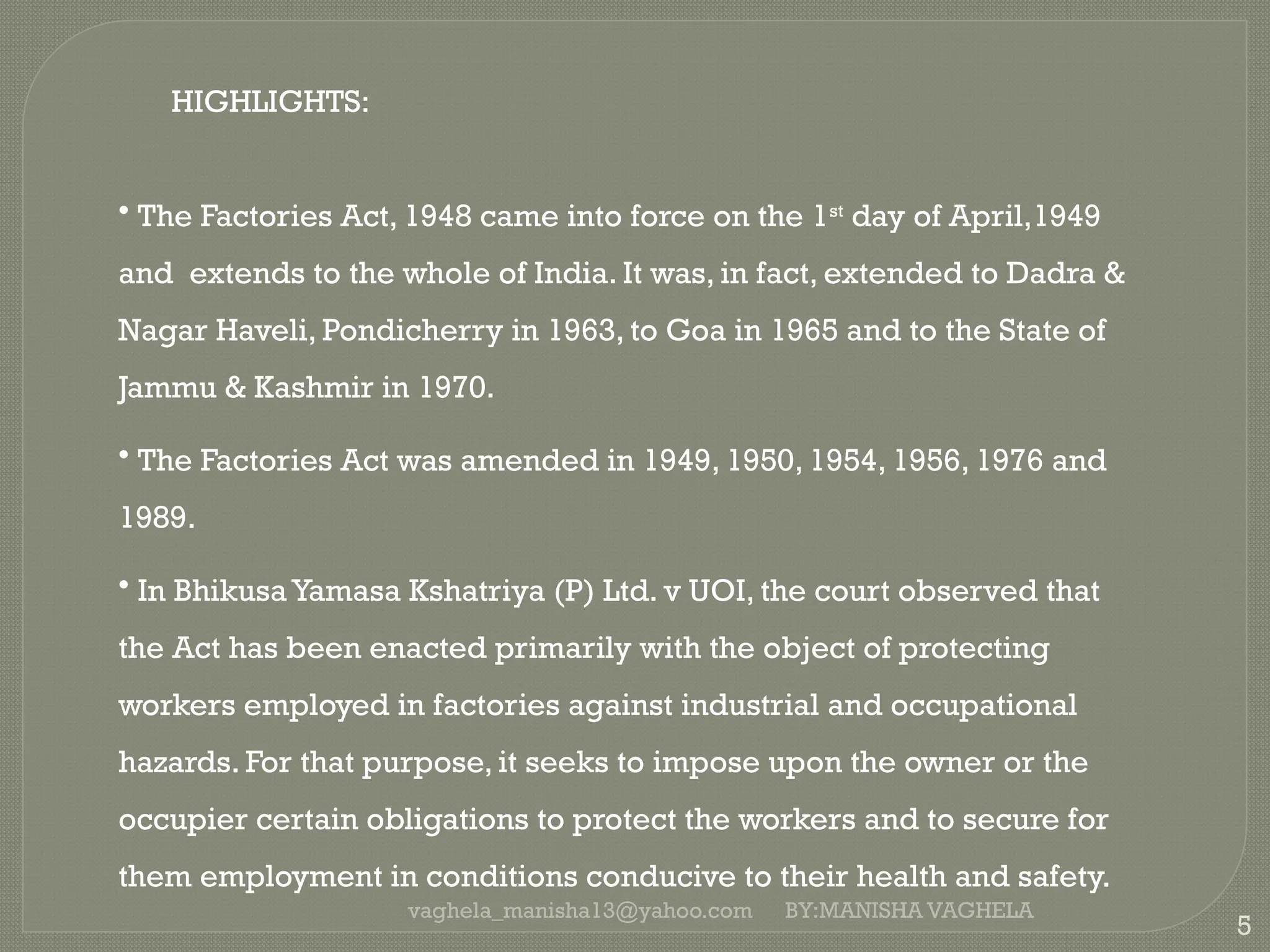
HIGHLIGHTS:
• The FactoriesAct, 1948 came into force on the 1st
day of April,1949
and extends to the whole of India. It was, in fact, extended to Dadra &
Nagar Haveli, Pondicherry in 1963, to Goa in 1965 and to the State of
Jammu & Kashmir in 1970.
• The Factories Act was amended in 1949, 1950, 1954, 1956, 1976 and
1989.
• In Bhikusa Yamasa Kshatriya (P) Ltd. v UOI, the court observed that
the Act has been enacted primarily with the object of protecting
workers employed in factories against industrial and occupational
hazards. For that purpose, it seeks to impose upon the owner or the
occupier certain obligations to protect the workers and to secure for
them employment in conditions conducive to their health and safety.
BY:MANISHA VAGHELA
6.
vaghela_manisha13@yahoo.com
6
BY:MANISHA VAGHELA
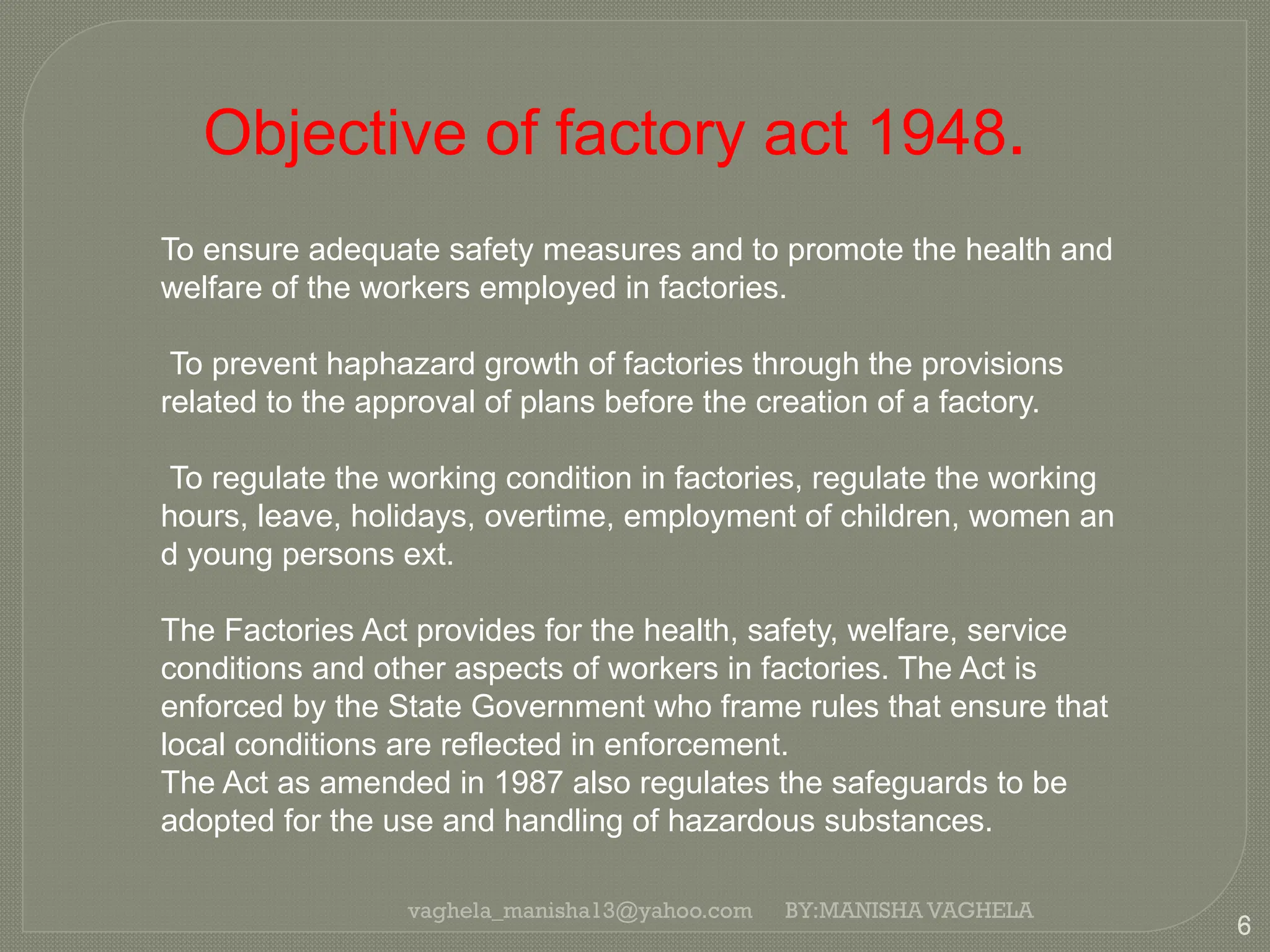
Objective offactory act 1948.
To ensure adequate safety measures and to promote the health and
welfare of the workers employed in factories.
To prevent haphazard growth of factories through the provisions
related to the approval of plans before the creation of a factory.
To regulate the working condition in factories, regulate the working
hours, leave, holidays, overtime, employment of children, women an
d young persons ext.
The Factories Act provides for the health, safety, welfare, service
conditions and other aspects of workers in factories. The Act is
enforced by the State Government who frame rules that ensure that
local conditions are reflected in enforcement.
The Act as amended in 1987 also regulates the safeguards to be
adopted for the use and handling of hazardous substances.
7.
vaghela_manisha13@yahoo.com
7
BY:MANISHA VAGHELA
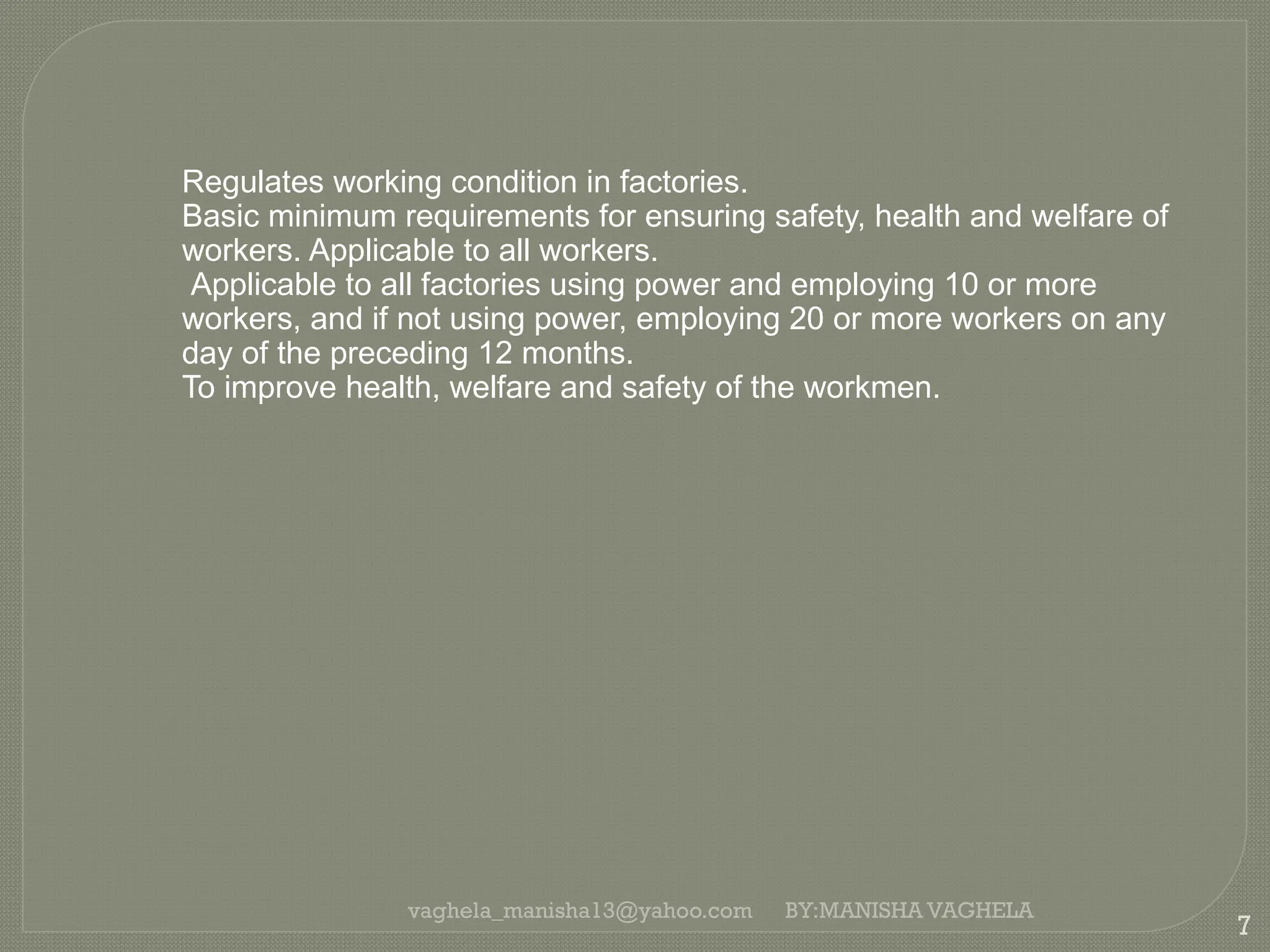
Regulates workingcondition in factories.
Basic minimum requirements for ensuring safety, health and welfare of
workers. Applicable to all workers.
Applicable to all factories using power and employing 10 or more
workers, and if not using power, employing 20 or more workers on any
day of the preceding 12 months.
To improve health, welfare and safety of the workmen.
8.
vaghela_manisha13@yahoo.com
8
BY:MANISHA VAGHELA
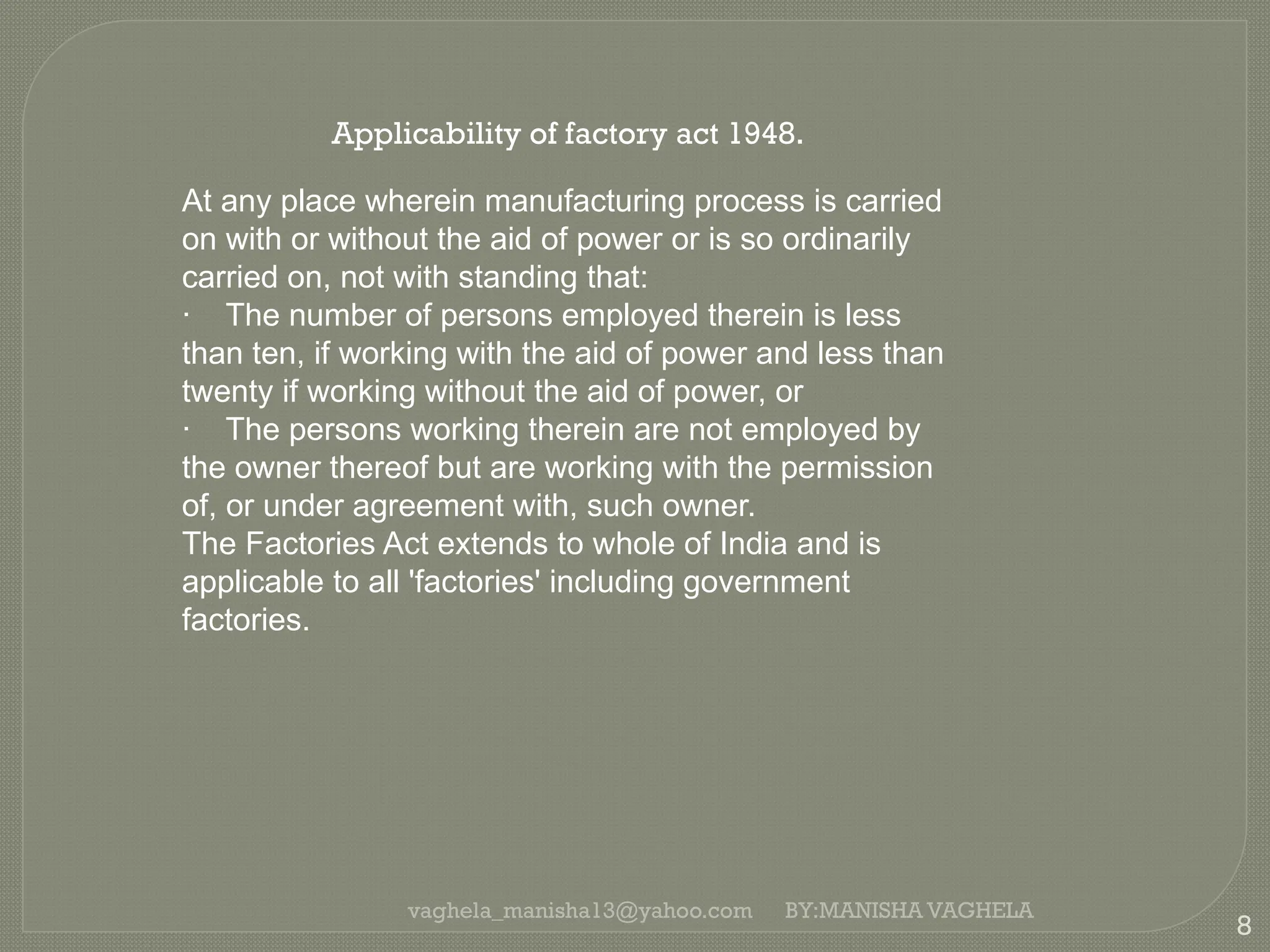
Applicability offactory act 1948.
At any place wherein manufacturing process is carried
on with or without the aid of power or is so ordinarily
carried on, not with standing that:
· The number of persons employed therein is less
than ten, if working with the aid of power and less than
twenty if working without the aid of power, or
· The persons working therein are not employed by
the owner thereof but are working with the permission
of, or under agreement with, such owner.
The Factories Act extends to whole of India and is
applicable to all 'factories' including government
factories.
9.
vaghela_manisha13@yahoo.com
9
BY:MANISHA VAGHELA
It appliesto all factories employing more than
10 people and working with the aid of power
or employing 20 people and working without
the aid of power.
Factory however does not include a mine
covered under the mines Act, 1952, a mobile
unit of the armed forces, a railway shed or a
hotel, restaurant or eating place.
10.
vaghela_manisha13@yahoo.com
10
BY:MANISHA VAGHELA
Importance offactory act 1948
No adult worker shall be required or allowed to work in a factory:-
(i) for more than forty-eight hours in any week; and/ or (ii) for more
than nine hours in any day.
Where a worker works in a factory for more than nine hours in any
day or for more than forty-eight hours in any week, he shall, in
respect of overtime work, be entitled to wages at the rate of twice
his ordinary rate of wages.
11.
vaghela_manisha13@yahoo.com
11
BY:MANISHA VAGHELA
The 'ordinaryrate of wages' means the basic wages
plus such allowances, including the cash equivalent
of the advantage accruing through the concessional
sale to workers of food grains and other articles, as
the worker is for the time being entitled to, but does
not include a bonus and wages for overtime work.
Where a worker is deprived of any of the weekly
holidays, he shall be allowed, within the month in
which the holidays were due to him or within the two
months immediately following that month,
compensatory holidays of equal number to the
holidays so lost.
12.
vaghela_manisha13@yahoo.com
12
BY:MANISHA VAGHELA
The periodsof work of adult workers in a factory
each day shall be so fixed that no period shall
exceed five hours and that no worker shall work for
more than five hours before he has had an interval
for rest of at least half an hour.
Adequate provisions have been made for
enforcement of the provisions of the act by
appointing factory inspectors.
Provisions are also made for appointment of
occupier of factory and various obligations of the
occupier have been set out in the act.
Additional provisions have been made for various
offences and penalties for the offences.
13.
vaghela_manisha13@yahoo.com
13
BY:MANISHA VAGHELA
Detailed provisionsare also made for the working hours,
holidays, leaves, leave with wages and overtime payment,
etc.
separate provisions are made for employment of young
persons, which include children and adolescents. The
employment of children below 14 years of age was stopped.
14.
vaghela_manisha13@yahoo.com
14
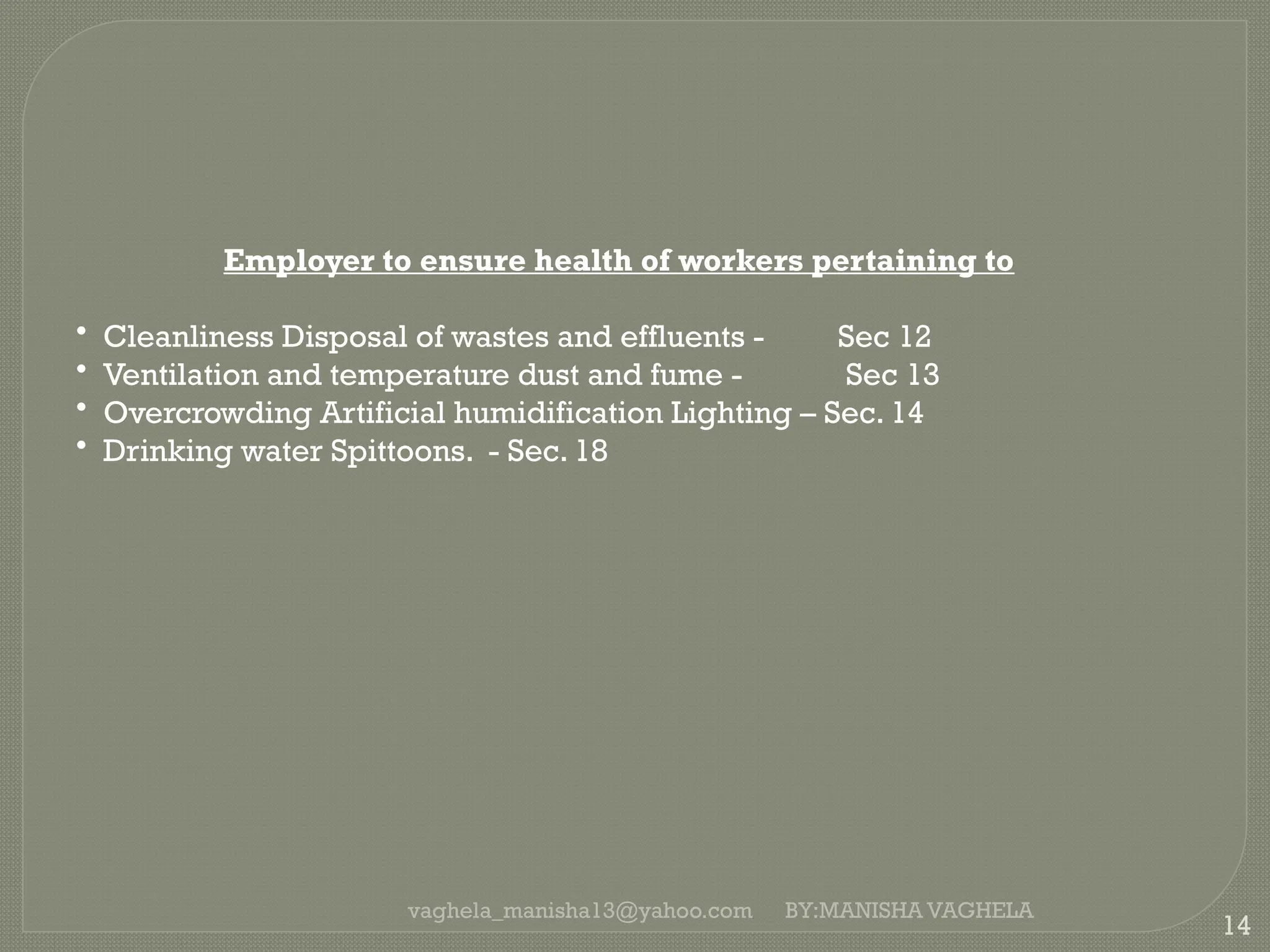
Employer to ensurehealth of workers pertaining to
• Cleanliness Disposal of wastes and effluents - Sec 12
• Ventilation and temperature dust and fume - Sec 13
• Overcrowding Artificial humidification Lighting – Sec. 14
• Drinking water Spittoons. - Sec. 18
BY:MANISHA VAGHELA
15.
vaghela_manisha13@yahoo.com
15
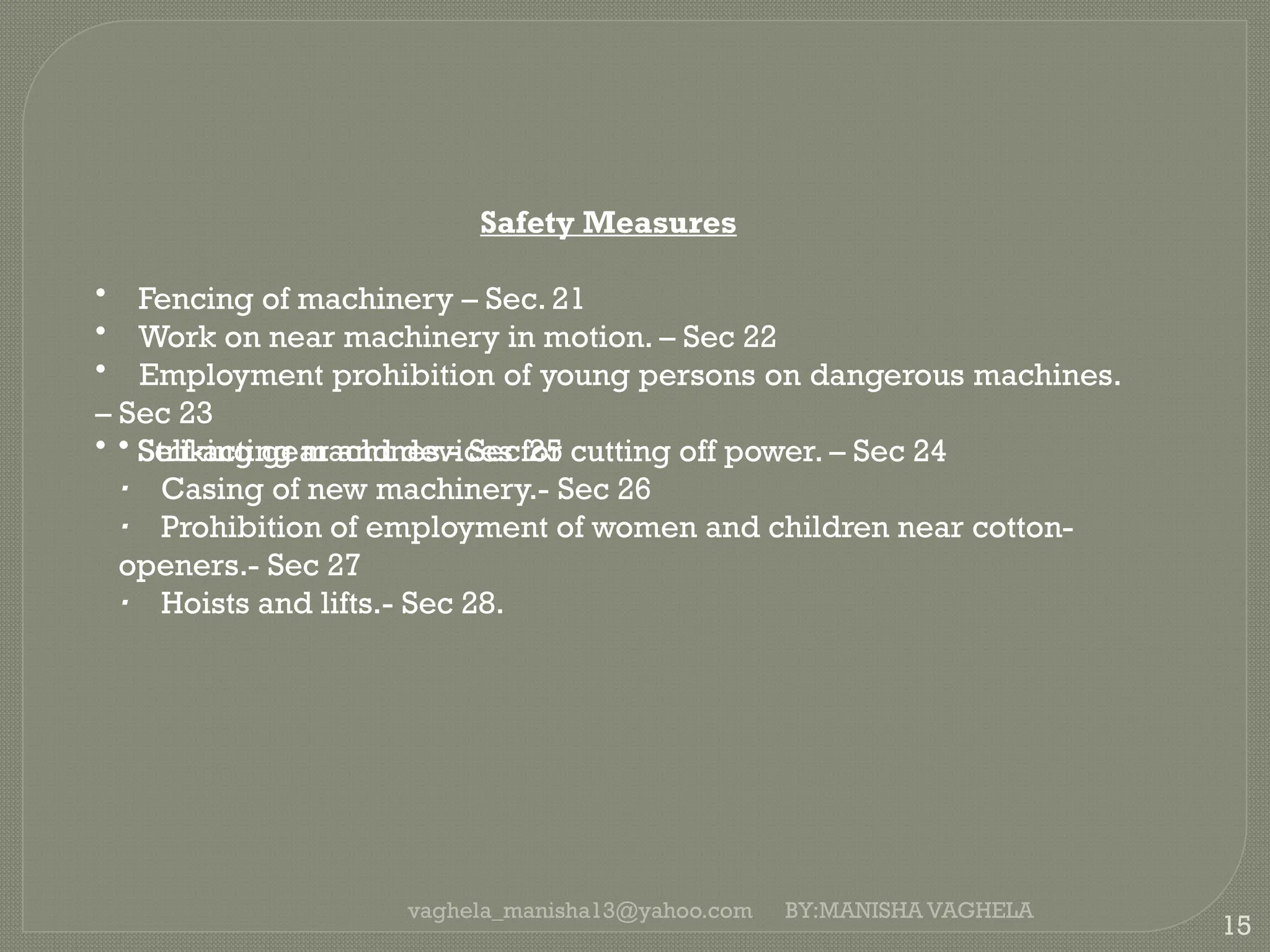
Safety Measures
• Fencingof machinery – Sec. 21
• Work on near machinery in motion. – Sec 22
• Employment prohibition of young persons on dangerous machines.
– Sec 23
• Striking gear and devices for cutting off power. – Sec 24
• Self-acting machines.- Sec 25
· Casing of new machinery.- Sec 26
· Prohibition of employment of women and children near cotton-
openers.- Sec 27
· Hoists and lifts.- Sec 28.
BY:MANISHA VAGHELA
16.
vaghela_manisha13@yahoo.com
16
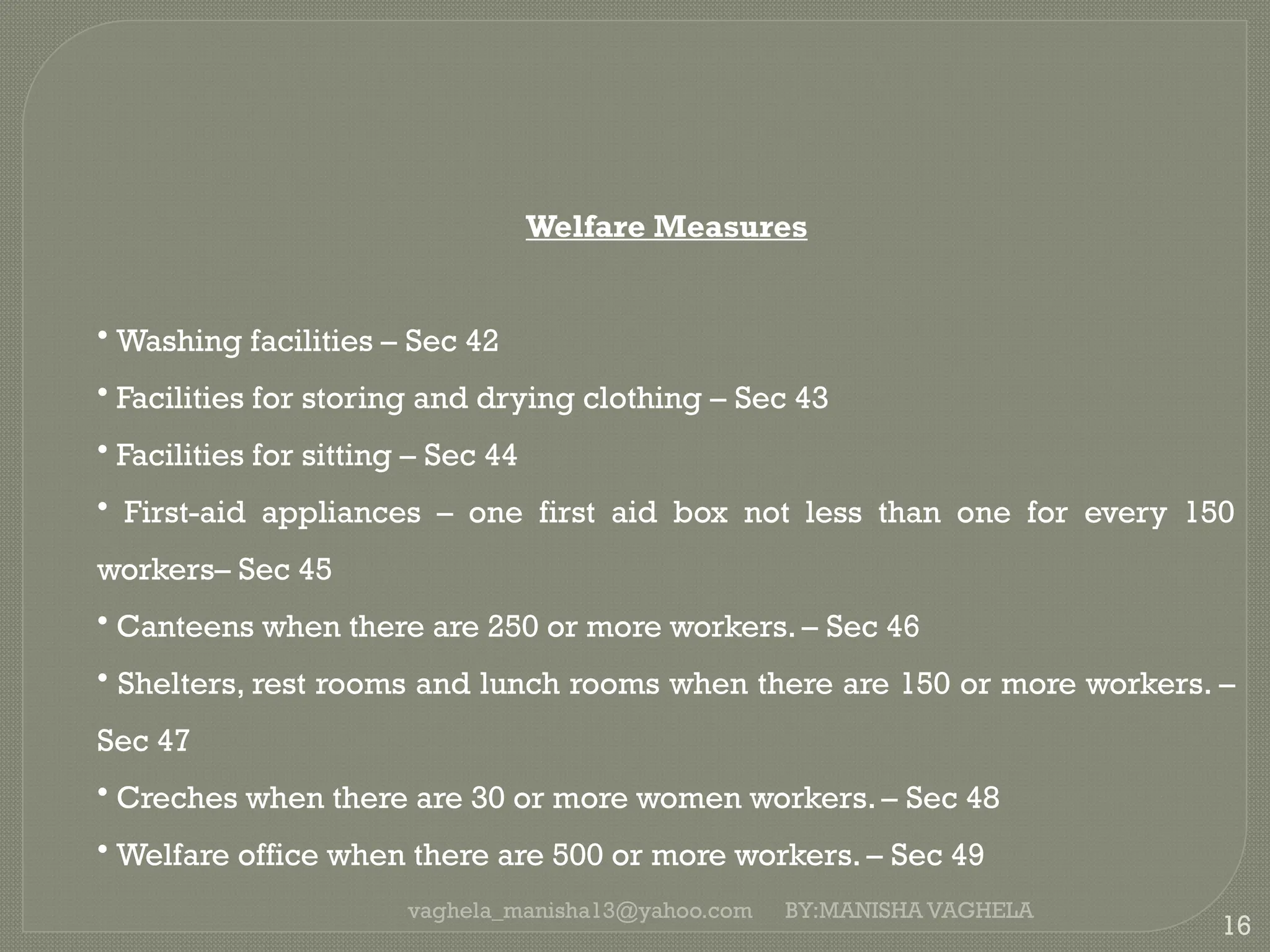
Welfare Measures
• Washingfacilities – Sec 42
• Facilities for storing and drying clothing – Sec 43
• Facilities for sitting – Sec 44
• First-aid appliances – one first aid box not less than one for every 150
workers– Sec 45
• Canteens when there are 250 or more workers. – Sec 46
• Shelters, rest rooms and lunch rooms when there are 150 or more workers. –
Sec 47
• Creches when there are 30 or more women workers. – Sec 48
• Welfare office when there are 500 or more workers. – Sec 49
BY:MANISHA VAGHELA
17.
vaghela_manisha13@yahoo.com
17
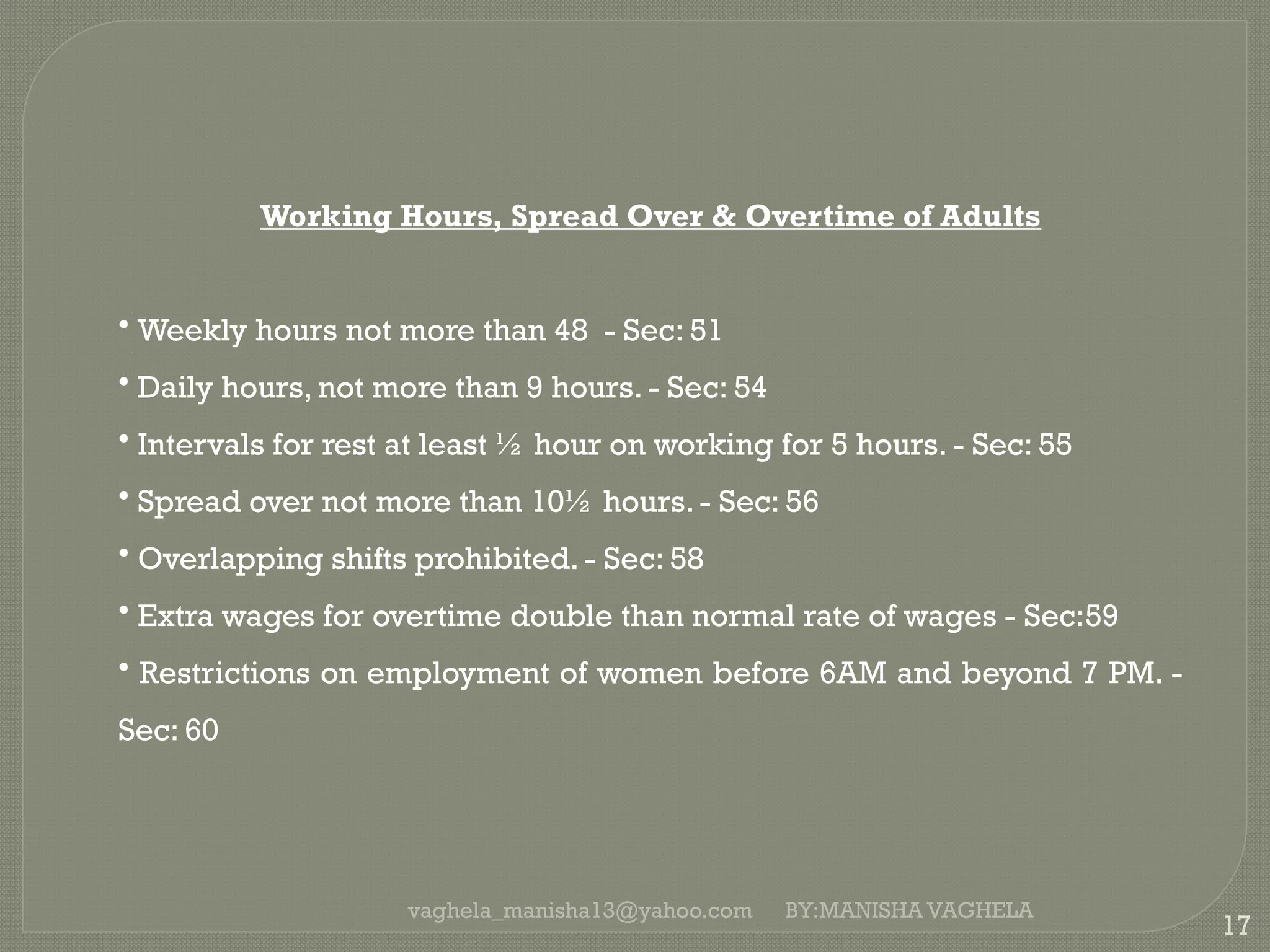
Working Hours, SpreadOver & Overtime of Adults
• Weekly hours not more than 48 - Sec: 51
• Daily hours, not more than 9 hours. - Sec: 54
• Intervals for rest at least ½ hour on working for 5 hours. - Sec: 55
• Spread over not more than 10½ hours. - Sec: 56
• Overlapping shifts prohibited. - Sec: 58
• Extra wages for overtime double than normal rate of wages - Sec:59
• Restrictions on employment of women before 6AM and beyond 7 PM. -
Sec: 60
BY:MANISHA VAGHELA
18.
vaghela_manisha13@yahoo.com
18
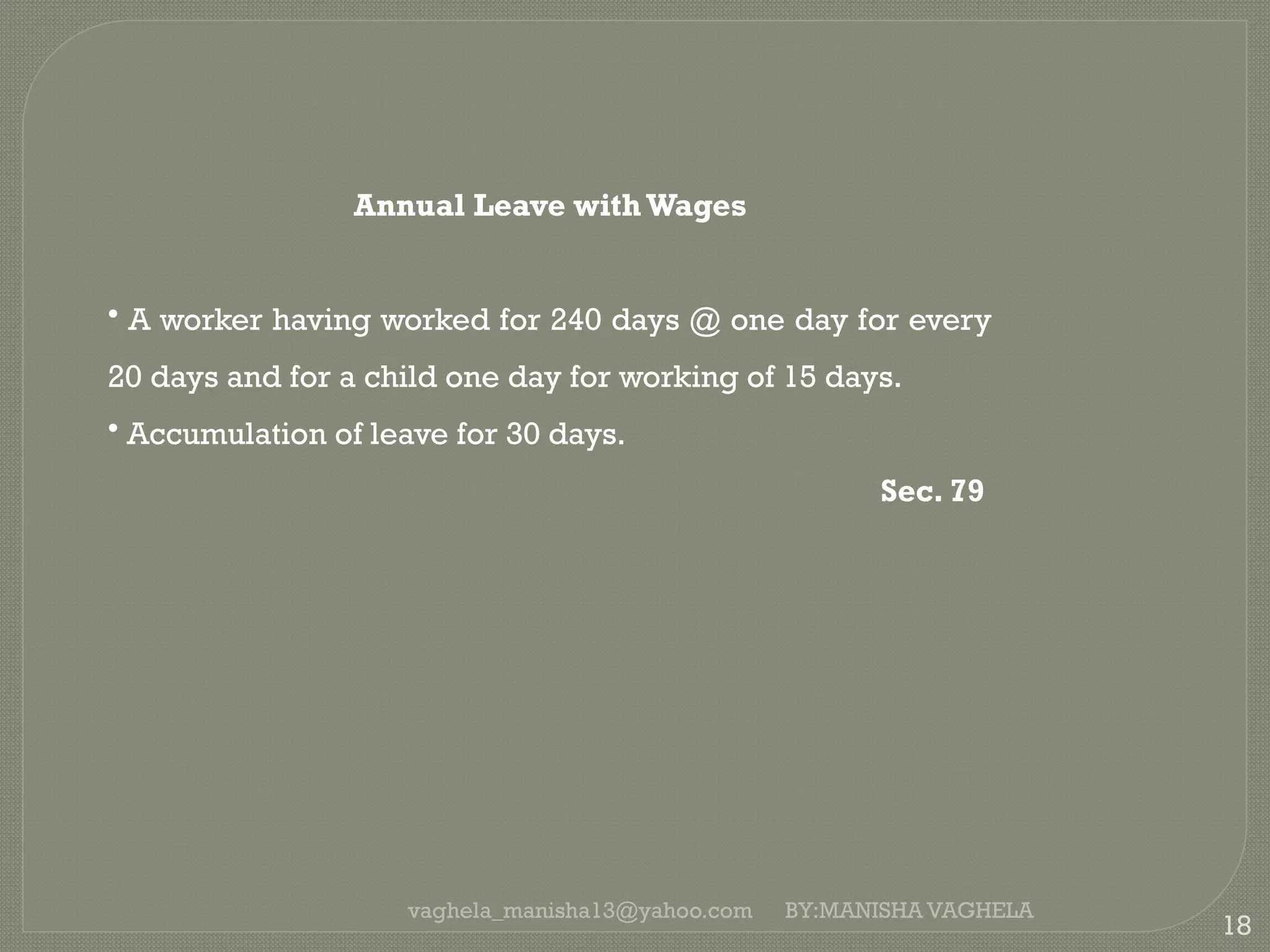
Annual Leave withWages
•A worker having worked for 240 days @ one day for every
20 days and for a child one day for working of 15 days.
• Accumulation of leave for 30 days.
Sec. 79
BY:MANISHA VAGHELA
19.
vaghela_manisha13@yahoo.com
19
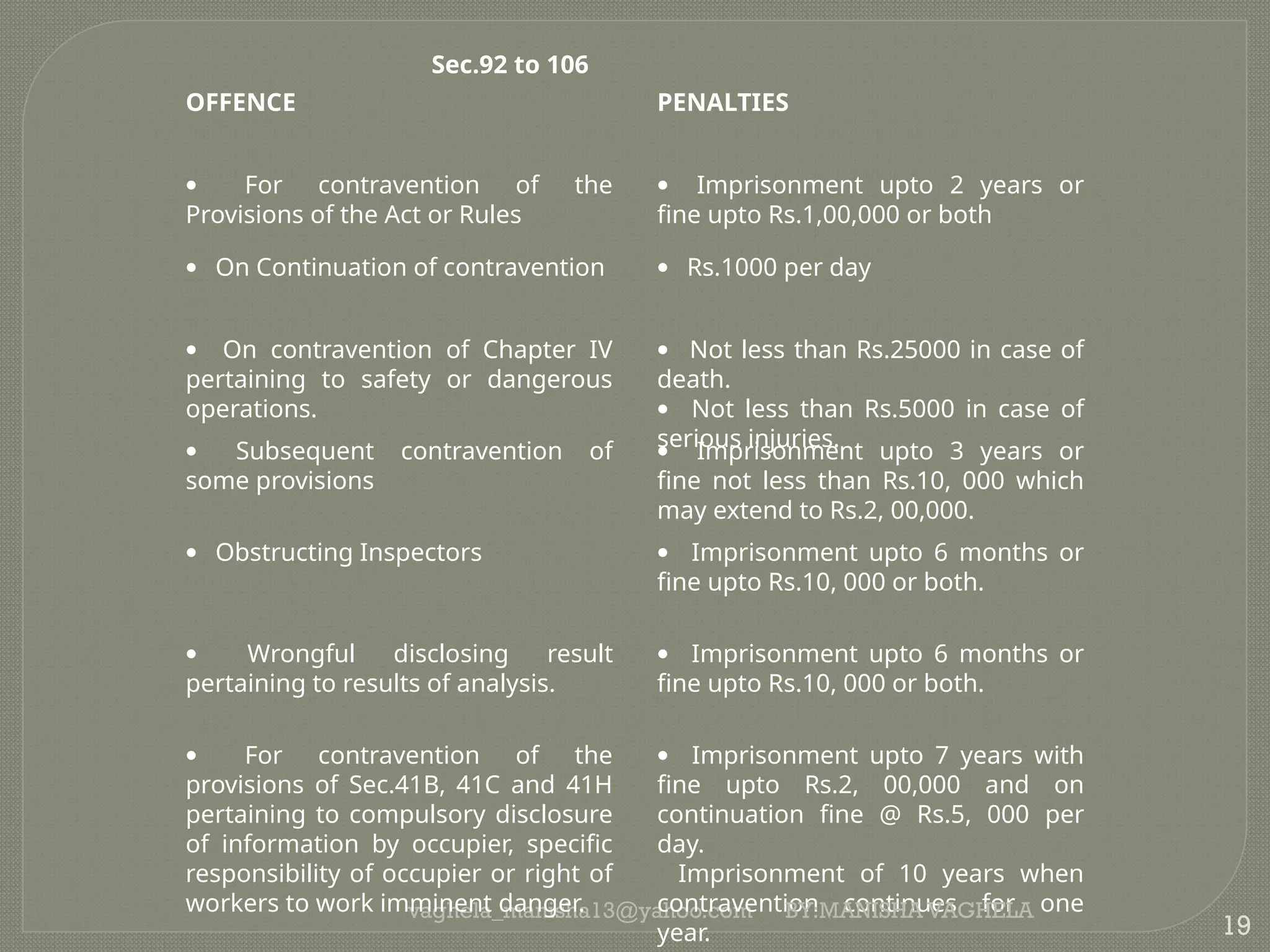
OFFENCE PENALTIES
· Forcontravention of the
Provisions of the Act or Rules
· Imprisonment upto 2 years or
fine upto Rs.1,00,000 or both
· On Continuation of contravention · Rs.1000 per day
· On contravention of Chapter IV
pertaining to safety or dangerous
operations.
· Not less than Rs.25000 in case of
death.
· Not less than Rs.5000 in case of
serious injuries.
· Subsequent contravention of
some provisions
· Imprisonment upto 3 years or
fine not less than Rs.10, 000 which
may extend to Rs.2, 00,000.
· Obstructing Inspectors · Imprisonment upto 6 months or
fine upto Rs.10, 000 or both.
· Wrongful disclosing result
pertaining to results of analysis.
· Imprisonment upto 6 months or
fine upto Rs.10, 000 or both.
· For contravention of the
provisions of Sec.41B, 41C and 41H
pertaining to compulsory disclosure
of information by occupier, specific
responsibility of occupier or right of
workers to work imminent danger.
· Imprisonment upto 7 years with
fine upto Rs.2, 00,000 and on
continuation fine @ Rs.5, 000 per
day.
Imprisonment of 10 years when
contravention continues for one
year.
Sec.92 to 106
BY:MANISHA VAGHELA