FOOD ANALYSIS
ADVANCED ANALYSIS OF
CARBOHYDRATE IN FOOD
PRESENTED BY,
SURIYA PRIYA . K
1ST YEAR M . PHARM
DEPARTMENT OF PHARMACEUTICAL ANALYSIS
KMCH COLLEGE OF PHARMACY
1
CONTENTS:
1.Introduction
• Simple carbohydrates : Monosaccharides and disaccharides
• Oligosaccharides
• Polysaccharides
2.Sample preparation for carbohydrates analysis
• Extraction and Fractionation
• Chemical treaments
3.Advanced analysis of carbohydrates in Food
• Gas Chromotography
• High performance liquid chromatography
• Capillary electrophoresis
2
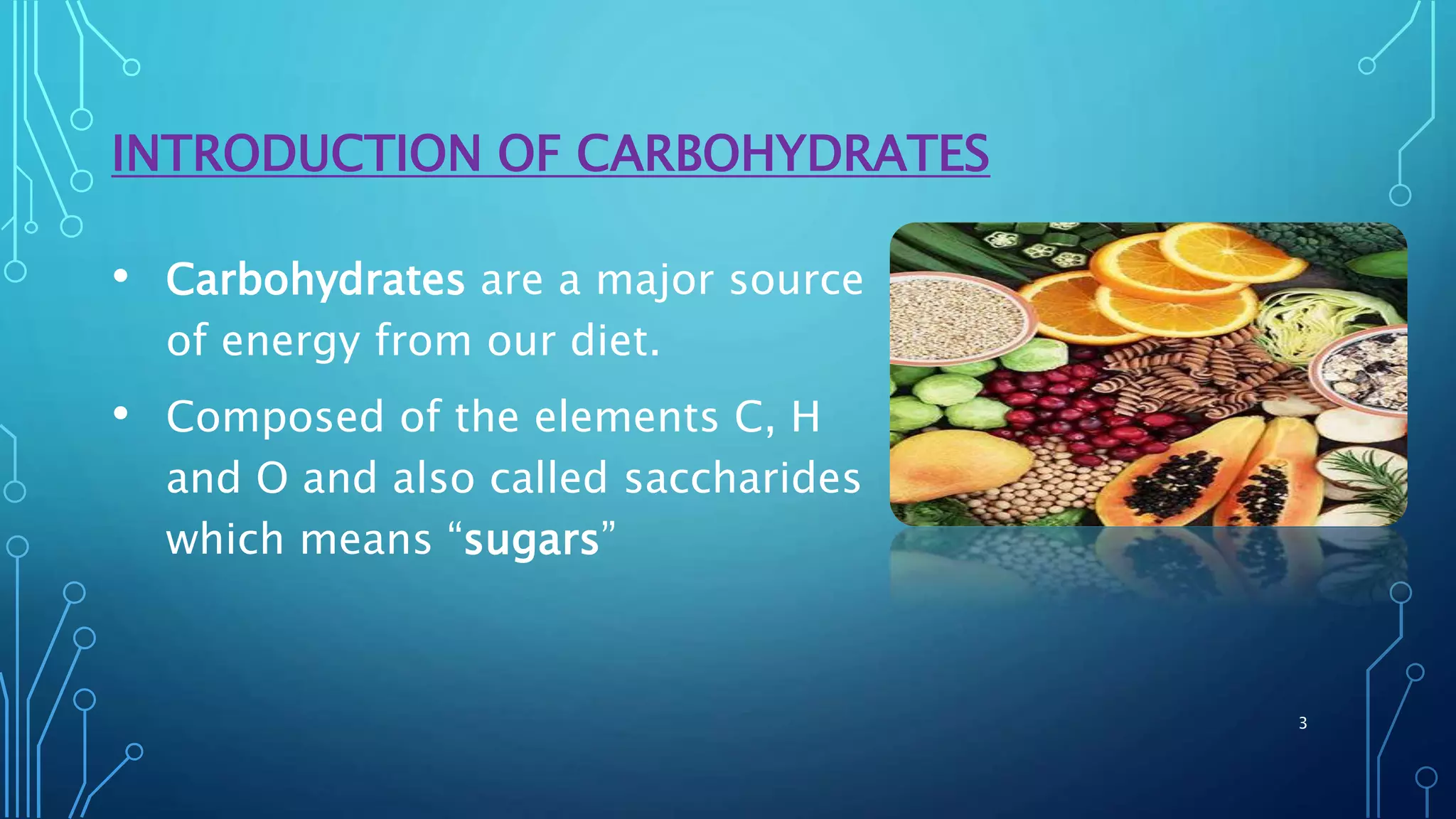
INTRODUCTION OF CARBOHYDRATES
• Carbohydrates are a major source
of energy from our diet.
• Composed of the elements C, H
and O and also called saccharides
which means “sugars”
3
Carbohydrates are sugars and provide energy when consumed .
• Our bodies down carbohydrates to extract energy. Carbon dioxide and
water are released in the process.
• Carbohydrates are classified as biomolecules.
• Glucose is the primary carbohydrate our bodies use to produce energy.
TO BE CONTINUED ,
4
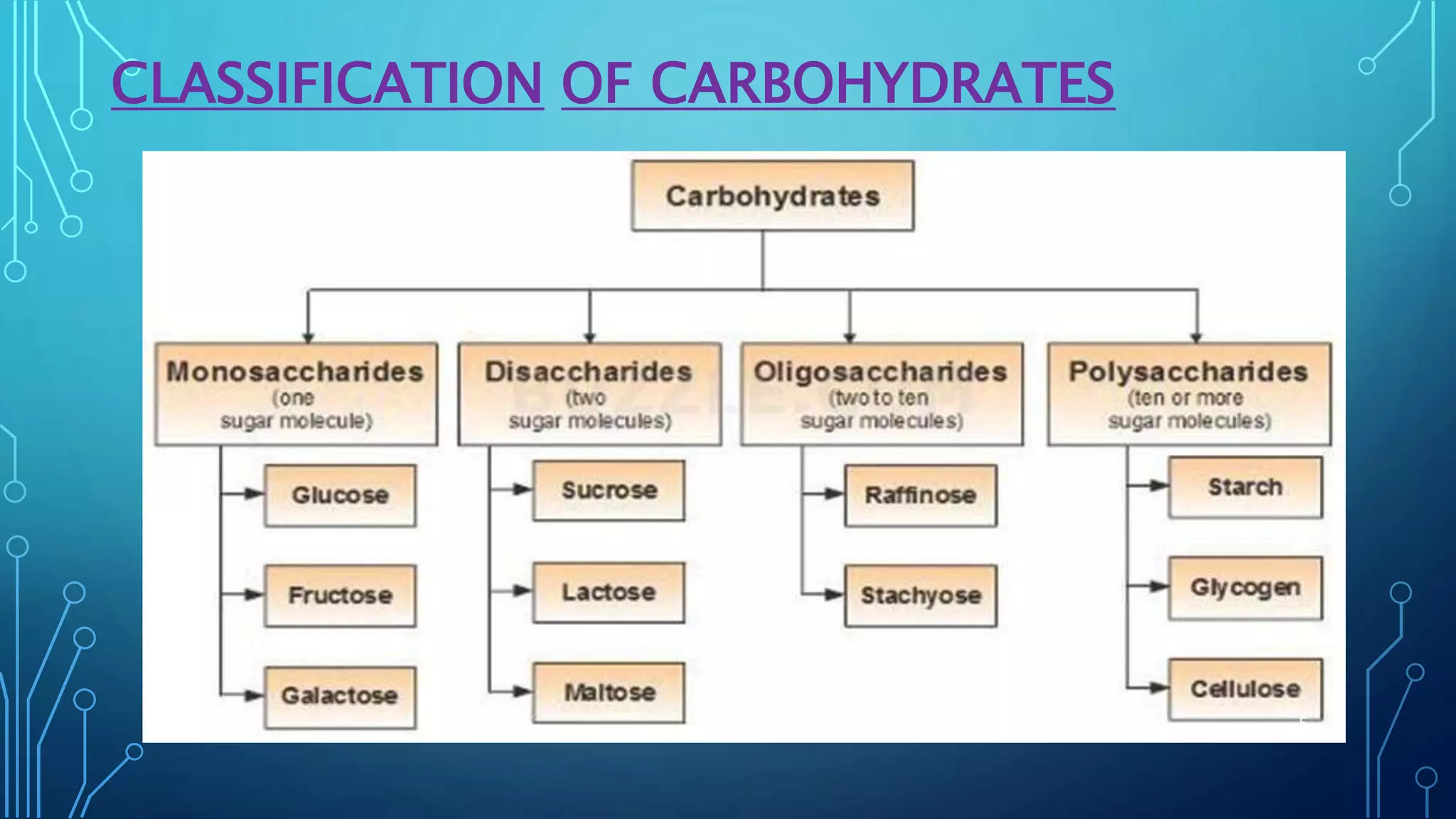
CLASSIFICATION OF CARBOHYDRATES
5
MONOSACCHARIDES
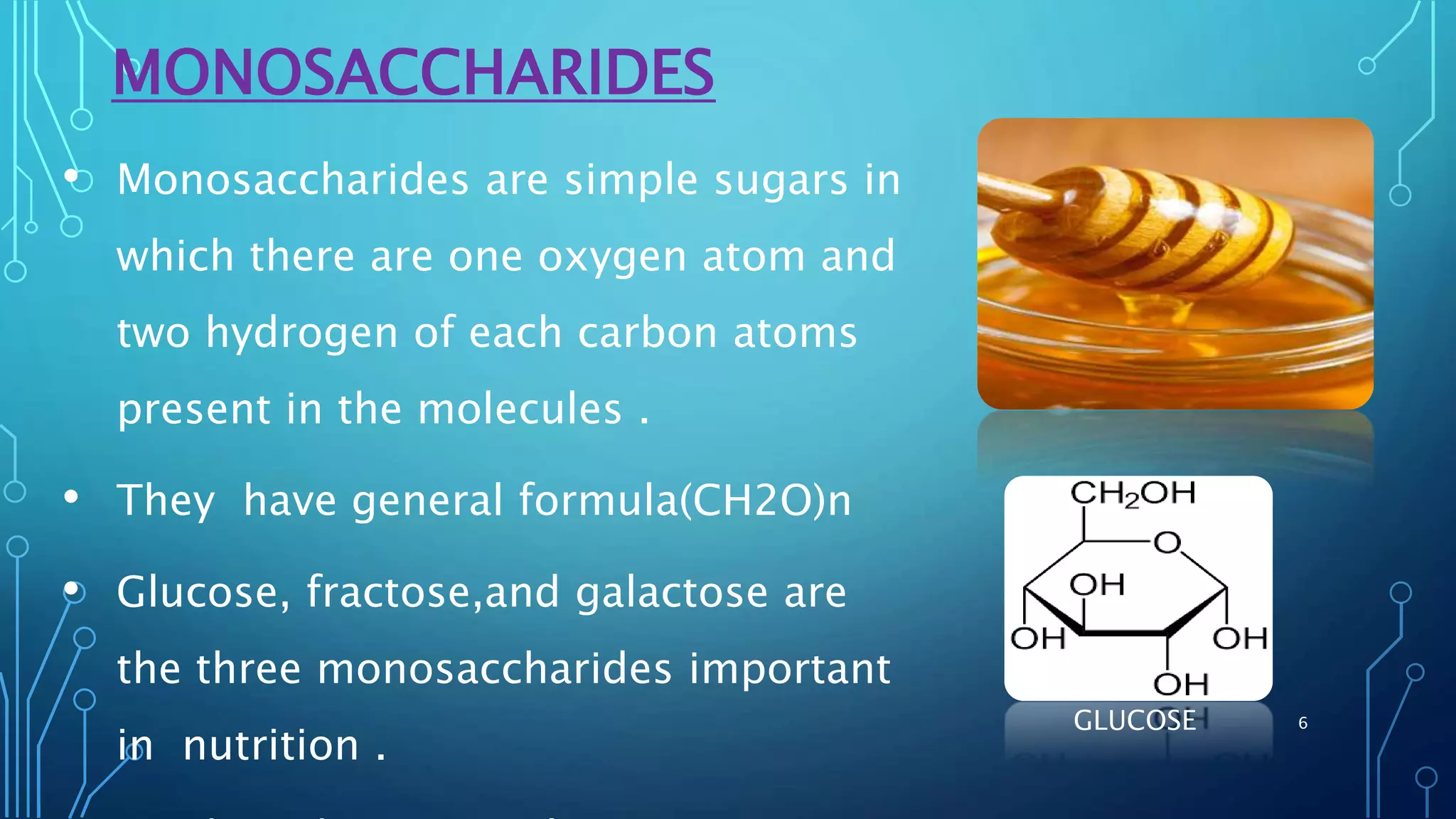
• Monosaccharides are simple sugars in
which there are one oxygen atom and
two hydrogen of each carbon atoms
present in the molecules .
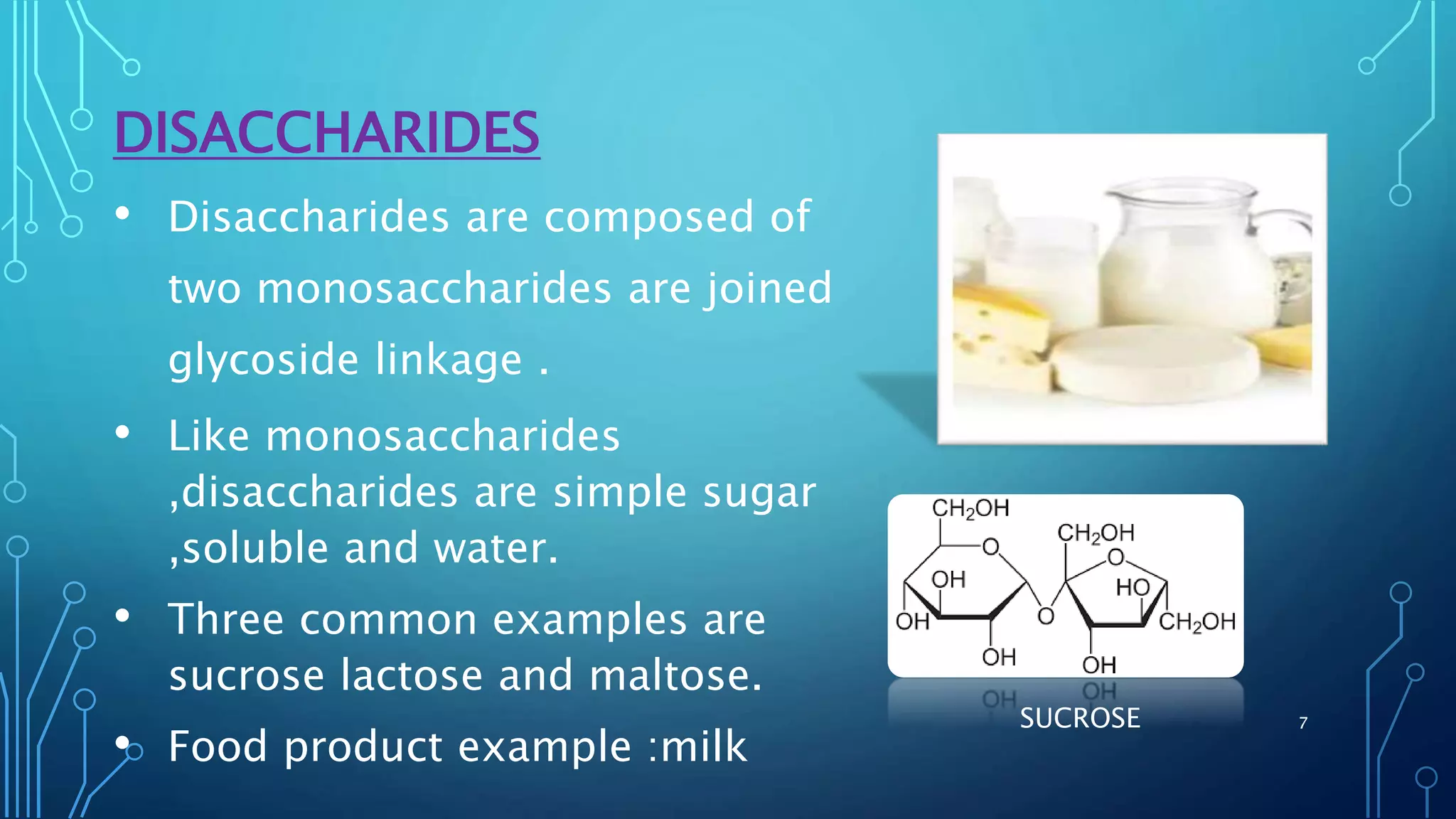
• They have general formula(CH2O)n
• Glucose, fractose,and galactose are
the three monosaccharides important
in nutrition .
GLUCOSE 6
DISACCHARIDES
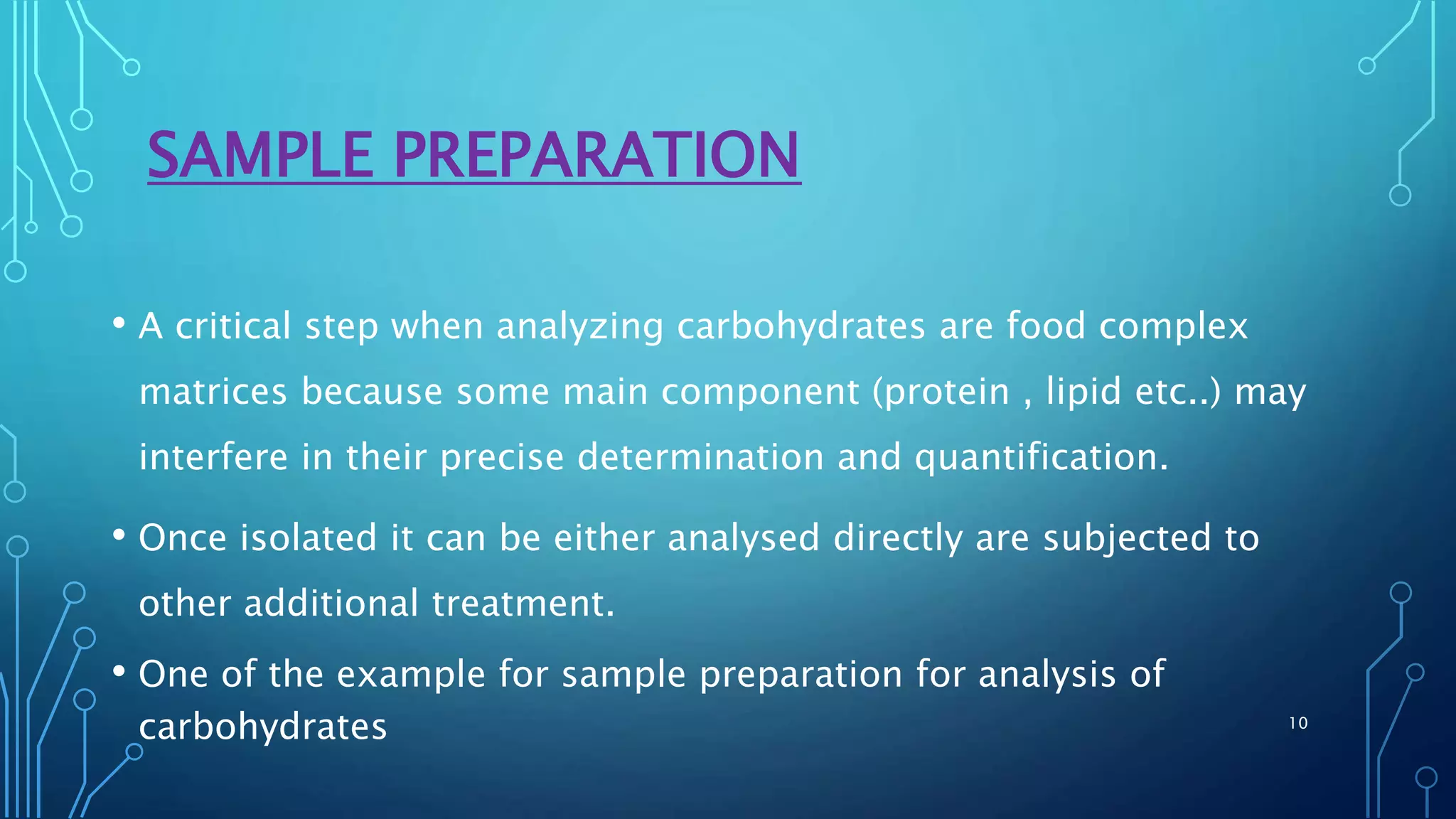
• Disaccharides are composed of
two monosaccharides are joined
glycoside linkage .
• Like monosaccharides
,disaccharides are simple sugar
,soluble and water.
• Three common examples are
sucrose lactose and maltose.
• Food product example :milk
SUCROSE 7
OLIGOSACCHARID
ES
• Oligosaccharides are the type of
carbohydrates formed when three
to 10 simples sugars are joined
together.
• Eg : Raffinose, stachyose
• Food product example : onion 8
POLYSACCHARIDES
• A polysaccharides is a large molecule
made of many smaller
monosaccharides.
• A special enzyme had more small
monomers together creating large
sugar polymers or polysaccharides.
• A polysaccharides is also called as
glycan.
• Eg: starch, glycogen and cellulose etc.
• Food product example : Grains ,
9
SAMPLE PREPARATION
• A critical step when analyzing carbohydrates are food complex
matrices because some main component (protein , lipid etc..) may
interfere in their precise determination and quantification.
• Once isolated it can be either analysed directly are subjected to
other additional treatment.
• One of the example for sample preparation for analysis of
carbohydrates 10
ONE WAY OF SAMPLE PREPARATION :
11
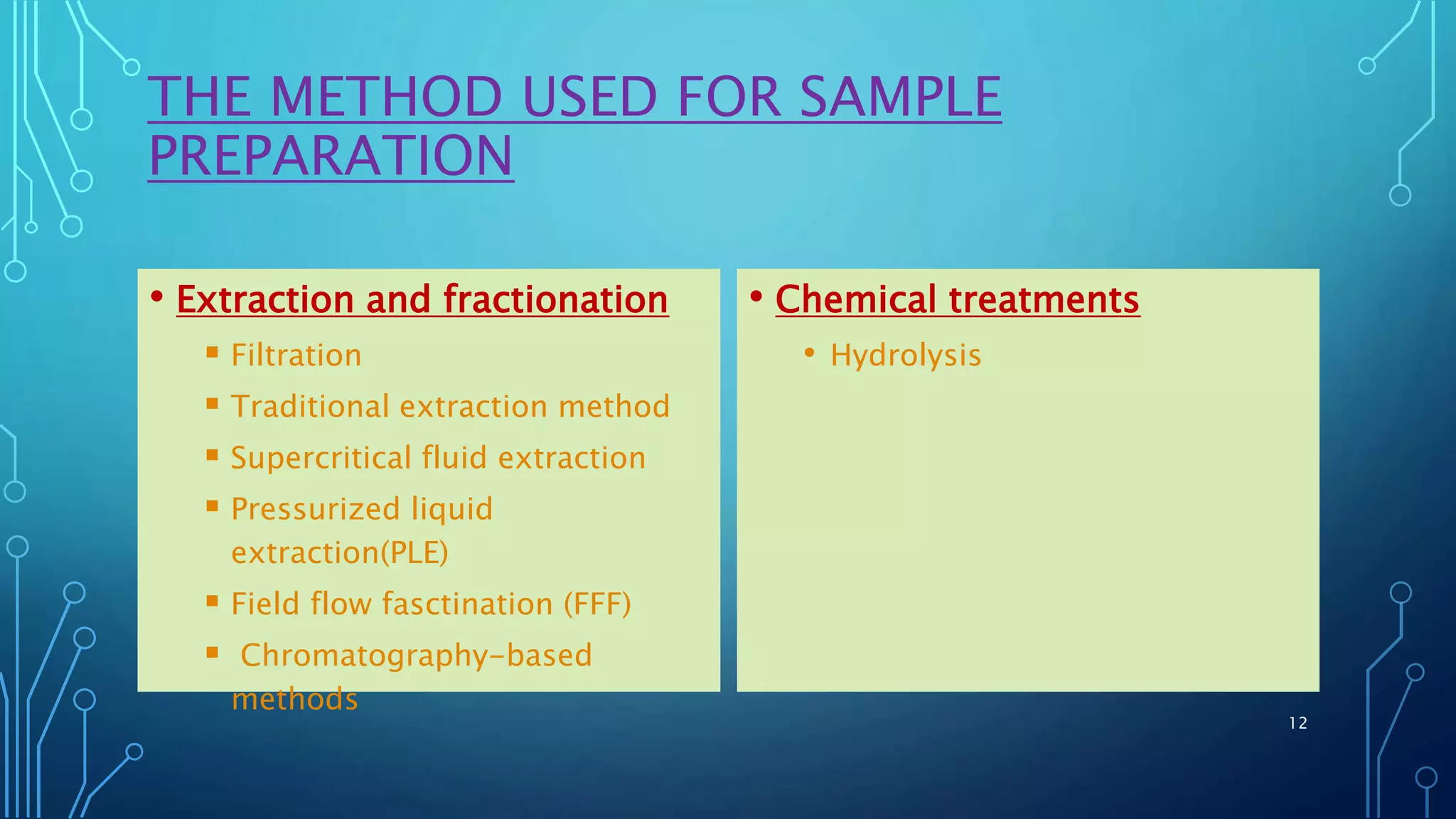
THE METHOD USED FOR SAMPLE
PREPARATION
• Extraction and fractionation
 Filtration
 Traditional extraction method
 Supercritical fluid extraction
 Pressurized liquid
extraction(PLE)
 Field flow fasctination (FFF)
 Chromatography-based
methods
• Chemical treatments
• Hydrolysis
12
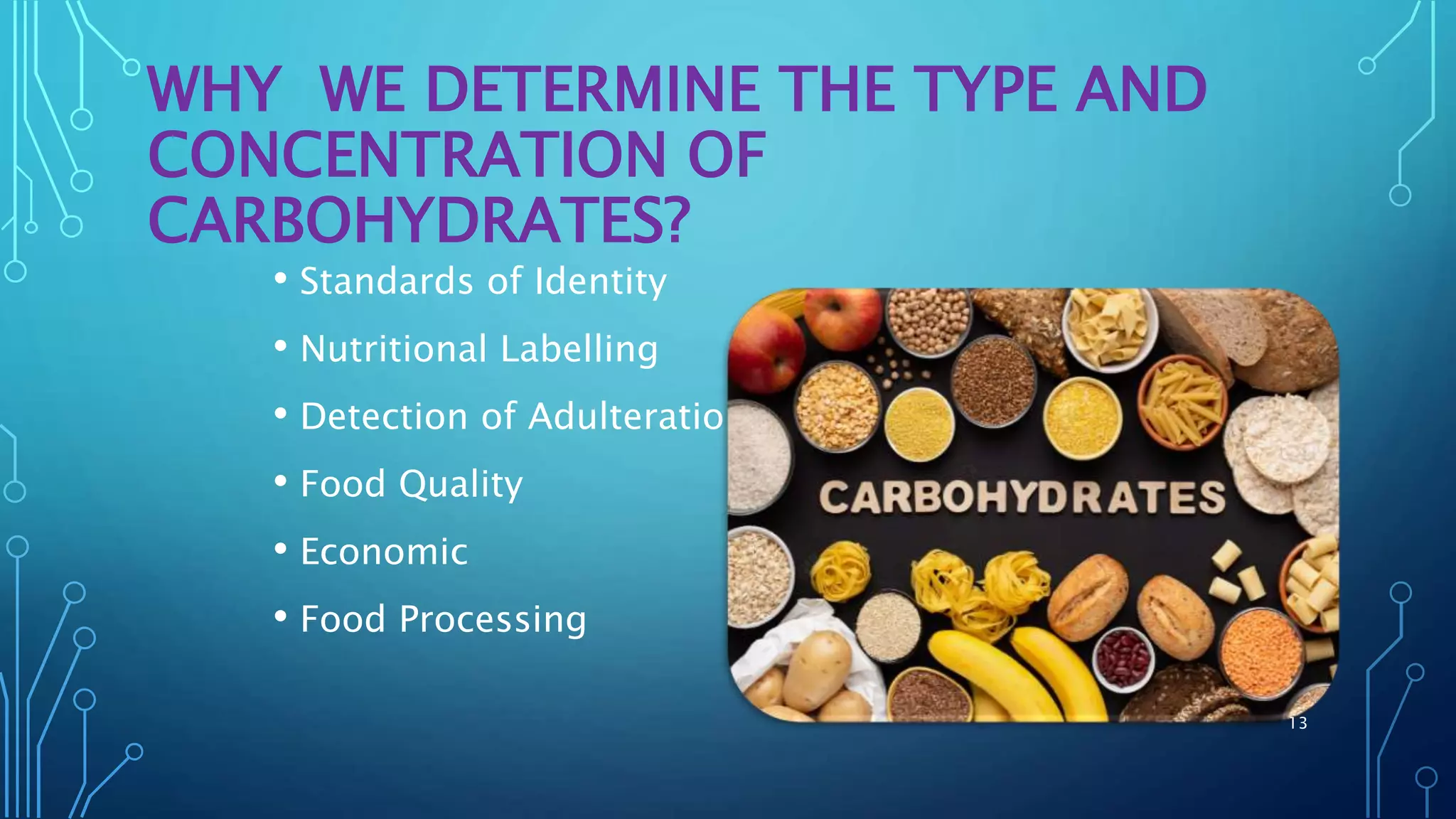
WHY WE DETERMINE THE TYPE AND
CONCENTRATION OF
CARBOHYDRATES?
• Standards of Identity
• Nutritional Labelling
• Detection of Adulteration
• Food Quality
• Economic
• Food Processing
13
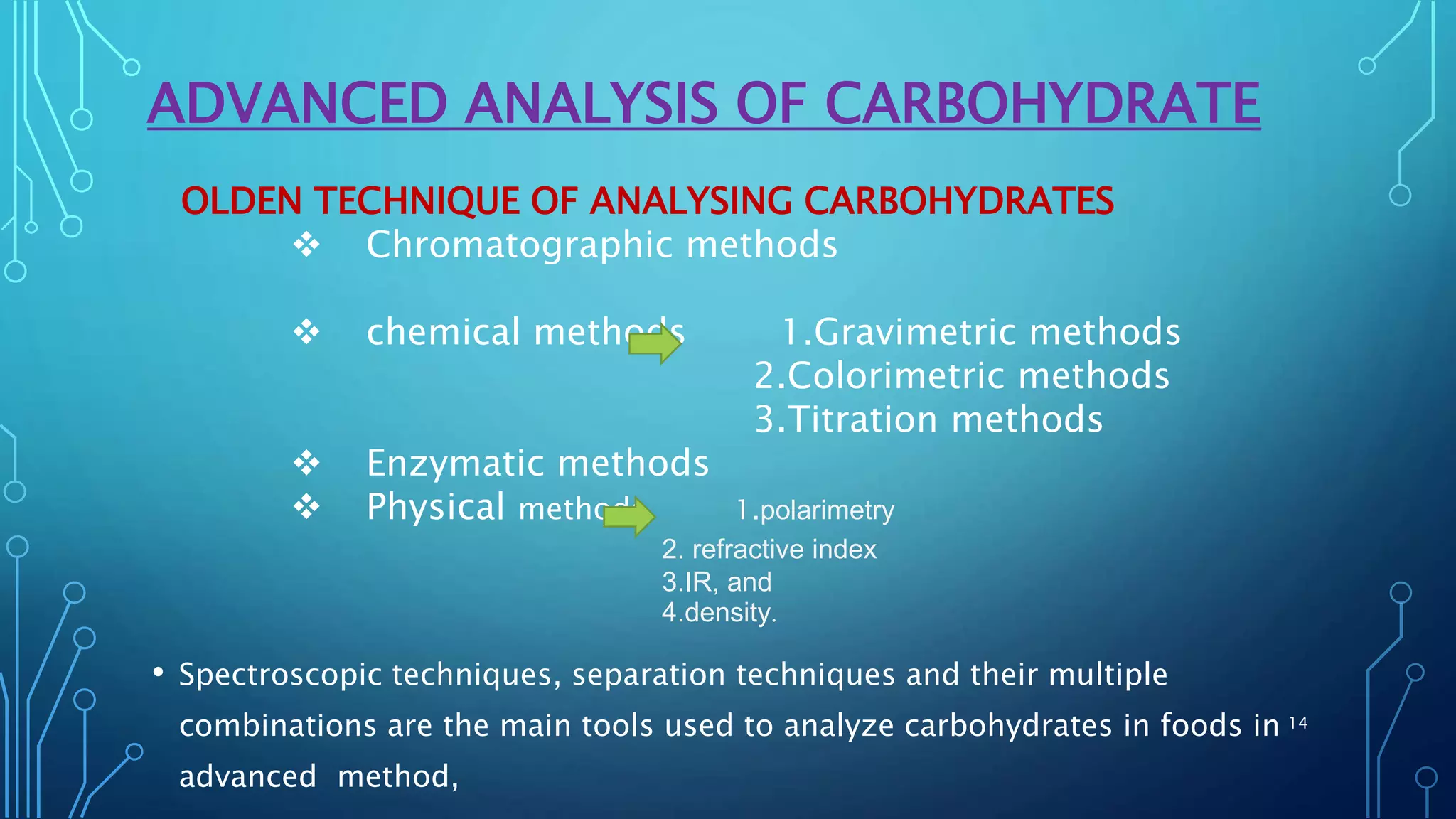
ADVANCED ANALYSIS OF CARBOHYDRATE
• Spectroscopic techniques, separation techniques and their multiple
combinations are the main tools used to analyze carbohydrates in foods in
advanced method,
OLDEN TECHNIQUE OF ANALYSING CARBOHYDRATES
 Chromatographic methods
 chemical methods 1.Gravimetric methods
2.Colorimetric methods
3.Titration methods
 Enzymatic methods
 Physical methods 1.polarimetry
2. refractive index
3.IR, and
4.density.
14
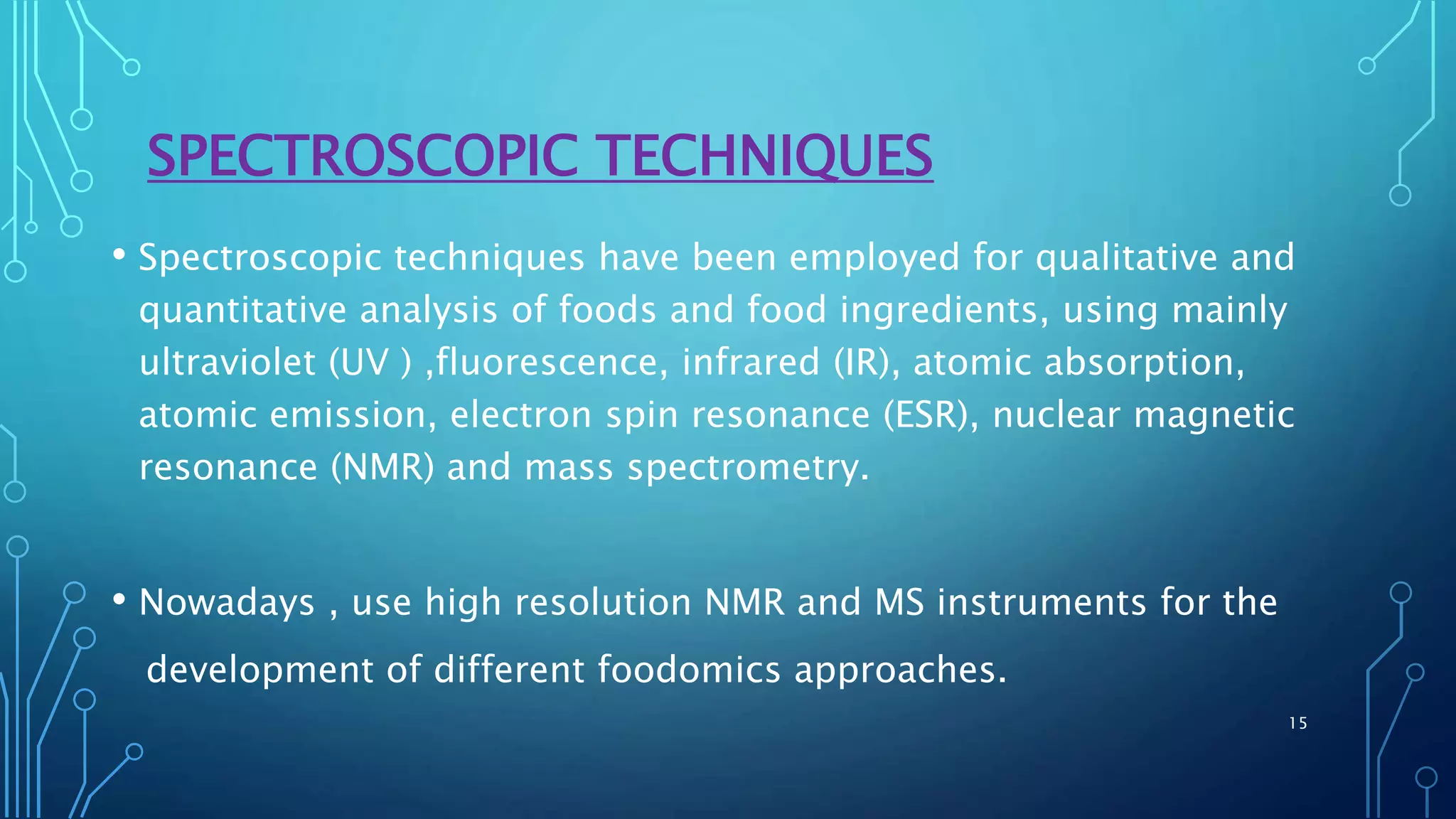
SPECTROSCOPIC TECHNIQUES
• Spectroscopic techniques have been employed for qualitative and
quantitative analysis of foods and food ingredients, using mainly
ultraviolet (UV ) ,fluorescence, infrared (IR), atomic absorption,
atomic emission, electron spin resonance (ESR), nuclear magnetic
resonance (NMR) and mass spectrometry.
• Nowadays , use high resolution NMR and MS instruments for the
development of different foodomics approaches.
15
NMR SPECTROSCOPY
NMR and MS techniques provide impressive possibilities
in food carbohydrates analysis and many structural
studies involve the application of identification and
characterization of food components.
NMR provide information related to the structure, purity and safety of
carbohydrate samples.
16
• NMR has been extensively employed for identification of food
carbohydrates and related compounds
• Eg: Characterization of very complex molecules containing
carbohydrates like coffee melanoidins.
• The application of 2D-NMR technique given information that
coffee melanoidins are based on condensed polyphenols.
• But previous studies indicates that they are formed by low
molecular weight chromophores bound to polysaccharides or
proteins. 17
MASS SPECTROMETRY (MS)
•MS is a powerful analytical technique used to identify
chemical compounds based on their different mass-
charge ratio (m/z).
•The chemical compound has to be ionized before
entering the MS analyzer electron impact ,ionization
(EI), chemical ionization (CI), electrospray etc, are
ionization techniques used for analysis of organic
18
• MALDI-TOF-MS is considered to be more sensitive for the detection
of larger oligosaccharides.
• Matrix-assisted laser desorption/ionization-time of flight (MALDI-
TOF) mass spectrometry (MS).
• Recently MALDI-TOF-MS applied for characterization of
oligosaccharides in some vegetable sample. Eg :Red onion
19
HPLC METHOD
• The analysis of carbohydrates is challenging due to their complex
structure and heterogeneity.
• To analyze carbohydrate content by HPLC, the test sample must
first be extracted and purified.
• Hydrolysis and derivatization techniques are used to release and
label carbohydrates for sensitive and selective detection.
20
CAPILLARY ELECTROPHORESIS METHOD
• Capillary electrophoresis has emerged as a highly promising
technique for the analysis of mono- and oligosaccharides.
• Based on the progress made, it can be concluded that capillary
electrophoresis represents a powerful alternative and complement
to existing methodology in the area of carbohydrate analysis.
21
GAS CHROMATOGRAPHY
• Due to the relatively low volatility of carbohydrates, GC analysis is
limited to derivatized sugars of low molecular weight, mainly
mono-, di- and trisaccharide.
• With suitable derivatives and appropriate GC conditions,
carbohydrates up to 12 monosaccharide units can be analyzed.
• Normally GC-FID (Flame ionization detection) is commonly used for
identification.
22
TO BE CONTINUED,
• Now a days GC-MS implied and it was possible to identify for
the first time trimethylsilyl oximes of scylloinositol and
sedoheptulose in the carrot chemical composition.
23
REFERENCE
• Miguel Herrero, Alejandro Cifuentes, Elena Ibáñez, Maria Dolores del Castillo
• Department of Food Analysis, Institute of Industrial Fermentations (CSIC), Juan de la Cuervo 3, 28006 Madrid, Spain
• Journal of Chromatography B
• Volume 879, Issues 17–18, 15 May 2011, Pages 1226-1240
• Analysis of carbohydrates in food slide share website
• https://pubs.acs.org/action/cookieAbsent#:~:text=Mass%20spectrometry%20is%20a%20promising,food%20authentic
ation%2C%20and%20marker%20detection
• https://www.researchgate.net/publication/301698343_HPLC_for_Carbohydrate_Analysis#:~:text=The%20analysis%20
of%20carbohydrates%20is,their%20complex%20structure%20and%20heterogeneity.&text=To%20analyze%20carbohydr
ate%20content%20by,for%20sensitive%20and%20selective%20detection
• https://people.umass.edu/~mcclemen/581Carbohydrates.html
24
25

ADVANCED ANALYSIS OF CARBOHYDRATES ,ANALYSIS OF CARBOHYDRATES IN FOOD MATRICES

  • 1.
    FOOD ANALYSIS ADVANCED ANALYSISOF CARBOHYDRATE IN FOOD PRESENTED BY, SURIYA PRIYA . K 1ST YEAR M . PHARM DEPARTMENT OF PHARMACEUTICAL ANALYSIS KMCH COLLEGE OF PHARMACY 1
  • 2.
    CONTENTS: 1.Introduction • Simple carbohydrates: Monosaccharides and disaccharides • Oligosaccharides • Polysaccharides 2.Sample preparation for carbohydrates analysis • Extraction and Fractionation • Chemical treaments 3.Advanced analysis of carbohydrates in Food • Gas Chromotography • High performance liquid chromatography • Capillary electrophoresis 2
  • 3.
    INTRODUCTION OF CARBOHYDRATES •Carbohydrates are a major source of energy from our diet. • Composed of the elements C, H and O and also called saccharides which means “sugars” 3
  • 4.
    Carbohydrates are sugarsand provide energy when consumed . • Our bodies down carbohydrates to extract energy. Carbon dioxide and water are released in the process. • Carbohydrates are classified as biomolecules. • Glucose is the primary carbohydrate our bodies use to produce energy. TO BE CONTINUED , 4
  • 5.
  • 6.
    MONOSACCHARIDES • Monosaccharides aresimple sugars in which there are one oxygen atom and two hydrogen of each carbon atoms present in the molecules . • They have general formula(CH2O)n • Glucose, fractose,and galactose are the three monosaccharides important in nutrition . GLUCOSE 6
  • 7.
    DISACCHARIDES • Disaccharides arecomposed of two monosaccharides are joined glycoside linkage . • Like monosaccharides ,disaccharides are simple sugar ,soluble and water. • Three common examples are sucrose lactose and maltose. • Food product example :milk SUCROSE 7
  • 8.
    OLIGOSACCHARID ES • Oligosaccharides arethe type of carbohydrates formed when three to 10 simples sugars are joined together. • Eg : Raffinose, stachyose • Food product example : onion 8
  • 9.
    POLYSACCHARIDES • A polysaccharidesis a large molecule made of many smaller monosaccharides. • A special enzyme had more small monomers together creating large sugar polymers or polysaccharides. • A polysaccharides is also called as glycan. • Eg: starch, glycogen and cellulose etc. • Food product example : Grains , 9
  • 10.
    SAMPLE PREPARATION • Acritical step when analyzing carbohydrates are food complex matrices because some main component (protein , lipid etc..) may interfere in their precise determination and quantification. • Once isolated it can be either analysed directly are subjected to other additional treatment. • One of the example for sample preparation for analysis of carbohydrates 10
  • 11.
    ONE WAY OFSAMPLE PREPARATION : 11
  • 12.
    THE METHOD USEDFOR SAMPLE PREPARATION • Extraction and fractionation  Filtration  Traditional extraction method  Supercritical fluid extraction  Pressurized liquid extraction(PLE)  Field flow fasctination (FFF)  Chromatography-based methods • Chemical treatments • Hydrolysis 12
  • 13.
    WHY WE DETERMINETHE TYPE AND CONCENTRATION OF CARBOHYDRATES? • Standards of Identity • Nutritional Labelling • Detection of Adulteration • Food Quality • Economic • Food Processing 13
  • 14.
    ADVANCED ANALYSIS OFCARBOHYDRATE • Spectroscopic techniques, separation techniques and their multiple combinations are the main tools used to analyze carbohydrates in foods in advanced method, OLDEN TECHNIQUE OF ANALYSING CARBOHYDRATES  Chromatographic methods  chemical methods 1.Gravimetric methods 2.Colorimetric methods 3.Titration methods  Enzymatic methods  Physical methods 1.polarimetry 2. refractive index 3.IR, and 4.density. 14
  • 15.
    SPECTROSCOPIC TECHNIQUES • Spectroscopictechniques have been employed for qualitative and quantitative analysis of foods and food ingredients, using mainly ultraviolet (UV ) ,fluorescence, infrared (IR), atomic absorption, atomic emission, electron spin resonance (ESR), nuclear magnetic resonance (NMR) and mass spectrometry. • Nowadays , use high resolution NMR and MS instruments for the development of different foodomics approaches. 15
  • 16.
    NMR SPECTROSCOPY NMR andMS techniques provide impressive possibilities in food carbohydrates analysis and many structural studies involve the application of identification and characterization of food components. NMR provide information related to the structure, purity and safety of carbohydrate samples. 16
  • 17.
    • NMR hasbeen extensively employed for identification of food carbohydrates and related compounds • Eg: Characterization of very complex molecules containing carbohydrates like coffee melanoidins. • The application of 2D-NMR technique given information that coffee melanoidins are based on condensed polyphenols. • But previous studies indicates that they are formed by low molecular weight chromophores bound to polysaccharides or proteins. 17
  • 18.
    MASS SPECTROMETRY (MS) •MSis a powerful analytical technique used to identify chemical compounds based on their different mass- charge ratio (m/z). •The chemical compound has to be ionized before entering the MS analyzer electron impact ,ionization (EI), chemical ionization (CI), electrospray etc, are ionization techniques used for analysis of organic 18
  • 19.
    • MALDI-TOF-MS isconsidered to be more sensitive for the detection of larger oligosaccharides. • Matrix-assisted laser desorption/ionization-time of flight (MALDI- TOF) mass spectrometry (MS). • Recently MALDI-TOF-MS applied for characterization of oligosaccharides in some vegetable sample. Eg :Red onion 19
  • 20.
    HPLC METHOD • Theanalysis of carbohydrates is challenging due to their complex structure and heterogeneity. • To analyze carbohydrate content by HPLC, the test sample must first be extracted and purified. • Hydrolysis and derivatization techniques are used to release and label carbohydrates for sensitive and selective detection. 20
  • 21.
    CAPILLARY ELECTROPHORESIS METHOD •Capillary electrophoresis has emerged as a highly promising technique for the analysis of mono- and oligosaccharides. • Based on the progress made, it can be concluded that capillary electrophoresis represents a powerful alternative and complement to existing methodology in the area of carbohydrate analysis. 21
  • 22.
    GAS CHROMATOGRAPHY • Dueto the relatively low volatility of carbohydrates, GC analysis is limited to derivatized sugars of low molecular weight, mainly mono-, di- and trisaccharide. • With suitable derivatives and appropriate GC conditions, carbohydrates up to 12 monosaccharide units can be analyzed. • Normally GC-FID (Flame ionization detection) is commonly used for identification. 22
  • 23.
    TO BE CONTINUED, •Now a days GC-MS implied and it was possible to identify for the first time trimethylsilyl oximes of scylloinositol and sedoheptulose in the carrot chemical composition. 23
  • 24.
    REFERENCE • Miguel Herrero,Alejandro Cifuentes, Elena Ibáñez, Maria Dolores del Castillo • Department of Food Analysis, Institute of Industrial Fermentations (CSIC), Juan de la Cuervo 3, 28006 Madrid, Spain • Journal of Chromatography B • Volume 879, Issues 17–18, 15 May 2011, Pages 1226-1240 • Analysis of carbohydrates in food slide share website • https://pubs.acs.org/action/cookieAbsent#:~:text=Mass%20spectrometry%20is%20a%20promising,food%20authentic ation%2C%20and%20marker%20detection • https://www.researchgate.net/publication/301698343_HPLC_for_Carbohydrate_Analysis#:~:text=The%20analysis%20 of%20carbohydrates%20is,their%20complex%20structure%20and%20heterogeneity.&text=To%20analyze%20carbohydr ate%20content%20by,for%20sensitive%20and%20selective%20detection • https://people.umass.edu/~mcclemen/581Carbohydrates.html 24
  • 25.