Harmonic Stack for
Speed
2018/3/6
Yung-Yu Chen
https://www.linkedin.com/in/yungyuc/
The World Is Changing
❖ Computing helps human beings to change the world in
an unprecedented pace
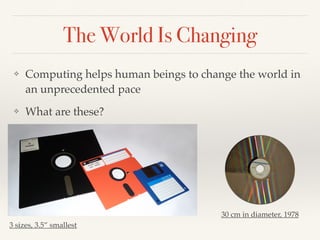
❖ What are these?
30 cm in diameter, 1978
3 sizes, 3.5” smallest
Python as Your Computing Platform
❖ Python programming language is the way to go
❖ One language to rule them all
❖ Interactive analysis and visualization
❖ Data preparation and processing
❖ Workflow automation
❖ Distributed processing and parallel computing
❖ Join PyCon TW 2018, 1-2 June: https://tw.pycon.org/2018/
Interactive
❖ http://jupyter.org: run Python everywhere and code it
through browser
❖ https://matplotlib.org: de facto 2D plotting library
❖ https://www.vtk.org: versatile 3D visualization toolbox
❖ https://www.paraview.org: if you only want a
frontend
Data Manipulation
❖ http://pandas.pydata.org: de facto tool for data
analytics
❖ http://www.pytables.org: HDF5 hierarchical data
access
❖ http://unidata.github.io/netcdf4-python/: netCDF, yet
another data storage based on HDF5
Workflow Automation
❖ https://docs.python.org/3/library/argparse.html:
standard command-line argument processing
❖ https://github.com/saltstack/salt: cloud-oriented
automation for management and configuration
❖ AWS, GCE, Azure all offer SDK for Python
Concurrency
❖ https://docs.python.org/3/library/asyncio.html
❖ support native asynchronous constructs
❖ https://docs.python.org/3/library/multiprocessing.html
❖ parallel computing and distributed processing using multiple
processes
❖ http://zeromq.org/bindings:python
❖ socket communication
❖ http://pythonhosted.org/mpi4py/
❖ use MPI in Python
The Only Thing That Doesn’t Change, Is Change
❖ Way too many options for computing
❖ What an engineer should learn?
❖ Yes, I know, Python. But it’s all the tools with Python,
and not Python alone, right?
❖ Can we find something so fundamental that doesn’t
change?
Machine Code
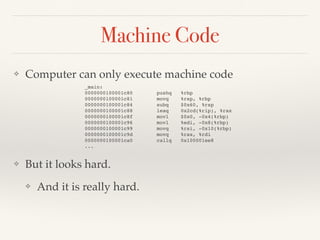
❖ Computer can only execute machine code
❖ But it looks hard.
❖ And it is really hard.
_main:
0000000100001c80 pushq %rbp
0000000100001c81 movq %rsp, %rbp
0000000100001c84 subq $0x60, %rsp
0000000100001c88 leaq 0x2cd(%rip), %rax
0000000100001c8f movl $0x0, -0x4(%rbp)
0000000100001c96 movl %edi, -0x8(%rbp)
0000000100001c99 movq %rsi, -0x10(%rbp)
0000000100001c9d movq %rax, %rdi
0000000100001ca0 callq 0x100001ee8
...
C++: Compromise
❖ First, there was the C programming language
❖ It allows us to write a little bit more friendly code
❖ A compiler takes the code and turn it into assembly,
and it is then turned into machine code
❖ Some geniuses want to make something super powerful
but looks like C
❖ It produces the fastest possible machine code from
machine-friendly, convoluted concepts
Slow for Fast, Fast Is Slow
❖ It takes a lot of time to write code that computers run
fast
❖ C++ -> machine code
❖ Quickly written code takes additional time from
computers to interpret
❖ Python
❖ Ease of use and performance are competing. You cannot
get both.
As Easy as Python, as Fast as C++
❖ Create a new tool that serves both purposes?
❖ You need to re-create two whole eco-systems that
develop for 20-30 years
❖ Doesn’t sound very realistic, does it?
❖ How about using C++ for what needs speed, and
Python for everything else? Yes if we have a way to
bridge them!
pybind11
❖ C++, born in 1985 (development since 1979)
❖ ISO standard: C++98, 03, 11, 14, 17
❖ Python, born in 1991
❖ Community maintained
❖ C++11/14/17(/20) is referred to as modern C++ and usually just “C+
+11”
❖ C++ is notoriously hard, but modern C++ starts to make sense
❖ pybind11 is a tool allowing us to use exclusively modern C++ with
Python
Wrapping Tools for Python Abound
❖ So many software packages provide Python API
❖ pybind11, boost.python, Cython, ctypes, swig, etc.
❖ Python C API
Multi-Language Systems
❖ Recall the purpose: quickly make fast software
❖ Know very well the system fundamentals
❖ It’s always the key to a good software system
❖ In C++: core data structure and performance hotspots
❖ In Python: workflow and customization
Things to Learn
❖ Master your problem domain: mathematics and
mechanics
❖ Computer architecture
❖ Numerical analysis
❖ Practice Python and then C++ for 10 years
Mathematics and Mechanics
❖ Calculus
❖ Linear algebra
❖ Vector analysis
❖ Thermodynamics
❖ Continuum mechanics: solids and fluids
❖ Materials and chemistry
Computer Architecture
❖ Abstract description for how silicon is made for
computing
❖ What runs fast and what runs slow, and why
❖ How do you code to make the best use of the hardware
Numerical Analysis
❖ Turn mathematics into code; the mathematics describes
the physics
❖ Interpolation
❖ Equation solving
❖ Linear systems
❖ Optimization
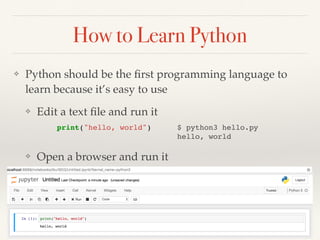
How to Learn Python
❖ Python should be the first programming language to
learn because it’s easy to use
❖ Edit a text file and run it
❖ Open a browser and run it
print("hello, world") $ python3 hello.py
hello, world
Step 1: Install Runtime
❖ https://www.anaconda.com/download/
❖ Anaconda contains Python and a lot of useful software
packages.
❖ When one starts, it’s even difficult to find and install
software, but Anaconda solves the problem
❖ Use command line as much as possible
❖ If you can, use Linux (Ubuntu) or mac osx, which give you a
powerful command-line shell. Windows 10 professional has
one too, but not as popular as the Unixes.
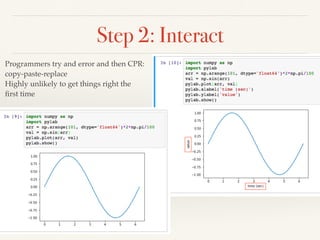
Step 2: Interact
Programmers try and error and then CPR:
copy-paste-replace
Highly unlikely to get things right the
first time
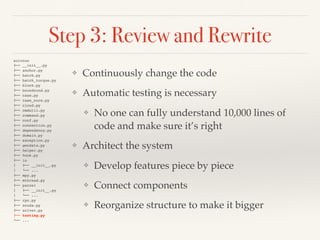
Step 3: Review and Rewrite
❖ Continuously change the code
❖ Automatic testing is necessary
❖ No one can fully understand 10,000 lines of
code and make sure it’s right
❖ Architect the system
❖ Develop features piece by piece
❖ Connect components
❖ Reorganize structure to make it bigger
solvcon
!"" __init__.py
!"" anchor.py
!"" batch.py
!"" batch_torque.py
!"" block.py
!"" boundcond.py
!"" case.py
!"" case_core.py
!"" cloud.py
!"" cmdutil.py
!"" command.py
!"" conf.py
!"" connection.py
!"" dependency.py
!"" domain.py
!"" exception.py
!"" gendata.py
!"" helper.py
!"" hook.py
!"" io
#   !"" __init__.py
#   $"" ...
!"" mpy.py
!"" mthread.py
!"" parcel
#   !"" __init__.py
#   $"" ...
!"" rpc.py
!"" scuda.py
!"" solver.py
!"" testing.py
$"" ...
How to Learn C++
❖ Never starts with C++
❖ Benchmark first
❖ Use C++ when you need to control from byte to byte
❖ Keep in mind the differences between Python and C++
❖ Python function calls are 10x-100x slower than C++
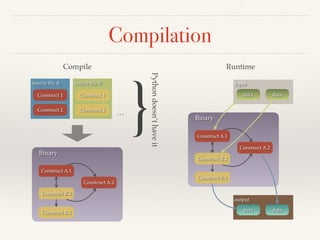
❖ Python determines everything in runtime; C++
determines many things in compile time.
Compilation
Source file A
Construct 1
Construct 2
Source file B
Construct 1
Construct 2
Binary
Construct A.1
Construct B.2
Construct B.1
Construct A.2
…
Compile Runtime
input
data data
output
data data
Binary
Construct A.1
Construct B.2
Construct B.1
Construct A.2
}Pythondoesn’thaveit
Learn by Doing
❖ Incentive is utmost important: Program to solve your
problems
❖ After your 500,000 lines of code, you’ll get it
❖ If you don’t code enough, reading books doesn’t help
Your Job
❖ Make mobile app run faster? No problem
❖ Scale web page higher? You nail it
❖ Increase video game frame rate? Yes
❖ Crunch more data? Absolutely
❖ Make scientific discoveries? That’s what you do
❖ If you can quickly make computers run fast, jobs find
you

Harmonic Stack for Speed

  • 1.
    Harmonic Stack for Speed 2018/3/6 Yung-YuChen https://www.linkedin.com/in/yungyuc/
  • 2.
    The World IsChanging ❖ Computing helps human beings to change the world in an unprecedented pace ❖ What are these? 30 cm in diameter, 1978 3 sizes, 3.5” smallest
  • 3.
    Python as YourComputing Platform ❖ Python programming language is the way to go ❖ One language to rule them all ❖ Interactive analysis and visualization ❖ Data preparation and processing ❖ Workflow automation ❖ Distributed processing and parallel computing ❖ Join PyCon TW 2018, 1-2 June: https://tw.pycon.org/2018/
  • 4.
    Interactive ❖ http://jupyter.org: runPython everywhere and code it through browser ❖ https://matplotlib.org: de facto 2D plotting library ❖ https://www.vtk.org: versatile 3D visualization toolbox ❖ https://www.paraview.org: if you only want a frontend
  • 5.
    Data Manipulation ❖ http://pandas.pydata.org:de facto tool for data analytics ❖ http://www.pytables.org: HDF5 hierarchical data access ❖ http://unidata.github.io/netcdf4-python/: netCDF, yet another data storage based on HDF5
  • 6.
    Workflow Automation ❖ https://docs.python.org/3/library/argparse.html: standardcommand-line argument processing ❖ https://github.com/saltstack/salt: cloud-oriented automation for management and configuration ❖ AWS, GCE, Azure all offer SDK for Python
  • 7.
    Concurrency ❖ https://docs.python.org/3/library/asyncio.html ❖ supportnative asynchronous constructs ❖ https://docs.python.org/3/library/multiprocessing.html ❖ parallel computing and distributed processing using multiple processes ❖ http://zeromq.org/bindings:python ❖ socket communication ❖ http://pythonhosted.org/mpi4py/ ❖ use MPI in Python
  • 9.
    The Only ThingThat Doesn’t Change, Is Change ❖ Way too many options for computing ❖ What an engineer should learn? ❖ Yes, I know, Python. But it’s all the tools with Python, and not Python alone, right? ❖ Can we find something so fundamental that doesn’t change?
  • 10.
    Machine Code ❖ Computercan only execute machine code ❖ But it looks hard. ❖ And it is really hard. _main: 0000000100001c80 pushq %rbp 0000000100001c81 movq %rsp, %rbp 0000000100001c84 subq $0x60, %rsp 0000000100001c88 leaq 0x2cd(%rip), %rax 0000000100001c8f movl $0x0, -0x4(%rbp) 0000000100001c96 movl %edi, -0x8(%rbp) 0000000100001c99 movq %rsi, -0x10(%rbp) 0000000100001c9d movq %rax, %rdi 0000000100001ca0 callq 0x100001ee8 ...
  • 11.
    C++: Compromise ❖ First,there was the C programming language ❖ It allows us to write a little bit more friendly code ❖ A compiler takes the code and turn it into assembly, and it is then turned into machine code ❖ Some geniuses want to make something super powerful but looks like C ❖ It produces the fastest possible machine code from machine-friendly, convoluted concepts
  • 12.
    Slow for Fast,Fast Is Slow ❖ It takes a lot of time to write code that computers run fast ❖ C++ -> machine code ❖ Quickly written code takes additional time from computers to interpret ❖ Python ❖ Ease of use and performance are competing. You cannot get both.
  • 13.
    As Easy asPython, as Fast as C++ ❖ Create a new tool that serves both purposes? ❖ You need to re-create two whole eco-systems that develop for 20-30 years ❖ Doesn’t sound very realistic, does it? ❖ How about using C++ for what needs speed, and Python for everything else? Yes if we have a way to bridge them!
  • 14.
    pybind11 ❖ C++, bornin 1985 (development since 1979) ❖ ISO standard: C++98, 03, 11, 14, 17 ❖ Python, born in 1991 ❖ Community maintained ❖ C++11/14/17(/20) is referred to as modern C++ and usually just “C+ +11” ❖ C++ is notoriously hard, but modern C++ starts to make sense ❖ pybind11 is a tool allowing us to use exclusively modern C++ with Python
  • 15.
    Wrapping Tools forPython Abound ❖ So many software packages provide Python API ❖ pybind11, boost.python, Cython, ctypes, swig, etc. ❖ Python C API
  • 16.
    Multi-Language Systems ❖ Recallthe purpose: quickly make fast software ❖ Know very well the system fundamentals ❖ It’s always the key to a good software system ❖ In C++: core data structure and performance hotspots ❖ In Python: workflow and customization
  • 17.
    Things to Learn ❖Master your problem domain: mathematics and mechanics ❖ Computer architecture ❖ Numerical analysis ❖ Practice Python and then C++ for 10 years
  • 18.
    Mathematics and Mechanics ❖Calculus ❖ Linear algebra ❖ Vector analysis ❖ Thermodynamics ❖ Continuum mechanics: solids and fluids ❖ Materials and chemistry
  • 19.
    Computer Architecture ❖ Abstractdescription for how silicon is made for computing ❖ What runs fast and what runs slow, and why ❖ How do you code to make the best use of the hardware
  • 20.
    Numerical Analysis ❖ Turnmathematics into code; the mathematics describes the physics ❖ Interpolation ❖ Equation solving ❖ Linear systems ❖ Optimization
  • 21.
    How to LearnPython ❖ Python should be the first programming language to learn because it’s easy to use ❖ Edit a text file and run it ❖ Open a browser and run it print("hello, world") $ python3 hello.py hello, world
  • 22.
    Step 1: InstallRuntime ❖ https://www.anaconda.com/download/ ❖ Anaconda contains Python and a lot of useful software packages. ❖ When one starts, it’s even difficult to find and install software, but Anaconda solves the problem ❖ Use command line as much as possible ❖ If you can, use Linux (Ubuntu) or mac osx, which give you a powerful command-line shell. Windows 10 professional has one too, but not as popular as the Unixes.
  • 23.
    Step 2: Interact Programmerstry and error and then CPR: copy-paste-replace Highly unlikely to get things right the first time
  • 24.
    Step 3: Reviewand Rewrite ❖ Continuously change the code ❖ Automatic testing is necessary ❖ No one can fully understand 10,000 lines of code and make sure it’s right ❖ Architect the system ❖ Develop features piece by piece ❖ Connect components ❖ Reorganize structure to make it bigger solvcon !"" __init__.py !"" anchor.py !"" batch.py !"" batch_torque.py !"" block.py !"" boundcond.py !"" case.py !"" case_core.py !"" cloud.py !"" cmdutil.py !"" command.py !"" conf.py !"" connection.py !"" dependency.py !"" domain.py !"" exception.py !"" gendata.py !"" helper.py !"" hook.py !"" io #   !"" __init__.py #   $"" ... !"" mpy.py !"" mthread.py !"" parcel #   !"" __init__.py #   $"" ... !"" rpc.py !"" scuda.py !"" solver.py !"" testing.py $"" ...
  • 25.
    How to LearnC++ ❖ Never starts with C++ ❖ Benchmark first ❖ Use C++ when you need to control from byte to byte ❖ Keep in mind the differences between Python and C++ ❖ Python function calls are 10x-100x slower than C++ ❖ Python determines everything in runtime; C++ determines many things in compile time.
  • 26.
    Compilation Source file A Construct1 Construct 2 Source file B Construct 1 Construct 2 Binary Construct A.1 Construct B.2 Construct B.1 Construct A.2 … Compile Runtime input data data output data data Binary Construct A.1 Construct B.2 Construct B.1 Construct A.2 }Pythondoesn’thaveit
  • 27.
    Learn by Doing ❖Incentive is utmost important: Program to solve your problems ❖ After your 500,000 lines of code, you’ll get it ❖ If you don’t code enough, reading books doesn’t help
  • 28.
    Your Job ❖ Makemobile app run faster? No problem ❖ Scale web page higher? You nail it ❖ Increase video game frame rate? Yes ❖ Crunch more data? Absolutely ❖ Make scientific discoveries? That’s what you do ❖ If you can quickly make computers run fast, jobs find you