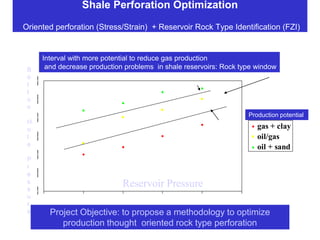
Shale Perforation Optimization
Oriented perforation (Stress/Strain) + Reservoir Rock Type Identification (FZI)
0
5
10
15
20
25
30
0 1 2 3 4 5
gas + clay
oil/gas
oil + sand
B
o
t
t
o
n
H
o
l
e
P
r
e
s
s
u
r
e
Interval with more potential to reduce gas production
and decrease production problems in shale reservoirs: Rock type window
Production potential
Project Objective: to propose a methodology to optimize
production thought oriented rock type perforation
Reservoir Pressure
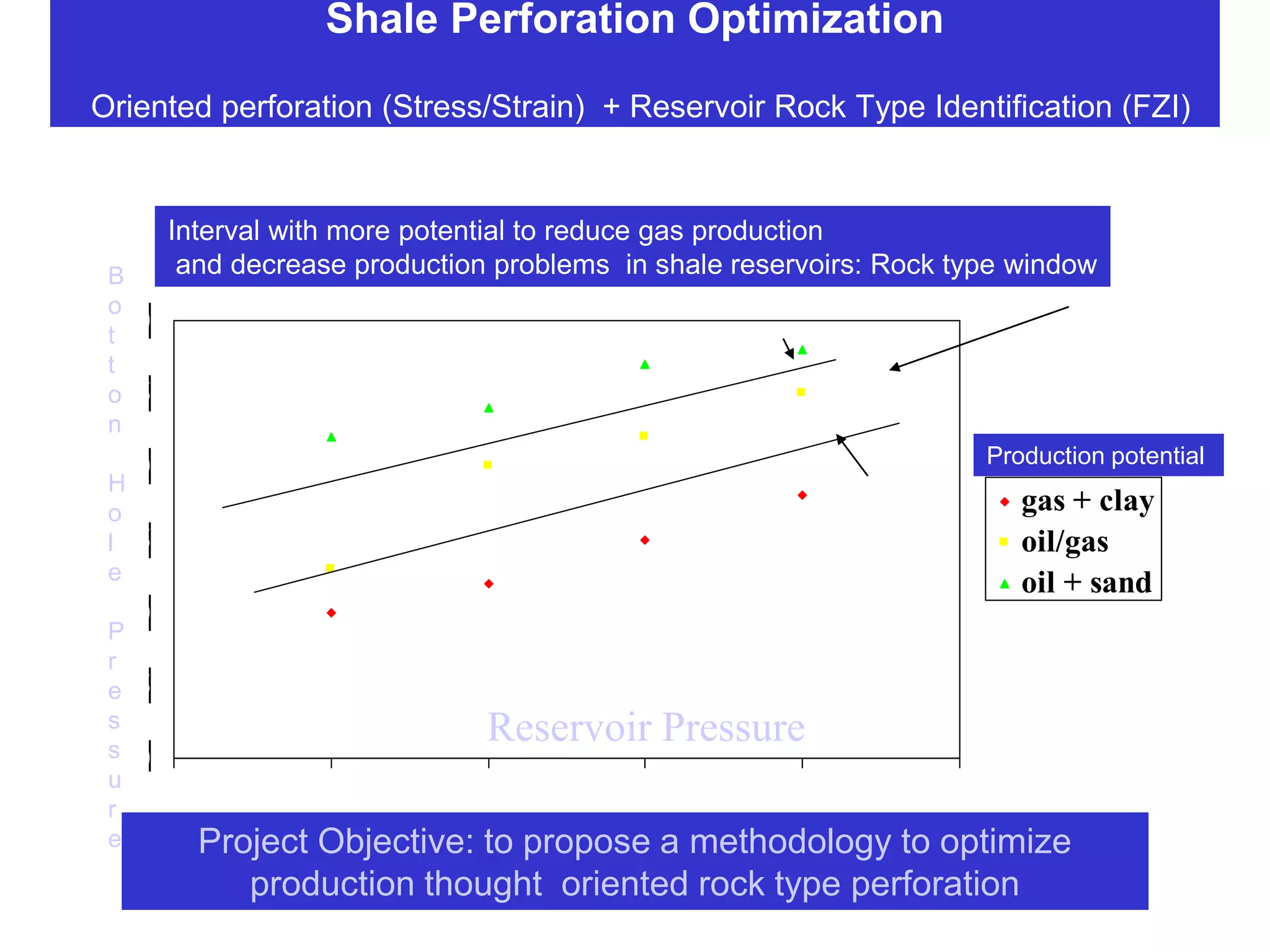
Proposed Rock type Analysis
Reservoir Pressure
Bottom
Hole
Pressure
Rock type window ?
Oriented rock type perforation
Rock
Type
Rock Strength
Rock type vs. Rock Strength
Rock type window
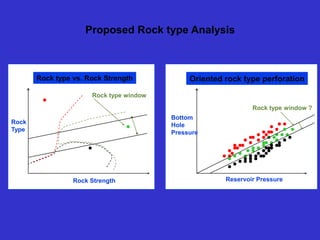
Pressure Differential Project
To analyze Drilling & Completion Evolution trough time in the
Tectono/stratigraphic & dynamic framework to show up potential compartments
Y x y
x
y
x
y
x
y
x Y x
Year 1 Year 2 Year 3
Oil well
Gas
Water
M
a
p
v
i
e
w
c
r
o
s
s
s
e
c
t
i
o
n
Shale sand
Compartment due to production
Potential pressure
differential problem
A B
A
B
A
A C B
C
B
A D C B
A D C
B
Smart well
candidate
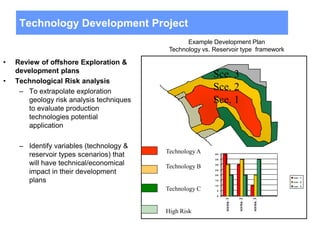
Technology Development Project
• Review of offshore Exploration &
development plans
• Technological Risk analysis
– To extrapolate exploration
geology risk analysis techniques
to evaluate production
technologies potential
application
– Identify variables (technology &
reservoir types scenarios) that
will have technical/economical
impact in their development
plans
Technology A
Technology B
Technology C
High Risk
Example Development Plan
Technology vs. Reservoir type framework
0
5
1 0
1 5
2 0
2 5
3 0
3 5
4 0
scena.1
scena.2
scena.3
v a r . 1
v a r . 2
v a r . 3
Sce. 3
Sce. 2
Sce. 1
1,866’
1,320’
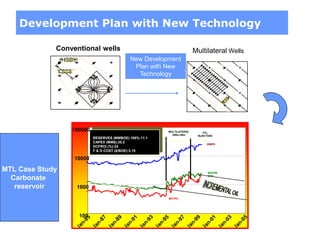
Development Plan with New Technology
1,866’
100
1000
10000
100000
RESERVES (MMBOE) 100%:11.1
CAPEX (MM$):35.2
DCFROI (%):24
F & D COST ($/BOE):3.15
BWPD
BOPDB
OPD
MCFPD
MULTILATERAL
DRILLING
CO2
INJECTION
Conventional wells Multilateral Wells
New Development
Plan with New
Technology
MTL Case Study
Carbonate
reservoir
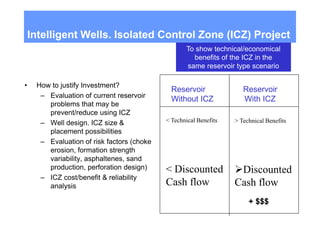
Intelligent Wells. Isolated Control Zone (ICZ) Project
• How to justify Investment?
– Evaluation of current reservoir
problems that may be
prevent/reduce using ICZ
– Well design. ICZ size &
placement possibilities
– Evaluation of risk factors (choke
erosion, formation strength
variability, asphaltenes, sand
production, perforation design)
– ICZ cost/benefit & reliability
analysis
Reservoir Reservoir
Without ICZ With ICZ
+ $$$
To show technical/economical
benefits of the ICZ in the
same reservoir type scenario
> Technical Benefits
Discounted
Cash flow
< Technical Benefits
< Discounted
Cash flow
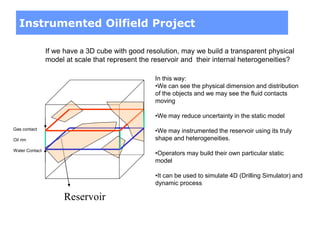
Instrumented Oilfield Project
If we have a 3D cube with good resolution, may we build a transparent physical
model at scale that represent the reservoir and their internal heterogeneities?
In this way:
•We can see the physical dimension and distribution
of the objects and we may see the fluid contacts
moving
•We may reduce uncertainty in the static model
•We may instrumented the reservoir using its truly
shape and heterogeneities.
•Operators may build their own particular static
model
•It can be used to simulate 4D (Drilling Simulator) and
dynamic process
Reservoir
Gas contact
Oil rim
Water Contact
Drilling cost
Completion cost
Simple
waterfr
ont
moveme
nt model
SIP 2.4
Valves/chokes:
Lifecycle
reliability
model,
SIP 1.4
+pressure drop
Random
geological
surprises
Simple
gasfront
moveme
nt model
SIP 2.4
Resid
ual
oil
mode
l?
SIP
2.4
LWD information
Surprise handling (FN)
Water breakout (SM)
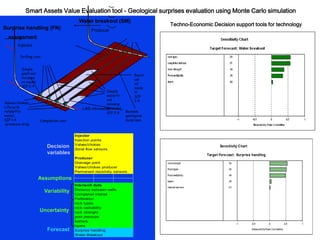
Smart Assets Value Evaluation tool - Geological surprises evaluation using Monte Carlo simulation
Techno-Economic Decision support tools for technology
assessment
Injector
Producer
Target Fore cast: Surprise handling
rockstrength .54
Rocktypes .52
Rockwettability .49
layers .05
internal barriers .01
-1 -0.5 0 0.5 1
Measured byRank Correlation
Sensitivity ChartDecision
variables
Assumptions
Variability
Uncertainty
Forecast
Injector
Injection points
Valves/chokes
Zonal flow sensors
Producer
Drainage point
Valves/chokes producer
Permanent resistivity sensors
Interwell data
Distance between wells
Completed interval
Perforation
rock types
rock wettability
rock strenght
pore pressure
barriers
layers
Surprise handling
Water Breakout
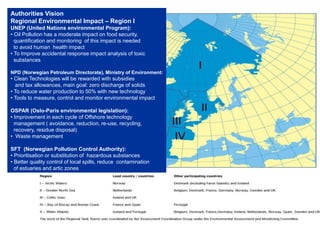
Authorities Vision
Regional Environmental Impact – Region I
UNEP (United Nations environmental Program):
• Oil Pollution has a moderate impact on food security,
quantification and monitoring of this impact is needed
to avoid human health impact
• To Improve accidental response impact analysis of toxic
substances
NPD (Norwegian Petroleum Directorate), Ministry of Environment:
• Clean Technologies will be rewarded with subsidies
and tax allowances, main goal: zero discharge of solids
• To reduce water production to 50% with new technology
• Tools to measure, control and monitor environmental impact
OSPAR (Oslo-Paris environmental legislation):
• Improvement in each cycle of Offshore technology
management ( avoidance, reduction, re-use, recycling,
recovery, residue disposal)
• Waste management
SFT (Norwegian Pollution Control Authority):
• Prioritisation or substitution of hazardous substances
• Better quality control of local spills, reduce contamination
of estuaries and artic zones
Production Geology Approach applied to Environmental Risk
Assessment
• Reduction of Number of Wells
• Review of technological options and development plans to reduce the
environmental impact of
•Production /injection management
• Water / Gas Handling
• Zero Discharge Policy
• Improvement in the technology Management Life cycle ( avoidance,
reduction, re-use, recycling, recovery, disposal)
• Novel control, monitoring and measurement environmental Oil & Gas
Solutions
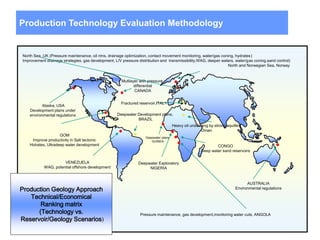
Production Technology Evaluation Methodology
Alaska, USA
Development plans under
environmental regulations
GOM
Improve productivity in Salt tectonic
Hidrates, Ultradeep water development
Mutilayer with pressure
differential
CANADA
North Sea ,UK (Pressure maintenance, oil rims, drainage optimization, contact movement monitoring, water/gas coning, hydrates)
Improvement drainage strategies, gas development, L/V pressure distribution and transmissibility,WAG, deeper waters, water/gas coning,sand control)
North and Norwegian Sea, Norway
Deepwater Exploratory
NIGERIA
VENEZUELA
WAG, potential offshore development
Pressure maintenance, gas development,monitoring water cuts, ANGOLA
CONGO
Deep water sand reservoirs
Deepwater plans
GUINEA
Fractured reservoir,ITALY
Deepwater Development plans,
BRAZIL
AUSTRALIA
Environmental regulations
Heavy oil underlying by strong aquifers
Oman
Production Geology Approach
Technical/Economical
Ranking matrix
(Technology vs.
Reservoir/Geology Scenarios)

Norway2000

  • 1.
    Shale Perforation Optimization Orientedperforation (Stress/Strain) + Reservoir Rock Type Identification (FZI) 0 5 10 15 20 25 30 0 1 2 3 4 5 gas + clay oil/gas oil + sand B o t t o n H o l e P r e s s u r e Interval with more potential to reduce gas production and decrease production problems in shale reservoirs: Rock type window Production potential Project Objective: to propose a methodology to optimize production thought oriented rock type perforation Reservoir Pressure
  • 2.
    Proposed Rock typeAnalysis Reservoir Pressure Bottom Hole Pressure Rock type window ? Oriented rock type perforation Rock Type Rock Strength Rock type vs. Rock Strength Rock type window
  • 3.
    Pressure Differential Project Toanalyze Drilling & Completion Evolution trough time in the Tectono/stratigraphic & dynamic framework to show up potential compartments Y x y x y x y x y x Y x Year 1 Year 2 Year 3 Oil well Gas Water M a p v i e w c r o s s s e c t i o n Shale sand Compartment due to production Potential pressure differential problem A B A B A A C B C B A D C B A D C B Smart well candidate
  • 4.
    Technology Development Project •Review of offshore Exploration & development plans • Technological Risk analysis – To extrapolate exploration geology risk analysis techniques to evaluate production technologies potential application – Identify variables (technology & reservoir types scenarios) that will have technical/economical impact in their development plans Technology A Technology B Technology C High Risk Example Development Plan Technology vs. Reservoir type framework 0 5 1 0 1 5 2 0 2 5 3 0 3 5 4 0 scena.1 scena.2 scena.3 v a r . 1 v a r . 2 v a r . 3 Sce. 3 Sce. 2 Sce. 1
  • 5.
    1,866’ 1,320’ Development Plan withNew Technology 1,866’ 100 1000 10000 100000 RESERVES (MMBOE) 100%:11.1 CAPEX (MM$):35.2 DCFROI (%):24 F & D COST ($/BOE):3.15 BWPD BOPDB OPD MCFPD MULTILATERAL DRILLING CO2 INJECTION Conventional wells Multilateral Wells New Development Plan with New Technology MTL Case Study Carbonate reservoir
  • 6.
    Intelligent Wells. IsolatedControl Zone (ICZ) Project • How to justify Investment? – Evaluation of current reservoir problems that may be prevent/reduce using ICZ – Well design. ICZ size & placement possibilities – Evaluation of risk factors (choke erosion, formation strength variability, asphaltenes, sand production, perforation design) – ICZ cost/benefit & reliability analysis Reservoir Reservoir Without ICZ With ICZ + $$$ To show technical/economical benefits of the ICZ in the same reservoir type scenario > Technical Benefits Discounted Cash flow < Technical Benefits < Discounted Cash flow
  • 7.
    Instrumented Oilfield Project Ifwe have a 3D cube with good resolution, may we build a transparent physical model at scale that represent the reservoir and their internal heterogeneities? In this way: •We can see the physical dimension and distribution of the objects and we may see the fluid contacts moving •We may reduce uncertainty in the static model •We may instrumented the reservoir using its truly shape and heterogeneities. •Operators may build their own particular static model •It can be used to simulate 4D (Drilling Simulator) and dynamic process Reservoir Gas contact Oil rim Water Contact
  • 8.
    Drilling cost Completion cost Simple waterfr ont moveme ntmodel SIP 2.4 Valves/chokes: Lifecycle reliability model, SIP 1.4 +pressure drop Random geological surprises Simple gasfront moveme nt model SIP 2.4 Resid ual oil mode l? SIP 2.4 LWD information Surprise handling (FN) Water breakout (SM) Smart Assets Value Evaluation tool - Geological surprises evaluation using Monte Carlo simulation Techno-Economic Decision support tools for technology assessment Injector Producer Target Fore cast: Surprise handling rockstrength .54 Rocktypes .52 Rockwettability .49 layers .05 internal barriers .01 -1 -0.5 0 0.5 1 Measured byRank Correlation Sensitivity ChartDecision variables Assumptions Variability Uncertainty Forecast Injector Injection points Valves/chokes Zonal flow sensors Producer Drainage point Valves/chokes producer Permanent resistivity sensors Interwell data Distance between wells Completed interval Perforation rock types rock wettability rock strenght pore pressure barriers layers Surprise handling Water Breakout
  • 9.
    Authorities Vision Regional EnvironmentalImpact – Region I UNEP (United Nations environmental Program): • Oil Pollution has a moderate impact on food security, quantification and monitoring of this impact is needed to avoid human health impact • To Improve accidental response impact analysis of toxic substances NPD (Norwegian Petroleum Directorate), Ministry of Environment: • Clean Technologies will be rewarded with subsidies and tax allowances, main goal: zero discharge of solids • To reduce water production to 50% with new technology • Tools to measure, control and monitor environmental impact OSPAR (Oslo-Paris environmental legislation): • Improvement in each cycle of Offshore technology management ( avoidance, reduction, re-use, recycling, recovery, residue disposal) • Waste management SFT (Norwegian Pollution Control Authority): • Prioritisation or substitution of hazardous substances • Better quality control of local spills, reduce contamination of estuaries and artic zones
  • 10.
    Production Geology Approachapplied to Environmental Risk Assessment • Reduction of Number of Wells • Review of technological options and development plans to reduce the environmental impact of •Production /injection management • Water / Gas Handling • Zero Discharge Policy • Improvement in the technology Management Life cycle ( avoidance, reduction, re-use, recycling, recovery, disposal) • Novel control, monitoring and measurement environmental Oil & Gas Solutions
  • 11.
    Production Technology EvaluationMethodology Alaska, USA Development plans under environmental regulations GOM Improve productivity in Salt tectonic Hidrates, Ultradeep water development Mutilayer with pressure differential CANADA North Sea ,UK (Pressure maintenance, oil rims, drainage optimization, contact movement monitoring, water/gas coning, hydrates) Improvement drainage strategies, gas development, L/V pressure distribution and transmissibility,WAG, deeper waters, water/gas coning,sand control) North and Norwegian Sea, Norway Deepwater Exploratory NIGERIA VENEZUELA WAG, potential offshore development Pressure maintenance, gas development,monitoring water cuts, ANGOLA CONGO Deep water sand reservoirs Deepwater plans GUINEA Fractured reservoir,ITALY Deepwater Development plans, BRAZIL AUSTRALIA Environmental regulations Heavy oil underlying by strong aquifers Oman Production Geology Approach Technical/Economical Ranking matrix (Technology vs. Reservoir/Geology Scenarios)