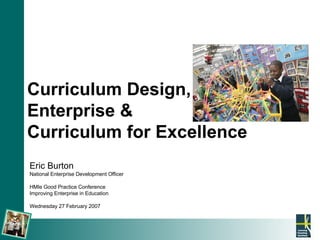
Curriculum Design,  Enterprise &  Curriculum for Excellence Eric Burton National Enterprise Development Officer HMIe Good Practice Conference  Improving Enterprise in Education Wednesday 27 February 2007
Presentation Outcomes By the end of this presentation you will have ; An insight into the role of  Learning & Teaching Scotland.  An overview of some of the ideas and support that have been developed at present. An opportunity for learning.
To get what we’ve never had….  we must do……  … ..what we have never done. Anon.  212 ° The Extra Degree
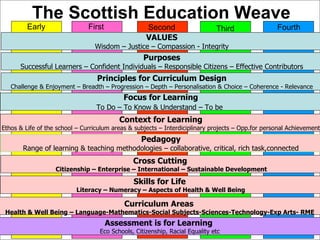
The Scottish Education Weave VALUES Wisdom – Justice – Compassion - Integrity Purposes Successful Learners – Confident Individuals – Responsible Citizens – Effective Contributors Principles for Curriculum Design Challenge & Enjoyment – Breadth – Progression – Depth – Personalisation & Choice – Coherence - Relevance Focus for Learning To Do – To Know & Understand – To be   Assessment is for Learning  Eco Schools, Citizenship, Racial Equality etc Context for Learning Ethos & Life of the school – Curriculum areas & subjects – Interdiciplinary projects – Opp.for personal Achievement Early First Second Third  Fourth Pedagogy Range of learning & teaching methodologies – collaborative, critical, rich task,connected Cross Cutting  Citizenship – Enterprise – International – Sustainable Development Skills for Life  Literacy – Numeracy – Aspects of Health & Well Being Curriculum Areas   Health & Well Being – Language-Mathematics-Social Subjects-Sciences-Technology-Exp Arts- RME
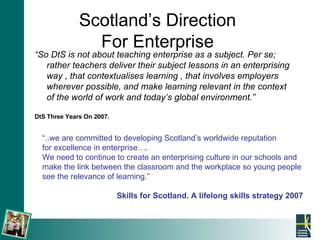
Scotland’s Direction  For Enterprise  “ So DtS is not about teaching enterprise as a subject. Per se; rather teachers deliver their subject lessons in an enterprising way , that contextualises learning , that involves employers wherever possible, and make learning relevant in the context of the world of work and today’s global environment.” DtS Three Years On 2007. “ ..we are committed to developing Scotland’s worldwide reputation  for excellence in enterprise…. We need to continue to create an enterprising culture in our schools and make the link between the classroom and the workplace so young people see the relevance of learning.” Skills for Scotland. A lifelong skills strategy 2007
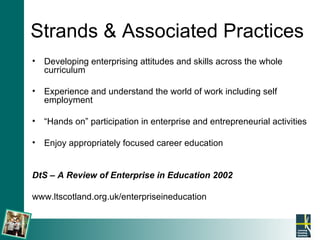
Strands & Associated Practices Developing enterprising attitudes and skills across the whole curriculum Experience and understand the world of work including self employment “ Hands on” participation in enterprise and entrepreneurial activities Enjoy appropriately focused career education DtS – A Review of Enterprise in Education 2002 www.ltscotland.org.uk/enterpriseineducation
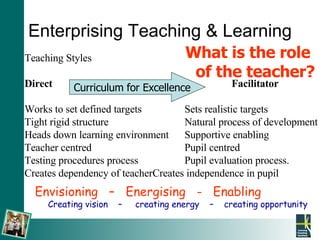
Enterprising Teaching & Learning Teaching Styles Direct    Facilitator Works to set defined targets Sets realistic targets  Tight rigid structure Natural process of development Heads down learning environment Supportive enabling  Teacher centred  Pupil centred Testing procedures process Pupil evaluation process. Creates dependency of teacher Creates independence in pupil   What is the role  of the teacher? Envisioning  –  Energising  -  Enabling Creating vision  –  creating energy  –  creating opportunity Curriculum for Excellence
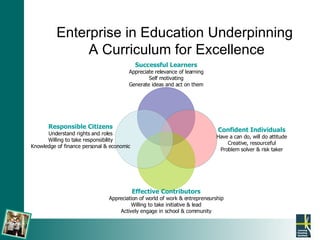
Enterprise in Education Underpinning  A Curriculum for Excellence Successful Learners Appreciate relevance of learning Self motivating Generate ideas and act on them Confident Individuals Have a can do, will do attitude Creative, resourceful Problem solver & risk taker Effective Contributors Appreciation of world of work & entrepreneurship Willing to take initiative & lead Actively engage in school & community Responsible Citizens Understand rights and roles Willing to take responsibility Knowledge of finance personal & economic
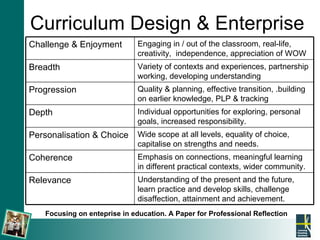
Curriculum Design & Enterprise Focusing on enteprise in education. A Paper for Professional Reflection Understanding of the present and the future, learn practice and develop skills, challenge disaffection, attainment and achievement.  Relevance Emphasis on connections, meaningful learning in different practical contexts, wider community. Coherence Wide scope at all levels, equality of choice, capitalise on strengths and needs. Personalisation & Choice Individual opportunities for exploring, personal goals, increased responsibility. Depth Quality & planning, effective transition, .building on earlier knowledge, PLP & tracking Progression Variety of contexts and experiences, partnership working, developing understanding Breadth Engaging in / out of the classroom, real-life, creativity,  independence, appreciation of WOW Challenge & Enjoyment
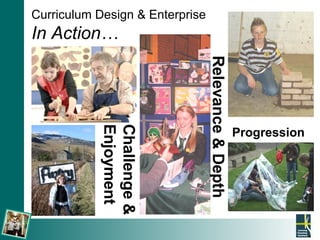
Curriculum Design & Enterprise In Action… Progression  Relevance & Depth   Challenge & Enjoyment
A Thought For Their Future 80% of the jobs… that current Primary 1 pupils  will do in the future. ……………… do not exist ! BT Futurologist 2006
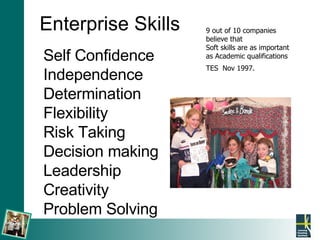
Enterprise Skills Self Confidence Independence Determination Flexibility Risk Taking Decision making Leadership Creativity Problem Solving 9 out of 10 companies believe that Soft skills are as important as Academic qualifications TES  Nov 1997.
LTS & DtS Support CPD Find – 21 opportunities CPD Business Engagement Day by Day Enterprise Matters Planner Enterprising teaching Subject Bites ITE Awareness & online community National Subject Roadshows LA CPD days.
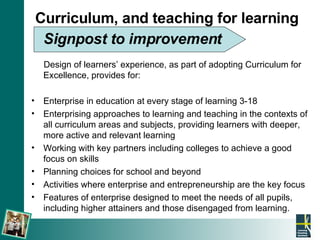
Curriculum, and teaching for learning   Signpost to improvement   Design of learners’ experience, as part of adopting Curriculum for Excellence, provides for: Enterprise in education at every stage of learning 3-18 Enterprising approaches to learning and teaching in the contexts of all curriculum areas and subjects, providing learners with deeper, more active and relevant learning Working with key partners including colleges to achieve a good focus on skills Planning choices for school and beyond Activities where enterprise and entrepreneurship are the key focus Features of enterprise designed to meet the needs of all pupils, including higher attainers and those disengaged from learning.
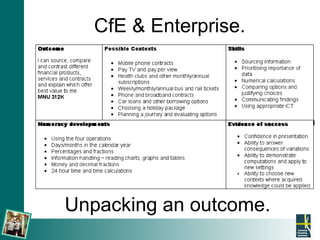
CfE & Enterprise. Unpacking an outcome.
Contact Us Eric Burton Learning and Teaching Scotland The Optima, 58 Robertson Street, Glasgow G2 8DU [email_address] www.LTScotland.org.uk

Norway Visit Lts March08

  • 1.
    Curriculum Design, Enterprise & Curriculum for Excellence Eric Burton National Enterprise Development Officer HMIe Good Practice Conference Improving Enterprise in Education Wednesday 27 February 2007
  • 2.
    Presentation Outcomes Bythe end of this presentation you will have ; An insight into the role of Learning & Teaching Scotland. An overview of some of the ideas and support that have been developed at present. An opportunity for learning.
  • 3.
    To get whatwe’ve never had…. we must do…… … ..what we have never done. Anon. 212 ° The Extra Degree
  • 4.
    The Scottish EducationWeave VALUES Wisdom – Justice – Compassion - Integrity Purposes Successful Learners – Confident Individuals – Responsible Citizens – Effective Contributors Principles for Curriculum Design Challenge & Enjoyment – Breadth – Progression – Depth – Personalisation & Choice – Coherence - Relevance Focus for Learning To Do – To Know & Understand – To be Assessment is for Learning Eco Schools, Citizenship, Racial Equality etc Context for Learning Ethos & Life of the school – Curriculum areas & subjects – Interdiciplinary projects – Opp.for personal Achievement Early First Second Third Fourth Pedagogy Range of learning & teaching methodologies – collaborative, critical, rich task,connected Cross Cutting Citizenship – Enterprise – International – Sustainable Development Skills for Life Literacy – Numeracy – Aspects of Health & Well Being Curriculum Areas Health & Well Being – Language-Mathematics-Social Subjects-Sciences-Technology-Exp Arts- RME
  • 5.
    Scotland’s Direction For Enterprise “ So DtS is not about teaching enterprise as a subject. Per se; rather teachers deliver their subject lessons in an enterprising way , that contextualises learning , that involves employers wherever possible, and make learning relevant in the context of the world of work and today’s global environment.” DtS Three Years On 2007. “ ..we are committed to developing Scotland’s worldwide reputation for excellence in enterprise…. We need to continue to create an enterprising culture in our schools and make the link between the classroom and the workplace so young people see the relevance of learning.” Skills for Scotland. A lifelong skills strategy 2007
  • 6.
    Strands & AssociatedPractices Developing enterprising attitudes and skills across the whole curriculum Experience and understand the world of work including self employment “ Hands on” participation in enterprise and entrepreneurial activities Enjoy appropriately focused career education DtS – A Review of Enterprise in Education 2002 www.ltscotland.org.uk/enterpriseineducation
  • 7.
    Enterprising Teaching &Learning Teaching Styles Direct Facilitator Works to set defined targets Sets realistic targets Tight rigid structure Natural process of development Heads down learning environment Supportive enabling Teacher centred Pupil centred Testing procedures process Pupil evaluation process. Creates dependency of teacher Creates independence in pupil What is the role of the teacher? Envisioning – Energising - Enabling Creating vision – creating energy – creating opportunity Curriculum for Excellence
  • 8.
    Enterprise in EducationUnderpinning A Curriculum for Excellence Successful Learners Appreciate relevance of learning Self motivating Generate ideas and act on them Confident Individuals Have a can do, will do attitude Creative, resourceful Problem solver & risk taker Effective Contributors Appreciation of world of work & entrepreneurship Willing to take initiative & lead Actively engage in school & community Responsible Citizens Understand rights and roles Willing to take responsibility Knowledge of finance personal & economic
  • 9.
    Curriculum Design &Enterprise Focusing on enteprise in education. A Paper for Professional Reflection Understanding of the present and the future, learn practice and develop skills, challenge disaffection, attainment and achievement. Relevance Emphasis on connections, meaningful learning in different practical contexts, wider community. Coherence Wide scope at all levels, equality of choice, capitalise on strengths and needs. Personalisation & Choice Individual opportunities for exploring, personal goals, increased responsibility. Depth Quality & planning, effective transition, .building on earlier knowledge, PLP & tracking Progression Variety of contexts and experiences, partnership working, developing understanding Breadth Engaging in / out of the classroom, real-life, creativity, independence, appreciation of WOW Challenge & Enjoyment
  • 10.
    Curriculum Design &Enterprise In Action… Progression Relevance & Depth Challenge & Enjoyment
  • 11.
    A Thought ForTheir Future 80% of the jobs… that current Primary 1 pupils will do in the future. ……………… do not exist ! BT Futurologist 2006
  • 12.
    Enterprise Skills SelfConfidence Independence Determination Flexibility Risk Taking Decision making Leadership Creativity Problem Solving 9 out of 10 companies believe that Soft skills are as important as Academic qualifications TES Nov 1997.
  • 13.
    LTS & DtSSupport CPD Find – 21 opportunities CPD Business Engagement Day by Day Enterprise Matters Planner Enterprising teaching Subject Bites ITE Awareness & online community National Subject Roadshows LA CPD days.
  • 14.
    Curriculum, and teachingfor learning Signpost to improvement Design of learners’ experience, as part of adopting Curriculum for Excellence, provides for: Enterprise in education at every stage of learning 3-18 Enterprising approaches to learning and teaching in the contexts of all curriculum areas and subjects, providing learners with deeper, more active and relevant learning Working with key partners including colleges to achieve a good focus on skills Planning choices for school and beyond Activities where enterprise and entrepreneurship are the key focus Features of enterprise designed to meet the needs of all pupils, including higher attainers and those disengaged from learning.
  • 15.
    CfE & Enterprise.Unpacking an outcome.
  • 16.
    Contact Us EricBurton Learning and Teaching Scotland The Optima, 58 Robertson Street, Glasgow G2 8DU [email_address] www.LTScotland.org.uk

Editor's Notes

  • #2 Overwrite the words with the presentation title, subtitle (if any), presenter’s name and date (if required). If you require any help with the use of this corporate PowerPoint then please contact Heidi Idle, Marketing Communications Manager.