NORMAL GROWTH AND
FACTORS AFFECTINGGROWTH
1
IAP UG Teaching slides2015‐16
DEFINITIONS
• Growth: Net increase in the size or mass of tissues
which is largely due to multiplication of cells and
increase in the intracellularsubstance.
• Development: Maturation of functions associated
with maturation and myelination of nervous system.
2
IAP UG Teaching slides2015‐16
GROWTH: SIGNIFICANCE
• Essential feature that distinguishes a child from an
adult.
• Indicates overall well‐being of achild.
• Reflects the nation’s economic status andpublic
health system.
3
IAP UG Teaching slides2015‐16
FACTORS AFFECTINGGROWTH
• Prenatal period
– Fetal
– Placental
– Maternal
• Postnatal period
– Genetic
– Environmental
4
IAP UG Teaching slides2015‐16
FACTORS AFFECTING PRENATALGROWTH
A. Genetic Potential
• Parental trait ‐ Tall parents have tallchildren
‐ Head size related toparents
• Sex ‐ Boys larger thangirls
• Race‐ Growth differs in differentraces
5
IAP UG Teaching slides2015‐16
FACTORS AFFECTING PRENATALGROWTH
B. Fetal GrowthFactors
Growth Promotion
• Insulin like growthfactors
(IGF‐I and IGF‐II)(~70%)
• Epidermal growthfactor
• Transforming growth
factor α (TGF‐α)
• Platelet derived growth
factor
• Fibroblast growth factor
• Nerve growth factoretc.
Growth Inhibition
• Transforming growthfactor
β (TGF‐β)
• Mullerian inhibiting
substance (AMH)
• Inhibin /Activin familyof
proteins
6
IAP UG Teaching slides2015‐16
FACTORS AFFECTING PRENATALGROWTH
C.Fetal hormones
•Have predominant role in lategestation
•Insulin and Thyroxine :Important for accretion and
differentiation of tissues
•Glucocorticoids :Required for maturation oforgans
like lungs, liver and GItract
•Note :Influence of Growth hormone on fetal growth is
minimal.
7
IAP UG Teaching slides2015‐16
FACTORS AFFECTING PRENATALGROWTH
D. Placental factors
•Placenta is essential for nutrition of fetus
•Fetal nutrition is enhancedby
– Increased villous surfacearea
– Decreased diffusion distance
– Increased dilatation of fetalcapillaries
– Decreased resistance ofvasculature
8
IAP UG Teaching slides2015‐16
FACTORS AFFECTING PRENATALGROWTH
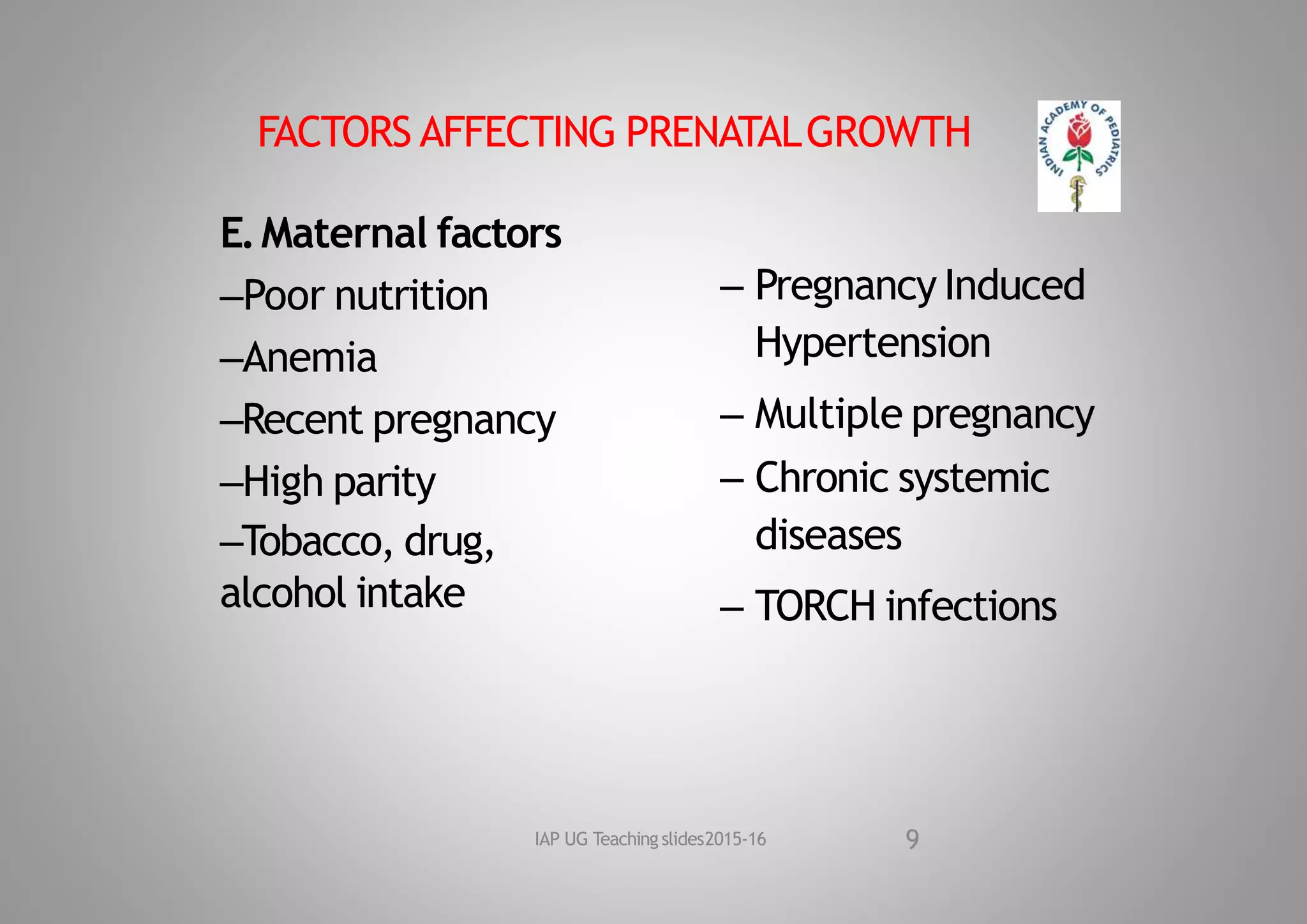
E.Maternal factors
–Poor nutrition
–Anemia
–Recent pregnancy
–High parity
–Tobacco, drug,
alcohol intake
– Pregnancy Induced
Hypertension
– Multiple pregnancy
– Chronic systemic
diseases
– TORCH infections
9
IAP UG Teaching slides2015‐16
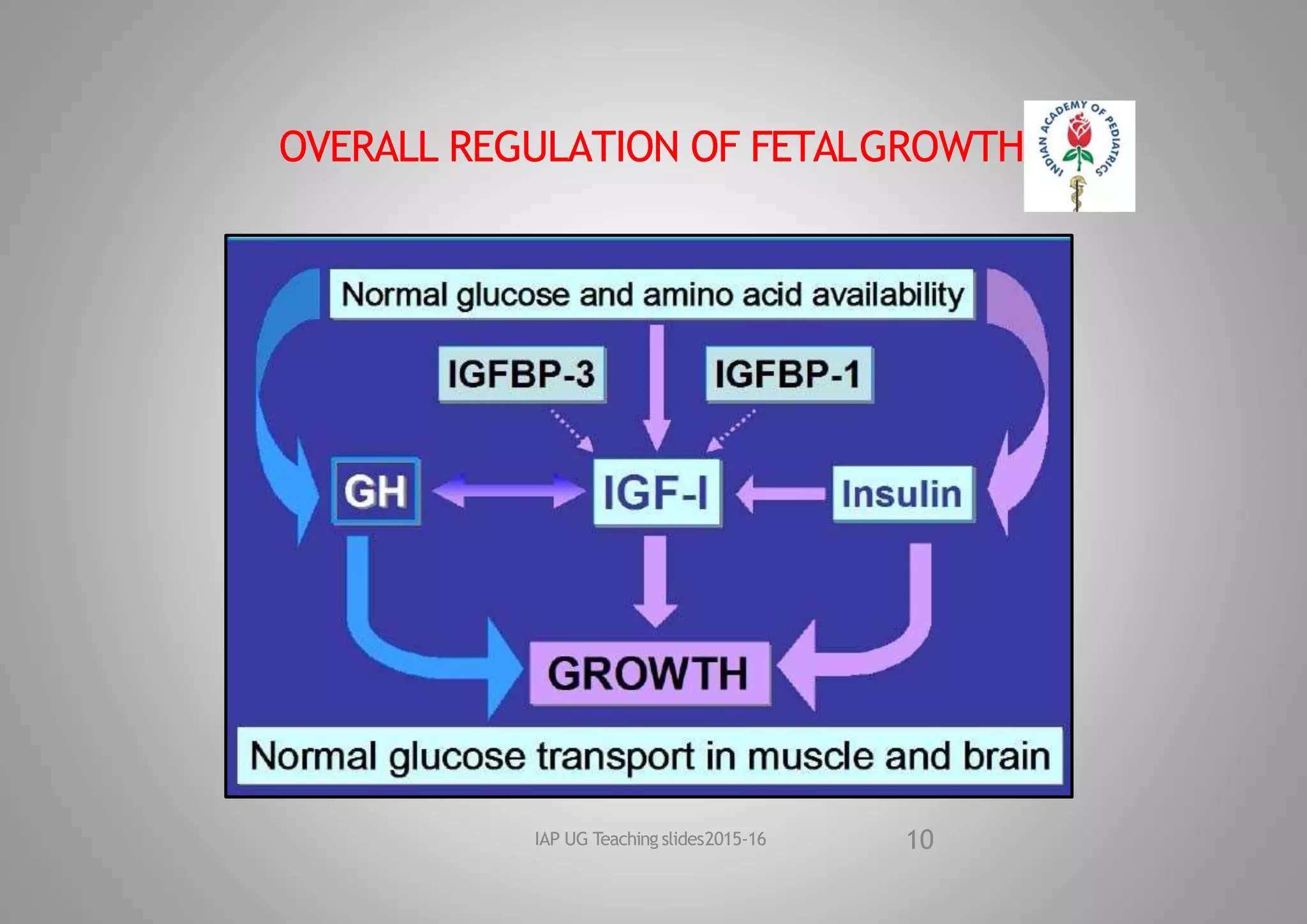
OVERALL REGULATION OF FETALGROWTH
10
IAP UG Teaching slides2015‐16
FACTORS AFFECTING POSTNATAL GROWTH
A. Sex
• Boys have greater
growth potentialthan
girls
• Girls have early
pubertal heightspurt
than boys
• Pubertal height gainis
more inboys
11
IAP UG Teaching slides2015‐16
FACTORS AFFECTING POSTNATAL GROWTH
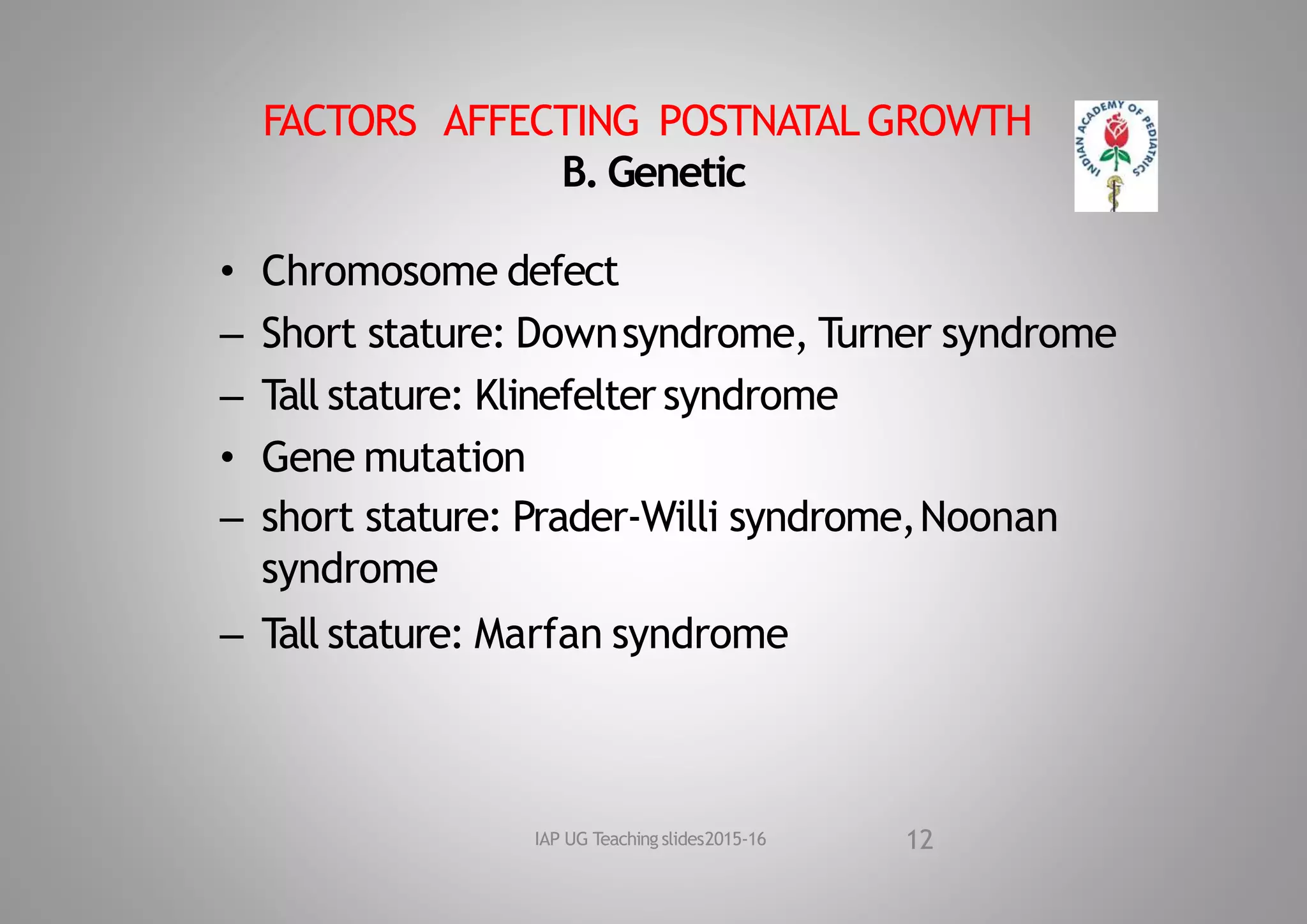
B. Genetic
• Chromosome defect
– Short stature: Downsyndrome, Turner syndrome
– Tall stature: Klinefelter syndrome
• Gene mutation
– short stature: Prader‐Willi syndrome,Noonan
syndrome
– Tall stature: Marfan syndrome
12
IAP UG Teaching slides2015‐16
FACTORS AFFECTING POSTNATAL GROWTH
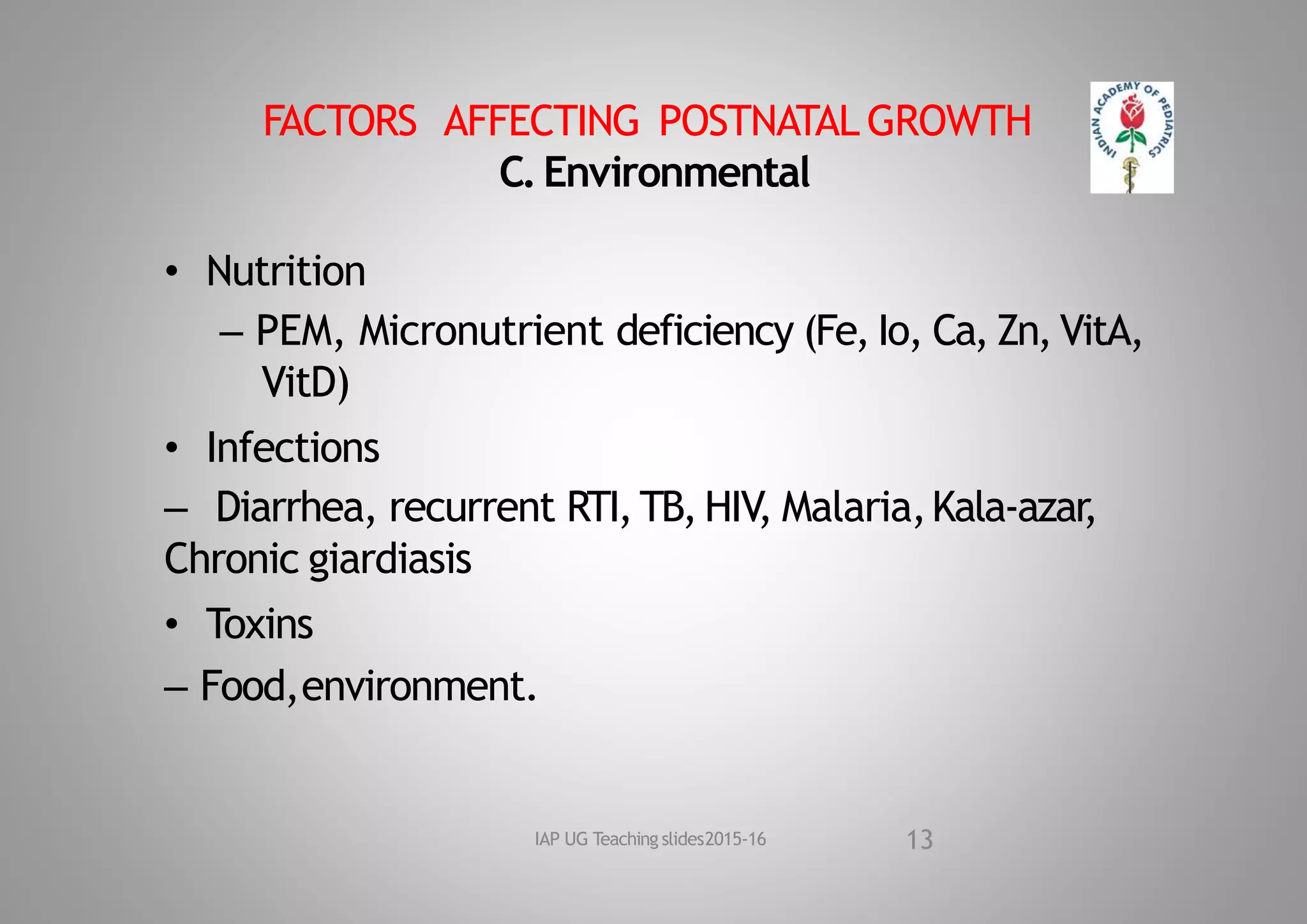
C.Environmental
• Nutrition
– PEM, Micronutrient deficiency (Fe, Io, Ca, Zn, VitA,
VitD)
• Infections
– Diarrhea, recurrent RTI,TB, HIV, Malaria,Kala‐azar
,
Chronic giardiasis
• Toxins
– Food,environment.
13
IAP UG Teaching slides2015‐16
Factors affecting postnatal growth
D. Hormonal
•Growth hormone deficiency
•Hypothyroidism
•Growth hormone resistance
14
IAP UG Teaching slides2015‐16
FACTORS AFFECTING POSTNATAL GROWTH
E.Social factors
• Low socio economic status: Poordiet, infections
• Hot and humidclimate
• Poor emotional support: Brokenfamily, orphans
• Cultural factors: Religioustaboos
• Low parental education: Poor healthpromotion,
poor nutrition.
15
IAP UG Teaching slides2015‐16
16
IAP UG Teaching slides2015‐16
LATE CONSEQUENCES OF POOR FETALGROWTH
(NUTRITION)
Fetal origin hypothesis (Barker’shypothesis)
•Alterations in fetal nutrition and endocrine status lead
to programming
•Permanent changes in structure, physiologyand
metabolism
•IUGR infants have increased risk of diabetes mellitus,
hypertension, hyperlipidemia and coronary artery
disease
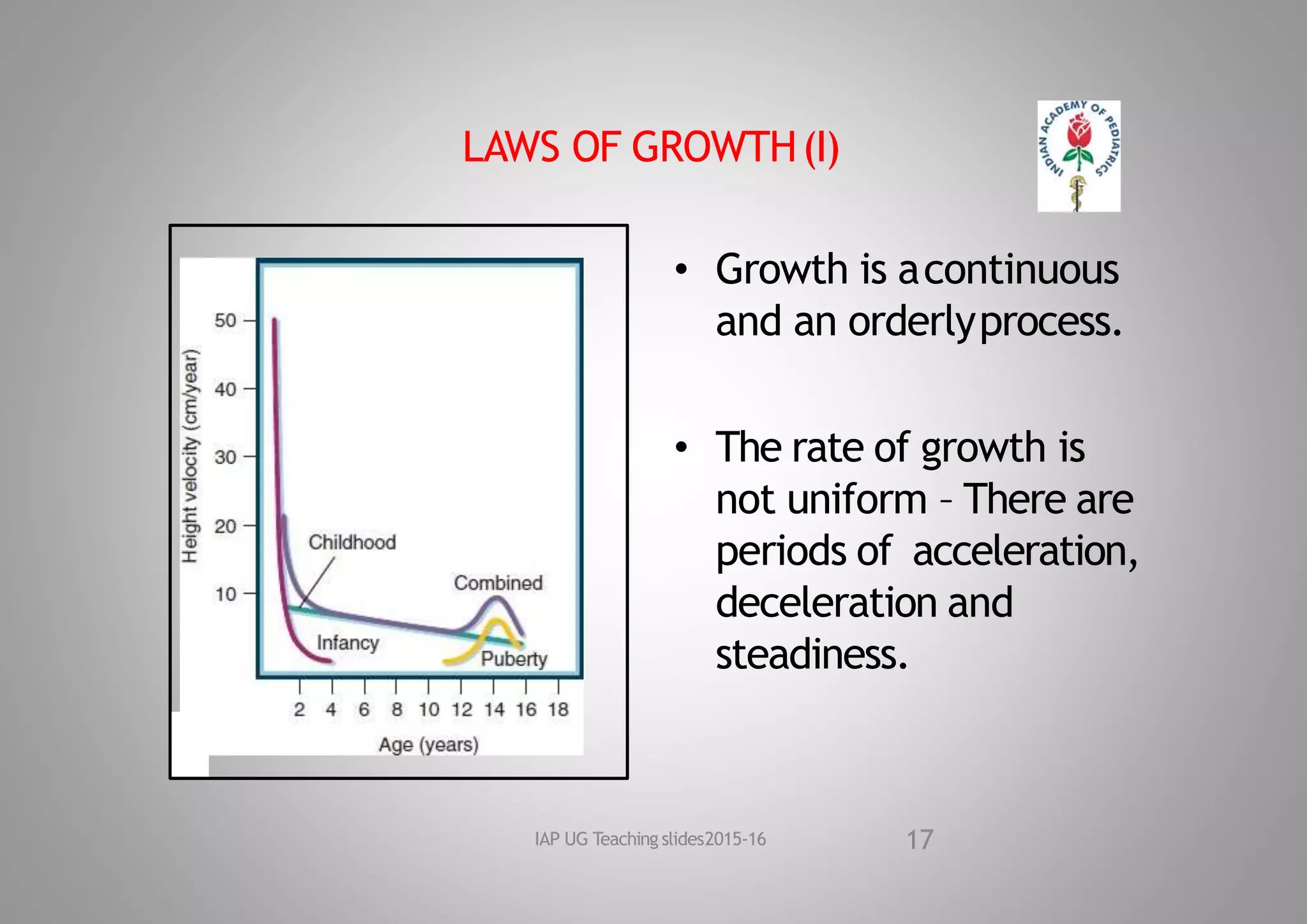
LAWS OF GROWTH(I)
• Growth is acontinuous
and an orderlyprocess.
• The rate of growth is
not uniform – There are
periods of acceleration,
deceleration and
steadiness.
17
IAP UG Teaching slides2015‐16
PHASES OF GROWTHACCELERATION,
DECELERATION AND STEADINESS
• Accelerationv(fv
ast)‐1st Half of gestation, 1st yearof
life, Puberty
• Deceleration‐ 2nd year
• Steady rate‐ 6‐9 years ofage
Dotted
line:
Weight
Solid
line:
Height
18
IAP UG Teaching slides2015‐16
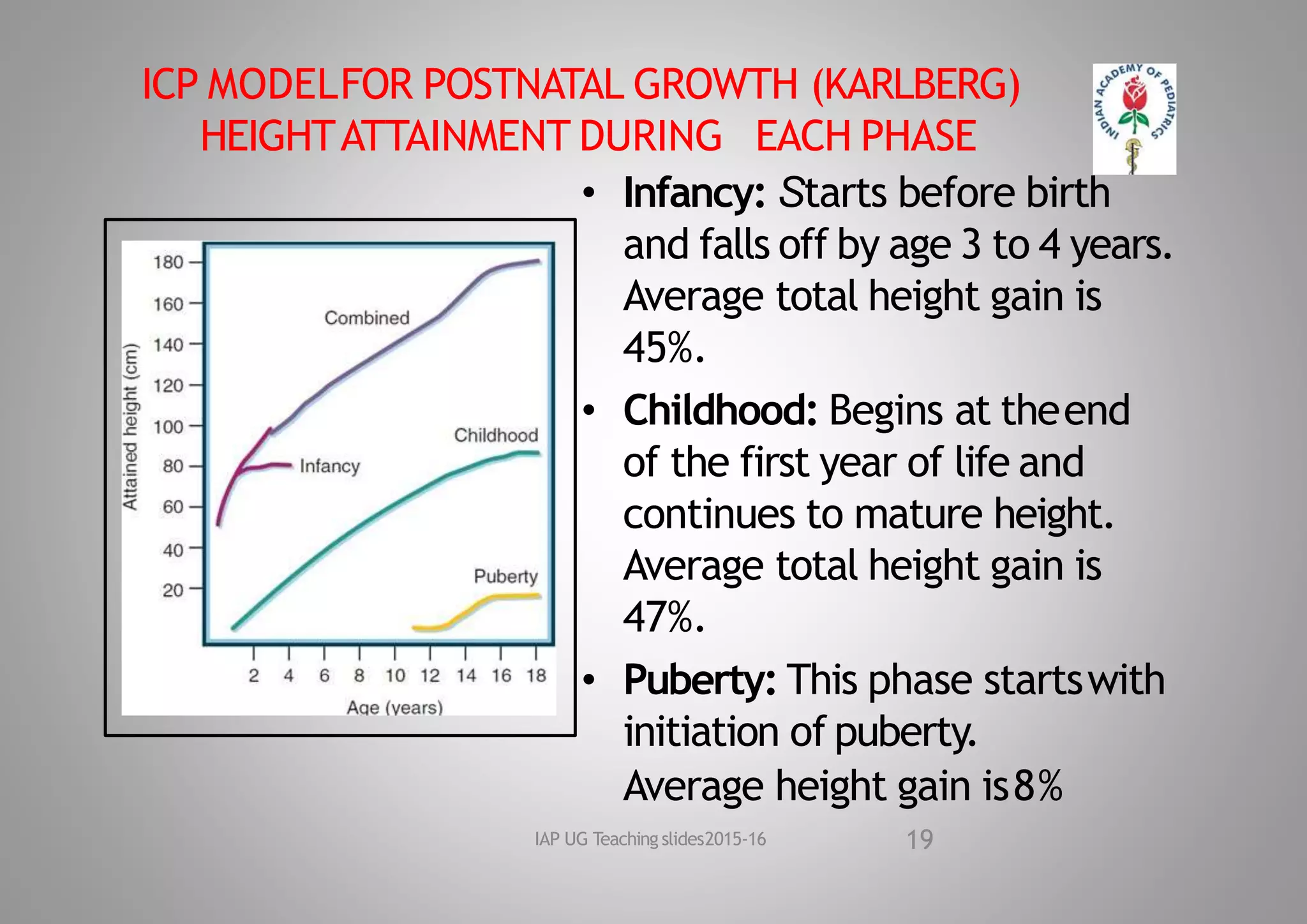
ICP MODELFOR POSTNATAL GROWTH (KARLBERG)
HEIGHTATTAINMENT DURING EACH PHASE
• Infancy: Starts before birth
and falls off by age 3 to 4 years.
Average total height gain is
45%.
• Childhood: Begins at theend
of the first year of life and
continues to mature height.
Average total height gain is
47%.
• Puberty: This phase startswith
initiation of puberty.
Average height gain is8%
19
IAP UG Teaching slides2015‐16
PREDOMINANT CONTROL
INEACH PHASE OF GROWTH
• Infancy: Nutrition,
GH, thyroxine
• Childhood: GHand
thyroxine
• Puberty: Sexsteroid
and GH.
20
IAP UG Teaching slides2015‐16
LAWS OF GROWTH(II)
Growth pattern of every individual isunique.
• Cephalocaudal
• Distal to proximal
21
IAP UG Teaching slides2015‐16
LAWS OF GROWTH(III)
•Different tissues of the
body grow at differentrates
•General growth: Rapid
during fetal life, first 1‐2y
and atpuberty
•Brain and head: Rapid
during late fetal andearly
postnatal life
At birth 70%, at 2 y 90% of
adult.
22
IAP UG Teaching slides2015‐16
LAWS OF GROWTH(II)
• Lymphoid – maximum growth during mid‐
childhood (4‐8y) Large tonsils and lymphnodes
• Gonads – grow at pubescence only
1 0 0 % 1 0 0 %
y e a r s
S o m a n i c G r o w t h
a g e
B r a i n G r o w t h
1 0 0 % 1 0 0 %
y e a r s
G o n a d s G r o w t h
a g e
L y m p h o i d G r o w t h
23
IAP UG Teaching slides2015‐16
PERIODS OFGROWTH
Prenatal period
• Ovum :0‐1w
• Embryo :2‐8w
• Fetus :9w ‐birth
• Perinatal period :22wk
of gestation to 7days
after birth.
Postnatal period
Newborn: Birth to 28days
Infancy: First year
Toddler: 2‐3y
Preschool: 4‐6y
School age: 7‐12y
Adolescence:10‐18y
24
IAP UG Teaching slides2015‐16
PRENATAL GROWTH
Embryonic period
• 2wk: Bi‐laminarembryo
• 3wk: Tri‐laminarembryo,
Heart pumpingbegins
• 4wk: 4cms, humanshape,
arm‐leg buds
• 5‐8wk: Major organsystem
development
• 9wk: 9g, 5cm. Fetalperiod
begins.
Fetal period
10wk: Externalgenitalia
distinguishable
20wk: 460gm, 19cms,lower
limit of viability
24w – Primitive alveoli,
surfactant production
25wk: 900gm, 25cm,3rd
trimester begins
38wk: Term, weight triples,
length doubles from thatof
25 w ofgestation
25
IAP UG Teaching slides2015‐16
PARAMETERS OFGROWTH
• Weight.
• Length <2 y or Height >2 y
.
• Head circumference (HC), Chest circumference(CC).
• Upper segment to lower segment (U:L) ratio.
• Arm span (AS).
26
IAP UG Teaching slides2015‐16
HOW TO MEASUREWEIGHT?
Weighing scales:
•Lever/Electronic
•Spring balance (lessaccurate)
•Minimum unit100gm
Technique
• In nude or minimalclothing
• Weighing scale checked for zeroerror
• Center the infant on the scale tray
• Weigh infant to the nearest 10 gm and older
child to nearest 100gm.
2
7
IAP UG Teaching slides2015‐16
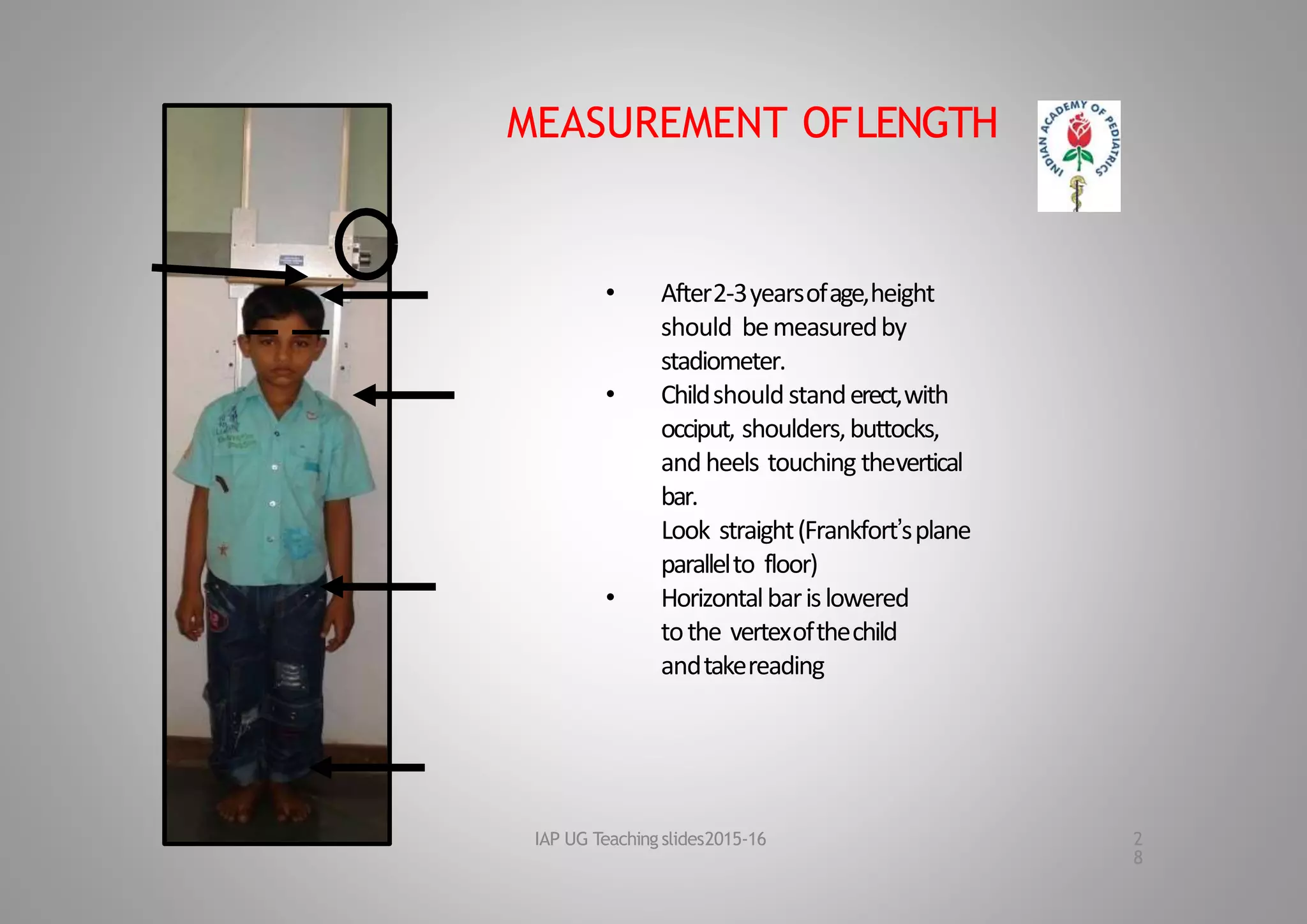
MEASUREMENT OFLENGTH
• After2‐3yearsofage,height
should bemeasuredby
stadiometer.
• Childshouldstanderect,with
occiput, shoulders,buttocks,
andheels touching thevertical
bar.
Look straight(Frankfort’splane
parallelto floor)
• Horizontalbarislowered
tothe vertexofthechild
andtakereading
IAP UG Teaching slides2015‐16 2
8
MEASUREMENT OFLENGTH
Length of children < 2‐3yare
measured byinfantometer.
IAP UG Teaching slides2015‐16 2
9
MEASUREMENT OF HEAD CIRCUMFERENCE (HC)
• HC should be measured
using non‐stretchabletapes
(e.g..Steel)
• Measure across most
prominent points of
superior orbital ridge
(anterior) and external
occipital protuberance
(posterior)
Should notbe
measured
within 24 hrs.after
birth to avoid spurious
values due tomoulding
3
0
IAP UG Teaching slides2015‐16 7
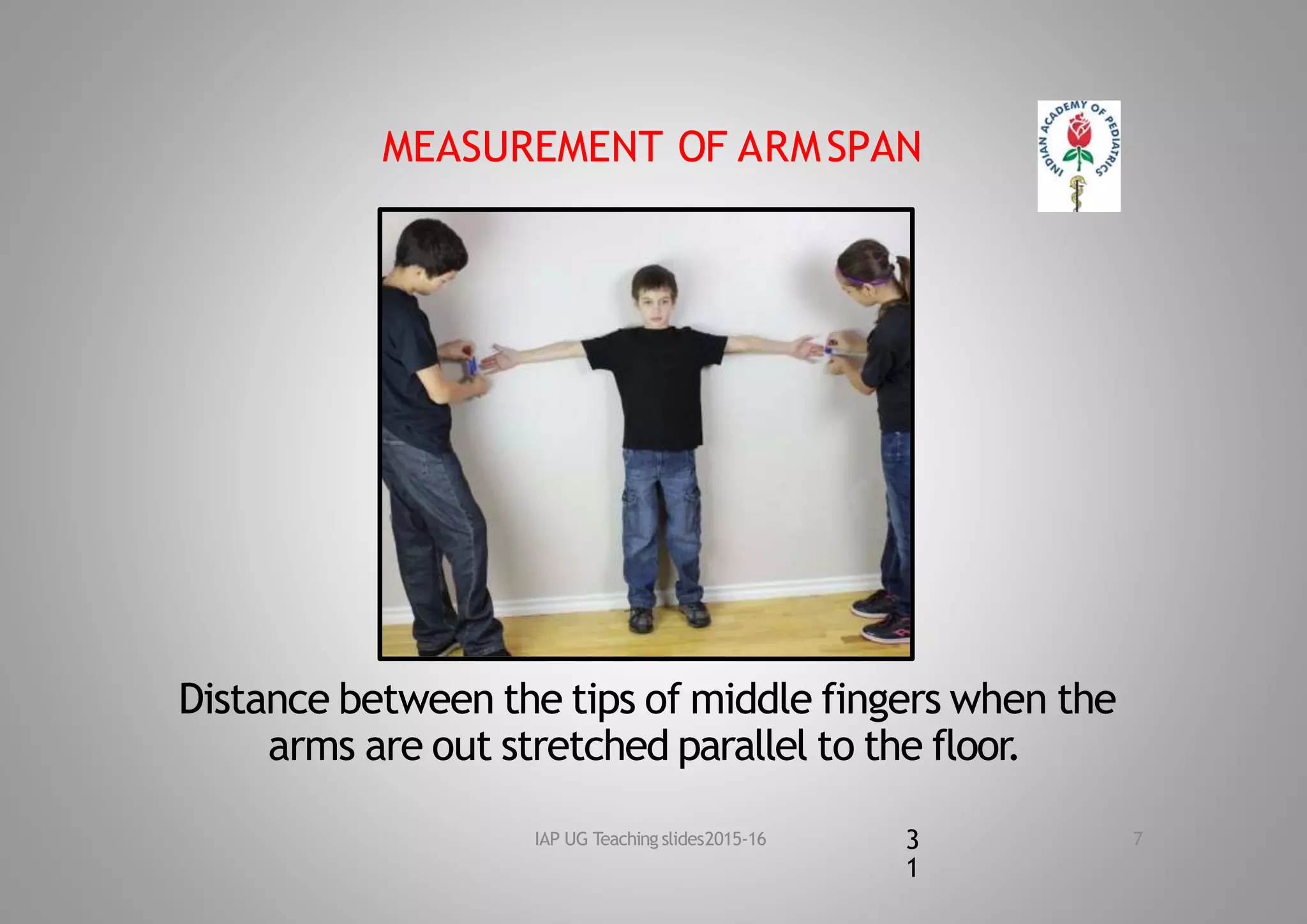
MEASUREMENT OF ARMSPAN
Distance between the tips of middle fingers when the
arms are out stretched parallel to the floor.
3
1
IAP UG Teaching slides2015‐16 7
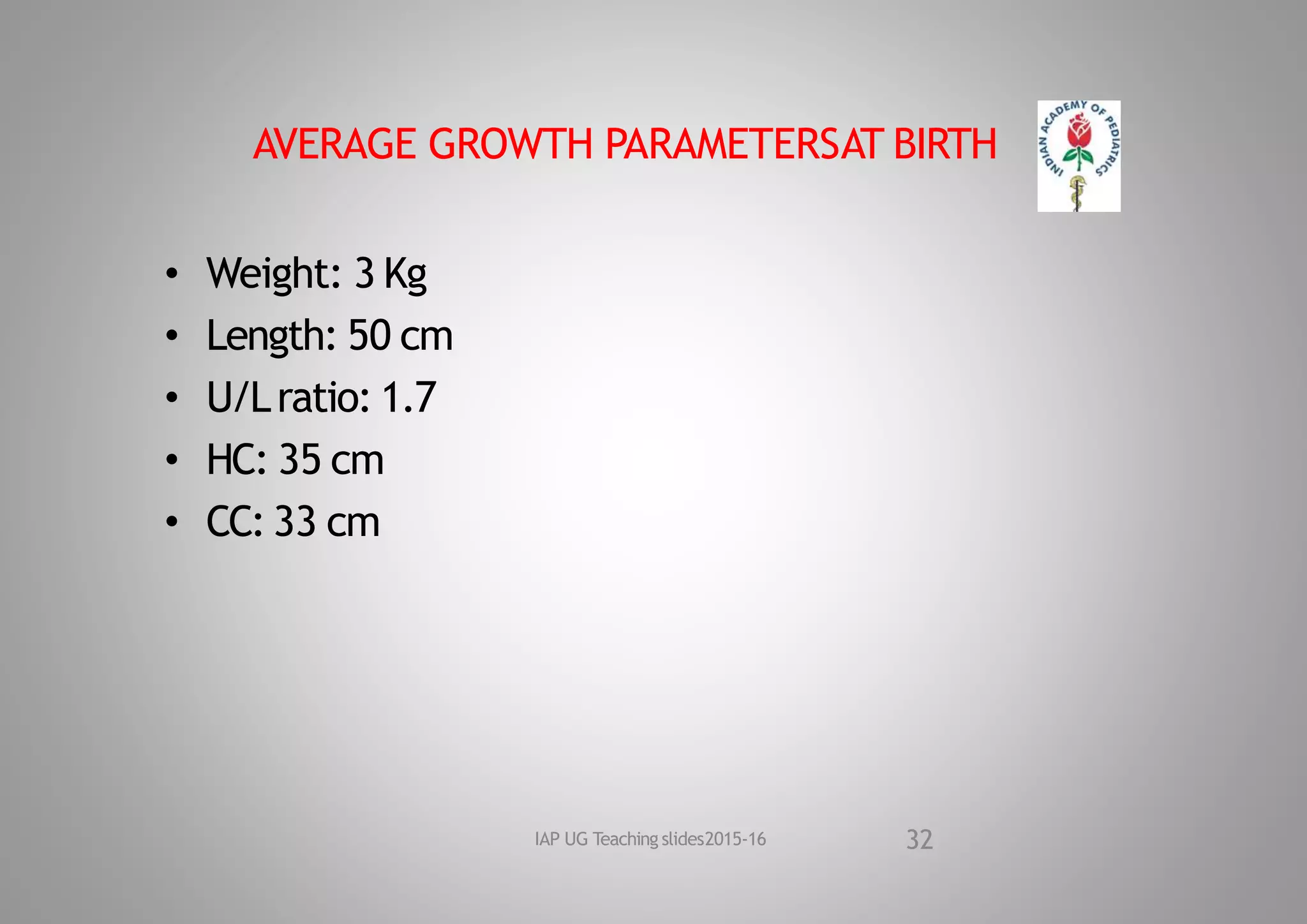
AVERAGE GROWTH PARAMETERSAT BIRTH
• Weight: 3 Kg
• Length: 50 cm
• U/Lratio: 1.7
• HC: 35 cm
• CC: 33 cm
32
IAP UG Teaching slides2015‐16
POSTNATAL GROWTH :WEIGHT
Age group
0‐3 m
4m‐1 yr.
2yr – Pubertal growth spurt*
2‐3 Kg/y
or
Weight gain
25‐30g/day
400g/month
[Wt. in Kg = (Age in years +4) X 2]
• Weight doubles at 5m, triples at 1 y
,quadruples
at 2y
* Boys 12 y
, girls 10 y
.
33
IAP UG Teaching slides2015‐16
POSTNATAL GROWTH: LENGTH/HEIGHT
Age group
0‐3 m
4‐6m
7‐9m
10‐12m
13‐24m
3‐10 yr.*
Height velocity
3.5cm/m
2cm/m
1.5cm/m
1.2cm/m
1cm/m
5‐6cm/y
* Weech’s formula: Ht in cms = (Age in
years X6)
+ 77 34
IAP UG Teaching slides2015‐16
POSTNATAL GROWTH:ADOLESCENCE
PARAMETER EARLY MIDDLE LATE
Age (years) 9-13 14-16 17-20
Weight gain/Year 2Kg 3.5kg 1kg
Height gain/year 6-8cms 8-10 cm 2-3 cm
SMR* stages 1,2 3,4 5
35
IAP UG Teaching slides2015‐16
* Sex maturity rating
Mean pubertal height gain :Boys‐27 cm, girls‐25 cm
Mean pubertal weight gain :Boys 29kg, girls 24 kg
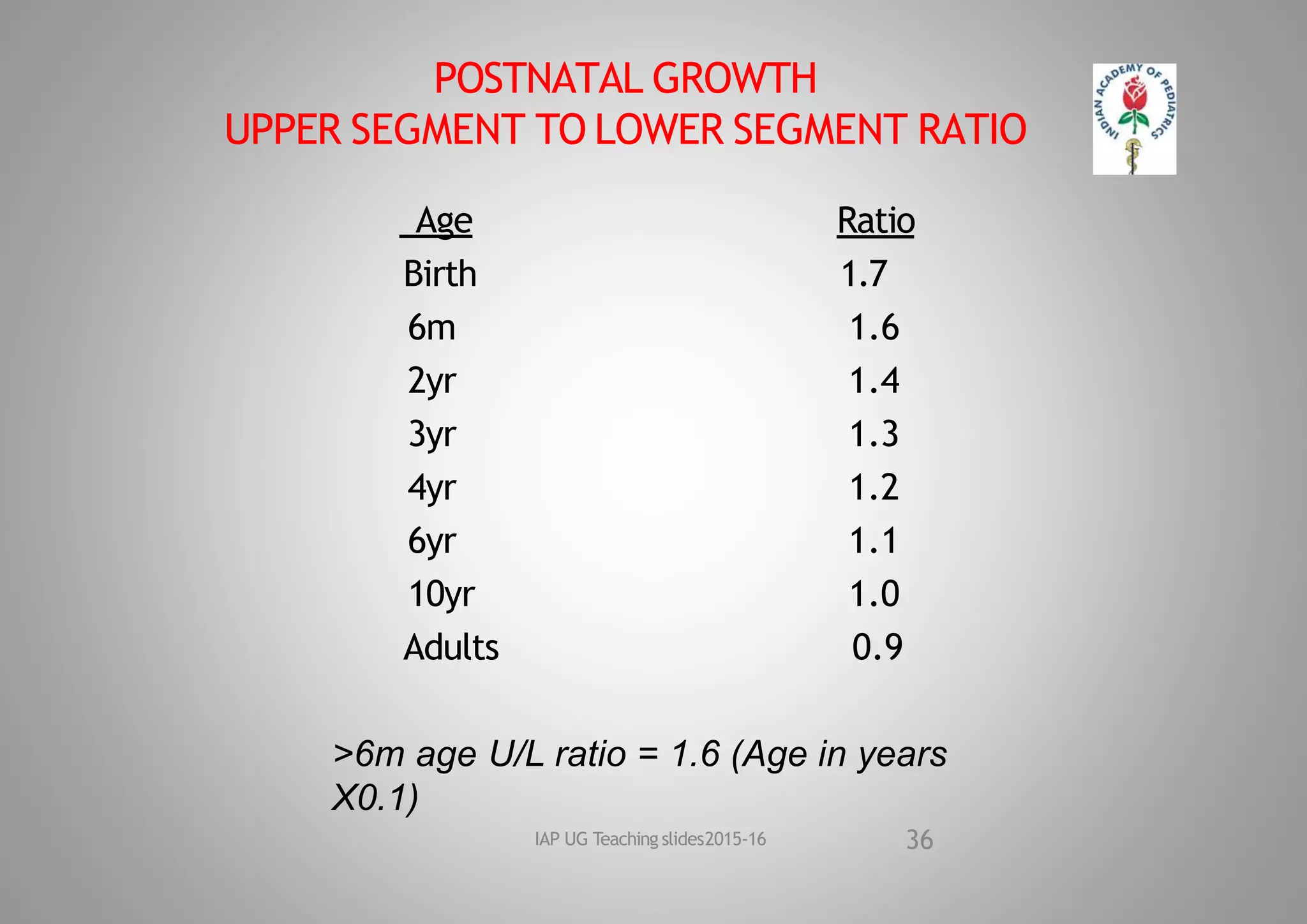
POSTNATAL GROWTH
UPPER SEGMENT TO LOWER SEGMENT RATIO
Age Ratio
Birth 1.7
6m 1.6
2yr 1.4
3yr 1.3
4yr 1.2
6yr 1.1
10yr 1.0
Adults 0.9
>6m age U/L ratio = 1.6 (Age in years
X0.1)
36
IAP UG Teaching slides2015‐16
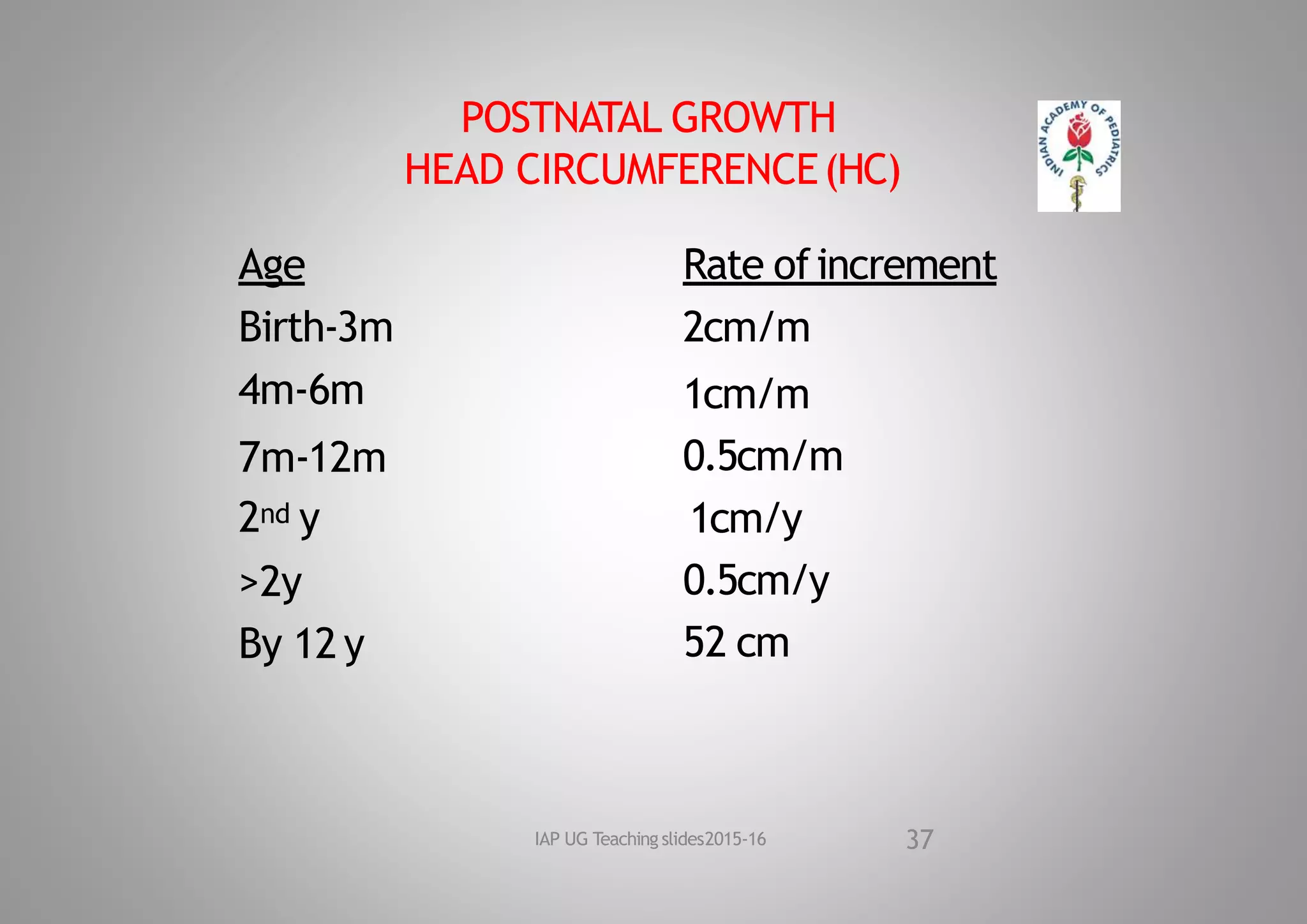
POSTNATAL GROWTH
HEAD CIRCUMFERENCE(HC)
Age
Birth‐3m
4m‐6m
7m‐12m
2nd y
>2y
By 12 y
Rate ofincrement
2cm/m
1cm/m
0.5cm/m
1cm/y
0.5cm/y
52 cm
37
IAP UG Teaching slides2015‐16
POSTNATAL GROWTH
CHEST CIRCUMFERENCE (CC)
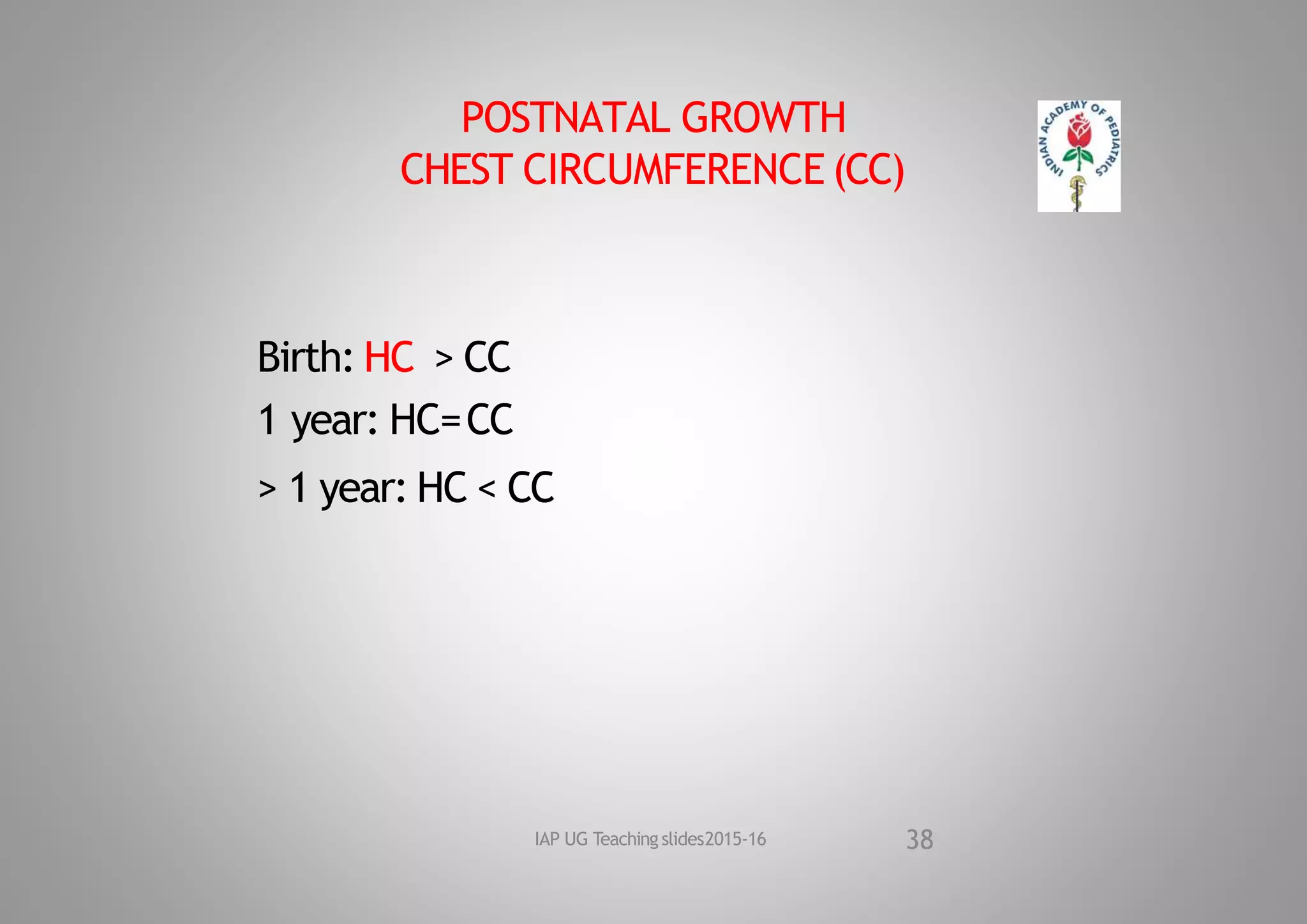
Birth: HC > CC
1 year: HC=CC
> 1 year: HC < CC
38
IAP UG Teaching slides2015‐16
POSTNATAL GROWTH: ARMSPAN (AS)
Birth to 5y Ht 2cm > armspan
5‐10 y Ht 1cm > armspan
10 y Ht = armspan
Adults Ht 2cm < armspan
39
IAP UG Teaching slides2015‐16
POSTNATAL GROWTH: SKELETALMATURATION
•Steady in childhood, accelerates atpuberty
•Closely correlates with sexualmaturation
•Maturity indicated by epiphysealclosure
•Complete in boys at 22 y
, girls at 18 y
Preferred areas for bone age estimationby
radiography
Birth‐3m
3‐9 m
1‐13 y
12‐14 y
knee andankle
Shoulder
Hands andwrists
Elbow and hip
40
IAP UG Teaching slides2015‐16
POSTNATAL GROWTH – DENTITION
Primary teeth(20)
Central incisors
Lateral incisors
Canines
I Molar
II Molar
Age ateruption
5m to 8m
7m to 11m
16m to20m
10m to16m
20m to30m
Approximate assessment
Expected number of teeth = Age in months ‐ 6
41
IAP UG Teaching slides2015‐16
POSTNATAL GROWTH – DENTITION
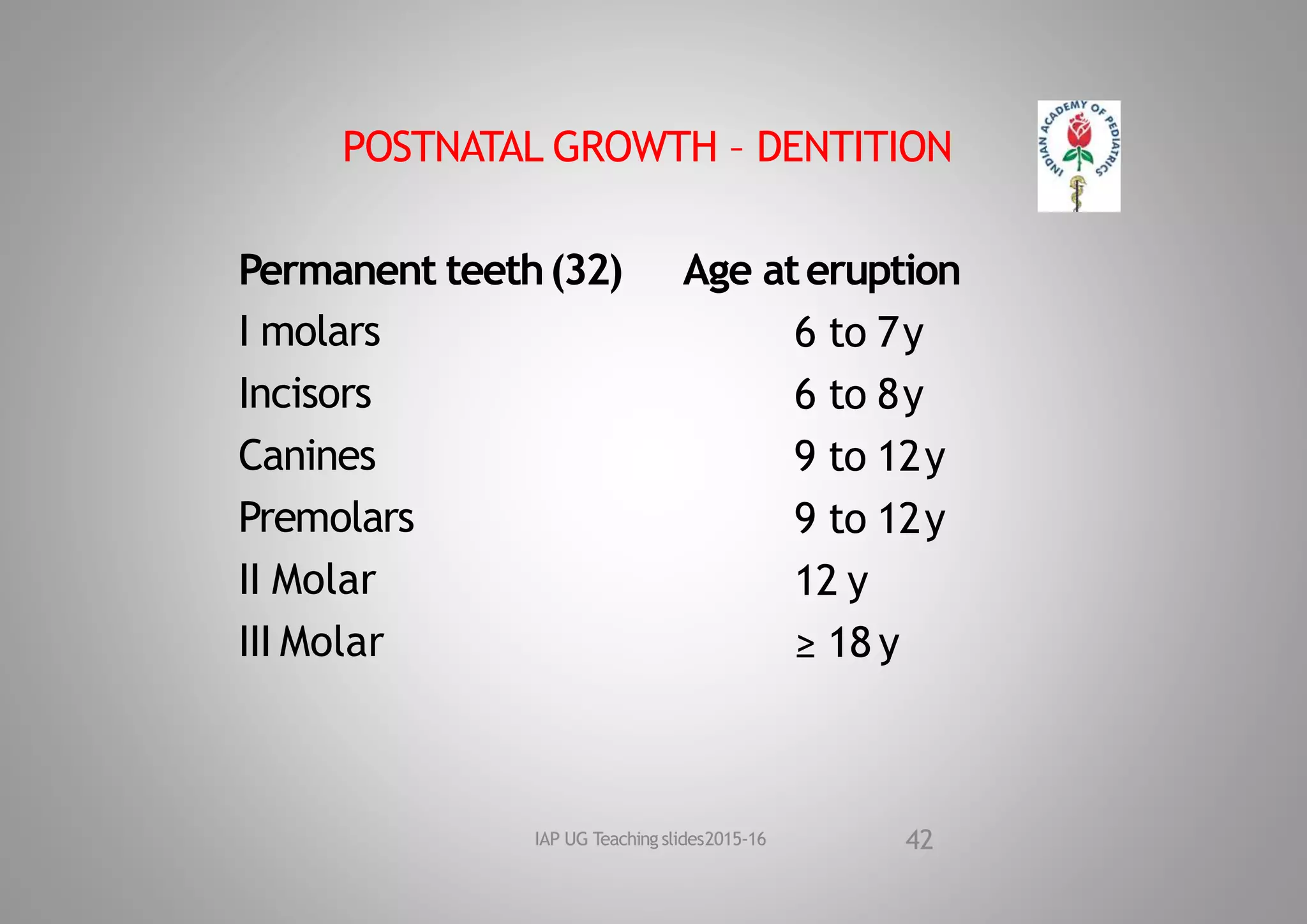
Permanent teeth(32)
I molars
Incisors
Canines
Premolars
II Molar
III Molar
Age ateruption
6 to 7y
6 to 8y
9 to 12y
9 to 12y
12 y
≥ 18 y
42
IAP UG Teaching slides2015‐16
GROWTH STANDARDS
• Norms of growth represented as tables or charts
• Derived from large cohort of healthy children by
cross sectional or longitudinalstudies
• Tables are useful as easy ready references
43
IAP UG Teaching slides2015‐16
GROWTH CHARTS
• Superior to tablesto
diagnose early
deviations ingrowth
• Distance growth charts
reveal the growth
acquired till the dateof
last evaluation
44
IAP UG Teaching slides2015‐16
HEIGHT VELOCITYCHARTS
• Height velocity: Rate ofheight
increment per unit timeand
• Indicates periods of
acceleration, decelerationand
steadiness
• Most useful for early
identification of growth
faltering
45
IAP UG Teaching slides2015‐16
DISTANCE GROWTH CHARTS
• Growth parameters
are presented in
graphical manner
• Age along the X axis
and measurementsin
the Yaxis
• Charts have 5 or 7
percentile curves
representing the
distribution of the
growth parameters
46
IAP UG Teaching slides2015‐16
GROWTH PARAMETERS INGROWTH CHARTS
• Weight forage
• Height/length for age
• Head circumference forage
• Weight forlength/height
• Body mass index
Each parameter separate for boys (Blue) & girls (pink)
47
IAP UG Teaching slides2015‐16
PLOTTING HEIGHT ONA GROWTH CHART
• 8 years oldboy,
• Height: 120 cm,
• Draw an imaginary line
along the X‐axis till the
age (8y) of thechild.
• Then extend the
imaginary line along
the Y‐axis till theheight
(116 cm) of thechild
• Mark thepoint
48
IAP UG Teaching slides2015‐16
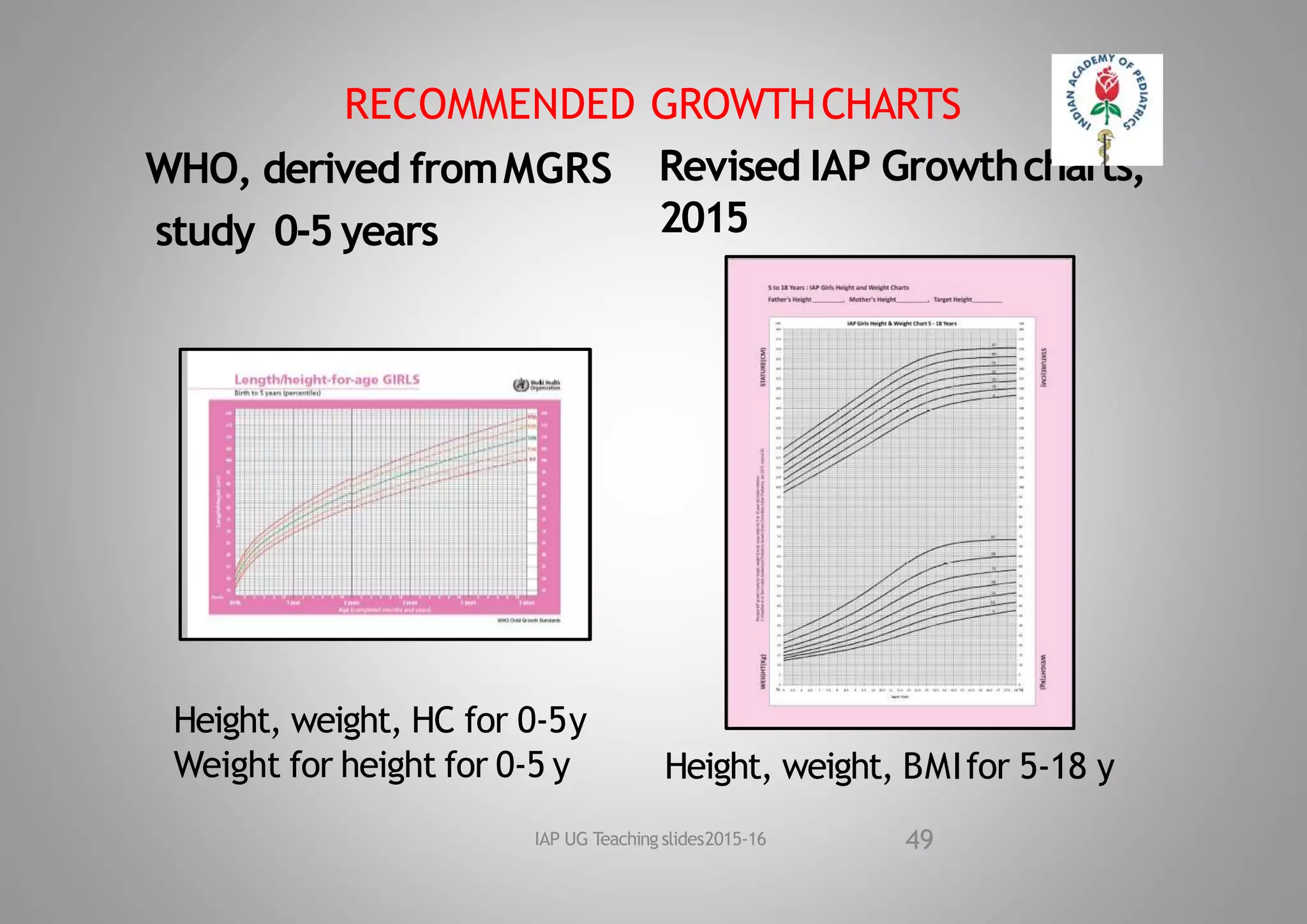
RECOMMENDED GROWTHCHARTS
Revised IAP Growthcharts,
2015
WHO, derived fromMGRS
study 0‐5 years
Height, weight, HC for 0‐5y
Weight for height for 0‐5 y
49
IAP UG Teaching slides2015‐16
Height, weight, BMIfor 5‐18 y
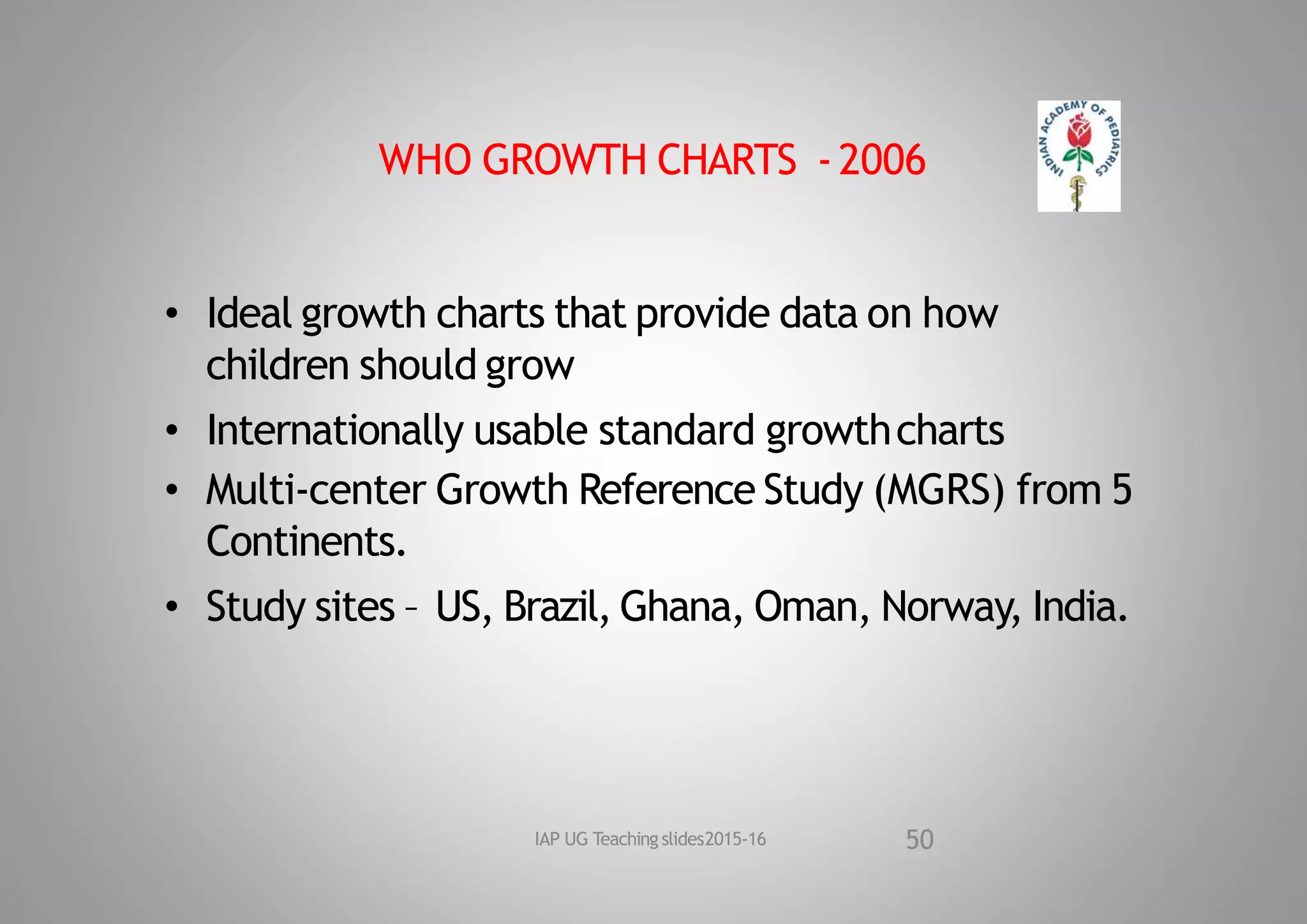
WHO GROWTH CHARTS ‐2006
• Ideal growth charts that provide data on how
children should grow
• Internationally usable standard growthcharts
• Multi‐center Growth Reference Study (MGRS) from 5
Continents.
• Study sites – US, Brazil, Ghana, Oman, Norway, India.
50
IAP UG Teaching slides2015‐16
WHO GROWTH CHARTS‐ 2006
• Derived from children raised underoptimal
conditions for growth suchas:
– Exclusive breast feeding
– Healthy environment
– Minimal infection
– Nonsmoking mothers
51
IAP UG Teaching slides2015‐16
STATISTICS USED IN DESCRIBINGGROWTH
• Normal: Healthy.
• Median: Value above and below which 50% of
observations lie.
• Mode: Value having highest number of observations
• Mean:The average value of observations.
• Standard deviation or Zscore: The extent to which
observed values cluster near themean.
52
IAP UG Teaching slides2015‐16
NORMAL DISTRIBUTION (GAUSSIAN)CURVE
• Symmetrical bell shaped curve in which 50% of the
observations lie above & 50% below a central line
which is the 50th percentile ormedian
• Values below 3rd (‐2SD) and above97th (+2SD)
percentile are abnormal.
53
IAP UG Teaching slides2015‐16
THANK YOU
54
IAP UG Teaching slides2015‐16

Normal growth,assessment ,charts

  • 1.
    NORMAL GROWTH AND FACTORSAFFECTINGGROWTH 1 IAP UG Teaching slides2015‐16
  • 2.
    DEFINITIONS • Growth: Netincrease in the size or mass of tissues which is largely due to multiplication of cells and increase in the intracellularsubstance. • Development: Maturation of functions associated with maturation and myelination of nervous system. 2 IAP UG Teaching slides2015‐16
  • 3.
    GROWTH: SIGNIFICANCE • Essentialfeature that distinguishes a child from an adult. • Indicates overall well‐being of achild. • Reflects the nation’s economic status andpublic health system. 3 IAP UG Teaching slides2015‐16
  • 4.
    FACTORS AFFECTINGGROWTH • Prenatalperiod – Fetal – Placental – Maternal • Postnatal period – Genetic – Environmental 4 IAP UG Teaching slides2015‐16
  • 5.
    FACTORS AFFECTING PRENATALGROWTH A.Genetic Potential • Parental trait ‐ Tall parents have tallchildren ‐ Head size related toparents • Sex ‐ Boys larger thangirls • Race‐ Growth differs in differentraces 5 IAP UG Teaching slides2015‐16
  • 6.
    FACTORS AFFECTING PRENATALGROWTH B.Fetal GrowthFactors Growth Promotion • Insulin like growthfactors (IGF‐I and IGF‐II)(~70%) • Epidermal growthfactor • Transforming growth factor α (TGF‐α) • Platelet derived growth factor • Fibroblast growth factor • Nerve growth factoretc. Growth Inhibition • Transforming growthfactor β (TGF‐β) • Mullerian inhibiting substance (AMH) • Inhibin /Activin familyof proteins 6 IAP UG Teaching slides2015‐16
  • 7.
    FACTORS AFFECTING PRENATALGROWTH C.Fetalhormones •Have predominant role in lategestation •Insulin and Thyroxine :Important for accretion and differentiation of tissues •Glucocorticoids :Required for maturation oforgans like lungs, liver and GItract •Note :Influence of Growth hormone on fetal growth is minimal. 7 IAP UG Teaching slides2015‐16
  • 8.
    FACTORS AFFECTING PRENATALGROWTH D.Placental factors •Placenta is essential for nutrition of fetus •Fetal nutrition is enhancedby – Increased villous surfacearea – Decreased diffusion distance – Increased dilatation of fetalcapillaries – Decreased resistance ofvasculature 8 IAP UG Teaching slides2015‐16
  • 9.
    FACTORS AFFECTING PRENATALGROWTH E.Maternalfactors –Poor nutrition –Anemia –Recent pregnancy –High parity –Tobacco, drug, alcohol intake – Pregnancy Induced Hypertension – Multiple pregnancy – Chronic systemic diseases – TORCH infections 9 IAP UG Teaching slides2015‐16
  • 10.
    OVERALL REGULATION OFFETALGROWTH 10 IAP UG Teaching slides2015‐16
  • 11.
    FACTORS AFFECTING POSTNATALGROWTH A. Sex • Boys have greater growth potentialthan girls • Girls have early pubertal heightspurt than boys • Pubertal height gainis more inboys 11 IAP UG Teaching slides2015‐16
  • 12.
    FACTORS AFFECTING POSTNATALGROWTH B. Genetic • Chromosome defect – Short stature: Downsyndrome, Turner syndrome – Tall stature: Klinefelter syndrome • Gene mutation – short stature: Prader‐Willi syndrome,Noonan syndrome – Tall stature: Marfan syndrome 12 IAP UG Teaching slides2015‐16
  • 13.
    FACTORS AFFECTING POSTNATALGROWTH C.Environmental • Nutrition – PEM, Micronutrient deficiency (Fe, Io, Ca, Zn, VitA, VitD) • Infections – Diarrhea, recurrent RTI,TB, HIV, Malaria,Kala‐azar , Chronic giardiasis • Toxins – Food,environment. 13 IAP UG Teaching slides2015‐16
  • 14.
    Factors affecting postnatalgrowth D. Hormonal •Growth hormone deficiency •Hypothyroidism •Growth hormone resistance 14 IAP UG Teaching slides2015‐16
  • 15.
    FACTORS AFFECTING POSTNATALGROWTH E.Social factors • Low socio economic status: Poordiet, infections • Hot and humidclimate • Poor emotional support: Brokenfamily, orphans • Cultural factors: Religioustaboos • Low parental education: Poor healthpromotion, poor nutrition. 15 IAP UG Teaching slides2015‐16
  • 16.
    16 IAP UG Teachingslides2015‐16 LATE CONSEQUENCES OF POOR FETALGROWTH (NUTRITION) Fetal origin hypothesis (Barker’shypothesis) •Alterations in fetal nutrition and endocrine status lead to programming •Permanent changes in structure, physiologyand metabolism •IUGR infants have increased risk of diabetes mellitus, hypertension, hyperlipidemia and coronary artery disease
  • 17.
    LAWS OF GROWTH(I) •Growth is acontinuous and an orderlyprocess. • The rate of growth is not uniform – There are periods of acceleration, deceleration and steadiness. 17 IAP UG Teaching slides2015‐16
  • 18.
    PHASES OF GROWTHACCELERATION, DECELERATIONAND STEADINESS • Accelerationv(fv ast)‐1st Half of gestation, 1st yearof life, Puberty • Deceleration‐ 2nd year • Steady rate‐ 6‐9 years ofage Dotted line: Weight Solid line: Height 18 IAP UG Teaching slides2015‐16
  • 19.
    ICP MODELFOR POSTNATALGROWTH (KARLBERG) HEIGHTATTAINMENT DURING EACH PHASE • Infancy: Starts before birth and falls off by age 3 to 4 years. Average total height gain is 45%. • Childhood: Begins at theend of the first year of life and continues to mature height. Average total height gain is 47%. • Puberty: This phase startswith initiation of puberty. Average height gain is8% 19 IAP UG Teaching slides2015‐16
  • 20.
    PREDOMINANT CONTROL INEACH PHASEOF GROWTH • Infancy: Nutrition, GH, thyroxine • Childhood: GHand thyroxine • Puberty: Sexsteroid and GH. 20 IAP UG Teaching slides2015‐16
  • 21.
    LAWS OF GROWTH(II) Growthpattern of every individual isunique. • Cephalocaudal • Distal to proximal 21 IAP UG Teaching slides2015‐16
  • 22.
    LAWS OF GROWTH(III) •Differenttissues of the body grow at differentrates •General growth: Rapid during fetal life, first 1‐2y and atpuberty •Brain and head: Rapid during late fetal andearly postnatal life At birth 70%, at 2 y 90% of adult. 22 IAP UG Teaching slides2015‐16
  • 23.
    LAWS OF GROWTH(II) •Lymphoid – maximum growth during mid‐ childhood (4‐8y) Large tonsils and lymphnodes • Gonads – grow at pubescence only 1 0 0 % 1 0 0 % y e a r s S o m a n i c G r o w t h a g e B r a i n G r o w t h 1 0 0 % 1 0 0 % y e a r s G o n a d s G r o w t h a g e L y m p h o i d G r o w t h 23 IAP UG Teaching slides2015‐16
  • 24.
    PERIODS OFGROWTH Prenatal period •Ovum :0‐1w • Embryo :2‐8w • Fetus :9w ‐birth • Perinatal period :22wk of gestation to 7days after birth. Postnatal period Newborn: Birth to 28days Infancy: First year Toddler: 2‐3y Preschool: 4‐6y School age: 7‐12y Adolescence:10‐18y 24 IAP UG Teaching slides2015‐16
  • 25.
    PRENATAL GROWTH Embryonic period •2wk: Bi‐laminarembryo • 3wk: Tri‐laminarembryo, Heart pumpingbegins • 4wk: 4cms, humanshape, arm‐leg buds • 5‐8wk: Major organsystem development • 9wk: 9g, 5cm. Fetalperiod begins. Fetal period 10wk: Externalgenitalia distinguishable 20wk: 460gm, 19cms,lower limit of viability 24w – Primitive alveoli, surfactant production 25wk: 900gm, 25cm,3rd trimester begins 38wk: Term, weight triples, length doubles from thatof 25 w ofgestation 25 IAP UG Teaching slides2015‐16
  • 26.
    PARAMETERS OFGROWTH • Weight. •Length <2 y or Height >2 y . • Head circumference (HC), Chest circumference(CC). • Upper segment to lower segment (U:L) ratio. • Arm span (AS). 26 IAP UG Teaching slides2015‐16
  • 27.
    HOW TO MEASUREWEIGHT? Weighingscales: •Lever/Electronic •Spring balance (lessaccurate) •Minimum unit100gm Technique • In nude or minimalclothing • Weighing scale checked for zeroerror • Center the infant on the scale tray • Weigh infant to the nearest 10 gm and older child to nearest 100gm. 2 7 IAP UG Teaching slides2015‐16
  • 28.
    MEASUREMENT OFLENGTH • After2‐3yearsofage,height shouldbemeasuredby stadiometer. • Childshouldstanderect,with occiput, shoulders,buttocks, andheels touching thevertical bar. Look straight(Frankfort’splane parallelto floor) • Horizontalbarislowered tothe vertexofthechild andtakereading IAP UG Teaching slides2015‐16 2 8
  • 29.
    MEASUREMENT OFLENGTH Length ofchildren < 2‐3yare measured byinfantometer. IAP UG Teaching slides2015‐16 2 9
  • 30.
    MEASUREMENT OF HEADCIRCUMFERENCE (HC) • HC should be measured using non‐stretchabletapes (e.g..Steel) • Measure across most prominent points of superior orbital ridge (anterior) and external occipital protuberance (posterior) Should notbe measured within 24 hrs.after birth to avoid spurious values due tomoulding 3 0 IAP UG Teaching slides2015‐16 7
  • 31.
    MEASUREMENT OF ARMSPAN Distancebetween the tips of middle fingers when the arms are out stretched parallel to the floor. 3 1 IAP UG Teaching slides2015‐16 7
  • 32.
    AVERAGE GROWTH PARAMETERSATBIRTH • Weight: 3 Kg • Length: 50 cm • U/Lratio: 1.7 • HC: 35 cm • CC: 33 cm 32 IAP UG Teaching slides2015‐16
  • 33.
    POSTNATAL GROWTH :WEIGHT Agegroup 0‐3 m 4m‐1 yr. 2yr – Pubertal growth spurt* 2‐3 Kg/y or Weight gain 25‐30g/day 400g/month [Wt. in Kg = (Age in years +4) X 2] • Weight doubles at 5m, triples at 1 y ,quadruples at 2y * Boys 12 y , girls 10 y . 33 IAP UG Teaching slides2015‐16
  • 34.
    POSTNATAL GROWTH: LENGTH/HEIGHT Agegroup 0‐3 m 4‐6m 7‐9m 10‐12m 13‐24m 3‐10 yr.* Height velocity 3.5cm/m 2cm/m 1.5cm/m 1.2cm/m 1cm/m 5‐6cm/y * Weech’s formula: Ht in cms = (Age in years X6) + 77 34 IAP UG Teaching slides2015‐16
  • 35.
    POSTNATAL GROWTH:ADOLESCENCE PARAMETER EARLYMIDDLE LATE Age (years) 9-13 14-16 17-20 Weight gain/Year 2Kg 3.5kg 1kg Height gain/year 6-8cms 8-10 cm 2-3 cm SMR* stages 1,2 3,4 5 35 IAP UG Teaching slides2015‐16 * Sex maturity rating Mean pubertal height gain :Boys‐27 cm, girls‐25 cm Mean pubertal weight gain :Boys 29kg, girls 24 kg
  • 36.
    POSTNATAL GROWTH UPPER SEGMENTTO LOWER SEGMENT RATIO Age Ratio Birth 1.7 6m 1.6 2yr 1.4 3yr 1.3 4yr 1.2 6yr 1.1 10yr 1.0 Adults 0.9 >6m age U/L ratio = 1.6 (Age in years X0.1) 36 IAP UG Teaching slides2015‐16
  • 37.
    POSTNATAL GROWTH HEAD CIRCUMFERENCE(HC) Age Birth‐3m 4m‐6m 7m‐12m 2ndy >2y By 12 y Rate ofincrement 2cm/m 1cm/m 0.5cm/m 1cm/y 0.5cm/y 52 cm 37 IAP UG Teaching slides2015‐16
  • 38.
    POSTNATAL GROWTH CHEST CIRCUMFERENCE(CC) Birth: HC > CC 1 year: HC=CC > 1 year: HC < CC 38 IAP UG Teaching slides2015‐16
  • 39.
    POSTNATAL GROWTH: ARMSPAN(AS) Birth to 5y Ht 2cm > armspan 5‐10 y Ht 1cm > armspan 10 y Ht = armspan Adults Ht 2cm < armspan 39 IAP UG Teaching slides2015‐16
  • 40.
    POSTNATAL GROWTH: SKELETALMATURATION •Steadyin childhood, accelerates atpuberty •Closely correlates with sexualmaturation •Maturity indicated by epiphysealclosure •Complete in boys at 22 y , girls at 18 y Preferred areas for bone age estimationby radiography Birth‐3m 3‐9 m 1‐13 y 12‐14 y knee andankle Shoulder Hands andwrists Elbow and hip 40 IAP UG Teaching slides2015‐16
  • 41.
    POSTNATAL GROWTH –DENTITION Primary teeth(20) Central incisors Lateral incisors Canines I Molar II Molar Age ateruption 5m to 8m 7m to 11m 16m to20m 10m to16m 20m to30m Approximate assessment Expected number of teeth = Age in months ‐ 6 41 IAP UG Teaching slides2015‐16
  • 42.
    POSTNATAL GROWTH –DENTITION Permanent teeth(32) I molars Incisors Canines Premolars II Molar III Molar Age ateruption 6 to 7y 6 to 8y 9 to 12y 9 to 12y 12 y ≥ 18 y 42 IAP UG Teaching slides2015‐16
  • 43.
    GROWTH STANDARDS • Normsof growth represented as tables or charts • Derived from large cohort of healthy children by cross sectional or longitudinalstudies • Tables are useful as easy ready references 43 IAP UG Teaching slides2015‐16
  • 44.
    GROWTH CHARTS • Superiorto tablesto diagnose early deviations ingrowth • Distance growth charts reveal the growth acquired till the dateof last evaluation 44 IAP UG Teaching slides2015‐16
  • 45.
    HEIGHT VELOCITYCHARTS • Heightvelocity: Rate ofheight increment per unit timeand • Indicates periods of acceleration, decelerationand steadiness • Most useful for early identification of growth faltering 45 IAP UG Teaching slides2015‐16
  • 46.
    DISTANCE GROWTH CHARTS •Growth parameters are presented in graphical manner • Age along the X axis and measurementsin the Yaxis • Charts have 5 or 7 percentile curves representing the distribution of the growth parameters 46 IAP UG Teaching slides2015‐16
  • 47.
    GROWTH PARAMETERS INGROWTHCHARTS • Weight forage • Height/length for age • Head circumference forage • Weight forlength/height • Body mass index Each parameter separate for boys (Blue) & girls (pink) 47 IAP UG Teaching slides2015‐16
  • 48.
    PLOTTING HEIGHT ONAGROWTH CHART • 8 years oldboy, • Height: 120 cm, • Draw an imaginary line along the X‐axis till the age (8y) of thechild. • Then extend the imaginary line along the Y‐axis till theheight (116 cm) of thechild • Mark thepoint 48 IAP UG Teaching slides2015‐16
  • 49.
    RECOMMENDED GROWTHCHARTS Revised IAPGrowthcharts, 2015 WHO, derived fromMGRS study 0‐5 years Height, weight, HC for 0‐5y Weight for height for 0‐5 y 49 IAP UG Teaching slides2015‐16 Height, weight, BMIfor 5‐18 y
  • 50.
    WHO GROWTH CHARTS‐2006 • Ideal growth charts that provide data on how children should grow • Internationally usable standard growthcharts • Multi‐center Growth Reference Study (MGRS) from 5 Continents. • Study sites – US, Brazil, Ghana, Oman, Norway, India. 50 IAP UG Teaching slides2015‐16
  • 51.
    WHO GROWTH CHARTS‐2006 • Derived from children raised underoptimal conditions for growth suchas: – Exclusive breast feeding – Healthy environment – Minimal infection – Nonsmoking mothers 51 IAP UG Teaching slides2015‐16
  • 52.
    STATISTICS USED INDESCRIBINGGROWTH • Normal: Healthy. • Median: Value above and below which 50% of observations lie. • Mode: Value having highest number of observations • Mean:The average value of observations. • Standard deviation or Zscore: The extent to which observed values cluster near themean. 52 IAP UG Teaching slides2015‐16
  • 53.
    NORMAL DISTRIBUTION (GAUSSIAN)CURVE •Symmetrical bell shaped curve in which 50% of the observations lie above & 50% below a central line which is the 50th percentile ormedian • Values below 3rd (‐2SD) and above97th (+2SD) percentile are abnormal. 53 IAP UG Teaching slides2015‐16
  • 54.
    THANK YOU 54 IAP UGTeaching slides2015‐16