Sjoerd Goderie
Wanderer |Merken | Digitaal | Dialoog |
Strategie | Ideeën | Muziek | Utrecht
(Maarssen eigenlijk) | Vader van 3 |
Energize | Deel wat me bezighoudt, niet
wat ik aan het doen ben |
@sjoerd
3.
Agenda
• Waarom zijn jullie hier?
• Even terug...
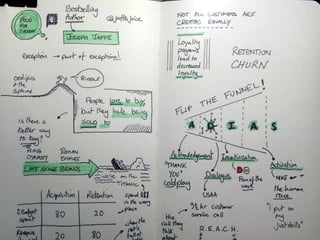
• Flip the Funnel
• De essentie
• Hoe?
Social media
“media waar gebruikers met elkaar
communiceren en dingen met elkaar
delen zoals kennis, ervaringen,
meningen, ideeën, verhalen, gezamenlijk
werk enzovoort. Het is de techniek die
erbij helpt om samen meer te weten,
kunnen en doen...”
DDMA | SMPA
Wat is uw strategie?
• Wat zijn succesvolle marketingtechnieken via de
telefoon?
• Hoe kan ik telefoon succesvol inzetten om mijn
bereik te vergroten?
• Hoe run je goede telefoon campagnes?
• Hoe integreer ik telefoon binnen mijn bestaande
middelenmix?
11.
“A revolution doesnot happen when
society adopts new tools. It happens
when society adopts new behaviour.”
Clay Shirky | US Now
Content Mentalitei Geen ego
- Share-able
- Like-able
t Je fans zijn
belangrijker dan
- Talkable Creëer een jij!
omgeving,
cultuur die naar
buiten gericht is
Wees Aandacht Wij
Je verdient de Betrek je fans,
dapper aandacht die je samen weet je meer
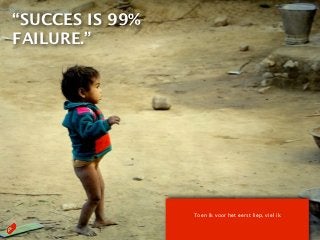
“Succes is 99% geeft! en... ze weten het
failure” vaak beter dan jij!
Sochiro Honda
Stimuleer ... ...
Geef mensen de
ruimte in plaats van
ze af te remmen.
20.
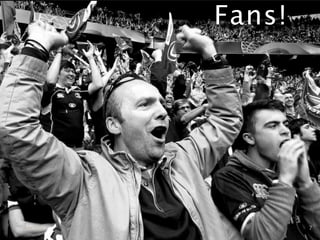
JE FANS ZIJN
BELANGRIJKER
Ekin
“Ekins are official company storytellers employed to
evangelise about the Nike brand and its sports
technology.”
21.
BETREK JE FANS
4food
Verzin en creeer je eigen burger. En voor elke
verkochte hamburger die je zelf hebt verzonnen krijg
je een kick back.
22.
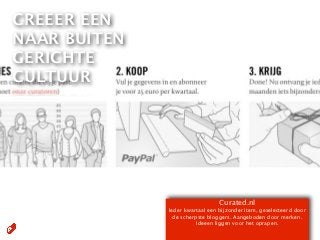
CREEER EEN
NAAR BUITEN
GERICHTE
CULTUUR
Curated.nl
Ieder kwartaal een bijzonder item, geselecteerd door
de scherpste bloggers. Aangeboden door merken.
Ideeen liggen voor het oprapen.
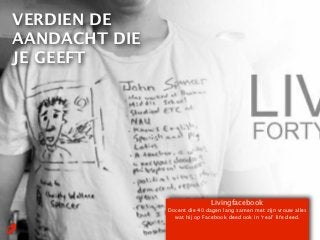
VERDIEN DE
AANDACHT DIE
JEGEEFT
Livingfacebook
Docent die 40 dagen lang samen met zijn vrouw alles
wat hij op Facebook deed ook in ‘real’ life deed.
25.
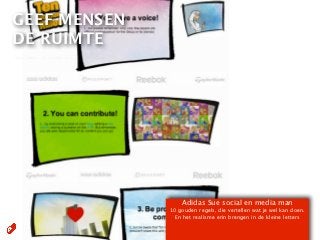
GEEF MENSEN
DE RUIMTE
Adidas Sue social en media man
10 gouden regels, die vertellen wat je wel kan doen.
En het realisme erin brengen in de kleine letters
Stel je voor...
Jewerkt bij Nike. Deze twee mensen komen naar je
toe en vragen je om een paar skateschoenen. Als
tegenprestatie gaan ze tweeten, posten, swipen,
pingen en appen. Wat doe jij?
#11 Het grote verschil tussen mensen en merken is de mentaliteit. Hoe zet ik social media in om nieuwe studenten aan te trekken vs hoe zou het gisteren op het feestje zijn geweest. Hoe zorgen we dat onze print advertenties doorgetrokken worden naar social media vs delen van een hype uit VS: phone stacking. \n
#12 Het grote verschil tussen mensen en merken is de mentaliteit. Hoe zet ik social media in om nieuwe studenten aan te trekken vs hoe zou het gisteren op het feestje zijn geweest. Hoe zorgen we dat onze print advertenties doorgetrokken worden naar social media vs delen van een hype uit VS: phone stacking. \n
#20 Het grote verschil tussen mensen en merken is de mentaliteit. Hoe zet ik social media in om nieuwe studenten aan te trekken vs hoe zou het gisteren op het feestje zijn geweest. Hoe zorgen we dat onze print advertenties doorgetrokken worden naar social media vs delen van een hype uit VS: phone stacking. \n
#21 But even more, their Ekins. Ekins are official company storytellers employed to evangelise about the Nike brand and its sports technology. Before being unleashed on the world, each “Ekin” (“Nike” spelled backwards) is required to undergo an almost military-like training regime comprising a nine-day rookie camp at Nike’s headquarters in Oregon and a full day’s running at the Hayward field track where Nike-founder Bill Bowerman worked as a track coach. Almost unbelievably, as a further sign of their devotion to the brand, each Ekin is then invited to have the Nike ‘swoosh’ tattooed on their ankle ahead of their ‘graduation’. Talking about employer brand dedication.\nI got to meet several Ekins. Amongst them, Bruno Garcia (right on the picture), a New York-based Ekin, might be the most remarkable one. He got the Nike Ekin tattoo (which is the Nike logo backwards, like “Ekin” is “Nike” spelled backwards) as well as Greek goddess Nike’s victory wings on his calves. Futhermore, he is very active within the Hash House Harriers, “a drinking club with a running problem”. Sounds like a foolish fraternity, but the HHH represent more than 1700 chapters throughout the world and have a yearly conference in Asia that assambles more than 17.000 HHH runners. With such ambassadors, you hardly need an advertising campaign.\n\n
#22 Het grote verschil tussen mensen en merken is de mentaliteit. Hoe zet ik social media in om nieuwe studenten aan te trekken vs hoe zou het gisteren op het feestje zijn geweest. Hoe zorgen we dat onze print advertenties doorgetrokken worden naar social media vs delen van een hype uit VS: phone stacking. \n
#23 Het grote verschil tussen mensen en merken is de mentaliteit. Hoe zet ik social media in om nieuwe studenten aan te trekken vs hoe zou het gisteren op het feestje zijn geweest. Hoe zorgen we dat onze print advertenties doorgetrokken worden naar social media vs delen van een hype uit VS: phone stacking. \n
#24 Het grote verschil tussen mensen en merken is de mentaliteit. Hoe zet ik social media in om nieuwe studenten aan te trekken vs hoe zou het gisteren op het feestje zijn geweest. Hoe zorgen we dat onze print advertenties doorgetrokken worden naar social media vs delen van een hype uit VS: phone stacking. \n
#25 WHAT I LEARNED ABOUT FACEBOOK1. Facebook Isn’t Shallow:  True, Facebook is a bit like a community lacking any art, poetry, religion or strong democratic institutions.  However, it is only as shallow as most public places.  We don’t typically have counseling sessions in the grocery store or philosophical arguments in a public restroom.  Why would Facebook be different in its public format.  But here’s the beauty of it: so often in links and comments and private messages, there’s a depth available on Facebook that we sometimes miss in 3-D.  We get to wish happy birthday, send gifts, offer badges and play games.2. Facebook Is Real Life: I went into this experience thinking of Facebook as this half-real, mythical place where I could be better than myself.  I could talk less and listen more and tell a better story.  After examining “real life” and Facebook, I’m convinced that Facebook is simply another manifestation of how we convey reality.  There are moments when the medium pushes the interaction toward the artificial, but more often than not, I’ve found that most phoniness comes from me and not the medium.3. Facebook Is a Spaceless Space: People mistakingly speak of “using” Facebook, as if it’s a tool. It’s not. It’s a site where people connect.  And thus, it exists in this strange zone of being totally private and totally public, bound by local customs and yet transnational, a neutral zone that has its own social norms.  It’s an experience in paradox.4. Facebook Is a Pleasant Place: In many respects, Facebook makes me a better person.  I wish people happy birthday and comment on their photographs and give a thumbs up without ever offering the middle finger.  Yet, pleasant has its own limitations.  There’s no intimacy in Pleasantville which means I have to break the Facebook norms if I want authentic relationships on a social network.5. Facebook Has Serious Limitations: While I embrace social media, the embrace is more like an awkward camp counselor side-hug. Doing Facebook in-person reminds me that social media compresses social interaction into something quick and efficient.  Sometimes this works.  Other times I need slow relationships.\nWHAT I LEARNED ABOUT PEOPLE6. People Aren’t Shallow: Not really, at least. They may seem that way when they wear a scowl or they wander too slowly through the aisles of the grocery store. But it’s all a part of following social norms. Ask them a ridiculous question about cooking unicorns and it has a real disarming effect. Prove that you’re vulnerable and they react with depth rather than scorn. It’s a beautiful thing.7. Technology Criticism Is Rare: Most often when I ask someone, “What is the danger in capturing life on a camera?” the response is, “I’ve never thought of that before.” It’s not that we’re shallow.  It’s just that media criticism is somehow relegated to geeks and hipsters.8. We’re All Hiding: True, we hide behind social media.  However, we also hide behind social norms.  Perhaps it’s a part of being social.  We’re part of a herd. We need to survive.  Yet the very process of blending in is precisely what keeps us away from others.  When I’m transparent, people can see me.  When I’m not transparent, they can see right through me.9. Strangers Aren’t Scary: I learned to drop some of the residual childhood stranger danger fear and recognize that people are generally kind.10. We Are Common and Diverse: I didn’t expect to see anything this deep.  However, when I had to break past my own fear and venture toward others in unusual ways, I realized that people were very different from me and yet very similar to me at the same time.  This wasn’t a new observation.  I had a hunch this was true.  This process confirmed it, though.\nWHAT I LEARNED ABOUT TECHNOLOGY11. The Medium Shapes the Interaction: Social media shapes my identity and my ability to communicate.  When I blog, I keep paragraphs short.  When I’m on Facebook, I rarely tell stories.  When I share a pint with a friend, I’m more likely to say something witty or cynical than when I’m on Facebook.  I’m also more likely to interrupt and dominate the conversation and then leave the room feeling guilty for being bombastic.12. The Medium Is Unpredictable: As much as I would like to believe that we can control the message through some kind of pure method of communication, the reality is that every medium is unpredictable in its overall consequences.13. The Medium Is Relational: We don’t use media. We interact with it.  Yet, we also relate to others through the medium.  This sense of dual relationships with both the people and the medium can be both challenging and fun.14. There Is No Perfect Medium: Every medium has limitations.  Text lacks body language, but it allows for imagination.  In-person interaction allows for engagement from all five senses, but it’s limited to physical geography and real-time.15. The Real Issue Is Power: Technology allows us to harness incredible power at our finger tips.  We can use this power for entertainment by shooting pretend birds at pretend pigs.  Or we can use this power to reshape society (like the revolutionaries in the Arab Spring).  However, regardless of our intentions, power changes people.\nWHAT I LEARNED ABOUT MYSELF16. I Am Afraid: Whether it was asking a butcher about unicorn meat or getting an autograph from QT, I had to come to terms with my fear of breaking rules or looking ridiculous.17. I Need People: This experience forced me to see how much unnecessary space I’ve created in my life with my friends.  I tend to pride myself on my self-reliance.  However, I’m seeing the value of community and relationships.  Moreover, I’m glad I was able to do something crazy (and sometimes scary) with Christy.  It was a reminder again of how much I need her in my life.18. I’m Broken: Living Facebook forced me to recognize my fear, jealousy, confusion and insecurity in relationships.  At one point, I really hurt someone with no malintention. It was humbling.19. I Am Creative: I already knew this was true, but I kept a part of my creativity hidden.  I tended to stick to writing, where my creativity looked a little more polished.  This was a chance for unvarnished creativity in some real unexpected moments.20. I Need to Slow Down: Now that this experience is over, I want to bake cup cakes more often and write letters to friends.  I want to slow down in conversations, too, so that I intentionally say, “I like that,” or listen entirely before I post a verbal comment.\n\n
#26 WHAT I LEARNED ABOUT FACEBOOK1. Facebook Isn’t Shallow:  True, Facebook is a bit like a community lacking any art, poetry, religion or strong democratic institutions.  However, it is only as shallow as most public places.  We don’t typically have counseling sessions in the grocery store or philosophical arguments in a public restroom.  Why would Facebook be different in its public format.  But here’s the beauty of it: so often in links and comments and private messages, there’s a depth available on Facebook that we sometimes miss in 3-D.  We get to wish happy birthday, send gifts, offer badges and play games.2. Facebook Is Real Life: I went into this experience thinking of Facebook as this half-real, mythical place where I could be better than myself.  I could talk less and listen more and tell a better story.  After examining “real life” and Facebook, I’m convinced that Facebook is simply another manifestation of how we convey reality.  There are moments when the medium pushes the interaction toward the artificial, but more often than not, I’ve found that most phoniness comes from me and not the medium.3. Facebook Is a Spaceless Space: People mistakingly speak of “using” Facebook, as if it’s a tool. It’s not. It’s a site where people connect.  And thus, it exists in this strange zone of being totally private and totally public, bound by local customs and yet transnational, a neutral zone that has its own social norms.  It’s an experience in paradox.4. Facebook Is a Pleasant Place: In many respects, Facebook makes me a better person.  I wish people happy birthday and comment on their photographs and give a thumbs up without ever offering the middle finger.  Yet, pleasant has its own limitations.  There’s no intimacy in Pleasantville which means I have to break the Facebook norms if I want authentic relationships on a social network.5. Facebook Has Serious Limitations: While I embrace social media, the embrace is more like an awkward camp counselor side-hug. Doing Facebook in-person reminds me that social media compresses social interaction into something quick and efficient.  Sometimes this works.  Other times I need slow relationships.\nWHAT I LEARNED ABOUT PEOPLE6. People Aren’t Shallow: Not really, at least. They may seem that way when they wear a scowl or they wander too slowly through the aisles of the grocery store. But it’s all a part of following social norms. Ask them a ridiculous question about cooking unicorns and it has a real disarming effect. Prove that you’re vulnerable and they react with depth rather than scorn. It’s a beautiful thing.7. Technology Criticism Is Rare: Most often when I ask someone, “What is the danger in capturing life on a camera?” the response is, “I’ve never thought of that before.” It’s not that we’re shallow.  It’s just that media criticism is somehow relegated to geeks and hipsters.8. We’re All Hiding: True, we hide behind social media.  However, we also hide behind social norms.  Perhaps it’s a part of being social.  We’re part of a herd. We need to survive.  Yet the very process of blending in is precisely what keeps us away from others.  When I’m transparent, people can see me.  When I’m not transparent, they can see right through me.9. Strangers Aren’t Scary: I learned to drop some of the residual childhood stranger danger fear and recognize that people are generally kind.10. We Are Common and Diverse: I didn’t expect to see anything this deep.  However, when I had to break past my own fear and venture toward others in unusual ways, I realized that people were very different from me and yet very similar to me at the same time.  This wasn’t a new observation.  I had a hunch this was true.  This process confirmed it, though.\nWHAT I LEARNED ABOUT TECHNOLOGY11. The Medium Shapes the Interaction: Social media shapes my identity and my ability to communicate.  When I blog, I keep paragraphs short.  When I’m on Facebook, I rarely tell stories.  When I share a pint with a friend, I’m more likely to say something witty or cynical than when I’m on Facebook.  I’m also more likely to interrupt and dominate the conversation and then leave the room feeling guilty for being bombastic.12. The Medium Is Unpredictable: As much as I would like to believe that we can control the message through some kind of pure method of communication, the reality is that every medium is unpredictable in its overall consequences.13. The Medium Is Relational: We don’t use media. We interact with it.  Yet, we also relate to others through the medium.  This sense of dual relationships with both the people and the medium can be both challenging and fun.14. There Is No Perfect Medium: Every medium has limitations.  Text lacks body language, but it allows for imagination.  In-person interaction allows for engagement from all five senses, but it’s limited to physical geography and real-time.15. The Real Issue Is Power: Technology allows us to harness incredible power at our finger tips.  We can use this power for entertainment by shooting pretend birds at pretend pigs.  Or we can use this power to reshape society (like the revolutionaries in the Arab Spring).  However, regardless of our intentions, power changes people.\nWHAT I LEARNED ABOUT MYSELF16. I Am Afraid: Whether it was asking a butcher about unicorn meat or getting an autograph from QT, I had to come to terms with my fear of breaking rules or looking ridiculous.17. I Need People: This experience forced me to see how much unnecessary space I’ve created in my life with my friends.  I tend to pride myself on my self-reliance.  However, I’m seeing the value of community and relationships.  Moreover, I’m glad I was able to do something crazy (and sometimes scary) with Christy.  It was a reminder again of how much I need her in my life.18. I’m Broken: Living Facebook forced me to recognize my fear, jealousy, confusion and insecurity in relationships.  At one point, I really hurt someone with no malintention. It was humbling.19. I Am Creative: I already knew this was true, but I kept a part of my creativity hidden.  I tended to stick to writing, where my creativity looked a little more polished.  This was a chance for unvarnished creativity in some real unexpected moments.20. I Need to Slow Down: Now that this experience is over, I want to bake cup cakes more often and write letters to friends.  I want to slow down in conversations, too, so that I intentionally say, “I like that,” or listen entirely before I post a verbal comment.\n\n
#28 WHAT I LEARNED ABOUT FACEBOOK1. Facebook Isn’t Shallow:  True, Facebook is a bit like a community lacking any art, poetry, religion or strong democratic institutions.  However, it is only as shallow as most public places.  We don’t typically have counseling sessions in the grocery store or philosophical arguments in a public restroom.  Why would Facebook be different in its public format.  But here’s the beauty of it: so often in links and comments and private messages, there’s a depth available on Facebook that we sometimes miss in 3-D.  We get to wish happy birthday, send gifts, offer badges and play games.2. Facebook Is Real Life: I went into this experience thinking of Facebook as this half-real, mythical place where I could be better than myself.  I could talk less and listen more and tell a better story.  After examining “real life” and Facebook, I’m convinced that Facebook is simply another manifestation of how we convey reality.  There are moments when the medium pushes the interaction toward the artificial, but more often than not, I’ve found that most phoniness comes from me and not the medium.3. Facebook Is a Spaceless Space: People mistakingly speak of “using” Facebook, as if it’s a tool. It’s not. It’s a site where people connect.  And thus, it exists in this strange zone of being totally private and totally public, bound by local customs and yet transnational, a neutral zone that has its own social norms.  It’s an experience in paradox.4. Facebook Is a Pleasant Place: In many respects, Facebook makes me a better person.  I wish people happy birthday and comment on their photographs and give a thumbs up without ever offering the middle finger.  Yet, pleasant has its own limitations.  There’s no intimacy in Pleasantville which means I have to break the Facebook norms if I want authentic relationships on a social network.5. Facebook Has Serious Limitations: While I embrace social media, the embrace is more like an awkward camp counselor side-hug. Doing Facebook in-person reminds me that social media compresses social interaction into something quick and efficient.  Sometimes this works.  Other times I need slow relationships.\nWHAT I LEARNED ABOUT PEOPLE6. People Aren’t Shallow: Not really, at least. They may seem that way when they wear a scowl or they wander too slowly through the aisles of the grocery store. But it’s all a part of following social norms. Ask them a ridiculous question about cooking unicorns and it has a real disarming effect. Prove that you’re vulnerable and they react with depth rather than scorn. It’s a beautiful thing.7. Technology Criticism Is Rare: Most often when I ask someone, “What is the danger in capturing life on a camera?” the response is, “I’ve never thought of that before.” It’s not that we’re shallow.  It’s just that media criticism is somehow relegated to geeks and hipsters.8. We’re All Hiding: True, we hide behind social media.  However, we also hide behind social norms.  Perhaps it’s a part of being social.  We’re part of a herd. We need to survive.  Yet the very process of blending in is precisely what keeps us away from others.  When I’m transparent, people can see me.  When I’m not transparent, they can see right through me.9. Strangers Aren’t Scary: I learned to drop some of the residual childhood stranger danger fear and recognize that people are generally kind.10. We Are Common and Diverse: I didn’t expect to see anything this deep.  However, when I had to break past my own fear and venture toward others in unusual ways, I realized that people were very different from me and yet very similar to me at the same time.  This wasn’t a new observation.  I had a hunch this was true.  This process confirmed it, though.\nWHAT I LEARNED ABOUT TECHNOLOGY11. The Medium Shapes the Interaction: Social media shapes my identity and my ability to communicate.  When I blog, I keep paragraphs short.  When I’m on Facebook, I rarely tell stories.  When I share a pint with a friend, I’m more likely to say something witty or cynical than when I’m on Facebook.  I’m also more likely to interrupt and dominate the conversation and then leave the room feeling guilty for being bombastic.12. The Medium Is Unpredictable: As much as I would like to believe that we can control the message through some kind of pure method of communication, the reality is that every medium is unpredictable in its overall consequences.13. The Medium Is Relational: We don’t use media. We interact with it.  Yet, we also relate to others through the medium.  This sense of dual relationships with both the people and the medium can be both challenging and fun.14. There Is No Perfect Medium: Every medium has limitations.  Text lacks body language, but it allows for imagination.  In-person interaction allows for engagement from all five senses, but it’s limited to physical geography and real-time.15. The Real Issue Is Power: Technology allows us to harness incredible power at our finger tips.  We can use this power for entertainment by shooting pretend birds at pretend pigs.  Or we can use this power to reshape society (like the revolutionaries in the Arab Spring).  However, regardless of our intentions, power changes people.\nWHAT I LEARNED ABOUT MYSELF16. I Am Afraid: Whether it was asking a butcher about unicorn meat or getting an autograph from QT, I had to come to terms with my fear of breaking rules or looking ridiculous.17. I Need People: This experience forced me to see how much unnecessary space I’ve created in my life with my friends.  I tend to pride myself on my self-reliance.  However, I’m seeing the value of community and relationships.  Moreover, I’m glad I was able to do something crazy (and sometimes scary) with Christy.  It was a reminder again of how much I need her in my life.18. I’m Broken: Living Facebook forced me to recognize my fear, jealousy, confusion and insecurity in relationships.  At one point, I really hurt someone with no malintention. It was humbling.19. I Am Creative: I already knew this was true, but I kept a part of my creativity hidden.  I tended to stick to writing, where my creativity looked a little more polished.  This was a chance for unvarnished creativity in some real unexpected moments.20. I Need to Slow Down: Now that this experience is over, I want to bake cup cakes more often and write letters to friends.  I want to slow down in conversations, too, so that I intentionally say, “I like that,” or listen entirely before I post a verbal comment.\n\n