A SEMINAR ON
Presented By,
SHRINIVAS KUMBHAR
ME5G (B)
 What is ntm process.
 Characteristic of ntm.
 Need of ntm processes.
 Advantages of ntm process
 Classification of ntm.
 Edm process.(Working , setup, adv/disadv )
 Ajm process. .( Working , setup, adv/disadv )
 Non traditional machining process
It is defined as a group of process that cut material
by utilizing mechanical, thermal ,electrical , or
chemical energy or combination of these energies but
do not use a sharp and hard cutting tools as required
for traditional manufacturing process.
 Extremely hard and brittle materials or Difficult to machine materials are
difficult to machine by traditional machining processes.
 When the workpiece is too flexible
 When the shape of the part is too complex.
 Machining of composites.
 To fulfill the requirements of low stress grinding .
 In NTM, there may not be a physical tool present.
 In NTM, the tool need not be harder than the work piece
material.
 Mostly NTM processes do not necessarily use mechanical
energy to provide material removal.
• Any material can be machined irrespective of its hardness.
• Any complicated shapes can be produced on the workpiece.
• Very fine holes can be easily drilled.
• No mechanical process exerted on workpiece.
• Drilling of tapered holes is possible.
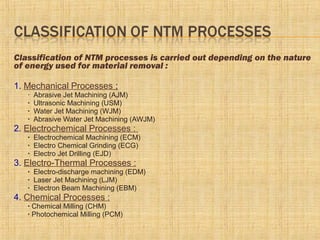
Classification of NTM processes is carried out depending on the nature
of energy used for material removal :
1. Mechanical Processes :
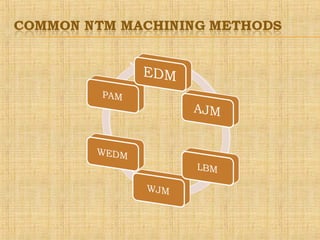
• Abrasive Jet Machining (AJM)
• Ultrasonic Machining (USM)
• Water Jet Machining (WJM)
• Abrasive Water Jet Machining (AWJM)
2. Electrochemical Processes :
• Electrochemical Machining (ECM)
• Electro Chemical Grinding (ECG)
• Electro Jet Drilling (EJD)
3. Electro-Thermal Processes :
• Electro-discharge machining (EDM)
• Laser Jet Machining (LJM)
• Electron Beam Machining (EBM)
4. Chemical Processes :
• Chemical Milling (CHM)
• Photochemical Milling (PCM)
 It is also known as Spark initiated discharge machining as well as Spark
erosion machining
 It is probably most versatile of all electrical machining method.
 The metal removal takes place due to erosion caused by the electric spark.
 This process can apply on any material irrespective of its hardness, which is
an electrical conductor
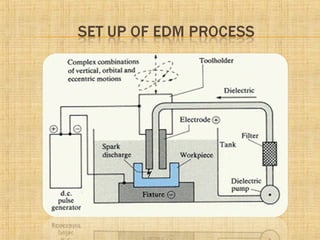
 Edm works on the principle that the heat energy generated
from spark is used for removing material from workpiece.
 In this spark gap is maintained of about 0.01 to o.5 mm.
 The tool & w/p both are I dielectric fluid.
 As supply switch on thousands of spark produced in spark gap
and material removes from the w/p.
 Any material can be machined irrespective of its hardness.
 Any shape that imparted on the tool can be reproduced on work
piece.
 No physical contact between tool and w/p. Therefor no stresses on
w/p.
 Harder material can be machined at faster rate.
 Good surface finish can be obtained.
Work piece should be good electrical conductor.
Power consumption is high.
Material removal rate is slow.
The wear rate of tool electrode is more.
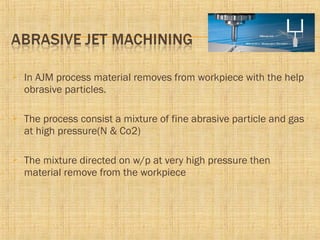
 In AJM process material removes from workpiece with the help
obrasive particles.
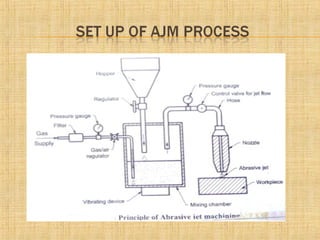
 The process consist a mixture of fine abrasive particle and gas
at high pressure(N & Co2)
 The mixture directed on w/p at very high pressure then
material remove from the workpiece
Advatages :
Brittle material of thin section can be easily machines.
Low initial investment.
No direct contact between tool and workpiece.
Highly sensitive material like Glass & Paraffin can easily machined
Disadvantages:
Low metal removal rate.
Once used abrasive particles cannot be used.
Not suitable for machining of ductile material.
Machining accuracy is poor
 It is used for drilling holes, cutting slots, cleaning hard surfaces.
 Machining of semi conductors.
 Machining of brittle materials glass and ceramics etc.
 Use for surace finishing purpose for hard material.
Non traditional machining

Non traditional machining

  • 1.
    A SEMINAR ON PresentedBy, SHRINIVAS KUMBHAR ME5G (B)
  • 2.
     What isntm process.  Characteristic of ntm.  Need of ntm processes.  Advantages of ntm process  Classification of ntm.  Edm process.(Working , setup, adv/disadv )  Ajm process. .( Working , setup, adv/disadv )
  • 3.
     Non traditionalmachining process It is defined as a group of process that cut material by utilizing mechanical, thermal ,electrical , or chemical energy or combination of these energies but do not use a sharp and hard cutting tools as required for traditional manufacturing process.
  • 4.
     Extremely hardand brittle materials or Difficult to machine materials are difficult to machine by traditional machining processes.  When the workpiece is too flexible  When the shape of the part is too complex.  Machining of composites.  To fulfill the requirements of low stress grinding .
  • 5.
     In NTM,there may not be a physical tool present.  In NTM, the tool need not be harder than the work piece material.  Mostly NTM processes do not necessarily use mechanical energy to provide material removal.
  • 6.
    • Any materialcan be machined irrespective of its hardness. • Any complicated shapes can be produced on the workpiece. • Very fine holes can be easily drilled. • No mechanical process exerted on workpiece. • Drilling of tapered holes is possible.
  • 7.
    Classification of NTMprocesses is carried out depending on the nature of energy used for material removal : 1. Mechanical Processes : • Abrasive Jet Machining (AJM) • Ultrasonic Machining (USM) • Water Jet Machining (WJM) • Abrasive Water Jet Machining (AWJM) 2. Electrochemical Processes : • Electrochemical Machining (ECM) • Electro Chemical Grinding (ECG) • Electro Jet Drilling (EJD) 3. Electro-Thermal Processes : • Electro-discharge machining (EDM) • Laser Jet Machining (LJM) • Electron Beam Machining (EBM) 4. Chemical Processes : • Chemical Milling (CHM) • Photochemical Milling (PCM)
  • 9.
     It isalso known as Spark initiated discharge machining as well as Spark erosion machining  It is probably most versatile of all electrical machining method.  The metal removal takes place due to erosion caused by the electric spark.  This process can apply on any material irrespective of its hardness, which is an electrical conductor
  • 11.
     Edm workson the principle that the heat energy generated from spark is used for removing material from workpiece.  In this spark gap is maintained of about 0.01 to o.5 mm.  The tool & w/p both are I dielectric fluid.  As supply switch on thousands of spark produced in spark gap and material removes from the w/p.
  • 12.
     Any materialcan be machined irrespective of its hardness.  Any shape that imparted on the tool can be reproduced on work piece.  No physical contact between tool and w/p. Therefor no stresses on w/p.  Harder material can be machined at faster rate.  Good surface finish can be obtained.
  • 13.
    Work piece shouldbe good electrical conductor. Power consumption is high. Material removal rate is slow. The wear rate of tool electrode is more.
  • 14.
     In AJMprocess material removes from workpiece with the help obrasive particles.  The process consist a mixture of fine abrasive particle and gas at high pressure(N & Co2)  The mixture directed on w/p at very high pressure then material remove from the workpiece
  • 16.
    Advatages : Brittle materialof thin section can be easily machines. Low initial investment. No direct contact between tool and workpiece. Highly sensitive material like Glass & Paraffin can easily machined Disadvantages: Low metal removal rate. Once used abrasive particles cannot be used. Not suitable for machining of ductile material. Machining accuracy is poor
  • 17.
     It isused for drilling holes, cutting slots, cleaning hard surfaces.  Machining of semi conductors.  Machining of brittle materials glass and ceramics etc.  Use for surace finishing purpose for hard material.