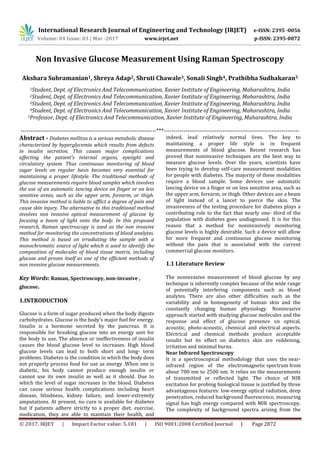
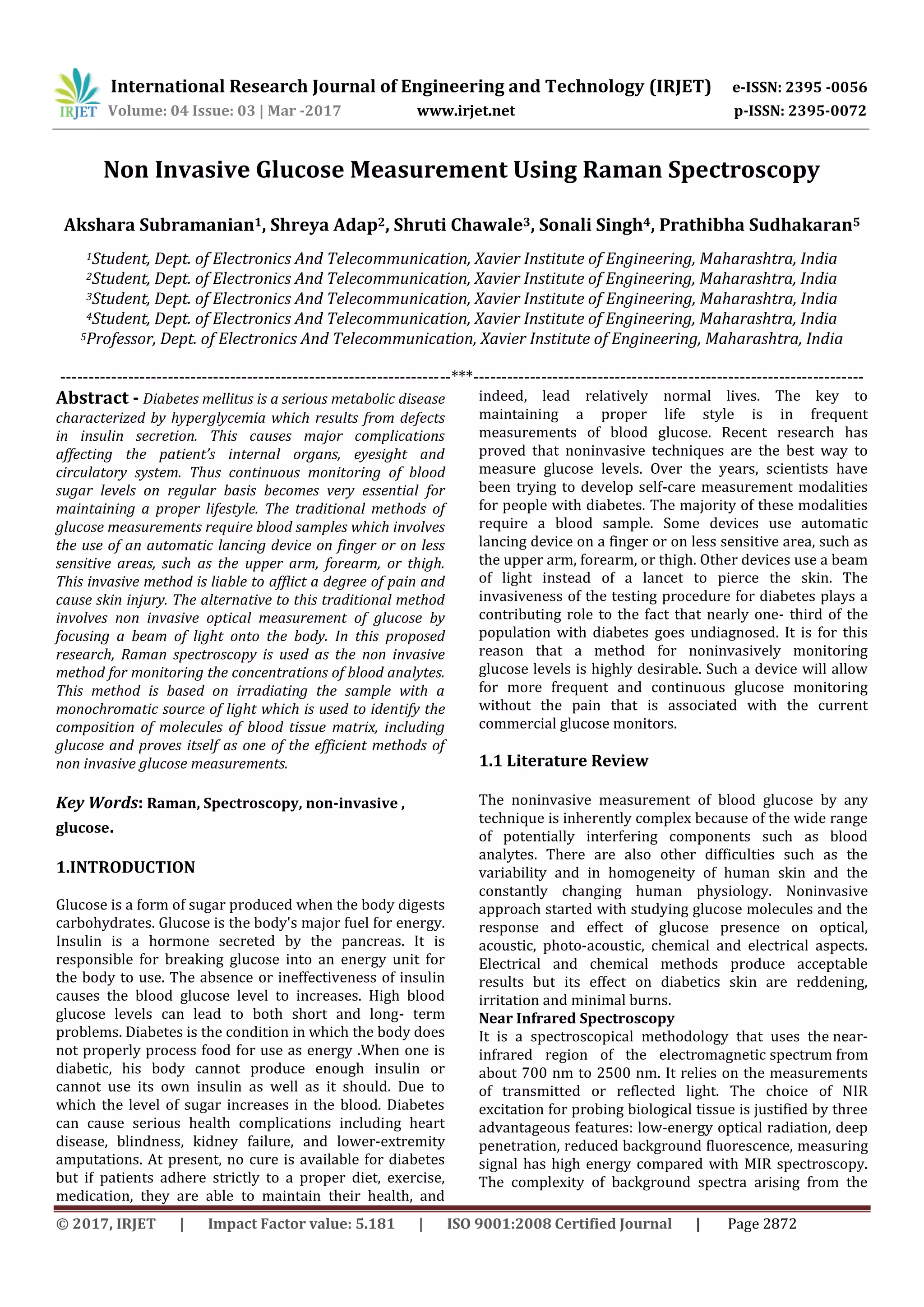
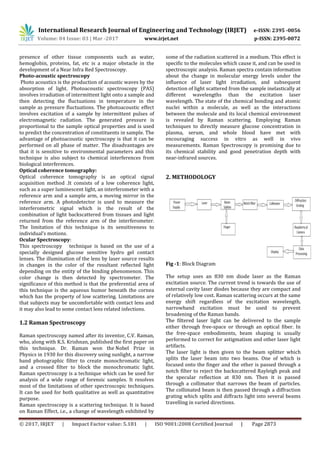
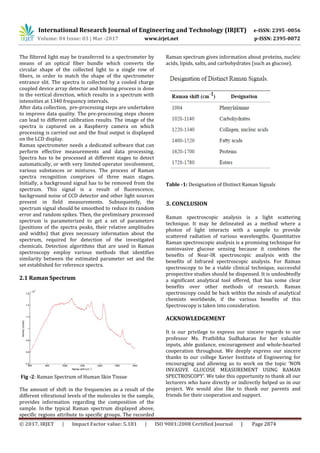
International Research Journal of Engineering and Technology (IRJET) e-ISSN: 2395 -0056
Volume: 04 Issue: 03 | Mar -2017 www.irjet.net p-ISSN: 2395-0072
© 2017, IRJET | Impact Factor value: 5.181 | ISO 9001:2008 Certified Journal | Page 2872
Non Invasive Glucose Measurement Using Raman Spectroscopy
Akshara Subramanian1, Shreya Adap2, Shruti Chawale3, Sonali Singh4, Prathibha Sudhakaran5
1Student, Dept. of Electronics And Telecommunication, Xavier Institute of Engineering, Maharashtra, India
2Student, Dept. of Electronics And Telecommunication, Xavier Institute of Engineering, Maharashtra, India
3Student, Dept. of Electronics And Telecommunication, Xavier Institute of Engineering, Maharashtra, India
4Student, Dept. of Electronics And Telecommunication, Xavier Institute of Engineering, Maharashtra, India
5Professor, Dept. of Electronics And Telecommunication, Xavier Institute of Engineering, Maharashtra, India
---------------------------------------------------------------------***---------------------------------------------------------------------
Abstract - Diabetes mellitus is a serious metabolic disease
characterized by hyperglycemia which results from defects
in insulin secretion. This causes major complications
affecting the patient’s internal organs, eyesight and
circulatory system. Thus continuous monitoring of blood
sugar levels on regular basis becomes very essential for
maintaining a proper lifestyle. The traditional methods of
glucose measurements require blood samples which involves
the use of an automatic lancing device on finger or on less
sensitive areas, such as the upper arm, forearm, or thigh.
This invasive method is liable to afflict a degree of pain and
cause skin injury. The alternative to this traditional method
involves non invasive optical measurement of glucose by
focusing a beam of light onto the body. In this proposed
research, Raman spectroscopy is used as the non invasive
method for monitoring the concentrations of blood analytes.
This method is based on irradiating the sample with a
monochromatic source of light which is used to identify the
composition of molecules of blood tissue matrix, including
glucose and proves itself as one of the efficient methods of
non invasive glucose measurements.
Key Words: Raman, Spectroscopy, non-invasive ,
glucose.
1.INTRODUCTION
Glucose is a form of sugar produced when the body digests
carbohydrates. Glucose is the body's major fuel for energy.
Insulin is a hormone secreted by the pancreas. It is
responsible for breaking glucose into an energy unit for
the body to use. The absence or ineffectiveness of insulin
causes the blood glucose level to increases. High blood
glucose levels can lead to both short and long- term
problems. Diabetes is the condition in which the body does
not properly process food for use as energy .When one is
diabetic, his body cannot produce enough insulin or
cannot use its own insulin as well as it should. Due to
which the level of sugar increases in the blood. Diabetes
can cause serious health complications including heart
disease, blindness, kidney failure, and lower-extremity
amputations. At present, no cure is available for diabetes
but if patients adhere strictly to a proper diet, exercise,
medication, they are able to maintain their health, and
indeed, lead relatively normal lives. The key to
maintaining a proper life style is in frequent
measurements of blood glucose. Recent research has
proved that noninvasive techniques are the best way to
measure glucose levels. Over the years, scientists have
been trying to develop self-care measurement modalities
for people with diabetes. The majority of these modalities
require a blood sample. Some devices use automatic
lancing device on a finger or on less sensitive area, such as
the upper arm, forearm, or thigh. Other devices use a beam
of light instead of a lancet to pierce the skin. The
invasiveness of the testing procedure for diabetes plays a
contributing role to the fact that nearly one- third of the
population with diabetes goes undiagnosed. It is for this
reason that a method for noninvasively monitoring
glucose levels is highly desirable. Such a device will allow
for more frequent and continuous glucose monitoring
without the pain that is associated with the current
commercial glucose monitors.
1.1 Literature Review
The noninvasive measurement of blood glucose by any
technique is inherently complex because of the wide range
of potentially interfering components such as blood
analytes. There are also other difficulties such as the
variability and in homogeneity of human skin and the
constantly changing human physiology. Noninvasive
approach started with studying glucose molecules and the
response and effect of glucose presence on optical,
acoustic, photo-acoustic, chemical and electrical aspects.
Electrical and chemical methods produce acceptable
results but its effect on diabetics skin are reddening,
irritation and minimal burns.
Near Infrared Spectroscopy
It is a spectroscopical methodology that uses the near-
infrared region of the electromagnetic spectrum from
about 700 nm to 2500 nm. It relies on the measurements
of transmitted or reflected light. The choice of NIR
excitation for probing biological tissue is justified by three
advantageous features: low-energy optical radiation, deep
penetration, reduced background fluorescence, measuring
signal has high energy compared with MIR spectroscopy.
The complexity of background spectra arising from the
International Research Journal of Engineering and Technology (IRJET) e-ISSN: 2395 -0056
Volume: 04 Issue: 03 | Mar -2017 www.irjet.net p-ISSN: 2395-0072
© 2017, IRJET | Impact Factor value: 5.181 | ISO 9001:2008 Certified Journal | Page 2873
presence of other tissue components such as water,
hemoglobin, proteins, fat, etc is a major obstacle in the
development of a Near Infra Red Spectroscopy.
Photo-acoustic spectroscopy
Photo acoustics is the production of acoustic waves by the
absorption of light. Photoacoustic spectroscopy (PAS)
involves irradiation of intermittent light onto a sample and
then detecting the fluctuations in temperature in the
sample as pressure fluctuations. The photoacoustic effect
involves excitation of a sample by intermittent pulses of
electromagnetic radiation. The generated pressure is
proportional to the sample optical properties and is used
to predict the concentration of constituents in sample. The
advantage of photoacoustic spectroscopy is that it can be
performed on all phase of matter. The disadvantages are
that it is sensitive to environmental parameters and this
technique is also subject to chemical interferences from
biological interferences.
Optical coherence tomography:
Optical coherence tomography is an optical signal
acquisition method .It consists of a low coherence light,
such as a super luminescent light, an interferometer with a
reference arm and a sample arm, a moving mirror in the
reference arm. A photodetector is used to measure the
interferometric signal which is the result of the
combination of light backscattered from tissues and light
returned from the reference arm of the interferometer.
The limitation of this technique is its sensitiveness to
individual’s motions.
Ocular Spectroscopy:
This spectroscopy technique is based on the use of a
specially designed glucose sensitive hydro gel contact
lenses. The illumination of the lens by laser source results
in changes in the color of the resultant reflected light
depending on the entity of the binding phenomenon. This
color change is then detected by spectrometer. The
significance of this method is that the preferential area of
this technique is the aqueous humor beneath the cornea
which has the property of low scattering. Limitations are
that subjects may be uncomfortable with contact lens and
it may also lead to some contact lens related infections.
1.2 Raman Spectroscopy
Raman spectroscopy named after its inventor, C.V. Raman,
who, along with K.S. Krishnan, published the first paper on
this technique. Dr. Raman won the Nobel Prize in
Physics in 1930 for this discovery using sunlight, a narrow
band photographic filter to create monochromatic light,
and a crossed filter to block the monochromatic light.
Raman spectroscopy is a technique which can be used for
analysis of a wide range of forensic samples. It resolves
most of the limitations of other spectroscopic techniques.
It can be used for both qualitative as well as quantitative
purpose.
Raman spectroscopy is a scattering technique. It is based
on Raman Effect, i.e., a change of wavelength exhibited by
some of the radiation scattered in a medium. This effect is
specific to the molecules which cause it, and can be used in
spectroscopic analysis. Raman spectra contain information
about the change in molecular energy levels under the
influence of laser light irradiation, and subsequent
detection of light scattered from the sample inelastically at
different wavelengths than the excitation laser
wavelength. The state of the chemical bonding and atomic
nuclei within a molecule, as well as the interactions
between the molecule and its local chemical environment
is revealed by Raman scattering. Employing Raman
techniques to directly measure glucose concentration in
plasma, serum, and whole blood have met with
encouraging success in vitro as well in vivo
measurements. Raman Spectroscopy is promising due to
its chemical stability and good penetration depth with
near-infrared sources.
2. METHODOLOGY
Fig -1: Block Diagram
The setup uses an 830 nm diode laser as the Raman
excitation source. The current trend is towards the use of
external cavity laser diodes because they are compact and
of relatively low cost. Raman scattering occurs at the same
energy shift regardless of the excitation wavelength,
narrowband excitation must be used to prevent
broadening of the Raman bands.
The filtered laser light can be delivered to the sample
either through free-space or through an optical fiber. In
the free-space embodiments, beam shaping is usually
performed to correct for astigmatism and other laser light
artifacts.
The laser light is then given to the beam splitter which
splits the laser beam into two beams. One of which is
focused onto the finger and the other is passed through a
notch filter to reject the backscattered Rayleigh peak and
the specular reflection at 830 nm. Then it is passed
through a collimator that narrows the beam of particles.
The collimated beam is then passed through a diffraction
grating which splits and diffracts light into several beams
travelling in varied directions.
International Research Journal of Engineering and Technology (IRJET) e-ISSN: 2395 -0056
Volume: 04 Issue: 03 | Mar -2017 www.irjet.net p-ISSN: 2395-0072
© 2017, IRJET | Impact Factor value: 5.181 | ISO 9001:2008 Certified Journal | Page 2874
The filtered light may be transferred to a spectrometer by
means of an optical fiber bundle which converts the
circular shape of the collected light to a single row of
fibers, in order to match the shape of the spectrometer
entrance slit. The spectra is collected by a cooled charge
coupled device array detector and binning process is done
in the vertical direction, which results in a spectrum with
intensities at 1340 frequency intervals.
After data collection, pre-processing steps are undertaken
to improve data quality. The pre-processing steps chosen
can lead to different calibration results. The image of the
spectra is captured on a Raspberry camera on which
processing is carried out and the final output is displayed
on the LCD display.
Raman spectrometer needs a dedicated software that can
perform effective measurements and data processing.
Spectra has to be processed at different stages to detect
automatically, or with very limited operator involvement,
various substances or mixtures. The process of Raman
spectra recognition comprises of three main stages.
Initially, a background signal has to be removed from the
spectrum. This signal is a result of fluorescence,
background noise of CCD detector and other light sources
present in field measurements. Subsequently, the
spectrum signal should be smoothed to reduce its random
error and random spikes. Then, the preliminary processed
spectrum is parameterized to get a set of parameters
(positions of the spectra peaks, their relative amplitudes
and widths) that gives necessary information about the
spectrum, required for detection of the investigated
chemicals. Detection algorithms that are used in Raman
spectroscopy employ various methods that identifies
similarity between the estimated parameter set and the
set established for reference spectra.
2.1 Raman Spectrum
Fig -2: Raman Spectrum of Human Skin Tissue
The amount of shift in the frequencies as a result of the
different vibrational levels of the molecules in the sample,
provides information regarding the composition of the
sample. In the typical Raman spectrum displayed above,
specific regions attribute to specific groups. The recorded
Raman spectrum gives information about proteins, nucleic
acids, lipids, salts, and carbohydrates (such as glucose).
Table -1: Designation of Distinct Raman Signals
3. CONCLUSION
Raman spectroscopic analysis is a light scattering
technique. It may be delineated as a method where a
photon of light interacts with a sample to provide
scattered radiation of various wavelengths. Quantitative
Raman spectroscopic analysis is a promising technique for
noninvasive glucose sensing because it combines the
benefits of Near-IR spectroscopic analysis with the
benefits of Infrared spectroscopic analysis. For Raman
spectroscopy to be a viable clinical technique, successful
prospective studies should be dispensed. It is undoubtedly
a significant analytical tool offered, that has some clear
benefits over other methods of research. Raman
spectroscopy could be back within the minds of analytical
chemists worldwide, if the various benefits of this
Spectroscopy is taken into consideration.
ACKNOWLEDGEMENT
It is our privilege to express our sincere regards to our
professor Ms. Prathibha Sudhakaran for her valuable
inputs, able guidance, encouragement and whole-hearted
cooperation throughout. We deeply express our sincere
thanks to our college Xavier Institute of Engineering for
encouraging and allowing us to work on the topic ‘NON
INVASIVE GLUCOSE MEASUREMENT USING RAMAN
SPECTROSCOPY’. We take this opportunity to thank all our
lecturers who have directly or indirectly helped us in our
project. We would also like to thank our parents and
friends for their cooperation and support.
International Research Journal of Engineering and Technology (IRJET) e-ISSN: 2395 -0056
Volume: 04 Issue: 03 | Mar -2017 www.irjet.net p-ISSN: 2395-0072
© 2017, IRJET | Impact Factor value: 5.181 | ISO 9001:2008 Certified Journal | Page 2875
REFERENCES
[1] The Diabetes Control and Complications Trial
Research Group, ‘‘The effect of intensive
treatment of diabetes on the development and
progression of long-term complications in insulin-
dependent diabetes mellitus,’’ N. Engl. J. Med. 329,
977–986 ~1993
[2] O. S. Khalil, ‘‘Spectroscopic and clinical aspects of
noninvasive glucose measurements,’’ Clin. Chem.
45, 165–177 ~1999
[3] M. R. Robinson, R. P. Eaton, D. M. Haaland, G. W.
Koepp, E. V. Thomas, B. R. Stallard, and P. L.
Robinson, ‘‘Noninvasive glucose monitoring in
diabetic patients: a preliminary evaluation,’’ Clin.
Chem. 38, 1618–1622 ~1992
[4] U. A. Muller, B. Mertes, C. Fischbacher, K. U.
Jageman, and K. Danzer, ‘‘Non-invasive blood
glucose monitoring by means of near infrared
spectroscopy: methods for improving the
reliability of calibration models,’’ Int. J. Artif.
Organs 20, 285–290 ~1997
[5] M. Gniadecka, O. Faurskov Nielsen, D. H.
Christensen, and H. C. Wulf, ‘‘Structure of water,
proteins, and lipids in intact human skin, hair, and
nail,’’ J. Invest. Dermatol. 110, 393–398 ~1998
[6] M. Gniadecka, H. C. Wulf, O. F. Nielsen, D. H.
Christensen, and J. Hercogova, ‘‘Distinctive
molecular abnormalities in benign and malignant
skin lesions: Studies by Raman spectroscopy,’’
Photochem. Photobiol. 66, 418–423 ~1997
[7] Lambert, J. L.; Morookian, J. M.; Sirk, S. J.; Borchert,
M. S. Journal of Raman Spectroscopy 2002, 33,
524-529

Non Invasive Glucose Measurement using Raman Spectroscopy

  • 1.
    International Research Journalof Engineering and Technology (IRJET) e-ISSN: 2395 -0056 Volume: 04 Issue: 03 | Mar -2017 www.irjet.net p-ISSN: 2395-0072 © 2017, IRJET | Impact Factor value: 5.181 | ISO 9001:2008 Certified Journal | Page 2872 Non Invasive Glucose Measurement Using Raman Spectroscopy Akshara Subramanian1, Shreya Adap2, Shruti Chawale3, Sonali Singh4, Prathibha Sudhakaran5 1Student, Dept. of Electronics And Telecommunication, Xavier Institute of Engineering, Maharashtra, India 2Student, Dept. of Electronics And Telecommunication, Xavier Institute of Engineering, Maharashtra, India 3Student, Dept. of Electronics And Telecommunication, Xavier Institute of Engineering, Maharashtra, India 4Student, Dept. of Electronics And Telecommunication, Xavier Institute of Engineering, Maharashtra, India 5Professor, Dept. of Electronics And Telecommunication, Xavier Institute of Engineering, Maharashtra, India ---------------------------------------------------------------------***--------------------------------------------------------------------- Abstract - Diabetes mellitus is a serious metabolic disease characterized by hyperglycemia which results from defects in insulin secretion. This causes major complications affecting the patient’s internal organs, eyesight and circulatory system. Thus continuous monitoring of blood sugar levels on regular basis becomes very essential for maintaining a proper lifestyle. The traditional methods of glucose measurements require blood samples which involves the use of an automatic lancing device on finger or on less sensitive areas, such as the upper arm, forearm, or thigh. This invasive method is liable to afflict a degree of pain and cause skin injury. The alternative to this traditional method involves non invasive optical measurement of glucose by focusing a beam of light onto the body. In this proposed research, Raman spectroscopy is used as the non invasive method for monitoring the concentrations of blood analytes. This method is based on irradiating the sample with a monochromatic source of light which is used to identify the composition of molecules of blood tissue matrix, including glucose and proves itself as one of the efficient methods of non invasive glucose measurements. Key Words: Raman, Spectroscopy, non-invasive , glucose. 1.INTRODUCTION Glucose is a form of sugar produced when the body digests carbohydrates. Glucose is the body's major fuel for energy. Insulin is a hormone secreted by the pancreas. It is responsible for breaking glucose into an energy unit for the body to use. The absence or ineffectiveness of insulin causes the blood glucose level to increases. High blood glucose levels can lead to both short and long- term problems. Diabetes is the condition in which the body does not properly process food for use as energy .When one is diabetic, his body cannot produce enough insulin or cannot use its own insulin as well as it should. Due to which the level of sugar increases in the blood. Diabetes can cause serious health complications including heart disease, blindness, kidney failure, and lower-extremity amputations. At present, no cure is available for diabetes but if patients adhere strictly to a proper diet, exercise, medication, they are able to maintain their health, and indeed, lead relatively normal lives. The key to maintaining a proper life style is in frequent measurements of blood glucose. Recent research has proved that noninvasive techniques are the best way to measure glucose levels. Over the years, scientists have been trying to develop self-care measurement modalities for people with diabetes. The majority of these modalities require a blood sample. Some devices use automatic lancing device on a finger or on less sensitive area, such as the upper arm, forearm, or thigh. Other devices use a beam of light instead of a lancet to pierce the skin. The invasiveness of the testing procedure for diabetes plays a contributing role to the fact that nearly one- third of the population with diabetes goes undiagnosed. It is for this reason that a method for noninvasively monitoring glucose levels is highly desirable. Such a device will allow for more frequent and continuous glucose monitoring without the pain that is associated with the current commercial glucose monitors. 1.1 Literature Review The noninvasive measurement of blood glucose by any technique is inherently complex because of the wide range of potentially interfering components such as blood analytes. There are also other difficulties such as the variability and in homogeneity of human skin and the constantly changing human physiology. Noninvasive approach started with studying glucose molecules and the response and effect of glucose presence on optical, acoustic, photo-acoustic, chemical and electrical aspects. Electrical and chemical methods produce acceptable results but its effect on diabetics skin are reddening, irritation and minimal burns. Near Infrared Spectroscopy It is a spectroscopical methodology that uses the near- infrared region of the electromagnetic spectrum from about 700 nm to 2500 nm. It relies on the measurements of transmitted or reflected light. The choice of NIR excitation for probing biological tissue is justified by three advantageous features: low-energy optical radiation, deep penetration, reduced background fluorescence, measuring signal has high energy compared with MIR spectroscopy. The complexity of background spectra arising from the
  • 2.
    International Research Journalof Engineering and Technology (IRJET) e-ISSN: 2395 -0056 Volume: 04 Issue: 03 | Mar -2017 www.irjet.net p-ISSN: 2395-0072 © 2017, IRJET | Impact Factor value: 5.181 | ISO 9001:2008 Certified Journal | Page 2873 presence of other tissue components such as water, hemoglobin, proteins, fat, etc is a major obstacle in the development of a Near Infra Red Spectroscopy. Photo-acoustic spectroscopy Photo acoustics is the production of acoustic waves by the absorption of light. Photoacoustic spectroscopy (PAS) involves irradiation of intermittent light onto a sample and then detecting the fluctuations in temperature in the sample as pressure fluctuations. The photoacoustic effect involves excitation of a sample by intermittent pulses of electromagnetic radiation. The generated pressure is proportional to the sample optical properties and is used to predict the concentration of constituents in sample. The advantage of photoacoustic spectroscopy is that it can be performed on all phase of matter. The disadvantages are that it is sensitive to environmental parameters and this technique is also subject to chemical interferences from biological interferences. Optical coherence tomography: Optical coherence tomography is an optical signal acquisition method .It consists of a low coherence light, such as a super luminescent light, an interferometer with a reference arm and a sample arm, a moving mirror in the reference arm. A photodetector is used to measure the interferometric signal which is the result of the combination of light backscattered from tissues and light returned from the reference arm of the interferometer. The limitation of this technique is its sensitiveness to individual’s motions. Ocular Spectroscopy: This spectroscopy technique is based on the use of a specially designed glucose sensitive hydro gel contact lenses. The illumination of the lens by laser source results in changes in the color of the resultant reflected light depending on the entity of the binding phenomenon. This color change is then detected by spectrometer. The significance of this method is that the preferential area of this technique is the aqueous humor beneath the cornea which has the property of low scattering. Limitations are that subjects may be uncomfortable with contact lens and it may also lead to some contact lens related infections. 1.2 Raman Spectroscopy Raman spectroscopy named after its inventor, C.V. Raman, who, along with K.S. Krishnan, published the first paper on this technique. Dr. Raman won the Nobel Prize in Physics in 1930 for this discovery using sunlight, a narrow band photographic filter to create monochromatic light, and a crossed filter to block the monochromatic light. Raman spectroscopy is a technique which can be used for analysis of a wide range of forensic samples. It resolves most of the limitations of other spectroscopic techniques. It can be used for both qualitative as well as quantitative purpose. Raman spectroscopy is a scattering technique. It is based on Raman Effect, i.e., a change of wavelength exhibited by some of the radiation scattered in a medium. This effect is specific to the molecules which cause it, and can be used in spectroscopic analysis. Raman spectra contain information about the change in molecular energy levels under the influence of laser light irradiation, and subsequent detection of light scattered from the sample inelastically at different wavelengths than the excitation laser wavelength. The state of the chemical bonding and atomic nuclei within a molecule, as well as the interactions between the molecule and its local chemical environment is revealed by Raman scattering. Employing Raman techniques to directly measure glucose concentration in plasma, serum, and whole blood have met with encouraging success in vitro as well in vivo measurements. Raman Spectroscopy is promising due to its chemical stability and good penetration depth with near-infrared sources. 2. METHODOLOGY Fig -1: Block Diagram The setup uses an 830 nm diode laser as the Raman excitation source. The current trend is towards the use of external cavity laser diodes because they are compact and of relatively low cost. Raman scattering occurs at the same energy shift regardless of the excitation wavelength, narrowband excitation must be used to prevent broadening of the Raman bands. The filtered laser light can be delivered to the sample either through free-space or through an optical fiber. In the free-space embodiments, beam shaping is usually performed to correct for astigmatism and other laser light artifacts. The laser light is then given to the beam splitter which splits the laser beam into two beams. One of which is focused onto the finger and the other is passed through a notch filter to reject the backscattered Rayleigh peak and the specular reflection at 830 nm. Then it is passed through a collimator that narrows the beam of particles. The collimated beam is then passed through a diffraction grating which splits and diffracts light into several beams travelling in varied directions.
  • 3.
    International Research Journalof Engineering and Technology (IRJET) e-ISSN: 2395 -0056 Volume: 04 Issue: 03 | Mar -2017 www.irjet.net p-ISSN: 2395-0072 © 2017, IRJET | Impact Factor value: 5.181 | ISO 9001:2008 Certified Journal | Page 2874 The filtered light may be transferred to a spectrometer by means of an optical fiber bundle which converts the circular shape of the collected light to a single row of fibers, in order to match the shape of the spectrometer entrance slit. The spectra is collected by a cooled charge coupled device array detector and binning process is done in the vertical direction, which results in a spectrum with intensities at 1340 frequency intervals. After data collection, pre-processing steps are undertaken to improve data quality. The pre-processing steps chosen can lead to different calibration results. The image of the spectra is captured on a Raspberry camera on which processing is carried out and the final output is displayed on the LCD display. Raman spectrometer needs a dedicated software that can perform effective measurements and data processing. Spectra has to be processed at different stages to detect automatically, or with very limited operator involvement, various substances or mixtures. The process of Raman spectra recognition comprises of three main stages. Initially, a background signal has to be removed from the spectrum. This signal is a result of fluorescence, background noise of CCD detector and other light sources present in field measurements. Subsequently, the spectrum signal should be smoothed to reduce its random error and random spikes. Then, the preliminary processed spectrum is parameterized to get a set of parameters (positions of the spectra peaks, their relative amplitudes and widths) that gives necessary information about the spectrum, required for detection of the investigated chemicals. Detection algorithms that are used in Raman spectroscopy employ various methods that identifies similarity between the estimated parameter set and the set established for reference spectra. 2.1 Raman Spectrum Fig -2: Raman Spectrum of Human Skin Tissue The amount of shift in the frequencies as a result of the different vibrational levels of the molecules in the sample, provides information regarding the composition of the sample. In the typical Raman spectrum displayed above, specific regions attribute to specific groups. The recorded Raman spectrum gives information about proteins, nucleic acids, lipids, salts, and carbohydrates (such as glucose). Table -1: Designation of Distinct Raman Signals 3. CONCLUSION Raman spectroscopic analysis is a light scattering technique. It may be delineated as a method where a photon of light interacts with a sample to provide scattered radiation of various wavelengths. Quantitative Raman spectroscopic analysis is a promising technique for noninvasive glucose sensing because it combines the benefits of Near-IR spectroscopic analysis with the benefits of Infrared spectroscopic analysis. For Raman spectroscopy to be a viable clinical technique, successful prospective studies should be dispensed. It is undoubtedly a significant analytical tool offered, that has some clear benefits over other methods of research. Raman spectroscopy could be back within the minds of analytical chemists worldwide, if the various benefits of this Spectroscopy is taken into consideration. ACKNOWLEDGEMENT It is our privilege to express our sincere regards to our professor Ms. Prathibha Sudhakaran for her valuable inputs, able guidance, encouragement and whole-hearted cooperation throughout. We deeply express our sincere thanks to our college Xavier Institute of Engineering for encouraging and allowing us to work on the topic ‘NON INVASIVE GLUCOSE MEASUREMENT USING RAMAN SPECTROSCOPY’. We take this opportunity to thank all our lecturers who have directly or indirectly helped us in our project. We would also like to thank our parents and friends for their cooperation and support.
  • 4.
    International Research Journalof Engineering and Technology (IRJET) e-ISSN: 2395 -0056 Volume: 04 Issue: 03 | Mar -2017 www.irjet.net p-ISSN: 2395-0072 © 2017, IRJET | Impact Factor value: 5.181 | ISO 9001:2008 Certified Journal | Page 2875 REFERENCES [1] The Diabetes Control and Complications Trial Research Group, ‘‘The effect of intensive treatment of diabetes on the development and progression of long-term complications in insulin- dependent diabetes mellitus,’’ N. Engl. J. Med. 329, 977–986 ~1993 [2] O. S. Khalil, ‘‘Spectroscopic and clinical aspects of noninvasive glucose measurements,’’ Clin. Chem. 45, 165–177 ~1999 [3] M. R. Robinson, R. P. Eaton, D. M. Haaland, G. W. Koepp, E. V. Thomas, B. R. Stallard, and P. L. Robinson, ‘‘Noninvasive glucose monitoring in diabetic patients: a preliminary evaluation,’’ Clin. Chem. 38, 1618–1622 ~1992 [4] U. A. Muller, B. Mertes, C. Fischbacher, K. U. Jageman, and K. Danzer, ‘‘Non-invasive blood glucose monitoring by means of near infrared spectroscopy: methods for improving the reliability of calibration models,’’ Int. J. Artif. Organs 20, 285–290 ~1997 [5] M. Gniadecka, O. Faurskov Nielsen, D. H. Christensen, and H. C. Wulf, ‘‘Structure of water, proteins, and lipids in intact human skin, hair, and nail,’’ J. Invest. Dermatol. 110, 393–398 ~1998 [6] M. Gniadecka, H. C. Wulf, O. F. Nielsen, D. H. Christensen, and J. Hercogova, ‘‘Distinctive molecular abnormalities in benign and malignant skin lesions: Studies by Raman spectroscopy,’’ Photochem. Photobiol. 66, 418–423 ~1997 [7] Lambert, J. L.; Morookian, J. M.; Sirk, S. J.; Borchert, M. S. Journal of Raman Spectroscopy 2002, 33, 524-529