International INTERNATIONAL Journal of Electronics and JOURNAL Communication Engineering OF ELECTRONICS & Technology (IJECET), AND 
ISSN 0976 – 
6464(Print), ISSN 0976 – 6472(Online), Volume 5, Issue 7, July (2014), pp. 32-38 © IAEME 
COMMUNICATION ENGINEERING  TECHNOLOGY (IJECET) 
ISSN 0976 – 6464(Print) 
ISSN 0976 – 6472(Online) 
Volume 5, Issue 7, July (2014), pp. 32-38 
© IAEME: http://www.iaeme.com/IJECET.asp 
Journal Impact Factor (2014): 7.2836 (Calculated by GISI) 
www.jifactor.com 
IJECET 
© I A E M E 
APPLICATION OF RF SPECTROSCOPY FOR BLOOD GLUCOSE 
MEASUREMENT 
Ingrid Anne P. Nazareth1, Sulaxana R. Vernekar2, Rajendra S. Gad3, Gourish M. Naik4 
1, 2Research Scholar, Dept. of Electronics, Taleigao Plateau, Goa University, Goa, India, 
3Associate Professor, Dept. of Electronics, Taleigao Plateau, Goa University, Goa, India, 
4Professor  Head, Dept. of Electronics, Taleigao Plateau, Goa University, Goa, India, 
32 
ABSTRACT 
The design and the fabrication of RF characteristics measurement cell to estimate the 
constituents of human blood is described in this manuscript. The human blood has over 100 
constituents of which glucose and cholesterol are important parameters which needs to be quantified 
for monitoring health parameters. It is necessary to find out the level of glucose in blood separately 
in order to determine the level of Cholesterol more accurately. Hence the authors propose a quick, 
portable and low-cost device which could be used to monitor the level of glucose and other important 
parameters. This manuscript includes the data obtained for Glucose dissolved in water as per 
percentage found in the human blood. The data will be fed to a multivariate system programmed in a 
FPGA device to estimate the glucose concentration. The results shown here are in the RF range of 
10MHz-4GHz. 
Keywords: Glucose, PLS, RF Spectroscopy. 
1. INTRODUCTION 
Glucose is by far the most common carbohydrate and classified as a monosaccharide, an 
aldose, a hexose, and is a reducing sugar. It is also known as dextrose, because it is dextrorotatory. 
Glucose is also called blood sugar as it circulates in the blood at a concentration of 70-110 mg/dL (or 
70-110 mg/100 ml) of blood. Glucose is initially synthesized by chlorophyll in plants using carbon 
dioxide from the air and sunlight as an energy source. Glucose is further converted to starch for 
storage. It is the main source of energy used by the body.[1] 
Normally, blood glucose levels increase slightly after eating. This increase causes the 
pancreas to release insulin so that the blood glucose levels do not get too high. Blood glucose levels 
that remain high over time can damage the eyes, kidneys, nerves, and blood vessels. Diabetes
International Journal of Electronics and Communication Engineering  Technology (IJECET), ISSN 0976 – 
6464(Print), ISSN 0976 – 6472(Online), Volume 5, Issue 7, July (2014), pp. 32-38 © IAEME 
mellitus (DM) also known simply as diabetes, is a group of metabolic diseases in which there are 
high blood sugar levels over a prolonged period.[2] Other conditions that can cause high blood 
glucose levels include: Severe stress, Heart attack, Stroke, Cushing's syndrome, Low values 
symptoms of hypoglycemia and insulinoma. Low glucose levels are caused by: Addison's disease, 
hypothyroidism, cirrhosis, Kidney failure, Malnutrition or an eating disorder, such as anorexia. 
In India, a recent study showed that total annual expenditure by patients on diabetes care was, 
on average, INR (Indian Rupee value) 10,000 (US $227) in urban areas and INR 6,260 (US $142) in 
rural areas. An increase of 113% was observed in the total expenditure between 1998 and 2005 in the 
urban population. Low-income groups spent a higher proportion of their income on diabetes care 
(34% and 27% for urban poor versus rural poor respectively) without subsidies. The medical costs 
incurred by a person with diabetes are two to fivefold higher than those incurred by people without 
diabetes. The average expenditure per patient per year would be a minimum of INR 4,500 
(approximately US $120). Therefore, the estimated annual cost of diabetes care would be 
approximately 180,000 million rupees.[3] 
Venipuncture is the collection of blood from a vein, usually for laboratory testing. The site 
from where blood is drawn from a vein located the inside of the elbow or the back of the hand is 
cleaned with germ-killing medicine (antiseptic). An elastic band is put around the upper arm to apply 
pressure to the area. This makes the vein swell with blood. A needle is inserted into the vein wherein 
a slight pain or a sting or a throbbing at the site after the blood is drawn is often felt. The blood 
collects into an airtight vial or tube attached to the needle. The elastic band is removed from the arm. 
The needle is taken out and the spot is covered with a bandage to stop bleeding. The tubes containing 
blood/serum contain a variety of additives when transported back to the laboratory. Reagents vary 
between laboratories and therefore it is important to know which tube the individual laboratory 
requires for which test. Whole blood needs to be mixed with Ethylene diaminete traacetic acid to 
prevent it clotting. 
33 
2. PREPARATION OF SAMPLES 
The Glucose in the normal human blood ranges from 70-110mg/dL. Here the experiment is 
conducted with average concentration of glucose i.e. 90mg/dL. Double distilled water is used to 
prepare solution samples with concentrations spanning from half to normal concentration and also 
double and triple concentration. Each sample consists of 14 mL of water and 1mL of Alcohol is 
added to water in order to dissolve the above said constituent. Experiments were performed in 2 
modes at a particular time (fast sweep and slow sweep). The experiment was repeated after 1 hour 
and 2 hours in order to nullify the environmental effect. The differences were compared to the first 
measure and were found to be accurate. 
3. CELL DESIGN 
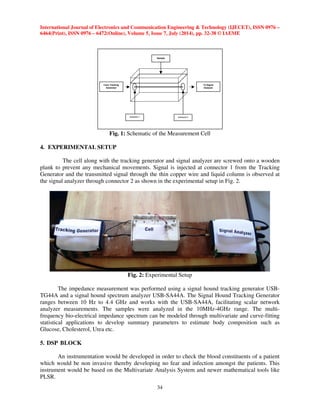
A rectangular shaped cell was designed to measure the RF responses of various blood 
constituents as shown in Fig. 1. It is made up of plastic sheets having length 12.5cms, breadth 1cm 
and height 2cms. It was covered with a thin copper foil inside and outside the cell. This cell was 
further placed in an iron container to prevent external radiation. The cell and the iron container were 
individually grounded. There are 2 connectors placed on either side of the cell. There is a thin Copper 
wire running through the center of the cell from Connector 1 to Connector 2.
International Journal of Electronics and Communication Engineering  Technology (IJECET), ISSN 0976 – 
6464(Print), ISSN 0976 – 6472(Online), Volume 5, Issue 7, July (2014), pp. 32-38 © IAEME 
From Tracking 
Generator 
To Signal 
Analyzer 
Sample 
Connector 1 Connector 2 
Fig. 1: Schematic of the Measurement Cell 
34 
4. EXPERIMENTAL SETUP 
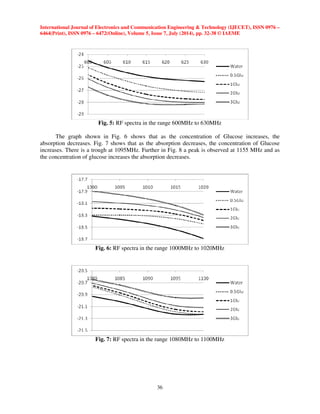
The cell along with the tracking generator and signal analyzer are screwed onto a wooden 
plank to prevent any mechanical movements. Signal is injected at connector 1 from the Tracking 
Generator and the transmitted signal through the thin copper wire and liquid column is observed at 
the signal analyzer through connector 2 as shown in the experimental setup in Fig. 2. 
Fig. 2: Experimental Setup 
The impedance measurement was performed using a signal hound tracking generator USB-TG44A 
and a signal hound spectrum analyzer USB-SA44A. The Signal Hound Tracking Generator 
ranges between 10 Hz to 4.4 GHz and works with the USB-SA44A, facilitating scalar network 
analyzer measurements. The samples were analyzed in the 10MHz-4GHz range. The multi-frequency 
bio-electrical impedance spectrum can be modeled through multivariate and curve-fitting 
statistical applications to develop summary parameters to estimate body composition such as 
Glucose, Cholesterol, Urea etc. 
5. DSP BLOCK 
An instrumentation would be developed in order to check the blood constituents of a patient 
which would be non invasive thereby developing no fear and infection amongst the patients. This 
instrument would be based on the Multivariate Analysis System and newer mathematical tools like 
PLSR.
International Journal of Electronics and Communication Engineering  Technology (IJECET), ISSN 0976 – 
6464(Print), ISSN 0976 – 6472(Online), Volume 5, Issue 7, July (2014), pp. 32-38 © IAEME 
Multivariate analysis (MVA) is based on the statistical principle of multivariate statistics, 
which involves observation and analysis of more than one statistical outcome variable at a time. 
Recent advances in computer technology and instrumentation techniques have enabled us to collect 
precise and varieties of data from chemical and biological processes. With the increased data 
dimensionality, Multivariate Statistical Process Control (MVSPC) has become very important and 
essential tool to extract the useful information from the measured data for improving process 
performance and product quality. During the last decade, this has been successfully applied for 
monitoring and modelling chemical / biological processes. [4][5][6][7][8] One of the most popular 
MVSPC techniques is Partial Least Squares (PLS). PLS is a multivariate process identification 
method that projects the input-output data down into a latent space, extracting a number of principal 
factors with an orthogonal structure, while capturing most of the variance in the original data. [9][10] 
35 
6. FIGURES AND TABLE 
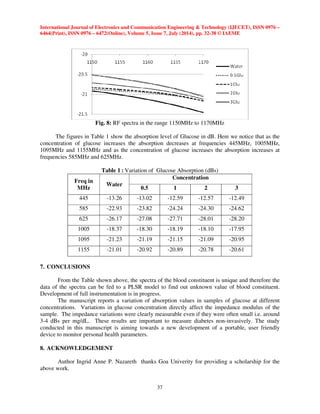
By using the above setup, the graphs are recorded as shown in Fig. 3 to Fig. 8. It may be 
noted here that even though the experiment was conducted from 10MHz to 4GHz continuously, the 
responses were found only in certain regions and some of them are shown in Fig. 3 to Fig. 8. 
It can be observed from the graph shown in Fig. 3 that as the concentration of Glucose 
increases, the absorption decreases. A peak of Glucose is observed at 445MHz. Further in Fig. 4, the 
absorption increases as the concentration of Glucose increases. There is a peak at 585MHz. Fig. 5 
shows a trough at 625 MHz and as the concentration of glucose increases the absorption increases. 
Fig. 3: RF spectra in the range 430MHz to 450MHz 
Fig. 4: RF spectra in the range 580MHz to 600MHz
International Journal of Electronics and Communication Engineering  Technology (IJECET), ISSN 0976 – 
6464(Print), ISSN 0976 – 6472(Online), Volume 5, Issue 7, July (2014), pp. 32-38 © IAEME 
Fig. 5: RF spectra in the range 600MHz to 630MHz 
The graph shown in Fig. 6 shows that as the concentration of Glucose increases, the 
absorption decreases. Fig. 7 shows that as the absorption decreases, the concentration of Glucose 
increases. There is a trough at 1095MHz. Further in Fig. 8 a peak is observed at 1155 MHz and as 
the concentration of glucose increases the absorption decreases. 
Fig. 6: RF spectra in the range 1000MHz to 1020MHz 
Fig. 7: RF spectra in the range 1080MHz to 1100MHz 
36
International Journal of Electronics and Communication Engineering  Technology (IJECET), ISSN 0976 – 
6464(Print), ISSN 0976 – 6472(Online), Volume 5, Issue 7, July (2014), pp. 32-38 © IAEME 
Fig. 8: RF spectra in the range 1150MHz to 1170MHz 
The figures in Table 1 show the absorption level of Glucose in dB. Here we notice that as the 
concentration of glucose increases the absorption decreases at frequencies 445MHz, 1005MHz, 
1095MHz and 1155MHz and as the concentration of glucose increases the absorption increases at 
frequencies 585MHz and 625MHz. 
Table 1 : Variation of Glucose Absorption (dBs) 
37 
Freq in 
MHz 
Water 
Concentration 
0.5 1 2 3 
445 -13.26 -13.02 -12.59 -12.57 -12.49 
585 -22.93 -23.82 -24.24 -24.30 -24.62 
625 -26.17 -27.08 -27.71 -28.01 -28.20 
1005 -18.37 -18.30 -18.19 -18.10 -17.95 
1095 -21.23 -21.19 -21.15 -21.09 -20.95 
1155 -21.01 -20.92 -20.89 -20.78 -20.61 
7. CONCLUSIONS 
From the Table shown above, the spectra of the blood constituent is unique and therefore the 
data of the spectra can be fed to a PLSR model to find out unknown value of blood constituent. 
Development of full instrumentation is in progress. 
The manuscript reports a variation of absorption values in samples of glucose at different 
concentrations. Variations in glucose concentration directly affect the impedance modulus of the 
sample. The impedance variations were clearly measurable even if they were often small i.e. around 
3-4 dBs per mg/dL. These results are important to measure diabetes non-invasively. The study 
conducted in this manuscript is aiming towards a new development of a portable, user friendly 
device to monitor personal health parameters. 
8. ACKNOWLEDGEMENT 
Author Ingrid Anne P. Nazareth thanks Goa Univerity for providing a scholarship for the 
above work.
International Journal of Electronics and Communication Engineering  Technology (IJECET), ISSN 0976 – 
6464(Print), ISSN 0976 – 6472(Online), Volume 5, Issue 7, July (2014), pp. 32-38 © IAEME 
38 
REFERENCES 
[1] About diabetes. World Health Organization. Retrieved 4 April 2014. 
[2] American Diabetes Association (2013). Standards of medical care in diabetes—2013. 
Diabetes Care, 36(Suppl 1): S11–S66. 
[3] Ramachandran A. Current scenario of diabetes in India. J Diabetes. 2009; 1:18-28. 
[4] Lee DS, Jeon CO, Park JM, Chang KS. Hybrid neural network modelling of a full-scale 
industrial wastewater treatment process. Biotechnol Bioeng 2002; 78:670–82. 
[5] Lee DS, Park JM, Vanrolleghem PA. Adaptive multiscale principal component analysis for 
on-line monitoring of a sequencing batch reactor. J Biotechnol 2005; 116:195–210. 
[6] Lee DS, Vanrolleghem PA. Monitoring of a sequencing batch reactor using adaptive 
multiblock principal component analysis. Biotechnol Bioeng 2003; 82(4):489–97. 
[7] MacGregor JF, Kourti T. Statistical process control of multivariate processes. Control Eng 
Pract 1995; 3:403–14. 
[8] Wise BM, Gallagher NB. The process chemometrics approach to process monitoring and 
fault detection. J Proc Control 1996; 6:329–48. 
[9] Geladi P, Kowalski BR. Partial least-squares regression: a tutorial. Anal Chim Acta 1986; 
185:1–17. 
[10] Wold S, Ruhe A, Wold H, Dunn WJ. The Collinearity problem in linear regression. The 
partial least squares approach to generalized inverse. SIAM J Sci Stat Comput 1984; 
3:735–43. 
[11] H. Ajith Hebbar and K.S.Jayantha, “Separation of Organic Based Oil and Grease from 
Restaurant Wastewater using a Horizontal Flow Batch Reactor Containing Laterite Medium”, 
International Journal of Advanced Research in Engineering  Technology (IJARET), 
Volume 5, Issue 2, 2014, pp. 152 - 155, ISSN Print: 0976-6480, ISSN Online: 0976-6499.

40120140507005

  • 1.
    International INTERNATIONAL Journalof Electronics and JOURNAL Communication Engineering OF ELECTRONICS & Technology (IJECET), AND ISSN 0976 – 6464(Print), ISSN 0976 – 6472(Online), Volume 5, Issue 7, July (2014), pp. 32-38 © IAEME COMMUNICATION ENGINEERING TECHNOLOGY (IJECET) ISSN 0976 – 6464(Print) ISSN 0976 – 6472(Online) Volume 5, Issue 7, July (2014), pp. 32-38 © IAEME: http://www.iaeme.com/IJECET.asp Journal Impact Factor (2014): 7.2836 (Calculated by GISI) www.jifactor.com IJECET © I A E M E APPLICATION OF RF SPECTROSCOPY FOR BLOOD GLUCOSE MEASUREMENT Ingrid Anne P. Nazareth1, Sulaxana R. Vernekar2, Rajendra S. Gad3, Gourish M. Naik4 1, 2Research Scholar, Dept. of Electronics, Taleigao Plateau, Goa University, Goa, India, 3Associate Professor, Dept. of Electronics, Taleigao Plateau, Goa University, Goa, India, 4Professor Head, Dept. of Electronics, Taleigao Plateau, Goa University, Goa, India, 32 ABSTRACT The design and the fabrication of RF characteristics measurement cell to estimate the constituents of human blood is described in this manuscript. The human blood has over 100 constituents of which glucose and cholesterol are important parameters which needs to be quantified for monitoring health parameters. It is necessary to find out the level of glucose in blood separately in order to determine the level of Cholesterol more accurately. Hence the authors propose a quick, portable and low-cost device which could be used to monitor the level of glucose and other important parameters. This manuscript includes the data obtained for Glucose dissolved in water as per percentage found in the human blood. The data will be fed to a multivariate system programmed in a FPGA device to estimate the glucose concentration. The results shown here are in the RF range of 10MHz-4GHz. Keywords: Glucose, PLS, RF Spectroscopy. 1. INTRODUCTION Glucose is by far the most common carbohydrate and classified as a monosaccharide, an aldose, a hexose, and is a reducing sugar. It is also known as dextrose, because it is dextrorotatory. Glucose is also called blood sugar as it circulates in the blood at a concentration of 70-110 mg/dL (or 70-110 mg/100 ml) of blood. Glucose is initially synthesized by chlorophyll in plants using carbon dioxide from the air and sunlight as an energy source. Glucose is further converted to starch for storage. It is the main source of energy used by the body.[1] Normally, blood glucose levels increase slightly after eating. This increase causes the pancreas to release insulin so that the blood glucose levels do not get too high. Blood glucose levels that remain high over time can damage the eyes, kidneys, nerves, and blood vessels. Diabetes
  • 2.
    International Journal ofElectronics and Communication Engineering Technology (IJECET), ISSN 0976 – 6464(Print), ISSN 0976 – 6472(Online), Volume 5, Issue 7, July (2014), pp. 32-38 © IAEME mellitus (DM) also known simply as diabetes, is a group of metabolic diseases in which there are high blood sugar levels over a prolonged period.[2] Other conditions that can cause high blood glucose levels include: Severe stress, Heart attack, Stroke, Cushing's syndrome, Low values symptoms of hypoglycemia and insulinoma. Low glucose levels are caused by: Addison's disease, hypothyroidism, cirrhosis, Kidney failure, Malnutrition or an eating disorder, such as anorexia. In India, a recent study showed that total annual expenditure by patients on diabetes care was, on average, INR (Indian Rupee value) 10,000 (US $227) in urban areas and INR 6,260 (US $142) in rural areas. An increase of 113% was observed in the total expenditure between 1998 and 2005 in the urban population. Low-income groups spent a higher proportion of their income on diabetes care (34% and 27% for urban poor versus rural poor respectively) without subsidies. The medical costs incurred by a person with diabetes are two to fivefold higher than those incurred by people without diabetes. The average expenditure per patient per year would be a minimum of INR 4,500 (approximately US $120). Therefore, the estimated annual cost of diabetes care would be approximately 180,000 million rupees.[3] Venipuncture is the collection of blood from a vein, usually for laboratory testing. The site from where blood is drawn from a vein located the inside of the elbow or the back of the hand is cleaned with germ-killing medicine (antiseptic). An elastic band is put around the upper arm to apply pressure to the area. This makes the vein swell with blood. A needle is inserted into the vein wherein a slight pain or a sting or a throbbing at the site after the blood is drawn is often felt. The blood collects into an airtight vial or tube attached to the needle. The elastic band is removed from the arm. The needle is taken out and the spot is covered with a bandage to stop bleeding. The tubes containing blood/serum contain a variety of additives when transported back to the laboratory. Reagents vary between laboratories and therefore it is important to know which tube the individual laboratory requires for which test. Whole blood needs to be mixed with Ethylene diaminete traacetic acid to prevent it clotting. 33 2. PREPARATION OF SAMPLES The Glucose in the normal human blood ranges from 70-110mg/dL. Here the experiment is conducted with average concentration of glucose i.e. 90mg/dL. Double distilled water is used to prepare solution samples with concentrations spanning from half to normal concentration and also double and triple concentration. Each sample consists of 14 mL of water and 1mL of Alcohol is added to water in order to dissolve the above said constituent. Experiments were performed in 2 modes at a particular time (fast sweep and slow sweep). The experiment was repeated after 1 hour and 2 hours in order to nullify the environmental effect. The differences were compared to the first measure and were found to be accurate. 3. CELL DESIGN A rectangular shaped cell was designed to measure the RF responses of various blood constituents as shown in Fig. 1. It is made up of plastic sheets having length 12.5cms, breadth 1cm and height 2cms. It was covered with a thin copper foil inside and outside the cell. This cell was further placed in an iron container to prevent external radiation. The cell and the iron container were individually grounded. There are 2 connectors placed on either side of the cell. There is a thin Copper wire running through the center of the cell from Connector 1 to Connector 2.
  • 3.
    International Journal ofElectronics and Communication Engineering Technology (IJECET), ISSN 0976 – 6464(Print), ISSN 0976 – 6472(Online), Volume 5, Issue 7, July (2014), pp. 32-38 © IAEME From Tracking Generator To Signal Analyzer Sample Connector 1 Connector 2 Fig. 1: Schematic of the Measurement Cell 34 4. EXPERIMENTAL SETUP The cell along with the tracking generator and signal analyzer are screwed onto a wooden plank to prevent any mechanical movements. Signal is injected at connector 1 from the Tracking Generator and the transmitted signal through the thin copper wire and liquid column is observed at the signal analyzer through connector 2 as shown in the experimental setup in Fig. 2. Fig. 2: Experimental Setup The impedance measurement was performed using a signal hound tracking generator USB-TG44A and a signal hound spectrum analyzer USB-SA44A. The Signal Hound Tracking Generator ranges between 10 Hz to 4.4 GHz and works with the USB-SA44A, facilitating scalar network analyzer measurements. The samples were analyzed in the 10MHz-4GHz range. The multi-frequency bio-electrical impedance spectrum can be modeled through multivariate and curve-fitting statistical applications to develop summary parameters to estimate body composition such as Glucose, Cholesterol, Urea etc. 5. DSP BLOCK An instrumentation would be developed in order to check the blood constituents of a patient which would be non invasive thereby developing no fear and infection amongst the patients. This instrument would be based on the Multivariate Analysis System and newer mathematical tools like PLSR.
  • 4.
    International Journal ofElectronics and Communication Engineering Technology (IJECET), ISSN 0976 – 6464(Print), ISSN 0976 – 6472(Online), Volume 5, Issue 7, July (2014), pp. 32-38 © IAEME Multivariate analysis (MVA) is based on the statistical principle of multivariate statistics, which involves observation and analysis of more than one statistical outcome variable at a time. Recent advances in computer technology and instrumentation techniques have enabled us to collect precise and varieties of data from chemical and biological processes. With the increased data dimensionality, Multivariate Statistical Process Control (MVSPC) has become very important and essential tool to extract the useful information from the measured data for improving process performance and product quality. During the last decade, this has been successfully applied for monitoring and modelling chemical / biological processes. [4][5][6][7][8] One of the most popular MVSPC techniques is Partial Least Squares (PLS). PLS is a multivariate process identification method that projects the input-output data down into a latent space, extracting a number of principal factors with an orthogonal structure, while capturing most of the variance in the original data. [9][10] 35 6. FIGURES AND TABLE By using the above setup, the graphs are recorded as shown in Fig. 3 to Fig. 8. It may be noted here that even though the experiment was conducted from 10MHz to 4GHz continuously, the responses were found only in certain regions and some of them are shown in Fig. 3 to Fig. 8. It can be observed from the graph shown in Fig. 3 that as the concentration of Glucose increases, the absorption decreases. A peak of Glucose is observed at 445MHz. Further in Fig. 4, the absorption increases as the concentration of Glucose increases. There is a peak at 585MHz. Fig. 5 shows a trough at 625 MHz and as the concentration of glucose increases the absorption increases. Fig. 3: RF spectra in the range 430MHz to 450MHz Fig. 4: RF spectra in the range 580MHz to 600MHz
  • 5.
    International Journal ofElectronics and Communication Engineering Technology (IJECET), ISSN 0976 – 6464(Print), ISSN 0976 – 6472(Online), Volume 5, Issue 7, July (2014), pp. 32-38 © IAEME Fig. 5: RF spectra in the range 600MHz to 630MHz The graph shown in Fig. 6 shows that as the concentration of Glucose increases, the absorption decreases. Fig. 7 shows that as the absorption decreases, the concentration of Glucose increases. There is a trough at 1095MHz. Further in Fig. 8 a peak is observed at 1155 MHz and as the concentration of glucose increases the absorption decreases. Fig. 6: RF spectra in the range 1000MHz to 1020MHz Fig. 7: RF spectra in the range 1080MHz to 1100MHz 36
  • 6.
    International Journal ofElectronics and Communication Engineering Technology (IJECET), ISSN 0976 – 6464(Print), ISSN 0976 – 6472(Online), Volume 5, Issue 7, July (2014), pp. 32-38 © IAEME Fig. 8: RF spectra in the range 1150MHz to 1170MHz The figures in Table 1 show the absorption level of Glucose in dB. Here we notice that as the concentration of glucose increases the absorption decreases at frequencies 445MHz, 1005MHz, 1095MHz and 1155MHz and as the concentration of glucose increases the absorption increases at frequencies 585MHz and 625MHz. Table 1 : Variation of Glucose Absorption (dBs) 37 Freq in MHz Water Concentration 0.5 1 2 3 445 -13.26 -13.02 -12.59 -12.57 -12.49 585 -22.93 -23.82 -24.24 -24.30 -24.62 625 -26.17 -27.08 -27.71 -28.01 -28.20 1005 -18.37 -18.30 -18.19 -18.10 -17.95 1095 -21.23 -21.19 -21.15 -21.09 -20.95 1155 -21.01 -20.92 -20.89 -20.78 -20.61 7. CONCLUSIONS From the Table shown above, the spectra of the blood constituent is unique and therefore the data of the spectra can be fed to a PLSR model to find out unknown value of blood constituent. Development of full instrumentation is in progress. The manuscript reports a variation of absorption values in samples of glucose at different concentrations. Variations in glucose concentration directly affect the impedance modulus of the sample. The impedance variations were clearly measurable even if they were often small i.e. around 3-4 dBs per mg/dL. These results are important to measure diabetes non-invasively. The study conducted in this manuscript is aiming towards a new development of a portable, user friendly device to monitor personal health parameters. 8. ACKNOWLEDGEMENT Author Ingrid Anne P. Nazareth thanks Goa Univerity for providing a scholarship for the above work.
  • 7.
    International Journal ofElectronics and Communication Engineering Technology (IJECET), ISSN 0976 – 6464(Print), ISSN 0976 – 6472(Online), Volume 5, Issue 7, July (2014), pp. 32-38 © IAEME 38 REFERENCES [1] About diabetes. World Health Organization. Retrieved 4 April 2014. [2] American Diabetes Association (2013). Standards of medical care in diabetes—2013. Diabetes Care, 36(Suppl 1): S11–S66. [3] Ramachandran A. Current scenario of diabetes in India. J Diabetes. 2009; 1:18-28. [4] Lee DS, Jeon CO, Park JM, Chang KS. Hybrid neural network modelling of a full-scale industrial wastewater treatment process. Biotechnol Bioeng 2002; 78:670–82. [5] Lee DS, Park JM, Vanrolleghem PA. Adaptive multiscale principal component analysis for on-line monitoring of a sequencing batch reactor. J Biotechnol 2005; 116:195–210. [6] Lee DS, Vanrolleghem PA. Monitoring of a sequencing batch reactor using adaptive multiblock principal component analysis. Biotechnol Bioeng 2003; 82(4):489–97. [7] MacGregor JF, Kourti T. Statistical process control of multivariate processes. Control Eng Pract 1995; 3:403–14. [8] Wise BM, Gallagher NB. The process chemometrics approach to process monitoring and fault detection. J Proc Control 1996; 6:329–48. [9] Geladi P, Kowalski BR. Partial least-squares regression: a tutorial. Anal Chim Acta 1986; 185:1–17. [10] Wold S, Ruhe A, Wold H, Dunn WJ. The Collinearity problem in linear regression. The partial least squares approach to generalized inverse. SIAM J Sci Stat Comput 1984; 3:735–43. [11] H. Ajith Hebbar and K.S.Jayantha, “Separation of Organic Based Oil and Grease from Restaurant Wastewater using a Horizontal Flow Batch Reactor Containing Laterite Medium”, International Journal of Advanced Research in Engineering Technology (IJARET), Volume 5, Issue 2, 2014, pp. 152 - 155, ISSN Print: 0976-6480, ISSN Online: 0976-6499.