Parametric modelling of time to onset
       of adverse drug reactions using
       parametric survival distributions

                        F. Maignen
             Principal scientific administrator
              European Medicines Agency


        Plan of the presentation
1. Conflicts of interests and disclaimers
2. Background and rationale of the project
3. Materials and methods
4. Results
5. Interpretation and
   discussion
6. Conclusions and
   future directions
Conflicts of interest and more disclaimers

•   P. Tsintis and M. Hauben have contributed to this study
•   Other external contributions received from other Experts
•   No external funding was received for this study
•   I do not have any financial interests with the Pharmaceutical
    industry or any IT software provider (declaration available from
    the Agency)
•   I thank the two Companies which have given their approval to
    publish these results
•   Disclaimer on the views expressed in this presentation wrt
    European Medicines Agency
•   No claim on a “better” safety profile on any medicinal product
    mentioned in this work should be made.


                 Disclaimers (cont.)
ACKNOWLEDGEMENTS
•   No external source of funding was used to perform this study. The
    implementation of EudraVigilance was undertaken by the EudraVigilance team
    at the EMEA lead by Dr Sabine Brosch. The following authors: FM has no
    conflicts of interest with the pharmaceutical industry (declaration of interest
    available from EMEA). P. Tsintis contributed to the study when he was working
    for the EMEA. M. Hauben is also working in Department of Medicine, Risk
    Management Strategy, Pfizer Inc., New York, New York University School of
    Medicine, Departments of Community and Preventive Medicine and
    Pharmacology, New York Medical College, Valhalla, New York, USA and for the
    School of Information Systems, Computing and Mathematics, Brunel University,
    London, England . None of the authors have any conflict of interests with any
    statistical software provider. Valuable comments on this work were received
    from Nils Feltelius, Hans-Georg Eichler, Francesco Pignatti, Xavier Kurz, Jim
    Slattery and Anders Sundström.
DISCLAIMER
•   The views expressed in this presentation are the personal views of the author(s)
    and may not be understood or quoted as being made on behalf of or reflecting
    the position of the European Medicines Agency or one of its committees or
    working parties.
Background


                         Background
•   The time to onset of adverse drug reactions is directly connected to the
    underlying mechanism of the toxicity associated with a medicine (DoTS
    classification)
•   The current quantitative methods do not integrate any information concerning
    the underlying toxic mechanism of the suspected medicinal product (some rare
    studies conducted by A. Bate and E. Van Puijenbroek).
•   Current methods used to analyse the reported time to onset of adverse drug
    reactions in Pharmacovigilance
•   Simple histograms (or LOESS)
     – Only provide a partial view of the evolution of the risk
     – The visualisation of the risk highly depends on the number of bins and
         bandwidth
     – Difficult to find a “risk window”
     – Output can be awful (LOESS).
•   Other non-parametric methods
     – Kaplan-Meier estimate of the survivor function: can be difficult
     to interpret and difficult to actually visualise the exact
     evolution of the risk.
•   Find patterns of toxicity (true signals) via the hazards
Rationale for the study: hazard and hazard
                          functions

  •   The hazard expresses the risk that something happens at a
      certain time t (does not help a lot).
  •   The hazard function specifies the instantaneous rate at which
      events / failures occur for items which survived until time t.
  •   Some recent classifications of adverse drug reactions (DoTS)
      includes the time relatedness as one key elements the
      classification.
  •   Therefore (in theory) the hazard should be directly connected to
      the underlying mechanism of the toxic effect resulting in an
      adverse drug reaction.
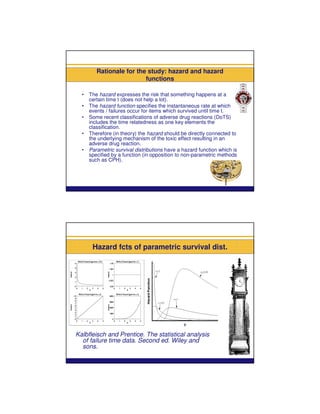
  •   Parametric survival distributions have a hazard function which is
      specified by a function (in opposition to non-parametric methods
      such as CPH).


       Hazard fcts of parametric survival dist.


Kalbfleisch and Prentice. The statistical analysis
  of failure time data. Second ed. Wiley and
  sons.
Reported hazard of occurrence: a phenomenon
               involving several mechanisms
        • P(occur.)*P(diag./occur.)*P(rep./diag.)(1)
        • P = prob. failure conditional on survival
          until time t.
        • Lim f(x)*g(x) = Lim f(x)*Lim g(x)
        • Then when we take Lim t -> 0 (1)
          becomes.

   h(occur.)*h(diag./occur.)*h(rep./diag.)

         PD              Monitoring and         Awareness
 Toxicology profile      “RM” activities   Reporting mechanisms
Efficacy / duration tt     Awareness


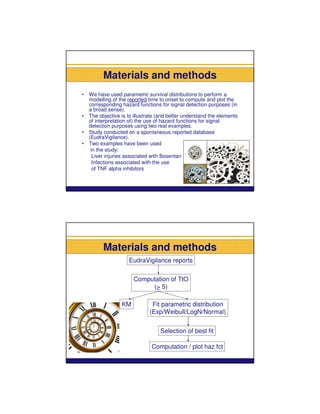
Materials and methods
•   We have used parametric survival distributions to perform a
    modelling of the reported time to onset to compute and plot the
    corresponding hazard functions for signal detection purposes (in
    a broad sense).
•   The objective is to illustrate (and better understand the elements
    of interpretation of) the use of hazard functions for signal
    detection purposes using two real examples.
•   Study conducted on a spontaneous reported database
    (EudraVigilance).
•   Two examples have been used
     in the study:
      Liver injuries associated with Bosentan
      Infections associated with the use
      of TNF alpha inhibitors


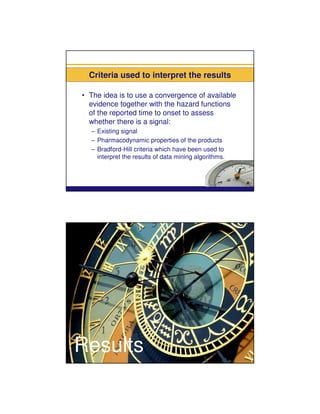
          Materials and methods
                     EudraVigilance reports


                       Computation of TtO
                            (> 5)

                  KM           Fit parametric distribution
                              (Exp/Weibull/LogN/Normal)


                                   Selection of best fit

                               Computation / plot haz fct
Criteria used to interpret the results

• The idea is to use a convergence of available
  evidence together with the hazard functions
  of the reported time to onset to assess
  whether there is a signal:
  – Existing signal
  – Pharmacodynamic properties of the products
  – Bradford-Hill criteria which have been used to
    interpret the results of data mining algorithms.


Results
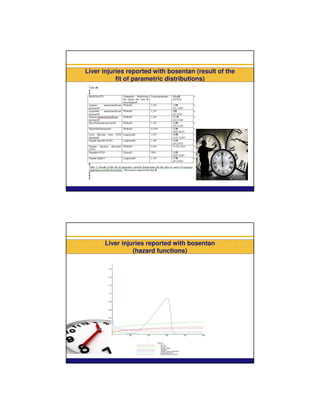
Liver injuries reported with bosentan
               (descriptive stats)


Liver injuries reported with bosentan (KM)
Liver injuries reported with bosentan (result of the
           fit of parametric distributions)


      Liver injuries reported with bosentan
                (hazard functions)
Bosentan – liver injuries
• Logical course of events some occurrences need
  careful interpretation (blood bilirubin inc. and
  [hyper]bilirubinemia)
• Pattern AST/ALT unusual for liver injuries (but not for
  mitochondrial injuries from hepatocytes) but
  consistent with clinical safety data
• Residual and constant risk of liver failure
• Consistent with the putative mechanism of toxicity
  (dose-dpt)
• Consistent with the safety profile of bosentan (lack of
  independence)
• Influence of the risk minimisation activities


 Infections reported with the administration of TNF
                alpha inhibitors (KM)
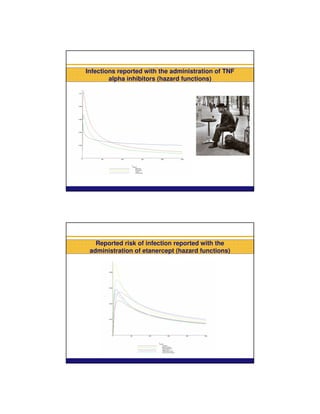
Infections reported with the administration of TNF
        alpha inhibitors (hazard functions)


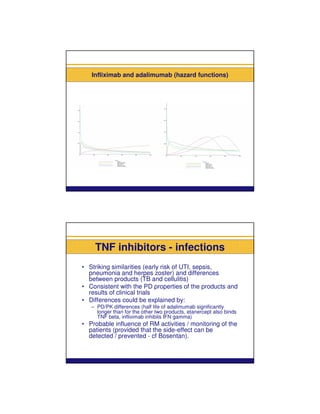
   Reported risk of infection reported with the
 administration of etanercept (hazard functions)
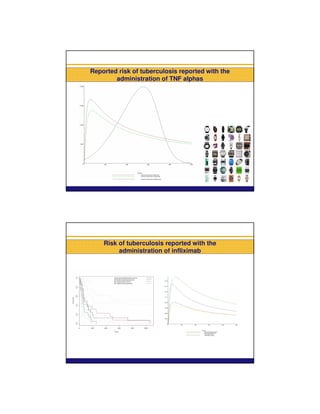
Infliximab and adalimumab (hazard functions)


    TNF inhibitors - infections
• Striking similarities (early risk of UTI, sepsis,
  pneumonia and herpes zoster) and differences
  between products (TB and cellulitis)
• Consistent with the PD properties of the products and
  results of clinical trials
• Differences could be explained by:
   – PD/PK differences (half life of adalimumab significantly
     longer than for the other two products, etanercept also binds
     TNF beta, infliximab inhibits IFN gamma)
• Probable influence of RM activities / monitoring of the
  patients (provided that the side-effect can be
  detected / prevented - cf Bosentan).
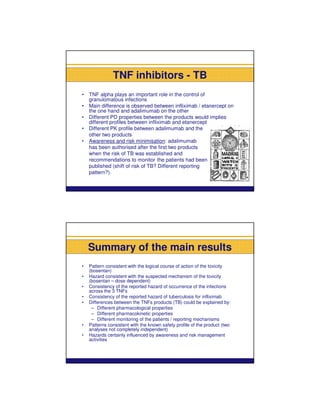
Reported risk of tuberculosis reported with the
        administration of TNF alphas


    Risk of tuberculosis reported with the
         administration of infliximab
TNF inhibitors - TB
•   TNF alpha plays an important role in the control of
    granulomatous infections
•   Main difference is observed between infliximab / etanercept on
    the one hand and adalimumab on the other
•   Different PD properties between the products would implies
    different profiles between infliximab and etanercept
•   Different PK profile between adalimumab and the
    other two products
•   Awareness and risk minimisation: adalimumab
    has been authorised after the first two products
    when the risk of TB was established and
    recommendations to monitor the patients had been
    published (shift of risk of TB? Different reporting
    pattern?).


    Summary of the main results
•   Pattern consistent with the logical course of action of the toxicity
    (bosentan)
•   Hazard consistent with the suspected mechanism of the toxicity
    (bosentan – dose dependent)
•   Consistency of the reported hazard of occurrence of the infections
    across the 3 TNFs
•   Consistency of the reported hazard of tuberculosis for infliximab
•   Differences between the TNFs products (TB) could be explained by:
     – Different pharmacological properties
     – Different pharmacokinetic properties
     – Different monitoring of the patients / reporting mechanisms
•   Patterns consistent with the known safety profile of the product (two
    analyses not completely independent)
•   Hazards certainly influenced by awareness and risk management
    activities
Discussion


    Factors influencing the modelling
• Nplicates
   – Method sensitive to duplication
     like any other DMA
   – Consider the cases of extreme
     duplication
   – Duplication vs clusters
• Data quality
   – Accuracy of the dates
   – Completeness and precision does not
     mean accuracy
• Good documentation and FUp of the cases
Statistical issues and important limitations

    • The work is still preliminary. Interpretation is
      still based on explanations which involve
      documented pharmacological or reporting
      behaviours which can be subjective
    • Issue with censoring and competing risks
    • Absence of hypothesis testing +++
    • Great difficulty to choose a suitable
      comparator to build the hypothesis testing.
    • Performances need to be tested


    Statistical issues and important limitations

•    Approach limited by the number and quality of the reports
•    Influence of the reporting mechanisms +++
      – since the modelling was performed on spontaneous
         reporting data, the hazard does not have the usual
         interpretation as an instantaneous probability of failure
         conditional on survival to time t.
      – As far as the spontaneous reports are concerned, the hazard
         reflects a mixture of reporting behaviour and natural history
         which cannot be disentangled.
•    Multi-state model?
      – A “complete model” would not be devoid of any limitations or would
        rely on strong assumptions which may not be met.
      – Spontaneous reporting does not collect all the information needed
        to build such model).
      – Situation dependent
CONCLUSIONS


               Conclusions
 • Encouraging work which illustrates the
   potential use of hazard functions in signal
   detection
 • Inherent limitations of the spontaneous
   reporting
 • A lot of data manipulation
 • Carefully consider the influence of reporting
   mechanisms (biases) and data quality (cliché)
 • Some statistical issues to be addressed
Future directions
• Better understand the reporting mechanisms
• Test the approach to discriminate true signals from
  confounding (find negative examples)
• Build a test of hypothesis
• Use it in specific situations where a “shift” of the
  hazard function could reflect an underlying /
  intercurrent event
• Assess the performances on a larger scale of data
• Potentially able to disantangle the reporting
  mechanisms by comparing functions from different
  sources of collection of information


           Acknowledgements
• Thank you to the persons who have
  supported me in this work (list not limitative)
   –   Jim Slattery
   –   Xavier Kurz
   –   JM Dogne
   –   Anders Sundstrom
   –   Eugene Van Puijenbroek
   –   HG Eichler

Parametric Modelling Time To Onset

  • 1.
    Parametric modelling oftime to onset of adverse drug reactions using parametric survival distributions F. Maignen Principal scientific administrator European Medicines Agency Plan of the presentation 1. Conflicts of interests and disclaimers 2. Background and rationale of the project 3. Materials and methods 4. Results 5. Interpretation and discussion 6. Conclusions and future directions
  • 2.
    Conflicts of interestand more disclaimers • P. Tsintis and M. Hauben have contributed to this study • Other external contributions received from other Experts • No external funding was received for this study • I do not have any financial interests with the Pharmaceutical industry or any IT software provider (declaration available from the Agency) • I thank the two Companies which have given their approval to publish these results • Disclaimer on the views expressed in this presentation wrt European Medicines Agency • No claim on a “better” safety profile on any medicinal product mentioned in this work should be made. Disclaimers (cont.) ACKNOWLEDGEMENTS • No external source of funding was used to perform this study. The implementation of EudraVigilance was undertaken by the EudraVigilance team at the EMEA lead by Dr Sabine Brosch. The following authors: FM has no conflicts of interest with the pharmaceutical industry (declaration of interest available from EMEA). P. Tsintis contributed to the study when he was working for the EMEA. M. Hauben is also working in Department of Medicine, Risk Management Strategy, Pfizer Inc., New York, New York University School of Medicine, Departments of Community and Preventive Medicine and Pharmacology, New York Medical College, Valhalla, New York, USA and for the School of Information Systems, Computing and Mathematics, Brunel University, London, England . None of the authors have any conflict of interests with any statistical software provider. Valuable comments on this work were received from Nils Feltelius, Hans-Georg Eichler, Francesco Pignatti, Xavier Kurz, Jim Slattery and Anders Sundström. DISCLAIMER • The views expressed in this presentation are the personal views of the author(s) and may not be understood or quoted as being made on behalf of or reflecting the position of the European Medicines Agency or one of its committees or working parties.
  • 3.
    Background Background • The time to onset of adverse drug reactions is directly connected to the underlying mechanism of the toxicity associated with a medicine (DoTS classification) • The current quantitative methods do not integrate any information concerning the underlying toxic mechanism of the suspected medicinal product (some rare studies conducted by A. Bate and E. Van Puijenbroek). • Current methods used to analyse the reported time to onset of adverse drug reactions in Pharmacovigilance • Simple histograms (or LOESS) – Only provide a partial view of the evolution of the risk – The visualisation of the risk highly depends on the number of bins and bandwidth – Difficult to find a “risk window” – Output can be awful (LOESS). • Other non-parametric methods – Kaplan-Meier estimate of the survivor function: can be difficult to interpret and difficult to actually visualise the exact evolution of the risk. • Find patterns of toxicity (true signals) via the hazards
  • 4.
    Rationale for thestudy: hazard and hazard functions • The hazard expresses the risk that something happens at a certain time t (does not help a lot). • The hazard function specifies the instantaneous rate at which events / failures occur for items which survived until time t. • Some recent classifications of adverse drug reactions (DoTS) includes the time relatedness as one key elements the classification. • Therefore (in theory) the hazard should be directly connected to the underlying mechanism of the toxic effect resulting in an adverse drug reaction. • Parametric survival distributions have a hazard function which is specified by a function (in opposition to non-parametric methods such as CPH). Hazard fcts of parametric survival dist. Kalbfleisch and Prentice. The statistical analysis of failure time data. Second ed. Wiley and sons.
  • 5.
    Reported hazard ofoccurrence: a phenomenon involving several mechanisms • P(occur.)*P(diag./occur.)*P(rep./diag.)(1) • P = prob. failure conditional on survival until time t. • Lim f(x)*g(x) = Lim f(x)*Lim g(x) • Then when we take Lim t -> 0 (1) becomes. h(occur.)*h(diag./occur.)*h(rep./diag.) PD Monitoring and Awareness Toxicology profile “RM” activities Reporting mechanisms Efficacy / duration tt Awareness Materials and methods
  • 6.
    Materials and methods • We have used parametric survival distributions to perform a modelling of the reported time to onset to compute and plot the corresponding hazard functions for signal detection purposes (in a broad sense). • The objective is to illustrate (and better understand the elements of interpretation of) the use of hazard functions for signal detection purposes using two real examples. • Study conducted on a spontaneous reported database (EudraVigilance). • Two examples have been used in the study: Liver injuries associated with Bosentan Infections associated with the use of TNF alpha inhibitors Materials and methods EudraVigilance reports Computation of TtO (> 5) KM Fit parametric distribution (Exp/Weibull/LogN/Normal) Selection of best fit Computation / plot haz fct
  • 7.
    Criteria used tointerpret the results • The idea is to use a convergence of available evidence together with the hazard functions of the reported time to onset to assess whether there is a signal: – Existing signal – Pharmacodynamic properties of the products – Bradford-Hill criteria which have been used to interpret the results of data mining algorithms. Results
  • 8.
    Liver injuries reportedwith bosentan (descriptive stats) Liver injuries reported with bosentan (KM)
  • 9.
    Liver injuries reportedwith bosentan (result of the fit of parametric distributions) Liver injuries reported with bosentan (hazard functions)
  • 10.
    Bosentan – liverinjuries • Logical course of events some occurrences need careful interpretation (blood bilirubin inc. and [hyper]bilirubinemia) • Pattern AST/ALT unusual for liver injuries (but not for mitochondrial injuries from hepatocytes) but consistent with clinical safety data • Residual and constant risk of liver failure • Consistent with the putative mechanism of toxicity (dose-dpt) • Consistent with the safety profile of bosentan (lack of independence) • Influence of the risk minimisation activities Infections reported with the administration of TNF alpha inhibitors (KM)
  • 11.
    Infections reported withthe administration of TNF alpha inhibitors (hazard functions) Reported risk of infection reported with the administration of etanercept (hazard functions)
  • 12.
    Infliximab and adalimumab(hazard functions) TNF inhibitors - infections • Striking similarities (early risk of UTI, sepsis, pneumonia and herpes zoster) and differences between products (TB and cellulitis) • Consistent with the PD properties of the products and results of clinical trials • Differences could be explained by: – PD/PK differences (half life of adalimumab significantly longer than for the other two products, etanercept also binds TNF beta, infliximab inhibits IFN gamma) • Probable influence of RM activities / monitoring of the patients (provided that the side-effect can be detected / prevented - cf Bosentan).
  • 13.
    Reported risk oftuberculosis reported with the administration of TNF alphas Risk of tuberculosis reported with the administration of infliximab
  • 14.
    TNF inhibitors -TB • TNF alpha plays an important role in the control of granulomatous infections • Main difference is observed between infliximab / etanercept on the one hand and adalimumab on the other • Different PD properties between the products would implies different profiles between infliximab and etanercept • Different PK profile between adalimumab and the other two products • Awareness and risk minimisation: adalimumab has been authorised after the first two products when the risk of TB was established and recommendations to monitor the patients had been published (shift of risk of TB? Different reporting pattern?). Summary of the main results • Pattern consistent with the logical course of action of the toxicity (bosentan) • Hazard consistent with the suspected mechanism of the toxicity (bosentan – dose dependent) • Consistency of the reported hazard of occurrence of the infections across the 3 TNFs • Consistency of the reported hazard of tuberculosis for infliximab • Differences between the TNFs products (TB) could be explained by: – Different pharmacological properties – Different pharmacokinetic properties – Different monitoring of the patients / reporting mechanisms • Patterns consistent with the known safety profile of the product (two analyses not completely independent) • Hazards certainly influenced by awareness and risk management activities
  • 15.
    Discussion Factors influencing the modelling • Nplicates – Method sensitive to duplication like any other DMA – Consider the cases of extreme duplication – Duplication vs clusters • Data quality – Accuracy of the dates – Completeness and precision does not mean accuracy • Good documentation and FUp of the cases
  • 16.
    Statistical issues andimportant limitations • The work is still preliminary. Interpretation is still based on explanations which involve documented pharmacological or reporting behaviours which can be subjective • Issue with censoring and competing risks • Absence of hypothesis testing +++ • Great difficulty to choose a suitable comparator to build the hypothesis testing. • Performances need to be tested Statistical issues and important limitations • Approach limited by the number and quality of the reports • Influence of the reporting mechanisms +++ – since the modelling was performed on spontaneous reporting data, the hazard does not have the usual interpretation as an instantaneous probability of failure conditional on survival to time t. – As far as the spontaneous reports are concerned, the hazard reflects a mixture of reporting behaviour and natural history which cannot be disentangled. • Multi-state model? – A “complete model” would not be devoid of any limitations or would rely on strong assumptions which may not be met. – Spontaneous reporting does not collect all the information needed to build such model). – Situation dependent
  • 17.
    CONCLUSIONS Conclusions • Encouraging work which illustrates the potential use of hazard functions in signal detection • Inherent limitations of the spontaneous reporting • A lot of data manipulation • Carefully consider the influence of reporting mechanisms (biases) and data quality (cliché) • Some statistical issues to be addressed
  • 18.
    Future directions • Betterunderstand the reporting mechanisms • Test the approach to discriminate true signals from confounding (find negative examples) • Build a test of hypothesis • Use it in specific situations where a “shift” of the hazard function could reflect an underlying / intercurrent event • Assess the performances on a larger scale of data • Potentially able to disantangle the reporting mechanisms by comparing functions from different sources of collection of information Acknowledgements • Thank you to the persons who have supported me in this work (list not limitative) – Jim Slattery – Xavier Kurz – JM Dogne – Anders Sundstrom – Eugene Van Puijenbroek – HG Eichler