By:
-CS Manisha Singh
M.com, B.com(H)
S.No. Topics Covered
1 Definition & Background
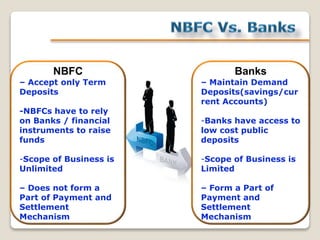
2 NBFCs Vs. Bank
3 Registration, Formation and Commencement
4 Classification of NBFC
5 Why NBFC?
6 Sector Highlights
7 Avenue for CS Professionals
8 Return Requirements
9 Recent Amendments
10 NBFCs in India
11 Outcome: Revised Regulations
12 Suggestions
13 Conclusion
NON –BANKING FINANCIAL COMPANY
Section 45I (f) of RBI Act, 1934
 A “Financial Institution” which is a
company;
A Non‐Banking Institution which is a
company and which has as its Principal Business the
receiving of deposits, under any scheme or
arrangement or in any other manner, or lending in
any manner;
Net Owned Funds
Requirement -
Min. 200 Lakhs unless specified
otherwise.
The Revised Regulatory Framework for
NBFCs enforced by RBI has plugged
the so called regulatory arbitrage and
brought parity
with banks.
NBFCs’ regulations have a history of 18
years and are today almost at par with
banks
Loans and Advances
Hire-Purchase
Acquisition of
Shares/Stocks/Debentures
/ Bonds/Securities
Leasing
Insurance Business
Chit Business
Agricultural Activity
Industrial Activity
Purchase or Sale of any
Goods (Other than
Securities)
Providing any Services
and Purchase/
Sale/Construction of
Immovable Property
Banks
– Maintain Demand
Deposits(savings/cur
rent Accounts)
-Banks have access to
low cost public
deposits
-Scope of Business is
Limited
– Form a Part of
Payment and
Settlement
Mechanism
NBFC
– Accept only Term
Deposits
-NBFCs have to rely
on Banks / financial
instruments to raise
funds
-Scope of Business is
Unlimited
– Does not form a
Part of Payment and
Settlement
Mechanism
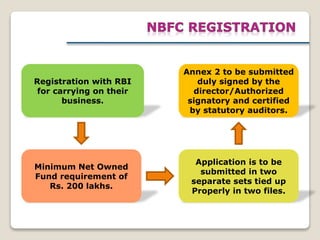
Registration with RBI
for carrying on their
business.
Minimum Net Owned
Fund requirement of
Rs. 200 lakhs.
Application is to be
submitted in two
separate sets tied up
Properly in two files.
Annex 2 to be submitted
duly signed by the
director/Authorized
signatory and certified
by statutory auditors.
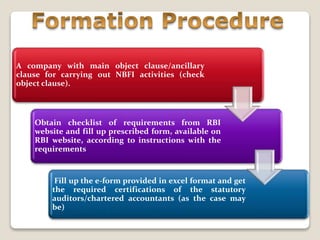
A company with main object clause/ancillary
clause for carrying out NBFI activities (check
object clause).
Obtain checklist of requirements from RBI
website and fill up prescribed form, available on
RBI website, according to instructions with the
requirements
Fill up the e‐form provided in excel format and get
the required certifications of the statutory
auditors/chartered accountants (as the case may
be)
Obtain the printout of successful submission
of the softcopy. Mention the date of
submission on the print if date is not
appearing on print.
Submit the hardcopy application in duplicate
to regional office of RBI, each page in the
application file should be numbered.
Prepare the application in triplicate so that a
replica is with the applicant for future
reference.
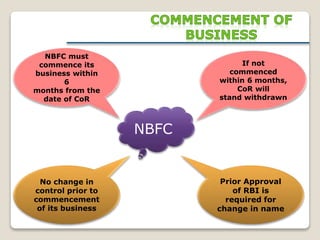
NBFC must
commence its
business within
6
months from the
date of CoR
If not
commenced
within 6 months,
CoR will
stand withdrawn
No change in
control prior to
commencement
of its business
Prior Approval
of RBI is
required for
change in name
NBFC
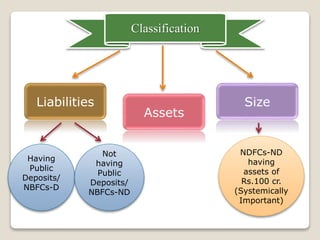
Classification
Liabilities
Assets
Size
Having
Public
Deposits/
NBFCs-D
Not
having
Public
Deposits/
NBFCs-ND
NDFCs-ND
having
assets of
Rs.100 cr.
(Systemically
Important)
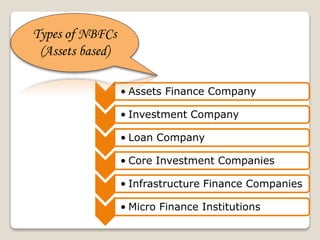
• Assets Finance Company
• Investment Company
• Loan Company
• Core Investment Companies
• Infrastructure Finance Companies
• Micro Finance Institutions
Types of NBFCs
(Assets based)
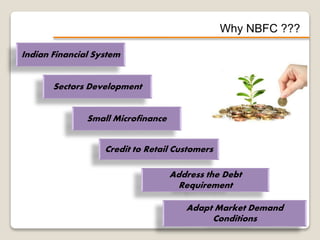
Why NBFC ???
Indian Financial System
Sectors Development
Address the Debt
Requirement
Credit to Retail Customers
Small Microfinance
Adapt Market Demand
Conditions
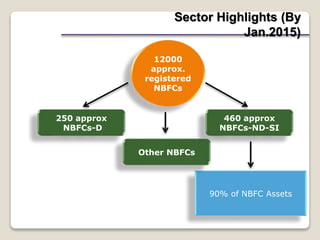
Sector Highlights (By
Jan.2015)
12000
approx.
registered
NBFCs
250 approx
NBFCs-D
460 approx
NBFCs-ND-SI
90% of NBFC Assets
Other NBFCs
•Passing of Board Resolution under Section 179 of the
Companies Act, 2013
•Shareholders Resolution under Section 180(1)(a) and
Section 180(1)(c) of the Companies Act,2013
•Preferential issue – Section 42 of the Companies Act, 2013
and Rules made there under.
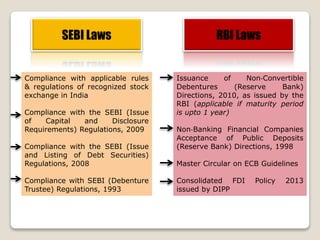
Compliance with applicable rules
& regulations of recognized stock
exchange in India
Compliance with the SEBI (Issue
of Capital and Disclosure
Requirements) Regulations, 2009
Compliance with the SEBI (Issue
and Listing of Debt Securities)
Regulations, 2008
Compliance with SEBI (Debenture
Trustee) Regulations, 1993
Issuance of Non‐Convertible
Debentures (Reserve Bank)
Directions, 2010, as issued by the
RBI (applicable if maturity period
is upto 1 year)
Non‐Banking Financial Companies
Acceptance of Public Deposits
(Reserve Bank) Directions, 1998
Master Circular on ECB Guidelines
Consolidated FDI Policy 2013
issued by DIPP
SEBI Laws RBI Laws
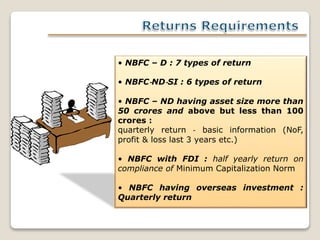
• NBFC – D : 7 types of return
• NBFC‐ND‐SI : 6 types of return
• NBFC – ND having asset size more than
50 crores and above but less than 100
crores :
quarterly return ‐ basic information (NoF,
profit & loss last 3 years etc.)
• NBFC with FDI : half yearly return on
compliance of Minimum Capitalization Norm
• NBFC having overseas investment :
Quarterly return
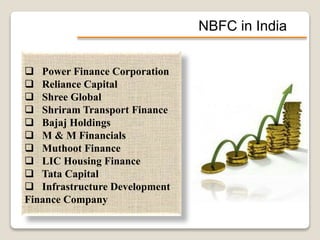
NBFC in India
 Power Finance Corporation
 Reliance Capital
 Shree Global
 Shriram Transport Finance
 Bajaj Holdings
 M & M Financials
 Muthoot Finance
 LIC Housing Finance
 Tata Capital
 Infrastructure Development
Finance Company
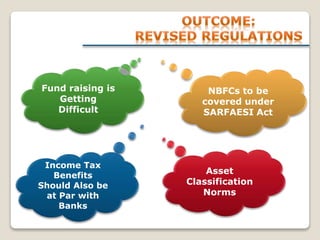
Fund raising is
Getting
Difficult
NBFCs to be
covered under
SARFAESI Act
Asset
Classification
Norms
Income Tax
Benefits
Should Also be
at Par with
Banks
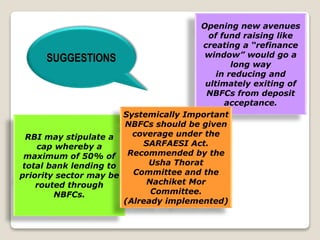
SUGGESTIONS
Opening new avenues
of fund raising like
creating a “refinance
window” would go a
long way
in reducing and
ultimately exiting of
NBFCs from deposit
acceptance.
RBI may stipulate a
cap whereby a
maximum of 50% of
total bank lending to
priority sector may be
routed through
NBFCs.
Systemically Important
NBFCs should be given
coverage under the
SARFAESI Act.
Recommended by the
Usha Thorat
Committee and the
Nachiket Mor
Committee.
(Already implemented)
Conclusion
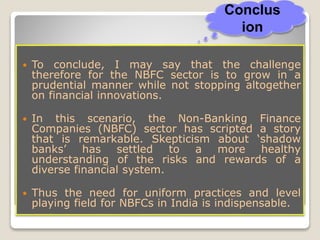
 To conclude, I may say that the challenge
therefore for the NBFC sector is to grow in a
prudential manner while not stopping altogether
on financial innovations.
 In this scenario, the Non-Banking Finance
Companies (NBFC) sector has scripted a story
that is remarkable. Skepticism about ‘shadow
banks’ has settled to a more healthy
understanding of the risks and rewards of a
diverse financial system.
 Thus the need for uniform practices and level
playing field for NBFCs in India is indispensable.
Conclus
ion
Non-Banking Financial Companies

Non-Banking Financial Companies

  • 1.
  • 2.
    S.No. Topics Covered 1Definition & Background 2 NBFCs Vs. Bank 3 Registration, Formation and Commencement 4 Classification of NBFC 5 Why NBFC? 6 Sector Highlights 7 Avenue for CS Professionals 8 Return Requirements 9 Recent Amendments 10 NBFCs in India 11 Outcome: Revised Regulations 12 Suggestions 13 Conclusion
  • 3.
    NON –BANKING FINANCIALCOMPANY Section 45I (f) of RBI Act, 1934  A “Financial Institution” which is a company; A Non‐Banking Institution which is a company and which has as its Principal Business the receiving of deposits, under any scheme or arrangement or in any other manner, or lending in any manner; Net Owned Funds Requirement - Min. 200 Lakhs unless specified otherwise.
  • 4.
    The Revised RegulatoryFramework for NBFCs enforced by RBI has plugged the so called regulatory arbitrage and brought parity with banks. NBFCs’ regulations have a history of 18 years and are today almost at par with banks
  • 5.
    Loans and Advances Hire-Purchase Acquisitionof Shares/Stocks/Debentures / Bonds/Securities Leasing Insurance Business Chit Business Agricultural Activity Industrial Activity Purchase or Sale of any Goods (Other than Securities) Providing any Services and Purchase/ Sale/Construction of Immovable Property
  • 6.
    Banks – Maintain Demand Deposits(savings/cur rentAccounts) -Banks have access to low cost public deposits -Scope of Business is Limited – Form a Part of Payment and Settlement Mechanism NBFC – Accept only Term Deposits -NBFCs have to rely on Banks / financial instruments to raise funds -Scope of Business is Unlimited – Does not form a Part of Payment and Settlement Mechanism
  • 7.
    Registration with RBI forcarrying on their business. Minimum Net Owned Fund requirement of Rs. 200 lakhs. Application is to be submitted in two separate sets tied up Properly in two files. Annex 2 to be submitted duly signed by the director/Authorized signatory and certified by statutory auditors.
  • 8.
    A company withmain object clause/ancillary clause for carrying out NBFI activities (check object clause). Obtain checklist of requirements from RBI website and fill up prescribed form, available on RBI website, according to instructions with the requirements Fill up the e‐form provided in excel format and get the required certifications of the statutory auditors/chartered accountants (as the case may be)
  • 9.
    Obtain the printoutof successful submission of the softcopy. Mention the date of submission on the print if date is not appearing on print. Submit the hardcopy application in duplicate to regional office of RBI, each page in the application file should be numbered. Prepare the application in triplicate so that a replica is with the applicant for future reference.
  • 10.
    NBFC must commence its businesswithin 6 months from the date of CoR If not commenced within 6 months, CoR will stand withdrawn No change in control prior to commencement of its business Prior Approval of RBI is required for change in name NBFC
  • 11.
  • 12.
    • Assets FinanceCompany • Investment Company • Loan Company • Core Investment Companies • Infrastructure Finance Companies • Micro Finance Institutions Types of NBFCs (Assets based)
  • 13.
    Why NBFC ??? IndianFinancial System Sectors Development Address the Debt Requirement Credit to Retail Customers Small Microfinance Adapt Market Demand Conditions
  • 14.
    Sector Highlights (By Jan.2015) 12000 approx. registered NBFCs 250approx NBFCs-D 460 approx NBFCs-ND-SI 90% of NBFC Assets Other NBFCs
  • 15.
    •Passing of BoardResolution under Section 179 of the Companies Act, 2013 •Shareholders Resolution under Section 180(1)(a) and Section 180(1)(c) of the Companies Act,2013 •Preferential issue – Section 42 of the Companies Act, 2013 and Rules made there under.
  • 16.
    Compliance with applicablerules & regulations of recognized stock exchange in India Compliance with the SEBI (Issue of Capital and Disclosure Requirements) Regulations, 2009 Compliance with the SEBI (Issue and Listing of Debt Securities) Regulations, 2008 Compliance with SEBI (Debenture Trustee) Regulations, 1993 Issuance of Non‐Convertible Debentures (Reserve Bank) Directions, 2010, as issued by the RBI (applicable if maturity period is upto 1 year) Non‐Banking Financial Companies Acceptance of Public Deposits (Reserve Bank) Directions, 1998 Master Circular on ECB Guidelines Consolidated FDI Policy 2013 issued by DIPP SEBI Laws RBI Laws
  • 17.
    • NBFC –D : 7 types of return • NBFC‐ND‐SI : 6 types of return • NBFC – ND having asset size more than 50 crores and above but less than 100 crores : quarterly return ‐ basic information (NoF, profit & loss last 3 years etc.) • NBFC with FDI : half yearly return on compliance of Minimum Capitalization Norm • NBFC having overseas investment : Quarterly return
  • 20.
    NBFC in India Power Finance Corporation  Reliance Capital  Shree Global  Shriram Transport Finance  Bajaj Holdings  M & M Financials  Muthoot Finance  LIC Housing Finance  Tata Capital  Infrastructure Development Finance Company
  • 21.
    Fund raising is Getting Difficult NBFCsto be covered under SARFAESI Act Asset Classification Norms Income Tax Benefits Should Also be at Par with Banks
  • 23.
    SUGGESTIONS Opening new avenues offund raising like creating a “refinance window” would go a long way in reducing and ultimately exiting of NBFCs from deposit acceptance. RBI may stipulate a cap whereby a maximum of 50% of total bank lending to priority sector may be routed through NBFCs. Systemically Important NBFCs should be given coverage under the SARFAESI Act. Recommended by the Usha Thorat Committee and the Nachiket Mor Committee. (Already implemented)
  • 24.
    Conclusion  To conclude,I may say that the challenge therefore for the NBFC sector is to grow in a prudential manner while not stopping altogether on financial innovations.  In this scenario, the Non-Banking Finance Companies (NBFC) sector has scripted a story that is remarkable. Skepticism about ‘shadow banks’ has settled to a more healthy understanding of the risks and rewards of a diverse financial system.  Thus the need for uniform practices and level playing field for NBFCs in India is indispensable. Conclus ion