NME MAGAZINE
Case Study
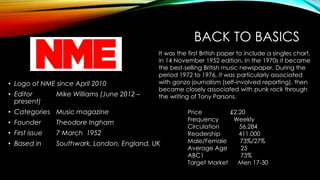
BACK TO BASICS
• Logo of NME since April 2010
• Editor Mike Williams (June 2012 –
present)
• Categories Music magazine
• Founder Theodore Ingham
• First issue 7 March 1952
• Based in Southwark, London, England, UK
It was the first British paper to include a singles chart,
in 14 November 1952 edition. In the 1970s it became
the best-selling British music newspaper. During the
period 1972 to 1976, it was particularly associated
with gonzo journalism (self-involved reporting), then
became closely associated with punk rock through
the writing of Tony Parsons.
Price £2.20
Frequency Weekly
Circulation 56,284
Readership 411,000
Male/Female 73%/27%
Average Age 25
ABC1 73%
Target Market Men 17-30
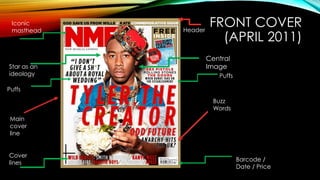
FRONT COVER
(APRIL 2011)
Central
Image
Cover
lines
Barcode /
Date / Price
Buzz
Words
Iconic
masthead
Star as an
ideology
Puffs
Header
Main
cover
line
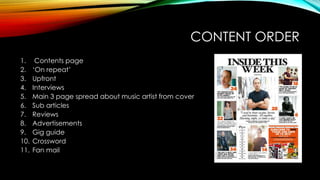
CONTENT ORDER
1. Contents page
2. ‘On repeat’
3. Upfront
4. Interviews
5. Main 3 page spread about music artist from cover
6. Sub articles
7. Reviews
8. Advertisements
9. Gig guide
10. Crossword
11. Fan mail
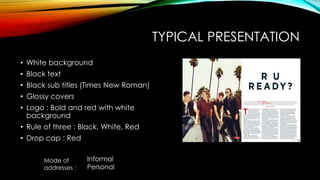
TYPICAL PRESENTATION
• White background
• Black text
• Black sub titles (Times New Roman)
• Glossy covers
• Logo : Bold and red with white
background
• Rule of three : Black, White, Red
• Drop cap : Red
Informal
Personal
Mode of
addresses :
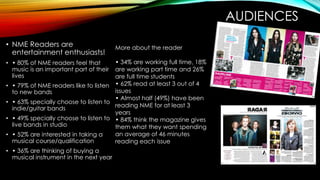
AUDIENCES
• NME Readers are
entertainment enthusiasts!
• • 80% of NME readers feel that
music is an important part of their
lives
• • 79% of NME readers like to listen
to new bands
• • 63% specially choose to listen to
indie/guitar bands
• • 49% specially choose to listen to
live bands in studio
• • 52% are interested in taking a
musical course/qualification
• • 36% are thinking of buying a
musical instrument in the next year
More about the reader
• 34% are working full time, 18%
are working part time and 26%
are full time students
• 62% read at least 3 out of 4
issues
• Almost half (49%) have been
reading NME for at least 3
years
• 84% think the magazine gives
them what they want spending
an average of 46 minutes
reading each issue
TV & RADIO
NME.com feature on NME Radio
including news, reviews, biography,
youtube video, audio, concerts,
tour dates, photos, pictures,
commentary, album reviews and
live reviews and cool facts.
NME Radio was a radio station
operated under NME magazine
branding, that broadcast a
commercially oriented alternative
music format. It first began
broadcasting on 24 June 2008 and
ceased on 25 March 2013.
NME TV was a British music
television channel owned and
operated by CSC Media Group.
This was a similar arrangement
to its radio station, NME Radio.
The channel replaced Minx on
22 November 2007. NME TV
kicked off at 6.00am that day.
On 3rd November 2010, NME TV
was replaced with Scuzz on
Freesat channel 503. On 1
February 2011, NME TV
relaunched on Freesat.

NME Magazine

  • 1.
  • 2.
    BACK TO BASICS •Logo of NME since April 2010 • Editor Mike Williams (June 2012 – present) • Categories Music magazine • Founder Theodore Ingham • First issue 7 March 1952 • Based in Southwark, London, England, UK It was the first British paper to include a singles chart, in 14 November 1952 edition. In the 1970s it became the best-selling British music newspaper. During the period 1972 to 1976, it was particularly associated with gonzo journalism (self-involved reporting), then became closely associated with punk rock through the writing of Tony Parsons. Price £2.20 Frequency Weekly Circulation 56,284 Readership 411,000 Male/Female 73%/27% Average Age 25 ABC1 73% Target Market Men 17-30
  • 3.
    FRONT COVER (APRIL 2011) Central Image Cover lines Barcode/ Date / Price Buzz Words Iconic masthead Star as an ideology Puffs Header Main cover line
  • 4.
    CONTENT ORDER 1. Contentspage 2. ‘On repeat’ 3. Upfront 4. Interviews 5. Main 3 page spread about music artist from cover 6. Sub articles 7. Reviews 8. Advertisements 9. Gig guide 10. Crossword 11. Fan mail
  • 5.
    TYPICAL PRESENTATION • Whitebackground • Black text • Black sub titles (Times New Roman) • Glossy covers • Logo : Bold and red with white background • Rule of three : Black, White, Red • Drop cap : Red Informal Personal Mode of addresses :
  • 6.
    AUDIENCES • NME Readersare entertainment enthusiasts! • • 80% of NME readers feel that music is an important part of their lives • • 79% of NME readers like to listen to new bands • • 63% specially choose to listen to indie/guitar bands • • 49% specially choose to listen to live bands in studio • • 52% are interested in taking a musical course/qualification • • 36% are thinking of buying a musical instrument in the next year More about the reader • 34% are working full time, 18% are working part time and 26% are full time students • 62% read at least 3 out of 4 issues • Almost half (49%) have been reading NME for at least 3 years • 84% think the magazine gives them what they want spending an average of 46 minutes reading each issue
  • 7.
    TV & RADIO NME.comfeature on NME Radio including news, reviews, biography, youtube video, audio, concerts, tour dates, photos, pictures, commentary, album reviews and live reviews and cool facts. NME Radio was a radio station operated under NME magazine branding, that broadcast a commercially oriented alternative music format. It first began broadcasting on 24 June 2008 and ceased on 25 March 2013. NME TV was a British music television channel owned and operated by CSC Media Group. This was a similar arrangement to its radio station, NME Radio. The channel replaced Minx on 22 November 2007. NME TV kicked off at 6.00am that day. On 3rd November 2010, NME TV was replaced with Scuzz on Freesat channel 503. On 1 February 2011, NME TV relaunched on Freesat.