DIRECT SPEECH
INDIRECT SPEECH
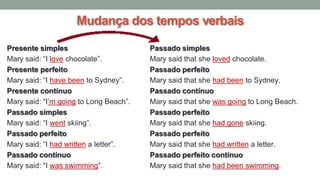
Mudança dos tempos verbais
Presente simples Passado simples
Mary said: “I love chocolate”. Mary said that she loved chocolate.
Presente perfeito Passado perfeito
Mary said: “I have been to Sydney”. Mary said that she had been to Sydney.
Presente contínuo Passado contínuo
Mary said: “I’m going to Long Beach”. Mary said that she was going to Long Beach.
Passado simples Passado perfeito
Mary said: “I went skiing”. Mary said that she had gone skiing.
Passado perfeito Passado perfeito
Mary said: “I had written a letter”. Mary said that she had written a letter.
Passado contínuo Passado perfeito contínuo
Mary said: “I was swimming”. Mary said that she had been swimming.
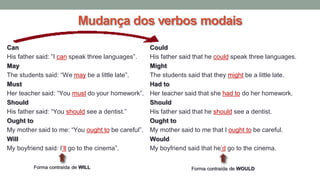
Can Could
His father said: ”I can speak three languages”. His father said that he could speak three languages.
May Might
The students said: “We may be a little late”. The students said that they might be a little late.
Must Had to
Her teacher said: “You must do your homework”. Her teacher said that she had to do her homework.
Should Should
His father said: “You should see a dentist.” His father said that he should see a dentist.
Ought to Ought to
My mother said to me: “You ought to be careful”. My mother said to me that I ought to be careful.
Will Would
My boyfriend said: I’ll go to the cinema”. My boyfriend said that he’d go to the cinema.
Mudança dos verbos modais
Forma contraída de WILL Forma contraída de WOULD
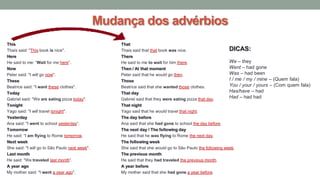
This That
Thaís said: "This book is nice". Thais said that that book was nice.
Here There
He said to me: “Wait for me here”. He said to me to wait for him there.
Now Then / At that moment
Peter said: "I will go now". Peter said that he would go then.
These Those
Beatrice said: "I want these clothes". Beatrice said that she wanted those clothes.
Today That day
Gabriel said: "We are eating pizza today". Gabriel said that they were eating pizza that day.
Tonight That night
Yago said: "I will travel tonight". Yago said that he would travel that night.
Yesterday The day before
Ana said: "I went to school yesterday“. Ana said that she had gone to school the day before.
Tomorrow The next day / The following day
He said: “I am flying to Rome tomorrow. He said that he was flying to Rome the next day.
Next week The following week
She said: "I will go to São Paulo next week". She said that she would go to São Paulo the following week.
Last month The previous month
He said: "We traveled last month”. He said that they had traveled the previous month.
A year ago A year before
My mother said: "I went a year ago". My mother said that she had gone a year before.
Mudança dos advérbios
DICAS:
We – they
Went – had gone
Was – had been
I / me / my / mine – (Quem fala)
You / your / yours – (Com quem fala)
Has/have – had
Had – had had
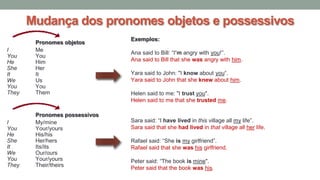
Pronomes objetos
I Me
You You
He Him
She Her
It It
We Us
You You
They Them
Pronomes possessivos
I My/mine
You Your/yours
He His/his
She Her/hers
It Its/its
We Our/ours
You Your/yours
They Their/theirs
Mudança dos pronomes objetos e possessivos
Exemplos:
Ana said to Bill: “I’m angry with you!”.
Ana said to Bill that she was angry with him.
Yara said to John: "I know about you“.
Yara said to John that she knew about him.
Helen said to me: "I trust you".
Helen said to me that she trusted me.
Sara said: “I have lived in this village all my life”.
Sara said that she had lived in that village all her life.
Rafael said: “She is my girlfriend”.
Rafael said that she was his girlfriend.
Peter said: “The book is mine".
Peter said that the book was his.
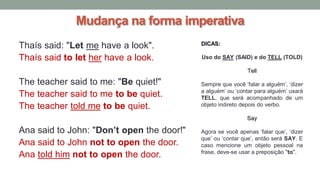
Mudança na forma imperativa
Thaís said: "Let me have a look".
Thaís said to let her have a look.
The teacher said to me: "Be quiet!"
The teacher said to me to be quiet.
The teacher told me to be quiet.
Ana said to John: "Don’t open the door!"
Ana said to John not to open the door.
Ana told him not to open the door.
DICAS:
Uso do SAY (SAID) e do TELL (TOLD)
Tell
Sempre que você ‘falar a alguém’, ‘dizer
a alguém’ ou ‘contar para alguém’ usará
TELL, que será acompanhado de um
objeto indireto depois do verbo.
Say
Agora se você apenas ‘falar que’, ‘dizer
que’ ou ‘contar que’, então será SAY. E
caso mencione um objeto pessoal na
frase, deve-se usar a preposição "to".
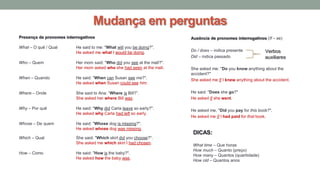
Mudança em perguntas
Presença de pronomes interrogativos
What – O quê / Qual He said to me: "What will you be doing?".
He asked me what I would be doing.
Who – Quem Her mom said: "Who did you see at the mall?".
Her mom asked who she had seen at the mall.
When – Quando He said: "When can Susan see me?".
He asked when Susan could see him.
Where – Onde She said to Ana: “Where is Bill?”.
She asked her where Bill was.
Why – Por quê He said: "Why did Carla leave so early?".
He asked why Carla had left so early.
Whose – De quem He said: "Whose dog is missing?".
He asked whose dog was missing.
Which – Qual She said: "Which skirt did you choose?".
She asked me which skirt I had chosen.
How – Como He said: "How is the baby?".
He asked how the baby was.
DICAS:
What time – Que horas
How much – Quanto (preço)
How many – Quantos (quantidade)
How old – Quantos anos
Ausência de pronomes interrogativos (If – se)
Do / does – indica presente
Did – indica passado
She asked me: "Do you know anything about the
accident?"
She asked me if I knew anything about the accident.
He said: "Does she go?"
He asked if she went.
He asked me, "Did you pay for this book?".
He asked me if I had paid for that book.
Verbos
auxiliares
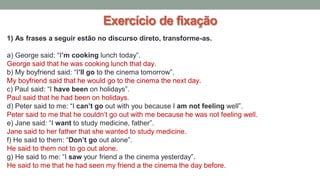
Exercício de fixação
1) As frases a seguir estão no discurso direto, transforme-as.
a) George said: “I’m cooking lunch today”.
George said that he was cooking lunch that day.
b) My boyfriend said: “I’ll go to the cinema tomorrow”.
My boyfriend said that he would go to the cinema the next day.
c) Paul said: “I have been on holidays”.
Paul said that he had been on holidays.
d) Peter said to me: “I can’t go out with you because I am not feeling well”.
Peter said to me that he couldn’t go out with me because he was not feeling well.
e) Jane said: “I want to study medicine, father”.
Jane said to her father that she wanted to study medicine.
f) He said to them: “Don’t go out alone”.
He said to them not to go out alone.
g) He said to me: “I saw your friend a the cinema yesterday”.
He said to me that he had seen my friend a the cinema the day before.
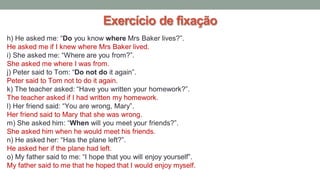
Exercício de fixação
h) He asked me: “Do you know where Mrs Baker lives?”.
He asked me if I knew where Mrs Baker lived.
i) She asked me: “Where are you from?”.
She asked me where I was from.
j) Peter said to Tom: “Do not do it again”.
Peter said to Tom not to do it again.
k) The teacher asked: “Have you written your homework?”.
The teacher asked if I had written my homework.
l) Her friend said: “You are wrong, Mary”.
Her friend said to Mary that she was wrong.
m) She asked him: “When will you meet your friends?”.
She asked him when he would meet his friends.
n) He asked her: “Has the plane left?”.
He asked her if the plane had left.
o) My father said to me: “I hope that you will enjoy yourself”.
My father said to me that he hoped that I would enjoy myself.
SUCESSO!
QUEREMOS 10,0!

Discurso Direto e Discurso Indireto (Inglês)

  • 1.
  • 2.
    Mudança dos temposverbais Presente simples Passado simples Mary said: “I love chocolate”. Mary said that she loved chocolate. Presente perfeito Passado perfeito Mary said: “I have been to Sydney”. Mary said that she had been to Sydney. Presente contínuo Passado contínuo Mary said: “I’m going to Long Beach”. Mary said that she was going to Long Beach. Passado simples Passado perfeito Mary said: “I went skiing”. Mary said that she had gone skiing. Passado perfeito Passado perfeito Mary said: “I had written a letter”. Mary said that she had written a letter. Passado contínuo Passado perfeito contínuo Mary said: “I was swimming”. Mary said that she had been swimming.
  • 3.
    Can Could His fathersaid: ”I can speak three languages”. His father said that he could speak three languages. May Might The students said: “We may be a little late”. The students said that they might be a little late. Must Had to Her teacher said: “You must do your homework”. Her teacher said that she had to do her homework. Should Should His father said: “You should see a dentist.” His father said that he should see a dentist. Ought to Ought to My mother said to me: “You ought to be careful”. My mother said to me that I ought to be careful. Will Would My boyfriend said: I’ll go to the cinema”. My boyfriend said that he’d go to the cinema. Mudança dos verbos modais Forma contraída de WILL Forma contraída de WOULD
  • 4.
    This That Thaís said:"This book is nice". Thais said that that book was nice. Here There He said to me: “Wait for me here”. He said to me to wait for him there. Now Then / At that moment Peter said: "I will go now". Peter said that he would go then. These Those Beatrice said: "I want these clothes". Beatrice said that she wanted those clothes. Today That day Gabriel said: "We are eating pizza today". Gabriel said that they were eating pizza that day. Tonight That night Yago said: "I will travel tonight". Yago said that he would travel that night. Yesterday The day before Ana said: "I went to school yesterday“. Ana said that she had gone to school the day before. Tomorrow The next day / The following day He said: “I am flying to Rome tomorrow. He said that he was flying to Rome the next day. Next week The following week She said: "I will go to São Paulo next week". She said that she would go to São Paulo the following week. Last month The previous month He said: "We traveled last month”. He said that they had traveled the previous month. A year ago A year before My mother said: "I went a year ago". My mother said that she had gone a year before. Mudança dos advérbios DICAS: We – they Went – had gone Was – had been I / me / my / mine – (Quem fala) You / your / yours – (Com quem fala) Has/have – had Had – had had
  • 5.
    Pronomes objetos I Me YouYou He Him She Her It It We Us You You They Them Pronomes possessivos I My/mine You Your/yours He His/his She Her/hers It Its/its We Our/ours You Your/yours They Their/theirs Mudança dos pronomes objetos e possessivos Exemplos: Ana said to Bill: “I’m angry with you!”. Ana said to Bill that she was angry with him. Yara said to John: "I know about you“. Yara said to John that she knew about him. Helen said to me: "I trust you". Helen said to me that she trusted me. Sara said: “I have lived in this village all my life”. Sara said that she had lived in that village all her life. Rafael said: “She is my girlfriend”. Rafael said that she was his girlfriend. Peter said: “The book is mine". Peter said that the book was his.
  • 6.
    Mudança na formaimperativa Thaís said: "Let me have a look". Thaís said to let her have a look. The teacher said to me: "Be quiet!" The teacher said to me to be quiet. The teacher told me to be quiet. Ana said to John: "Don’t open the door!" Ana said to John not to open the door. Ana told him not to open the door. DICAS: Uso do SAY (SAID) e do TELL (TOLD) Tell Sempre que você ‘falar a alguém’, ‘dizer a alguém’ ou ‘contar para alguém’ usará TELL, que será acompanhado de um objeto indireto depois do verbo. Say Agora se você apenas ‘falar que’, ‘dizer que’ ou ‘contar que’, então será SAY. E caso mencione um objeto pessoal na frase, deve-se usar a preposição "to".
  • 7.
    Mudança em perguntas Presençade pronomes interrogativos What – O quê / Qual He said to me: "What will you be doing?". He asked me what I would be doing. Who – Quem Her mom said: "Who did you see at the mall?". Her mom asked who she had seen at the mall. When – Quando He said: "When can Susan see me?". He asked when Susan could see him. Where – Onde She said to Ana: “Where is Bill?”. She asked her where Bill was. Why – Por quê He said: "Why did Carla leave so early?". He asked why Carla had left so early. Whose – De quem He said: "Whose dog is missing?". He asked whose dog was missing. Which – Qual She said: "Which skirt did you choose?". She asked me which skirt I had chosen. How – Como He said: "How is the baby?". He asked how the baby was. DICAS: What time – Que horas How much – Quanto (preço) How many – Quantos (quantidade) How old – Quantos anos Ausência de pronomes interrogativos (If – se) Do / does – indica presente Did – indica passado She asked me: "Do you know anything about the accident?" She asked me if I knew anything about the accident. He said: "Does she go?" He asked if she went. He asked me, "Did you pay for this book?". He asked me if I had paid for that book. Verbos auxiliares
  • 8.
    Exercício de fixação 1)As frases a seguir estão no discurso direto, transforme-as. a) George said: “I’m cooking lunch today”. George said that he was cooking lunch that day. b) My boyfriend said: “I’ll go to the cinema tomorrow”. My boyfriend said that he would go to the cinema the next day. c) Paul said: “I have been on holidays”. Paul said that he had been on holidays. d) Peter said to me: “I can’t go out with you because I am not feeling well”. Peter said to me that he couldn’t go out with me because he was not feeling well. e) Jane said: “I want to study medicine, father”. Jane said to her father that she wanted to study medicine. f) He said to them: “Don’t go out alone”. He said to them not to go out alone. g) He said to me: “I saw your friend a the cinema yesterday”. He said to me that he had seen my friend a the cinema the day before.
  • 9.
    Exercício de fixação h)He asked me: “Do you know where Mrs Baker lives?”. He asked me if I knew where Mrs Baker lived. i) She asked me: “Where are you from?”. She asked me where I was from. j) Peter said to Tom: “Do not do it again”. Peter said to Tom not to do it again. k) The teacher asked: “Have you written your homework?”. The teacher asked if I had written my homework. l) Her friend said: “You are wrong, Mary”. Her friend said to Mary that she was wrong. m) She asked him: “When will you meet your friends?”. She asked him when he would meet his friends. n) He asked her: “Has the plane left?”. He asked her if the plane had left. o) My father said to me: “I hope that you will enjoy yourself”. My father said to me that he hoped that I would enjoy myself.
  • 10.