Prepared by : Nurul Najwa Mustapa
Supervisor: Dr Azhar
EMERGENCY DRUGS IN ANESTHESIA
CONTENT
• ATROPINE
• PHENYLEPHRINE
• EPHEDRINE
• ADRENALINE
• NORADRENALINE
ATROPINE
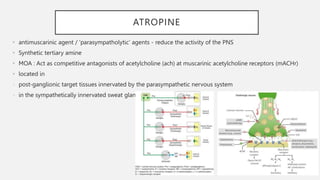
• antimuscarinic agent / ‘parasympatholytic’ agents - reduce the activity of the PNS
• Synthetic tertiary amine
• MOA : Act as competitive antagonists of acetylcholine (ach) at muscarinic acetylcholine receptors (mACHr)
• located in
- post-ganglionic target tissues innervated by the parasympathetic nervous system
- in the sympathetically innervated sweat glands.
ATROPINE
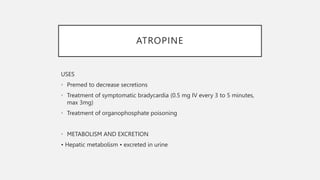
USES
• Premed to decrease secretions
• Treatment of symptomatic bradycardia (0.5 mg IV every 3 to 5 minutes,
max 3mg)
• Treatment of organophosphate poisoning
• METABOLISM AND EXCRETION
• Hepatic metabolism • excreted in urine
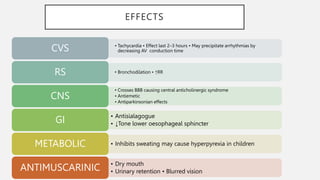
EFFECTS
• Tachycardia • Effect last 2–3 hours • May precipitate arrhythmias by
decreasing AV conduction time
CVS
• Bronchodilation • ↑RR
RS
• Crosses BBB causing central anticholinergic syndrome
• Antiemetic
• Antiparkinsonian effects
CNS
• Antisialagogue
• ↓Tone lower oesophageal sphincter
GI
• Inhibits sweating may cause hyperpyrexia in children
METABOLIC
• Dry mouth
• Urinary retention • Blurred vision
ANTIMUSCARINIC
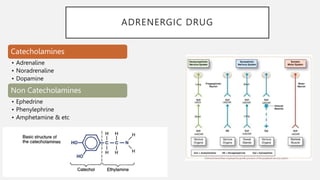
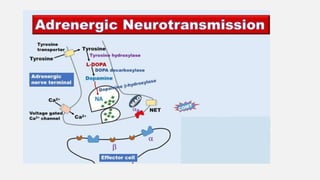
ADRENERGIC DRUG
Catecholamines
• Adrenaline
• Noradrenaline
• Dopamine
Non Catecholamines
• Ephedrine
• Phenylephrine
• Amphetamine & etc
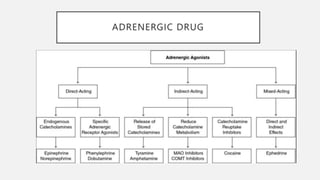
ADRENERGIC DRUG
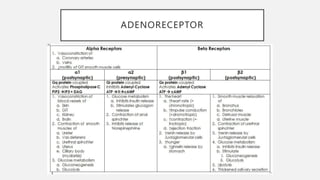
ADENORECEPTOR
PHENYLEPHRINE
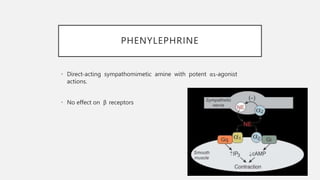
• Direct-acting sympathomimetic amine with potent α1-agonist
actions.
• No effect on β receptors
EFFECT
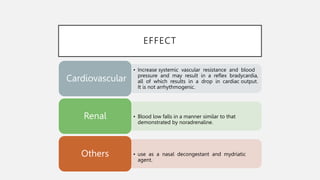
• Increase systemic vascular resistance and blood
pressure and may result in a reflex bradycardia,
all of which results in a drop in cardiac output.
It is not arrhythmogenic.
Cardiovascular
• Blood low falls in a manner similar to that
demonstrated by noradrenaline.
Renal
• use as a nasal decongestant and mydriatic
agent.
Others
PHENYLEPHRINE
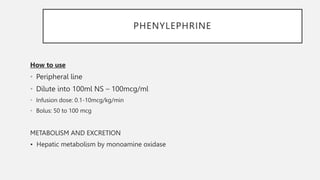
How to use
• Peripheral line
• Dilute into 100ml NS – 100mcg/ml
• Infusion dose: 0.1-10mcg/kg/min
• Bolus: 50 to 100 mcg
METABOLISM AND EXCRETION
• Hepatic metabolism by monoamine oxidase
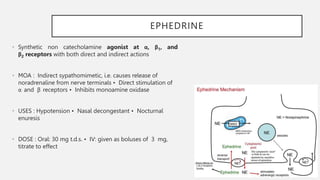
EPHEDRINE
• Synthetic non catecholamine agonist at α, β1, and
β2 receptors with both direct and indirect actions
• MOA : Indirect sypathomimetic, i.e. causes release of
noradrenaline from nerve terminals • Direct stimulation of
α and β receptors • Inhibits monoamine oxidase
• USES : Hypotension • Nasal decongestant • Nocturnal
enuresis
• DOSE : Oral: 30 mg t.d.s. • IV: given as boluses of 3 mg,
titrate to effect
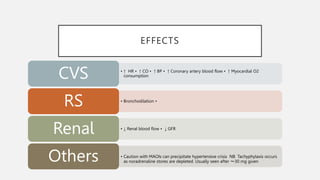
EFFECTS
• ↑ HR • ↑ CO • ↑ BP • ↑ Coronary artery blood flow • ↑ Myocardial O2
consumption
CVS
• Bronchodilation •
RS
• ↓ Renal blood flow • ↓ GFR
Renal
• Caution with MAOIs can precipitate hypertensive crisis NB Tachyphylaxis occurs
as noradrenaline stores are depleted. Usually seen after ~30 mg given
Others
EPHEDRINE
METABOLISM AND EXCRETION
• Minimal hepatic metabolism • 65% excreted
unchanged in urine
ADRENALINE
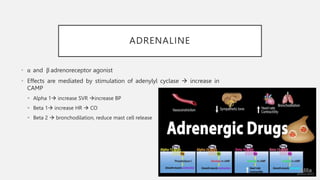
• α and β adrenoreceptor agonist
• Effects are mediated by stimulation of adenylyl cyclase  increase in
CAMP
 Alpha 1 increase SVR increase BP
 Beta 1 increase HR  CO
 Beta 2  bronchodilation, reduce mast cell release
ADRENALINE
Pharmacokinetics
• Administration : IV /IM
• Elimination : degraded by conjugation with glucuronic and sulphuric acids and excreted in
the urine. Smaller part oxidised by amine oxidase and inactivated by o-methyl-transferase
Dose
• Infusion dose : 0.01-1.5 mcg/kg/min
• Single strength: 3mg in 50cc (0.06mg/ml)
• Double strength: 6mg in 50cc (0.12mg/ml)
EFFECTS
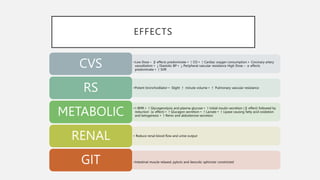
•Low Dose – β effects predominate • ↑ CO • ↑ Cardiac oxygen consumption • Coronary artery
vasodilation • ↓ Diastolic BP • ↓ Peripheral vascular resistance High Dose – α effects
predominate • ↑ SVR
CVS
•Potent bronchodilator • Slight ↑ minute volume • ↑ Pulmonary vascular resistance
RS
•↑ BMR • ↑ Glycogenolysis and plasma glucose • ↑ Initial insulin secretion ( β effect) followed by
reduction (α effect) • ↑ Glucagon secretion • ↑ Lactate • ↑ Lipase causing fatty acid oxidation
and ketogenesis • ↑ Renin and aldosterone secretion
METABOLIC
• Reduce renal blood flow and urine output
RENAL
•Intestinal muscle relaxed, pyloric and ileocolic sphincter constricted
GIT
EPINEPHRINE
USES
• Severe septic shock
 Added as 2nd vasoactive agent when noradrenaline dose > 15-20mcg/min does not achieve the
target
• ACLS
 1mg 3-5min push IV
• Anaphylaxis
 Administered adrenaline in boluses of 0.05-0.1mg. If no response, administered infusion adrenaline
at 0.1mcg/kg/min.
 Adrenaline is preferred as it reverses peripheral vasodilation and reduces oedema
• Viral croup
• Asthma
 Use 1:1000 solution and (if required) make up to a total of 5ml using normal saline prior to
administration
• Used locally to decrease the spread of LA and to reduce surgical blood loss
NORADRENALINE
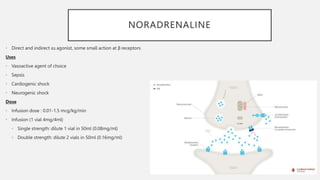
• Direct and indirect α1 agonist, some small action at β receptors
Uses
• Vasoactive agent of choice
• Sepsis
• Cardiogenic shock
• Neurogenic shock
Dose
• Infusion dose : 0.01-1.5 mcg/kg/min
• Infusion (1 vial 4mg/4ml)
• Single strength: dilute 1 vial in 50ml (0.08mg/ml)
• Double strength: dilute 2 vials in 50ml (0.16mg/ml)
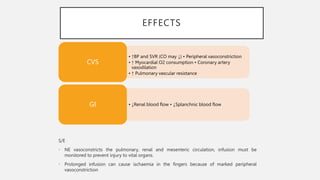
EFFECTS
S/E
• NE vasoconstricts the pulmonary, renal and mesenteric circulation, infusion must be
monitored to prevent injury to vital organs.
• Prolonged infusion can cause ischaemia in the fingers because of marked peripheral
vasoconstriction
• ↑BP and SVR (CO may ↓) • Peripheral vasoconstriction
• ↑ Myocardial O2 consumption • Coronary artery
vasodilation
• ↑ Pulmonary vascular resistance
CVS
• ↓Renal blood flow • ↓Splanchnic blood flow
GI
NORADRENALINE
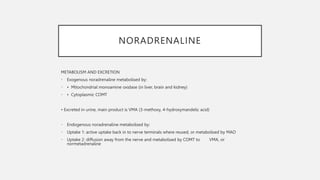
METABOLISM AND EXCRETION
• Exogenous noradrenaline metabolised by:
• • Mitochondrial monoamine oxidase (in liver, brain and kidney)
• • Cytoplasmic COMT
• Excreted in urine, main product is VMA (3-methoxy, 4-hydroxymandelic acid)
• Endogenous noradrenaline metabolised by:
• Uptake 1: active uptake back in to nerve terminals where reused, or metabolised by MAO
• Uptake 2: diffusion away from the nerve and metabolised by COMT to VMA, or
normetadrenaline
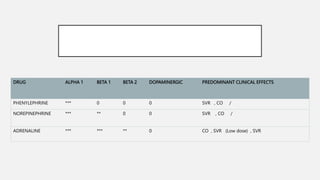
DRUG ALPHA 1 BETA 1 BETA 2 DOPAMINERGIC PREDOMINANT CLINICAL EFFECTS
PHENYLEPHRINE *** 0 0 0 SVR , CO /
NOREPINEPHRINE *** ** 0 0 SVR , CO /
ADRENALINE *** *** ** 0 CO , SVR (Low dose) , SVR
REFERENCES
• The Primary FRCA Structured Oral Examination Study Guide 2. Second Edition. Kate
McCombe and Lara Wijayasiri
• Pharmacology for Anaesthesia and Intensive Care. Fourth Edition. T.E Peck, S.A Hill

nknn.pptx

  • 1.
    Prepared by :Nurul Najwa Mustapa Supervisor: Dr Azhar EMERGENCY DRUGS IN ANESTHESIA
  • 2.
    CONTENT • ATROPINE • PHENYLEPHRINE •EPHEDRINE • ADRENALINE • NORADRENALINE
  • 3.
    ATROPINE • antimuscarinic agent/ ‘parasympatholytic’ agents - reduce the activity of the PNS • Synthetic tertiary amine • MOA : Act as competitive antagonists of acetylcholine (ach) at muscarinic acetylcholine receptors (mACHr) • located in - post-ganglionic target tissues innervated by the parasympathetic nervous system - in the sympathetically innervated sweat glands.
  • 4.
    ATROPINE USES • Premed todecrease secretions • Treatment of symptomatic bradycardia (0.5 mg IV every 3 to 5 minutes, max 3mg) • Treatment of organophosphate poisoning • METABOLISM AND EXCRETION • Hepatic metabolism • excreted in urine
  • 5.
    EFFECTS • Tachycardia •Effect last 2–3 hours • May precipitate arrhythmias by decreasing AV conduction time CVS • Bronchodilation • ↑RR RS • Crosses BBB causing central anticholinergic syndrome • Antiemetic • Antiparkinsonian effects CNS • Antisialagogue • ↓Tone lower oesophageal sphincter GI • Inhibits sweating may cause hyperpyrexia in children METABOLIC • Dry mouth • Urinary retention • Blurred vision ANTIMUSCARINIC
  • 6.
    ADRENERGIC DRUG Catecholamines • Adrenaline •Noradrenaline • Dopamine Non Catecholamines • Ephedrine • Phenylephrine • Amphetamine & etc
  • 7.
  • 9.
  • 10.
    PHENYLEPHRINE • Direct-acting sympathomimeticamine with potent α1-agonist actions. • No effect on β receptors
  • 11.
    EFFECT • Increase systemicvascular resistance and blood pressure and may result in a reflex bradycardia, all of which results in a drop in cardiac output. It is not arrhythmogenic. Cardiovascular • Blood low falls in a manner similar to that demonstrated by noradrenaline. Renal • use as a nasal decongestant and mydriatic agent. Others
  • 12.
    PHENYLEPHRINE How to use •Peripheral line • Dilute into 100ml NS – 100mcg/ml • Infusion dose: 0.1-10mcg/kg/min • Bolus: 50 to 100 mcg METABOLISM AND EXCRETION • Hepatic metabolism by monoamine oxidase
  • 13.
    EPHEDRINE • Synthetic noncatecholamine agonist at α, β1, and β2 receptors with both direct and indirect actions • MOA : Indirect sypathomimetic, i.e. causes release of noradrenaline from nerve terminals • Direct stimulation of α and β receptors • Inhibits monoamine oxidase • USES : Hypotension • Nasal decongestant • Nocturnal enuresis • DOSE : Oral: 30 mg t.d.s. • IV: given as boluses of 3 mg, titrate to effect
  • 14.
    EFFECTS • ↑ HR• ↑ CO • ↑ BP • ↑ Coronary artery blood flow • ↑ Myocardial O2 consumption CVS • Bronchodilation • RS • ↓ Renal blood flow • ↓ GFR Renal • Caution with MAOIs can precipitate hypertensive crisis NB Tachyphylaxis occurs as noradrenaline stores are depleted. Usually seen after ~30 mg given Others
  • 15.
    EPHEDRINE METABOLISM AND EXCRETION •Minimal hepatic metabolism • 65% excreted unchanged in urine
  • 16.
    ADRENALINE • α andβ adrenoreceptor agonist • Effects are mediated by stimulation of adenylyl cyclase  increase in CAMP  Alpha 1 increase SVR increase BP  Beta 1 increase HR  CO  Beta 2  bronchodilation, reduce mast cell release
  • 17.
    ADRENALINE Pharmacokinetics • Administration :IV /IM • Elimination : degraded by conjugation with glucuronic and sulphuric acids and excreted in the urine. Smaller part oxidised by amine oxidase and inactivated by o-methyl-transferase Dose • Infusion dose : 0.01-1.5 mcg/kg/min • Single strength: 3mg in 50cc (0.06mg/ml) • Double strength: 6mg in 50cc (0.12mg/ml)
  • 18.
    EFFECTS •Low Dose –β effects predominate • ↑ CO • ↑ Cardiac oxygen consumption • Coronary artery vasodilation • ↓ Diastolic BP • ↓ Peripheral vascular resistance High Dose – α effects predominate • ↑ SVR CVS •Potent bronchodilator • Slight ↑ minute volume • ↑ Pulmonary vascular resistance RS •↑ BMR • ↑ Glycogenolysis and plasma glucose • ↑ Initial insulin secretion ( β effect) followed by reduction (α effect) • ↑ Glucagon secretion • ↑ Lactate • ↑ Lipase causing fatty acid oxidation and ketogenesis • ↑ Renin and aldosterone secretion METABOLIC • Reduce renal blood flow and urine output RENAL •Intestinal muscle relaxed, pyloric and ileocolic sphincter constricted GIT
  • 19.
    EPINEPHRINE USES • Severe septicshock  Added as 2nd vasoactive agent when noradrenaline dose > 15-20mcg/min does not achieve the target • ACLS  1mg 3-5min push IV • Anaphylaxis  Administered adrenaline in boluses of 0.05-0.1mg. If no response, administered infusion adrenaline at 0.1mcg/kg/min.  Adrenaline is preferred as it reverses peripheral vasodilation and reduces oedema • Viral croup • Asthma  Use 1:1000 solution and (if required) make up to a total of 5ml using normal saline prior to administration • Used locally to decrease the spread of LA and to reduce surgical blood loss
  • 20.
    NORADRENALINE • Direct andindirect α1 agonist, some small action at β receptors Uses • Vasoactive agent of choice • Sepsis • Cardiogenic shock • Neurogenic shock Dose • Infusion dose : 0.01-1.5 mcg/kg/min • Infusion (1 vial 4mg/4ml) • Single strength: dilute 1 vial in 50ml (0.08mg/ml) • Double strength: dilute 2 vials in 50ml (0.16mg/ml)
  • 21.
    EFFECTS S/E • NE vasoconstrictsthe pulmonary, renal and mesenteric circulation, infusion must be monitored to prevent injury to vital organs. • Prolonged infusion can cause ischaemia in the fingers because of marked peripheral vasoconstriction • ↑BP and SVR (CO may ↓) • Peripheral vasoconstriction • ↑ Myocardial O2 consumption • Coronary artery vasodilation • ↑ Pulmonary vascular resistance CVS • ↓Renal blood flow • ↓Splanchnic blood flow GI
  • 22.
    NORADRENALINE METABOLISM AND EXCRETION •Exogenous noradrenaline metabolised by: • • Mitochondrial monoamine oxidase (in liver, brain and kidney) • • Cytoplasmic COMT • Excreted in urine, main product is VMA (3-methoxy, 4-hydroxymandelic acid) • Endogenous noradrenaline metabolised by: • Uptake 1: active uptake back in to nerve terminals where reused, or metabolised by MAO • Uptake 2: diffusion away from the nerve and metabolised by COMT to VMA, or normetadrenaline
  • 23.
    DRUG ALPHA 1BETA 1 BETA 2 DOPAMINERGIC PREDOMINANT CLINICAL EFFECTS PHENYLEPHRINE *** 0 0 0 SVR , CO / NOREPINEPHRINE *** ** 0 0 SVR , CO / ADRENALINE *** *** ** 0 CO , SVR (Low dose) , SVR
  • 24.
    REFERENCES • The PrimaryFRCA Structured Oral Examination Study Guide 2. Second Edition. Kate McCombe and Lara Wijayasiri • Pharmacology for Anaesthesia and Intensive Care. Fourth Edition. T.E Peck, S.A Hill

Editor's Notes

  • #16 Tolerance: larger doses required to produce the same effect. Pharmacokinetic clearance: increased drug clearance induced by repeat doses Pharmacodynamic tolerance: changes in receptor number or function due to exposure to the drug Physiological tolerance: homeostatic adaptation of unrelated systems to compensate for drug effect Behavioural tolerance: learned compensation for the effect of the drug which diminishes its effects. Tachyphylaxis: a rapid decrease in response to repeated doses over a short time period Not dose-dependent (i.e. giving a larger dose of the drug may not restore the maximum effect) Rate-sensitive (i.e. requires frequent dosing) After a relatively short period of withholding the drug, its effect is restored (i.e tachyphylaxis resolves rapidly)