Redefining Suburbs Part I:
Understanding the Trends
Tim Evans
New Jersey Future
Redevelopment Forum 2017
March 10, 2017
New Jersey Future is a nonprofit, nonpartisan
organization that brings together concerned
citizens and leaders to promote responsible land-
use policies. The organization employs original
research, analysis and advocacy to build coalitions
and drive land-use policies that help revitalize cities
and towns, protect natural lands and farms, provide
more transportation choices beyond cars, expand
access to safe and affordable neighborhoods and
fuel a prosperous economy.
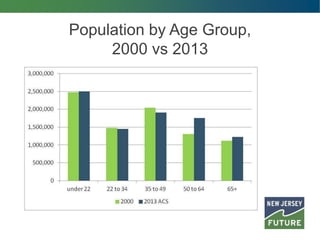
Population by Age Group,
2000 vs 2013
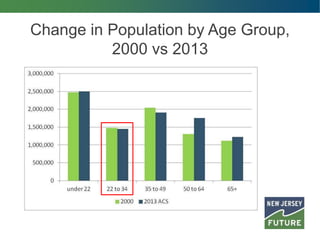
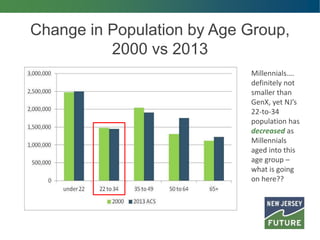
Change in Population by Age Group,
2000 vs 2013
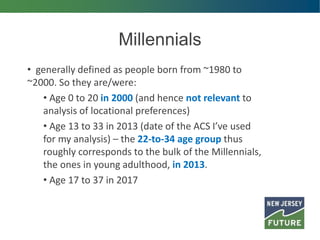
Millennials
• generally defined as people born from ~1980 to
~2000. So they are/were:
• Age 0 to 20 in 2000 (and hence not relevant to
analysis of locational preferences)
• Age 13 to 33 in 2013 (date of the ACS I’ve used
for my analysis) – the 22-to-34 age group thus
roughly corresponds to the bulk of the Millennials,
the ones in young adulthood, in 2013.
• Age 17 to 37 in 2017
Change in Population by Age Group,
2000 vs 2013
Millennials….
definitely not
smaller than
GenX, yet NJ’s
22-to-34
population has
decreased as
Millennials
aged into this
age group –
what is going
on here??
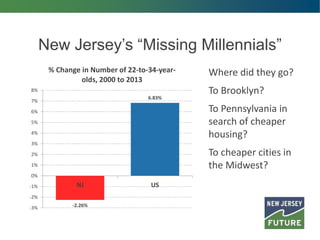
New Jersey’s “Missing Millennials”
-2.26%
6.83%
-3%
-2%
-1%
0%
1%
2%
3%
4%
5%
6%
7%
8%
NJ US
% Change in Number of 22-to-34-year-
olds, 2000 to 2013
Where did they go?
To Brooklyn?
To Pennsylvania in
search of cheaper
housing?
To cheaper cities in
the Midwest?
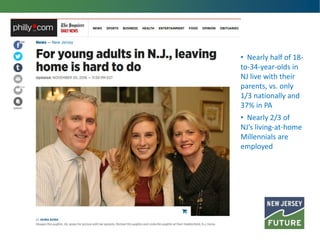
• Nearly half of 18-
to-34-year-olds in
NJ live with their
parents, vs. only
1/3 nationally and
37% in PA
• Nearly 2/3 of
NJ’s living-at-home
Millennials are
employed
NJ Millennials
What about the ones who have
stayed, and who can afford to move
out of their parents’ houses?
Where have they moved to?
Do Millennials really love cities?
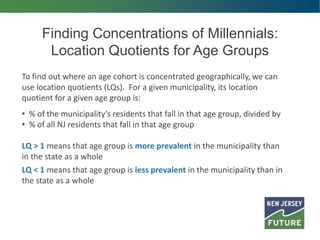
Finding Concentrations of Millennials:
Location Quotients for Age Groups
To find out where an age cohort is concentrated geographically, we can
use location quotients (LQs). For a given municipality, its location
quotient for a given age group is:
• % of the municipality’s residents that fall in that age group, divided by
• % of all NJ residents that fall in that age group
LQ > 1 means that age group is more prevalent in the municipality than
in the state as a whole
LQ < 1 means that age group is less prevalent in the municipality than in
the state as a whole
Finding Concentrations of Millennials:
Location Quotients for Age Groups
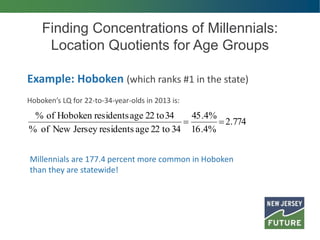
Example: Hoboken (which ranks #1 in the state)
Hoboken’s LQ for 22-to-34-year-olds in 2013 is:
774.2
%4.16
%4.45
34to22ageresidentsJerseyNewof%
34to22ageresidentsHobokenof%

Millennials are 177.4 percent more common in Hoboken
than they are statewide!
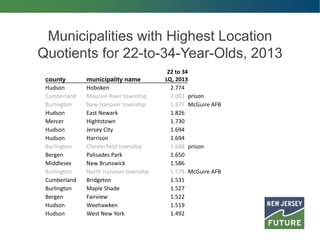
Municipalities with Highest Location
Quotients for 22-to-34-Year-Olds, 2013
county municipality name
22 to 34
LQ, 2013
Hudson Hoboken 2.774
Cumberland Maurice River township 2.003 prison
Burlington New Hanover township 1.877 McGuire AFB
Hudson East Newark 1.826
Mercer Hightstown 1.730
Hudson Jersey City 1.694
Hudson Harrison 1.694
Burlington Chesterfield township 1.688 prison
Bergen Palisades Park 1.650
Middlesex New Brunswick 1.586
Burlington North Hanover township 1.578 McGuire AFB
Cumberland Bridgeton 1.531
Burlington Maple Shade 1.527
Bergen Fairview 1.522
Hudson Weehawken 1.519
Hudson West New York 1.492
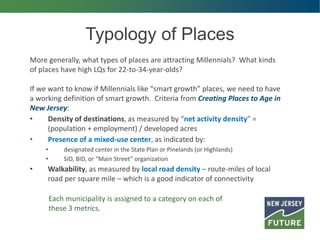
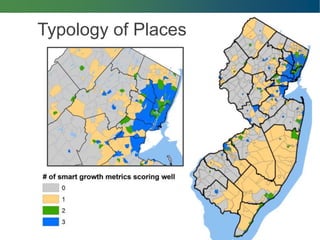
Typology of Places
More generally, what types of places are attracting Millennials? What kinds
of places have high LQs for 22-to-34-year-olds?
If we want to know if Millennials like “smart growth” places, we need to have
a working definition of smart growth. Criteria from Creating Places to Age in
New Jersey:
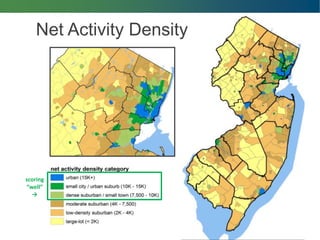
• Density of destinations, as measured by “net activity density” =
(population + employment) / developed acres
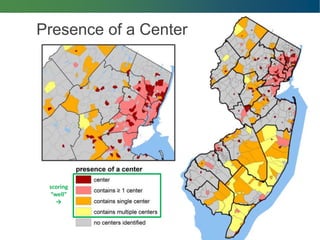
• Presence of a mixed-use center, as indicated by:
• designated center in the State Plan or Pinelands (or Highlands)
• SID, BID, or “Main Street” organization
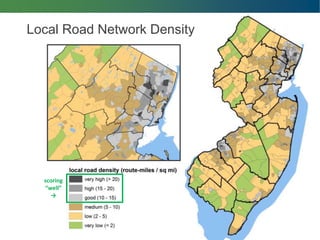
• Walkability, as measured by local road density – route-miles of local
road per square mile – which is a good indicator of connectivity
Each municipality is assigned to a category on each of
these 3 metrics.
scoring
“well”
→
Net Activity Density
scoring
“well”
→
Presence of a Center
scoring
“well”
→
Local Road Network Density
Typology of Places
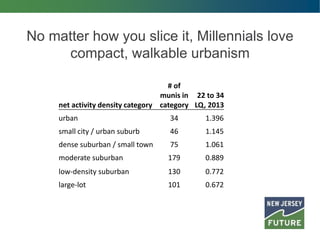
No matter how you slice it, Millennials love
compact, walkable urbanism
net activity density category
# of
munis in
category
22 to 34
LQ, 2013
urban 34 1.396
small city / urban suburb 46 1.145
dense suburban / small town 75 1.061
moderate suburban 179 0.889
low-density suburban 130 0.772
large-lot 101 0.672
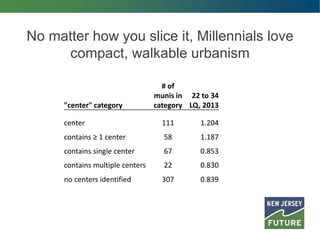
No matter how you slice it, Millennials love
compact, walkable urbanism
"center" category
# of
munis in
category
22 to 34
LQ, 2013
center 111 1.204
contains ≥ 1 center 58 1.187
contains single center 67 0.853
contains multiple centers 22 0.830
no centers identified 307 0.839
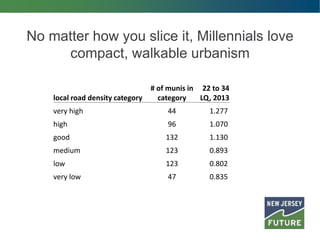
No matter how you slice it, Millennials love
compact, walkable urbanism
local road density category
# of munis in
category
22 to 34
LQ, 2013
very high 44 1.277
high 96 1.070
good 132 1.130
medium 123 0.893
low 123 0.802
very low 47 0.835
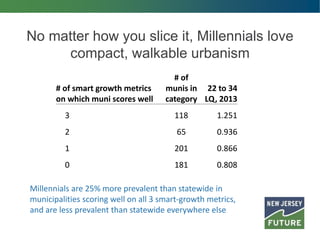
No matter how you slice it, Millennials love
compact, walkable urbanism
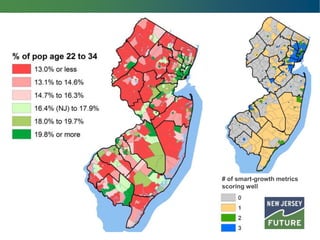
# of smart growth metrics
on which muni scores well
# of
munis in
category
22 to 34
LQ, 2013
3 118 1.251
2 65 0.936
1 201 0.866
0 181 0.808
Millennials are 25% more prevalent than statewide in
municipalities scoring well on all 3 smart-growth metrics,
and are less prevalent than statewide everywhere else
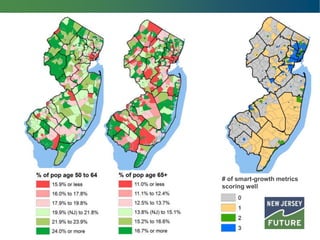
# of smart-growth metrics
scoring well
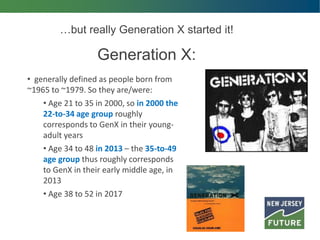
…but really Generation X started it!
Generation X:
• generally defined as people born from
~1965 to ~1979. So they are/were:
• Age 21 to 35 in 2000, so in 2000 the
22-to-34 age group roughly
corresponds to GenX in their young-
adult years
• Age 34 to 48 in 2013 – the 35-to-49
age group thus roughly corresponds
to GenX in their early middle age, in
2013
• Age 38 to 52 in 2017
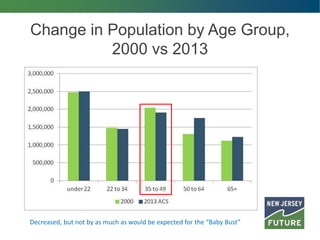
Change in Population by Age Group,
2000 vs 2013
Decreased, but not by as much as would be expected for the “Baby Bust”
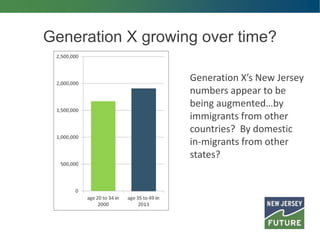
Generation X growing over time?
Generation X’s New Jersey
numbers appear to be
being augmented…by
immigrants from other
countries? By domestic
in-migrants from other
states?
…but really Generation X started it!
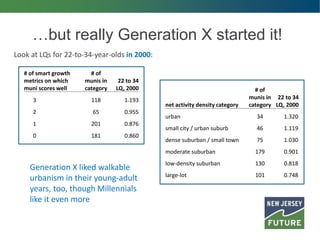
Look at LQs for 22-to-34-year-olds in 2000:
# of smart growth
metrics on which
muni scores well
# of
munis in
category
22 to 34
LQ, 2000
3 118 1.193
2 65 0.955
1 201 0.876
0 181 0.860
net activity density category
# of
munis in
category
22 to 34
LQ, 2000
urban 34 1.320
small city / urban suburb 46 1.119
dense suburban / small town 75 1.030
moderate suburban 179 0.901
low-density suburban 130 0.818
large-lot 101 0.748
Generation X liked walkable
urbanism in their young-adult
years, too, though Millennials
like it even more
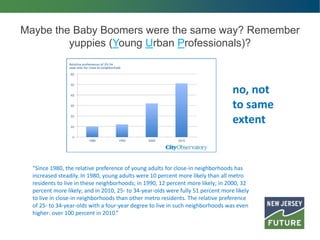
Maybe the Baby Boomers were the same way? Remember
yuppies (Young Urban Professionals)?
“Since 1980, the relative preference of young adults for close-in neighborhoods has
increased steadily. In 1980, young adults were 10 percent more likely than all metro
residents to live in these neighborhoods; in 1990, 12 percent more likely; in 2000, 32
percent more likely; and in 2010, 25- to 34-year-olds were fully 51 percent more likely
to live in close-in neighborhoods than other metro residents. The relative preference
of 25- to 34-year-olds with a four-year degree to live in such neighborhoods was even
higher: over 100 percent in 2010.”
no, not
to same
extent
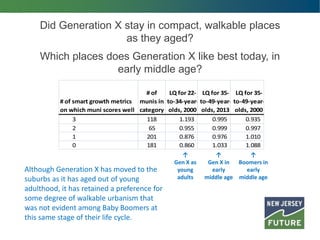
Did Generation X stay in compact, walkable places
as they aged?
Which places does Generation X like best today, in
early middle age?
Although Generation X has moved to the
suburbs as it has aged out of young
adulthood, it has retained a preference for
some degree of walkable urbanism that
was not evident among Baby Boomers at
this same stage of their life cycle.
# of smart growth metrics
on which muni scores well
# of
munis in
category
LQ for 22-
to-34-year-
olds, 2000
LQ for 35-
to-49-year-
olds, 2013
LQ for 35-
to-49-year-
olds, 2000
3 118 1.193 0.995 0.935
2 65 0.955 0.999 0.997
1 201 0.876 0.976 1.010
0 181 0.860 1.033 1.088
↑
Gen X as
young
adults
↑
Gen X in
early
middle age
↑
Boomers in
early
middle age
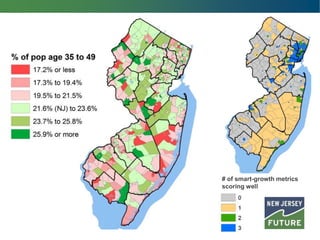
# of smart-growth metrics
scoring well
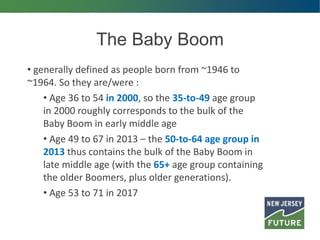
The Baby Boom
• generally defined as people born from ~1946 to
~1964. So they are/were :
• Age 36 to 54 in 2000, so the 35-to-49 age group
in 2000 roughly corresponds to the bulk of the
Baby Boom in early middle age
• Age 49 to 67 in 2013 – the 50-to-64 age group in
2013 thus contains the bulk of the Baby Boom in
late middle age (with the 65+ age group containing
the older Boomers, plus older generations).
• Age 53 to 71 in 2017
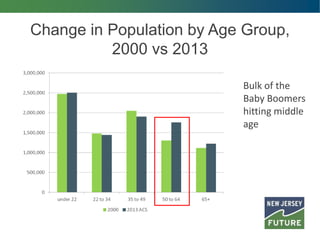
Change in Population by Age Group,
2000 vs 2013
Bulk of the
Baby Boomers
hitting middle
age
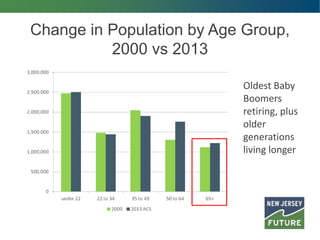
Change in Population by Age Group,
2000 vs 2013
Oldest Baby
Boomers
retiring, plus
older
generations
living longer
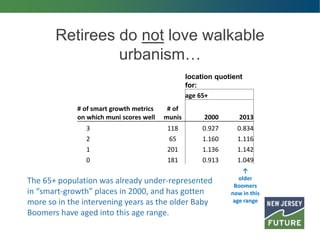
Retirees do not love walkable
urbanism…
location quotient
for:
age 65+
# of smart growth metrics
on which muni scores well
# of
munis 2000 2013
3 118 0.927 0.834
2 65 1.160 1.116
1 201 1.136 1.142
0 181 0.913 1.049
The 65+ population was already under-represented
in “smart-growth” places in 2000, and has gotten
more so in the intervening years as the older Baby
Boomers have aged into this age range.
↑
older
Boomers
now in this
age range
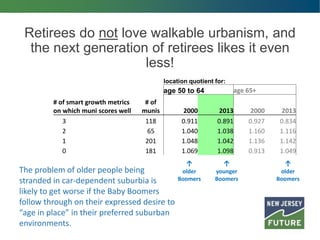
Retirees do not love walkable urbanism, and
the next generation of retirees likes it even
less!
location quotient for:
age 50 to 64 age 65+
# of smart growth metrics
on which muni scores well
# of
munis 2000 2013 2000 2013
3 118 0.911 0.891 0.927 0.834
2 65 1.040 1.038 1.160 1.116
1 201 1.048 1.042 1.136 1.142
0 181 1.069 1.098 0.913 1.049
The problem of older people being
stranded in car-dependent suburbia is
likely to get worse if the Baby Boomers
follow through on their expressed desire to
“age in place” in their preferred suburban
environments.
↑
older
Boomers
↑
older
Boomers
↑
younger
Boomers
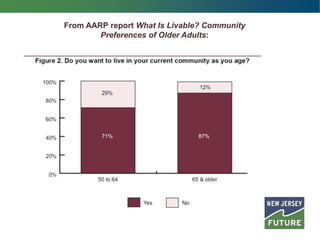
From AARP report What Is Livable? Community
Preferences of Older Adults:
# of smart-growth metrics
scoring well
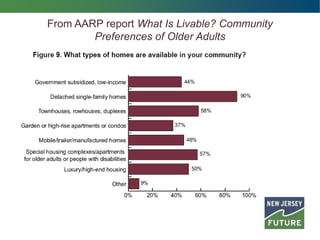
From AARP report What Is Livable? Community
Preferences of Older Adults
Building for New Demographic Realities
In places that already have “good bones”:
• Add to and diversify the housing stock
In places that score poorly:
• Create brand-new “downtowns” (e.g.
Robbinsville Town Center, Plainsboro)
• Retrofit existing single-use development to
make more mixed-use and pedestrian-friendly
(e.g. Willingboro, Echelon Mall, Somerdale)
Thank you!
Tim Evans
Research Director
tevans@njfuture.org
New Jersey Future
16 W. Lafayette St.
Trenton, NJ 08618
609-393-0008 ext. 103
http://www.njfuture.org

NJ Future Redevelopment Forum 2017 Evans

  • 1.
    Redefining Suburbs PartI: Understanding the Trends Tim Evans New Jersey Future Redevelopment Forum 2017 March 10, 2017
  • 2.
    New Jersey Futureis a nonprofit, nonpartisan organization that brings together concerned citizens and leaders to promote responsible land- use policies. The organization employs original research, analysis and advocacy to build coalitions and drive land-use policies that help revitalize cities and towns, protect natural lands and farms, provide more transportation choices beyond cars, expand access to safe and affordable neighborhoods and fuel a prosperous economy.
  • 3.
    Population by AgeGroup, 2000 vs 2013
  • 4.
    Change in Populationby Age Group, 2000 vs 2013
  • 5.
    Millennials • generally definedas people born from ~1980 to ~2000. So they are/were: • Age 0 to 20 in 2000 (and hence not relevant to analysis of locational preferences) • Age 13 to 33 in 2013 (date of the ACS I’ve used for my analysis) – the 22-to-34 age group thus roughly corresponds to the bulk of the Millennials, the ones in young adulthood, in 2013. • Age 17 to 37 in 2017
  • 6.
    Change in Populationby Age Group, 2000 vs 2013 Millennials…. definitely not smaller than GenX, yet NJ’s 22-to-34 population has decreased as Millennials aged into this age group – what is going on here??
  • 7.
    New Jersey’s “MissingMillennials” -2.26% 6.83% -3% -2% -1% 0% 1% 2% 3% 4% 5% 6% 7% 8% NJ US % Change in Number of 22-to-34-year- olds, 2000 to 2013 Where did they go? To Brooklyn? To Pennsylvania in search of cheaper housing? To cheaper cities in the Midwest?
  • 8.
    • Nearly halfof 18- to-34-year-olds in NJ live with their parents, vs. only 1/3 nationally and 37% in PA • Nearly 2/3 of NJ’s living-at-home Millennials are employed
  • 9.
    NJ Millennials What aboutthe ones who have stayed, and who can afford to move out of their parents’ houses? Where have they moved to? Do Millennials really love cities?
  • 10.
    Finding Concentrations ofMillennials: Location Quotients for Age Groups To find out where an age cohort is concentrated geographically, we can use location quotients (LQs). For a given municipality, its location quotient for a given age group is: • % of the municipality’s residents that fall in that age group, divided by • % of all NJ residents that fall in that age group LQ > 1 means that age group is more prevalent in the municipality than in the state as a whole LQ < 1 means that age group is less prevalent in the municipality than in the state as a whole
  • 11.
    Finding Concentrations ofMillennials: Location Quotients for Age Groups Example: Hoboken (which ranks #1 in the state) Hoboken’s LQ for 22-to-34-year-olds in 2013 is: 774.2 %4.16 %4.45 34to22ageresidentsJerseyNewof% 34to22ageresidentsHobokenof%  Millennials are 177.4 percent more common in Hoboken than they are statewide!
  • 12.
    Municipalities with HighestLocation Quotients for 22-to-34-Year-Olds, 2013 county municipality name 22 to 34 LQ, 2013 Hudson Hoboken 2.774 Cumberland Maurice River township 2.003 prison Burlington New Hanover township 1.877 McGuire AFB Hudson East Newark 1.826 Mercer Hightstown 1.730 Hudson Jersey City 1.694 Hudson Harrison 1.694 Burlington Chesterfield township 1.688 prison Bergen Palisades Park 1.650 Middlesex New Brunswick 1.586 Burlington North Hanover township 1.578 McGuire AFB Cumberland Bridgeton 1.531 Burlington Maple Shade 1.527 Bergen Fairview 1.522 Hudson Weehawken 1.519 Hudson West New York 1.492
  • 13.
    Typology of Places Moregenerally, what types of places are attracting Millennials? What kinds of places have high LQs for 22-to-34-year-olds? If we want to know if Millennials like “smart growth” places, we need to have a working definition of smart growth. Criteria from Creating Places to Age in New Jersey: • Density of destinations, as measured by “net activity density” = (population + employment) / developed acres • Presence of a mixed-use center, as indicated by: • designated center in the State Plan or Pinelands (or Highlands) • SID, BID, or “Main Street” organization • Walkability, as measured by local road density – route-miles of local road per square mile – which is a good indicator of connectivity Each municipality is assigned to a category on each of these 3 metrics.
  • 14.
  • 15.
  • 16.
  • 17.
  • 18.
    No matter howyou slice it, Millennials love compact, walkable urbanism net activity density category # of munis in category 22 to 34 LQ, 2013 urban 34 1.396 small city / urban suburb 46 1.145 dense suburban / small town 75 1.061 moderate suburban 179 0.889 low-density suburban 130 0.772 large-lot 101 0.672
  • 19.
    No matter howyou slice it, Millennials love compact, walkable urbanism "center" category # of munis in category 22 to 34 LQ, 2013 center 111 1.204 contains ≥ 1 center 58 1.187 contains single center 67 0.853 contains multiple centers 22 0.830 no centers identified 307 0.839
  • 20.
    No matter howyou slice it, Millennials love compact, walkable urbanism local road density category # of munis in category 22 to 34 LQ, 2013 very high 44 1.277 high 96 1.070 good 132 1.130 medium 123 0.893 low 123 0.802 very low 47 0.835
  • 21.
    No matter howyou slice it, Millennials love compact, walkable urbanism # of smart growth metrics on which muni scores well # of munis in category 22 to 34 LQ, 2013 3 118 1.251 2 65 0.936 1 201 0.866 0 181 0.808 Millennials are 25% more prevalent than statewide in municipalities scoring well on all 3 smart-growth metrics, and are less prevalent than statewide everywhere else
  • 22.
    # of smart-growthmetrics scoring well
  • 23.
    …but really GenerationX started it! Generation X: • generally defined as people born from ~1965 to ~1979. So they are/were: • Age 21 to 35 in 2000, so in 2000 the 22-to-34 age group roughly corresponds to GenX in their young- adult years • Age 34 to 48 in 2013 – the 35-to-49 age group thus roughly corresponds to GenX in their early middle age, in 2013 • Age 38 to 52 in 2017
  • 24.
    Change in Populationby Age Group, 2000 vs 2013 Decreased, but not by as much as would be expected for the “Baby Bust”
  • 25.
    Generation X growingover time? Generation X’s New Jersey numbers appear to be being augmented…by immigrants from other countries? By domestic in-migrants from other states?
  • 26.
    …but really GenerationX started it! Look at LQs for 22-to-34-year-olds in 2000: # of smart growth metrics on which muni scores well # of munis in category 22 to 34 LQ, 2000 3 118 1.193 2 65 0.955 1 201 0.876 0 181 0.860 net activity density category # of munis in category 22 to 34 LQ, 2000 urban 34 1.320 small city / urban suburb 46 1.119 dense suburban / small town 75 1.030 moderate suburban 179 0.901 low-density suburban 130 0.818 large-lot 101 0.748 Generation X liked walkable urbanism in their young-adult years, too, though Millennials like it even more
  • 27.
    Maybe the BabyBoomers were the same way? Remember yuppies (Young Urban Professionals)? “Since 1980, the relative preference of young adults for close-in neighborhoods has increased steadily. In 1980, young adults were 10 percent more likely than all metro residents to live in these neighborhoods; in 1990, 12 percent more likely; in 2000, 32 percent more likely; and in 2010, 25- to 34-year-olds were fully 51 percent more likely to live in close-in neighborhoods than other metro residents. The relative preference of 25- to 34-year-olds with a four-year degree to live in such neighborhoods was even higher: over 100 percent in 2010.” no, not to same extent
  • 28.
    Did Generation Xstay in compact, walkable places as they aged? Which places does Generation X like best today, in early middle age? Although Generation X has moved to the suburbs as it has aged out of young adulthood, it has retained a preference for some degree of walkable urbanism that was not evident among Baby Boomers at this same stage of their life cycle. # of smart growth metrics on which muni scores well # of munis in category LQ for 22- to-34-year- olds, 2000 LQ for 35- to-49-year- olds, 2013 LQ for 35- to-49-year- olds, 2000 3 118 1.193 0.995 0.935 2 65 0.955 0.999 0.997 1 201 0.876 0.976 1.010 0 181 0.860 1.033 1.088 ↑ Gen X as young adults ↑ Gen X in early middle age ↑ Boomers in early middle age
  • 29.
    # of smart-growthmetrics scoring well
  • 30.
    The Baby Boom •generally defined as people born from ~1946 to ~1964. So they are/were : • Age 36 to 54 in 2000, so the 35-to-49 age group in 2000 roughly corresponds to the bulk of the Baby Boom in early middle age • Age 49 to 67 in 2013 – the 50-to-64 age group in 2013 thus contains the bulk of the Baby Boom in late middle age (with the 65+ age group containing the older Boomers, plus older generations). • Age 53 to 71 in 2017
  • 31.
    Change in Populationby Age Group, 2000 vs 2013 Bulk of the Baby Boomers hitting middle age
  • 32.
    Change in Populationby Age Group, 2000 vs 2013 Oldest Baby Boomers retiring, plus older generations living longer
  • 33.
    Retirees do notlove walkable urbanism… location quotient for: age 65+ # of smart growth metrics on which muni scores well # of munis 2000 2013 3 118 0.927 0.834 2 65 1.160 1.116 1 201 1.136 1.142 0 181 0.913 1.049 The 65+ population was already under-represented in “smart-growth” places in 2000, and has gotten more so in the intervening years as the older Baby Boomers have aged into this age range. ↑ older Boomers now in this age range
  • 34.
    Retirees do notlove walkable urbanism, and the next generation of retirees likes it even less! location quotient for: age 50 to 64 age 65+ # of smart growth metrics on which muni scores well # of munis 2000 2013 2000 2013 3 118 0.911 0.891 0.927 0.834 2 65 1.040 1.038 1.160 1.116 1 201 1.048 1.042 1.136 1.142 0 181 1.069 1.098 0.913 1.049 The problem of older people being stranded in car-dependent suburbia is likely to get worse if the Baby Boomers follow through on their expressed desire to “age in place” in their preferred suburban environments. ↑ older Boomers ↑ older Boomers ↑ younger Boomers
  • 35.
    From AARP reportWhat Is Livable? Community Preferences of Older Adults:
  • 36.
    # of smart-growthmetrics scoring well
  • 37.
    From AARP reportWhat Is Livable? Community Preferences of Older Adults
  • 38.
    Building for NewDemographic Realities In places that already have “good bones”: • Add to and diversify the housing stock In places that score poorly: • Create brand-new “downtowns” (e.g. Robbinsville Town Center, Plainsboro) • Retrofit existing single-use development to make more mixed-use and pedestrian-friendly (e.g. Willingboro, Echelon Mall, Somerdale)
  • 39.
    Thank you! Tim Evans ResearchDirector tevans@njfuture.org New Jersey Future 16 W. Lafayette St. Trenton, NJ 08618 609-393-0008 ext. 103 http://www.njfuture.org