From Proof of Concept
to Patent:
The Nitty Gritty About the
Patenting Process
Types of Intellectual Property
• Patents
- Inventions:
*Processes/Methods
*Machines/Devices
• Copyrights
- Expressions of Ideas:
*Writings
*Music
*Art Works
Types of Intellectual Property
• Trademarks
- Source indicators
• Trade Secrets
- Confidential information that has economic
value:
*Formulas
*Customer lists
*Manufacturing processes
®
®
Patents
.
Patents: Practical Inventions
Patentable Subject Matter Includes…
• “Anything under the sun that is made by man”
• Excludes laws of nature, physical phenomena, abstract
ideas
• Statutory classes: process, machine, manufacture,
composition of matter
– Compositions, devices, techniques, new
combinations, software, new uses of an old thing
Terminology
• 1-year grace period:
– U.S. has a 1-year grace period from first public disclosure
of invention to file patent application
– NO GRACE PERIOD in foreign countries  must file
BEFORE publish.
• Provisional application: Never examined, never issues into
patent.
– Automatically expires after 12 months (consider research
timeline)
– Minimal formality requirements for filing
Terminology
• Non-Provisional: Full blown patent application, will be examined,
and may issue into a patent
• PCT: Patent Cooperation Treaty – international non-provisional –
“filed” in 148 countries
– Examined, but never issues into a patent unless proceed to
national stage.
• National stage/phase: individual
filings for patents in each country
of interest – based upon the
PCT application.
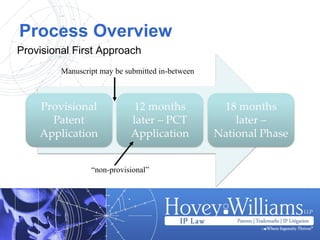
Process Overview
Provisional First Approach
“non-provisional”
Manuscript may be submitted in-between
Process Overview
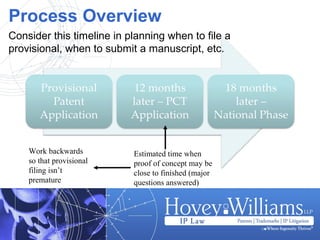
Consider this timeline in planning when to file a
provisional, when to submit a manuscript, etc.
Estimated time when
proof of concept may be
close to finished (major
questions answered)
Work backwards
so that provisional
filing isn’t
premature
How to disclose?
Invention Disclosure Form
-Submitted to Tech Transfer Office or Appropriate Division of Company
-Important to meet with Tech Transfer early in process – keep apprised of
manuscript deadlines, etc.
-Important to document invention development.
-Company or University Policy may require employees or faculty to
submit all IP for consideration
The Invention Disclosure
• What to disclose?
• Identification of full scope of invention
• Explore metes & bounds
• Explore alternative or non-optimized versions
• Any proposed manuscripts should be included with disclosure
form
• Materials and methods for any working examples – very
important
• How to disclose?
– In writing most preferred, e.g., manuscripts, grant applications
– Oral interview – expand on concepts contained in written
document
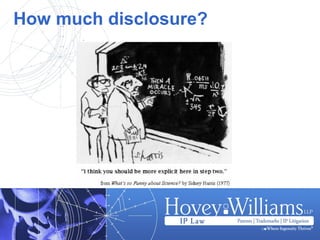
How much disclosure?
Disclosure considerations
• Patent application disclosure must enable one skilled in the art to
practice the invention without undue additional experimentation
– “show your work”
– Best mode must be disclosed
• Patent application must adequately describe the invention
(sufficient species to claim a genus)
• Once the application is filed there is virtually no possibility to
add to it or update it*
* Added material is considered “new matter” and gets a new filing
date.
• Important that disclosure/application is as comprehensive as
possible.
Disclosure considerations
• Patent application will and should be more comprehensive
than your manuscript (the patent attorney will help with
this)
• Patent application should be submitted BEFORE your
manuscript, poster presentation, etc.
Disclosure considerations
Road Trip - Hitting the Slopes!
•The Manuscript Approach
• Why go to the mountains?
• How do we get there?
• I-70 is East/West Highway to Colorado
• We suspected that driving I-70 west, we’d eventually run
into mountains
• Report results—after driving west for 500 miles, we
encountered mountains
• Future investigation – alternate routes to the mountains
• The Grant Application Approach
– We’ve driven I-70 west and reached mountains
– Problems with this approach – boring, not enough
places to stop
– We suspect there are better routes, but need funding
to investigate (Dodge City route?)
Disclosure considerations
• The Patent Application Approach
– Go North on I-135 for 1.5 miles, take the exit to West
I-70 for approximately 530 miles
– Providing directions to achieve an outcome
– Provide alternative directions, not just your preferred
route (back highways through Dodge City)
– Disclosure should enable others to also reach the
mountains
Disclosure considerations
The Drawings
• Drawings helpful to understanding the
invention
• PCT drawing quality issues:
• Must be black & white – avoid colored lines!
• Amenable to reproduction
• Original, editable files preferable
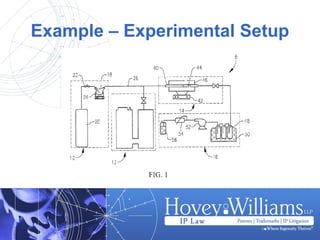
Example – Experimental Setup
How do I know if my invention is
patentable?
• Ask Tech Transfer or Patent Attorney
• The patent act defines what is patentable:
– Whoever invents or discovers any new and useful process,
machine, manufacture, or composition of the matter, or any new
and useful improvement thereof, may obtain a patent therefore,
subject to the conditions and requirements of this title. (35 USC §
101)
– The remaining fundamental requirements are that the invention
be novel and non-obvious.
Basic Requirements for Protection
• Novel: loosely means that the invention is new
and is non identical to the previous work of
others. (35 USC § 102)
• Non-obvious: means that the invention must
not be an obvious extension of what has gone
before. (35 USC § 103)
- Obviousness is measured by what one of
ordinary skill in the subject area of the patent
would have known at the time of the invention.
America Invents Act
• The AIA significantly encourages early (and
often) filing of patent applications
• U.S. patent laws are now based on “first-
inventor-to-file” rather than “first-to-invent”
America Invents Act
• File patent applications before any public
disclosure, use, presentation, commercial
activity, etc. involving the invention
– Limited “grace period” still available
– Use Non-Disclosure Agreements consistently, but do not
rely on NDAs to fully protect invention
– Inter-institutional inventions: Use written joint
development agreements with confidentiality provisions
and publication restrictions
America Invents Act
• Invention Disclosure forms and streamlined
protocol for submitting and evaluating
inventions becomes even more important
under the AIA
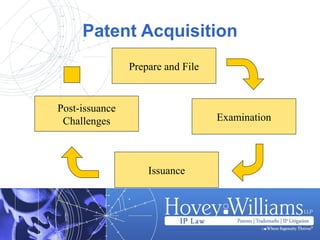
Patent Acquisition
. Prepare and File
Post-issuance
Challenges Examination
Issuance
Examination process
• Patent examiner will do a search based upon the application
claims to see if there is any “prior art” related to the invention
– Claims describe the metes and bounds of protection
– “A method of…” “A composition comprising…”
– Claimed invention must be: new, non-obvious as compared to
one or more prior art references located by Examiner.
• Examiner issues an “Office Action” – patent attorney will
have a back and forth exchange with the Examiner regarding
the prior art and the claims.
– Inventor input can be helpful – “person skilled in the art”
– Often Examiner is misinterpreting the claims, the prior art, or
both
Common Patent Misconceptions
• A patent gives the right to use or make the
invention.
• Patented products are better than unpatented
products.
• If I find a new use for an old product, I can get a
patent on the product.
ThankYou!
Crissa A. Seymour Cook
HoveyWilliams LLP
84 CorporateWoods
10801 Mastin Blvd., Suite 1000
Overland Park, KS 66210
913.647.9050
www.hoveywilliams.com

NittyGritty

  • 1.
    From Proof ofConcept to Patent: The Nitty Gritty About the Patenting Process
  • 2.
    Types of IntellectualProperty • Patents - Inventions: *Processes/Methods *Machines/Devices • Copyrights - Expressions of Ideas: *Writings *Music *Art Works
  • 3.
    Types of IntellectualProperty • Trademarks - Source indicators • Trade Secrets - Confidential information that has economic value: *Formulas *Customer lists *Manufacturing processes ® ®
  • 4.
  • 5.
    Patents: Practical Inventions PatentableSubject Matter Includes… • “Anything under the sun that is made by man” • Excludes laws of nature, physical phenomena, abstract ideas • Statutory classes: process, machine, manufacture, composition of matter – Compositions, devices, techniques, new combinations, software, new uses of an old thing
  • 6.
    Terminology • 1-year graceperiod: – U.S. has a 1-year grace period from first public disclosure of invention to file patent application – NO GRACE PERIOD in foreign countries  must file BEFORE publish. • Provisional application: Never examined, never issues into patent. – Automatically expires after 12 months (consider research timeline) – Minimal formality requirements for filing
  • 7.
    Terminology • Non-Provisional: Fullblown patent application, will be examined, and may issue into a patent • PCT: Patent Cooperation Treaty – international non-provisional – “filed” in 148 countries – Examined, but never issues into a patent unless proceed to national stage. • National stage/phase: individual filings for patents in each country of interest – based upon the PCT application.
  • 8.
    Process Overview Provisional FirstApproach “non-provisional” Manuscript may be submitted in-between
  • 9.
    Process Overview Consider thistimeline in planning when to file a provisional, when to submit a manuscript, etc. Estimated time when proof of concept may be close to finished (major questions answered) Work backwards so that provisional filing isn’t premature
  • 10.
    How to disclose? InventionDisclosure Form -Submitted to Tech Transfer Office or Appropriate Division of Company -Important to meet with Tech Transfer early in process – keep apprised of manuscript deadlines, etc. -Important to document invention development. -Company or University Policy may require employees or faculty to submit all IP for consideration
  • 11.
    The Invention Disclosure •What to disclose? • Identification of full scope of invention • Explore metes & bounds • Explore alternative or non-optimized versions • Any proposed manuscripts should be included with disclosure form • Materials and methods for any working examples – very important • How to disclose? – In writing most preferred, e.g., manuscripts, grant applications – Oral interview – expand on concepts contained in written document
  • 12.
  • 13.
    Disclosure considerations • Patentapplication disclosure must enable one skilled in the art to practice the invention without undue additional experimentation – “show your work” – Best mode must be disclosed • Patent application must adequately describe the invention (sufficient species to claim a genus) • Once the application is filed there is virtually no possibility to add to it or update it* * Added material is considered “new matter” and gets a new filing date. • Important that disclosure/application is as comprehensive as possible.
  • 14.
    Disclosure considerations • Patentapplication will and should be more comprehensive than your manuscript (the patent attorney will help with this) • Patent application should be submitted BEFORE your manuscript, poster presentation, etc.
  • 15.
    Disclosure considerations Road Trip- Hitting the Slopes! •The Manuscript Approach • Why go to the mountains? • How do we get there? • I-70 is East/West Highway to Colorado • We suspected that driving I-70 west, we’d eventually run into mountains • Report results—after driving west for 500 miles, we encountered mountains • Future investigation – alternate routes to the mountains
  • 16.
    • The GrantApplication Approach – We’ve driven I-70 west and reached mountains – Problems with this approach – boring, not enough places to stop – We suspect there are better routes, but need funding to investigate (Dodge City route?) Disclosure considerations
  • 17.
    • The PatentApplication Approach – Go North on I-135 for 1.5 miles, take the exit to West I-70 for approximately 530 miles – Providing directions to achieve an outcome – Provide alternative directions, not just your preferred route (back highways through Dodge City) – Disclosure should enable others to also reach the mountains Disclosure considerations
  • 18.
    The Drawings • Drawingshelpful to understanding the invention • PCT drawing quality issues: • Must be black & white – avoid colored lines! • Amenable to reproduction • Original, editable files preferable
  • 19.
  • 20.
    How do Iknow if my invention is patentable? • Ask Tech Transfer or Patent Attorney • The patent act defines what is patentable: – Whoever invents or discovers any new and useful process, machine, manufacture, or composition of the matter, or any new and useful improvement thereof, may obtain a patent therefore, subject to the conditions and requirements of this title. (35 USC § 101) – The remaining fundamental requirements are that the invention be novel and non-obvious.
  • 21.
    Basic Requirements forProtection • Novel: loosely means that the invention is new and is non identical to the previous work of others. (35 USC § 102) • Non-obvious: means that the invention must not be an obvious extension of what has gone before. (35 USC § 103) - Obviousness is measured by what one of ordinary skill in the subject area of the patent would have known at the time of the invention.
  • 22.
    America Invents Act •The AIA significantly encourages early (and often) filing of patent applications • U.S. patent laws are now based on “first- inventor-to-file” rather than “first-to-invent”
  • 23.
    America Invents Act •File patent applications before any public disclosure, use, presentation, commercial activity, etc. involving the invention – Limited “grace period” still available – Use Non-Disclosure Agreements consistently, but do not rely on NDAs to fully protect invention – Inter-institutional inventions: Use written joint development agreements with confidentiality provisions and publication restrictions
  • 24.
    America Invents Act •Invention Disclosure forms and streamlined protocol for submitting and evaluating inventions becomes even more important under the AIA
  • 25.
    Patent Acquisition . Prepareand File Post-issuance Challenges Examination Issuance
  • 26.
    Examination process • Patentexaminer will do a search based upon the application claims to see if there is any “prior art” related to the invention – Claims describe the metes and bounds of protection – “A method of…” “A composition comprising…” – Claimed invention must be: new, non-obvious as compared to one or more prior art references located by Examiner. • Examiner issues an “Office Action” – patent attorney will have a back and forth exchange with the Examiner regarding the prior art and the claims. – Inventor input can be helpful – “person skilled in the art” – Often Examiner is misinterpreting the claims, the prior art, or both
  • 27.
    Common Patent Misconceptions •A patent gives the right to use or make the invention. • Patented products are better than unpatented products. • If I find a new use for an old product, I can get a patent on the product.
  • 28.
    ThankYou! Crissa A. SeymourCook HoveyWilliams LLP 84 CorporateWoods 10801 Mastin Blvd., Suite 1000 Overland Park, KS 66210 913.647.9050 www.hoveywilliams.com

Editor's Notes

  • #6 Quote from Chakrabarty
  • #20 Experimental set up depicted in Fig. 1 May be flow charts