Practical Strategies for Managing Patent Rights
After the America Invents Act (AIA)
Marcus Simon
Partner, Patent Prosecution Group
Dorsey & Whitney LLP
Salt Lake City Office
June 23, 2014
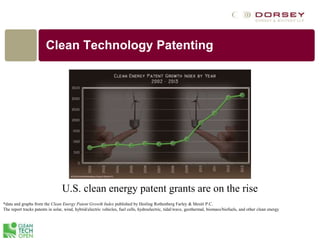
Clean Technology Patenting
*data and graphs from the Clean Energy Patent Growth Index published by Hesling Rothenberg Farley & Mesiti P.C.
The report tracks patents in solar, wind, hybrid/electric vehicles, fuel cells, hydroelectric, tidal/wave, geothermal, biomass/biofuels, and other clean energy
U.S. clean energy patent grants are on the rise
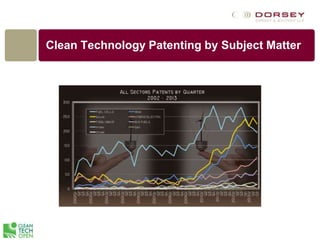
Clean Technology Patenting by Subject Matter
Overview
• Patent Basics
• The America Invents Act (AIA)
• Patent Strategy
Patent Basics: What is a Patent?
• Complete description of an invention, followed by
“claims”
• Claims: The claims define in words the inventive
technology owned by the patent holder
• Rights: Patents provide the right to exclude others
from making, using, selling, or importing the claimed
invention into the United States – a patent does not
confer a right to use invention
• Term: of 20 years from filing (not counting various
patent and regulatory extensions)
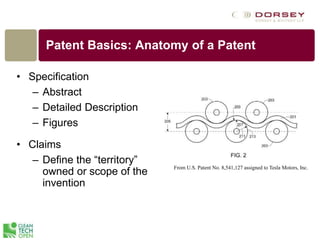
Patent Basics: Anatomy of a Patent
• Specification
– Abstract
– Detailed Description
– Figures
• Claims
– Define the “territory”
owned or scope of the
invention
From U.S. Patent No. 8,541,127 assigned to Tesla Motors, Inc.
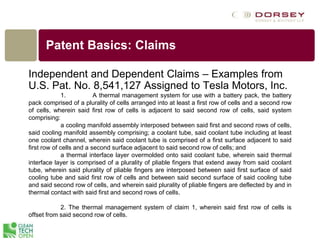
Patent Basics: Claims
Independent and Dependent Claims – Examples from
U.S. Pat. No. 8,541,127 Assigned to Tesla Motors, Inc.
1. A thermal management system for use with a battery pack, the battery
pack comprised of a plurality of cells arranged into at least a first row of cells and a second row
of cells, wherein said first row of cells is adjacent to said second row of cells, said system
comprising:
a cooling manifold assembly interposed between said first and second rows of cells,
said cooling manifold assembly comprising; a coolant tube, said coolant tube including at least
one coolant channel, wherein said coolant tube is comprised of a first surface adjacent to said
first row of cells and a second surface adjacent to said second row of cells; and
a thermal interface layer overmolded onto said coolant tube, wherein said thermal
interface layer is comprised of a plurality of pliable fingers that extend away from said coolant
tube, wherein said plurality of pliable fingers are interposed between said first surface of said
cooling tube and said first row of cells and between said second surface of said cooling tube
and said second row of cells, and wherein said plurality of pliable fingers are deflected by and in
thermal contact with said first and second rows of cells.
2. The thermal management system of claim 1, wherein said first row of cells is
offset from said second row of cells.
Types of Patents: Technologies
Patentable Subject Matter: Any “new and useful process, machine,
manufacture, or composition of matter”
• Mechanical Inventions – turbines, wind power, hydropower, electric
vehicles, fueling stations, modular housing
• Electrical Inventions (hardware, software) – solar cells, fuel cells,
batteries, power distribution control, network architecture for power
management, LEDs
• Chemistry-Related Inventions and Biotechnology – biodegradable
materials, polymers made from recycled pollutants, light-weight
composites, high-temperature materials for more efficient combustion
technologies, cement alternatives, insulation materials
• Methods or processes for any of the above-types of Inventions –
methods of use, methods of making, etc.
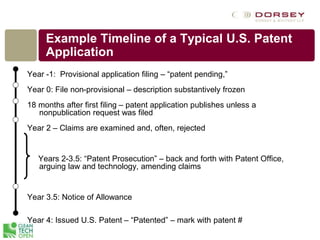
Example Timeline of a Typical U.S. Patent
Application
Year -1: Provisional application filing – “patent pending,”
Year 0: File non-provisional – description substantively frozen
18 months after first filing – patent application publishes unless a
nonpublication request was filed
Year 2 – Claims are examined and, often, rejected
Years 2-3.5: “Patent Prosecution” – back and forth with Patent Office,
arguing law and technology, amending claims
Year 3.5: Notice of Allowance
Year 4: Issued U.S. Patent – “Patented” – mark with patent #
Additional Patent Requirements:
Duty of Disclosure
• Duty of Disclosure
– Must disclose anything material to patentability
– Applies to everyone involved with the prosecution of a
patent application – including non-inventors
– No duty to search
– Related cases, prior sales, publications, other
prior art
• Consequences: Failure to comply can render patent
(and even related patents) unenforceable
Additional Patent Requirements: Proper
Inventorship
• Inventor = One who makes an inventive contribution to at least
one of the claims (i.e., conceived of an essential element of the
claimed invention)
• AN INVENTOR IS NOT:
– Someone who uses routine skill in the art to implement
another’s idea
– Someone who explains how the invention works
– Someone who invented subject matter that is not claimed
– analogous to publication authorship
• Consequences: Incorrect inventorship can render patent
unenforceable, but corrections possible for good faith mistakes
Additional Requirements: Records
• Why are records important?
– Can be used to establish date of invention
– Can be used to establish inventorship
– Document “Conception” and “Reduction to practice” (old
law) and “Derivation” (new law)
• Recording Research and & Development
– Bound books or verifiable electronic records
– At start of project, describe the goals
– Have a non-inventor review, understand, and witness pages
of your notebook
America Invents Act – Main Provisions
• First inventor to file
• Prioritized examination
• Micro-entity status
• Ways to challenge patents
– Prior art submission
– Post-grant review
– Inter partes review
– Supplemental examination
America Invents Act (AIA)
• First Inventor to File (effective March 16, 2013)
– Priority given to first filed patent application
• Prioritized Examination (effective September 26,
2011)
– Patent Office will target final disposition in 12 months
– Limited number of claims (4 independent, 30 total)
• Opposition Period (effective September 16, 2012)
– Within 9 months of a patent grant, a party may challenge
claims in a patent by Petition to the Patent Office
– Must demonstrate it is more likely than not the petitioner will
prevail on at least one claim
First Inventor to File
(effective March 16, 2013)
• Previous Law – First to Invent
– Can show that one was first to invent, not first to file a
patent application
• America Invents Act
– The first patent applicant to file a patent application
has the rights
• No longer first patent applicant to invent
– Inventor’s one-year grace period remains
– May argue earlier filer derived the invention from you
• Consequence: Race to the patent office
16
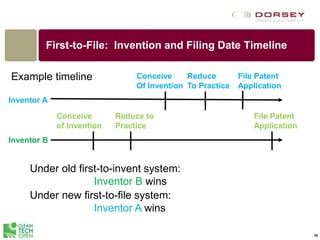
First-to-File: Invention and Filing Date Timeline
Example timeline
Under old first-to-invent system:
Inventor B wins
Conceive
Of Invention
Reduce
To Practice
File Patent
Application
Conceive
of Invention
Reduce to
Practice
File Patent
Application
Under new first-to-file system:
Inventor A wins
Inventor B
Inventor A
17
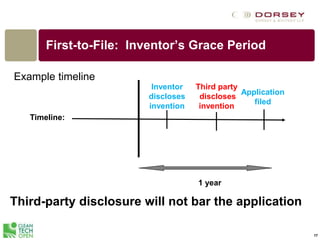
First-to-File: Inventor’s Grace Period
Example timeline
Third-party disclosure will not bar the application
Timeline:
Inventor
discloses
invention
Application
filed
1 year
Third party
discloses
invention
18
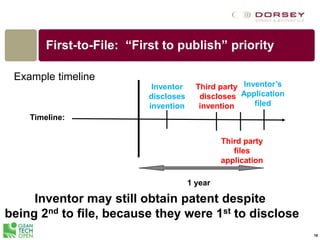
First-to-File: “First to publish” priority
Example timeline
Inventor may still obtain patent despite
being 2nd to file, because they were 1st to disclose
Timeline:
Inventor
discloses
invention
Inventor’s
Application
filed
1 year
Third party
discloses
invention
Third party
files
application
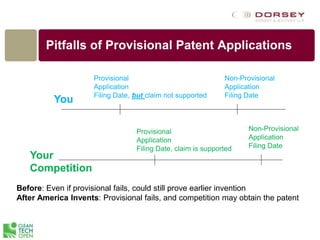
Pitfalls of Provisional Patent Applications
You
Your
Competition
Provisional
Application
Filing Date, but claim not supported
Before: Even if provisional fails, could still prove earlier invention
After America Invents: Provisional fails, and competition may obtain the patent
Non-Provisional
Application
Filing Date
Provisional
Application
Filing Date, claim is supported
Non-Provisional
Application
Filing Date
Track I Prioritized Examination
• Patent Office Goal: final disposition in 12 months
– Application is picked-up for examination very quickly
by the Patent Office
• Claim Limit: maximum 30 claims, 4 independent
• Prosecution: Costs incurred earlier – It’s expensive
$2,000 for a small entity
• Program limited to 10,000 per fiscal year
21
Micro-Entity Status
• Establishes micro-entity status:
– For small entities and universities that:
• filed less than 4 applications in the prior year; and
• had a gross income of less than 3 times the median household
income in the prior year (less than $153,051); or
– Inventors employed by, or obligated to assign/license
to, institution of higher education – beware of
assignments to tech transfer offices that are not
institutes of higher education
– Micro-entity applicants receive a 75% reduction in
application costs
– Current small entity status: 50% reduction
Third Parties: How to Mess with other people’s
patents
• Preissuance Submission of Prior Art by Third Party
• Post-Grant Review
• Inter Partes Review (replacing inter partes re-exam)
Third Party Prior Art Submission
• Submitting patents or other printed materials to the Examiner of
competitor’s patent applications
• Submit before the Examiner allows application or, if application
has not been allowed, before a first rejection and before
application has been published for 6 months
– Third party can describe why the materials are relevant
 Strategic Issues
Monitor published patent applications
Big Potential Liability: Could strengthen competitor’s patent,
so only use if you would not consider challenging the patent
later in court based on same prior art
Post-Grant Review (PGR)
• Challenge a patent during the nine months following the patent
grants
• Basis: any ground for invalidity (broader than existing
reexamination)
• Standard: preponderance of evidence (“more likely than not”)
to initiate and to prevail
• Estoppel: precluded from using same art, or other known
references, in district court action
• PGR may only be filed against patents issuing with priority
dates later than March 15, 2013
Post-Grant Review – continued
• Proceeding is conducted by the Patent Trial and
Appeal Board
• Final determination must be given within 1 year of
institution of proceedings (can be extended by 6
months for good cause shown)
 Strategic Concerns: Can be quicker, and cheaper
than litigating, but can preclude your ability to litigate
later!
Post-Issuance: Inter Partes Review (IPR)
• Available 9 months after issuance or after
termination of post-grant review
• The 3rd party also participates
• Basis: only novelty and non-obviousness
• Standard: to initiate – reasonable likelihood of
prevailing (slightly lower threshold than PGR); to
prevail – preponderance of evidence
• Estoppel: precluded from using same art, or other
known references, in district court action
26
27
Supplemental Examination Process –
effective Sept. 16, 2012
• Patentee may request the patent office consider or
correct information that may be relevant to the patent
• Patent Office will order re-examination if a substantial
new question of patentability is identified
• Cannot be used if an infringement suit is already
underway
 Strategic Considerations
Can “cure” your own questionable patents
Information considered during supplemental
examination cannot be used later in court for an
unenforceability claim
Patent Strategy: Developing a Cohesive Approach
• Business Goals
– What is the Market?
– Competitors?
• Develop a long-term patent strategy
– Protect current and future product developments
– Patents protecting current R&D trajectory
– Patents protecting new products
• Freedom to Practice – Does the product, component of the
product, or performance of a process infringe a third party
patent?
• In-license Patent Portfolios
Patent Strategy: General Guides for First-to-File
• Consider Competitive Strategy Early
– Define your market
– Define your competitors
• File Patent Applications Early – Before public disclosure even though
there is still a grace period
– Use of provisional applications as an integral component of the
overall strategy
– Cover IP through multiple filings over time
– Claim invention in a variety of ways
• File Patent Applications Fully – Support the claimed subject matter
• Monitor new technological developments/directions of competitors
Patent Strategy: Goals of a Robust Patent Portfolio
• Enforcement – prevent a third party from practicing
– Monitor marketplace for competitors; notify & pursue
• Support licensing and business negotiations
– Exclusive or non-exclusive licensees
– Geographic areas
– Patent pooling, patent ‘warfare’, patent sales
• Freedom to Practice
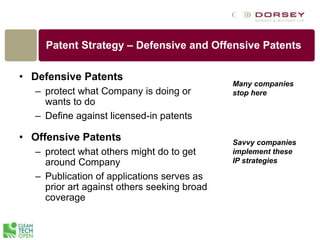
Patent Strategy – Defensive and Offensive Patents
• Defensive Patents
– protect what Company is doing or
wants to do
– Define against licensed-in patents
• Offensive Patents
– protect what others might do to get
around Company
– Publication of applications serves as
prior art against others seeking broad
coverage
Many companies
stop here
Savvy companies
implement these
IP strategies
32
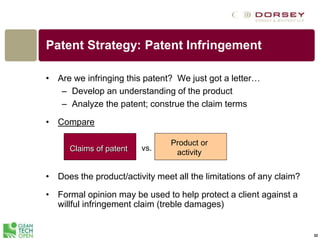
Patent Strategy: Patent Infringement
• Are we infringing this patent? We just got a letter…
– Develop an understanding of the product
– Analyze the patent; construe the claim terms
• Compare
• Does the product/activity meet all the limitations of any claim?
• Formal opinion may be used to help protect a client against a
willful infringement claim (treble damages)
Claims of patent vs.
Product or
activity
33
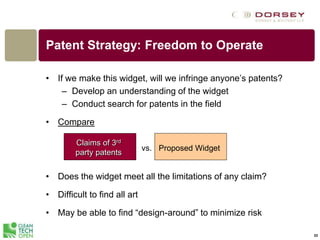
Patent Strategy: Freedom to Operate
• If we make this widget, will we infringe anyone’s patents?
– Develop an understanding of the widget
– Conduct search for patents in the field
• Compare
• Does the widget meet all the limitations of any claim?
• Difficult to find all art
• May be able to find “design-around” to minimize risk
Claims of 3rd
party patents
vs. Proposed Widget
• Consider your patent strategy before you disclose
technology!!
• After public disclosure, have 1 year to file (in the U.S.)
• Public disclosure defeats most foreign patent rights
– Includes sales, offers for sale
– Can include trade shows, marketing materials, posters,
websites or demos
 Institute an Internal Patent Review
Patent Strategy: Timing of Filing
Thank You! Questions
Marcus S. Simon
Partner, U.S. Patent Attorney
Patent Group Head – SLC Office
Dorsey & Whitney LLP
136 South Main Street, Suite 1000
Salt Lake City, Utah 84101
Phone: (801) 933-7360
simon.marcus@dorsey.com

CTO-Patent-Pres

  • 1.
    Practical Strategies forManaging Patent Rights After the America Invents Act (AIA) Marcus Simon Partner, Patent Prosecution Group Dorsey & Whitney LLP Salt Lake City Office June 23, 2014
  • 2.
    Clean Technology Patenting *dataand graphs from the Clean Energy Patent Growth Index published by Hesling Rothenberg Farley & Mesiti P.C. The report tracks patents in solar, wind, hybrid/electric vehicles, fuel cells, hydroelectric, tidal/wave, geothermal, biomass/biofuels, and other clean energy U.S. clean energy patent grants are on the rise
  • 3.
    Clean Technology Patentingby Subject Matter
  • 4.
    Overview • Patent Basics •The America Invents Act (AIA) • Patent Strategy
  • 5.
    Patent Basics: Whatis a Patent? • Complete description of an invention, followed by “claims” • Claims: The claims define in words the inventive technology owned by the patent holder • Rights: Patents provide the right to exclude others from making, using, selling, or importing the claimed invention into the United States – a patent does not confer a right to use invention • Term: of 20 years from filing (not counting various patent and regulatory extensions)
  • 6.
    Patent Basics: Anatomyof a Patent • Specification – Abstract – Detailed Description – Figures • Claims – Define the “territory” owned or scope of the invention From U.S. Patent No. 8,541,127 assigned to Tesla Motors, Inc.
  • 7.
    Patent Basics: Claims Independentand Dependent Claims – Examples from U.S. Pat. No. 8,541,127 Assigned to Tesla Motors, Inc. 1. A thermal management system for use with a battery pack, the battery pack comprised of a plurality of cells arranged into at least a first row of cells and a second row of cells, wherein said first row of cells is adjacent to said second row of cells, said system comprising: a cooling manifold assembly interposed between said first and second rows of cells, said cooling manifold assembly comprising; a coolant tube, said coolant tube including at least one coolant channel, wherein said coolant tube is comprised of a first surface adjacent to said first row of cells and a second surface adjacent to said second row of cells; and a thermal interface layer overmolded onto said coolant tube, wherein said thermal interface layer is comprised of a plurality of pliable fingers that extend away from said coolant tube, wherein said plurality of pliable fingers are interposed between said first surface of said cooling tube and said first row of cells and between said second surface of said cooling tube and said second row of cells, and wherein said plurality of pliable fingers are deflected by and in thermal contact with said first and second rows of cells. 2. The thermal management system of claim 1, wherein said first row of cells is offset from said second row of cells.
  • 8.
    Types of Patents:Technologies Patentable Subject Matter: Any “new and useful process, machine, manufacture, or composition of matter” • Mechanical Inventions – turbines, wind power, hydropower, electric vehicles, fueling stations, modular housing • Electrical Inventions (hardware, software) – solar cells, fuel cells, batteries, power distribution control, network architecture for power management, LEDs • Chemistry-Related Inventions and Biotechnology – biodegradable materials, polymers made from recycled pollutants, light-weight composites, high-temperature materials for more efficient combustion technologies, cement alternatives, insulation materials • Methods or processes for any of the above-types of Inventions – methods of use, methods of making, etc.
  • 9.
    Example Timeline ofa Typical U.S. Patent Application Year -1: Provisional application filing – “patent pending,” Year 0: File non-provisional – description substantively frozen 18 months after first filing – patent application publishes unless a nonpublication request was filed Year 2 – Claims are examined and, often, rejected Years 2-3.5: “Patent Prosecution” – back and forth with Patent Office, arguing law and technology, amending claims Year 3.5: Notice of Allowance Year 4: Issued U.S. Patent – “Patented” – mark with patent #
  • 10.
    Additional Patent Requirements: Dutyof Disclosure • Duty of Disclosure – Must disclose anything material to patentability – Applies to everyone involved with the prosecution of a patent application – including non-inventors – No duty to search – Related cases, prior sales, publications, other prior art • Consequences: Failure to comply can render patent (and even related patents) unenforceable
  • 11.
    Additional Patent Requirements:Proper Inventorship • Inventor = One who makes an inventive contribution to at least one of the claims (i.e., conceived of an essential element of the claimed invention) • AN INVENTOR IS NOT: – Someone who uses routine skill in the art to implement another’s idea – Someone who explains how the invention works – Someone who invented subject matter that is not claimed – analogous to publication authorship • Consequences: Incorrect inventorship can render patent unenforceable, but corrections possible for good faith mistakes
  • 12.
    Additional Requirements: Records •Why are records important? – Can be used to establish date of invention – Can be used to establish inventorship – Document “Conception” and “Reduction to practice” (old law) and “Derivation” (new law) • Recording Research and & Development – Bound books or verifiable electronic records – At start of project, describe the goals – Have a non-inventor review, understand, and witness pages of your notebook
  • 13.
    America Invents Act– Main Provisions • First inventor to file • Prioritized examination • Micro-entity status • Ways to challenge patents – Prior art submission – Post-grant review – Inter partes review – Supplemental examination
  • 14.
    America Invents Act(AIA) • First Inventor to File (effective March 16, 2013) – Priority given to first filed patent application • Prioritized Examination (effective September 26, 2011) – Patent Office will target final disposition in 12 months – Limited number of claims (4 independent, 30 total) • Opposition Period (effective September 16, 2012) – Within 9 months of a patent grant, a party may challenge claims in a patent by Petition to the Patent Office – Must demonstrate it is more likely than not the petitioner will prevail on at least one claim
  • 15.
    First Inventor toFile (effective March 16, 2013) • Previous Law – First to Invent – Can show that one was first to invent, not first to file a patent application • America Invents Act – The first patent applicant to file a patent application has the rights • No longer first patent applicant to invent – Inventor’s one-year grace period remains – May argue earlier filer derived the invention from you • Consequence: Race to the patent office
  • 16.
    16 First-to-File: Invention andFiling Date Timeline Example timeline Under old first-to-invent system: Inventor B wins Conceive Of Invention Reduce To Practice File Patent Application Conceive of Invention Reduce to Practice File Patent Application Under new first-to-file system: Inventor A wins Inventor B Inventor A
  • 17.
    17 First-to-File: Inventor’s GracePeriod Example timeline Third-party disclosure will not bar the application Timeline: Inventor discloses invention Application filed 1 year Third party discloses invention
  • 18.
    18 First-to-File: “First topublish” priority Example timeline Inventor may still obtain patent despite being 2nd to file, because they were 1st to disclose Timeline: Inventor discloses invention Inventor’s Application filed 1 year Third party discloses invention Third party files application
  • 19.
    Pitfalls of ProvisionalPatent Applications You Your Competition Provisional Application Filing Date, but claim not supported Before: Even if provisional fails, could still prove earlier invention After America Invents: Provisional fails, and competition may obtain the patent Non-Provisional Application Filing Date Provisional Application Filing Date, claim is supported Non-Provisional Application Filing Date
  • 20.
    Track I PrioritizedExamination • Patent Office Goal: final disposition in 12 months – Application is picked-up for examination very quickly by the Patent Office • Claim Limit: maximum 30 claims, 4 independent • Prosecution: Costs incurred earlier – It’s expensive $2,000 for a small entity • Program limited to 10,000 per fiscal year
  • 21.
    21 Micro-Entity Status • Establishesmicro-entity status: – For small entities and universities that: • filed less than 4 applications in the prior year; and • had a gross income of less than 3 times the median household income in the prior year (less than $153,051); or – Inventors employed by, or obligated to assign/license to, institution of higher education – beware of assignments to tech transfer offices that are not institutes of higher education – Micro-entity applicants receive a 75% reduction in application costs – Current small entity status: 50% reduction
  • 22.
    Third Parties: Howto Mess with other people’s patents • Preissuance Submission of Prior Art by Third Party • Post-Grant Review • Inter Partes Review (replacing inter partes re-exam)
  • 23.
    Third Party PriorArt Submission • Submitting patents or other printed materials to the Examiner of competitor’s patent applications • Submit before the Examiner allows application or, if application has not been allowed, before a first rejection and before application has been published for 6 months – Third party can describe why the materials are relevant  Strategic Issues Monitor published patent applications Big Potential Liability: Could strengthen competitor’s patent, so only use if you would not consider challenging the patent later in court based on same prior art
  • 24.
    Post-Grant Review (PGR) •Challenge a patent during the nine months following the patent grants • Basis: any ground for invalidity (broader than existing reexamination) • Standard: preponderance of evidence (“more likely than not”) to initiate and to prevail • Estoppel: precluded from using same art, or other known references, in district court action • PGR may only be filed against patents issuing with priority dates later than March 15, 2013
  • 25.
    Post-Grant Review –continued • Proceeding is conducted by the Patent Trial and Appeal Board • Final determination must be given within 1 year of institution of proceedings (can be extended by 6 months for good cause shown)  Strategic Concerns: Can be quicker, and cheaper than litigating, but can preclude your ability to litigate later!
  • 26.
    Post-Issuance: Inter PartesReview (IPR) • Available 9 months after issuance or after termination of post-grant review • The 3rd party also participates • Basis: only novelty and non-obviousness • Standard: to initiate – reasonable likelihood of prevailing (slightly lower threshold than PGR); to prevail – preponderance of evidence • Estoppel: precluded from using same art, or other known references, in district court action 26
  • 27.
    27 Supplemental Examination Process– effective Sept. 16, 2012 • Patentee may request the patent office consider or correct information that may be relevant to the patent • Patent Office will order re-examination if a substantial new question of patentability is identified • Cannot be used if an infringement suit is already underway  Strategic Considerations Can “cure” your own questionable patents Information considered during supplemental examination cannot be used later in court for an unenforceability claim
  • 28.
    Patent Strategy: Developinga Cohesive Approach • Business Goals – What is the Market? – Competitors? • Develop a long-term patent strategy – Protect current and future product developments – Patents protecting current R&D trajectory – Patents protecting new products • Freedom to Practice – Does the product, component of the product, or performance of a process infringe a third party patent? • In-license Patent Portfolios
  • 29.
    Patent Strategy: GeneralGuides for First-to-File • Consider Competitive Strategy Early – Define your market – Define your competitors • File Patent Applications Early – Before public disclosure even though there is still a grace period – Use of provisional applications as an integral component of the overall strategy – Cover IP through multiple filings over time – Claim invention in a variety of ways • File Patent Applications Fully – Support the claimed subject matter • Monitor new technological developments/directions of competitors
  • 30.
    Patent Strategy: Goalsof a Robust Patent Portfolio • Enforcement – prevent a third party from practicing – Monitor marketplace for competitors; notify & pursue • Support licensing and business negotiations – Exclusive or non-exclusive licensees – Geographic areas – Patent pooling, patent ‘warfare’, patent sales • Freedom to Practice
  • 31.
    Patent Strategy –Defensive and Offensive Patents • Defensive Patents – protect what Company is doing or wants to do – Define against licensed-in patents • Offensive Patents – protect what others might do to get around Company – Publication of applications serves as prior art against others seeking broad coverage Many companies stop here Savvy companies implement these IP strategies
  • 32.
    32 Patent Strategy: PatentInfringement • Are we infringing this patent? We just got a letter… – Develop an understanding of the product – Analyze the patent; construe the claim terms • Compare • Does the product/activity meet all the limitations of any claim? • Formal opinion may be used to help protect a client against a willful infringement claim (treble damages) Claims of patent vs. Product or activity
  • 33.
    33 Patent Strategy: Freedomto Operate • If we make this widget, will we infringe anyone’s patents? – Develop an understanding of the widget – Conduct search for patents in the field • Compare • Does the widget meet all the limitations of any claim? • Difficult to find all art • May be able to find “design-around” to minimize risk Claims of 3rd party patents vs. Proposed Widget
  • 34.
    • Consider yourpatent strategy before you disclose technology!! • After public disclosure, have 1 year to file (in the U.S.) • Public disclosure defeats most foreign patent rights – Includes sales, offers for sale – Can include trade shows, marketing materials, posters, websites or demos  Institute an Internal Patent Review Patent Strategy: Timing of Filing
  • 35.
    Thank You! Questions MarcusS. Simon Partner, U.S. Patent Attorney Patent Group Head – SLC Office Dorsey & Whitney LLP 136 South Main Street, Suite 1000 Salt Lake City, Utah 84101 Phone: (801) 933-7360 simon.marcus@dorsey.com