Intellectual Property concepts
and filing process
Dr Rendy Tan
24 Feb 2014
Agenda
• Basic Intellectual Property concepts
• What/how to protect
• Timeline
• Invention disclosure form
What is Intellectual Property
(IP) and its importance?
• Creation of the mind
• Why do we want to protect?
– Right to exclude others from practicing your
invention
– Freedom to operate (in case of future
commercialization activities)
– For research collaborations etc.
How are patents obtained?
• Novel
• Inventive
• Industrially Applicable
Industry vs Academia
• Industry
– Is there any IP?
– Cost

• Academia
– Publishable
research
– Performance

– Safety

– Safety

– Performance

– Cost
Types of patents (cont’d)
• Electronics
– Modules of a system
– Features of the system
– Functions of the system
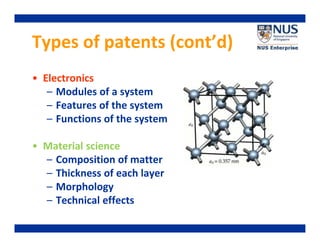
• Material science
– Composition of matter
– Thickness of each layer
– Morphology
– Technical effects
Types of patents
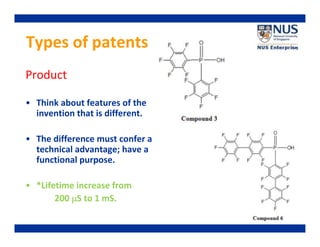
Product
• Think about features of the
invention that is different.
• The difference must confer a
technical advantage; have a
functional purpose.
• *Lifetime increase from
200 µS to 1 mS.
Types of patent (cont’d)
Method of production
• Steps of producing a
product, material etc.
• The steps must produce a
technical effect.
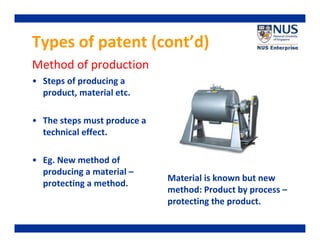
• Eg. New method of
producing a material –
protecting a method.

Material is known but new
method: Product by process –
protecting the product.
Some questions
• What does it take for the industry to adopt my
technology?
• Is my material safe?
• Performance under extreme temperatures?
• Is my process scalable?
• Does my product/process provide any cost
advantage?
Invention Disclosure Form
• Different parts:
- Field of invention :
• Generalize what your invention is about.
• Is it a product or a process or both.

- Summary of the invention :
- Highlight the problems in this field.
- What has been done before and their outcomes.
- Briefly state what your invention is and how it can solve
the problems differently.
- Advantages of your invention.

- Brief description of the drawings:
• What do the diagrams mean?
Invention Disclosure Form
(cont’d)
• Different parts:
- Detailed Description:
- What is the invention – step by step in full details.
- How is your invention different from the prior art.
- Alternative embodiments: think broadly –
- Product – What other groups can I have on the
molecule?
- Process – Can I use a different solvent? Can I replace a
step with another? If so, what are the consequences?
Invention Disclosure Form (cont’d)
• Different parts:
- What problems does the invention solve and what
are the advantages over existing products and/or
method:
- What problem does your invention address?
- Cost, performance advantages
- By how what magnitude

- Industrial applications:
- Can your invention be used in other areas?

- Limitations and competing ways to solve the same
problems:
- Disadvantages of your invention.
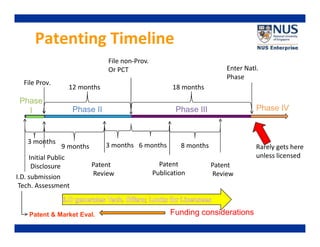
Patenting Timeline
File non-Prov.
Or PCT
File Prov.

12 months

Phase
I

3 months

Enter Natl.
Phase
18 months

Phase II

3 months 6 months

9 months

Initial Public
Disclosure
I.D. submission
Tech. Assessment

Patent
Review

Patent & Market Eval.

Phase IV

Phase III

8 months

Patent
Publication

Rarely gets here
unless licensed
Patent
Review

Funding considerations
Information for NUS inventions
• http://ilo.nus.edu.sg/
• http://ilo.nus.edu.sg/forresearchers/disclosing-an-invention/
• ilobox3@nus.edu.sg
Strategy
• OODA framework for IP strategy
• Observe – Know the landscape
– Think: How does your invention fit in a bigger system,
module? Where is the industry heading? Does your
invention really solve a problem?

• Orientate – Know your research (where it
stands in the industry)
– Think: What are the steps required to put your
invention to work? Can your invention be applied
elsewhere?
Strategy (cont’d)
• OODA framework for IP strategy
• Decide – Make decisions (to further develop or
to protect now; how/what to protect)
– Think: How much more time do I need to get more
results? What are my future research plans? Should I
publish now?

• Act – Take the necessary actions
– Talk to us!
Concluding remarks
• Do not publish until a patent application has
been filed ……
Can be novelty destroying!
• Once patent application filed, the invention is
patent pending BUT …….
Do establish a non-disclosure agreement
when discussing with external parties!
Key takeaways
• Filing of patents create a win-win situation for
both academia and industry
• Patent filed then publish!
• Strategize! OODA framework.
Thank You

Intellectual Property Concepts and Filing Process at the National University of Singapore

  • 1.
    Intellectual Property concepts andfiling process Dr Rendy Tan 24 Feb 2014
  • 2.
    Agenda • Basic IntellectualProperty concepts • What/how to protect • Timeline • Invention disclosure form
  • 3.
    What is IntellectualProperty (IP) and its importance? • Creation of the mind • Why do we want to protect? – Right to exclude others from practicing your invention – Freedom to operate (in case of future commercialization activities) – For research collaborations etc.
  • 4.
    How are patentsobtained? • Novel • Inventive • Industrially Applicable
  • 5.
    Industry vs Academia •Industry – Is there any IP? – Cost • Academia – Publishable research – Performance – Safety – Safety – Performance – Cost
  • 6.
    Types of patents(cont’d) • Electronics – Modules of a system – Features of the system – Functions of the system • Material science – Composition of matter – Thickness of each layer – Morphology – Technical effects
  • 7.
    Types of patents Product •Think about features of the invention that is different. • The difference must confer a technical advantage; have a functional purpose. • *Lifetime increase from 200 µS to 1 mS.
  • 8.
    Types of patent(cont’d) Method of production • Steps of producing a product, material etc. • The steps must produce a technical effect. • Eg. New method of producing a material – protecting a method. Material is known but new method: Product by process – protecting the product.
  • 9.
    Some questions • Whatdoes it take for the industry to adopt my technology? • Is my material safe? • Performance under extreme temperatures? • Is my process scalable? • Does my product/process provide any cost advantage?
  • 10.
    Invention Disclosure Form •Different parts: - Field of invention : • Generalize what your invention is about. • Is it a product or a process or both. - Summary of the invention : - Highlight the problems in this field. - What has been done before and their outcomes. - Briefly state what your invention is and how it can solve the problems differently. - Advantages of your invention. - Brief description of the drawings: • What do the diagrams mean?
  • 11.
    Invention Disclosure Form (cont’d) •Different parts: - Detailed Description: - What is the invention – step by step in full details. - How is your invention different from the prior art. - Alternative embodiments: think broadly – - Product – What other groups can I have on the molecule? - Process – Can I use a different solvent? Can I replace a step with another? If so, what are the consequences?
  • 12.
    Invention Disclosure Form(cont’d) • Different parts: - What problems does the invention solve and what are the advantages over existing products and/or method: - What problem does your invention address? - Cost, performance advantages - By how what magnitude - Industrial applications: - Can your invention be used in other areas? - Limitations and competing ways to solve the same problems: - Disadvantages of your invention.
  • 13.
    Patenting Timeline File non-Prov. OrPCT File Prov. 12 months Phase I 3 months Enter Natl. Phase 18 months Phase II 3 months 6 months 9 months Initial Public Disclosure I.D. submission Tech. Assessment Patent Review Patent & Market Eval. Phase IV Phase III 8 months Patent Publication Rarely gets here unless licensed Patent Review Funding considerations
  • 14.
    Information for NUSinventions • http://ilo.nus.edu.sg/ • http://ilo.nus.edu.sg/forresearchers/disclosing-an-invention/ • ilobox3@nus.edu.sg
  • 15.
    Strategy • OODA frameworkfor IP strategy • Observe – Know the landscape – Think: How does your invention fit in a bigger system, module? Where is the industry heading? Does your invention really solve a problem? • Orientate – Know your research (where it stands in the industry) – Think: What are the steps required to put your invention to work? Can your invention be applied elsewhere?
  • 16.
    Strategy (cont’d) • OODAframework for IP strategy • Decide – Make decisions (to further develop or to protect now; how/what to protect) – Think: How much more time do I need to get more results? What are my future research plans? Should I publish now? • Act – Take the necessary actions – Talk to us!
  • 17.
    Concluding remarks • Donot publish until a patent application has been filed …… Can be novelty destroying! • Once patent application filed, the invention is patent pending BUT ……. Do establish a non-disclosure agreement when discussing with external parties!
  • 18.
    Key takeaways • Filingof patents create a win-win situation for both academia and industry • Patent filed then publish! • Strategize! OODA framework.
  • 19.