ANALYTICAL METHOD DEVELOPMENT AND VALIDATION OF THE CONTENT
ESTIMATION OF GENOTOXIC IMPURITIES OF N-NITROSODIMETHYLAMINE,
N-NITROSODIETHYLAMINE AND N-NITROSODIISOPROPYLAMINE IN
RIFAPENTINE IN BULK AND ITS DOSAGE FORMS
PROJECT REPORT
Submitted for the partial fulfillment
for the award of degree of
BACHELOR OF PHARMACY
FRANKLIN SYLVESTER C (188021601011)
JAWITH SAHUL A (188021601018)
MOHAMMED MEERAN MASTHAN K (188021601035)
RIZWANA PARVEEN N (188021601043)
SWETHA S (188021601054)
Under the supervision of
Dr. Y. Ismail M. Pharm., Ph.D.
Associate Professor
Crescent School of Pharmacy
INTRODUCTION
GENOTOXIC
IMPURITIES
henomenon
ability of an
s to destruct the
of a cell .
ame of the
destruction
c material of the
e loss of
g to cancer,
defects
3
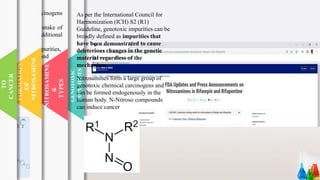
As per the International Council for
Harmonization (ICH) S2 (R1)
Guideline, genotoxic impurities can be
broadly defined as impurities that
have been demonstrated to cause
deleterious changes in the genetic
material regardless of the
mechanism.
Nitrosamines form a large group of
genotoxic chemical carcinogens and
can be formed endogenously in the
human body. N-Nitroso compounds
can induce cancer
NITROSAMINE
&
TYPES
bable human carcinogens
7(R1), a lifetime intake of
e less than one additional
line as Class 1 impurities,
t carcinogenicity and
FORMATION
OF
NITROSAMINE
TO
CANCER
PROBLEM STATEMENT
PROBLEM STATEMENT
The pharmaceutical industry is under intense pressure to increase productivity and release new drugs into the
market. Analytical chemists are challenged to find faster ways of delivering quality data across a range of
project needs. Rifapentine is a drug indicated for the treatment of tuberculosis. Rifapentine can be used by
adults and children of 12 years age for the treatment of active pulmonary tuberculosis (TB) caused by
Mycobacterium tuberculosis. On September 2020, Food and Drug Administration announced nitrosamine
impurities in certain samples of Rifapentine due to contamination of unacceptable level of the N-nitrosamine
analogue impurities like N-nitrosodimethylamine (NDMA), N-nitrosodiethylamine (NDEA) and
N-nitrosodiisopropylamine (NDIPA), These N-nitrosamine Impurities are under organic compounds with
genotoxic, carcinogenic and mutagenic activity. In general, they can be found in the natural environment, food
and water, as well as in industrial manufacturing during drug processing. In Industry, it is deducted that
N-nitrosamine is formed because of the reaction between sodium nitrite or another nitrosating agent and the
presence of amine groups in their substances.
Due to the likely danger to the human body, limit set for nitrosamine in Rifapentine were regulated and the
FDA established at interim limit where by acceptable intake of N-nitrosamine in Rifapentine is 0.3 ppm. There
is a need for the development of analytical method and validation for the detection and quantification of
N-nitrosamine impurities in Rifapentine is of great interest. Hence, the research work embodied in this project
work is to develop an analytical method and validation for the content estimation of N-nitrosamine impurities
in Rifapentine in bulk and its dosage forms.
5
DRUG PROFILE
DRUG PROFILE
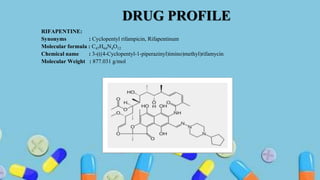
RIFAPENTINE:
Synonyms : Cyclopentyl rifampicin, Rifapentinum
Molecular formula : C47H64N4O12
Chemical name : 3-(((4-Cyclopentyl-1-piperazinyl)imino)methyl)rifamycin
Molecular Weight : 877.031 g/mol
Figure 1: Structure of Rifapentine
Description:
Rifapentine is a rifamycin antibiotic that is similar in structure and activity to rifampin and rifabutin and that is used in
combination with other agents as therapy of tuberculosis, particularly in once or twice weekly regimens.
Rifapentine is a long-acting, cyclopentyl-substituted derivative of rifamycin used to treat mycobacterium
infections.Rifapentine is a N-alkylpiperazine, a N-iminopiperazine and a member of rifamycins.
It has a role as an antitubercular agent and a leprostatic drug.
Solubility:
Freely soluble in chloroform and dimethyl sulfoxide; soluble in ethyl acetate, methanol, tetrahydrofuran; slightly soluble in
acetone, water, carbon tetrachloride.
Category:
Anti-Bacterial Agents , Anti-Infective Agents, Antibiotics, Anti-tubercular, Anti-infectives for Systemic Use , Anti-
mycobacterials, Cytochrome P-450 CYP2B6 Inducers, Cytochrome P-450 CYP2B6 Inducers (strength unknown),
Cytochrome P-450 CYP2C19 Inducers, Cytochrome P-450 CYP2C19 Inducers (strong).
8
Possible Impurities:
1-cyclopentyl-4-nitrosopiperazine (CPNP) (CAS 61379-66-6).
Indication:
Rifapentine is indicated in adults and children 12 years and older for the treatment of active pulmonary
tuberculosis (TB) caused by Mycobacterium tuberculosis.
Rifapentine must always be used in combination with one or more anti-tuberculosis (anti-TB) drugs to which
the isolate is susceptible.
Brand: Priftin
Available dosage forms: Tablets, Injectable powder.
Recommended dosage: Tablet – 150mg, 300mg
Injectable powder – 600mg
Uses:
For the treatment of pulmonary tuberculosis caused by Mycobacterium tuberculosis in combination with 1 or more
anti-tuberculosis drugs.
9
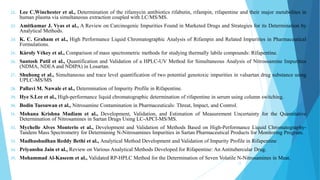
LITERATURE REVIEW
LITERATURE REVIEW
1. Khaja Moinuddin Shaik et al., Research on Regulatory Updates and Analytical Methodologies for Nitrosamine Impurities Detection in
Sartans, Ranitidine, Nizatidine, and Metformin along with Sample Preparation Techniques
2. Maria Kristina Parr et al., Research on NDMA Impurity in Valsartan and other Pharmaceutical Products: Analytical Methods for the
Determination of N-Nitrosamines
3. Sebastian Schmidtsdorf et al., Analytical life cycle management for comprehensive and universal nitrosamine analysis in various
pharmaceutical formulations by supercritical fluid chromatography
4. Claudia Giménez-Campillo et al., Development of a new methodology for the determination of N-5 nitrosamines impurities in ranitidine
pharmaceuticals using 6 microextraction and gas chromatography-mass spectrometry
5. Jie Liu et al., Development of a sensitive and stable GC-MS/MS method for simultaneous determination of four
N-nitrosamine genotoxic impurities insartan substances.
6. Mikhail Khorolskiy et al., Development and Validation of four Nitrosamine Impurities Determination Method in Medicines of Valsartan,
Losartan, and Irbesartan with HPLC-MS/MS (APCI)
7. Sayaka Masada et al., Rapid and efficient high-performance liquid chromatography analysis of N-nitrosodimethylamine impurity in
valsartan drug substance and its products.
8. Pornchai Rojsitthisak et al., Development of a Sensitive Headspace Gas Chromatography−Mass Spectrometry Method for the
Simultaneous Determination of Nitrosamines in Losartan Active Pharmaceutical Ingredients
9. Fahad S. Aldawsari et al., HS-SPME-GC-MS as an alternative method for NDMA analysis in ranitidine products
10. Hassan Y. Aboul-Enein et al., Determination of Potential Genotoxic Impurity, 5-Amino-2-Chloropyridine, in Active Pharmaceutical
Ingredient Using the HPLC-UV System
11. Jinjian Zheng et al., A Full Evaporation Static Headspace Gas Chromatography Method with Nitrogen Phosphorous Detection for
Ultrasensitive Analysis of Semi-volatile Nitrosamines in Pharmaceutical Products.
12. R.Gonzalez et al., Development of an analytical method for the determination and quantification of N-
nitrosodimethylamine in olmesartan by HPLC-MS/MS
13. Farzad Malihi et al., An improved analytical method for quantitation of nitrosamine impurities in ophthalmic solutions using
liquid chromatography with tandem mass spectrometry.
14. Sebastian Schmidtsdorff et al., Simultaneous detection of nitrosamines and other sartan-related impurities in active
pharmaceutical ingredients by supercritical fluid chromatography
15. Krista L.Dobo et al., Practical and Science-Based Strategy for Establishing Acceptable Intakes for Drug Product N-
Nitrosamine Impurities.
16. Minju Lee et al., Analysis of Nnitrosamines and other nitro(so) compounds in water by high-performance liquid
chromatography with post-column UV photolysis/Griess reaction
17. Kartheek Srinivas Chidella et al., Ultra-Sensitive LC-MS/MS Method for the Trace Level Quantification of Six Potential
Genotoxic Nitrosamine Impurities in Telmisartan.
18. Yuyuan Chen et al., Development and Validation of LC-MS/MS for Analyzing Potential Genotoxic Impurities in Pantoprazole
Starting Materials.
19. Qing Lv et al., High resolution GC–Orbitrap MS for nitrosamines analysis: Method performance, exploration of solid phase
extraction regularity, and screening of children’s products.
20. Ho-Sang Shin et al., High resolution GC–Orbitrap MS for nitrosamines analysis: Method performance, exploration of solid
phase extraction regularity, and screening of children’s products
21. Scott W. Roberts et al., N-Nitrosamine Impurity Control Strategies in the Pharmaceutical and Biotechnology Industries.
12
22. Lee C.Winchester et al., Determination of the rifamycin antibiotics rifabutin, rifampin, rifapentine and their major metabolites in
human plasma via simultaneous extraction coupled with LC/MS/MS.
23. Amitkumar J. Vyas et al., A Review on Carcinogenic Impurities Found in Marketed Drugs and Strategies for its Determination by
Analytical Methods.
24. K. C. Graham et al., High Performance Liquid Chromatographic Analysis of Rifampin and Related Impurities in Pharmaceutical
Formulations.
25. Kàroly Vékey et al., Comparison of mass spectrometric methods for studying thermally labile compounds: Rifapentine.
26. Santosh Patil et al., Quantification and Validation of a HPLC-UV Method for Simultaneous Analysis of Nitrosoamine Impurities
(NDMA, NDEA and NDIPA) in Losartan.
27. Shuhong et al., Simultaneous and trace level quantification of two potential genotoxic impurities in valsartan drug substance using
UPLC-MS/MS
28. Pallavi M. Nawale et al., Determination of Impurity Profile in Rifapentine.
29. Hye S.Lee et al., High-performance liquid chromatographic determination of rifapentine in serum using column switching.
30. Bodin Tuesuwan et al., Nitrosamine Contamination in Pharmaceuticals: Threat, Impact, and Control.
31. Mohana Krishna Mudiam et al., Development, Validation, and Estimation of Measurement Uncertainty for the Quantitative
Determination of Nitrosamines in Sartan Drugs Using LC-APCI-MS/MS.
32. Mychelle Alves Monterio et al., Development and Validation of Methods Based on High-Performance Liquid Chromatography-
Tandem Mass Spectrometry for Determining N-Nitrosamines Impurities in Sartan Pharmaceutical Products for Monitoring Program.
33. Madhushudhan Reddy Bethi et al., Analytical Method Development and Validation of Impurity Profile in Rifapentine
34. Priyanshu Jain et al., Review on Various Analytical Methods Developed for Rifapentine: An Antitubercular Drug.
35. Mohammad Al-Kaseem et al., Validated RP-HPLC Method for the Determination of Seven Volatile N-Nitrosamines in Meat.
13
AIM AND OBJECTIVE
AIM AND OBJECTIVE
AIM:
Develop an analytical method and validation for the content estimation of N-nitrosodimethylamine (NDMA), N-
nitrosodiethylamine (NDEA) and N-nitrosodiisopropylamine (NDIPA) impurities in Rifapentine in bulk and its
dosage forms by RP-HPLC technique.
OBJECTIVE:
The Literature survey reveals that there are no analytical methods available for content estimation of
N-nitrosodimethylamine (NDMA), N-nitrosodiethylamine (NDEA) and N-nitrosodiisopropylamine (NDIPA)
impurities in Rifapentine in bulk and its dosage forms by RP-HPLC technique.
Hence our present plan is to develop a new, simple, precise & accurate RP-HPLC analytical method development
and validation for content estimation of N-nitrosodimethylamine(NDMA), N-nitrosodiethylamine(NDEA) and
N-nitrosodiisopropylamine(NDIPA) impurities in Rifapentine in bulk and its dosage forms.
15
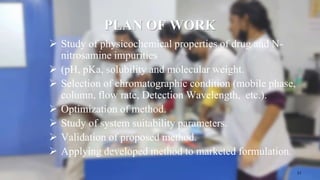
PLAN OF WORK
PLAN OF WORK
 Study of physicochemical properties of drug and N-
nitrosamine impurities
 (pH, pKa, solubility and molecular weight.
 Selection of chromatographic condition (mobile phase,
column, flow rate, Detection Wavelength, etc.).
 Optimization of method.
 Study of system suitability parameters.
 Validation of proposed method.
 Applying developed method to marketed formulation.
17
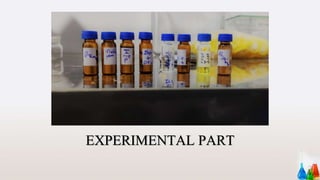
EXPERIMENTAL PART
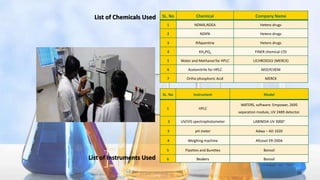
SL. No Instrument Model
1 HPLC
WATERS, software: Empower, 2695
separation module, UV 2489 detector.
2 UV/VIS spectrophotometer LABINDIA UV 3000+
3 pH meter Adwa – AD 1020
4 Weighing machine Afcoset ER-200A
5 Pipettes and Burettes Borosil
6 Beakers Borosil
19
SL. No Chemical Company Name
1 NDMA,NDEA Hetero drugs
2 NDIPA Hetero drugs
3 Rifapentine Hetero drugs
4 KH2PO4 FINER chemical LTD
5 Water and Methanol for HPLC LICHROSOLV (MERCK)
6 Acetonitrile for HPLC MOLYCHEM
7 Ortho phosphoric Acid MERCK
List of Instruments Used
List of Chemicals Used
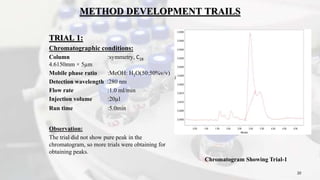
METHOD DEVELOPMENT TRAILS
TRIAL 1:
Chromatographic conditions:
Column :symmetry, C18
4.6150mm × 5µm
Mobile phase ratio :MeOH: H2O(50:50%v/v)
Detection wavelength :280 nm
Flow rate :1.0 ml/min
Injection volume :20µl
Run time :5.0min
Observation:
The trial did not show pure peak in the
chromatogram, so more trials were obtaining for
obtaining peaks.
20
Chromatogram Showing Trial-1
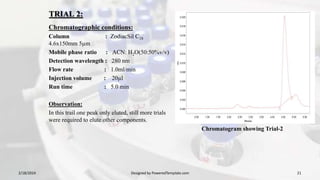
TRIAL 2:
Chromatographic conditions:
Column : ZodiacSil C18
4.6x150mm 5µm
Mobile phase ratio : ACN: H2O(50:50%v/v)
Detection wavelength : 280 nm
Flow rate : 1.0ml/min
Injection volume : 20µl
Run time : 5.0 min
Observation:
In this trail one peak only eluted, still more trials
were required to elute other components.
2/18/2024 Designed by PoweredTemplate.com 21
Chromatogram showing Trial-2
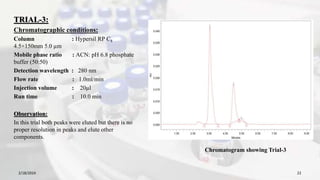
TRIAL-3:
Chromatographic conditions:
Column : Hypersil RP C8
4.5×150mm 5.0 µm
Mobile phase ratio : ACN: pH 6.8 phosphate
buffer (50:50)
Detection wavelength : 280 nm
Flow rate : 1.0ml/min
Injection volume : 20µl
Run time : 10.0 min
Observation:
In this trial both peaks were eluted but there is no
proper resolution in peaks and elute other
components.
2/18/2024 22
Chromatogram showing Trial-3
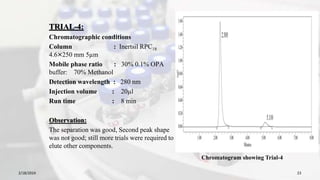
TRIAL-4:
Chromatographic conditions
Column : Inertsil RPC18
4.6×250 mm 5µm
Mobile phase ratio : 30% 0.1% OPA
buffer: 70% Methanol
Detection wavelength : 280 nm
Injection volume : 20µl
Run time : 8 min
Observation:
The separation was good, Second peak shape
was not good; still more trials were required to
elute other components.
2/18/2024 23
Chromatogram showing Trial-4
TRAIL - 5
Chromatographic conditions
Column : Endoversil C18
(2.1 x 150mm,4.6m)
Flow rate : 1.0 ml/min .
Injection volume : 20 µl.
Wavelength : 280 nm.
Run time : 5 min.
Mobile phase preparation: 0.1% OPA :
Acetonitrile (30:70)
Diluents : mobile phase
Observation:
The separation was good but still more trails
required to elute the Rifapentine.
2/18/2024 Designed by PoweredTemplate.com 24
Chromatogram showing Trial-5
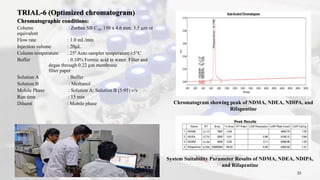
TRIAL-6 (Optimized chromatogram)
Chromatographic conditions:
Column : Zorbax SB C18, 150 x 4.6 mm, 3.5 µm or
equivalent
Flow rate : 1.0 mL/min
Injection volume : 20L
Column temperature : 250 Auto sampler temperature ±5°C
Buffer : 0.10% Formic acid in water. Filter and
degas through 0.22 µm membrane
filter paper
Solution A : Buffer
Solution B : Methanol
Mobile Phase : Solution A: Solution B (5:95) v/v
Run time : 15 min
Diluent : Mobile phase
25
System Suitability Parameter Results of NDMA, NDEA, NDIPA,
and Rifapentine
Chromatogram showing peak of NDMA, NDEA, NDIPA, and
Rifapentine
1. SYSTEM PRECISION
Procedure:
Take each 20mg of NDMA, and NDIPA std solutions into a 20mL
vol flask containing 5mL diluent and make up with diluent. Transfer
0.75mL of above sol. Into 25mL vol flask containing diluent and
make up with diluent.
Take 20mg of NDEA std solutions into a 20mL vol flask containing
5mL diluent and make up with diluent. Transfer 0.75mL of above
sol. Into 25mL vol flask containing diluent and make up with diluent.
Transfer 1.0mL of std stock solution-I and std stock solution-ii in to a
100mL vol flask containing 25mL
Take1.0 mL of standard solution into a headspace vial immediately
the vial.
Inject blank solution into the system and record the chromatogram.
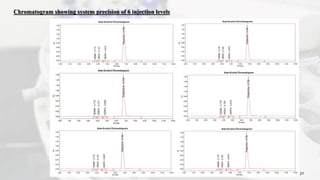
Inject standard solutions into the system separately for six times
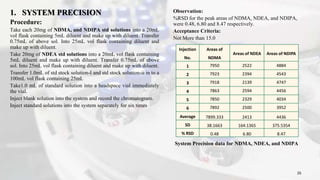
Observation:
%RSD for the peak areas of NDMA, NDEA, and NDIPA,
were 0.48, 6.80 and 8.47 respectively.
Acceptance Criteria:
Not More than 15.0
System Precision data for NDMA, NDEA, and NDIPA
26
Injection
No.
Areas of
NDMA
Areas of NDEA Areas of NDIPA
1 7950 2522 4884
2 7923 2394 4543
3 7918 2139 4747
4 7863 2594 4456
5 7850 2329 4034
6 7892 2500 3952
Average 7899.333 2413 4436
SD 38.1663 164.1365 375.5354
% RSD 0.48 6.80 8.47
27
Chromatogram showing system precision of 6 injection levels
2. SPECIFICITY
Procedure:
Weigh accurately about 10 mg of the test sample into a 10 ml VF and add 7.0 mL of diluent and make up the
solution upto 10 ml(1mg/ml). Further Pipette out 0.1 ml from the above solution and make up with Same solution
(0.1mg/ml).
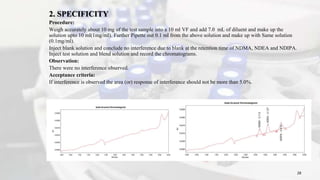
Inject blank solution and conclude no interference due to blank at the retention time of NDMA, NDEA and NDIPA.
Inject test solution and blend solution and record the chromatograms.
Observation:
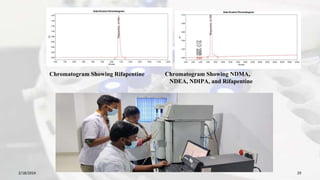
There were no interference observed.
Acceptance criteria:
If interference is observed the area (or) response of interference should not be more than 5.0%.
Chromatogram Showing Blank Solution Impurity Mix Chromatogram
28
Chromatogram Showing Rifapentine Chromatogram Showing NDMA,
NDEA, NDIPA, and Rifapentine
2/18/2024 29
3. DETECTION LIMIT:
Procedure:
Prepare DL solution containing NDMA, NDEA, and NDIPA with respect to test concentration by diluting NDMA,
NDEA, NEIA and NDIPA stock solutions so as to get S/N ratio about 3:1 or by visual method.
Inject blank solution into the system and record the chromatograms. Inject DL solution into the system and record the
chromatograms. Calculate the signal to noise ratio of NDMA, NDEA, and NDIPA peaks from DL solution through
software.
Observation:
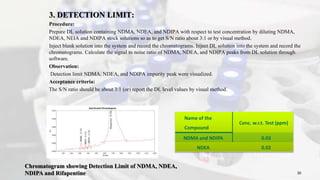
Detection limit NDMA, NDEA, and NDIPA impurity peak were visualized.
Acceptance criteria:
The S/N ratio should be about 3:1 (or) report the DL level values by visual method.
30
Name of the
Compound
Conc. w.r.t. Test (ppm)
NDMA and NDIPA 0.03
NDEA 0.02
Chromatogram showing Detection Limit of NDMA, NDEA,
NDIPA and Rifapentine
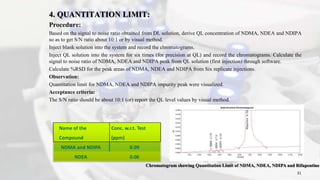
4. QUANTITATION LIMIT:
Procedure:
Based on the signal to noise ratio obtained from DL solution, derive QL concentration of NDMA, NDEA and NDIPA
so as to get S/N ratio about 10:1 or by visual method.
Inject blank solution into the system and record the chromatograms.
Inject QL solution into the system for six times (for precision at QL) and record the chromatograms. Calculate the
signal to noise ratio of NDMA, NDEA and NDIPA peak from QL solution (first injection) through software.
Calculate %RSD for the peak areas of NDMA, NDEA and NDIPA from Six replicate injections.
Observation:
Quantitation limit for NDMA, NDEA and NDIPA impurity peak were visualized.
Acceptance criteria:
The S/N ratio should be about 10:1 (or) report the QL level values by visual method.
31
Name of the
Compound
Conc. w.r.t. Test
(ppm)
NDMA and NDIPA 0.09
NDEA 0.06
Chromatogram showing Quantitation Limit of NDMA, NDEA, NDIPA and Rifapentine
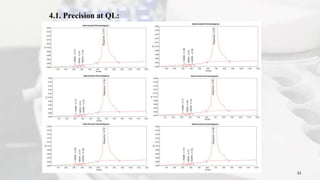
4.1. Precision at QL:
32
QL Level
Peak Areas of
NDMA
Peak Areas of
NDEA
Peak Areas of
NDIPA
Injection-1 2423 495 1386
Injection-2 2214 444 1352
Injection-3 2103 463 1349
Injection-4 2590 433 1391
Injection-5 2191 476 1369
Injection-6 2208 485 1311
Average 2288.167 466 1359.667
SD 181.6253 24.01666 29.33712
%RSD 7.94 5.15 2.16
2/18/2024 Designed by PoweredTemplate.com 33
Observation: QL level were within the limit.
Acceptance criteria:
The % RSD for the six replicate injections of QL level should not to be more than 20.0.
5. LINEARITY:
Preparation of Linearity Level-1 Solution (QL):
Consider first two injections of precision at QL.
Preparation of Linearity level-2 (50 %) standard solution:
Dilute 0.5 mL of standard stock solution in to a 25 mL volumetric flask dilute to Volume with diluents and mix well.
Preparation of Linearity level-3 (75 %) standard solution:
Dilute 0.75 mL of standard stock solution in to a 25 mL volumetric flask dilute to Volume with diluents and mix well.
Preparation of Linearity level-4 (100 %) standard solution:
Dilute 1.0 mL of standard stock solution in to a 25 mL volumetric flask dilute to volume with diluents and mix well.
Preparation of Linearity level-5 (125 %) standard solution:
Dilute 1.25mL of standard stock solution in to a 25 mL volumetric flask dilute to volume with diluent and mix well.
Preparation of Linearity level-6 (150 %) standard solution:
Dilute 1.5 mL of standard stock solution in to a 25 mL volumetric flask dilute to volume with diluent and mix well.
Inject linearity level (Level 2-6) in duplicate runs and record the chromatograms. Plot linearity graph between average
peak areas from duplicate injections against Concentration and determine the correlation coefficient values for NDMA,
NDEA and NDIPA by using Microsoft excel.
34
Chromatogram showing Linearity
35
Level Concentration of NDMA (ppm) Average Areas of NDMA
Level-1 0.093 2391
Level-2 0.155 3985
Level-3 0.232 5964
Level-4 0.309 7944
Level-5 0.387 9949
Level-6 0.464 11929
Correlation Coefficient 0.999
36
2391
3985
5964
7944
9949
11929
y = 25709x + 1E-11
R² = 0.9999
0
2000
4000
6000
8000
10000
12000
14000
0 0.1 0.2 0.3 0.4 0.5
LINEARITY GRAPH OF NDMA
Linearity data for NDMA
Level Concentration of NDEA (ppm) Average Areas of NDEA
Level-1 0.062 497
Level-2 0.154 1234
Level-3 0.231 1850
Level-4 0.308 2467
Level-5 0.384 3076
Level-6 0.461 3692
Correlation Coefficient 0.999
497
1234
1850
2467
3076
3692
y = 25709x + 1E-11
R² = 0.9999
0
500
1000
1500
2000
2500
3000
3500
4000
0 0.1 0.2 0.3 0.4 0.5
LINEARITY GRAPH OF NDEA
Linearity data for NDEA
Level Concentration of NDIPA (ppm) Average Areas of NDIPA
Level-1 0.088 1345
Level-2 0.146 2231
Level-3 0.220 3362
Level-4 0.293 4478
Level-5 0.366 5594
Level-6 0.439 6709
Correlation Coefficient 0.999
1345
2231
3362
4478
5594
6709
y = 25709x + 1E-11
R² = 0.9999
0
1000
2000
3000
4000
5000
6000
7000
8000
0 0.1 0.2 0.3 0.4 0.5
LINEARITY GRAPH OF NDIPA
Linearity Data for NDIPA
Observation:
Correlation coefficient value of NDMA, NDEA and NDIPA derived from respective linearity graph were
within the limit.
Acceptance criteria:
Correlation coefficient value derived from the linearity graph should be not less than 0.999.
6. ACCURACY:
Procedure:
Inject blank solution into the system and record the chromatograms.
Inject test solution into the system and record the chromatograms.
Inject each accuracy level-2 and level-6 in triplicate preparations and accuracy
Level-4 in six preparations (method precision) and record the chromatograms.
Consider first three preparations for accuracy study.
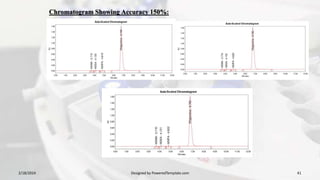
Calculate the % recovery of NDMA, NDEA and NDIPA separately from each preparation by using the formula given
below and report the results in the range.
Calculate the NDMA, NDEA and NDIPA content in test sample using the following formula:
AT CS
NDMA content (ppm) = --------x -------- x P x10000
AS CT
Where,
AT = Peak area of NDMA in test solution.
AS = Average peak area of NDMA in standard solutions.
CS = Concentration of NDMA in standard preparation (mg/mL).
CT = Concentration of test solution (mg/mL).
P = Purity or Assay of NDMA standard (%).
Similarly calculate for the NDEA and NDIPA by using the above formula.
2/18/2024 Designed by PoweredTemplate.com 38
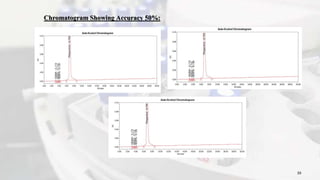
Chromatogram Showing Accuracy 50%:
39
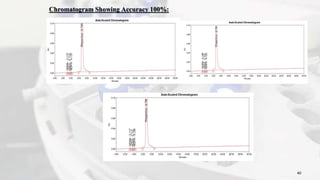
Chromatogram Showing Accuracy 100%:
40
Chromatogram Showing Accuracy 150%:
2/18/2024 Designed by PoweredTemplate.com 41
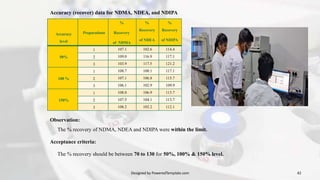
Accuracy
level
Preparations
%
Recovery
of NDMA
%
Recovery
of NDEA
%
Recovery
of NDIPA
50%
1 107.1 102.6 114.4
2 109.0 116.9 117.1
3 103.9 117.5 121.2
100 %
1 108.7 108.1 117.1
2 107.1 106.8 115.7
3 106.1 102.9 109.9
150%
1 108.0 106.9 113.7
2 107.5 104.1 113.7
3 108.2 102.2 112.1
Designed by PoweredTemplate.com 42
Accuracy (recover) data for NDMA, NDEA, and NDIPA
Observation:
The % recovery of NDMA, NDEA and NDIPA were within the limit.
Acceptance criteria:
The % recovery should be between 70 to 130 for 50%, 100% & 150% level.
7. METHOD PRECISION:
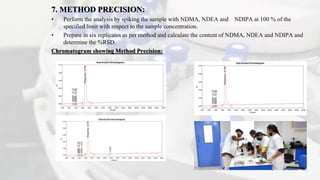
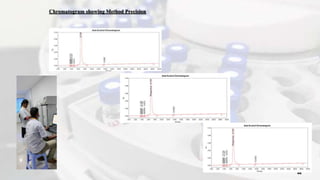
• Perform the analysis by spiking the sample with NDMA, NDEA and NDIPA at 100 % of the
specified limit with respect to the sample concentration.
• Prepare in six replicates as per method and calculate the content of NDMA, NDEA and NDIPA and
determine the %RSD.
Chromatogram showing Method Precision:
Chromatogram showing Method Precision
44
44
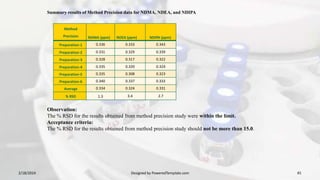
Method
Precision NDMA (ppm) NDEA (ppm) NDIPA (ppm)
Preparation-1 0.336 0.333 0.343
Preparation-2 0.331 0.329 0.339
Preparation-3 0.328 0.317 0.322
Preparation-4 0.335 0.320 0.324
Preparation-5 0.335 0.308 0.323
Preparation-6 0.340 0.337 0.333
Average 0.334 0.324 0.331
% RSD 1.3 3.4 2.7
2/18/2024 Designed by PoweredTemplate.com 45
Observation:
The % RSD for the results obtained from method precision study were within the limit.
Acceptance criteria:
The % RSD for the results obtained from method precision study should not be more than 15.0.
Summary results of Method Precision data for NDMA, NDEA, and NDIPA
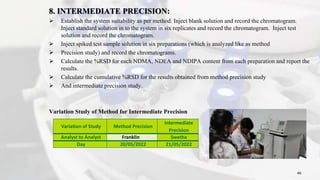
8. INTERMEDIATE PRECISION:
 Establish the system suitability as per method. Inject blank solution and record the chromatogram.
Inject standard solution in to the system in six replicates and record the chromatogram. Inject test
solution and record the chromatogram.
 Inject spiked test sample solution in six preparations (which is analyzed like as method
 Precision study) and record the chromatograms.
 Calculate the %RSD for each NDMA, NDEA and NDIPA content from each preparation and report the
results.
 Calculate the cumulative %RSD for the results obtained from method precision study
 And intermediate precision study.
Variation Study of Method for Intermediate Precision
46
Variation of Study Method Precision
Intermediate
Precision
Analyst to Analyst Franklin Swetha
Day 20/05/2022 21/05/2022
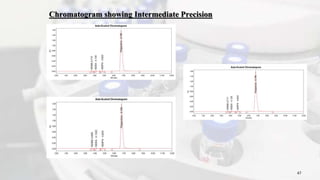
Chromatogram showing Intermediate Precision
47
48
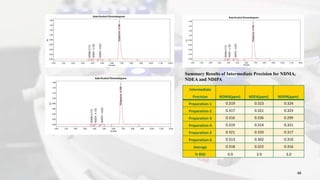
Intermediate
Precision NDMA(ppm) NDEA(ppm) NDIPA(ppm)
Preparation-1 0.319 0.323 0.324
Preparation-2 0.317 0.321 0.323
Preparation-3 0.316 0.336 0.299
Preparation-4 0.319 0.314 0.321
Preparation-5 0.321 0.333 0.317
Preparation-6 0.313 0.302 0.310
Average 0.318 0.322 0.316
% RSD 0.9 3.9 3.0
Summary Results of Intermediate Precision for NDMA,
NDEA and NDIPA
Preparations
Content(ppm)ND
MA
Content(ppm)NDEA Content(ppm)NDIPA
Method Precision
Preparation-1
0.336 0.333 0.343
Method Precision
Preparation-2
0.331 0.329 0.339
Method Precision
Preparation-3
0.328 0.317 0.322
Method Precision
Preparation-4
0.335 0.320 0.324
Method Precision
Preparation-5
0.335 0.308 0.323
Method Precision
Preparatton-6
0.340 0.337 0.333
Intermediate Precision
Preparation-1
0.319 0.323 0.324
Intermediate Precision
Preparation-2
0.317 0.321 0.323
Intermediate Precision
Preparation-3
0.316 0.336 0.299
Intermediate Precision
Preparation-4
0.319 0.314 0.321
Intermediate Precision
Preparation-5
0.321 0.333 0.317
Intermediate Precision
Preparation-6
0.313 0.302 0.310
Average 0.326 0.323 0.323
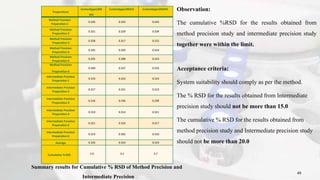
Cumulative % RSD 2.9 3.5 3.7
49
Summary results for Cumulative % RSD of Method Precision and
Intermediate Precision
Observation:
The cumulative %RSD for the results obtained from
method precision study and intermediate precision study
together were within the limit.
Acceptance criteria:
System suitability should comply as per the method.
The % RSD for the results obtained from Intermediate
precision study should not be more than 15.0
The cumulative % RSD for the results obtained from
method precision study and Intermediate precision study
should not be more than 20.0
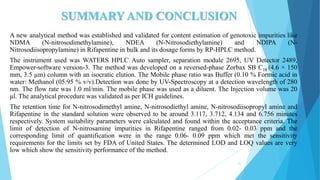
SUMMARY AND CONCLUSION
A new analytical method was established and validated for content estimation of genotoxic impurities like
NDMA (N-nitrosodimethylamine), NDEA (N-Nitrosodiethylamine) and NDIPA (N-
Nitrosodiisopropylamine) in Rifapentine in bulk and its dosage forms by RP-HPLC method.
The instrument used was WATERS HPLC Auto sampler, separation module 2695, UV Detector 2489,
Empower-software version-3. The method was developed on a reversed-phase Zorbax SB C18 (4.6 × 150
mm, 3.5 µm) column with an isocratic elution. The Mobile phase ratio was Buffer (0.10 % Formic acid in
water: Methanol (05:95 % v/v).Detection was done by UV-Spectroscopy at a detection wavelength of 280
nm. The flow rate was 1.0 ml/min. The mobile phase was used as a diluent. The Injection volume was 20
μl. The analytical procedure was validated as per ICH guidelines.
The retention time for N-nitrosodimethyl amine, N-nitrosodiethyl amine, N-nitrosodiisopropyl amine and
Rifapentine in the standard solution were observed to be around 3.117, 3.712, 4.134 and 6.756 minutes
respectively. System suitability parameters were calculated and found within the acceptance criteria. The
limit of detection of N-nitrosamine impurities in Rifapentine ranged from 0.02- 0.03 ppm and the
corresponding limit of quantification were in the range 0.06- 0.09 ppm which met the sensitivity
requirements for the limits set by FDA of United States. The determined LOD and LOQ values are very
low which show the sensitivity performance of the method.
51
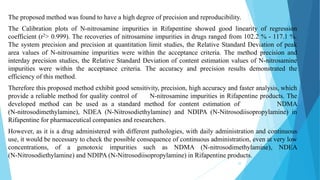
The proposed method was found to have a high degree of precision and reproducibility.
The Calibration plots of N-nitrosamine impurities in Rifapentine showed good linearity of regression
coefficient (r2> 0.999). The recoveries of nitrosamine impurities in drugs ranged from 102.2 % - 117.1 %.
The system precision and precision at quantitation limit studies, the Relative Standard Deviation of peak
area values of N-nitrosamine impurities were within the acceptance criteria. The method precision and
interday precision studies, the Relative Standard Deviation of content estimation values of N-nitrosamine
impurities were within the acceptance criteria. The accuracy and precision results demonstrated the
efficiency of this method.
Therefore this proposed method exhibit good sensitivity, precision, high accuracy and faster analysis, which
provide a reliable method for quality control of N-nitrosamine impurities in Rifapentine products. The
developed method can be used as a standard method for content estimation of NDMA
(N-nitrosodimethylamine), NDEA (N-Nitrosodiethylamine) and NDIPA (N-Nitrosodiisopropylamine) in
Rifapentine for pharmaceutical companies and researchers.
However, as it is a drug administered with different pathologies, with daily administration and continuous
use, it would be necessary to check the possible consequence of continuous administration, even at very low
concentrations, of a genotoxic impurities such as NDMA (N-nitrosodimethylamine), NDEA
(N-Nitrosodiethylamine) and NDIPA (N-Nitrosodiisopropylamine) in Rifapentine products.
52
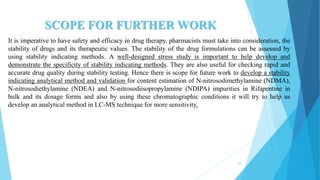
SCOPE FOR FURTHER WORK
It is imperative to have safety and efficacy in drug therapy, pharmacists must take into consideration, the
stability of drugs and its therapeutic values. The stability of the drug formulations can be assessed by
using stability indicating methods. A well-designed stress study is important to help develop and
demonstrate the specificity of stability indicating methods. They are also useful for checking rapid and
accurate drug quality during stability testing. Hence there is scope for future work to develop a stability
indicating analytical method and validation for content estimation of N-nitrosodimethylamine (NDMA),
N-nitrosodiethylamine (NDEA) and N-nitrosodiisopropylamine (NDIPA) impurities in Rifapentine in
bulk and its dosage forms and also by using these chromatographic conditions it will try to help us
develop an analytical method in LC-MS technique for more sensitivity.
54
REFERENCES
REFERENCES
1. Pilaniya, K., Chandrawanshi, H. K., Pilaniya, U., Manchandani, P., Jain, P., & Singh, N. Recent trends in the impurity profile of
pharmaceuticals. Journal of advanced pharmaceutical technology & research, (1) (3) (2010), 302–310.
https://doi.org/10.4103/0110-5558.72422
2. Abdin AY, Yeboah P, Jacob C. Chemical Impurities: An Epistemological Riddle with Serious Side Effects. Int J Environ Res
Public Health. (17) (3) (2020), doi:10.3390/ijerph17031030.
3. Global Research Online - International Journal of Pharmaceutical Sciences Review and Research. (3) (2) (2010).
https://www.globalresearchonline.net/pharmajournal/pharmajournal6.aspx
4. Liu, K., & Chen, C. Determination of Impurities in Pharmaceuticals: Why and How?. In P. Pereira, & S. Xavier (Eds.), Quality
Management and Quality Control - New Trends and Developments. IntechOpen. (2019)
doi:https://doi.org/10.5772/intechopen.83849
5. David Q. Liu, Mingjiang Sun, Alireza S. Kord,Recent advances in trace analysis of pharmaceutical genotoxic impurities,Journal of
Pharmaceutical and Biomedical Analysis,(51) (5) (2010) , 999-1014, doi:https://doi.org/10.1016/j.jpba.2009.11.009.
6. Shaikh, T. Genotoxic Impurities and Its Risk Assessment in Drug Compounds, (2018).
7. N.V.V.S.S. Raman, A.V.S.S. Prasad, K. Ratnakar Reddy,Strategies for the identification, control and determination of genotoxic
impurities in drug substances: A pharmaceutical industry perspective,Journal of Pharmaceutical and Biomedical Analysis,Volume
(55) (4) (2011), 662-667, doi:https://doi.org/10.1016/j.jpba.2010.11.039.
8. Brigo, A. and Müller, L. Development of the Threshold of Toxicological Concern Concept and its Relationship to Duration of
Exposure, in Genotoxic Impurities (Ed. A. Teasdale), John Wiley & Sons, Inc., Hoboken, NJ, USA. (2011)
doi:10.1002/9780470929377.ch2
56
9. Control of Genotoxic Impurities in Active Pharmaceutical Ingredients: A Review and Perspective Derek I. Robinson Organic
Process Research & Development (14) (4) (2010), doi: 946-959, 10.1021/op900341a
10. Snodin, D.J., and Elder, D. Genotoxic Impurities Part 1: General Overview. Pharmaceutical Outsourcing, (2012).
11. Reddy, Ambavaram Vijaya Bhaskar; Jaafar, Jafariah; Umar, Khalid; Majid, Zaiton Abdul; Aris, Azmi Bin; Talib, Juhaizah;
Madhavi, Gajulapalle. Identification, control strategies, and analytical approaches for the determination of potential genotoxic
impurities in pharmaceuticals: A comprehensive review. Journal of Separation Science, (38) (5) (2015), 764–
779. doi:10.1002/jssc.201401143
12. David Q. Liu; Mingjiang Sun; Alireza S. Kord. Recent advances in trace analysis of pharmaceuticalgenotoxic impurities,
(51)(5)(2010), 999-1014, doi:10.1016/j.jpba.2009.11.009
13. Lutz Müller; Robert J. Mauthe; Christopher M. Riley; Marta M. Andino; David De Antonis; Chris Beels; Joseph DeGeorge;
Alfons G.M. De Knaep; Dean Ellison; Jane A. Fagerland; Rebecca Frank; Betsy Fritschel; Sheila Galloway; Ernie Harpur;
Charles D.N. Humfrey; Alexander S. Jacks; Nirdosh Jagota; John Mackinnon; Ganapathy Mohan; Daniel K. Ness; Michael R.
O’Donovan; Mark D. Smith; Gopi Vudathala; Larry Yotti. A rationale for determining, testing, and controlling specific impurities
in pharmaceuticals that possess potential for genotoxicity, (44) (3) (2006), 0–211. doi:10.1016/j.yrtph.2005.12.001
14. POUNIKAR, A. R., UMEKAR, M. J., & GUPTA, K. R. genotoxic impurities: An important regulatory aspect. Asian Journal of
Pharmaceutical and Clinical Research, (2020), 10-25
15. Regulska K, Michalak M, Murias M, Stanisz B. Genotoxic impurities in pharmaceutical products – regula-tory,
toxicological and pharmaceutical considerations. JMS. (90) (1) (2021) , doi:10.20883/medical.e502
16. Liu, David Q.; Kord, Alireza S. Analytical challenges in stability testing for genotoxic impurities. TrAC Trends in Analytical
Chemistry, (49) (2013), 108–117. doi:10.1016/j.trac.2013.06.004
17. Khamis, A. M., qizi Omonova, C. T., & Mugaka, B. P. SHORT REVIEW ON GENOTOXIC IMPURITIES IN SARTANS,
(2021).
18. Tuesuwan B, Vongsutilers V. Nitrosamine contamination in pharmaceuticals: threat, impact, and control. J Pharm Sci; (2021)
https://doi.org/10.1016/j.xphs.2021.04.021.
57
19. Dr. Tabrez Shaikh, Dr. Amit Gosar, & Dr. Hussain Sayyed. Nitrosamine Impurities in Drug Substances and Drug Products.
Journal of Advances in Pharmacy Practices, (2) (1) (2020), 48–57. http://doi.org/10.5281/zenodo.3629095
20. Food and Drug Administration (U.S.). Control of nitrosamine impurities in human drugs: guidance for industry. Rockville, MD:
Food and Drug Administration; (2020). https://www.fda.gov/regulatory-information/search-fda-guidance-documents/control-
nitrosamine-impurities-human-drugs.
21. Dobo, K. L., Kenyon, M. O., Dirat, O., Engel, M., Fleetwood, A., Martin, M., Mattano, S., Musso, A., McWilliams, J. C.,
Papanikolaou, A., Parris, P., Whritenour, J., Yu, S., & Kalgutkar, A. S. Practical and Science-Based Strategy for Establishing
Acceptable Intakes for Drug Product N-Nitrosamine Impurities. Chemical Research in Toxicology, (35) (3) (2022), 475–489.
https://doi.org/10.1021/acs.chemrestox.1c00369
22. Shephard, Emily A.; Nawarskas, James J. Nitrosamine Impurities in Angiotensin Receptor Blockers. Cardiology in Review,
(2020), doi:10.1097/CRD.0000000000000323.
23. N.V.V.S.S. Raman; A.V.S.S. Prasad; K. Ratnakar Reddy. Strategies for the identification, control and determination of
genotoxic impurities in drug substances: A pharmaceutical industry perspective, (55) (4) (2011),
662–667. doi:10.1016/j.jpba.2010.11.039
24. Elder DP, Lipczynski AM, Teasdale A. Control and analysis of alkyl and benzyl halides and other related reactive organohalides
as potential genotoxic impurities in active pharmaceutical ingredients (APIs). J Pharm Biomed Anal. (48) (3) (2008), 497-507.
doi: 10.1016/j.jpba.2008.06.009.
25. Johnson, G. E., Dobo, K., Gollapudi, B., Harvey, J., Kenny, J., Kenyon, M., & Zeller, A. Permitted daily exposure limits for
noteworthy N‐nitrosamines. Environmental and Molecular Mutagenesis, (62) (5) (2021), 293-305.
26. FDA Issues New Guidance on Nitrosamine Impurities in APIs and Drug Products. JD Supra. Retrieved (2022)
https://www.jdsupra.com /legalnews/fda-issues-new-guidance-on-nitrosamine.
27. Unpacking FDA’s New Guidance on Controlling Nitrosamine Impurities in Drugs. (n.d.). Pharmaceutical Online. Retrieved
(2022),
58
28. van Arnum, P. (2021, December 2). FDA Updates Risk Mitigation for Nitrosamine Impurities. DCAT Value Chain Insights. 2(022),
https://www.dcatvci.org/features/fda-updates-risk-mitigation-for-nitrosamine-impurities/
29. Snow, S., Panesar, N., & Suman, R. Nitrosamine Impurities in Medicinal Products. PharmTech, (2022),
https://www.pharmtech.com/view/nitrosamine-impurities-in-medicinal-products
30. National Center for Biotechnology Information. PubChem Compound Summary for CID 135403821, Rifapentine. Retrieved (2022)
https://pubchem.ncbi.nlm.nih.gov/compound/Rifapentine.
31. Rifampin,Tuberculosis, (88) (2) (2008), 151-154, https://doi.org/10.1016/S1472-9792(08)70024-6.
32. Rifapentine hydrochloride | DrugBank Online. (2005, June 13). DrugBank. Retrieved May 22, 2022, from
https://go.drugbank.com/salts/DBSALT002329
33. Priftin (rifapentine) dosing, indications, interactions, adverse effects, and more. (2020, June 17). MedScape. Retrieved May 22, 2022,
from https://reference.medscape.com/drug/priftin-rifapentine-342681
34. Priftin (Rifapentine): Uses, Dosage, Side Effects, Interactions, Warning. (2020, June 18). RxList. https://www.rxlist.com/priftin-
drug.htm
35. TO, A. A. S. G. Rifapentine.
36. Cloëz, S., & Frick, M. N-nitrosamines and Tuberculosis Medicines Rifampicin and Rifapentine, (2021).
37. Khaja Moinuddin Shaik , Bhaskar Sarmah , Gaurav Suresh Wadekar & Pramod Kumar: Regulatory Updates and Analytical
Methodologies for Nitrosamine Impurities Detection in Sartans, Ranitidine, Nizatidine, and Metformin along with Sample Preparation
Techniques, Critical Reviews in Analytical Chemistry, (2020) 10.1080/10408347.2020.1788375
38. Parr MK, Joseph JF, NDMA Impurity in Valsartan and other Pharmaceutical Products: Analytical Methods for the Determination of N-
Nitrosamines, Journal of Pharmaceutical and Biomedical Analysis (2018), https://doi.org/10.1016/j.jpba.2018.11.010
39. Sebastian Schmidtsdorff, Jonas Neumann, Alexander H. Schmidt, Maria K. Parr, Analytical lifecycle management for comprehensive
and universal nitrosamine analysis in various pharmaceutical formulations by supercritical fluid chromatography, Journal of
Pharmaceutical and Biomedical Analysis, (197) (2021), https://doi.org/10.1016/j.jpba.2021.113960.
59
40. C. Giménez-Campillo, M. Pastor-Belda, N. Campillo, M. Hernández-Córdoba, P. Viñas, Monitoring N-Nitrosamines impurities in
ranitidine pharmaceuticals using microextraction and gas chromatography-mass spectrometry, Talanta,
https://doi.org/10.1016/j.talanta.2020.121659.
41. Liu, J., Xie, B., Mai, B. et al. Development of a sensitive and stable GC-MS/MS method for simultaneous determination of four N-
nitrosamine genotoxic impurities in sartan substances. J Anal Sci Technol (12) (3) (2021). https://doi.org/10.1186/s40543-020-00254-2
42. Khorolskiy, M., Ramenskaya, G., Vlasov, A., Perederyaev, O., & Maslennikova, N. Development and Validation of four Nitrosamine
Impurities Determination Method in Medicines of Valsartan, Losartan, and Irbesartan with HPLC-MS/MS (APCI). Iranian journal of
pharmaceutical research: IJPR, (20) (3) (2021), 541–552. https://doi.org/10.22037/ijpr.2021.115102.15195
43. Masada, S., Tsuji, G., Arai, R. et al. Rapid and efficient high-performance liquid chromatography analysis of N-nitrosodimethylamine
impurity in valsartan drug substance and its products. Sci Rep 9, 11852 (2019). https://doi.org/10.1038/s41598-019-48344-5
44. Wisut Wichitnithad; Orawan Sudtanon; Pawadee Srisunak; Kamonrak Cheewatanakornkool; Siriwan Nantaphol; Pornchai Rojsitthisak;
Development of a Sensitive Headspace Gas Chromatography–Mass Spectrometry Method for the Simultaneous Determination of
Nitrosamines in Losartan Active Pharmaceutical Ingredients . ACS Omega, (2021), 10.1021/acsomega.1c00982.
45. Yahya M. Alshehri, Thamer S. Alghamdi, Fahad S. Aldawsari, HS-SPME-GC-MS as an alternative method for NDMA analysis in
ranitidine products, Journal of Pharmaceutical and Biomedical Analysis, (191) (2020), 113582,
https://doi.org/10.1016/j.jpba.2020.113582.
46. Murat Soyseven, RüstemKeçili, Hassan Y Aboul-Enein, GökselArli, Determination of Potential Genotoxic Impurity, 5-Amino-2-
Chloropyridine, in Active Pharmaceutical Ingredient Using the HPLC-UV System, Journal of Chromatographic Science, (59) (3),
(20210, 241–245, https://doi.org/10.1093/chromsci/bmaa100
47. Zheng, J., Kirkpatrick, C.L., Lee, D. et al. A Full Evaporation Static Headspace Gas Chromatography Method with Nitrogen
Phosphorous Detection for Ultrasensitive Analysis of Semi-volatile Nitrosamines in Pharmaceutical Products. AAPS J 24, 23 (2022).
https://doi.org/10.1208/s12248-021-00669-8
60
48. R. González, G. Torrado, J.M. Arribas, M.A. Peña, Development of an analytical method for the determination and quantification of n
nitrosodimethylamine in olmesartan by HPLC-MS/MS, Microchemical Journal, (179) (2022), 107402,
https://doi.org/10.1016/j.microc.2022.107402.
49. Farzad Malihi, Tao Wang, An improved analytical method for quantitation of nitrosamine impurities in ophthalmic solutions using liquid
chromatography with tandem mass spectrometry, Journal of Chromatography Open,(2) (2022), 100037,
https://doi.org/10.1016/j.jcoa.2022.100037.
50. Schmidtsdorff S, Schmidt AH, Simultaneous detection of nitrosamines and other sartan-related impurities in active pharmaceutical
ingredients by supercritical fluid chromatography, Journal of Pharmaceutical and Biomedical Analysis (2019),
https://doi.org/10.1016/j.jpba.2019.04.049
51. Minju Lee, Yunho Lee, Fabian Soltermann, Urs von Gunten, Analysis of N-nitrosamines and other nitro(so) compounds in water by high-
performance liquid chromatography with post-column UV photolysis/Griess reaction, Water Research, (47) (14) (2013), 4893-4903,
https://doi.org/10.1016/j.watres.2013.05.031.
52. Chidella, K. , Dasari, V. and Anireddy, J. Ultra-Sensitive LC-MS/MS Method for the Trace Level Quantification of Six Potential
Genotoxic Nitrosamine Impurities in Telmisartan. American Journal of Analytical Chemistry, 12, (2021), 227-240.
10.4236/ajac.2021.126014.
53. Chen, Y., Wu, S., & Yang, Q. Development and Validation of LC-MS/MS for Analyzing Potential Genotoxic Impurities in Pantoprazole
Starting Materials. Journal of Analytical Methods in Chemistry, (2020), 1–8. https://doi.org/10.1155/2020/6597363.
54. Rong Li, Yahui Liu, Zhijuan Wang, Qing Zhang, Hua Bai, Qing Lv, High resolution GC–Orbitrap MS for nitrosamines analysis: Method
performance, exploration of solid phase extraction regularity, and screening of children’s products, Microchemical Journal, (162), (2021),
105878. https://doi.org/10.1016/j.microc.2020.105878.
55. Lim H-Hee, Oh Y-Suk, Shin H-Sang, Determination of N-nitrosodimethylamine and N-nitrosomethylethylamine in drug substances and
products of sartans, metformin and ranitidine by precipitation and solid phase extraction and gas chromatography–tandem mass
spectrometry, Journal of Pharmaceutical and Biomedical Analysis (2020), doi: https://doi.org/10.1016/j.jpba.2020.113460
56. Roberts, S.W., Lennard, A., Mohan, G. et al. Meeting Report: N-Nitrosamine Impurity Control Strategies in the Pharmaceutical and
Biotechnology Industries. AAPS J 23, 94 (2021). https://doi.org/10.1208/s12248-021-00618-5
61
57. Winchester, L. C., Podany, A. T., Baldwin, J. S., Robbins, B. L., & Fletcher, C. V. (2015). Determination of the rifamycin antibiotics
rifabutin, rifampin, rifapentine and their major metabolites in human plasma via simultaneous extraction coupled with LC/MS/MS.
Journal of Pharmaceutical and Biomedical Analysis, (104), 55–61. https://doi.org/10.1016/j.jpba.2014.11.011
58. Vyas, A. J., Godhaniya, J. P., Patel, A. I., Patel, A. B., Patel, N. K., Chudasama, A., & Shah, S. R. A Review on Carcinogenic Impurities
Found in Marketed Drugs and Strategies for its Determination by Analytical Methods. Asian Journal of Pharmaceutical Analysis, (2021)
159–169. https://doi.org/10.52711/2231-5675.2021.00028.
59. Graham, K. C., Lebelle, M. J., & Wilson, W. L. High Performance Liquid Chromatographic Analysis of Rifampin and Related Impurities
in Pharmaceutical Formulations. Journal of Liquid Chromatography, (2) (3) (1979), 365–371.
https://doi.org/10.1080/01483917908060069.
60. Vékey, K., Edwards, D. M. F., Zerilli, L. F., Màk, M., Tamàs, J., Raverdino, V., & Selva, A. Comparison of mass spectrometric methods
for studying thermally labile compounds: Rifapentine. Organic Mass Spectrometry, (25) (9) (1990), 465–474.
https://doi.org/10.1002/oms.1210250907
61. Patil, S., Chadar, R., Prasad, A., Koppula, P., & Koppula, S. Quantification and Validation of a HPLC-UV Method for Simultaneous
Analysis of Nitrosoamine Impurities (NDMA, NDEA and NDIPA) in Losartan. Journal of Pharmaceutical Research, (20) (4) (2021), 43–
49. https://doi.org/10.18579/jopcr/v20i4.ms21084
62. Shuhong Li, Lixin Dong, Keqin Tang, Zhenwei Lan, Rong Liu, Yuanjian Wang, Ruixun Wang, Huaqing Lin, Simultaneous and trace
level quantification of two potential genotoxic impurities in valsartan drug substance using UPLC-MS/MS, Journal of Pharmaceutical
and Biomedical Analysis, (212) (2022), 114630, https://doi.org/10.1016/j.jpba.2022.114630.
63. Nawale, P. M., Deshpande, M. M., & Kachve, R. N. Determination of Impurity Profile in Rifapentine. International Journal of Research
in Engineering, Science and Management, (3) (9) (2020), 155-158.
64. Lee, H. S., Shin, H. C., Han, S. S., & Roh, J. K. High-performance liquid chromatographic determination of rifapentine in serum using
column switching. Journal of Chromatography B: Biomedical Sciences and Applications, (574) (1) (1992), 175–178.
https://doi.org/10.1016/0378-4347(92)80116-8
62
65. Tuesuwan, B., & Vongsutilers, V. (2021). Nitrosamine Contamination in Pharmaceuticals: Threat, Impact, and Control. Journal of
Pharmaceutical Sciences, (110) (9), 3118–3128. https://doi.org/10.1016/j.xphs.2021.04.021
66. Nagendla, N. K., Shaik, H., Balasubramanyam, S., Godugu, D., & Mudiam, M. K., Development, Validation, and Estimation of
Measurement Uncertainty for the Quantitative Determination of Nitrosamines in Sartan Drugs Using LC-APCI-MS/MS. SSRN Electronic
Journal (2022). https://doi.org/10.2139/ssrn.4009734
67. Monteiro, M. A., de Lima, P. C., Novotny, T. S., Santana, D. S., Lima, M. E. D., Dantas, A. S. C. L., dos Santos, L. O., de Souza, M. N.,
Maranho, R. L. D. N., & Ochs, S. D. M. Development and Validation of Methods Based on High-Performance Liquid Chromatography-
Tandem Mass Spectrometry for Determining N-Nitrosamines Impurities in Sartan Pharmaceutical Products for Monitoring Program.
SSRN Electronic Journal. (2022).https://doi.org/10.2139/ssrn.4057039
68. Bethi, Madhusudhan & Bethanamudi, Prasanna. Analytical Method Development and Validation of Impurity Profile in Rifapentine,
(2017).
69. Jain, P. (n.d.). Review on Various Analytical Methods Developed for Rifapentine: An Antitubercular Drug | Jain | International Journal of
Chem-informatics Research. International Journal of Chem-Informatics Research, (2022)
https://chemical.journalspub.info/index.php?journal=JAWCM&page=article&op=view&path%5B%5D=209
70. Al-Kaseem, M., Al-Assaf, Z., & Karabeet, F. A Rapid, Validated RP-HPLC Method for the Determination of Seven Volatile N-
Nitrosamines in Meat. Pharmacology &Amp; Pharmacy, (05) (03) (2014), 298–308. https://doi.org/10.4236/pp.2014.53037.
63

PROJECT REVIEW FINAL PPT 2018-2022 TEAM FINAL.pptx

  • 1.
    ANALYTICAL METHOD DEVELOPMENTAND VALIDATION OF THE CONTENT ESTIMATION OF GENOTOXIC IMPURITIES OF N-NITROSODIMETHYLAMINE, N-NITROSODIETHYLAMINE AND N-NITROSODIISOPROPYLAMINE IN RIFAPENTINE IN BULK AND ITS DOSAGE FORMS PROJECT REPORT Submitted for the partial fulfillment for the award of degree of BACHELOR OF PHARMACY FRANKLIN SYLVESTER C (188021601011) JAWITH SAHUL A (188021601018) MOHAMMED MEERAN MASTHAN K (188021601035) RIZWANA PARVEEN N (188021601043) SWETHA S (188021601054) Under the supervision of Dr. Y. Ismail M. Pharm., Ph.D. Associate Professor Crescent School of Pharmacy
  • 2.
  • 3.
    GENOTOXIC IMPURITIES henomenon ability of an sto destruct the of a cell . ame of the destruction c material of the e loss of g to cancer, defects 3 As per the International Council for Harmonization (ICH) S2 (R1) Guideline, genotoxic impurities can be broadly defined as impurities that have been demonstrated to cause deleterious changes in the genetic material regardless of the mechanism. Nitrosamines form a large group of genotoxic chemical carcinogens and can be formed endogenously in the human body. N-Nitroso compounds can induce cancer NITROSAMINE & TYPES bable human carcinogens 7(R1), a lifetime intake of e less than one additional line as Class 1 impurities, t carcinogenicity and FORMATION OF NITROSAMINE TO CANCER
  • 4.
  • 5.
    PROBLEM STATEMENT The pharmaceuticalindustry is under intense pressure to increase productivity and release new drugs into the market. Analytical chemists are challenged to find faster ways of delivering quality data across a range of project needs. Rifapentine is a drug indicated for the treatment of tuberculosis. Rifapentine can be used by adults and children of 12 years age for the treatment of active pulmonary tuberculosis (TB) caused by Mycobacterium tuberculosis. On September 2020, Food and Drug Administration announced nitrosamine impurities in certain samples of Rifapentine due to contamination of unacceptable level of the N-nitrosamine analogue impurities like N-nitrosodimethylamine (NDMA), N-nitrosodiethylamine (NDEA) and N-nitrosodiisopropylamine (NDIPA), These N-nitrosamine Impurities are under organic compounds with genotoxic, carcinogenic and mutagenic activity. In general, they can be found in the natural environment, food and water, as well as in industrial manufacturing during drug processing. In Industry, it is deducted that N-nitrosamine is formed because of the reaction between sodium nitrite or another nitrosating agent and the presence of amine groups in their substances. Due to the likely danger to the human body, limit set for nitrosamine in Rifapentine were regulated and the FDA established at interim limit where by acceptable intake of N-nitrosamine in Rifapentine is 0.3 ppm. There is a need for the development of analytical method and validation for the detection and quantification of N-nitrosamine impurities in Rifapentine is of great interest. Hence, the research work embodied in this project work is to develop an analytical method and validation for the content estimation of N-nitrosamine impurities in Rifapentine in bulk and its dosage forms. 5
  • 6.
  • 7.
    DRUG PROFILE RIFAPENTINE: Synonyms :Cyclopentyl rifampicin, Rifapentinum Molecular formula : C47H64N4O12 Chemical name : 3-(((4-Cyclopentyl-1-piperazinyl)imino)methyl)rifamycin Molecular Weight : 877.031 g/mol Figure 1: Structure of Rifapentine
  • 8.
    Description: Rifapentine is arifamycin antibiotic that is similar in structure and activity to rifampin and rifabutin and that is used in combination with other agents as therapy of tuberculosis, particularly in once or twice weekly regimens. Rifapentine is a long-acting, cyclopentyl-substituted derivative of rifamycin used to treat mycobacterium infections.Rifapentine is a N-alkylpiperazine, a N-iminopiperazine and a member of rifamycins. It has a role as an antitubercular agent and a leprostatic drug. Solubility: Freely soluble in chloroform and dimethyl sulfoxide; soluble in ethyl acetate, methanol, tetrahydrofuran; slightly soluble in acetone, water, carbon tetrachloride. Category: Anti-Bacterial Agents , Anti-Infective Agents, Antibiotics, Anti-tubercular, Anti-infectives for Systemic Use , Anti- mycobacterials, Cytochrome P-450 CYP2B6 Inducers, Cytochrome P-450 CYP2B6 Inducers (strength unknown), Cytochrome P-450 CYP2C19 Inducers, Cytochrome P-450 CYP2C19 Inducers (strong). 8
  • 9.
    Possible Impurities: 1-cyclopentyl-4-nitrosopiperazine (CPNP)(CAS 61379-66-6). Indication: Rifapentine is indicated in adults and children 12 years and older for the treatment of active pulmonary tuberculosis (TB) caused by Mycobacterium tuberculosis. Rifapentine must always be used in combination with one or more anti-tuberculosis (anti-TB) drugs to which the isolate is susceptible. Brand: Priftin Available dosage forms: Tablets, Injectable powder. Recommended dosage: Tablet – 150mg, 300mg Injectable powder – 600mg Uses: For the treatment of pulmonary tuberculosis caused by Mycobacterium tuberculosis in combination with 1 or more anti-tuberculosis drugs. 9
  • 10.
  • 11.
    LITERATURE REVIEW 1. KhajaMoinuddin Shaik et al., Research on Regulatory Updates and Analytical Methodologies for Nitrosamine Impurities Detection in Sartans, Ranitidine, Nizatidine, and Metformin along with Sample Preparation Techniques 2. Maria Kristina Parr et al., Research on NDMA Impurity in Valsartan and other Pharmaceutical Products: Analytical Methods for the Determination of N-Nitrosamines 3. Sebastian Schmidtsdorf et al., Analytical life cycle management for comprehensive and universal nitrosamine analysis in various pharmaceutical formulations by supercritical fluid chromatography 4. Claudia Giménez-Campillo et al., Development of a new methodology for the determination of N-5 nitrosamines impurities in ranitidine pharmaceuticals using 6 microextraction and gas chromatography-mass spectrometry 5. Jie Liu et al., Development of a sensitive and stable GC-MS/MS method for simultaneous determination of four N-nitrosamine genotoxic impurities insartan substances. 6. Mikhail Khorolskiy et al., Development and Validation of four Nitrosamine Impurities Determination Method in Medicines of Valsartan, Losartan, and Irbesartan with HPLC-MS/MS (APCI) 7. Sayaka Masada et al., Rapid and efficient high-performance liquid chromatography analysis of N-nitrosodimethylamine impurity in valsartan drug substance and its products. 8. Pornchai Rojsitthisak et al., Development of a Sensitive Headspace Gas Chromatography−Mass Spectrometry Method for the Simultaneous Determination of Nitrosamines in Losartan Active Pharmaceutical Ingredients 9. Fahad S. Aldawsari et al., HS-SPME-GC-MS as an alternative method for NDMA analysis in ranitidine products 10. Hassan Y. Aboul-Enein et al., Determination of Potential Genotoxic Impurity, 5-Amino-2-Chloropyridine, in Active Pharmaceutical Ingredient Using the HPLC-UV System 11. Jinjian Zheng et al., A Full Evaporation Static Headspace Gas Chromatography Method with Nitrogen Phosphorous Detection for Ultrasensitive Analysis of Semi-volatile Nitrosamines in Pharmaceutical Products.
  • 12.
    12. R.Gonzalez etal., Development of an analytical method for the determination and quantification of N- nitrosodimethylamine in olmesartan by HPLC-MS/MS 13. Farzad Malihi et al., An improved analytical method for quantitation of nitrosamine impurities in ophthalmic solutions using liquid chromatography with tandem mass spectrometry. 14. Sebastian Schmidtsdorff et al., Simultaneous detection of nitrosamines and other sartan-related impurities in active pharmaceutical ingredients by supercritical fluid chromatography 15. Krista L.Dobo et al., Practical and Science-Based Strategy for Establishing Acceptable Intakes for Drug Product N- Nitrosamine Impurities. 16. Minju Lee et al., Analysis of Nnitrosamines and other nitro(so) compounds in water by high-performance liquid chromatography with post-column UV photolysis/Griess reaction 17. Kartheek Srinivas Chidella et al., Ultra-Sensitive LC-MS/MS Method for the Trace Level Quantification of Six Potential Genotoxic Nitrosamine Impurities in Telmisartan. 18. Yuyuan Chen et al., Development and Validation of LC-MS/MS for Analyzing Potential Genotoxic Impurities in Pantoprazole Starting Materials. 19. Qing Lv et al., High resolution GC–Orbitrap MS for nitrosamines analysis: Method performance, exploration of solid phase extraction regularity, and screening of children’s products. 20. Ho-Sang Shin et al., High resolution GC–Orbitrap MS for nitrosamines analysis: Method performance, exploration of solid phase extraction regularity, and screening of children’s products 21. Scott W. Roberts et al., N-Nitrosamine Impurity Control Strategies in the Pharmaceutical and Biotechnology Industries. 12
  • 13.
    22. Lee C.Winchesteret al., Determination of the rifamycin antibiotics rifabutin, rifampin, rifapentine and their major metabolites in human plasma via simultaneous extraction coupled with LC/MS/MS. 23. Amitkumar J. Vyas et al., A Review on Carcinogenic Impurities Found in Marketed Drugs and Strategies for its Determination by Analytical Methods. 24. K. C. Graham et al., High Performance Liquid Chromatographic Analysis of Rifampin and Related Impurities in Pharmaceutical Formulations. 25. Kàroly Vékey et al., Comparison of mass spectrometric methods for studying thermally labile compounds: Rifapentine. 26. Santosh Patil et al., Quantification and Validation of a HPLC-UV Method for Simultaneous Analysis of Nitrosoamine Impurities (NDMA, NDEA and NDIPA) in Losartan. 27. Shuhong et al., Simultaneous and trace level quantification of two potential genotoxic impurities in valsartan drug substance using UPLC-MS/MS 28. Pallavi M. Nawale et al., Determination of Impurity Profile in Rifapentine. 29. Hye S.Lee et al., High-performance liquid chromatographic determination of rifapentine in serum using column switching. 30. Bodin Tuesuwan et al., Nitrosamine Contamination in Pharmaceuticals: Threat, Impact, and Control. 31. Mohana Krishna Mudiam et al., Development, Validation, and Estimation of Measurement Uncertainty for the Quantitative Determination of Nitrosamines in Sartan Drugs Using LC-APCI-MS/MS. 32. Mychelle Alves Monterio et al., Development and Validation of Methods Based on High-Performance Liquid Chromatography- Tandem Mass Spectrometry for Determining N-Nitrosamines Impurities in Sartan Pharmaceutical Products for Monitoring Program. 33. Madhushudhan Reddy Bethi et al., Analytical Method Development and Validation of Impurity Profile in Rifapentine 34. Priyanshu Jain et al., Review on Various Analytical Methods Developed for Rifapentine: An Antitubercular Drug. 35. Mohammad Al-Kaseem et al., Validated RP-HPLC Method for the Determination of Seven Volatile N-Nitrosamines in Meat. 13
  • 14.
  • 15.
    AIM AND OBJECTIVE AIM: Developan analytical method and validation for the content estimation of N-nitrosodimethylamine (NDMA), N- nitrosodiethylamine (NDEA) and N-nitrosodiisopropylamine (NDIPA) impurities in Rifapentine in bulk and its dosage forms by RP-HPLC technique. OBJECTIVE: The Literature survey reveals that there are no analytical methods available for content estimation of N-nitrosodimethylamine (NDMA), N-nitrosodiethylamine (NDEA) and N-nitrosodiisopropylamine (NDIPA) impurities in Rifapentine in bulk and its dosage forms by RP-HPLC technique. Hence our present plan is to develop a new, simple, precise & accurate RP-HPLC analytical method development and validation for content estimation of N-nitrosodimethylamine(NDMA), N-nitrosodiethylamine(NDEA) and N-nitrosodiisopropylamine(NDIPA) impurities in Rifapentine in bulk and its dosage forms. 15
  • 16.
  • 17.
    PLAN OF WORK Study of physicochemical properties of drug and N- nitrosamine impurities  (pH, pKa, solubility and molecular weight.  Selection of chromatographic condition (mobile phase, column, flow rate, Detection Wavelength, etc.).  Optimization of method.  Study of system suitability parameters.  Validation of proposed method.  Applying developed method to marketed formulation. 17
  • 18.
  • 19.
    SL. No InstrumentModel 1 HPLC WATERS, software: Empower, 2695 separation module, UV 2489 detector. 2 UV/VIS spectrophotometer LABINDIA UV 3000+ 3 pH meter Adwa – AD 1020 4 Weighing machine Afcoset ER-200A 5 Pipettes and Burettes Borosil 6 Beakers Borosil 19 SL. No Chemical Company Name 1 NDMA,NDEA Hetero drugs 2 NDIPA Hetero drugs 3 Rifapentine Hetero drugs 4 KH2PO4 FINER chemical LTD 5 Water and Methanol for HPLC LICHROSOLV (MERCK) 6 Acetonitrile for HPLC MOLYCHEM 7 Ortho phosphoric Acid MERCK List of Instruments Used List of Chemicals Used
  • 20.
    METHOD DEVELOPMENT TRAILS TRIAL1: Chromatographic conditions: Column :symmetry, C18 4.6150mm × 5µm Mobile phase ratio :MeOH: H2O(50:50%v/v) Detection wavelength :280 nm Flow rate :1.0 ml/min Injection volume :20µl Run time :5.0min Observation: The trial did not show pure peak in the chromatogram, so more trials were obtaining for obtaining peaks. 20 Chromatogram Showing Trial-1
  • 21.
    TRIAL 2: Chromatographic conditions: Column: ZodiacSil C18 4.6x150mm 5µm Mobile phase ratio : ACN: H2O(50:50%v/v) Detection wavelength : 280 nm Flow rate : 1.0ml/min Injection volume : 20µl Run time : 5.0 min Observation: In this trail one peak only eluted, still more trials were required to elute other components. 2/18/2024 Designed by PoweredTemplate.com 21 Chromatogram showing Trial-2
  • 22.
    TRIAL-3: Chromatographic conditions: Column :Hypersil RP C8 4.5×150mm 5.0 µm Mobile phase ratio : ACN: pH 6.8 phosphate buffer (50:50) Detection wavelength : 280 nm Flow rate : 1.0ml/min Injection volume : 20µl Run time : 10.0 min Observation: In this trial both peaks were eluted but there is no proper resolution in peaks and elute other components. 2/18/2024 22 Chromatogram showing Trial-3
  • 23.
    TRIAL-4: Chromatographic conditions Column :Inertsil RPC18 4.6×250 mm 5µm Mobile phase ratio : 30% 0.1% OPA buffer: 70% Methanol Detection wavelength : 280 nm Injection volume : 20µl Run time : 8 min Observation: The separation was good, Second peak shape was not good; still more trials were required to elute other components. 2/18/2024 23 Chromatogram showing Trial-4
  • 24.
    TRAIL - 5 Chromatographicconditions Column : Endoversil C18 (2.1 x 150mm,4.6m) Flow rate : 1.0 ml/min . Injection volume : 20 µl. Wavelength : 280 nm. Run time : 5 min. Mobile phase preparation: 0.1% OPA : Acetonitrile (30:70) Diluents : mobile phase Observation: The separation was good but still more trails required to elute the Rifapentine. 2/18/2024 Designed by PoweredTemplate.com 24 Chromatogram showing Trial-5
  • 25.
    TRIAL-6 (Optimized chromatogram) Chromatographicconditions: Column : Zorbax SB C18, 150 x 4.6 mm, 3.5 µm or equivalent Flow rate : 1.0 mL/min Injection volume : 20L Column temperature : 250 Auto sampler temperature ±5°C Buffer : 0.10% Formic acid in water. Filter and degas through 0.22 µm membrane filter paper Solution A : Buffer Solution B : Methanol Mobile Phase : Solution A: Solution B (5:95) v/v Run time : 15 min Diluent : Mobile phase 25 System Suitability Parameter Results of NDMA, NDEA, NDIPA, and Rifapentine Chromatogram showing peak of NDMA, NDEA, NDIPA, and Rifapentine
  • 26.
    1. SYSTEM PRECISION Procedure: Takeeach 20mg of NDMA, and NDIPA std solutions into a 20mL vol flask containing 5mL diluent and make up with diluent. Transfer 0.75mL of above sol. Into 25mL vol flask containing diluent and make up with diluent. Take 20mg of NDEA std solutions into a 20mL vol flask containing 5mL diluent and make up with diluent. Transfer 0.75mL of above sol. Into 25mL vol flask containing diluent and make up with diluent. Transfer 1.0mL of std stock solution-I and std stock solution-ii in to a 100mL vol flask containing 25mL Take1.0 mL of standard solution into a headspace vial immediately the vial. Inject blank solution into the system and record the chromatogram. Inject standard solutions into the system separately for six times Observation: %RSD for the peak areas of NDMA, NDEA, and NDIPA, were 0.48, 6.80 and 8.47 respectively. Acceptance Criteria: Not More than 15.0 System Precision data for NDMA, NDEA, and NDIPA 26 Injection No. Areas of NDMA Areas of NDEA Areas of NDIPA 1 7950 2522 4884 2 7923 2394 4543 3 7918 2139 4747 4 7863 2594 4456 5 7850 2329 4034 6 7892 2500 3952 Average 7899.333 2413 4436 SD 38.1663 164.1365 375.5354 % RSD 0.48 6.80 8.47
  • 27.
    27 Chromatogram showing systemprecision of 6 injection levels
  • 28.
    2. SPECIFICITY Procedure: Weigh accuratelyabout 10 mg of the test sample into a 10 ml VF and add 7.0 mL of diluent and make up the solution upto 10 ml(1mg/ml). Further Pipette out 0.1 ml from the above solution and make up with Same solution (0.1mg/ml). Inject blank solution and conclude no interference due to blank at the retention time of NDMA, NDEA and NDIPA. Inject test solution and blend solution and record the chromatograms. Observation: There were no interference observed. Acceptance criteria: If interference is observed the area (or) response of interference should not be more than 5.0%. Chromatogram Showing Blank Solution Impurity Mix Chromatogram 28
  • 29.
    Chromatogram Showing RifapentineChromatogram Showing NDMA, NDEA, NDIPA, and Rifapentine 2/18/2024 29
  • 30.
    3. DETECTION LIMIT: Procedure: PrepareDL solution containing NDMA, NDEA, and NDIPA with respect to test concentration by diluting NDMA, NDEA, NEIA and NDIPA stock solutions so as to get S/N ratio about 3:1 or by visual method. Inject blank solution into the system and record the chromatograms. Inject DL solution into the system and record the chromatograms. Calculate the signal to noise ratio of NDMA, NDEA, and NDIPA peaks from DL solution through software. Observation: Detection limit NDMA, NDEA, and NDIPA impurity peak were visualized. Acceptance criteria: The S/N ratio should be about 3:1 (or) report the DL level values by visual method. 30 Name of the Compound Conc. w.r.t. Test (ppm) NDMA and NDIPA 0.03 NDEA 0.02 Chromatogram showing Detection Limit of NDMA, NDEA, NDIPA and Rifapentine
  • 31.
    4. QUANTITATION LIMIT: Procedure: Basedon the signal to noise ratio obtained from DL solution, derive QL concentration of NDMA, NDEA and NDIPA so as to get S/N ratio about 10:1 or by visual method. Inject blank solution into the system and record the chromatograms. Inject QL solution into the system for six times (for precision at QL) and record the chromatograms. Calculate the signal to noise ratio of NDMA, NDEA and NDIPA peak from QL solution (first injection) through software. Calculate %RSD for the peak areas of NDMA, NDEA and NDIPA from Six replicate injections. Observation: Quantitation limit for NDMA, NDEA and NDIPA impurity peak were visualized. Acceptance criteria: The S/N ratio should be about 10:1 (or) report the QL level values by visual method. 31 Name of the Compound Conc. w.r.t. Test (ppm) NDMA and NDIPA 0.09 NDEA 0.06 Chromatogram showing Quantitation Limit of NDMA, NDEA, NDIPA and Rifapentine
  • 32.
  • 33.
    QL Level Peak Areasof NDMA Peak Areas of NDEA Peak Areas of NDIPA Injection-1 2423 495 1386 Injection-2 2214 444 1352 Injection-3 2103 463 1349 Injection-4 2590 433 1391 Injection-5 2191 476 1369 Injection-6 2208 485 1311 Average 2288.167 466 1359.667 SD 181.6253 24.01666 29.33712 %RSD 7.94 5.15 2.16 2/18/2024 Designed by PoweredTemplate.com 33 Observation: QL level were within the limit. Acceptance criteria: The % RSD for the six replicate injections of QL level should not to be more than 20.0.
  • 34.
    5. LINEARITY: Preparation ofLinearity Level-1 Solution (QL): Consider first two injections of precision at QL. Preparation of Linearity level-2 (50 %) standard solution: Dilute 0.5 mL of standard stock solution in to a 25 mL volumetric flask dilute to Volume with diluents and mix well. Preparation of Linearity level-3 (75 %) standard solution: Dilute 0.75 mL of standard stock solution in to a 25 mL volumetric flask dilute to Volume with diluents and mix well. Preparation of Linearity level-4 (100 %) standard solution: Dilute 1.0 mL of standard stock solution in to a 25 mL volumetric flask dilute to volume with diluents and mix well. Preparation of Linearity level-5 (125 %) standard solution: Dilute 1.25mL of standard stock solution in to a 25 mL volumetric flask dilute to volume with diluent and mix well. Preparation of Linearity level-6 (150 %) standard solution: Dilute 1.5 mL of standard stock solution in to a 25 mL volumetric flask dilute to volume with diluent and mix well. Inject linearity level (Level 2-6) in duplicate runs and record the chromatograms. Plot linearity graph between average peak areas from duplicate injections against Concentration and determine the correlation coefficient values for NDMA, NDEA and NDIPA by using Microsoft excel. 34
  • 35.
  • 36.
    Level Concentration ofNDMA (ppm) Average Areas of NDMA Level-1 0.093 2391 Level-2 0.155 3985 Level-3 0.232 5964 Level-4 0.309 7944 Level-5 0.387 9949 Level-6 0.464 11929 Correlation Coefficient 0.999 36 2391 3985 5964 7944 9949 11929 y = 25709x + 1E-11 R² = 0.9999 0 2000 4000 6000 8000 10000 12000 14000 0 0.1 0.2 0.3 0.4 0.5 LINEARITY GRAPH OF NDMA Linearity data for NDMA Level Concentration of NDEA (ppm) Average Areas of NDEA Level-1 0.062 497 Level-2 0.154 1234 Level-3 0.231 1850 Level-4 0.308 2467 Level-5 0.384 3076 Level-6 0.461 3692 Correlation Coefficient 0.999 497 1234 1850 2467 3076 3692 y = 25709x + 1E-11 R² = 0.9999 0 500 1000 1500 2000 2500 3000 3500 4000 0 0.1 0.2 0.3 0.4 0.5 LINEARITY GRAPH OF NDEA Linearity data for NDEA
  • 37.
    Level Concentration ofNDIPA (ppm) Average Areas of NDIPA Level-1 0.088 1345 Level-2 0.146 2231 Level-3 0.220 3362 Level-4 0.293 4478 Level-5 0.366 5594 Level-6 0.439 6709 Correlation Coefficient 0.999 1345 2231 3362 4478 5594 6709 y = 25709x + 1E-11 R² = 0.9999 0 1000 2000 3000 4000 5000 6000 7000 8000 0 0.1 0.2 0.3 0.4 0.5 LINEARITY GRAPH OF NDIPA Linearity Data for NDIPA Observation: Correlation coefficient value of NDMA, NDEA and NDIPA derived from respective linearity graph were within the limit. Acceptance criteria: Correlation coefficient value derived from the linearity graph should be not less than 0.999.
  • 38.
    6. ACCURACY: Procedure: Inject blanksolution into the system and record the chromatograms. Inject test solution into the system and record the chromatograms. Inject each accuracy level-2 and level-6 in triplicate preparations and accuracy Level-4 in six preparations (method precision) and record the chromatograms. Consider first three preparations for accuracy study. Calculate the % recovery of NDMA, NDEA and NDIPA separately from each preparation by using the formula given below and report the results in the range. Calculate the NDMA, NDEA and NDIPA content in test sample using the following formula: AT CS NDMA content (ppm) = --------x -------- x P x10000 AS CT Where, AT = Peak area of NDMA in test solution. AS = Average peak area of NDMA in standard solutions. CS = Concentration of NDMA in standard preparation (mg/mL). CT = Concentration of test solution (mg/mL). P = Purity or Assay of NDMA standard (%). Similarly calculate for the NDEA and NDIPA by using the above formula. 2/18/2024 Designed by PoweredTemplate.com 38
  • 39.
  • 40.
  • 41.
    Chromatogram Showing Accuracy150%: 2/18/2024 Designed by PoweredTemplate.com 41
  • 42.
    Accuracy level Preparations % Recovery of NDMA % Recovery of NDEA % Recovery ofNDIPA 50% 1 107.1 102.6 114.4 2 109.0 116.9 117.1 3 103.9 117.5 121.2 100 % 1 108.7 108.1 117.1 2 107.1 106.8 115.7 3 106.1 102.9 109.9 150% 1 108.0 106.9 113.7 2 107.5 104.1 113.7 3 108.2 102.2 112.1 Designed by PoweredTemplate.com 42 Accuracy (recover) data for NDMA, NDEA, and NDIPA Observation: The % recovery of NDMA, NDEA and NDIPA were within the limit. Acceptance criteria: The % recovery should be between 70 to 130 for 50%, 100% & 150% level.
  • 43.
    7. METHOD PRECISION: •Perform the analysis by spiking the sample with NDMA, NDEA and NDIPA at 100 % of the specified limit with respect to the sample concentration. • Prepare in six replicates as per method and calculate the content of NDMA, NDEA and NDIPA and determine the %RSD. Chromatogram showing Method Precision:
  • 44.
  • 45.
    Method Precision NDMA (ppm)NDEA (ppm) NDIPA (ppm) Preparation-1 0.336 0.333 0.343 Preparation-2 0.331 0.329 0.339 Preparation-3 0.328 0.317 0.322 Preparation-4 0.335 0.320 0.324 Preparation-5 0.335 0.308 0.323 Preparation-6 0.340 0.337 0.333 Average 0.334 0.324 0.331 % RSD 1.3 3.4 2.7 2/18/2024 Designed by PoweredTemplate.com 45 Observation: The % RSD for the results obtained from method precision study were within the limit. Acceptance criteria: The % RSD for the results obtained from method precision study should not be more than 15.0. Summary results of Method Precision data for NDMA, NDEA, and NDIPA
  • 46.
    8. INTERMEDIATE PRECISION: Establish the system suitability as per method. Inject blank solution and record the chromatogram. Inject standard solution in to the system in six replicates and record the chromatogram. Inject test solution and record the chromatogram.  Inject spiked test sample solution in six preparations (which is analyzed like as method  Precision study) and record the chromatograms.  Calculate the %RSD for each NDMA, NDEA and NDIPA content from each preparation and report the results.  Calculate the cumulative %RSD for the results obtained from method precision study  And intermediate precision study. Variation Study of Method for Intermediate Precision 46 Variation of Study Method Precision Intermediate Precision Analyst to Analyst Franklin Swetha Day 20/05/2022 21/05/2022
  • 47.
  • 48.
    48 Intermediate Precision NDMA(ppm) NDEA(ppm)NDIPA(ppm) Preparation-1 0.319 0.323 0.324 Preparation-2 0.317 0.321 0.323 Preparation-3 0.316 0.336 0.299 Preparation-4 0.319 0.314 0.321 Preparation-5 0.321 0.333 0.317 Preparation-6 0.313 0.302 0.310 Average 0.318 0.322 0.316 % RSD 0.9 3.9 3.0 Summary Results of Intermediate Precision for NDMA, NDEA and NDIPA
  • 49.
    Preparations Content(ppm)ND MA Content(ppm)NDEA Content(ppm)NDIPA Method Precision Preparation-1 0.3360.333 0.343 Method Precision Preparation-2 0.331 0.329 0.339 Method Precision Preparation-3 0.328 0.317 0.322 Method Precision Preparation-4 0.335 0.320 0.324 Method Precision Preparation-5 0.335 0.308 0.323 Method Precision Preparatton-6 0.340 0.337 0.333 Intermediate Precision Preparation-1 0.319 0.323 0.324 Intermediate Precision Preparation-2 0.317 0.321 0.323 Intermediate Precision Preparation-3 0.316 0.336 0.299 Intermediate Precision Preparation-4 0.319 0.314 0.321 Intermediate Precision Preparation-5 0.321 0.333 0.317 Intermediate Precision Preparation-6 0.313 0.302 0.310 Average 0.326 0.323 0.323 Cumulative % RSD 2.9 3.5 3.7 49 Summary results for Cumulative % RSD of Method Precision and Intermediate Precision Observation: The cumulative %RSD for the results obtained from method precision study and intermediate precision study together were within the limit. Acceptance criteria: System suitability should comply as per the method. The % RSD for the results obtained from Intermediate precision study should not be more than 15.0 The cumulative % RSD for the results obtained from method precision study and Intermediate precision study should not be more than 20.0
  • 50.
  • 51.
    SUMMARY AND CONCLUSION Anew analytical method was established and validated for content estimation of genotoxic impurities like NDMA (N-nitrosodimethylamine), NDEA (N-Nitrosodiethylamine) and NDIPA (N- Nitrosodiisopropylamine) in Rifapentine in bulk and its dosage forms by RP-HPLC method. The instrument used was WATERS HPLC Auto sampler, separation module 2695, UV Detector 2489, Empower-software version-3. The method was developed on a reversed-phase Zorbax SB C18 (4.6 × 150 mm, 3.5 µm) column with an isocratic elution. The Mobile phase ratio was Buffer (0.10 % Formic acid in water: Methanol (05:95 % v/v).Detection was done by UV-Spectroscopy at a detection wavelength of 280 nm. The flow rate was 1.0 ml/min. The mobile phase was used as a diluent. The Injection volume was 20 μl. The analytical procedure was validated as per ICH guidelines. The retention time for N-nitrosodimethyl amine, N-nitrosodiethyl amine, N-nitrosodiisopropyl amine and Rifapentine in the standard solution were observed to be around 3.117, 3.712, 4.134 and 6.756 minutes respectively. System suitability parameters were calculated and found within the acceptance criteria. The limit of detection of N-nitrosamine impurities in Rifapentine ranged from 0.02- 0.03 ppm and the corresponding limit of quantification were in the range 0.06- 0.09 ppm which met the sensitivity requirements for the limits set by FDA of United States. The determined LOD and LOQ values are very low which show the sensitivity performance of the method. 51
  • 52.
    The proposed methodwas found to have a high degree of precision and reproducibility. The Calibration plots of N-nitrosamine impurities in Rifapentine showed good linearity of regression coefficient (r2> 0.999). The recoveries of nitrosamine impurities in drugs ranged from 102.2 % - 117.1 %. The system precision and precision at quantitation limit studies, the Relative Standard Deviation of peak area values of N-nitrosamine impurities were within the acceptance criteria. The method precision and interday precision studies, the Relative Standard Deviation of content estimation values of N-nitrosamine impurities were within the acceptance criteria. The accuracy and precision results demonstrated the efficiency of this method. Therefore this proposed method exhibit good sensitivity, precision, high accuracy and faster analysis, which provide a reliable method for quality control of N-nitrosamine impurities in Rifapentine products. The developed method can be used as a standard method for content estimation of NDMA (N-nitrosodimethylamine), NDEA (N-Nitrosodiethylamine) and NDIPA (N-Nitrosodiisopropylamine) in Rifapentine for pharmaceutical companies and researchers. However, as it is a drug administered with different pathologies, with daily administration and continuous use, it would be necessary to check the possible consequence of continuous administration, even at very low concentrations, of a genotoxic impurities such as NDMA (N-nitrosodimethylamine), NDEA (N-Nitrosodiethylamine) and NDIPA (N-Nitrosodiisopropylamine) in Rifapentine products. 52
  • 53.
  • 54.
    SCOPE FOR FURTHERWORK It is imperative to have safety and efficacy in drug therapy, pharmacists must take into consideration, the stability of drugs and its therapeutic values. The stability of the drug formulations can be assessed by using stability indicating methods. A well-designed stress study is important to help develop and demonstrate the specificity of stability indicating methods. They are also useful for checking rapid and accurate drug quality during stability testing. Hence there is scope for future work to develop a stability indicating analytical method and validation for content estimation of N-nitrosodimethylamine (NDMA), N-nitrosodiethylamine (NDEA) and N-nitrosodiisopropylamine (NDIPA) impurities in Rifapentine in bulk and its dosage forms and also by using these chromatographic conditions it will try to help us develop an analytical method in LC-MS technique for more sensitivity. 54
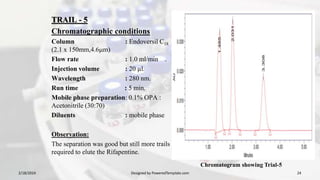
  • 55.
  • 56.
    REFERENCES 1. Pilaniya, K.,Chandrawanshi, H. K., Pilaniya, U., Manchandani, P., Jain, P., & Singh, N. Recent trends in the impurity profile of pharmaceuticals. Journal of advanced pharmaceutical technology & research, (1) (3) (2010), 302–310. https://doi.org/10.4103/0110-5558.72422 2. Abdin AY, Yeboah P, Jacob C. Chemical Impurities: An Epistemological Riddle with Serious Side Effects. Int J Environ Res Public Health. (17) (3) (2020), doi:10.3390/ijerph17031030. 3. Global Research Online - International Journal of Pharmaceutical Sciences Review and Research. (3) (2) (2010). https://www.globalresearchonline.net/pharmajournal/pharmajournal6.aspx 4. Liu, K., & Chen, C. Determination of Impurities in Pharmaceuticals: Why and How?. In P. Pereira, & S. Xavier (Eds.), Quality Management and Quality Control - New Trends and Developments. IntechOpen. (2019) doi:https://doi.org/10.5772/intechopen.83849 5. David Q. Liu, Mingjiang Sun, Alireza S. Kord,Recent advances in trace analysis of pharmaceutical genotoxic impurities,Journal of Pharmaceutical and Biomedical Analysis,(51) (5) (2010) , 999-1014, doi:https://doi.org/10.1016/j.jpba.2009.11.009. 6. Shaikh, T. Genotoxic Impurities and Its Risk Assessment in Drug Compounds, (2018). 7. N.V.V.S.S. Raman, A.V.S.S. Prasad, K. Ratnakar Reddy,Strategies for the identification, control and determination of genotoxic impurities in drug substances: A pharmaceutical industry perspective,Journal of Pharmaceutical and Biomedical Analysis,Volume (55) (4) (2011), 662-667, doi:https://doi.org/10.1016/j.jpba.2010.11.039. 8. Brigo, A. and Müller, L. Development of the Threshold of Toxicological Concern Concept and its Relationship to Duration of Exposure, in Genotoxic Impurities (Ed. A. Teasdale), John Wiley & Sons, Inc., Hoboken, NJ, USA. (2011) doi:10.1002/9780470929377.ch2 56
  • 57.
    9. Control ofGenotoxic Impurities in Active Pharmaceutical Ingredients: A Review and Perspective Derek I. Robinson Organic Process Research & Development (14) (4) (2010), doi: 946-959, 10.1021/op900341a 10. Snodin, D.J., and Elder, D. Genotoxic Impurities Part 1: General Overview. Pharmaceutical Outsourcing, (2012). 11. Reddy, Ambavaram Vijaya Bhaskar; Jaafar, Jafariah; Umar, Khalid; Majid, Zaiton Abdul; Aris, Azmi Bin; Talib, Juhaizah; Madhavi, Gajulapalle. Identification, control strategies, and analytical approaches for the determination of potential genotoxic impurities in pharmaceuticals: A comprehensive review. Journal of Separation Science, (38) (5) (2015), 764– 779. doi:10.1002/jssc.201401143 12. David Q. Liu; Mingjiang Sun; Alireza S. Kord. Recent advances in trace analysis of pharmaceuticalgenotoxic impurities, (51)(5)(2010), 999-1014, doi:10.1016/j.jpba.2009.11.009 13. Lutz Müller; Robert J. Mauthe; Christopher M. Riley; Marta M. Andino; David De Antonis; Chris Beels; Joseph DeGeorge; Alfons G.M. De Knaep; Dean Ellison; Jane A. Fagerland; Rebecca Frank; Betsy Fritschel; Sheila Galloway; Ernie Harpur; Charles D.N. Humfrey; Alexander S. Jacks; Nirdosh Jagota; John Mackinnon; Ganapathy Mohan; Daniel K. Ness; Michael R. O’Donovan; Mark D. Smith; Gopi Vudathala; Larry Yotti. A rationale for determining, testing, and controlling specific impurities in pharmaceuticals that possess potential for genotoxicity, (44) (3) (2006), 0–211. doi:10.1016/j.yrtph.2005.12.001 14. POUNIKAR, A. R., UMEKAR, M. J., & GUPTA, K. R. genotoxic impurities: An important regulatory aspect. Asian Journal of Pharmaceutical and Clinical Research, (2020), 10-25 15. Regulska K, Michalak M, Murias M, Stanisz B. Genotoxic impurities in pharmaceutical products – regula-tory, toxicological and pharmaceutical considerations. JMS. (90) (1) (2021) , doi:10.20883/medical.e502 16. Liu, David Q.; Kord, Alireza S. Analytical challenges in stability testing for genotoxic impurities. TrAC Trends in Analytical Chemistry, (49) (2013), 108–117. doi:10.1016/j.trac.2013.06.004 17. Khamis, A. M., qizi Omonova, C. T., & Mugaka, B. P. SHORT REVIEW ON GENOTOXIC IMPURITIES IN SARTANS, (2021). 18. Tuesuwan B, Vongsutilers V. Nitrosamine contamination in pharmaceuticals: threat, impact, and control. J Pharm Sci; (2021) https://doi.org/10.1016/j.xphs.2021.04.021. 57
  • 58.
    19. Dr. TabrezShaikh, Dr. Amit Gosar, & Dr. Hussain Sayyed. Nitrosamine Impurities in Drug Substances and Drug Products. Journal of Advances in Pharmacy Practices, (2) (1) (2020), 48–57. http://doi.org/10.5281/zenodo.3629095 20. Food and Drug Administration (U.S.). Control of nitrosamine impurities in human drugs: guidance for industry. Rockville, MD: Food and Drug Administration; (2020). https://www.fda.gov/regulatory-information/search-fda-guidance-documents/control- nitrosamine-impurities-human-drugs. 21. Dobo, K. L., Kenyon, M. O., Dirat, O., Engel, M., Fleetwood, A., Martin, M., Mattano, S., Musso, A., McWilliams, J. C., Papanikolaou, A., Parris, P., Whritenour, J., Yu, S., & Kalgutkar, A. S. Practical and Science-Based Strategy for Establishing Acceptable Intakes for Drug Product N-Nitrosamine Impurities. Chemical Research in Toxicology, (35) (3) (2022), 475–489. https://doi.org/10.1021/acs.chemrestox.1c00369 22. Shephard, Emily A.; Nawarskas, James J. Nitrosamine Impurities in Angiotensin Receptor Blockers. Cardiology in Review, (2020), doi:10.1097/CRD.0000000000000323. 23. N.V.V.S.S. Raman; A.V.S.S. Prasad; K. Ratnakar Reddy. Strategies for the identification, control and determination of genotoxic impurities in drug substances: A pharmaceutical industry perspective, (55) (4) (2011), 662–667. doi:10.1016/j.jpba.2010.11.039 24. Elder DP, Lipczynski AM, Teasdale A. Control and analysis of alkyl and benzyl halides and other related reactive organohalides as potential genotoxic impurities in active pharmaceutical ingredients (APIs). J Pharm Biomed Anal. (48) (3) (2008), 497-507. doi: 10.1016/j.jpba.2008.06.009. 25. Johnson, G. E., Dobo, K., Gollapudi, B., Harvey, J., Kenny, J., Kenyon, M., & Zeller, A. Permitted daily exposure limits for noteworthy N‐nitrosamines. Environmental and Molecular Mutagenesis, (62) (5) (2021), 293-305. 26. FDA Issues New Guidance on Nitrosamine Impurities in APIs and Drug Products. JD Supra. Retrieved (2022) https://www.jdsupra.com /legalnews/fda-issues-new-guidance-on-nitrosamine. 27. Unpacking FDA’s New Guidance on Controlling Nitrosamine Impurities in Drugs. (n.d.). Pharmaceutical Online. Retrieved (2022), 58
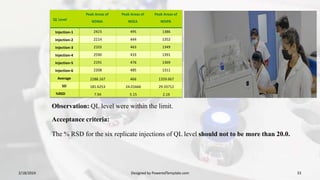
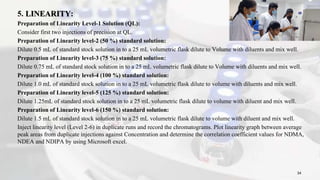
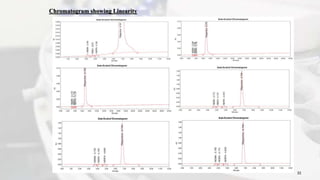
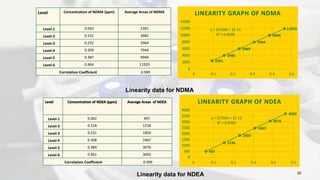
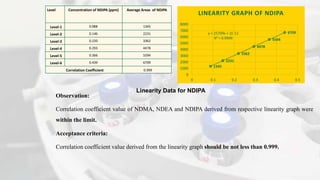
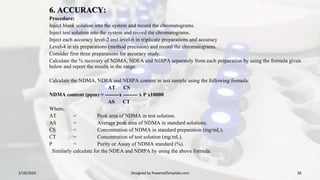
  • 59.
    28. van Arnum,P. (2021, December 2). FDA Updates Risk Mitigation for Nitrosamine Impurities. DCAT Value Chain Insights. 2(022), https://www.dcatvci.org/features/fda-updates-risk-mitigation-for-nitrosamine-impurities/ 29. Snow, S., Panesar, N., & Suman, R. Nitrosamine Impurities in Medicinal Products. PharmTech, (2022), https://www.pharmtech.com/view/nitrosamine-impurities-in-medicinal-products 30. National Center for Biotechnology Information. PubChem Compound Summary for CID 135403821, Rifapentine. Retrieved (2022) https://pubchem.ncbi.nlm.nih.gov/compound/Rifapentine. 31. Rifampin,Tuberculosis, (88) (2) (2008), 151-154, https://doi.org/10.1016/S1472-9792(08)70024-6. 32. Rifapentine hydrochloride | DrugBank Online. (2005, June 13). DrugBank. Retrieved May 22, 2022, from https://go.drugbank.com/salts/DBSALT002329 33. Priftin (rifapentine) dosing, indications, interactions, adverse effects, and more. (2020, June 17). MedScape. Retrieved May 22, 2022, from https://reference.medscape.com/drug/priftin-rifapentine-342681 34. Priftin (Rifapentine): Uses, Dosage, Side Effects, Interactions, Warning. (2020, June 18). RxList. https://www.rxlist.com/priftin- drug.htm 35. TO, A. A. S. G. Rifapentine. 36. Cloëz, S., & Frick, M. N-nitrosamines and Tuberculosis Medicines Rifampicin and Rifapentine, (2021). 37. Khaja Moinuddin Shaik , Bhaskar Sarmah , Gaurav Suresh Wadekar & Pramod Kumar: Regulatory Updates and Analytical Methodologies for Nitrosamine Impurities Detection in Sartans, Ranitidine, Nizatidine, and Metformin along with Sample Preparation Techniques, Critical Reviews in Analytical Chemistry, (2020) 10.1080/10408347.2020.1788375 38. Parr MK, Joseph JF, NDMA Impurity in Valsartan and other Pharmaceutical Products: Analytical Methods for the Determination of N- Nitrosamines, Journal of Pharmaceutical and Biomedical Analysis (2018), https://doi.org/10.1016/j.jpba.2018.11.010 39. Sebastian Schmidtsdorff, Jonas Neumann, Alexander H. Schmidt, Maria K. Parr, Analytical lifecycle management for comprehensive and universal nitrosamine analysis in various pharmaceutical formulations by supercritical fluid chromatography, Journal of Pharmaceutical and Biomedical Analysis, (197) (2021), https://doi.org/10.1016/j.jpba.2021.113960. 59
  • 60.
    40. C. Giménez-Campillo,M. Pastor-Belda, N. Campillo, M. Hernández-Córdoba, P. Viñas, Monitoring N-Nitrosamines impurities in ranitidine pharmaceuticals using microextraction and gas chromatography-mass spectrometry, Talanta, https://doi.org/10.1016/j.talanta.2020.121659. 41. Liu, J., Xie, B., Mai, B. et al. Development of a sensitive and stable GC-MS/MS method for simultaneous determination of four N- nitrosamine genotoxic impurities in sartan substances. J Anal Sci Technol (12) (3) (2021). https://doi.org/10.1186/s40543-020-00254-2 42. Khorolskiy, M., Ramenskaya, G., Vlasov, A., Perederyaev, O., & Maslennikova, N. Development and Validation of four Nitrosamine Impurities Determination Method in Medicines of Valsartan, Losartan, and Irbesartan with HPLC-MS/MS (APCI). Iranian journal of pharmaceutical research: IJPR, (20) (3) (2021), 541–552. https://doi.org/10.22037/ijpr.2021.115102.15195 43. Masada, S., Tsuji, G., Arai, R. et al. Rapid and efficient high-performance liquid chromatography analysis of N-nitrosodimethylamine impurity in valsartan drug substance and its products. Sci Rep 9, 11852 (2019). https://doi.org/10.1038/s41598-019-48344-5 44. Wisut Wichitnithad; Orawan Sudtanon; Pawadee Srisunak; Kamonrak Cheewatanakornkool; Siriwan Nantaphol; Pornchai Rojsitthisak; Development of a Sensitive Headspace Gas Chromatography–Mass Spectrometry Method for the Simultaneous Determination of Nitrosamines in Losartan Active Pharmaceutical Ingredients . ACS Omega, (2021), 10.1021/acsomega.1c00982. 45. Yahya M. Alshehri, Thamer S. Alghamdi, Fahad S. Aldawsari, HS-SPME-GC-MS as an alternative method for NDMA analysis in ranitidine products, Journal of Pharmaceutical and Biomedical Analysis, (191) (2020), 113582, https://doi.org/10.1016/j.jpba.2020.113582. 46. Murat Soyseven, RüstemKeçili, Hassan Y Aboul-Enein, GökselArli, Determination of Potential Genotoxic Impurity, 5-Amino-2- Chloropyridine, in Active Pharmaceutical Ingredient Using the HPLC-UV System, Journal of Chromatographic Science, (59) (3), (20210, 241–245, https://doi.org/10.1093/chromsci/bmaa100 47. Zheng, J., Kirkpatrick, C.L., Lee, D. et al. A Full Evaporation Static Headspace Gas Chromatography Method with Nitrogen Phosphorous Detection for Ultrasensitive Analysis of Semi-volatile Nitrosamines in Pharmaceutical Products. AAPS J 24, 23 (2022). https://doi.org/10.1208/s12248-021-00669-8 60
  • 61.
    48. R. González,G. Torrado, J.M. Arribas, M.A. Peña, Development of an analytical method for the determination and quantification of n nitrosodimethylamine in olmesartan by HPLC-MS/MS, Microchemical Journal, (179) (2022), 107402, https://doi.org/10.1016/j.microc.2022.107402. 49. Farzad Malihi, Tao Wang, An improved analytical method for quantitation of nitrosamine impurities in ophthalmic solutions using liquid chromatography with tandem mass spectrometry, Journal of Chromatography Open,(2) (2022), 100037, https://doi.org/10.1016/j.jcoa.2022.100037. 50. Schmidtsdorff S, Schmidt AH, Simultaneous detection of nitrosamines and other sartan-related impurities in active pharmaceutical ingredients by supercritical fluid chromatography, Journal of Pharmaceutical and Biomedical Analysis (2019), https://doi.org/10.1016/j.jpba.2019.04.049 51. Minju Lee, Yunho Lee, Fabian Soltermann, Urs von Gunten, Analysis of N-nitrosamines and other nitro(so) compounds in water by high- performance liquid chromatography with post-column UV photolysis/Griess reaction, Water Research, (47) (14) (2013), 4893-4903, https://doi.org/10.1016/j.watres.2013.05.031. 52. Chidella, K. , Dasari, V. and Anireddy, J. Ultra-Sensitive LC-MS/MS Method for the Trace Level Quantification of Six Potential Genotoxic Nitrosamine Impurities in Telmisartan. American Journal of Analytical Chemistry, 12, (2021), 227-240. 10.4236/ajac.2021.126014. 53. Chen, Y., Wu, S., & Yang, Q. Development and Validation of LC-MS/MS for Analyzing Potential Genotoxic Impurities in Pantoprazole Starting Materials. Journal of Analytical Methods in Chemistry, (2020), 1–8. https://doi.org/10.1155/2020/6597363. 54. Rong Li, Yahui Liu, Zhijuan Wang, Qing Zhang, Hua Bai, Qing Lv, High resolution GC–Orbitrap MS for nitrosamines analysis: Method performance, exploration of solid phase extraction regularity, and screening of children’s products, Microchemical Journal, (162), (2021), 105878. https://doi.org/10.1016/j.microc.2020.105878. 55. Lim H-Hee, Oh Y-Suk, Shin H-Sang, Determination of N-nitrosodimethylamine and N-nitrosomethylethylamine in drug substances and products of sartans, metformin and ranitidine by precipitation and solid phase extraction and gas chromatography–tandem mass spectrometry, Journal of Pharmaceutical and Biomedical Analysis (2020), doi: https://doi.org/10.1016/j.jpba.2020.113460 56. Roberts, S.W., Lennard, A., Mohan, G. et al. Meeting Report: N-Nitrosamine Impurity Control Strategies in the Pharmaceutical and Biotechnology Industries. AAPS J 23, 94 (2021). https://doi.org/10.1208/s12248-021-00618-5 61
  • 62.
    57. Winchester, L.C., Podany, A. T., Baldwin, J. S., Robbins, B. L., & Fletcher, C. V. (2015). Determination of the rifamycin antibiotics rifabutin, rifampin, rifapentine and their major metabolites in human plasma via simultaneous extraction coupled with LC/MS/MS. Journal of Pharmaceutical and Biomedical Analysis, (104), 55–61. https://doi.org/10.1016/j.jpba.2014.11.011 58. Vyas, A. J., Godhaniya, J. P., Patel, A. I., Patel, A. B., Patel, N. K., Chudasama, A., & Shah, S. R. A Review on Carcinogenic Impurities Found in Marketed Drugs and Strategies for its Determination by Analytical Methods. Asian Journal of Pharmaceutical Analysis, (2021) 159–169. https://doi.org/10.52711/2231-5675.2021.00028. 59. Graham, K. C., Lebelle, M. J., & Wilson, W. L. High Performance Liquid Chromatographic Analysis of Rifampin and Related Impurities in Pharmaceutical Formulations. Journal of Liquid Chromatography, (2) (3) (1979), 365–371. https://doi.org/10.1080/01483917908060069. 60. Vékey, K., Edwards, D. M. F., Zerilli, L. F., Màk, M., Tamàs, J., Raverdino, V., & Selva, A. Comparison of mass spectrometric methods for studying thermally labile compounds: Rifapentine. Organic Mass Spectrometry, (25) (9) (1990), 465–474. https://doi.org/10.1002/oms.1210250907 61. Patil, S., Chadar, R., Prasad, A., Koppula, P., & Koppula, S. Quantification and Validation of a HPLC-UV Method for Simultaneous Analysis of Nitrosoamine Impurities (NDMA, NDEA and NDIPA) in Losartan. Journal of Pharmaceutical Research, (20) (4) (2021), 43– 49. https://doi.org/10.18579/jopcr/v20i4.ms21084 62. Shuhong Li, Lixin Dong, Keqin Tang, Zhenwei Lan, Rong Liu, Yuanjian Wang, Ruixun Wang, Huaqing Lin, Simultaneous and trace level quantification of two potential genotoxic impurities in valsartan drug substance using UPLC-MS/MS, Journal of Pharmaceutical and Biomedical Analysis, (212) (2022), 114630, https://doi.org/10.1016/j.jpba.2022.114630. 63. Nawale, P. M., Deshpande, M. M., & Kachve, R. N. Determination of Impurity Profile in Rifapentine. International Journal of Research in Engineering, Science and Management, (3) (9) (2020), 155-158. 64. Lee, H. S., Shin, H. C., Han, S. S., & Roh, J. K. High-performance liquid chromatographic determination of rifapentine in serum using column switching. Journal of Chromatography B: Biomedical Sciences and Applications, (574) (1) (1992), 175–178. https://doi.org/10.1016/0378-4347(92)80116-8 62
  • 63.
    65. Tuesuwan, B.,& Vongsutilers, V. (2021). Nitrosamine Contamination in Pharmaceuticals: Threat, Impact, and Control. Journal of Pharmaceutical Sciences, (110) (9), 3118–3128. https://doi.org/10.1016/j.xphs.2021.04.021 66. Nagendla, N. K., Shaik, H., Balasubramanyam, S., Godugu, D., & Mudiam, M. K., Development, Validation, and Estimation of Measurement Uncertainty for the Quantitative Determination of Nitrosamines in Sartan Drugs Using LC-APCI-MS/MS. SSRN Electronic Journal (2022). https://doi.org/10.2139/ssrn.4009734 67. Monteiro, M. A., de Lima, P. C., Novotny, T. S., Santana, D. S., Lima, M. E. D., Dantas, A. S. C. L., dos Santos, L. O., de Souza, M. N., Maranho, R. L. D. N., & Ochs, S. D. M. Development and Validation of Methods Based on High-Performance Liquid Chromatography- Tandem Mass Spectrometry for Determining N-Nitrosamines Impurities in Sartan Pharmaceutical Products for Monitoring Program. SSRN Electronic Journal. (2022).https://doi.org/10.2139/ssrn.4057039 68. Bethi, Madhusudhan & Bethanamudi, Prasanna. Analytical Method Development and Validation of Impurity Profile in Rifapentine, (2017). 69. Jain, P. (n.d.). Review on Various Analytical Methods Developed for Rifapentine: An Antitubercular Drug | Jain | International Journal of Chem-informatics Research. International Journal of Chem-Informatics Research, (2022) https://chemical.journalspub.info/index.php?journal=JAWCM&page=article&op=view&path%5B%5D=209 70. Al-Kaseem, M., Al-Assaf, Z., & Karabeet, F. A Rapid, Validated RP-HPLC Method for the Determination of Seven Volatile N- Nitrosamines in Meat. Pharmacology &Amp; Pharmacy, (05) (03) (2014), 298–308. https://doi.org/10.4236/pp.2014.53037. 63