FDA Drug Topics:
Nitrosamine Impurities in Drugs:
What Health Care Professionals
Need to Know
Jacqueline Lee Hoffman, PharmD
Safety Regulatory Project Manager
Division of Gastroenterology and Inborn Errors
Products
Center for Drug Evaluation and Research
U.S. Food and Drug Administration
Sonia Kim, PharmD, MS
Team Leader
Division of Drug Information
Center for Drug Evaluation and Research
U.S. Food and Drug Administration
2
Objectives
• Describe FDA’s role in helping to
ensure the quality of drugs marketed
in the U.S.
• Discuss the drug classes that have
been affected by nitrosamine
impurities
• Identify 3 ways to obtain information
about medications recalled due to
nitrosamine impurities
3
Outline
• Background information on
nitrosamine impurities
• Nitrosamine impurities in drugs
• Understanding pharmaceutical
quality
• FDA’s role in protecting the public
• Public outreach and engagement
4
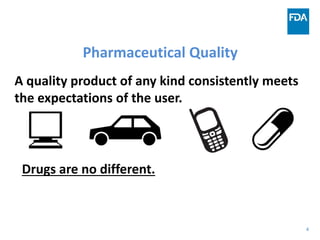
Pharmaceutical Quality
A quality product of any kind consistently meets
the expectations of the user.
Drugs are no different.
5
Patients expect safe and effective
medicine with every dose they
take.
6
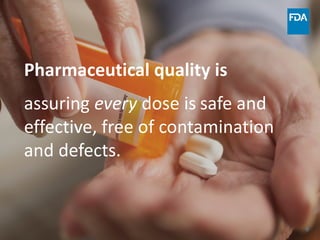
Pharmaceutical quality is
assuring every dose is safe and
effective, free of contamination
and defects.
7
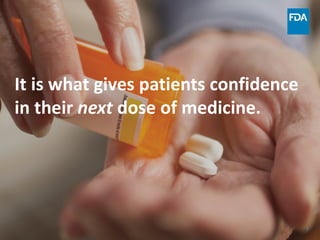
It is what gives patients confidence
in their next dose of medicine.
8
Nitrosamines
• Organic compounds that we are
exposed to in our everyday lives
• They exist in low levels in our water
and foods
 Meat
 Vegetables
 Dairy products
9
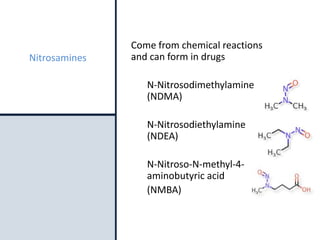
Nitrosamines
Come from chemical reactions
and can form in drugs
N-Nitrosodimethylamine
(NDMA)
N-Nitrosodiethylamine
(NDEA)
N-Nitroso-N-methyl-4-
aminobutyric acid
(NMBA)
10
Risks
• Some nitrosamines may increase the
risk of cancer if people are exposed to
them above acceptable levels and over
long periods of time
• People taking drugs that contain
NDMA at or below the acceptable daily
intake limits everyday for 70 years are
not expected to have an increased risk
of cancer
11
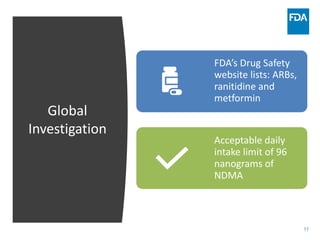
Global
Investigation
FDA’s Drug Safety
website lists: ARBs,
ranitidine and
metformin
Acceptable daily
intake limit of 96
nanograms of
NDMA
12
Global collaboration
• Nitrosamine impurities task force meets
weekly
• Global task force collaborates in real time
13
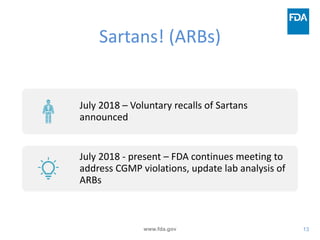
Sartans! (ARBs)
www.fda.gov
July 2018 – Voluntary recalls of Sartans
announced
July 2018 - present – FDA continues meeting to
address CGMP violations, update lab analysis of
ARBs
14
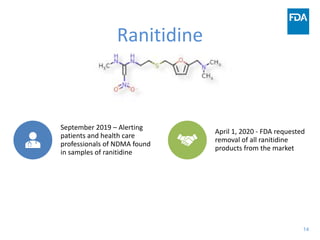
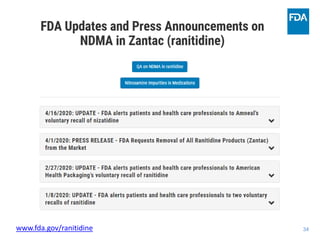
Ranitidine
September 2019 – Alerting
patients and health care
professionals of NDMA found
in samples of ranitidine
April 1, 2020 - FDA requested
removal of all ranitidine
products from the market
15
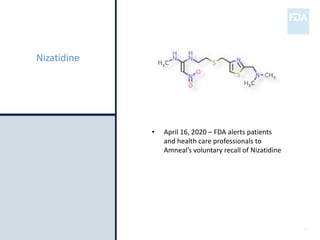
Nizatidine
• April 16, 2020 – FDA alerts patients
and health care professionals to
Amneal’s voluntary recall of Nizatidine
16
FDA
• FDA will continue to
investigate the source of
these impurities
• There are multiple reasons
why NDMA can be present in
drugs
https://www.fda.gov/news-events/press-
announcements/statement-janet-woodcock-md-director-
fdas-center-drug-evaluation-and-research-impurities-
found
17
Drugs and Impurities
• Understand Pharmaceutical Quality
18
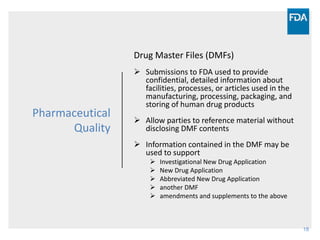
Pharmaceutical
Quality
Drug Master Files (DMFs)
 Submissions to FDA used to provide
confidential, detailed information about
facilities, processes, or articles used in the
manufacturing, processing, packaging, and
storing of human drug products
 Allow parties to reference material without
disclosing DMF contents
 Information contained in the DMF may be
used to support
 Investigational New Drug Application
 New Drug Application
 Abbreviated New Drug Application
 another DMF
 amendments and supplements to the above
19
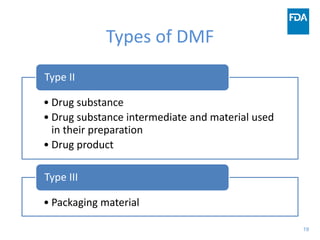
Types of DMF
• Drug substance
• Drug substance intermediate and material used
in their preparation
• Drug product
Type II
• Packaging material
Type III
20
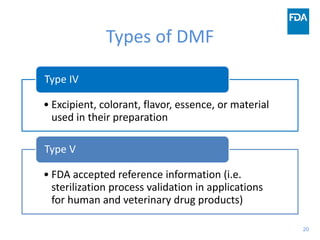
Types of DMF
• Excipient, colorant, flavor, essence, or material
used in their preparation
Type IV
• FDA accepted reference information (i.e.
sterilization process validation in applications
for human and veterinary drug products)
Type V
21
M1 M2 M3 M4 M5 M6 M7 M8 M9 M10
M-6 M-3
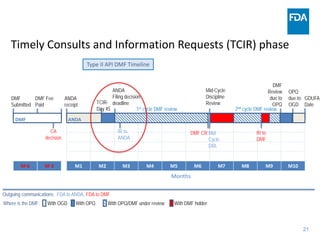
Timely Consults and Information Requests (TCIR) phase
Type II API DMF Timeline
Months
ANDA
receipt
ANDA
Filing decision
deadline
Mid-Cycle
Discipline
Review
GDUFA
Date
ANDA
DMF Fee
Paid
DMF
Submitted
Where is the DMF:
DMF
TCIR-
Day 45
DMF
Review
due to
OPQ
OPQ
due to
OGD
1st cycle DMF review 2nd cycle DMF review
Mid-
Cycle
DRL
CA
decision
IR to
ANDA
DMF CR IR to
DMF
With OGD With OPQ With DMF holder
With OPQ/DMF under review
Outgoing communications: FDA to ANDA, FDA to DMF
22
M1 M2 M3 M4 M5 M6 M7 M8 M9 M10
M-6 M-3
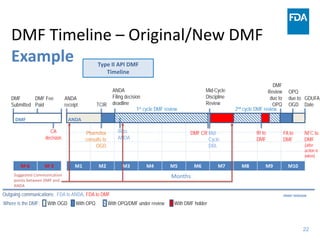
DMF Timeline – Original/New DMF
Example Type II API DMF
Timeline
Months
ANDA
receipt
ANDA
Filing decision
deadline
Mid-Cycle
Discipline
Review
GDUFA
Date
ANDA
DMF Fee
Paid
DMF
Submitted
Where is the DMF:
DMF
TCIR
DMF
Review
due to
OPQ
OPQ
due to
OGD
1st cycle DMF review 2nd cycle DMF review
With OGD With OPQ With DMF holder
With OPQ/DMF under review
Outgoing communications: FDA to ANDA, FDA to DMF
Mid-
Cycle
DRL
CA
decision
IR to
ANDA
DMF CR IR to
DMF
FA to
DMF
NFC to
DMF
(after
action is
taken)
Suggested Communication
points between DMF and
ANDA
PRINT VERSION
Pharm/tox
consults to
OGD
23
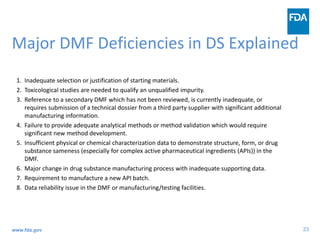
Major DMF Deficiencies in DS Explained
1. Inadequate selection or justification of starting materials.
2. Toxicological studies are needed to qualify an unqualified impurity.
3. Reference to a secondary DMF which has not been reviewed, is currently inadequate, or
requires submission of a technical dossier from a third party supplier with significant additional
manufacturing information.
4. Failure to provide adequate analytical methods or method validation which would require
significant new method development.
5. Insufficient physical or chemical characterization data to demonstrate structure, form, or drug
substance sameness (especially for complex active pharmaceutical ingredients (APIs)) in the
DMF.
6. Major change in drug substance manufacturing process with inadequate supporting data.
7. Requirement to manufacture a new API batch.
8. Data reliability issue in the DMF or manufacturing/testing facilities.
www.fda.gov
24
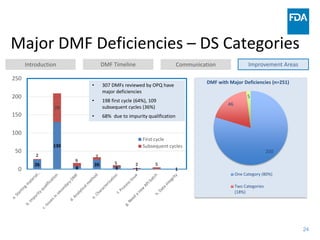
Major DMF Deficiencies – DS Categories
DMF Timeline Communication Improvement Areas
Introduction
26
130
8
26
6 1 1
2
79
9
7
5 2 5
0
50
100
150
200
250
First cycle
Subsequent cycles
200
46
5
One Category (80%)
Two Categories
(18%)
DMF with Major Deficiencies (n=251)
• 307 DMFs reviewed by OPQ have
major deficiencies
• 198 first cycle (64%), 109
subsequent cycles (36%)
• 68% due to impurity qualification
25
Nitrosamine
Task Force
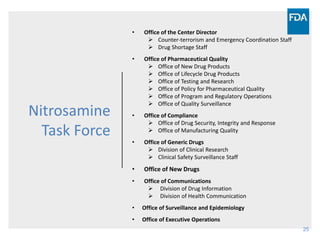
• Office of the Center Director
 Counter-terrorism and Emergency Coordination Staff
 Drug Shortage Staff
• Office of Pharmaceutical Quality
 Office of New Drug Products
 Office of Lifecycle Drug Products
 Office of Testing and Research
 Office of Policy for Pharmaceutical Quality
 Office of Program and Regulatory Operations
 Office of Quality Surveillance
• Office of Compliance
 Office of Drug Security, Integrity and Response
 Office of Manufacturing Quality
• Office of Generic Drugs
 Division of Clinical Research
 Clinical Safety Surveillance Staff
• Office of New Drugs
• Office of Communications
 Division of Drug Information
 Division of Health Communication
• Office of Surveillance and Epidemiology
• Office of Executive Operations
26
Division of
Drug
Information
• The Division of Drug Information is the
Center for Drug Evaluation and
Research’s focal point for public
inquiries regarding human drug
products
• The Division of Drug Information
supports the Food and Drug
Administration’s mission to promote
and protect public health
27
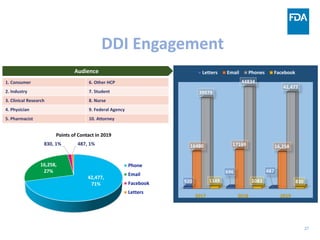
2017 2018 2019
920
696 487
16480 17169 16,258
39979
44834
42,477
1149 1083 830
Letters Email Phones Facebook
42,477,
71%
16,258,
27%
830, 1% 487, 1%
Phone
Email
Facebook
Letters
Points of Contact in 2019
1. Consumer 6. Other HCP
2. Industry 7. Student
3. Clinical Research 8. Nurse
4. Physician 9. Federal Agency
5. Pharmacist 10. Attorney
Audience
DDI Engagement
28
29
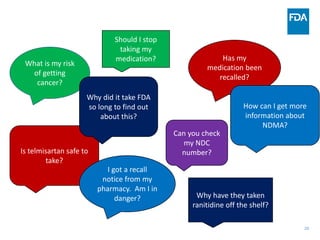
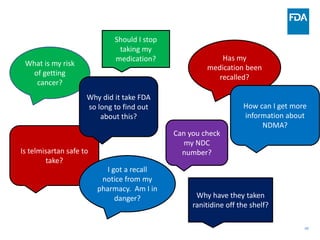
Should I stop
taking my
medication?
Can you check
my NDC
number?
Has my
medication been
recalled?
Why have they taken
ranitidine off the shelf?
Is telmisartan safe to
take?
I got a recall
notice from my
pharmacy. Am I in
danger?
How can I get more
information about
NDMA?
What is my risk
of getting
cancer?
Why did it take FDA
so long to find out
about this?
30
Main Message
• Patient safety is FDA’s top priority
• Patients should not stop taking their
medications without first talking to their
health care provider
• Health care providers and consumers can
stay up to date with FDA resources
31
Resources
• FDA Website
• CDER Social Media
• Live Webinars
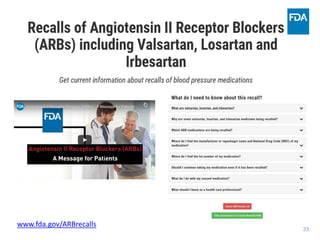
• DDI
32
FDA
Website
• Updates and press announcements
Warning letters
Agency statements
Testing methods and results
• Recall information
• Q&A
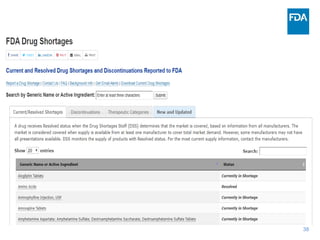
• Drug shortages
33
www.fda.gov/ARBrecalls
34
www.fda.gov/ranitidine
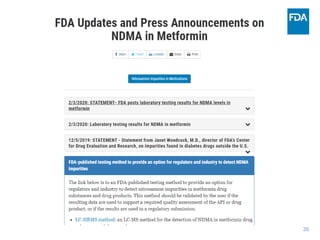
35
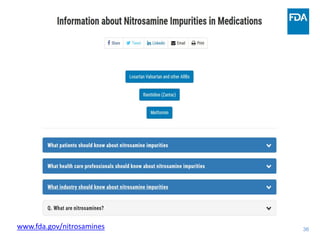
36
www.fda.gov/nitrosamines
37
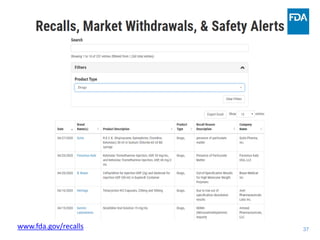
www.fda.gov/recalls
38
39
CDER
Social
Media
• Facebook
• Twitter
• LinkedIn
40
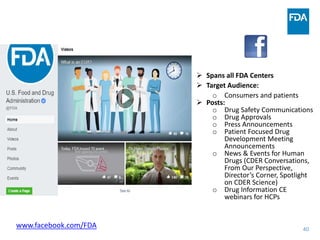
 Spans all FDA Centers
 Target Audience:
o Consumers and patients
 Posts:
o Drug Safety Communications
o Drug Approvals
o Press Announcements
o Patient Focused Drug
Development Meeting
Announcements
o News & Events for Human
Drugs (CDER Conversations,
From Our Perspective,
Director’s Corner, Spotlight
on CDER Science)
o Drug Information CE
webinars for HCPs
www.facebook.com/FDA
41
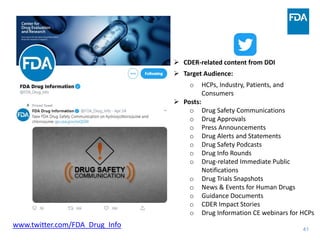
www.twitter.com/FDA_Drug_Info
 CDER-related content from DDI
 Target Audience:
o HCPs, Industry, Patients, and
Consumers
 Posts:
o Drug Safety Communications
o Drug Approvals
o Press Announcements
o Drug Alerts and Statements
o Drug Safety Podcasts
o Drug Info Rounds
o Drug-related Immediate Public
Notifications
o Drug Trials Snapshots
o News & Events for Human Drugs
o Guidance Documents
o CDER Impact Stories
o Drug Information CE webinars for HCPs
42
43
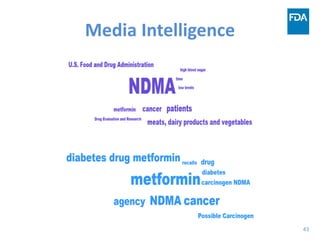
Media Intelligence
44
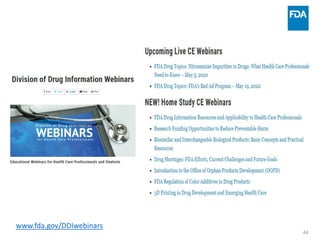
www.fda.gov/DDIwebinars
45
DDI Contact Information
Phone Contacts
• Drug Information 855-543-DRUG or 888-INFO-FDA
• MedWatch 800-FDA-1088
• Small Business and Industry Assistance 866-405-5367
• eIND requests during regular business hours
Email accounts
• DrugInfo@fda.hhs.gov
• CDERSBIA@fda.hhs.gov
• AskGDUFA@fda.hhs.gov
www.fda.gov/aboutDDI
46
Should I stop
taking my
medication?
Can you check
my NDC
number?
Has my
medication been
recalled?
Why have they taken
ranitidine off the shelf?
Is telmisartan safe to
take?
I got a recall
notice from my
pharmacy. Am I in
danger?
How can I get more
information about
NDMA?
What is my risk
of getting
cancer?
Why did it take FDA
so long to find out
about this?
53
Questions?
Division of Drug Information
855-543-DRUG (3784)
301-796-3400
druginfo@fda.hhs.gov
www.fda.gov/aboutDDI
www.fda.gov
DDI Webinars Nitrosamines US FDA Guidance

DDI Webinars Nitrosamines US FDA Guidance

  • 1.
    FDA Drug Topics: NitrosamineImpurities in Drugs: What Health Care Professionals Need to Know Jacqueline Lee Hoffman, PharmD Safety Regulatory Project Manager Division of Gastroenterology and Inborn Errors Products Center for Drug Evaluation and Research U.S. Food and Drug Administration Sonia Kim, PharmD, MS Team Leader Division of Drug Information Center for Drug Evaluation and Research U.S. Food and Drug Administration
  • 2.
    2 Objectives • Describe FDA’srole in helping to ensure the quality of drugs marketed in the U.S. • Discuss the drug classes that have been affected by nitrosamine impurities • Identify 3 ways to obtain information about medications recalled due to nitrosamine impurities
  • 3.
    3 Outline • Background informationon nitrosamine impurities • Nitrosamine impurities in drugs • Understanding pharmaceutical quality • FDA’s role in protecting the public • Public outreach and engagement
  • 4.
    4 Pharmaceutical Quality A qualityproduct of any kind consistently meets the expectations of the user. Drugs are no different.
  • 5.
    5 Patients expect safeand effective medicine with every dose they take.
  • 6.
    6 Pharmaceutical quality is assuringevery dose is safe and effective, free of contamination and defects.
  • 7.
    7 It is whatgives patients confidence in their next dose of medicine.
  • 8.
    8 Nitrosamines • Organic compoundsthat we are exposed to in our everyday lives • They exist in low levels in our water and foods  Meat  Vegetables  Dairy products
  • 9.
    9 Nitrosamines Come from chemicalreactions and can form in drugs N-Nitrosodimethylamine (NDMA) N-Nitrosodiethylamine (NDEA) N-Nitroso-N-methyl-4- aminobutyric acid (NMBA)
  • 10.
    10 Risks • Some nitrosaminesmay increase the risk of cancer if people are exposed to them above acceptable levels and over long periods of time • People taking drugs that contain NDMA at or below the acceptable daily intake limits everyday for 70 years are not expected to have an increased risk of cancer
  • 11.
    11 Global Investigation FDA’s Drug Safety websitelists: ARBs, ranitidine and metformin Acceptable daily intake limit of 96 nanograms of NDMA
  • 12.
    12 Global collaboration • Nitrosamineimpurities task force meets weekly • Global task force collaborates in real time
  • 13.
    13 Sartans! (ARBs) www.fda.gov July 2018– Voluntary recalls of Sartans announced July 2018 - present – FDA continues meeting to address CGMP violations, update lab analysis of ARBs
  • 14.
    14 Ranitidine September 2019 –Alerting patients and health care professionals of NDMA found in samples of ranitidine April 1, 2020 - FDA requested removal of all ranitidine products from the market
  • 15.
    15 Nizatidine • April 16,2020 – FDA alerts patients and health care professionals to Amneal’s voluntary recall of Nizatidine
  • 16.
    16 FDA • FDA willcontinue to investigate the source of these impurities • There are multiple reasons why NDMA can be present in drugs https://www.fda.gov/news-events/press- announcements/statement-janet-woodcock-md-director- fdas-center-drug-evaluation-and-research-impurities- found
  • 17.
    17 Drugs and Impurities •Understand Pharmaceutical Quality
  • 18.
    18 Pharmaceutical Quality Drug Master Files(DMFs)  Submissions to FDA used to provide confidential, detailed information about facilities, processes, or articles used in the manufacturing, processing, packaging, and storing of human drug products  Allow parties to reference material without disclosing DMF contents  Information contained in the DMF may be used to support  Investigational New Drug Application  New Drug Application  Abbreviated New Drug Application  another DMF  amendments and supplements to the above
  • 19.
    19 Types of DMF •Drug substance • Drug substance intermediate and material used in their preparation • Drug product Type II • Packaging material Type III
  • 20.
    20 Types of DMF •Excipient, colorant, flavor, essence, or material used in their preparation Type IV • FDA accepted reference information (i.e. sterilization process validation in applications for human and veterinary drug products) Type V
  • 21.
    21 M1 M2 M3M4 M5 M6 M7 M8 M9 M10 M-6 M-3 Timely Consults and Information Requests (TCIR) phase Type II API DMF Timeline Months ANDA receipt ANDA Filing decision deadline Mid-Cycle Discipline Review GDUFA Date ANDA DMF Fee Paid DMF Submitted Where is the DMF: DMF TCIR- Day 45 DMF Review due to OPQ OPQ due to OGD 1st cycle DMF review 2nd cycle DMF review Mid- Cycle DRL CA decision IR to ANDA DMF CR IR to DMF With OGD With OPQ With DMF holder With OPQ/DMF under review Outgoing communications: FDA to ANDA, FDA to DMF
  • 22.
    22 M1 M2 M3M4 M5 M6 M7 M8 M9 M10 M-6 M-3 DMF Timeline – Original/New DMF Example Type II API DMF Timeline Months ANDA receipt ANDA Filing decision deadline Mid-Cycle Discipline Review GDUFA Date ANDA DMF Fee Paid DMF Submitted Where is the DMF: DMF TCIR DMF Review due to OPQ OPQ due to OGD 1st cycle DMF review 2nd cycle DMF review With OGD With OPQ With DMF holder With OPQ/DMF under review Outgoing communications: FDA to ANDA, FDA to DMF Mid- Cycle DRL CA decision IR to ANDA DMF CR IR to DMF FA to DMF NFC to DMF (after action is taken) Suggested Communication points between DMF and ANDA PRINT VERSION Pharm/tox consults to OGD
  • 23.
    23 Major DMF Deficienciesin DS Explained 1. Inadequate selection or justification of starting materials. 2. Toxicological studies are needed to qualify an unqualified impurity. 3. Reference to a secondary DMF which has not been reviewed, is currently inadequate, or requires submission of a technical dossier from a third party supplier with significant additional manufacturing information. 4. Failure to provide adequate analytical methods or method validation which would require significant new method development. 5. Insufficient physical or chemical characterization data to demonstrate structure, form, or drug substance sameness (especially for complex active pharmaceutical ingredients (APIs)) in the DMF. 6. Major change in drug substance manufacturing process with inadequate supporting data. 7. Requirement to manufacture a new API batch. 8. Data reliability issue in the DMF or manufacturing/testing facilities. www.fda.gov
  • 24.
    24 Major DMF Deficiencies– DS Categories DMF Timeline Communication Improvement Areas Introduction 26 130 8 26 6 1 1 2 79 9 7 5 2 5 0 50 100 150 200 250 First cycle Subsequent cycles 200 46 5 One Category (80%) Two Categories (18%) DMF with Major Deficiencies (n=251) • 307 DMFs reviewed by OPQ have major deficiencies • 198 first cycle (64%), 109 subsequent cycles (36%) • 68% due to impurity qualification
  • 25.
    25 Nitrosamine Task Force • Officeof the Center Director  Counter-terrorism and Emergency Coordination Staff  Drug Shortage Staff • Office of Pharmaceutical Quality  Office of New Drug Products  Office of Lifecycle Drug Products  Office of Testing and Research  Office of Policy for Pharmaceutical Quality  Office of Program and Regulatory Operations  Office of Quality Surveillance • Office of Compliance  Office of Drug Security, Integrity and Response  Office of Manufacturing Quality • Office of Generic Drugs  Division of Clinical Research  Clinical Safety Surveillance Staff • Office of New Drugs • Office of Communications  Division of Drug Information  Division of Health Communication • Office of Surveillance and Epidemiology • Office of Executive Operations
  • 26.
    26 Division of Drug Information • TheDivision of Drug Information is the Center for Drug Evaluation and Research’s focal point for public inquiries regarding human drug products • The Division of Drug Information supports the Food and Drug Administration’s mission to promote and protect public health
  • 27.
    27 2017 2018 2019 920 696487 16480 17169 16,258 39979 44834 42,477 1149 1083 830 Letters Email Phones Facebook 42,477, 71% 16,258, 27% 830, 1% 487, 1% Phone Email Facebook Letters Points of Contact in 2019 1. Consumer 6. Other HCP 2. Industry 7. Student 3. Clinical Research 8. Nurse 4. Physician 9. Federal Agency 5. Pharmacist 10. Attorney Audience DDI Engagement
  • 28.
  • 29.
    29 Should I stop takingmy medication? Can you check my NDC number? Has my medication been recalled? Why have they taken ranitidine off the shelf? Is telmisartan safe to take? I got a recall notice from my pharmacy. Am I in danger? How can I get more information about NDMA? What is my risk of getting cancer? Why did it take FDA so long to find out about this?
  • 30.
    30 Main Message • Patientsafety is FDA’s top priority • Patients should not stop taking their medications without first talking to their health care provider • Health care providers and consumers can stay up to date with FDA resources
  • 31.
    31 Resources • FDA Website •CDER Social Media • Live Webinars • DDI
  • 32.
    32 FDA Website • Updates andpress announcements Warning letters Agency statements Testing methods and results • Recall information • Q&A • Drug shortages
  • 33.
  • 34.
  • 35.
  • 36.
  • 37.
  • 38.
  • 39.
  • 40.
    40  Spans allFDA Centers  Target Audience: o Consumers and patients  Posts: o Drug Safety Communications o Drug Approvals o Press Announcements o Patient Focused Drug Development Meeting Announcements o News & Events for Human Drugs (CDER Conversations, From Our Perspective, Director’s Corner, Spotlight on CDER Science) o Drug Information CE webinars for HCPs www.facebook.com/FDA
  • 41.
    41 www.twitter.com/FDA_Drug_Info  CDER-related contentfrom DDI  Target Audience: o HCPs, Industry, Patients, and Consumers  Posts: o Drug Safety Communications o Drug Approvals o Press Announcements o Drug Alerts and Statements o Drug Safety Podcasts o Drug Info Rounds o Drug-related Immediate Public Notifications o Drug Trials Snapshots o News & Events for Human Drugs o Guidance Documents o CDER Impact Stories o Drug Information CE webinars for HCPs
  • 42.
  • 43.
  • 44.
  • 45.
    45 DDI Contact Information PhoneContacts • Drug Information 855-543-DRUG or 888-INFO-FDA • MedWatch 800-FDA-1088 • Small Business and Industry Assistance 866-405-5367 • eIND requests during regular business hours Email accounts • DrugInfo@fda.hhs.gov • CDERSBIA@fda.hhs.gov • AskGDUFA@fda.hhs.gov www.fda.gov/aboutDDI
  • 46.
    46 Should I stop takingmy medication? Can you check my NDC number? Has my medication been recalled? Why have they taken ranitidine off the shelf? Is telmisartan safe to take? I got a recall notice from my pharmacy. Am I in danger? How can I get more information about NDMA? What is my risk of getting cancer? Why did it take FDA so long to find out about this?
  • 47.
    53 Questions? Division of DrugInformation 855-543-DRUG (3784) 301-796-3400 druginfo@fda.hhs.gov www.fda.gov/aboutDDI www.fda.gov