Submitted by
Thara .R
INTRODUCTION
Two basic types of biogeo chemical cycles.
Gaseous cycle
Sedimentary cycle
 Gaseous cycle – carbon cycle, nitrogen cycle and oxygen cycle.
 Nitrogen is converted between its various chemical forms through following
steps.
1. Nitrogen fixation
2.Ammonic fixation
3.Nitrification
4.De nitrification
5.Assimilation
 Content about 78%
 Essential constituent of plants and animals.
 Plants take up nitrogen either as nitrates or ammonia.
Due to thunderstorm and lightening the gaseous nitrogen is converted in to
nitric oxide.
PROCESSES OF NITROGEN CYCLE
 Nitrogen present in variety of forms
 Organic nitrogen, nitrous oxide (NO) or inorganic
nitrogen gas (N2)
 Processes of the nitrogen cycle transforms nitrogen
from one form to another
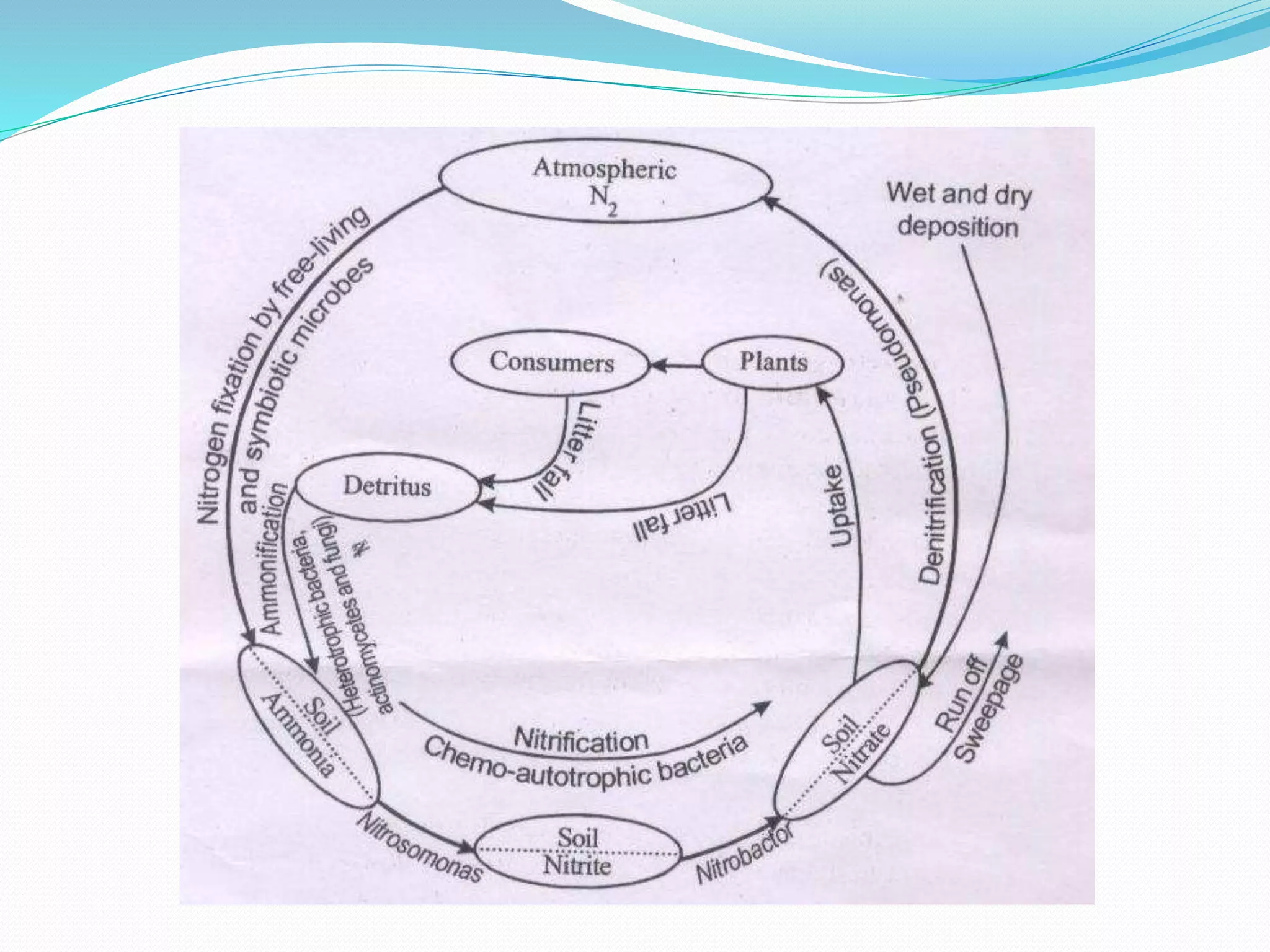
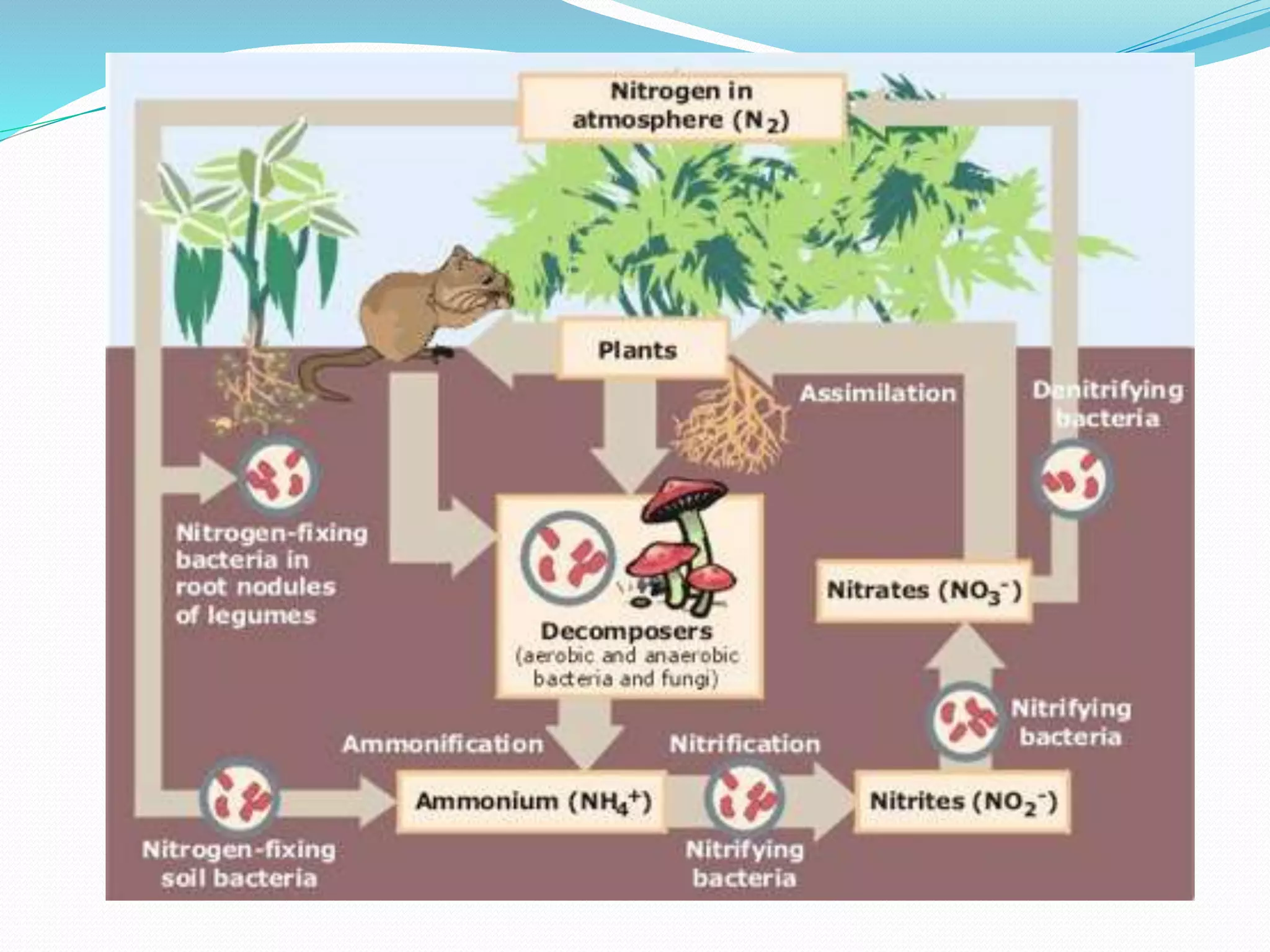
NITROGEN CYCLE
 The major reservoir of nitrogen – Atmosphere
 Various steps involved in this cycle
Nitrogen fixation
 Atmospheric free nitrogen _ Ammonia
Nitrogen fixation are of two type
 None biological fixation
 Biological fixation
NONE BIOLOGICAL FIXATION
 Physical process/ high energy fixation
 Two processes
 Natural process ie, photochemical fixation
 Man made process ie, industrial fixation
a) Photochemical Fixation/Natural
process
 Dissociation of nitrogen molecule and its combination
with oxygen and hydrogen of water provided by
lightening
 The high energy is required
 It is provided by cosmic radiation and meteorite trails
b) Industrial Fixation/ Man
Made Process
 Fertilizers in various industries
 Most chemical fertilizers are nitrates or ammonium
 For agriculture field to yield crop to increase soil
fertility
BIOLOGICAL FIXATION
 Carried out by certain bacteria cyanobacteria and few
fungi
 Nitrogen is fixed in the form of ammonia –
Ammonium salts or nitrates
 Nitrogen fixing organisms are called diazotrophs
This process is two type
 Symbiotic nitrogen fixation
 Non-symbiotic nitrogen fixation
SYMBIOTIC NITROGEN FIXATION
 Carried out by micro organisms
 Symbiotic nitrogen fixation
 Rhizobium that lives in the root nodules of
leguminous plants.
NON SYMBIOTIC NITROGEN FIXATION
 Carried out by micro-organisms.
 Living free in the soil.
Eg:- Bacteria : Basillus, Clostridium Pasteurianum
Aerobicforms: Azotobacter
Blue green algae(cyanobacteria):Nostoc,Anabaena
AMMONIFICATION
 Ammonification organic matter converted to
Ammonia
 Heterotrophic bacteria, actinomycetes and fungi
 Organic nitrogen – Inorganic form as ammonia.
 Energy releasing reaction.
NITRIFICATION
 Ammonia/ ammonium salts-nitrites and nitrates.
 This process – nitrification.
 NH3 cannot be utilized directly.
DE-NITRIFICATION
 Bacteria and fungi convert nitrates – nitrites, nitrous
oxide
 De-nitrification – conversion of nitrates to gaseous
nitrogen gas
 Occur in oxygen depleted water – logged soils.
 Common denitrifying bacteria- Pseudomonas,
Thiobacillus.
NO3 - NO2- NO2 NO N2
(Nitrate) (Nitrite) (Nitrous oxide) (Nitric oxide) (Nitrogen gas)
ASSIMILATION
 Principle source of nitrogen for plants – Nitrate ions
and water
 Nitrate assimilation – absorb nitrates for the synthesis
of proteins.
CONCLUSION
 Nitrogen is an important components.
 This conversion is a Cyclic process.
 The process of nitrogen cycle transforms nitrogen
from one form to another.
NITROGEN CYCLE.pdf
NITROGEN CYCLE.pdf
NITROGEN CYCLE.pdf

NITROGEN CYCLE.pdf

  • 1.
  • 2.
    INTRODUCTION Two basic typesof biogeo chemical cycles. Gaseous cycle Sedimentary cycle  Gaseous cycle – carbon cycle, nitrogen cycle and oxygen cycle.  Nitrogen is converted between its various chemical forms through following steps. 1. Nitrogen fixation 2.Ammonic fixation 3.Nitrification 4.De nitrification 5.Assimilation  Content about 78%  Essential constituent of plants and animals.  Plants take up nitrogen either as nitrates or ammonia. Due to thunderstorm and lightening the gaseous nitrogen is converted in to nitric oxide.
  • 3.
    PROCESSES OF NITROGENCYCLE  Nitrogen present in variety of forms  Organic nitrogen, nitrous oxide (NO) or inorganic nitrogen gas (N2)  Processes of the nitrogen cycle transforms nitrogen from one form to another
  • 4.
    NITROGEN CYCLE  Themajor reservoir of nitrogen – Atmosphere  Various steps involved in this cycle Nitrogen fixation  Atmospheric free nitrogen _ Ammonia Nitrogen fixation are of two type  None biological fixation  Biological fixation
  • 5.
    NONE BIOLOGICAL FIXATION Physical process/ high energy fixation  Two processes  Natural process ie, photochemical fixation  Man made process ie, industrial fixation
  • 6.
    a) Photochemical Fixation/Natural process Dissociation of nitrogen molecule and its combination with oxygen and hydrogen of water provided by lightening  The high energy is required  It is provided by cosmic radiation and meteorite trails
  • 7.
    b) Industrial Fixation/Man Made Process  Fertilizers in various industries  Most chemical fertilizers are nitrates or ammonium  For agriculture field to yield crop to increase soil fertility
  • 8.
    BIOLOGICAL FIXATION  Carriedout by certain bacteria cyanobacteria and few fungi  Nitrogen is fixed in the form of ammonia – Ammonium salts or nitrates  Nitrogen fixing organisms are called diazotrophs This process is two type  Symbiotic nitrogen fixation  Non-symbiotic nitrogen fixation
  • 9.
    SYMBIOTIC NITROGEN FIXATION Carried out by micro organisms  Symbiotic nitrogen fixation  Rhizobium that lives in the root nodules of leguminous plants.
  • 10.
    NON SYMBIOTIC NITROGENFIXATION  Carried out by micro-organisms.  Living free in the soil. Eg:- Bacteria : Basillus, Clostridium Pasteurianum Aerobicforms: Azotobacter Blue green algae(cyanobacteria):Nostoc,Anabaena
  • 11.
    AMMONIFICATION  Ammonification organicmatter converted to Ammonia  Heterotrophic bacteria, actinomycetes and fungi  Organic nitrogen – Inorganic form as ammonia.  Energy releasing reaction.
  • 12.
    NITRIFICATION  Ammonia/ ammoniumsalts-nitrites and nitrates.  This process – nitrification.  NH3 cannot be utilized directly.
  • 13.
    DE-NITRIFICATION  Bacteria andfungi convert nitrates – nitrites, nitrous oxide  De-nitrification – conversion of nitrates to gaseous nitrogen gas  Occur in oxygen depleted water – logged soils.  Common denitrifying bacteria- Pseudomonas, Thiobacillus. NO3 - NO2- NO2 NO N2 (Nitrate) (Nitrite) (Nitrous oxide) (Nitric oxide) (Nitrogen gas)
  • 14.
    ASSIMILATION  Principle sourceof nitrogen for plants – Nitrate ions and water  Nitrate assimilation – absorb nitrates for the synthesis of proteins.
  • 15.
    CONCLUSION  Nitrogen isan important components.  This conversion is a Cyclic process.  The process of nitrogen cycle transforms nitrogen from one form to another.