Lecture 1
BASIC CONCEPTS OF CHEMISTRY
Prepared by PhD Valentina Yuz’kova
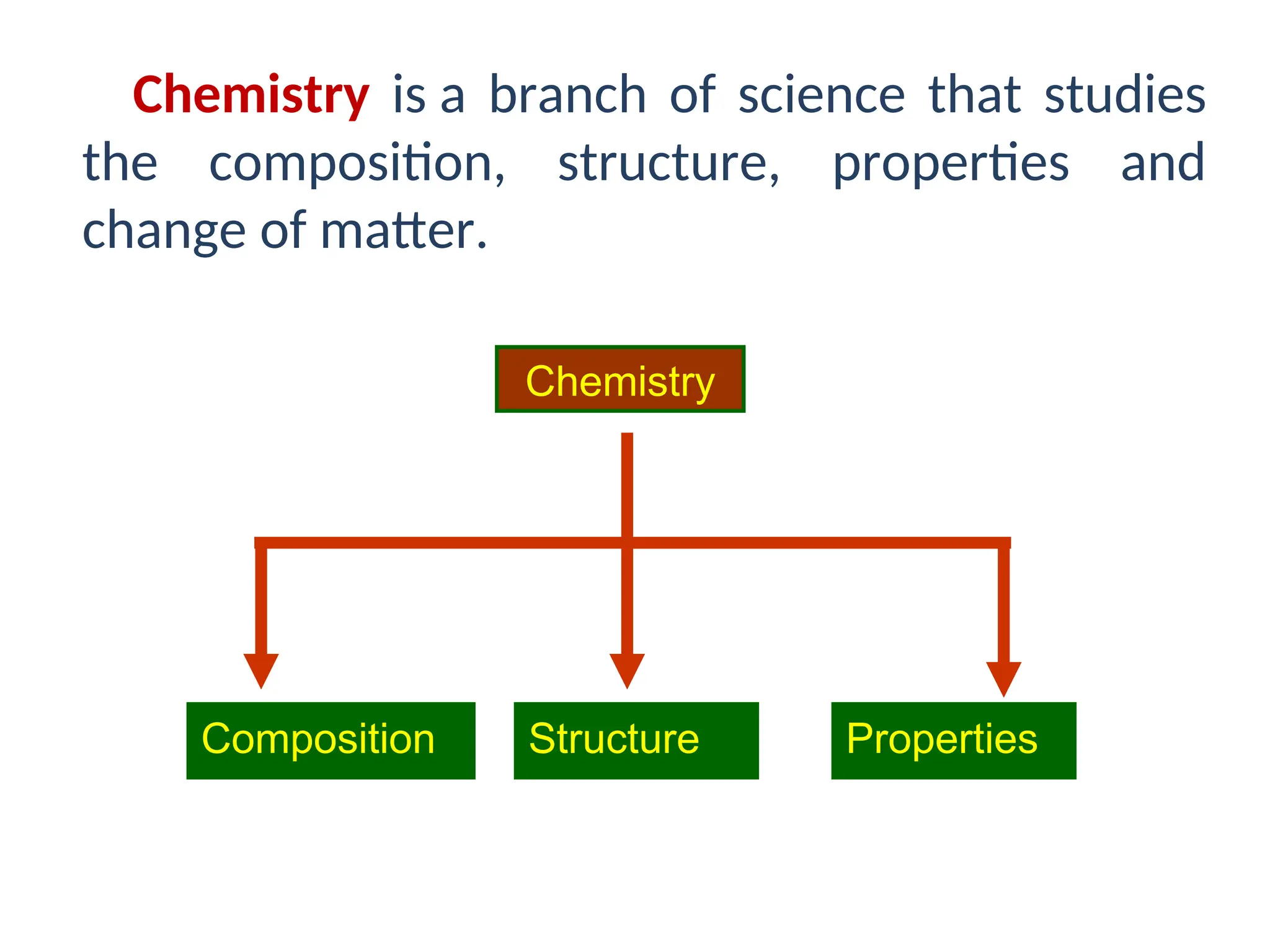
Chemistry
Chemistry is a branch of science that studies
the composition, structure, properties and
change of matter.
Chemistry
Composition Structure Properties
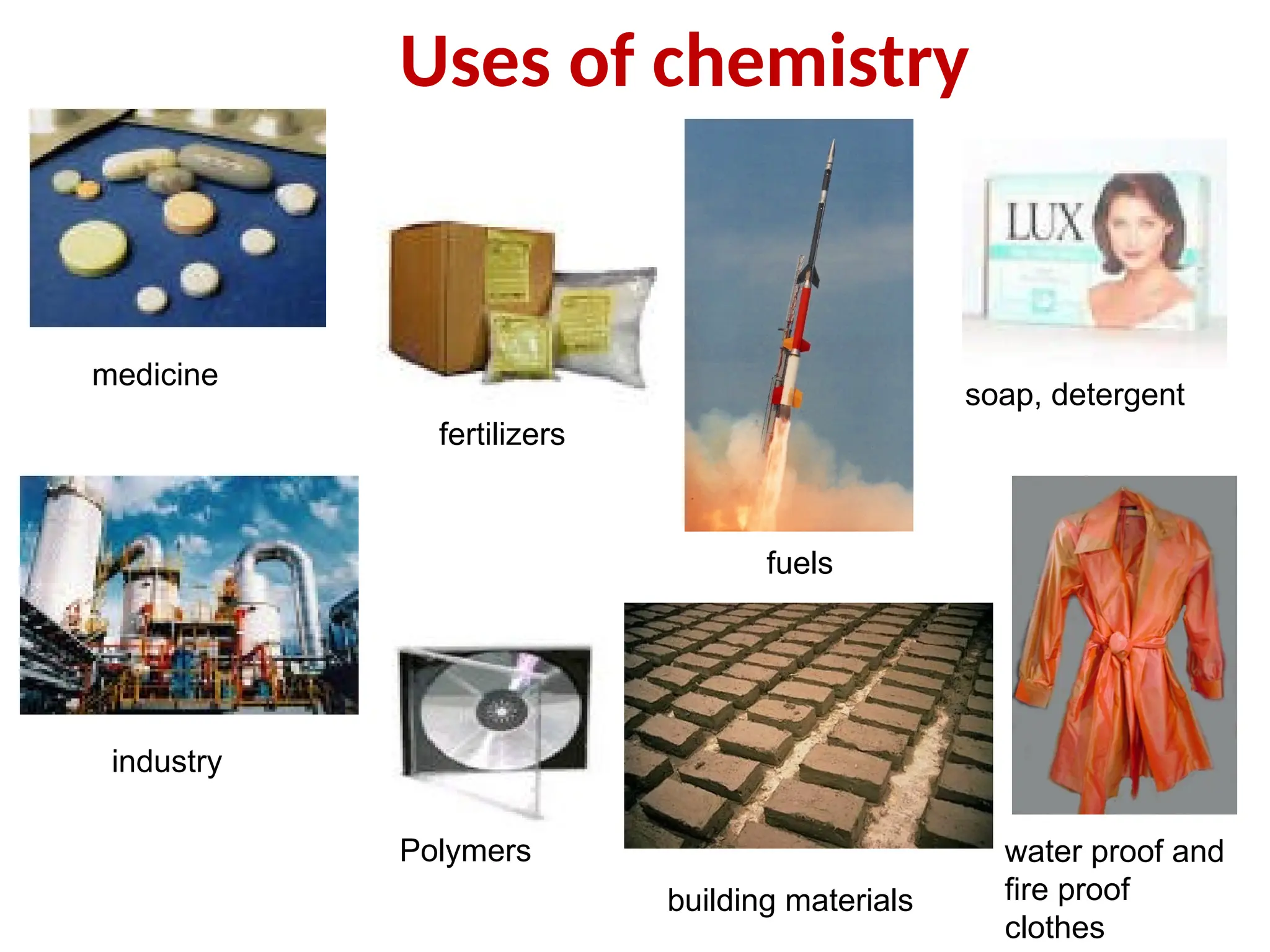
Uses of chemistry
medicine
fertilizers
industry
Polymers
soap, detergent
fuels
building materials
water proof and
fire proof
clothes
Abuses of chemistry
lead to environmental
problems
Ozone
depletion
Water
pollution
Acid rains
Green house
effect
Branches of chemistry
Physical chemistry
Organic chemistry
Inorganic chemistry
Analytical chemistry
Medical chemistry
Bio chemistry
Industrial chemistry
Agricultural chemistry
Geo chemistry
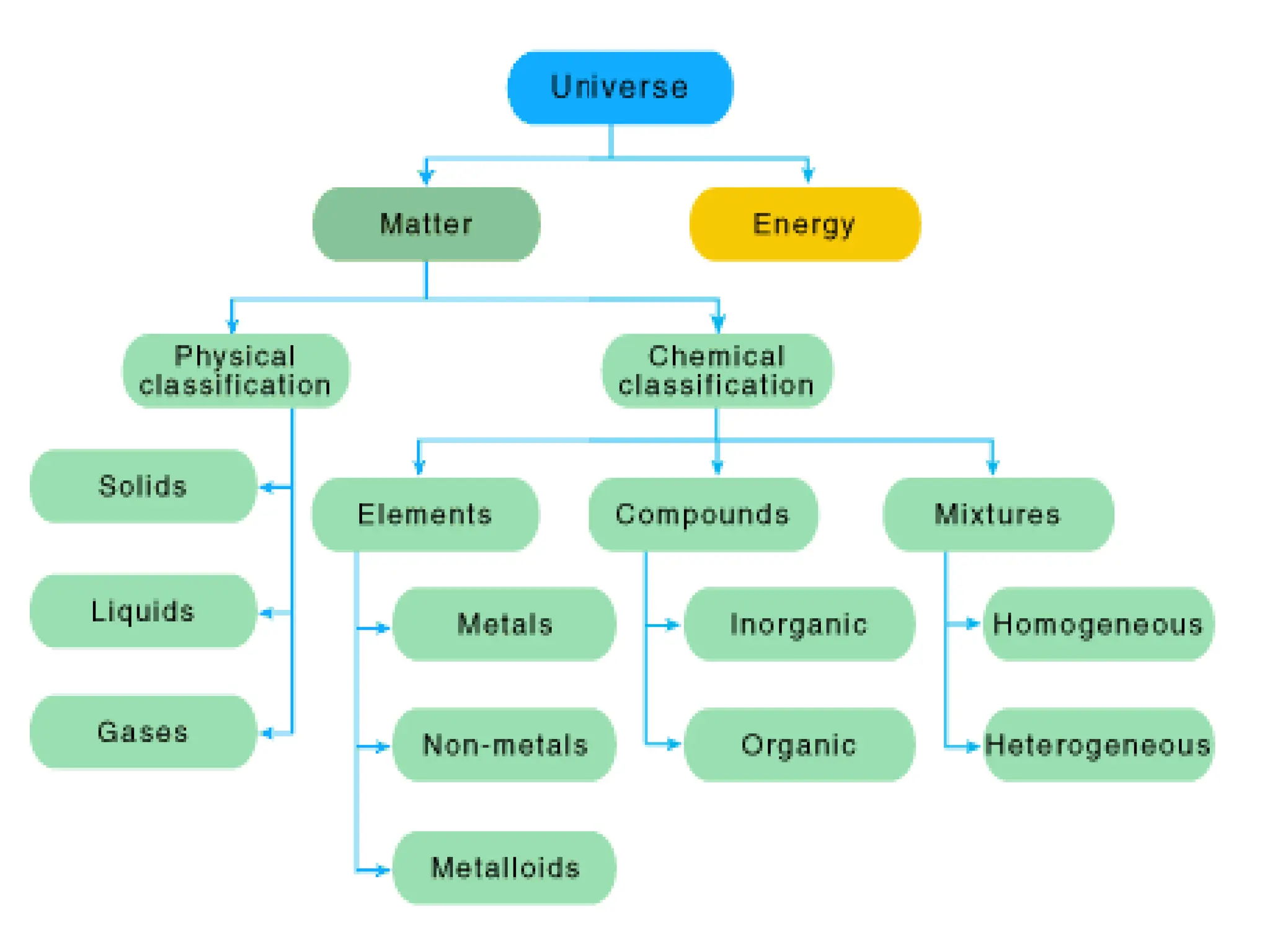
Matter
Matter = any material
substance with Mass
& Volume
Matter comes in 3 physical states
Physical
state
Shape Volume
solid definite definite
liquid indefinite definite
gas indefinite indefinite
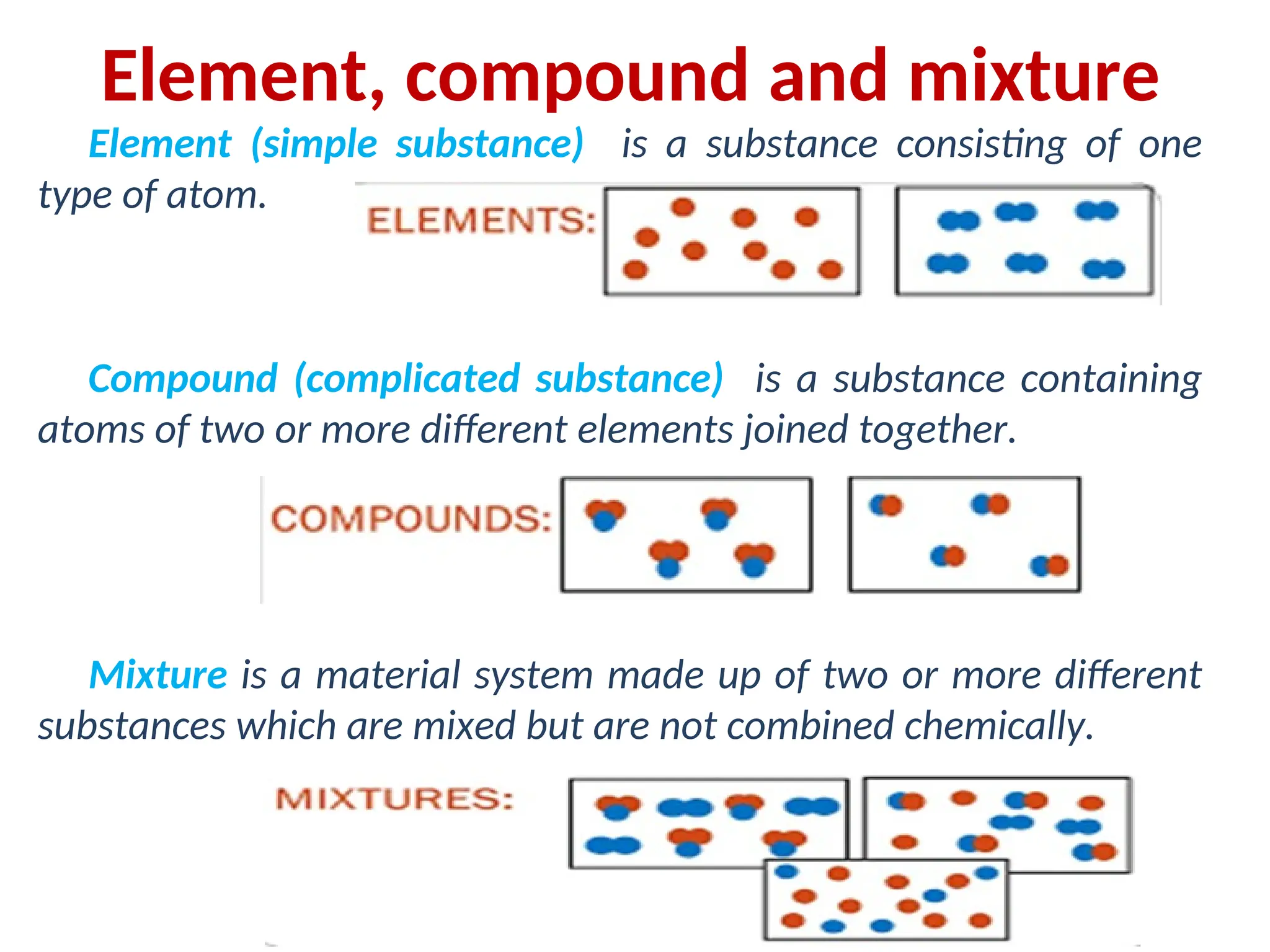
Element, compound and mixture
Element (simple substance) is a substance consisting of one
type of atom.
Compound (complicated substance) is a substance containing
atoms of two or more different elements joined together.
Mixture is a material system made up of two or more different
substances which are mixed but are not combined chemically.
Homogenous and Heterogeneous
Mixtures
Heterogeneous mixture:
•means “different”
•two or more phases present
•you can see the different parts
(phases) of the mixture
Homogenous mixture:
•means “the same”
•single phase present
•you can’t see the different
parts (phases) of the mixture
Exercise
• Classify the following into elements and
compounds.
(1)H2O; (2) He; (3) Cl2; (4) CO; (5) Co.
• Among the substances given below
choose the simple substance, mixtures and
compounds:
(1) Air (2) Sand
(3) Diamond (4) Steel
Atom, molecule, ion
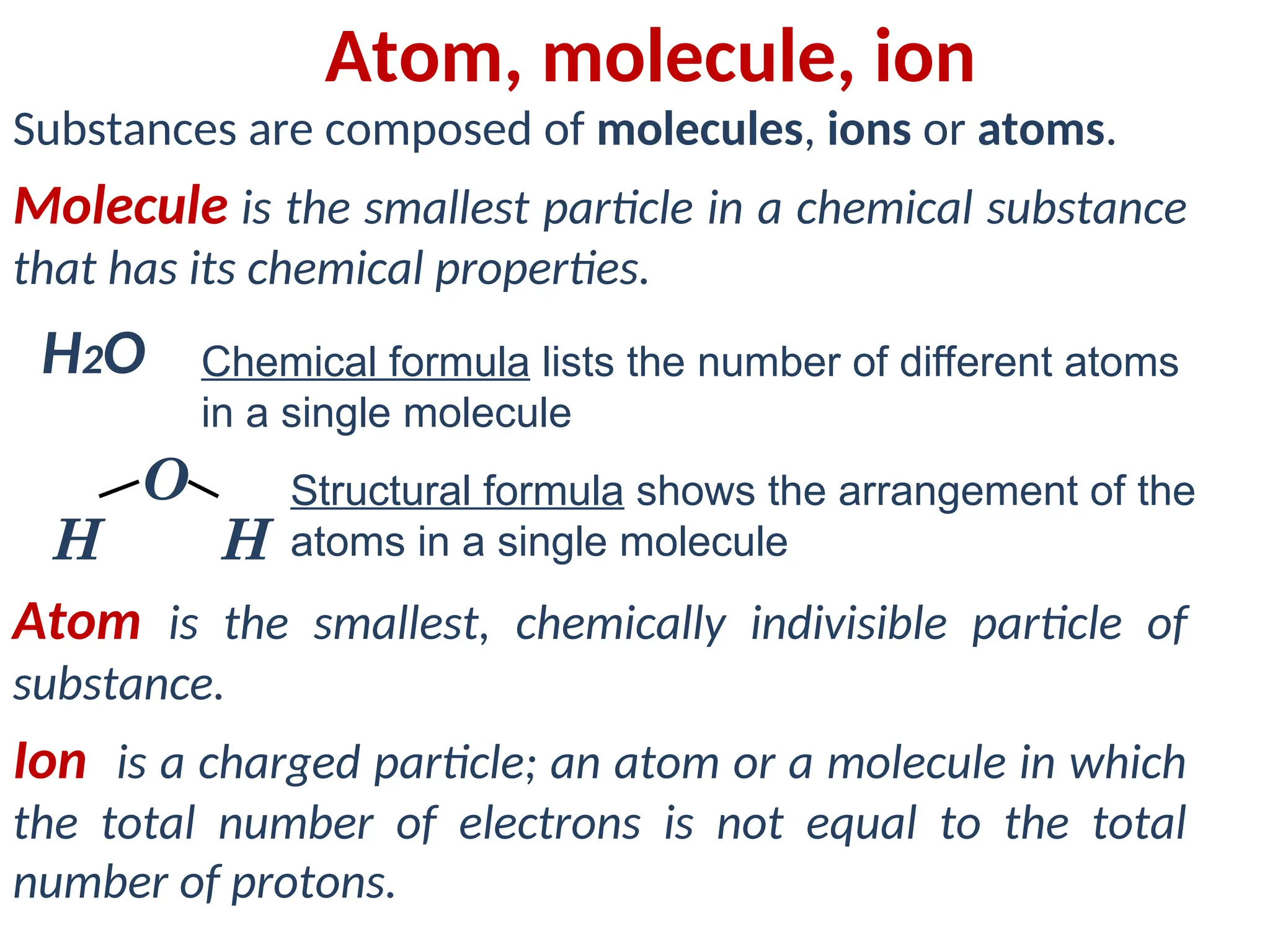
Substances are composed of molecules, ions or atoms.
Molecule is the smallest particle in a chemical substance
that has its chemical properties.
H2O
Atom is the smallest, chemically indivisible particle of
substance.
Ion is a charged particle; an atom or a molecule in which
the total number of electrons is not equal to the total
number of protons.
H
O
H
Chemical formula lists the number of different atoms
in a single molecule
Structural formula shows the arrangement of the
atoms in a single molecule
atoms
molecules
ions
Valency
Valency is the number of chemical bonds an atom
can form.
Compound H2 CH4 NH3 H2SO4 Cl2O7
Diagram
Valencies Hidrogen,
1
Carbon, 4
Hydrogen, 1
Nitrogen, 3
Hydrogen, 1
Sulfur, 6
Oxygen, 2
Hydrogen, 1
Chlorine, 7
Oxygen, 2
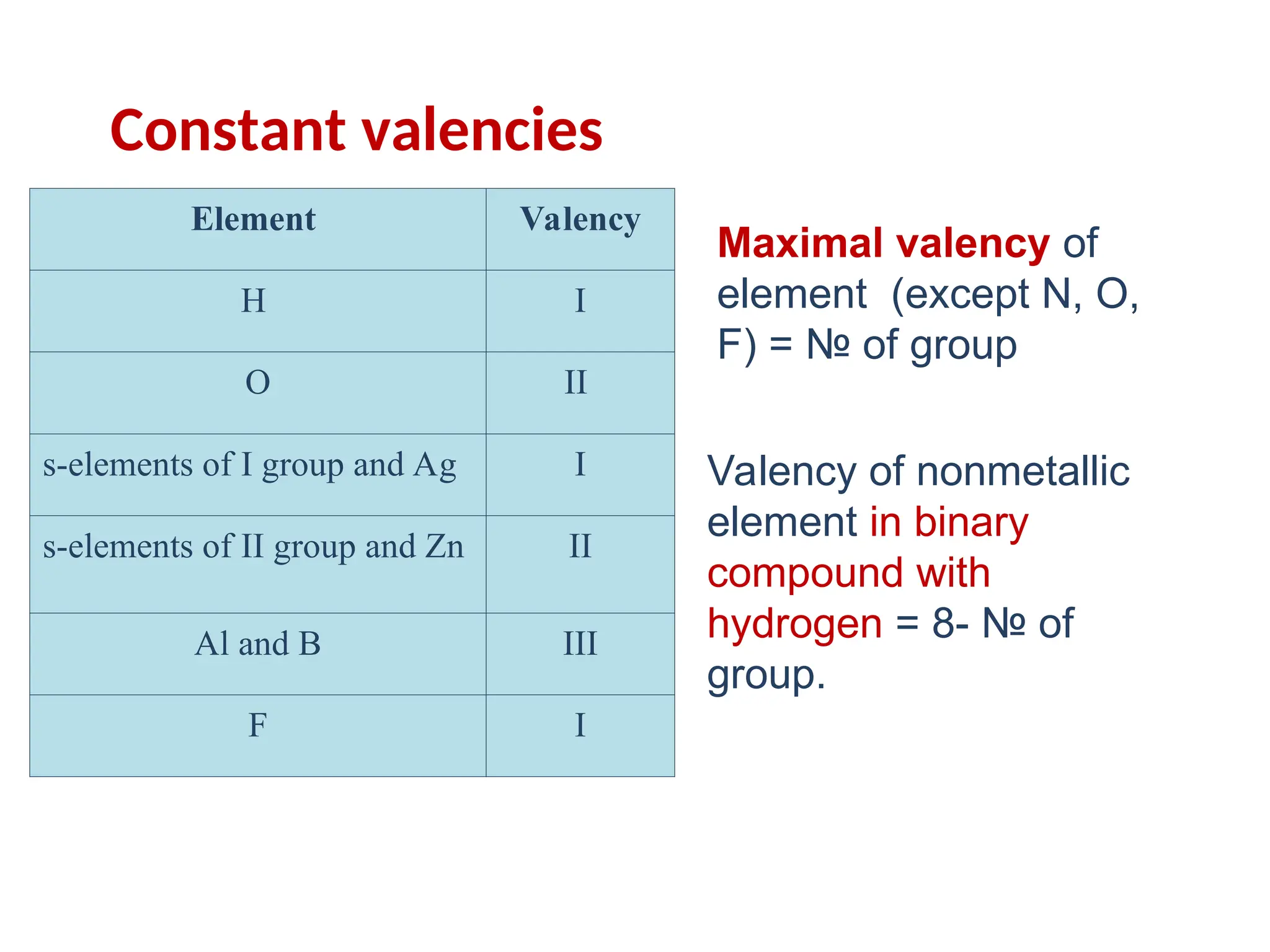
Constant valencies
Element Valency
H I
O II
s-elements of I group and Ag I
s-elements of II group and Zn II
Al and B III
F I
Maximal valency of
element (except N, O,
F) = № of group
Valency of nonmetallic
element in binary
compound with
hydrogen = 8- № of
group.
Properties of substance
Physical properties and their units
Quantifiable physical property is called physical quantity.
A physical quantity can be expressed as the combination of a number
and a unit .
Most physical quantities include a unit, but some are dimensionless.
Some base physical quantities and their units
Physical quantity Unit Symbol
Length (L) meter m
Mass (m) kilogram
gram
Kg
g
Time (t) second s
Temperature (T) kelvin
degree Celsius
K
⁰C
Amount of substance (ν) mole mol
One mole is the amount of substance that contains as many particles (atoms,
molecules or ions) as there are atoms in exactly 12 g of 12
C isotope (6.02·1023
).
Some other physical quantities and their units
Physical quantity Unit Symbol
Volume cubic meter
litre
m3
l
Density kilogram per cubic meter
gram per cubic centimeter
kg m-3
g cm-3
Pressure Pascal (Newton per square
meter)
atmosphere
millimeter of mercury
Pa (N·m-2
)
atm
mmHg
Molar mass kilogram per mole
gram per mole
kg mol-1
g mol-1
Atomic mass and
Molecular mass
one atomic mass unit
(unified mass)
amu (u)
One atomic mass unit is defined as a mass exactly equal to one twelfth of one
carbon 12 atom.
Scientific notation
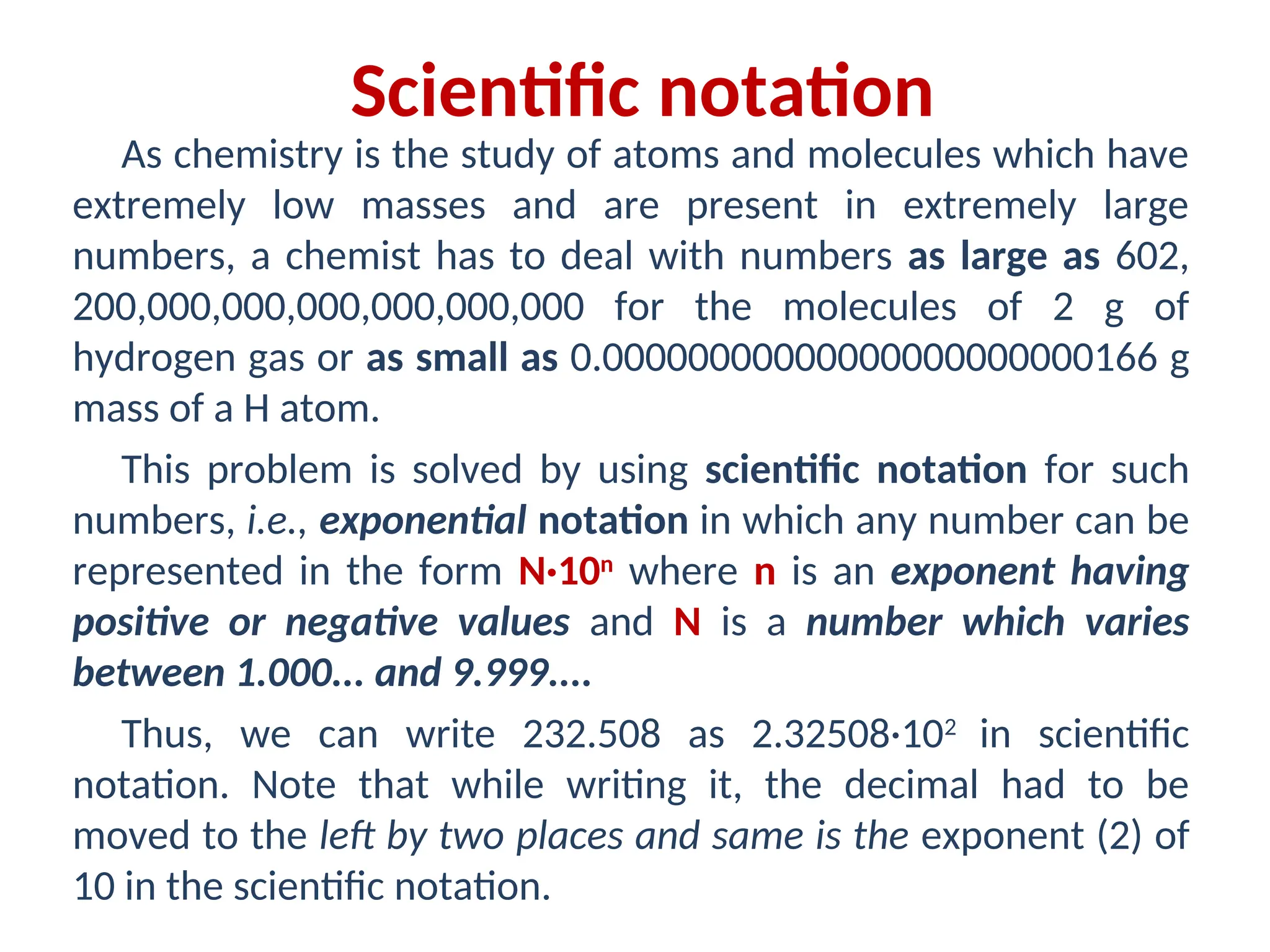
As chemistry is the study of atoms and molecules which have
extremely low masses and are present in extremely large
numbers, a chemist has to deal with numbers as large as 602,
200,000,000,000,000,000,000 for the molecules of 2 g of
hydrogen gas or as small as 0.00000000000000000000000166 g
mass of a H atom.
This problem is solved by using scientific notation for such
numbers, i.e., exponential notation in which any number can be
represented in the form N·10n
where n is an exponent having
positive or negative values and N is a number which varies
between 1.000... and 9.999....
Thus, we can write 232.508 as 2.32508·102
in scientific
notation. Note that while writing it, the decimal had to be
moved to the left by two places and same is the exponent (2) of
10 in the scientific notation.
Basic operations with exponentiation
Multiplication and Division: These two operations follow the same rules
which are there for exponential numbers, i.e.
Multiple Division
Addition and Subtraction: For these two operations, first the numbers are
written in such a way that they have same exponent. After that, the
coefficient are added or subtracted.
Thus, for adding 6.65·104
and 8.95 ·103
, 6.65· 104
+ 0.895 X10⁴
exponent is
made same for both the numbers. Then these numbers can be added by
(6.65 + 0.895) ·104
.
Similarly the subtraction of two numbers can be done as follows -
2.5· 10-2
– 4.8· 10-3
= 2.5·10-2
-0.48·10-2
=(2.5-0.48) ·10-2
= 2.02·10-2
.
O
Some prefixes used in the SI System
Multiple Prefix Symbol
10-9
nano n
10-6
micro μ
10-3
milli m
10-2
centi c
10-1
deci d
10 deca da
102
hecto h
103
kilo k
106
mega M
109
giga G

Lecture 1. BASIC CONCEPTS OF CHEMISTRY.ppt

  • 1.
    Lecture 1 BASIC CONCEPTSOF CHEMISTRY Prepared by PhD Valentina Yuz’kova Chemistry
  • 2.
    Chemistry is abranch of science that studies the composition, structure, properties and change of matter. Chemistry Composition Structure Properties
  • 3.
    Uses of chemistry medicine fertilizers industry Polymers soap,detergent fuels building materials water proof and fire proof clothes
  • 4.
    Abuses of chemistry leadto environmental problems Ozone depletion Water pollution Acid rains Green house effect
  • 5.
    Branches of chemistry Physicalchemistry Organic chemistry Inorganic chemistry Analytical chemistry Medical chemistry Bio chemistry Industrial chemistry Agricultural chemistry Geo chemistry
  • 7.
    Matter Matter = anymaterial substance with Mass & Volume
  • 8.
    Matter comes in3 physical states Physical state Shape Volume solid definite definite liquid indefinite definite gas indefinite indefinite
  • 10.
    Element, compound andmixture Element (simple substance) is a substance consisting of one type of atom. Compound (complicated substance) is a substance containing atoms of two or more different elements joined together. Mixture is a material system made up of two or more different substances which are mixed but are not combined chemically.
  • 11.
    Homogenous and Heterogeneous Mixtures Heterogeneousmixture: •means “different” •two or more phases present •you can see the different parts (phases) of the mixture Homogenous mixture: •means “the same” •single phase present •you can’t see the different parts (phases) of the mixture
  • 12.
    Exercise • Classify thefollowing into elements and compounds. (1)H2O; (2) He; (3) Cl2; (4) CO; (5) Co. • Among the substances given below choose the simple substance, mixtures and compounds: (1) Air (2) Sand (3) Diamond (4) Steel
  • 13.
    Atom, molecule, ion Substancesare composed of molecules, ions or atoms. Molecule is the smallest particle in a chemical substance that has its chemical properties. H2O Atom is the smallest, chemically indivisible particle of substance. Ion is a charged particle; an atom or a molecule in which the total number of electrons is not equal to the total number of protons. H O H Chemical formula lists the number of different atoms in a single molecule Structural formula shows the arrangement of the atoms in a single molecule
  • 14.
  • 15.
    Valency Valency is thenumber of chemical bonds an atom can form. Compound H2 CH4 NH3 H2SO4 Cl2O7 Diagram Valencies Hidrogen, 1 Carbon, 4 Hydrogen, 1 Nitrogen, 3 Hydrogen, 1 Sulfur, 6 Oxygen, 2 Hydrogen, 1 Chlorine, 7 Oxygen, 2
  • 16.
    Constant valencies Element Valency HI O II s-elements of I group and Ag I s-elements of II group and Zn II Al and B III F I Maximal valency of element (except N, O, F) = № of group Valency of nonmetallic element in binary compound with hydrogen = 8- № of group.
  • 17.
  • 18.
    Physical properties andtheir units Quantifiable physical property is called physical quantity. A physical quantity can be expressed as the combination of a number and a unit . Most physical quantities include a unit, but some are dimensionless. Some base physical quantities and their units Physical quantity Unit Symbol Length (L) meter m Mass (m) kilogram gram Kg g Time (t) second s Temperature (T) kelvin degree Celsius K ⁰C Amount of substance (ν) mole mol One mole is the amount of substance that contains as many particles (atoms, molecules or ions) as there are atoms in exactly 12 g of 12 C isotope (6.02·1023 ).
  • 19.
    Some other physicalquantities and their units Physical quantity Unit Symbol Volume cubic meter litre m3 l Density kilogram per cubic meter gram per cubic centimeter kg m-3 g cm-3 Pressure Pascal (Newton per square meter) atmosphere millimeter of mercury Pa (N·m-2 ) atm mmHg Molar mass kilogram per mole gram per mole kg mol-1 g mol-1 Atomic mass and Molecular mass one atomic mass unit (unified mass) amu (u) One atomic mass unit is defined as a mass exactly equal to one twelfth of one carbon 12 atom.
  • 20.
    Scientific notation As chemistryis the study of atoms and molecules which have extremely low masses and are present in extremely large numbers, a chemist has to deal with numbers as large as 602, 200,000,000,000,000,000,000 for the molecules of 2 g of hydrogen gas or as small as 0.00000000000000000000000166 g mass of a H atom. This problem is solved by using scientific notation for such numbers, i.e., exponential notation in which any number can be represented in the form N·10n where n is an exponent having positive or negative values and N is a number which varies between 1.000... and 9.999.... Thus, we can write 232.508 as 2.32508·102 in scientific notation. Note that while writing it, the decimal had to be moved to the left by two places and same is the exponent (2) of 10 in the scientific notation.
  • 21.
    Basic operations withexponentiation Multiplication and Division: These two operations follow the same rules which are there for exponential numbers, i.e. Multiple Division Addition and Subtraction: For these two operations, first the numbers are written in such a way that they have same exponent. After that, the coefficient are added or subtracted. Thus, for adding 6.65·104 and 8.95 ·103 , 6.65· 104 + 0.895 X10⁴ exponent is made same for both the numbers. Then these numbers can be added by (6.65 + 0.895) ·104 . Similarly the subtraction of two numbers can be done as follows - 2.5· 10-2 – 4.8· 10-3 = 2.5·10-2 -0.48·10-2 =(2.5-0.48) ·10-2 = 2.02·10-2 . O
  • 22.
    Some prefixes usedin the SI System Multiple Prefix Symbol 10-9 nano n 10-6 micro μ 10-3 milli m 10-2 centi c 10-1 deci d 10 deca da 102 hecto h 103 kilo k 106 mega M 109 giga G

Editor's Notes

  • #3 Medicines(vitamins, tonic) Fertilizers Industry Polymers Soaps Detergents Water proof clothes and fire proof Building material
  • #4 War chemicals, brown sugar ,polyethylene