© 2015 GridGain Systems, Inc.
NIKITA IVANOV
GridGain CTO/Founder
In-Memory Computing:
From Big Data to Fast Data
nivanov@gridgain.com #c64hacker
© 2015 GridGain Systems, Inc.
Agenda
> Why In-Memory Computing?
> What is In-Memory Computing?
> Facts & Myths
> Use Cases
> Q & A
© 2015 GridGain Systems, Inc.
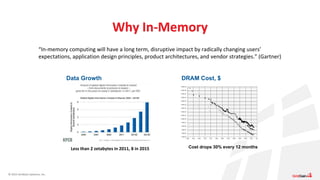
Why In-Memory
“In-memory computing will have a long term, disruptive impact by radically changing users’
expectations, application design principles, product architectures, and vendor strategies.” (Gartner)
DRAM Cost, $
Cost drops 30% every 12 monthsLess than 2 zetabytes in 2011, 8 in 2015
Data Growth
© 2015 GridGain Systems, Inc.
Paradigm Shift à la 1970s
1970 – 2000s: Era of Disk
> IBM released “Winchester” IBM 340 disk
Tapes start to decline
> SQL
Era of Structured Data
2010s – … : Era of Memory
> 64-bit CPUs + DRAM prices drop 30% YoY
HDDs start to decline
> NoSQL + SQL
Era of Unstructured Data
> Last frontier for storage
RAM is the new disk, disk is the new tape (Gartner)
© 2015 GridGain Systems, Inc.
Memory First - Disk Second
Disk First Architecture: 1970-2000s
Disk as primary storage, memory for caching
Reading Record: API call <-> OS I/O <-> I/O controller <-> disk
Latency: milliseconds
Memory First Architecture: since 2000s
Memory is primary storage, disk for backups
Reading Record: API call <-> pointer arithmetic
Latency: nanoseconds to microseconds
© 2015 GridGain Systems, Inc.
Bring Computation to Data
Client-Server 1970 - 2000s
> Data is moved to application layer:
Data not-partitioned
Data sizes are small
In-Memory Computing / Hadoop since mid-2000s
> Computations are moved to data:
Data is partitioned
Data sizes are massive
Possible to distribute computations to partitioned data
© 2015 GridGain Systems, Inc.
Myth #1: Too Expensive
Facts:
> 2013: 1TB DRAM cluster $25K
> 2015: 1TB DRAM cluster <$20K
> Memory Channel Storage (MCS)
> Storage Class Memory (SCM)
> Non-Volatile RAM (NVDIMM)
© 2015 GridGain Systems, Inc.
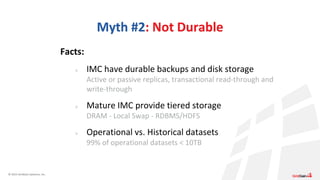
Myth #2: Not Durable
Facts:
> IMC have durable backups and disk storage
Active or passive replicas, transactional read-through and
write-through
> Mature IMC provide tiered storage
DRAM - Local Swap - RDBMS/HDFS
> Operational vs. Historical datasets
99% of operational datasets < 10TB
© 2015 GridGain Systems, Inc.
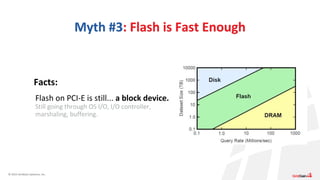
Myth #3: Flash is Fast Enough
Facts:
Flash on PCI-E is still... a block device.
Still going through OS I/O, I/O controller,
marshaling, buffering.
© 2015 GridGain Systems, Inc.
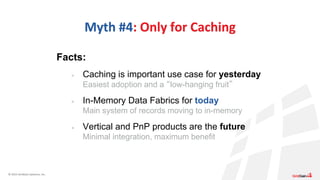
Myth #4: Only for Caching
Facts:
> Caching is important use case for yesterday
Easiest adoption and a “low-hanging fruit”
> In-Memory Data Fabrics for today
Main system of records moving to in-memory
> Vertical and PnP products are the future
Minimal integration, maximum benefit
© 2015 GridGain Systems, Inc.
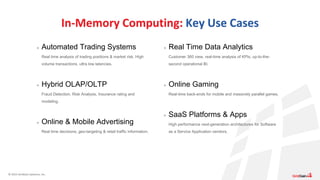
In-Memory Computing: Key Use Cases
> Automated Trading Systems
Real time analysis of trading positions & market risk. High
volume transactions, ultra low latencies.
> Hybrid OLAP/OLTP
Fraud Detection, Risk Analysis, Insurance rating and
modeling.
> Online & Mobile Advertising
Real time decisions, geo-targeting & retail traffic information.
> Real Time Data Analytics
Customer 360 view, real-time analysis of KPIs, up-to-the-
second operational BI.
> Online Gaming
Real-time back-ends for mobile and massively parallel games.
> SaaS Platforms & Apps
High performance next-generation architectures for Software
as a Service Application vendors.
© 2015 GridGain Systems, Inc.
THANK YOU!
nivanov@gridgain.com #c64hacker

IMCSummit 2015 - Day 1 - General Session - From Big Data to Fast Data

  • 1.
    © 2015 GridGainSystems, Inc. NIKITA IVANOV GridGain CTO/Founder In-Memory Computing: From Big Data to Fast Data nivanov@gridgain.com #c64hacker
  • 2.
    © 2015 GridGainSystems, Inc. Agenda > Why In-Memory Computing? > What is In-Memory Computing? > Facts & Myths > Use Cases > Q & A
  • 3.
    © 2015 GridGainSystems, Inc. Why In-Memory “In-memory computing will have a long term, disruptive impact by radically changing users’ expectations, application design principles, product architectures, and vendor strategies.” (Gartner) DRAM Cost, $ Cost drops 30% every 12 monthsLess than 2 zetabytes in 2011, 8 in 2015 Data Growth
  • 4.
    © 2015 GridGainSystems, Inc. Paradigm Shift à la 1970s 1970 – 2000s: Era of Disk > IBM released “Winchester” IBM 340 disk Tapes start to decline > SQL Era of Structured Data 2010s – … : Era of Memory > 64-bit CPUs + DRAM prices drop 30% YoY HDDs start to decline > NoSQL + SQL Era of Unstructured Data > Last frontier for storage RAM is the new disk, disk is the new tape (Gartner)
  • 5.
    © 2015 GridGainSystems, Inc. Memory First - Disk Second Disk First Architecture: 1970-2000s Disk as primary storage, memory for caching Reading Record: API call <-> OS I/O <-> I/O controller <-> disk Latency: milliseconds Memory First Architecture: since 2000s Memory is primary storage, disk for backups Reading Record: API call <-> pointer arithmetic Latency: nanoseconds to microseconds
  • 6.
    © 2015 GridGainSystems, Inc. Bring Computation to Data Client-Server 1970 - 2000s > Data is moved to application layer: Data not-partitioned Data sizes are small In-Memory Computing / Hadoop since mid-2000s > Computations are moved to data: Data is partitioned Data sizes are massive Possible to distribute computations to partitioned data
  • 7.
    © 2015 GridGainSystems, Inc. Myth #1: Too Expensive Facts: > 2013: 1TB DRAM cluster $25K > 2015: 1TB DRAM cluster <$20K > Memory Channel Storage (MCS) > Storage Class Memory (SCM) > Non-Volatile RAM (NVDIMM)
  • 8.
    © 2015 GridGainSystems, Inc. Myth #2: Not Durable Facts: > IMC have durable backups and disk storage Active or passive replicas, transactional read-through and write-through > Mature IMC provide tiered storage DRAM - Local Swap - RDBMS/HDFS > Operational vs. Historical datasets 99% of operational datasets < 10TB
  • 9.
    © 2015 GridGainSystems, Inc. Myth #3: Flash is Fast Enough Facts: Flash on PCI-E is still... a block device. Still going through OS I/O, I/O controller, marshaling, buffering.
  • 10.
    © 2015 GridGainSystems, Inc. Myth #4: Only for Caching Facts: > Caching is important use case for yesterday Easiest adoption and a “low-hanging fruit” > In-Memory Data Fabrics for today Main system of records moving to in-memory > Vertical and PnP products are the future Minimal integration, maximum benefit
  • 11.
    © 2015 GridGainSystems, Inc. In-Memory Computing: Key Use Cases > Automated Trading Systems Real time analysis of trading positions & market risk. High volume transactions, ultra low latencies. > Hybrid OLAP/OLTP Fraud Detection, Risk Analysis, Insurance rating and modeling. > Online & Mobile Advertising Real time decisions, geo-targeting & retail traffic information. > Real Time Data Analytics Customer 360 view, real-time analysis of KPIs, up-to-the- second operational BI. > Online Gaming Real-time back-ends for mobile and massively parallel games. > SaaS Platforms & Apps High performance next-generation architectures for Software as a Service Application vendors.
  • 12.
    © 2015 GridGainSystems, Inc. THANK YOU! nivanov@gridgain.com #c64hacker