INNOVATIVE LESSON PLAN 
ON BRAIN STORMING 
STRATEGY 
Submitted by, 
T.C. NIJINA 
Optional – Natural Science.
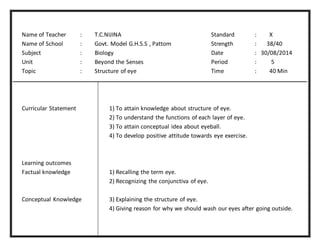
Name of Teacher : T.C.NIJINA Standard : X 
Name of School : Govt. Model G.H.S.S , Pattom Strength : 38/40 
Subject : Biology Date : 30/08/2014 
Unit : Beyond the Senses Period : 5 
Topic : Structure of eye Time : 40 Min 
Curricular Statement 1) To attain knowledge about structure of eye. 
2) To understand the functions of each layer of eye. 
3) To attain conceptual idea about eyeball. 
4) To develop positive attitude towards eye exercise. 
Learning outcomes 
Factual knowledge 1) Recalling the term eye. 
2) Recognizing the conjunctiva of eye. 
Conceptual Knowledge 3) Explaining the structure of eye. 
4) Giving reason for why we should wash our eyes after going outside.
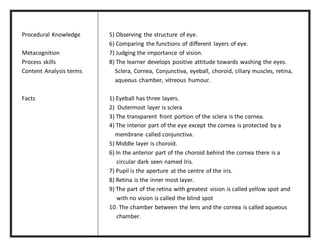
Procedural Knowledge 5) Observing the structure of eye. 
6) Comparing the functions of different layers of eye. 
Metacognition 7) Judging the importance of vision. 
Process skills 8) The learner develops positive attitude towards washing the eyes. 
Content Analysis terms Sclera, Cornea, Conjunctiva, eyeball, choroid, ciliary muscles, retina, 
aqueous chamber, vitreous humour. 
Facts 1) Eyeball has three layers. 
2) Outermost layer is sclera 
3) The transparent front portion of the sclera is the cornea. 
4) The interior part of the eye except the cornea is protected by a 
membrane called conjunctiva. 
5) Middle layer is choroid. 
6) In the anterior part of the choroid behind the cornea there is a 
circular dark seen named lris. 
7) Pupil is the aperture at the centre of the iris. 
8) Retina is the inner most layer. 
9) The part of the retina with greatest vision is called yellow spot and 
with no vision is called the blind spot 
10. The chamber between the lens and the cornea is called aqueous 
chamber.
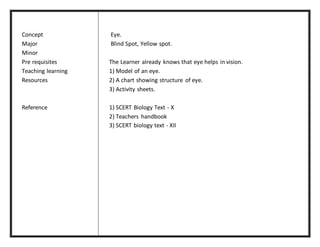
Concept Eye. 
Major Blind Spot, Yellow spot. 
Minor 
Pre requisites The Learner already knows that eye helps in vision. 
Teaching learning 1) Model of an eye. 
Resources 2) A chart showing structure of eye. 
3) Activity sheets. 
Reference 1) SCERT Biology Text - X 
2) Teachers handbook 
3) SCERT biology text - XII
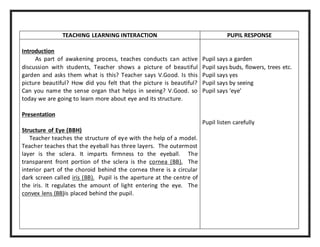
TEACHING LEARNING INTERACTION PUPIL RESPONSE 
Introduction 
As part of awakening process, teaches conducts can active 
discussion with students, Teacher shows a picture of beautiful 
garden and asks them what is this? Teacher says V.Good. Is this 
picture beautiful? How did you felt that the picture is beautiful? 
Can you name the sense organ that helps in seeing? V.Good. so 
today we are going to learn more about eye and its structure. 
Presentation 
Structure of Eye (BBH) 
Teacher teaches the structure of eye with the help of a model. 
Teacher teaches that the eyeball has three layers. The outermost 
layer is the sclera. It imparts firmness to the eyeball. The 
transparent front portion of the sclera is the cornea (BB). The 
interior part of the choroid behind the cornea there is a circular 
dark screen called iris (BB). Pupil is the aperture at the centre of 
the iris. It regulates the amount of light entering the eye. The 
convex lens (BB)is placed behind the pupil. 
Pupil says a garden 
Pupil says buds, flowers, trees etc. 
Pupil says yes 
Pupil says by seeing 
Pupil says ‘eye’ 
Pupil listen carefully
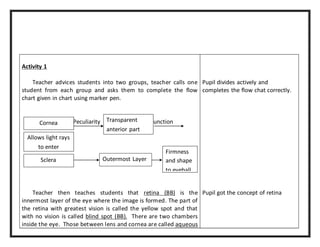
Activity 1 
Teacher advices students into two groups, teacher calls one 
student from each group and asks them to complete the flow 
chart given in chart using marker pen. 
Peculiarity Function 
Teacher then teaches students that retina (BB) is the 
innermost layer of the eye where the image is formed. The part of 
the retina with greatest vision is called the yellow spot and that 
with no vision is called blind spot (BB). There are two chambers 
inside the eye. Those between lens and cornea are called aqueous 
Pupil divides actively and 
completes the flow chat correctly. 
Pupil got the concept of retina 
Cornea 
Allows light rays 
to enter 
Sclera 
Transparent 
anterior part 
Outermost Layer 
Firmness 
and shape 
to eyeball
chamber (BB). It contains a fluid called aqueous humor (BB) which 
supplies nutrients and oxygen to the cells of the cornea and the 
lens. The chamber between the lens and retina is the vitreous 
humor which helps to maintain the shape of the eyeball. 
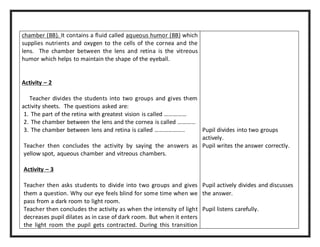
Activity – 2 
Teacher divides the students into two groups and gives them 
activity sheets. The questions asked are: 
1. The part of the retina with greatest vision is called …………… 
2. The chamber between the lens and the cornea is called ………… 
3. The chamber between lens and retina is called ……………….. 
Teacher then concludes the activity by saying the answers as 
yellow spot, aqueous chamber and vitreous chambers. 
Activity – 3 
Teacher then asks students to divide into two groups and gives 
them a question. Why our eye feels blind for some time when we 
pass from a dark room to light room. 
Teacher then concludes the activity as when the intensity of light 
decreases pupil dilates as in case of dark room. But when it enters 
the light room the pupil gets contracted. During this transition 
Pupil divides into two groups 
actively. 
Pupil writes the answer correctly. 
Pupil actively divides and discusses 
the answer. 
Pupil listens carefully.
time the eyes feels to be blind. 
FORMATIVE ASSESSMENT 
Review Questions 
1. What is the function of Sclera? 
2. What is the function of Choroid? 
3. Which is the innermost layer of the eye? 
Follow up Activity 
Draw the diagram of eye neatly in your Science diary.

Nijina innovatve lessn plan

  • 1.
    INNOVATIVE LESSON PLAN ON BRAIN STORMING STRATEGY Submitted by, T.C. NIJINA Optional – Natural Science.
  • 2.
    Name of Teacher: T.C.NIJINA Standard : X Name of School : Govt. Model G.H.S.S , Pattom Strength : 38/40 Subject : Biology Date : 30/08/2014 Unit : Beyond the Senses Period : 5 Topic : Structure of eye Time : 40 Min Curricular Statement 1) To attain knowledge about structure of eye. 2) To understand the functions of each layer of eye. 3) To attain conceptual idea about eyeball. 4) To develop positive attitude towards eye exercise. Learning outcomes Factual knowledge 1) Recalling the term eye. 2) Recognizing the conjunctiva of eye. Conceptual Knowledge 3) Explaining the structure of eye. 4) Giving reason for why we should wash our eyes after going outside.
  • 3.
    Procedural Knowledge 5)Observing the structure of eye. 6) Comparing the functions of different layers of eye. Metacognition 7) Judging the importance of vision. Process skills 8) The learner develops positive attitude towards washing the eyes. Content Analysis terms Sclera, Cornea, Conjunctiva, eyeball, choroid, ciliary muscles, retina, aqueous chamber, vitreous humour. Facts 1) Eyeball has three layers. 2) Outermost layer is sclera 3) The transparent front portion of the sclera is the cornea. 4) The interior part of the eye except the cornea is protected by a membrane called conjunctiva. 5) Middle layer is choroid. 6) In the anterior part of the choroid behind the cornea there is a circular dark seen named lris. 7) Pupil is the aperture at the centre of the iris. 8) Retina is the inner most layer. 9) The part of the retina with greatest vision is called yellow spot and with no vision is called the blind spot 10. The chamber between the lens and the cornea is called aqueous chamber.
  • 4.
    Concept Eye. MajorBlind Spot, Yellow spot. Minor Pre requisites The Learner already knows that eye helps in vision. Teaching learning 1) Model of an eye. Resources 2) A chart showing structure of eye. 3) Activity sheets. Reference 1) SCERT Biology Text - X 2) Teachers handbook 3) SCERT biology text - XII
  • 5.
    TEACHING LEARNING INTERACTIONPUPIL RESPONSE Introduction As part of awakening process, teaches conducts can active discussion with students, Teacher shows a picture of beautiful garden and asks them what is this? Teacher says V.Good. Is this picture beautiful? How did you felt that the picture is beautiful? Can you name the sense organ that helps in seeing? V.Good. so today we are going to learn more about eye and its structure. Presentation Structure of Eye (BBH) Teacher teaches the structure of eye with the help of a model. Teacher teaches that the eyeball has three layers. The outermost layer is the sclera. It imparts firmness to the eyeball. The transparent front portion of the sclera is the cornea (BB). The interior part of the choroid behind the cornea there is a circular dark screen called iris (BB). Pupil is the aperture at the centre of the iris. It regulates the amount of light entering the eye. The convex lens (BB)is placed behind the pupil. Pupil says a garden Pupil says buds, flowers, trees etc. Pupil says yes Pupil says by seeing Pupil says ‘eye’ Pupil listen carefully
  • 6.
    Activity 1 Teacheradvices students into two groups, teacher calls one student from each group and asks them to complete the flow chart given in chart using marker pen. Peculiarity Function Teacher then teaches students that retina (BB) is the innermost layer of the eye where the image is formed. The part of the retina with greatest vision is called the yellow spot and that with no vision is called blind spot (BB). There are two chambers inside the eye. Those between lens and cornea are called aqueous Pupil divides actively and completes the flow chat correctly. Pupil got the concept of retina Cornea Allows light rays to enter Sclera Transparent anterior part Outermost Layer Firmness and shape to eyeball
  • 7.
    chamber (BB). Itcontains a fluid called aqueous humor (BB) which supplies nutrients and oxygen to the cells of the cornea and the lens. The chamber between the lens and retina is the vitreous humor which helps to maintain the shape of the eyeball. Activity – 2 Teacher divides the students into two groups and gives them activity sheets. The questions asked are: 1. The part of the retina with greatest vision is called …………… 2. The chamber between the lens and the cornea is called ………… 3. The chamber between lens and retina is called ……………….. Teacher then concludes the activity by saying the answers as yellow spot, aqueous chamber and vitreous chambers. Activity – 3 Teacher then asks students to divide into two groups and gives them a question. Why our eye feels blind for some time when we pass from a dark room to light room. Teacher then concludes the activity as when the intensity of light decreases pupil dilates as in case of dark room. But when it enters the light room the pupil gets contracted. During this transition Pupil divides into two groups actively. Pupil writes the answer correctly. Pupil actively divides and discusses the answer. Pupil listens carefully.
  • 8.
    time the eyesfeels to be blind. FORMATIVE ASSESSMENT Review Questions 1. What is the function of Sclera? 2. What is the function of Choroid? 3. Which is the innermost layer of the eye? Follow up Activity Draw the diagram of eye neatly in your Science diary.