The Structure and
Function of the Eye
SCIENCE CLASS 8
UZMA AMER
Windows to the World
• Eyes are photosensitive organs
designed to detect light and pass
on the information as electrical
signal to the brain.
• Vision such as ours and animals are
know as ‘camera’ like vision.
• Camera like vision has evolved at
least seven separate times through
out natures history.
01/02/2024 Structure and Function of the Eye 2
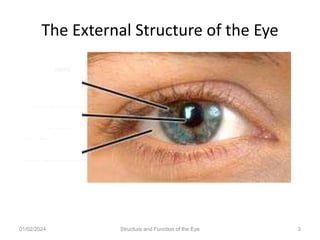
The External Structure of the Eye
01/02/2024 Structure and Function of the Eye 3
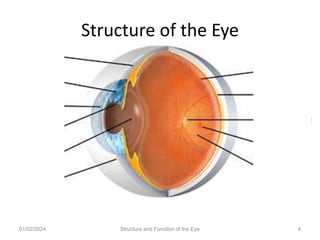
Structure of the Eye
01/02/2024 Structure and Function of the Eye 4
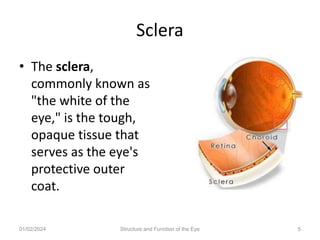
Sclera
• The sclera,
commonly known as
"the white of the
eye," is the tough,
opaque tissue that
serves as the eye's
protective outer
coat.
01/02/2024 Structure and Function of the Eye 5
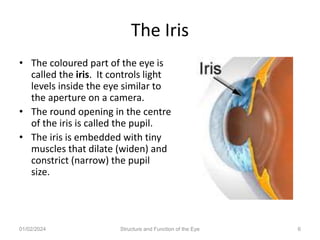
The Iris
• The coloured part of the eye is
called the iris. It controls light
levels inside the eye similar to
the aperture on a camera.
• The round opening in the centre
of the iris is called the pupil.
• The iris is embedded with tiny
muscles that dilate (widen) and
constrict (narrow) the pupil
size.
01/02/2024 Structure and Function of the Eye 6
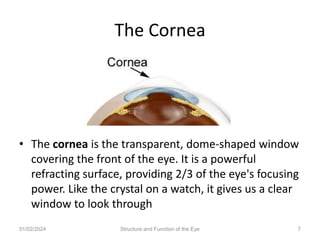
The Cornea
• The cornea is the transparent, dome-shaped window
covering the front of the eye. It is a powerful
refracting surface, providing 2/3 of the eye's focusing
power. Like the crystal on a watch, it gives us a clear
window to look through
01/02/2024 Structure and Function of the Eye 7
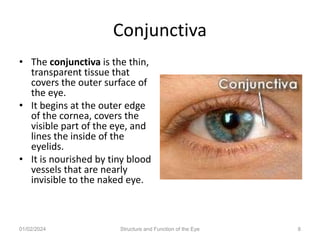
Conjunctiva
• The conjunctiva is the thin,
transparent tissue that
covers the outer surface of
the eye.
• It begins at the outer edge
of the cornea, covers the
visible part of the eye, and
lines the inside of the
eyelids.
• It is nourished by tiny blood
vessels that are nearly
invisible to the naked eye.
01/02/2024 Structure and Function of the Eye 8
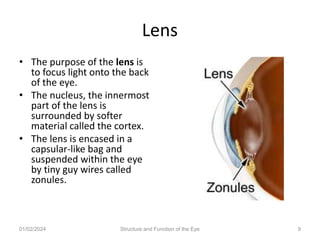
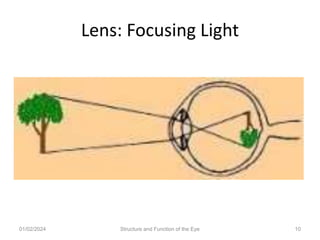
Lens
• The purpose of the lens is
to focus light onto the back
of the eye.
• The nucleus, the innermost
part of the lens is
surrounded by softer
material called the cortex.
• The lens is encased in a
capsular-like bag and
suspended within the eye
by tiny guy wires called
zonules.
01/02/2024 Structure and Function of the Eye 9
Lens: Focusing Light
01/02/2024 Structure and Function of the Eye 10
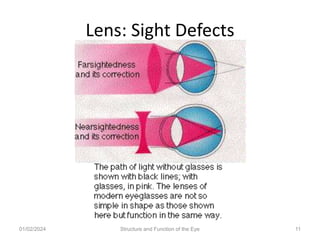
Lens: Sight Defects
01/02/2024 Structure and Function of the Eye 11
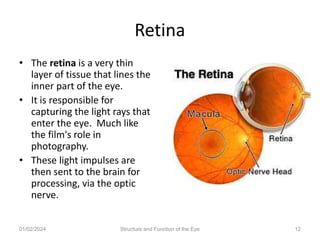
Retina
• The retina is a very thin
layer of tissue that lines the
inner part of the eye.
• It is responsible for
capturing the light rays that
enter the eye. Much like
the film's role in
photography.
• These light impulses are
then sent to the brain for
processing, via the optic
nerve.
01/02/2024 Structure and Function of the Eye 12
Optic Nerve
• The optic nerve
transmits electrical
impulses from the
retina to the brain.
• It connects to the back
of the eye near the
macula.
• The visible portion of
the optic nerve is called
the optic disc.
01/02/2024 Structure and Function of the Eye 13
Optic Nerve: Blind Spot
• Where the optic nerve meets the retina there are no
light sensitive cells. It is a blind spot.
• Take a piece of paper and draw a dot and 10 cm to
the left an x.
• Close your right eye and hold the paper at arms
length.
• Look at the dot and move the paper towards you.
• What happens to the X?
• It disappears into the blind spot!
01/02/2024 Structure and Function of the Eye 14
Eyes and Animation (Off Syllabus)
• There is a .4 second delay in response from
the time the image falls on the retina. The
sensation may persist for up to 2 minutes.
• This after image effect is exploited by film, TV
and computer monitors which display a rapid
succession of still images, which are refreshed
before the perceptual image has decayed.
01/02/2024 Structure and Function of the Eye 15
Eye Disorders (Off Syllabus)
• About one in ten men and one in a hundred
women experience some form of divergent
colour perception.
• The most common is confusion between red
and green. This can cause some problems in
colour matching.
• The genes for colour blindness located on the
X chromosome.
01/02/2024 Structure and Function of the Eye 16
Colour Blindness Test
01/02/2024 Structure and Function of the Eye 17
Colour Blindness Test
01/02/2024 Structure and Function of the Eye 18
Colour Blindness Test
01/02/2024 Structure and Function of the Eye 19
Colour Blindness Test
01/02/2024 Structure and Function of the Eye 20
Colour Blindness Test
01/02/2024 Structure and Function of the Eye 21

eye_structure_and_function_science__8.ppt

  • 1.
    The Structure and Functionof the Eye SCIENCE CLASS 8 UZMA AMER
  • 2.
    Windows to theWorld • Eyes are photosensitive organs designed to detect light and pass on the information as electrical signal to the brain. • Vision such as ours and animals are know as ‘camera’ like vision. • Camera like vision has evolved at least seven separate times through out natures history. 01/02/2024 Structure and Function of the Eye 2
  • 3.
    The External Structureof the Eye 01/02/2024 Structure and Function of the Eye 3
  • 4.
    Structure of theEye 01/02/2024 Structure and Function of the Eye 4
  • 5.
    Sclera • The sclera, commonlyknown as "the white of the eye," is the tough, opaque tissue that serves as the eye's protective outer coat. 01/02/2024 Structure and Function of the Eye 5
  • 6.
    The Iris • Thecoloured part of the eye is called the iris. It controls light levels inside the eye similar to the aperture on a camera. • The round opening in the centre of the iris is called the pupil. • The iris is embedded with tiny muscles that dilate (widen) and constrict (narrow) the pupil size. 01/02/2024 Structure and Function of the Eye 6
  • 7.
    The Cornea • Thecornea is the transparent, dome-shaped window covering the front of the eye. It is a powerful refracting surface, providing 2/3 of the eye's focusing power. Like the crystal on a watch, it gives us a clear window to look through 01/02/2024 Structure and Function of the Eye 7
  • 8.
    Conjunctiva • The conjunctivais the thin, transparent tissue that covers the outer surface of the eye. • It begins at the outer edge of the cornea, covers the visible part of the eye, and lines the inside of the eyelids. • It is nourished by tiny blood vessels that are nearly invisible to the naked eye. 01/02/2024 Structure and Function of the Eye 8
  • 9.
    Lens • The purposeof the lens is to focus light onto the back of the eye. • The nucleus, the innermost part of the lens is surrounded by softer material called the cortex. • The lens is encased in a capsular-like bag and suspended within the eye by tiny guy wires called zonules. 01/02/2024 Structure and Function of the Eye 9
  • 10.
    Lens: Focusing Light 01/02/2024Structure and Function of the Eye 10
  • 11.
    Lens: Sight Defects 01/02/2024Structure and Function of the Eye 11
  • 12.
    Retina • The retinais a very thin layer of tissue that lines the inner part of the eye. • It is responsible for capturing the light rays that enter the eye. Much like the film's role in photography. • These light impulses are then sent to the brain for processing, via the optic nerve. 01/02/2024 Structure and Function of the Eye 12
  • 13.
    Optic Nerve • Theoptic nerve transmits electrical impulses from the retina to the brain. • It connects to the back of the eye near the macula. • The visible portion of the optic nerve is called the optic disc. 01/02/2024 Structure and Function of the Eye 13
  • 14.
    Optic Nerve: BlindSpot • Where the optic nerve meets the retina there are no light sensitive cells. It is a blind spot. • Take a piece of paper and draw a dot and 10 cm to the left an x. • Close your right eye and hold the paper at arms length. • Look at the dot and move the paper towards you. • What happens to the X? • It disappears into the blind spot! 01/02/2024 Structure and Function of the Eye 14
  • 15.
    Eyes and Animation(Off Syllabus) • There is a .4 second delay in response from the time the image falls on the retina. The sensation may persist for up to 2 minutes. • This after image effect is exploited by film, TV and computer monitors which display a rapid succession of still images, which are refreshed before the perceptual image has decayed. 01/02/2024 Structure and Function of the Eye 15
  • 16.
    Eye Disorders (OffSyllabus) • About one in ten men and one in a hundred women experience some form of divergent colour perception. • The most common is confusion between red and green. This can cause some problems in colour matching. • The genes for colour blindness located on the X chromosome. 01/02/2024 Structure and Function of the Eye 16
  • 17.
    Colour Blindness Test 01/02/2024Structure and Function of the Eye 17
  • 18.
    Colour Blindness Test 01/02/2024Structure and Function of the Eye 18
  • 19.
    Colour Blindness Test 01/02/2024Structure and Function of the Eye 19
  • 20.
    Colour Blindness Test 01/02/2024Structure and Function of the Eye 20
  • 21.
    Colour Blindness Test 01/02/2024Structure and Function of the Eye 21