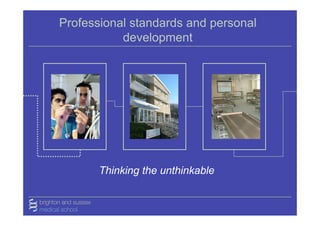
Professional standards and personal
           development


       Thinking the unthinkable
My text for today

• The importance of professional standards
  and personal development planning in a
  changing environment. Why are these
  important and significant for health care
  librarians?
New rôles
•   Outreach Librarians
•   Clinical Librarians
•   Knowledge managers
•   Primary care knowledge managers
•   Clinical Governance facilitators
•   R&D facilitators
•   Information analysts
•   Lecturers and Trainers
•   Electronic Resource Managers
•   Webmasters
•   Health Informaticians
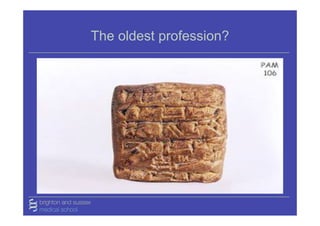
The oldest profession?
What’s a profession?

• Control
• Regulate
• Educate
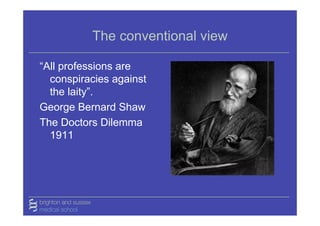
The conventional view

“All professions are
  conspiracies against
  the laity”.
George Bernard Shaw
The Doctors Dilemma
  1911
Professional redefinition

• CILIP:
  – Framework of Qualifications
    • Body of Professional Knowledge
  – Health EAG
  – HLG Manifesto
• UKCHIP
• MLA/AAHSL:Building on Success Charting
  the Future of Knowledge Management
  within the Academic Health Center
The Future of the Professions (2001)

• Council of Excellence in Management
  and Leadership
  – Impetus for change from
    • Technical development
    • Increased user expectations and knowledge
    • New managerialism
• Professions that succeeded were those
  who looked at the future and planned
Challenges to professionals

• Developments in technology: expert
  systems
• New areas of work and tension with other
  professions
• Corporate whittling away at professional
  autonomy
A crisis

• The UK crisis of confidence in professions:
  high profile cases focus public concern on
  regulation of health professions: Bristol,
  Shipman
• Demographic challenges
Health as an exemplar

•   Vanguard role
•   Large, diverse
•   Politically important
•   Centre for change
Health EAG
•   Roles and opportunities for librarians
    –   Work cross-sectorally across health, social care and education
    –   Work in multidisciplinary teams
    –   Use traditional skills in new ways
    –   Contribute to the development of evidence-based health care and
        services
    –   Play a role in the development and cascading of critical appraisal skills
        in the workplace
    –   Train and educate users in information skills
    –   Promote the importance of information quality in clinical governance
        and risk management
    –   Support rapid decision-making by making better quality information
        available
    –   Work with a range of information providers, for example publishers and
        public health information analysts, in developing new services
EBM revolution

• EBM
• Changes in health care professions
• Flatter networked cultures: teams working,
  partnership, user needs
• Need for greater quality assurance. Value for
  money
• New ways of working and learning
Policy

–   The shift of decision making from secondary to
    primary care
–   A drive to modernise services and improve access
    to health care
–   The need to ensure quality, safety and equity
–   Patient and public involvement and empowerment
–   Addressing the lifelong learning, demographic and
    workforce challenges
–   Harnessing the technical revolutions of the digital
    age
Working with others

• Information professionals
• Archivists
• Records managers
Modernising professional education
            and CPD (1)
• Reaccreditation (?mandatory)
• New ways of delivering:
  – E-learning: Folio
  – Multiple learning styles
  – Performance indicators
• Network of mentors
• Complement NHS knowledge and skills
  framework
• Work with UKCHIP/MLA’s AHIP
Modernising professional education
            and CPD (2)
• Need for accredited academic,ic modules
  in health information
• Audit and accreditation of LIS training and
  CPD providers
Influencing

• Policy work
• International dimension
Knight and Brice (1)

• Conclude that libraries are being reshaped
  in response to changes in:
  – The economics of information
  – Advances in computing and communication
  – Global information policies
  – Changes in teaching, research and
    scholarship
Knight and Brice (2)

• Expect health libraries to be
  – Centres of evidence
  – Libraries without walls
  – Centres of instruction
  – Filters
  – Centres for R&D
                                  Knight, Thalia, Brice, Anne
                       Librarians, Surgeons and Knowledge
Surgical Clinics of North America, Vol. 86, No. 1. (February
                                            2006), pp. 71-90

Professional standards and personal development

  • 1.
    Professional standards andpersonal development Thinking the unthinkable
  • 2.
    My text fortoday • The importance of professional standards and personal development planning in a changing environment. Why are these important and significant for health care librarians?
  • 3.
    New rôles • Outreach Librarians • Clinical Librarians • Knowledge managers • Primary care knowledge managers • Clinical Governance facilitators • R&D facilitators • Information analysts • Lecturers and Trainers • Electronic Resource Managers • Webmasters • Health Informaticians
  • 4.
  • 5.
    What’s a profession? •Control • Regulate • Educate
  • 6.
    The conventional view “Allprofessions are conspiracies against the laity”. George Bernard Shaw The Doctors Dilemma 1911
  • 7.
    Professional redefinition • CILIP: – Framework of Qualifications • Body of Professional Knowledge – Health EAG – HLG Manifesto • UKCHIP • MLA/AAHSL:Building on Success Charting the Future of Knowledge Management within the Academic Health Center
  • 8.
    The Future ofthe Professions (2001) • Council of Excellence in Management and Leadership – Impetus for change from • Technical development • Increased user expectations and knowledge • New managerialism • Professions that succeeded were those who looked at the future and planned
  • 9.
    Challenges to professionals •Developments in technology: expert systems • New areas of work and tension with other professions • Corporate whittling away at professional autonomy
  • 10.
    A crisis • TheUK crisis of confidence in professions: high profile cases focus public concern on regulation of health professions: Bristol, Shipman • Demographic challenges
  • 11.
    Health as anexemplar • Vanguard role • Large, diverse • Politically important • Centre for change
  • 12.
    Health EAG • Roles and opportunities for librarians – Work cross-sectorally across health, social care and education – Work in multidisciplinary teams – Use traditional skills in new ways – Contribute to the development of evidence-based health care and services – Play a role in the development and cascading of critical appraisal skills in the workplace – Train and educate users in information skills – Promote the importance of information quality in clinical governance and risk management – Support rapid decision-making by making better quality information available – Work with a range of information providers, for example publishers and public health information analysts, in developing new services
  • 13.
    EBM revolution • EBM •Changes in health care professions • Flatter networked cultures: teams working, partnership, user needs • Need for greater quality assurance. Value for money • New ways of working and learning
  • 14.
    Policy – The shift of decision making from secondary to primary care – A drive to modernise services and improve access to health care – The need to ensure quality, safety and equity – Patient and public involvement and empowerment – Addressing the lifelong learning, demographic and workforce challenges – Harnessing the technical revolutions of the digital age
  • 15.
    Working with others •Information professionals • Archivists • Records managers
  • 16.
    Modernising professional education and CPD (1) • Reaccreditation (?mandatory) • New ways of delivering: – E-learning: Folio – Multiple learning styles – Performance indicators • Network of mentors • Complement NHS knowledge and skills framework • Work with UKCHIP/MLA’s AHIP
  • 17.
    Modernising professional education and CPD (2) • Need for accredited academic,ic modules in health information • Audit and accreditation of LIS training and CPD providers
  • 18.
    Influencing • Policy work •International dimension
  • 19.
    Knight and Brice(1) • Conclude that libraries are being reshaped in response to changes in: – The economics of information – Advances in computing and communication – Global information policies – Changes in teaching, research and scholarship
  • 20.
    Knight and Brice(2) • Expect health libraries to be – Centres of evidence – Libraries without walls – Centres of instruction – Filters – Centres for R&D Knight, Thalia, Brice, Anne Librarians, Surgeons and Knowledge Surgical Clinics of North America, Vol. 86, No. 1. (February 2006), pp. 71-90