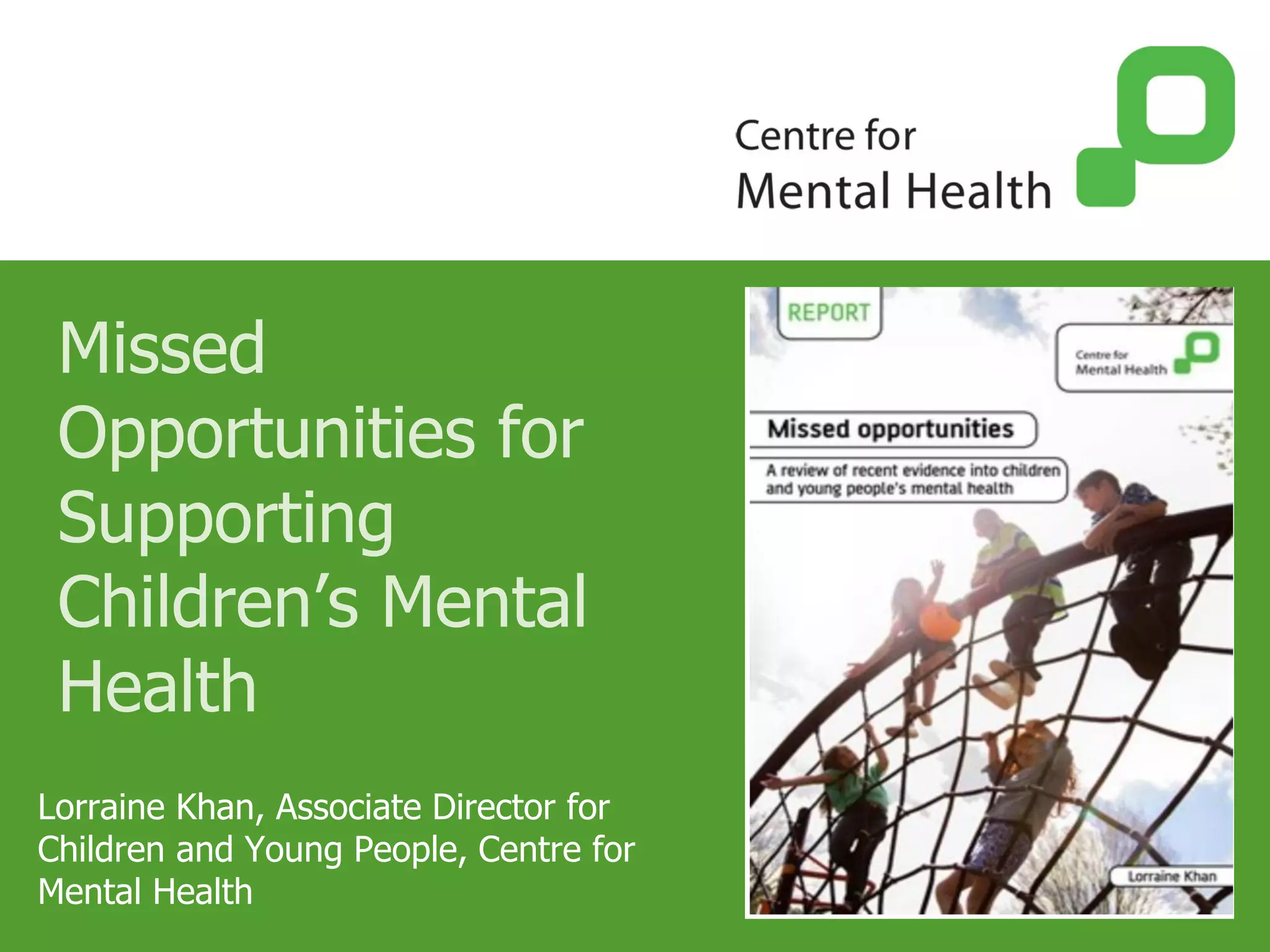
Missed
Opportunities for
Supporting
Children’s Mental
Health
Lorraine Khan, Associate Director for
Children and Young People, Centre for
Mental Health
Missed Opportunities:
headlines from research and
practice
Three children and young people in every classroom will have a
diagnosable mental health difficulty
Many more remain under this threshold but will be on a trajectory for poor
mental health
Untreated mental health problems cast a long shadow, well into adult life
Early good quality help can improve children’s outcomes
Most parents seek help – usually from schools
Only a quarter get assistance
On average young people wait 10 years before getting help
Diagnosable difficulties among 16 to 24 year old women have increased
by around 30% - a huge jump
Current problems in the
system
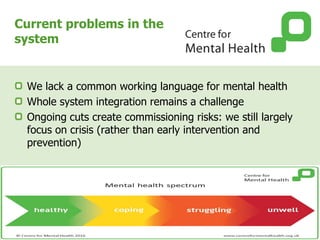
We lack a common working language for mental health
Whole system integration remains a challenge
Ongoing cuts create commissioning risks: we still largely
focus on crisis (rather than early intervention and
prevention)
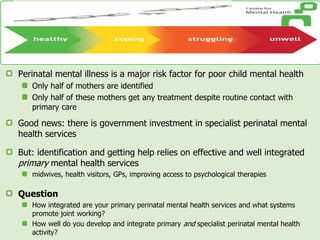
Perinatal mental illness is a major risk factor for poor child mental health
Only half of mothers are identified
Only half of these mothers get any treatment despite routine contact with
primary care
Good news: there is government investment in specialist perinatal mental
health services
But: identification and getting help relies on effective and well integrated
primary mental health services
midwives, health visitors, GPs, improving access to psychological therapies
Question
How integrated are your primary perinatal mental health services and what systems
promote joint working?
How well do you develop and integrate primary and specialist perinatal mental health
activity?
Early starting
behavioural difficulties
Childhood conduct problems remain our most common childhood mental
illness
Children’s needs often missed – despite most parents seeking help
children can be punished rather than seen as children in need
Parents hold key to helping children settle their behaviour – by learning
specific parenting strategies
There are some of the most effective interventions for these difficulties
Need to be well implemented
In some of the areas, fewer than 20% of children and parents are being
reached
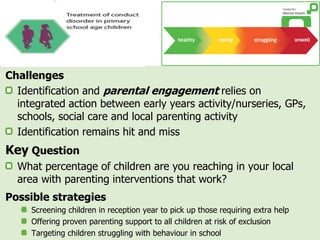
Challenges
Identification and parental engagement relies on
integrated action between early years activity/nurseries, GPs,
schools, social care and local parenting activity
Identification remains hit and miss
Key Question
What percentage of children are you reaching in your local
area with parenting interventions that work?
Possible strategies
Screening children in reception year to pick up those requiring extra help
Offering proven parenting support to all children at risk of exclusion
Targeting children struggling with behaviour in school
Schools
Most children spend large parts of their life in schools
Research suggests schools have unique opportunities to
promote children’s mental health
Children with good mental health do better in school and in
life:
Social and emotional competencies are essential for children’s success
in life
Good quality universal and targeted programmes can prevent poor
mental health and improve resilience and coping skills
Investment in CYP mental health saves money (WSIPP, 2016)
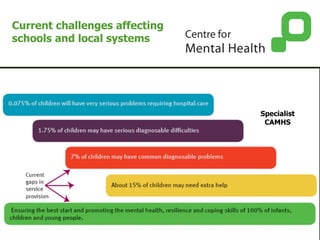
Current challenges affecting
schools and local systems
Specialist
CAMHS
Schools and colleges
Challenges
Nearly 80% of schools colleges need speedy access to reliable and
practical advice/resources to promote CYP mental
These resources are currently extremely widely dispersed
Schools often struggle to understand the local landscape of support
Schools often feel isolated supporting children with social and emotional
difficulties
Lack of partnership working
Schools have limited resources to invest in mental health and want to
know what’s the best investment
Doing more and more with less and less
Promising
developments and ideas
being tried
Bringing schools and local CAMHS services together – Anna Freud Centre/PHE
Mental Health First Aid Training for school staff
Designated EHWB leads in school - backed up by local networks and capacity building
Building capacity in Learning Mentors and school nurses to support SEL
Commissioning EHWB teams that link with schools: helping children who are
struggling or with common diagnosable mental health problems
What works in schools in enhancing social and emotional skills development
(Clarke, 2015)
Dr Pooky Knightsmith’s webinars – practical advice.
http://www.inourhands.com/category/training-and-consultancy/online-learning/
NCBs Whole School Mental health and emotional wellbeing toolkit
https://www.ncb.org.uk/sites/default/files/field/attachment/NCB%20School%20Well%20Being%20Framework%20Leaders%20Resources%20FINAL.pdf
16 to 24 year olds: what is
happening to our young
women?
16 to 24 year olds:
Most likely to develop first diagnosable difficulties at this age
Least likely to approach services than any other age group – only 20%
Containing episodes of illness and preventing re-occurrence during this
time reduces chance of poor adult mental health and life chances
Since 2007 - 30% increase in diagnosable depression and anxiety
(including increase in severity of problems) in young women
urgent need to understand what’s driving this deterioration & to find solutions
Key questions:
What percentage of need for this age group is being met locally by
Improving Access to Psychological Therapies
How engaged/satisfied are this age group with these services
What can local areas do to understand and address deteriorations in
young women’s mental health
Thank you
lorraine.khan@centreformentalhealth.org.uk

Lorraine Khan

  • 1.
    Missed Opportunities for Supporting Children’s Mental Health LorraineKhan, Associate Director for Children and Young People, Centre for Mental Health
  • 2.
    Missed Opportunities: headlines fromresearch and practice Three children and young people in every classroom will have a diagnosable mental health difficulty Many more remain under this threshold but will be on a trajectory for poor mental health Untreated mental health problems cast a long shadow, well into adult life Early good quality help can improve children’s outcomes Most parents seek help – usually from schools Only a quarter get assistance On average young people wait 10 years before getting help Diagnosable difficulties among 16 to 24 year old women have increased by around 30% - a huge jump
  • 3.
    Current problems inthe system We lack a common working language for mental health Whole system integration remains a challenge Ongoing cuts create commissioning risks: we still largely focus on crisis (rather than early intervention and prevention)
  • 4.
    Perinatal mental illnessis a major risk factor for poor child mental health Only half of mothers are identified Only half of these mothers get any treatment despite routine contact with primary care Good news: there is government investment in specialist perinatal mental health services But: identification and getting help relies on effective and well integrated primary mental health services midwives, health visitors, GPs, improving access to psychological therapies Question How integrated are your primary perinatal mental health services and what systems promote joint working? How well do you develop and integrate primary and specialist perinatal mental health activity?
  • 5.
    Early starting behavioural difficulties Childhoodconduct problems remain our most common childhood mental illness Children’s needs often missed – despite most parents seeking help children can be punished rather than seen as children in need Parents hold key to helping children settle their behaviour – by learning specific parenting strategies There are some of the most effective interventions for these difficulties Need to be well implemented In some of the areas, fewer than 20% of children and parents are being reached
  • 6.
    Challenges Identification and parentalengagement relies on integrated action between early years activity/nurseries, GPs, schools, social care and local parenting activity Identification remains hit and miss Key Question What percentage of children are you reaching in your local area with parenting interventions that work? Possible strategies Screening children in reception year to pick up those requiring extra help Offering proven parenting support to all children at risk of exclusion Targeting children struggling with behaviour in school
  • 7.
    Schools Most children spendlarge parts of their life in schools Research suggests schools have unique opportunities to promote children’s mental health Children with good mental health do better in school and in life: Social and emotional competencies are essential for children’s success in life Good quality universal and targeted programmes can prevent poor mental health and improve resilience and coping skills Investment in CYP mental health saves money (WSIPP, 2016)
  • 8.
    Current challenges affecting schoolsand local systems Specialist CAMHS
  • 9.
    Schools and colleges Challenges Nearly80% of schools colleges need speedy access to reliable and practical advice/resources to promote CYP mental These resources are currently extremely widely dispersed Schools often struggle to understand the local landscape of support Schools often feel isolated supporting children with social and emotional difficulties Lack of partnership working Schools have limited resources to invest in mental health and want to know what’s the best investment Doing more and more with less and less
  • 10.
    Promising developments and ideas beingtried Bringing schools and local CAMHS services together – Anna Freud Centre/PHE Mental Health First Aid Training for school staff Designated EHWB leads in school - backed up by local networks and capacity building Building capacity in Learning Mentors and school nurses to support SEL Commissioning EHWB teams that link with schools: helping children who are struggling or with common diagnosable mental health problems What works in schools in enhancing social and emotional skills development (Clarke, 2015) Dr Pooky Knightsmith’s webinars – practical advice. http://www.inourhands.com/category/training-and-consultancy/online-learning/ NCBs Whole School Mental health and emotional wellbeing toolkit https://www.ncb.org.uk/sites/default/files/field/attachment/NCB%20School%20Well%20Being%20Framework%20Leaders%20Resources%20FINAL.pdf
  • 11.
    16 to 24year olds: what is happening to our young women? 16 to 24 year olds: Most likely to develop first diagnosable difficulties at this age Least likely to approach services than any other age group – only 20% Containing episodes of illness and preventing re-occurrence during this time reduces chance of poor adult mental health and life chances Since 2007 - 30% increase in diagnosable depression and anxiety (including increase in severity of problems) in young women urgent need to understand what’s driving this deterioration & to find solutions Key questions: What percentage of need for this age group is being met locally by Improving Access to Psychological Therapies How engaged/satisfied are this age group with these services What can local areas do to understand and address deteriorations in young women’s mental health
  • 12.