AMERICAN CHEMICAL SOCIETY BROUGHT TO YOU BY
NEW LIFE FOR RECYCLED
PLASTIC: CHARACTERIZING
POSTCONSUMER RESIN WITH
MATERIALS ANALYSIS
It’s impossible to think about plastics without picturing piles of soda bottles,
filmy food wrappers, and other packaging floating in the ocean or washing up
on the shore. Plastic waste is everywhere, sometimes in pieces too small for the
naked eye. In fact, plastic waste is so omnipresent that it’s been recommended
as a geological indicator of the current period of Earth’s history.1
The complex problem of plastic waste is on the radar of every industry that
touches the plastic. Fundamental materials science to measure the properties of
recycled plastic can support solutions to make reuse more feasible and efficient.
Plastic is a problem without an expiration date. If the current trajectory
continues unabated, plastic production will double by 2040; by 2050, the total
emissions over the lifetime of those plastics will equal those of 615 coal plants
operating at maximum capacity.2,3
One alternative to single-use plastics is plastic waste recycled into
postconsumer resin (PCR). These pellets or flakes of recycled plastic can be the
base material for new packaging and products. Yet while many plastic products
are technically recyclable, over 90% of them are incinerated or deposited
into landfills or the natural environment.2
Between 1950 and 2015, the US
generated 6.3 billion metric tons (t) of plastic waste. Only 9% of this was
recycled, and less than 1% was recycled more than once.1
Recycling is complicated in part because it’s managed at the state or local level, so
what’s recyclable in one community may not be in another. Even if every piece of
plastic reached a recycler, additives in the resin, along with varied closures, labels,
adhesives, and inks, make PCR harder to convert to new packaging than plastics
fresh from fossil feedstocks. In addition, recycling labels can be confusing.
Steve Alexander, president of the Association of Plastic Recyclers (APR), recalls
that when he addressed environmental journalists at a conference a few years
AMERICAN CHEMICAL SOCIETY
2
NEW LIFE FOR RECYCLED PLASTICS: CHARACTERIZING POSTCONSUMER RESINWITH MATERIALS ANALYSIS
ago, he was asked what he would do if he had a magic wand. His answer: “Every
recycling program in the United States would take the same things. Every label
would have the same stuff on it in terms of if it’s recyclable or not.”
Despite these challenges, companies that use plastic packaging, like
polyethylene (PE), polypropylene (PP), and polyethylene terephthalate (PET),
face growing pressure from governments, environmental scientists, and
consumers to decrease their reliance on plastic produced from fresh feedstock.
Around the world, legislation prioritizing the use of PCR over new resin supports
a growing circular plastics economy (see sidebar on page 6).4
Rapid and routine material analyses of PCR are essential to look for
contamination and additives, assess blend compatibility, explain variations
between and within batches, and better understand failed batches.4
A data sheet for a plastic polymer contains information about physical
properties that are helpful in characterizing the pure material. “But it often
does not give the level of detailed information that’s needed to differentiate
between materials,” Bharath Rajaram, senior manager of strategic marketing at
TA Instruments, says in a recent webinar.5
“Or it’s not nuanced enough to help
you troubleshoot problems [during reuse].”
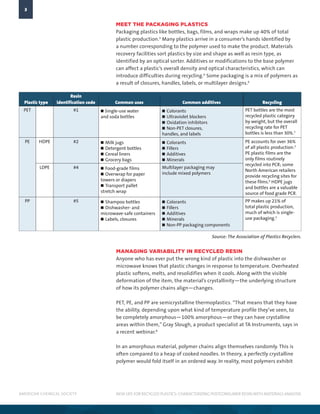
Ethylene and propylene monomers derived from fossil fuel hydrocarbons can be turned
into the polymers that make up common plastics. The polymers include polyethylene,
polypropylene, and polyethylene terephthalate.
Credit: Shutterstock
AMERICAN CHEMICAL SOCIETY
3
NEW LIFE FOR RECYCLED PLASTICS: CHARACTERIZING POSTCONSUMER RESINWITH MATERIALS ANALYSIS
MANAGING VARIABILITY IN RECYCLED RESIN
Anyone who has ever put the wrong kind of plastic into the dishwasher or
microwave knows that plastic changes in response to temperature. Overheated
plastic softens, melts, and resolidifies when it cools. Along with the visible
deformation of the item, the material’s crystallinity—the underlying structure
of how its polymer chains align—changes.
PET, PE, and PP are semicrystalline thermoplastics. “That means that they have
the ability, depending upon what kind of temperature profile they’ve seen, to
be completely amorphous—100% amorphous—or they can have crystalline
areas within them,” Gray Slough, a product specialist at TA Instruments, says in
a recent webinar.8
In an amorphous material, polymer chains align themselves randomly. This is
often compared to a heap of cooked noodles. In theory, a perfectly crystalline
polymer would fold itself in an ordered way. In reality, most polymers exhibit
Plastic type
Resin
identification code Common uses Common additives Recycling
PET #1 ▪ Single-use water
and soda bottles
▪ Colorants
▪ Ultraviolet blockers
▪ Oxidation inhibitors
▪ Non-PET closures,
handles, and labels
PET bottles are the most
recycled plastic category
by weight, but the overall
recycling rate for PET
bottles is less than 30%.7
PE HDPE #2 ▪ Milk jugs
▪ Detergent bottles
▪ Cereal liners
▪ Grocery bags
▪ Colorants
▪ Fillers
▪ Additives
▪ Minerals
PE accounts for over 36%
of all plastic production.3
PE plastic films are the
only films routinely
recycled into PCR; some
North American retailers
provide recycling sites for
these films.6
HDPE jugs
and bottles are a valuable
source of food grade PCR.
LDPE #4 ▪ Food-grade films
▪ Overwrap for paper
towers or diapers
▪ Transport pallet
stretch wrap
Multilayer packaging may
include mixed polymers
PP #5 ▪ Shampoo bottles
▪ Dishwasher- and
microwave-safe containers
▪ Labels, closures
▪ Colorants
▪ Fillers
▪ Additives
▪ Minerals
▪ Non-PP packaging components
PP makes up 21% of
total plastic production,
much of which is single-
use packaging.3
Source: The Association of Plastics Recyclers.
MEET THE PACKAGING PLASTICS
Packaging plastics like bottles, bags, films, and wraps make up 40% of total
plastic production.3
Many plastics arrive in a consumer’s hands identified by
a number corresponding to the polymer used to make the product. Materials
recovery facilities sort plastics by size and shape as well as resin type, as
identified by an optical sorter. Additives or modifications to the base polymer
can affect a plastic’s overall density and optical characteristics, which can
introduce difficulties during recycling.6
Some packaging is a mix of polymers as
a result of closures, handles, labels, or multilayer designs.6
AMERICAN CHEMICAL SOCIETY
4
NEW LIFE FOR RECYCLED PLASTICS: CHARACTERIZING POSTCONSUMER RESINWITH MATERIALS ANALYSIS
a semicrystalline structure, with a combination of both amorphous and
crystalline regions, depending on their thermal histories. Crystallinity affects
how stiff and transparent the plastic is at different temperatures.4,9
Those
qualities are important considerations when formulating a rigid container
versus a flexible film or designing opaque detergent containers versus a see-
through water bottle.
Crystallinity can vary between batches of PCR because of polymer mixtures
caused by incomplete sorting or additives such as colorants, impact modifiers,
and plasticizers. Previous thermal processing such as blow molding can also
influence crystallinity. 9,10
Details about the composition and physical properties of PCR could help
scientists and process engineers manage the feedstock’s inherent variability.
Scientists can use that information to adjust formulations incorporating PCR so
that the final plastic will work for the intended products.
THERMAL AND MECHANICAL ANALYSIS TECHNIQUES
Two fundamental measurements of materials science can provide
quantitative information about variation in PCR feedstock. These techniques
examine a resin’s thermal behavior and analyze its mechanical properties under
strain.
In the glass transition region, plastics absorb heat and change from a brittle,
solid-like state, as with single-use water bottles, to relatively soft and flexible
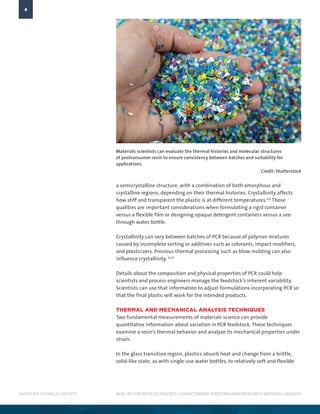
Materials scientists can evaluate the thermal histories and molecular structures
of postconsumer resin to ensure consistency between batches and suitability for
applications.
Credit: Shutterstock
AMERICAN CHEMICAL SOCIETY
5
NEW LIFE FOR RECYCLED PLASTICS: CHARACTERIZING POSTCONSUMER RESINWITH MATERIALS ANALYSIS
state, like that seen in rubber bands.11
One way to determine a material’s glass
transition temperature is through differential scanning calorimetry (DSC).
This technique tracks how heat flows into and out of a material when the
temperature is increased.
DSC analysis helps quickly evaluate PCR quality because it can provide a thermal
fingerprint of the resin.8,10
Each polymer has its own unique glass transition
temperature, and fillers or plasticizers—originally added to speed processing—
further influence the material’s crystallinity.10–12
PCR’s crystallinity is also
influenced by the plastic’s original processing history, and understanding its
crystallinity informs the mechanical properties of plastics made with recycled
resin.9,10,12
Another analysis mimics real-world conditions to help determine if a product
made with PCR will perform
correctly downstream.4
Dynamic
mechanical analysis (DMA)
quantifies how a polymer
performs under an applied
mechanical stress or strain,
while varying the temperature
and environmental conditions.
These data provide information
about a resin’s strength and
whether polymer blends
in a resin combine into a
homogeneous mixture—valuable
in understanding why certain
batches of products made with
PCR fail quality control tests.
Like DSC, DMA can measure
a material’s glass transition
temperature and thus provide information about composition and processing
history. But DMA is 100–1,000 times as sensitive as DSC in identifying subtle
shifts in polymer properties that result from the presence of small, amorphous
molecules such as plasticizers, says Rajaram of TA Instruments, which makes
DSC and DMA instruments.5
These molecules induce transitions in sections
of the material that are secondary to the glass transition. While changes in
amorphous materials have a minimal effect on heat flow measured in DSC,
Rajaram says, they can have a large impact on mechanical measurements
during DMA.
LOOKING AHEAD TO DESIGN FOR RECYCLABILITY
As pressure increases to ramp up PCR percentages in packaging plastics, it’s
imperative to focus on that plastic’s end of life at every point in its production.
Fortunately, there’s already a resource to assist with this.
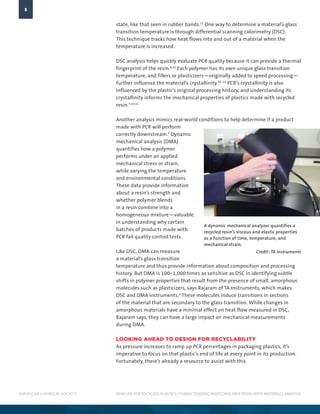
A dynamic mechanical analyzer quantifies a
recycled resin’s viscous and elastic properties
as a function of time, temperature, and
mechanical strain.
Credit: TA Instruments
AMERICAN CHEMICAL SOCIETY
6
NEW LIFE FOR RECYCLED PLASTICS: CHARACTERIZING POSTCONSUMER RESINWITH MATERIALS ANALYSIS
“The Association of Plastics Recyclers is the only place where there’s a design
guide that teaches consumer brand companies and innovators to design their
packaging so it’s compatible with recycling,” Alexander says. “Our design
guide for plastics recyclability is the most referenced authoritative document
on designing for recyclability in the world.”The association also provides
comprehensive testing protocols to help along the way.
“There’s a lot of hope out there for plastics recycling,” says Trina Matta, director
of circular ventures for The Recycling Partnership. “There’s a lot of news that
makes it sound like it’s a complete failure, but I also see a lot of hope as we see
improvements year over year and more enthusiasm for using PCR. I think that
means there’s a future for plastics recycling.”
REFERENCES
1.	 Richard Geyer et al., “Production, Use, and Fate of All Plastics Ever Made,”
Sci. Adv. 3, no. 7 (July 19, 2017): e1700782, https://www.science.org/doi/
epdf/10.1126/sciadv.1700782.
2.	 Joe Brock, Valerie Volcovoci, and John Geddie, “The Recycling Myth: Big Oil’s
A CIRCULAR ECONOMY FOR PLASTICS
A true circular economy is a system in which plastics are designed with end of life in mind so that this material
returns to the loop in the form of PCR—again and again as recycling technology improves.13
By thoughtfully
designing plastic products with the goal of zero waste, manufacturers can essentially generate their own PCR
feedstock supply, eliminating the need for most primary plastic production.
We think of circularity as keeping these materials in the system—recycling them into new packaging or other
products, according to Matta. The business model has potential for a major payoff: circularity could reduce CO2
emissions from plastics by 62 million t per year.3
That’s the impetus behind mandating increases in PCR in plastic manufacturing. For example, current law in the EU and
UK requires that by 2030 new plastic products include 30% PCR; regulation in California and Canada stipulates 50% PCR
in the same time frame.4
At the same time, voluntary commitments like those of the US Plastics Pact are bolder. The
consortium has set targets for 2025 to show what’s possible in the short run.
The pact, which is one of 12 such agreements worldwide, unites more than 850 businesses, nonprofits, research
institutions, government agencies, and other stakeholders. And yet there’s room for more influence.
According to US Plastics Pact executive director Emily Tipaldo, member companies put roughly a third of the plastic
packaging into the US market. “To make a shift toward using really measurable quantities of postconsumer recycled
content, a lot needs to happen within companies and within the system more broadly,” she says.
To meet content minimums and move toward a true circular economy, recyclers need support in the form of
expanded infrastructure, along with universal standards and clear labeling for what’s recyclable, the APR’s
Alexander says. Through widespread stakeholder alignment, regulatory, social, and market pressure can converge to
drive production of plastics designed to eventually become PCR feedstock.
© C&EN MEDIA GROUP
AMERICAN CHEMICAL SOCIETY
1155 Sixteenth Street, NW,
Washington, DC 20036
7
Solution for Plastic Waste Littered with Failure,”Reuters (July 29, 2021),
https://www.reuters.com/investigates/special-report/environment-plastic-
oil-recycling/.
3.	 Lisa Anne Hamilton et al., Plastic & Climate: The Hidden Cost of a
Plastic Planet, Center for International Environmental Law, May 2019,
https://www.ciel.org/wp-content/uploads/2019/05/Plastic-and-Climate-
FINAL-2019.pdf.
4.	 Bharath Rajaram and Morgan Ulrich, “Post-consumer Resin Legislation: What
Polymer Developers Need to Know,”TA Instruments, March 1, 2022, https://
www.tainstruments.com/post-consumer-resin-legislation-what-polymer-
developers-need-to-know/.
5.	 Bharath Rajaram, “Connecting Polymer Processing and Product Performance
Through Rheology and DMA on the New DHR,”webinar, TA Instruments,
https://www.tainstruments.com/connecting-polymer-processing-and-
product-performance-through-rheology-dma-on-the-new-dhr/.
6.	 Association of Plastic Recyclers, “APR Design Guide,”2022, https://
plasticsrecycling.org/apr-design-guide.
7.	 Association of Plastic Recyclers, “2020 US Post-Consumer Plastic Recycling
Data Dashboard,” https://circularityinaction.com/2020PlasticRecyclingData.
8.	 Gray Slough, “Polymer Analysis Using the New Multi Sample Discovery X3
DSC,”webinar, TA Instruments, https://www.tainstruments.com/polymer-
analysis-using-the-new-multi-sample-discovery-x3-dsc.
9.	 Andrew Janisse, Semi-Crystalline Thermoplastic Analysis Using the Discovery
X3 DSC, (TA Instruments TA448), http://www.tainstruments.com/pdf/
literature/TA448.pdf.
10.	 TA Instruments, Comparison of Crystallization Behavior of Different
Colored Parts Made from Polypropylene Using a Single DSC Experiment,
(TA Instruments TA393), http://www.tainstruments.com/pdf/literature/
TA393.pdf.
11.	 Kevin Whitcomb, Measurement of Glass Transition Temperatures by Dynamic
Mechanical Analysis and Rheology, (TA Instruments RH100), https://www.
tainstruments.com/pdf/literature/RH100.pdf.
12.	 Els Verdonck, Comparison of the Thermal Behavior of Different Types of
Recycled PET for Advanced Honeycomb Structures, (TA Instruments TA444),
https://www.tainstruments.com/pdf/literature/TA444.pdf.
13.	 Zoé O. G. Schyns and Michael P. Shaver, “Mechanical Recycling of Packaging
Plastics: A Review,”Macromol. Rapid Commun. 42, no. 3 (Feb. 2020): 2000415,
https://onlinelibrary.wiley.com/doi/10.1002/marc.202000415.

RecycledPlastics.pdf

  • 1.
    AMERICAN CHEMICAL SOCIETYBROUGHT TO YOU BY NEW LIFE FOR RECYCLED PLASTIC: CHARACTERIZING POSTCONSUMER RESIN WITH MATERIALS ANALYSIS It’s impossible to think about plastics without picturing piles of soda bottles, filmy food wrappers, and other packaging floating in the ocean or washing up on the shore. Plastic waste is everywhere, sometimes in pieces too small for the naked eye. In fact, plastic waste is so omnipresent that it’s been recommended as a geological indicator of the current period of Earth’s history.1 The complex problem of plastic waste is on the radar of every industry that touches the plastic. Fundamental materials science to measure the properties of recycled plastic can support solutions to make reuse more feasible and efficient. Plastic is a problem without an expiration date. If the current trajectory continues unabated, plastic production will double by 2040; by 2050, the total emissions over the lifetime of those plastics will equal those of 615 coal plants operating at maximum capacity.2,3 One alternative to single-use plastics is plastic waste recycled into postconsumer resin (PCR). These pellets or flakes of recycled plastic can be the base material for new packaging and products. Yet while many plastic products are technically recyclable, over 90% of them are incinerated or deposited into landfills or the natural environment.2 Between 1950 and 2015, the US generated 6.3 billion metric tons (t) of plastic waste. Only 9% of this was recycled, and less than 1% was recycled more than once.1 Recycling is complicated in part because it’s managed at the state or local level, so what’s recyclable in one community may not be in another. Even if every piece of plastic reached a recycler, additives in the resin, along with varied closures, labels, adhesives, and inks, make PCR harder to convert to new packaging than plastics fresh from fossil feedstocks. In addition, recycling labels can be confusing. Steve Alexander, president of the Association of Plastic Recyclers (APR), recalls that when he addressed environmental journalists at a conference a few years
  • 2.
    AMERICAN CHEMICAL SOCIETY 2 NEWLIFE FOR RECYCLED PLASTICS: CHARACTERIZING POSTCONSUMER RESINWITH MATERIALS ANALYSIS ago, he was asked what he would do if he had a magic wand. His answer: “Every recycling program in the United States would take the same things. Every label would have the same stuff on it in terms of if it’s recyclable or not.” Despite these challenges, companies that use plastic packaging, like polyethylene (PE), polypropylene (PP), and polyethylene terephthalate (PET), face growing pressure from governments, environmental scientists, and consumers to decrease their reliance on plastic produced from fresh feedstock. Around the world, legislation prioritizing the use of PCR over new resin supports a growing circular plastics economy (see sidebar on page 6).4 Rapid and routine material analyses of PCR are essential to look for contamination and additives, assess blend compatibility, explain variations between and within batches, and better understand failed batches.4 A data sheet for a plastic polymer contains information about physical properties that are helpful in characterizing the pure material. “But it often does not give the level of detailed information that’s needed to differentiate between materials,” Bharath Rajaram, senior manager of strategic marketing at TA Instruments, says in a recent webinar.5 “Or it’s not nuanced enough to help you troubleshoot problems [during reuse].” Ethylene and propylene monomers derived from fossil fuel hydrocarbons can be turned into the polymers that make up common plastics. The polymers include polyethylene, polypropylene, and polyethylene terephthalate. Credit: Shutterstock
  • 3.
    AMERICAN CHEMICAL SOCIETY 3 NEWLIFE FOR RECYCLED PLASTICS: CHARACTERIZING POSTCONSUMER RESINWITH MATERIALS ANALYSIS MANAGING VARIABILITY IN RECYCLED RESIN Anyone who has ever put the wrong kind of plastic into the dishwasher or microwave knows that plastic changes in response to temperature. Overheated plastic softens, melts, and resolidifies when it cools. Along with the visible deformation of the item, the material’s crystallinity—the underlying structure of how its polymer chains align—changes. PET, PE, and PP are semicrystalline thermoplastics. “That means that they have the ability, depending upon what kind of temperature profile they’ve seen, to be completely amorphous—100% amorphous—or they can have crystalline areas within them,” Gray Slough, a product specialist at TA Instruments, says in a recent webinar.8 In an amorphous material, polymer chains align themselves randomly. This is often compared to a heap of cooked noodles. In theory, a perfectly crystalline polymer would fold itself in an ordered way. In reality, most polymers exhibit Plastic type Resin identification code Common uses Common additives Recycling PET #1 ▪ Single-use water and soda bottles ▪ Colorants ▪ Ultraviolet blockers ▪ Oxidation inhibitors ▪ Non-PET closures, handles, and labels PET bottles are the most recycled plastic category by weight, but the overall recycling rate for PET bottles is less than 30%.7 PE HDPE #2 ▪ Milk jugs ▪ Detergent bottles ▪ Cereal liners ▪ Grocery bags ▪ Colorants ▪ Fillers ▪ Additives ▪ Minerals PE accounts for over 36% of all plastic production.3 PE plastic films are the only films routinely recycled into PCR; some North American retailers provide recycling sites for these films.6 HDPE jugs and bottles are a valuable source of food grade PCR. LDPE #4 ▪ Food-grade films ▪ Overwrap for paper towers or diapers ▪ Transport pallet stretch wrap Multilayer packaging may include mixed polymers PP #5 ▪ Shampoo bottles ▪ Dishwasher- and microwave-safe containers ▪ Labels, closures ▪ Colorants ▪ Fillers ▪ Additives ▪ Minerals ▪ Non-PP packaging components PP makes up 21% of total plastic production, much of which is single- use packaging.3 Source: The Association of Plastics Recyclers. MEET THE PACKAGING PLASTICS Packaging plastics like bottles, bags, films, and wraps make up 40% of total plastic production.3 Many plastics arrive in a consumer’s hands identified by a number corresponding to the polymer used to make the product. Materials recovery facilities sort plastics by size and shape as well as resin type, as identified by an optical sorter. Additives or modifications to the base polymer can affect a plastic’s overall density and optical characteristics, which can introduce difficulties during recycling.6 Some packaging is a mix of polymers as a result of closures, handles, labels, or multilayer designs.6
  • 4.
    AMERICAN CHEMICAL SOCIETY 4 NEWLIFE FOR RECYCLED PLASTICS: CHARACTERIZING POSTCONSUMER RESINWITH MATERIALS ANALYSIS a semicrystalline structure, with a combination of both amorphous and crystalline regions, depending on their thermal histories. Crystallinity affects how stiff and transparent the plastic is at different temperatures.4,9 Those qualities are important considerations when formulating a rigid container versus a flexible film or designing opaque detergent containers versus a see- through water bottle. Crystallinity can vary between batches of PCR because of polymer mixtures caused by incomplete sorting or additives such as colorants, impact modifiers, and plasticizers. Previous thermal processing such as blow molding can also influence crystallinity. 9,10 Details about the composition and physical properties of PCR could help scientists and process engineers manage the feedstock’s inherent variability. Scientists can use that information to adjust formulations incorporating PCR so that the final plastic will work for the intended products. THERMAL AND MECHANICAL ANALYSIS TECHNIQUES Two fundamental measurements of materials science can provide quantitative information about variation in PCR feedstock. These techniques examine a resin’s thermal behavior and analyze its mechanical properties under strain. In the glass transition region, plastics absorb heat and change from a brittle, solid-like state, as with single-use water bottles, to relatively soft and flexible Materials scientists can evaluate the thermal histories and molecular structures of postconsumer resin to ensure consistency between batches and suitability for applications. Credit: Shutterstock
  • 5.
    AMERICAN CHEMICAL SOCIETY 5 NEWLIFE FOR RECYCLED PLASTICS: CHARACTERIZING POSTCONSUMER RESINWITH MATERIALS ANALYSIS state, like that seen in rubber bands.11 One way to determine a material’s glass transition temperature is through differential scanning calorimetry (DSC). This technique tracks how heat flows into and out of a material when the temperature is increased. DSC analysis helps quickly evaluate PCR quality because it can provide a thermal fingerprint of the resin.8,10 Each polymer has its own unique glass transition temperature, and fillers or plasticizers—originally added to speed processing— further influence the material’s crystallinity.10–12 PCR’s crystallinity is also influenced by the plastic’s original processing history, and understanding its crystallinity informs the mechanical properties of plastics made with recycled resin.9,10,12 Another analysis mimics real-world conditions to help determine if a product made with PCR will perform correctly downstream.4 Dynamic mechanical analysis (DMA) quantifies how a polymer performs under an applied mechanical stress or strain, while varying the temperature and environmental conditions. These data provide information about a resin’s strength and whether polymer blends in a resin combine into a homogeneous mixture—valuable in understanding why certain batches of products made with PCR fail quality control tests. Like DSC, DMA can measure a material’s glass transition temperature and thus provide information about composition and processing history. But DMA is 100–1,000 times as sensitive as DSC in identifying subtle shifts in polymer properties that result from the presence of small, amorphous molecules such as plasticizers, says Rajaram of TA Instruments, which makes DSC and DMA instruments.5 These molecules induce transitions in sections of the material that are secondary to the glass transition. While changes in amorphous materials have a minimal effect on heat flow measured in DSC, Rajaram says, they can have a large impact on mechanical measurements during DMA. LOOKING AHEAD TO DESIGN FOR RECYCLABILITY As pressure increases to ramp up PCR percentages in packaging plastics, it’s imperative to focus on that plastic’s end of life at every point in its production. Fortunately, there’s already a resource to assist with this. A dynamic mechanical analyzer quantifies a recycled resin’s viscous and elastic properties as a function of time, temperature, and mechanical strain. Credit: TA Instruments
  • 6.
    AMERICAN CHEMICAL SOCIETY 6 NEWLIFE FOR RECYCLED PLASTICS: CHARACTERIZING POSTCONSUMER RESINWITH MATERIALS ANALYSIS “The Association of Plastics Recyclers is the only place where there’s a design guide that teaches consumer brand companies and innovators to design their packaging so it’s compatible with recycling,” Alexander says. “Our design guide for plastics recyclability is the most referenced authoritative document on designing for recyclability in the world.”The association also provides comprehensive testing protocols to help along the way. “There’s a lot of hope out there for plastics recycling,” says Trina Matta, director of circular ventures for The Recycling Partnership. “There’s a lot of news that makes it sound like it’s a complete failure, but I also see a lot of hope as we see improvements year over year and more enthusiasm for using PCR. I think that means there’s a future for plastics recycling.” REFERENCES 1. Richard Geyer et al., “Production, Use, and Fate of All Plastics Ever Made,” Sci. Adv. 3, no. 7 (July 19, 2017): e1700782, https://www.science.org/doi/ epdf/10.1126/sciadv.1700782. 2. Joe Brock, Valerie Volcovoci, and John Geddie, “The Recycling Myth: Big Oil’s A CIRCULAR ECONOMY FOR PLASTICS A true circular economy is a system in which plastics are designed with end of life in mind so that this material returns to the loop in the form of PCR—again and again as recycling technology improves.13 By thoughtfully designing plastic products with the goal of zero waste, manufacturers can essentially generate their own PCR feedstock supply, eliminating the need for most primary plastic production. We think of circularity as keeping these materials in the system—recycling them into new packaging or other products, according to Matta. The business model has potential for a major payoff: circularity could reduce CO2 emissions from plastics by 62 million t per year.3 That’s the impetus behind mandating increases in PCR in plastic manufacturing. For example, current law in the EU and UK requires that by 2030 new plastic products include 30% PCR; regulation in California and Canada stipulates 50% PCR in the same time frame.4 At the same time, voluntary commitments like those of the US Plastics Pact are bolder. The consortium has set targets for 2025 to show what’s possible in the short run. The pact, which is one of 12 such agreements worldwide, unites more than 850 businesses, nonprofits, research institutions, government agencies, and other stakeholders. And yet there’s room for more influence. According to US Plastics Pact executive director Emily Tipaldo, member companies put roughly a third of the plastic packaging into the US market. “To make a shift toward using really measurable quantities of postconsumer recycled content, a lot needs to happen within companies and within the system more broadly,” she says. To meet content minimums and move toward a true circular economy, recyclers need support in the form of expanded infrastructure, along with universal standards and clear labeling for what’s recyclable, the APR’s Alexander says. Through widespread stakeholder alignment, regulatory, social, and market pressure can converge to drive production of plastics designed to eventually become PCR feedstock.
  • 7.
    © C&EN MEDIAGROUP AMERICAN CHEMICAL SOCIETY 1155 Sixteenth Street, NW, Washington, DC 20036 7 Solution for Plastic Waste Littered with Failure,”Reuters (July 29, 2021), https://www.reuters.com/investigates/special-report/environment-plastic- oil-recycling/. 3. Lisa Anne Hamilton et al., Plastic & Climate: The Hidden Cost of a Plastic Planet, Center for International Environmental Law, May 2019, https://www.ciel.org/wp-content/uploads/2019/05/Plastic-and-Climate- FINAL-2019.pdf. 4. Bharath Rajaram and Morgan Ulrich, “Post-consumer Resin Legislation: What Polymer Developers Need to Know,”TA Instruments, March 1, 2022, https:// www.tainstruments.com/post-consumer-resin-legislation-what-polymer- developers-need-to-know/. 5. Bharath Rajaram, “Connecting Polymer Processing and Product Performance Through Rheology and DMA on the New DHR,”webinar, TA Instruments, https://www.tainstruments.com/connecting-polymer-processing-and- product-performance-through-rheology-dma-on-the-new-dhr/. 6. Association of Plastic Recyclers, “APR Design Guide,”2022, https:// plasticsrecycling.org/apr-design-guide. 7. Association of Plastic Recyclers, “2020 US Post-Consumer Plastic Recycling Data Dashboard,” https://circularityinaction.com/2020PlasticRecyclingData. 8. Gray Slough, “Polymer Analysis Using the New Multi Sample Discovery X3 DSC,”webinar, TA Instruments, https://www.tainstruments.com/polymer- analysis-using-the-new-multi-sample-discovery-x3-dsc. 9. Andrew Janisse, Semi-Crystalline Thermoplastic Analysis Using the Discovery X3 DSC, (TA Instruments TA448), http://www.tainstruments.com/pdf/ literature/TA448.pdf. 10. TA Instruments, Comparison of Crystallization Behavior of Different Colored Parts Made from Polypropylene Using a Single DSC Experiment, (TA Instruments TA393), http://www.tainstruments.com/pdf/literature/ TA393.pdf. 11. Kevin Whitcomb, Measurement of Glass Transition Temperatures by Dynamic Mechanical Analysis and Rheology, (TA Instruments RH100), https://www. tainstruments.com/pdf/literature/RH100.pdf. 12. Els Verdonck, Comparison of the Thermal Behavior of Different Types of Recycled PET for Advanced Honeycomb Structures, (TA Instruments TA444), https://www.tainstruments.com/pdf/literature/TA444.pdf. 13. Zoé O. G. Schyns and Michael P. Shaver, “Mechanical Recycling of Packaging Plastics: A Review,”Macromol. Rapid Commun. 42, no. 3 (Feb. 2020): 2000415, https://onlinelibrary.wiley.com/doi/10.1002/marc.202000415.