Next Generation ACO Model
Open Door Forum:
Financial Deep Dive
March 31, 2015
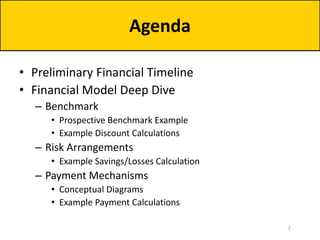
Agenda
• Preliminary Financial Timeline
• Financial Model Deep Dive
– Benchmark
• Prospective Benchmark Example
• Example Discount Calculations
– Risk Arrangements
• Example Savings/Losses Calculation
– Payment Mechanisms
• Conceptual Diagrams
• Example Payment Calculations
2
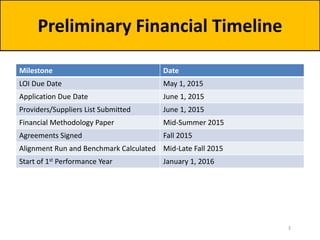
Milestone Date
LOI Due Date May 1, 2015
Application Due Date June 1, 2015
Providers/Suppliers List Submitted June 1, 2015
Financial Methodology Paper Mid-Summer 2015
Agreements Signed Fall 2015
Alignment Run and Benchmark Calculated Mid-Late Fall 2015
Start of 1st Performance Year January 1, 2016
Preliminary Financial Timeline
3
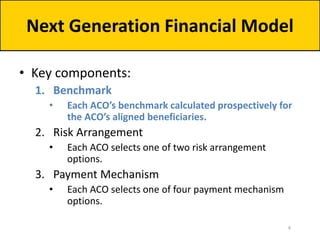
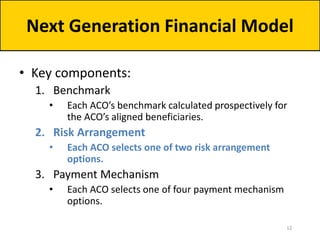
• Key components:
1. Benchmark
• Each ACO’s benchmark calculated prospectively for
the ACO’s aligned beneficiaries.
2. Risk Arrangement
• Each ACO selects one of two risk arrangement
options.
3. Payment Mechanism
• Each ACO selects one of four payment mechanism
options.
Next Generation Financial Model
4
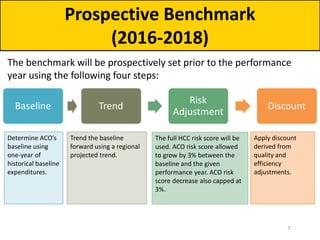
The benchmark will be prospectively set prior to the performance
year using the following four steps:
Determine ACO’s
baseline using
one-year of
historical baseline
expenditures.
Trend the baseline
forward using a regional
projected trend.
The full HCC risk score will be
used. ACO risk score allowed
to grow by 3% between the
baseline and the given
performance year. ACO risk
score decrease also capped at
3%.
Apply discount
derived from
quality and
efficiency
adjustments.
Prospective Benchmark
(2016-2018)
5
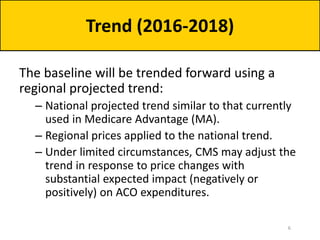
The baseline will be trended forward using a
regional projected trend:
– National projected trend similar to that currently
used in Medicare Advantage (MA).
– Regional prices applied to the national trend.
– Under limited circumstances, CMS may adjust the
trend in response to price changes with
substantial expected impact (negatively or
positively) on ACO expenditures.
Trend (2016-2018)
6
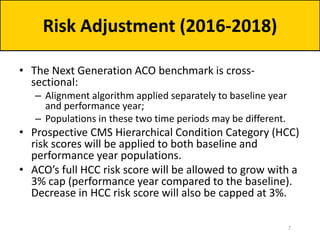
• The Next Generation ACO benchmark is cross-
sectional:
– Alignment algorithm applied separately to baseline year
and performance year;
– Populations in these two time periods may be different.
• Prospective CMS Hierarchical Condition Category (HCC)
risk scores will be applied to both baseline and
performance year populations.
• ACO’s full HCC risk score will be allowed to grow with a
3% cap (performance year compared to the baseline).
Decrease in HCC risk score will also be capped at 3%.
Risk Adjustment (2016-2018)
7
• Once the baseline has been calculated, trended, and risk-adjusted,
CMS will apply a discount.
• Summing the following components creates each ACO’s discount:
– Quality:
• Range: 2.0% to 3.0%
• Formula: [2.0 + (1- quality score)]%
– Regional Efficiency:
• Range: -1% to 1%
• Compares the ACO’s risk-adjusted historical per capita baseline to a risk-
adjusted regional FFS per capita baseline.
– National Efficiency:
• Range: -0.5% to 0.5%
• Compares the risk-adjusted regional FFS baseline to risk-adjusted national FFS
per capita spending.
• Total discount range: 0.5% to 4.5%
Discount (2016-2018)
Example ACO A
Discount Calculation
Calculating the Discount Illustrative
Amount
1. Quality null
Quality Score 100%
Quality Component 2.0%
2. Regional Efficiency null
ACO Risk-Adjusted Baseline $8,000
Regional FFS Risk-Adjusted Baseline $8,500
Regional Efficiency Ratio 0.94
Regional Efficiency Discount Component -0.6%
3. National Efficiency null
Regional FFS Risk-Adjusted Baseline $8,500
National FFS Risk-Adjusted Baseline $10,500
National Efficiency Ratio 0.81
National Efficiency Discount Component -0.5%
Example ACO A Discount 0.9%
• In PY1, 100% will be used as the
quality score for all Next
Generation ACOs:
• [2.0 + (1-1.0)]%
• Example ACO A’s historic
baseline expenditures are 6%
less expensive than regional
FFS—ACO is rewarded for this
attainment by having the
discount reduced by 0.6%.
• ACO is in a very low cost region
(19% below national FFS)—ACO
is rewarded with 0.5% discount
reduction (the maximum
regional-to-national FFS
discount reduction).
9
Example ACO B
Discount Calculation
Calculating the Discount Illustrative
Amount
1. Quality null
Quality Score 100%
Quality Component 2.0%
2. Regional Efficiency null
ACO Risk-Adjusted Baseline $12,000
Regional FFS Risk-Adjusted Baseline $13,000
Regional Efficiency Ratio 0.92
Regional Efficiency Discount Component -0.8%
3. National Efficiency null
Regional FFS Risk-Adjusted Baseline $13,000
National FFS Risk-Adjusted Baseline $11,500
National Efficiency Ratio 1.13
National Efficiency Discount Component 0.4%
Example ACO B Discount 1.6%
• In PY1, 100% will be used as the
quality score for all Next
Generation ACOs:
• [2.0 + (1-1.0)]%
• Example ACO B’s historic
baseline expenditures are 8%
less expensive than regional
FFS—ACO is rewarded for this
attainment by having the
discount reduced by 0.8%.
• ACO is in a region whose
spending is 13% higher than
national FFS—ACO’s discount is
increased by 0.4% to reflect this
regional-to-national FFS
differential.
10
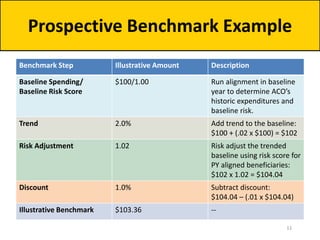
Prospective Benchmark Example
Benchmark Step Illustrative Amount Description
Baseline Spending/
Baseline Risk Score
$100/1.00 Run alignment in baseline
year to determine ACO’s
historic expenditures and
baseline risk.
Trend 2.0% Add trend to the baseline:
$100 + (.02 x $100) = $102
Risk Adjustment 1.02 Risk adjust the trended
baseline using risk score for
PY aligned beneficiaries:
$102 x 1.02 = $104.04
Discount 1.0% Subtract discount:
$104.04 – (.01 x $104.04)
Illustrative Benchmark $103.36 --
11
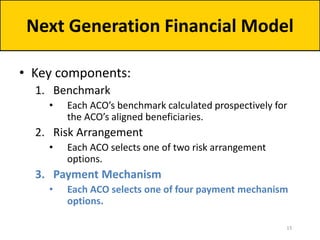
• Key components:
1. Benchmark
• Each ACO’s benchmark calculated prospectively for
the ACO’s aligned beneficiaries.
2. Risk Arrangement
• Each ACO selects one of two risk arrangement
options.
3. Payment Mechanism
• Each ACO selects one of four payment mechanism
options.
Next Generation Financial Model
12
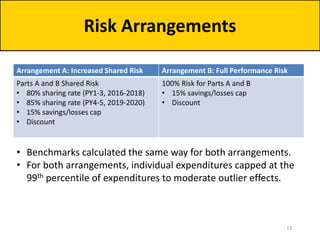
Risk Arrangements
Arrangement A: Increased Shared Risk
Parts A and B Shared Risk
• 80% sharing rate (PY1-3, 2016-2018)
• 85% sharing rate (PY4-5, 2019-2020)
• 15% savings/losses cap
• Discount
Arrangement B: Full Performance Risk
100% Risk for Parts A and B
• 15% savings/losses cap
• Discount
13
• Benchmarks calculated the same way for both arrangements.
• For both arrangements, individual expenditures capped at the
99th percentile of expenditures to moderate outlier effects.
Example Savings/Losses Calculation
Shared Savings/Loss
Reconciliation
Arrangement A: Increased
Shared Risk
Arrangement B: Full
Performance Risk
Illustrative Benchmark $100,000,000 $100,000,000
Sharing Rate 80% 100%
Savings/Losses Cap 15% 15%
Maximum
Savings/Losses
+/- $12,000,000
[80% x (15% x $100,000,000)]
+/- $15,000,000
[100% x (15% x $100,000,000)]
Actual PY Expenditures $97,000,000 $97,000,000
Shared Savings Payment $2,400,000 $3,000,000
Actual PY Expenditures $103,000,000 $103,000,000
Shared Losses Owed $2,400,000 $3,000,000
• Savings or losses determined by comparing total Parts A and B
spending for aligned beneficiaries to the benchmark.
• Risk arrangement determines ACO’s share of savings or losses. 14
• Key components:
1. Benchmark
• Each ACO’s benchmark calculated prospectively for
the ACO’s aligned beneficiaries.
2. Risk Arrangement
• Each ACO selects one of two risk arrangement
options.
3. Payment Mechanism
• Each ACO selects one of four payment mechanism
options.
Next Generation Financial Model
15
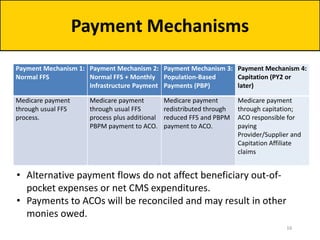
Payment Mechanisms
Payment Mechanism 1:
Normal FFS
Payment Mechanism 2:
Normal FFS + Monthly
Infrastructure Payment
Payment Mechanism 3:
Population-Based
Payments (PBP)
Payment Mechanism 4:
Capitation (PY2 or
later)
Medicare payment
through usual FFS
process.
Medicare payment
through usual FFS
process plus additional
PBPM payment to ACO.
Medicare payment
redistributed through
reduced FFS and PBPM
payment to ACO.
Medicare payment
through capitation;
ACO responsible for
paying
Provider/Supplier and
Capitation Affiliate
claims
• Alternative payment flows do not affect beneficiary out-of-
pocket expenses or net CMS expenditures.
• Payments to ACOs will be reconciled and may result in other
monies owed.
16
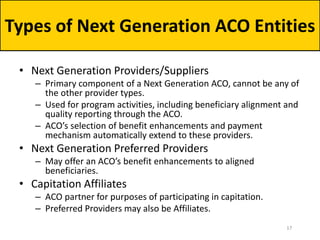
• Next Generation Providers/Suppliers
– Primary component of a Next Generation ACO, cannot be any of
the other provider types.
– Used for program activities, including beneficiary alignment and
quality reporting through the ACO.
– ACO’s selection of benefit enhancements and payment
mechanism automatically extend to these providers.
• Next Generation Preferred Providers
– May offer an ACO’s benefit enhancements to aligned
beneficiaries.
• Capitation Affiliates
– ACO partner for purposes of participating in capitation.
– Preferred Providers may also be Affiliates.
Types of Next Generation ACO Entities
17
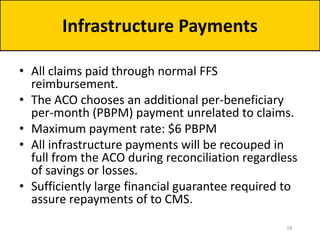
• All claims paid through normal FFS
reimbursement.
• The ACO chooses an additional per-beneficiary
per-month (PBPM) payment unrelated to claims.
• Maximum payment rate: $6 PBPM
• All infrastructure payments will be recouped in
full from the ACO during reconciliation regardless
of savings or losses.
• Sufficiently large financial guarantee required to
assure repayments of to CMS.
Infrastructure Payments
18
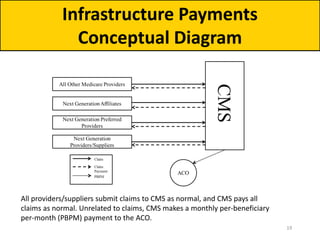
Infrastructure Payments
Conceptual Diagram
All providers/suppliers submit claims to CMS as normal, and CMS pays all
claims as normal. Unrelated to claims, CMS makes a monthly per-beneficiary
per-month (PBPM) payment to the ACO.
19
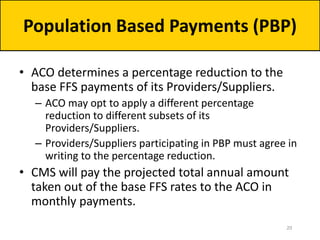
• ACO determines a percentage reduction to the
base FFS payments of its Providers/Suppliers.
– ACO may opt to apply a different percentage
reduction to different subsets of its
Providers/Suppliers.
– Providers/Suppliers participating in PBP must agree in
writing to the percentage reduction.
• CMS will pay the projected total annual amount
taken out of the base FFS rates to the ACO in
monthly payments.
Population Based Payments (PBP)
20
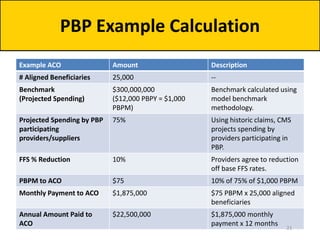
Example ACO Amount Description
# Aligned Beneficiaries 25,000 --
Benchmark
(Projected Spending)
$300,000,000
($12,000 PBPY = $1,000
PBPM)
Benchmark calculated using
model benchmark
methodology.
Projected Spending by PBP
participating
providers/suppliers
75% Using historic claims, CMS
projects spending by
providers participating in
PBP.
FFS % Reduction 10% Providers agree to reduction
off base FFS rates.
PBPM to ACO $75 10% of 75% of $1,000 PBPM
Monthly Payment to ACO $1,875,000 $75 PBPM x 25,000 aligned
beneficiaries
Annual Amount Paid to
ACO
$22,500,000 $1,875,000 monthly
payment x 12 months
PBP Example Calculation
21
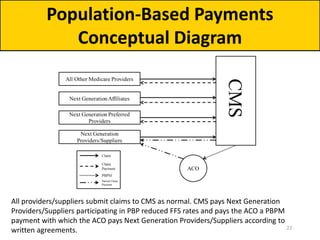
Population-Based Payments
Conceptual Diagram
All providers/suppliers submit claims to CMS as normal. CMS pays Next Generation
Providers/Suppliers participating in PBP reduced FFS rates and pays the ACO a PBPM
payment with which the ACO pays Next Generation Providers/Suppliers according to
written agreements. 22
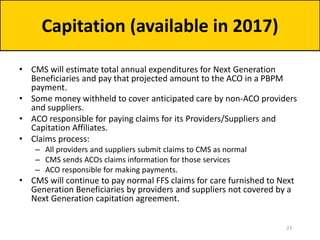
• CMS will estimate total annual expenditures for Next Generation
Beneficiaries and pay that projected amount to the ACO in a PBPM
payment.
• Some money withheld to cover anticipated care by non-ACO providers
and suppliers.
• ACO responsible for paying claims for its Providers/Suppliers and
Capitation Affiliates.
• Claims process:
– All providers and suppliers submit claims to CMS as normal
– CMS sends ACOs claims information for those services
– ACO responsible for making payments.
• CMS will continue to pay normal FFS claims for care furnished to Next
Generation Beneficiaries by providers and suppliers not covered by a
Next Generation capitation agreement.
Capitation (available in 2017)
23
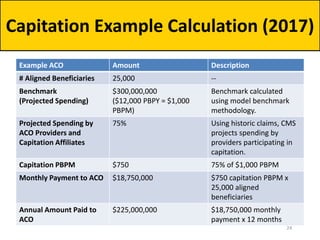
Example ACO Amount Description
# Aligned Beneficiaries 25,000 --
Benchmark
(Projected Spending)
$300,000,000
($12,000 PBPY = $1,000
PBPM)
Benchmark calculated
using model benchmark
methodology.
Projected Spending by
ACO Providers and
Capitation Affiliates
75% Using historic claims, CMS
projects spending by
providers participating in
capitation.
Capitation PBPM $750 75% of $1,000 PBPM
Monthly Payment to ACO $18,750,000 $750 capitation PBPM x
25,000 aligned
beneficiaries
Annual Amount Paid to
ACO
$225,000,000 $18,750,000 monthly
payment x 12 months
Capitation Example Calculation (2017)
24
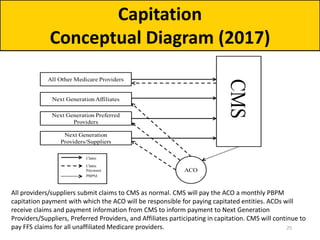
Capitation
Conceptual Diagram (2017)
All providers/suppliers submit claims to CMS as normal. CMS will pay the ACO a monthly PBPM
capitation payment with which the ACO will be responsible for paying capitated entities. ACOs will
receive claims and payment information from CMS to inform payment to Next Generation
Providers/Suppliers, Preferred Providers, and Affiliates participating in capitation. CMS will continue to
pay FFS claims for all unaffiliated Medicare providers. 25
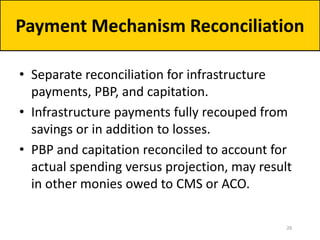
• Separate reconciliation for infrastructure
payments, PBP, and capitation.
• Infrastructure payments fully recouped from
savings or in addition to losses.
• PBP and capitation reconciled to account for
actual spending versus projection, may result
in other monies owed to CMS or ACO.
Payment Mechanism Reconciliation
26
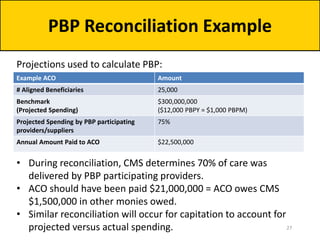
PBP Reconciliation Example
Projections used to calculate PBP:
Example ACO Amount
# Aligned Beneficiaries 25,000
Benchmark
(Projected Spending)
$300,000,000
($12,000 PBPY = $1,000 PBPM)
Projected Spending by PBP participating
providers/suppliers
75%
Annual Amount Paid to ACO $22,500,000
• During reconciliation, CMS determines 70% of care was
delivered by PBP participating providers.
• ACO should have been paid $21,000,000 = ACO owes CMS
$1,500,000 in other monies owed.
• Similar reconciliation will occur for capitation to account for
projected versus actual spending. 27
Next Generation ACO Model Webpage:
http://innovation.cms.gov/initiatives/Next-Generation-
ACO-Model/
E-mail: NextGenerationACOModel@cms.hhs.gov
Questions?
28

Open Door Forum: Next Generation ACO Model - Financial Methodology and Related Issues

  • 1.
    Next Generation ACOModel Open Door Forum: Financial Deep Dive March 31, 2015
  • 2.
    Agenda • Preliminary FinancialTimeline • Financial Model Deep Dive – Benchmark • Prospective Benchmark Example • Example Discount Calculations – Risk Arrangements • Example Savings/Losses Calculation – Payment Mechanisms • Conceptual Diagrams • Example Payment Calculations 2
  • 3.
    Milestone Date LOI DueDate May 1, 2015 Application Due Date June 1, 2015 Providers/Suppliers List Submitted June 1, 2015 Financial Methodology Paper Mid-Summer 2015 Agreements Signed Fall 2015 Alignment Run and Benchmark Calculated Mid-Late Fall 2015 Start of 1st Performance Year January 1, 2016 Preliminary Financial Timeline 3
  • 4.
    • Key components: 1.Benchmark • Each ACO’s benchmark calculated prospectively for the ACO’s aligned beneficiaries. 2. Risk Arrangement • Each ACO selects one of two risk arrangement options. 3. Payment Mechanism • Each ACO selects one of four payment mechanism options. Next Generation Financial Model 4
  • 5.
    The benchmark willbe prospectively set prior to the performance year using the following four steps: Determine ACO’s baseline using one-year of historical baseline expenditures. Trend the baseline forward using a regional projected trend. The full HCC risk score will be used. ACO risk score allowed to grow by 3% between the baseline and the given performance year. ACO risk score decrease also capped at 3%. Apply discount derived from quality and efficiency adjustments. Prospective Benchmark (2016-2018) 5
  • 6.
    The baseline willbe trended forward using a regional projected trend: – National projected trend similar to that currently used in Medicare Advantage (MA). – Regional prices applied to the national trend. – Under limited circumstances, CMS may adjust the trend in response to price changes with substantial expected impact (negatively or positively) on ACO expenditures. Trend (2016-2018) 6
  • 7.
    • The NextGeneration ACO benchmark is cross- sectional: – Alignment algorithm applied separately to baseline year and performance year; – Populations in these two time periods may be different. • Prospective CMS Hierarchical Condition Category (HCC) risk scores will be applied to both baseline and performance year populations. • ACO’s full HCC risk score will be allowed to grow with a 3% cap (performance year compared to the baseline). Decrease in HCC risk score will also be capped at 3%. Risk Adjustment (2016-2018) 7
  • 8.
    • Once thebaseline has been calculated, trended, and risk-adjusted, CMS will apply a discount. • Summing the following components creates each ACO’s discount: – Quality: • Range: 2.0% to 3.0% • Formula: [2.0 + (1- quality score)]% – Regional Efficiency: • Range: -1% to 1% • Compares the ACO’s risk-adjusted historical per capita baseline to a risk- adjusted regional FFS per capita baseline. – National Efficiency: • Range: -0.5% to 0.5% • Compares the risk-adjusted regional FFS baseline to risk-adjusted national FFS per capita spending. • Total discount range: 0.5% to 4.5% Discount (2016-2018)
  • 9.
    Example ACO A DiscountCalculation Calculating the Discount Illustrative Amount 1. Quality null Quality Score 100% Quality Component 2.0% 2. Regional Efficiency null ACO Risk-Adjusted Baseline $8,000 Regional FFS Risk-Adjusted Baseline $8,500 Regional Efficiency Ratio 0.94 Regional Efficiency Discount Component -0.6% 3. National Efficiency null Regional FFS Risk-Adjusted Baseline $8,500 National FFS Risk-Adjusted Baseline $10,500 National Efficiency Ratio 0.81 National Efficiency Discount Component -0.5% Example ACO A Discount 0.9% • In PY1, 100% will be used as the quality score for all Next Generation ACOs: • [2.0 + (1-1.0)]% • Example ACO A’s historic baseline expenditures are 6% less expensive than regional FFS—ACO is rewarded for this attainment by having the discount reduced by 0.6%. • ACO is in a very low cost region (19% below national FFS)—ACO is rewarded with 0.5% discount reduction (the maximum regional-to-national FFS discount reduction). 9
  • 10.
    Example ACO B DiscountCalculation Calculating the Discount Illustrative Amount 1. Quality null Quality Score 100% Quality Component 2.0% 2. Regional Efficiency null ACO Risk-Adjusted Baseline $12,000 Regional FFS Risk-Adjusted Baseline $13,000 Regional Efficiency Ratio 0.92 Regional Efficiency Discount Component -0.8% 3. National Efficiency null Regional FFS Risk-Adjusted Baseline $13,000 National FFS Risk-Adjusted Baseline $11,500 National Efficiency Ratio 1.13 National Efficiency Discount Component 0.4% Example ACO B Discount 1.6% • In PY1, 100% will be used as the quality score for all Next Generation ACOs: • [2.0 + (1-1.0)]% • Example ACO B’s historic baseline expenditures are 8% less expensive than regional FFS—ACO is rewarded for this attainment by having the discount reduced by 0.8%. • ACO is in a region whose spending is 13% higher than national FFS—ACO’s discount is increased by 0.4% to reflect this regional-to-national FFS differential. 10
  • 11.
    Prospective Benchmark Example BenchmarkStep Illustrative Amount Description Baseline Spending/ Baseline Risk Score $100/1.00 Run alignment in baseline year to determine ACO’s historic expenditures and baseline risk. Trend 2.0% Add trend to the baseline: $100 + (.02 x $100) = $102 Risk Adjustment 1.02 Risk adjust the trended baseline using risk score for PY aligned beneficiaries: $102 x 1.02 = $104.04 Discount 1.0% Subtract discount: $104.04 – (.01 x $104.04) Illustrative Benchmark $103.36 -- 11
  • 12.
    • Key components: 1.Benchmark • Each ACO’s benchmark calculated prospectively for the ACO’s aligned beneficiaries. 2. Risk Arrangement • Each ACO selects one of two risk arrangement options. 3. Payment Mechanism • Each ACO selects one of four payment mechanism options. Next Generation Financial Model 12
  • 13.
    Risk Arrangements Arrangement A:Increased Shared Risk Parts A and B Shared Risk • 80% sharing rate (PY1-3, 2016-2018) • 85% sharing rate (PY4-5, 2019-2020) • 15% savings/losses cap • Discount Arrangement B: Full Performance Risk 100% Risk for Parts A and B • 15% savings/losses cap • Discount 13 • Benchmarks calculated the same way for both arrangements. • For both arrangements, individual expenditures capped at the 99th percentile of expenditures to moderate outlier effects.
  • 14.
    Example Savings/Losses Calculation SharedSavings/Loss Reconciliation Arrangement A: Increased Shared Risk Arrangement B: Full Performance Risk Illustrative Benchmark $100,000,000 $100,000,000 Sharing Rate 80% 100% Savings/Losses Cap 15% 15% Maximum Savings/Losses +/- $12,000,000 [80% x (15% x $100,000,000)] +/- $15,000,000 [100% x (15% x $100,000,000)] Actual PY Expenditures $97,000,000 $97,000,000 Shared Savings Payment $2,400,000 $3,000,000 Actual PY Expenditures $103,000,000 $103,000,000 Shared Losses Owed $2,400,000 $3,000,000 • Savings or losses determined by comparing total Parts A and B spending for aligned beneficiaries to the benchmark. • Risk arrangement determines ACO’s share of savings or losses. 14
  • 15.
    • Key components: 1.Benchmark • Each ACO’s benchmark calculated prospectively for the ACO’s aligned beneficiaries. 2. Risk Arrangement • Each ACO selects one of two risk arrangement options. 3. Payment Mechanism • Each ACO selects one of four payment mechanism options. Next Generation Financial Model 15
  • 16.
    Payment Mechanisms Payment Mechanism1: Normal FFS Payment Mechanism 2: Normal FFS + Monthly Infrastructure Payment Payment Mechanism 3: Population-Based Payments (PBP) Payment Mechanism 4: Capitation (PY2 or later) Medicare payment through usual FFS process. Medicare payment through usual FFS process plus additional PBPM payment to ACO. Medicare payment redistributed through reduced FFS and PBPM payment to ACO. Medicare payment through capitation; ACO responsible for paying Provider/Supplier and Capitation Affiliate claims • Alternative payment flows do not affect beneficiary out-of- pocket expenses or net CMS expenditures. • Payments to ACOs will be reconciled and may result in other monies owed. 16
  • 17.
    • Next GenerationProviders/Suppliers – Primary component of a Next Generation ACO, cannot be any of the other provider types. – Used for program activities, including beneficiary alignment and quality reporting through the ACO. – ACO’s selection of benefit enhancements and payment mechanism automatically extend to these providers. • Next Generation Preferred Providers – May offer an ACO’s benefit enhancements to aligned beneficiaries. • Capitation Affiliates – ACO partner for purposes of participating in capitation. – Preferred Providers may also be Affiliates. Types of Next Generation ACO Entities 17
  • 18.
    • All claimspaid through normal FFS reimbursement. • The ACO chooses an additional per-beneficiary per-month (PBPM) payment unrelated to claims. • Maximum payment rate: $6 PBPM • All infrastructure payments will be recouped in full from the ACO during reconciliation regardless of savings or losses. • Sufficiently large financial guarantee required to assure repayments of to CMS. Infrastructure Payments 18
  • 19.
    Infrastructure Payments Conceptual Diagram Allproviders/suppliers submit claims to CMS as normal, and CMS pays all claims as normal. Unrelated to claims, CMS makes a monthly per-beneficiary per-month (PBPM) payment to the ACO. 19
  • 20.
    • ACO determinesa percentage reduction to the base FFS payments of its Providers/Suppliers. – ACO may opt to apply a different percentage reduction to different subsets of its Providers/Suppliers. – Providers/Suppliers participating in PBP must agree in writing to the percentage reduction. • CMS will pay the projected total annual amount taken out of the base FFS rates to the ACO in monthly payments. Population Based Payments (PBP) 20
  • 21.
    Example ACO AmountDescription # Aligned Beneficiaries 25,000 -- Benchmark (Projected Spending) $300,000,000 ($12,000 PBPY = $1,000 PBPM) Benchmark calculated using model benchmark methodology. Projected Spending by PBP participating providers/suppliers 75% Using historic claims, CMS projects spending by providers participating in PBP. FFS % Reduction 10% Providers agree to reduction off base FFS rates. PBPM to ACO $75 10% of 75% of $1,000 PBPM Monthly Payment to ACO $1,875,000 $75 PBPM x 25,000 aligned beneficiaries Annual Amount Paid to ACO $22,500,000 $1,875,000 monthly payment x 12 months PBP Example Calculation 21
  • 22.
    Population-Based Payments Conceptual Diagram Allproviders/suppliers submit claims to CMS as normal. CMS pays Next Generation Providers/Suppliers participating in PBP reduced FFS rates and pays the ACO a PBPM payment with which the ACO pays Next Generation Providers/Suppliers according to written agreements. 22
  • 23.
    • CMS willestimate total annual expenditures for Next Generation Beneficiaries and pay that projected amount to the ACO in a PBPM payment. • Some money withheld to cover anticipated care by non-ACO providers and suppliers. • ACO responsible for paying claims for its Providers/Suppliers and Capitation Affiliates. • Claims process: – All providers and suppliers submit claims to CMS as normal – CMS sends ACOs claims information for those services – ACO responsible for making payments. • CMS will continue to pay normal FFS claims for care furnished to Next Generation Beneficiaries by providers and suppliers not covered by a Next Generation capitation agreement. Capitation (available in 2017) 23
  • 24.
    Example ACO AmountDescription # Aligned Beneficiaries 25,000 -- Benchmark (Projected Spending) $300,000,000 ($12,000 PBPY = $1,000 PBPM) Benchmark calculated using model benchmark methodology. Projected Spending by ACO Providers and Capitation Affiliates 75% Using historic claims, CMS projects spending by providers participating in capitation. Capitation PBPM $750 75% of $1,000 PBPM Monthly Payment to ACO $18,750,000 $750 capitation PBPM x 25,000 aligned beneficiaries Annual Amount Paid to ACO $225,000,000 $18,750,000 monthly payment x 12 months Capitation Example Calculation (2017) 24
  • 25.
    Capitation Conceptual Diagram (2017) Allproviders/suppliers submit claims to CMS as normal. CMS will pay the ACO a monthly PBPM capitation payment with which the ACO will be responsible for paying capitated entities. ACOs will receive claims and payment information from CMS to inform payment to Next Generation Providers/Suppliers, Preferred Providers, and Affiliates participating in capitation. CMS will continue to pay FFS claims for all unaffiliated Medicare providers. 25
  • 26.
    • Separate reconciliationfor infrastructure payments, PBP, and capitation. • Infrastructure payments fully recouped from savings or in addition to losses. • PBP and capitation reconciled to account for actual spending versus projection, may result in other monies owed to CMS or ACO. Payment Mechanism Reconciliation 26
  • 27.
    PBP Reconciliation Example Projectionsused to calculate PBP: Example ACO Amount # Aligned Beneficiaries 25,000 Benchmark (Projected Spending) $300,000,000 ($12,000 PBPY = $1,000 PBPM) Projected Spending by PBP participating providers/suppliers 75% Annual Amount Paid to ACO $22,500,000 • During reconciliation, CMS determines 70% of care was delivered by PBP participating providers. • ACO should have been paid $21,000,000 = ACO owes CMS $1,500,000 in other monies owed. • Similar reconciliation will occur for capitation to account for projected versus actual spending. 27
  • 28.
    Next Generation ACOModel Webpage: http://innovation.cms.gov/initiatives/Next-Generation- ACO-Model/ E-mail: NextGenerationACOModel@cms.hhs.gov Questions? 28