Next Generation ACO Model
Open Door Forum:
Beneficiary Engagement
April 7, 2015
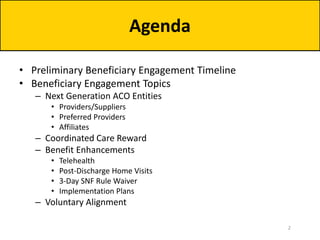
• Preliminary Beneficiary Engagement Timeline
• Beneficiary Engagement Topics
– Next Generation ACO Entities
• Providers/Suppliers
• Preferred Providers
• Affiliates
– Coordinated Care Reward
– Benefit Enhancements
• Telehealth
• Post-Discharge Home Visits
• 3-Day SNF Rule Waiver
• Implementation Plans
– Voluntary Alignment
Agenda
2
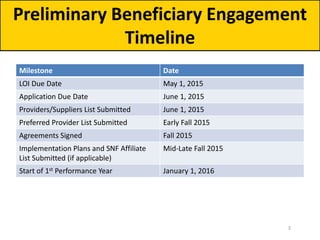
Milestone Date
LOI Due Date May 1, 2015
Application Due Date June 1, 2015
Providers/Suppliers List Submitted June 1, 2015
Preferred Provider List Submitted Early Fall 2015
Agreements Signed Fall 2015
Implementation Plans and SNF Affiliate
List Submitted (if applicable)
Mid-Late Fall 2015
Start of 1st Performance Year January 1, 2016
Preliminary Beneficiary Engagement
Timeline
3
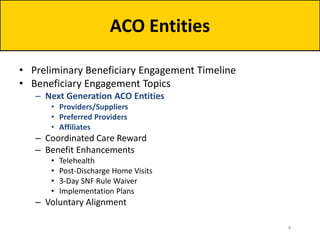
• Preliminary Beneficiary Engagement Timeline
• Beneficiary Engagement Topics
– Next Generation ACO Entities
• Providers/Suppliers
• Preferred Providers
• Affiliates
– Coordinated Care Reward
– Benefit Enhancements
• Telehealth
• Post-Discharge Home Visits
• 3-Day SNF Rule Waiver
• Implementation Plans
– Voluntary Alignment
ACO Entities
4
• Next Generation ACOs may be formed by Medicare-enrolled
providers and/or suppliers structured as:
– Physicians or other practitioners in group practice arrangements
– Networks of individual practices of physicians or other practitioners
– Hospitals employing physicians or other practitioners
– Partnerships or joint venture arrangements between hospitals and
physicians or other practitioners
– Federally Qualified Health Centers (FQHCs)
– Rural Health Clinics (RHCs)
– Critical Access Hospitals (CAHs)
• Any other Medicare-enrolled providers/suppliers may
participate in an ACO formed by one or more of the entities
listed above.
• ACOs will be required to identify all providers/suppliers
participating in the Model.
Eligible Providers/Suppliers
5
• Goal: Contribute to ACO goals by extending and facilitating
valuable care relationships beyond the ACO:
– ACO-selected set of partners to contribute to ACO goals;
– May offer an ACO’s benefit enhancements to aligned
beneficiaries;
– Services delivered to Next Generation Beneficiaries count
toward the coordinated care reward calculation (direct
payments made to beneficiaries by CMS);
– Preferred Providers will NOT be associated with alignment or
used for quality reporting by the ACO;
– Preferred Providers may also be Affiliates in order to participate
in the capitation payment mechanism or the SNF 3-Day Rule
waiver.
• ACOs will be required to identify all providers participating
as Preferred Providers.
Next Generation Preferred Providers
6
• Goal: extend and advance ACO cost and quality goals.
• Two types of ACO partner entities associated with
specific Next Generation design elements:
– Capitation Affiliates
– SNF Affiliates
• Affiliate care counts toward the coordinated care
reward calculation.
• Preferred Providers may also be Affiliates.
• ACOs will be required to identify all providers
participating as Affiliates.
Next Generation Affiliates
7
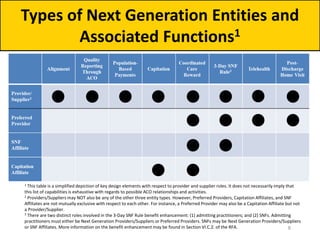
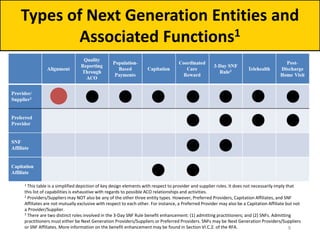
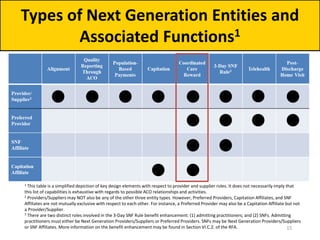
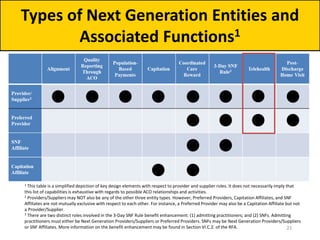
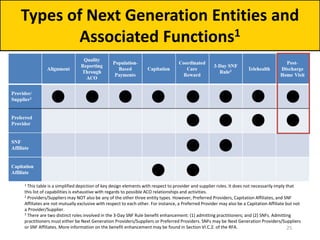
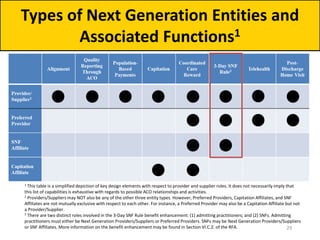
Types of Next Generation Entities and
Associated Functions1
8
1 This table is a simplified depiction of key design elements with respect to provider and supplier roles. It does not necessarily imply that
this list of capabilities is exhaustive with regards to possible ACO relationships and activities.
2 Providers/Suppliers may NOT also be any of the other three entity types. However, Preferred Providers, Capitation Affiliates, and SNF
Affiliates are not mutually exclusive with respect to each other. For instance, a Preferred Provider may also be a Capitation Affiliate but not
a Provider/Supplier.
3 There are two distinct roles involved in the 3-Day SNF Rule benefit enhancement: (1) admitting practitioners; and (2) SNFs. Admitting
practitioners must either be Next Generation Providers/Suppliers or Preferred Providers. SNFs may be Next Generation Providers/Suppliers
or SNF Affiliates. More information on the benefit enhancement may be found in Section VI.C.2. of the RFA.
Types of Next Generation Entities and
Associated Functions1
9
1 This table is a simplified depiction of key design elements with respect to provider and supplier roles. It does not necessarily imply that
this list of capabilities is exhaustive with regards to possible ACO relationships and activities.
2 Providers/Suppliers may NOT also be any of the other three entity types. However, Preferred Providers, Capitation Affiliates, and SNF
Affiliates are not mutually exclusive with respect to each other. For instance, a Preferred Provider may also be a Capitation Affiliate but not
a Provider/Supplier.
3 There are two distinct roles involved in the 3-Day SNF Rule benefit enhancement: (1) admitting practitioners; and (2) SNFs. Admitting
practitioners must either be Next Generation Providers/Suppliers or Preferred Providers. SNFs may be Next Generation Providers/Suppliers
or SNF Affiliates. More information on the benefit enhancement may be found in Section VI.C.2. of the RFA.
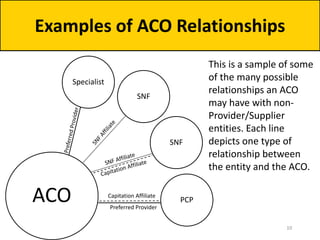
Examples of ACO Relationships
Preferred Provider
Capitation Affiliate
ACO
SNF
SNF
PCP
Specialist
This is a sample of some
of the many possible
relationships an ACO
may have with non-
Provider/Supplier
entities. Each line
depicts one type of
relationship between
the entity and the ACO.
10
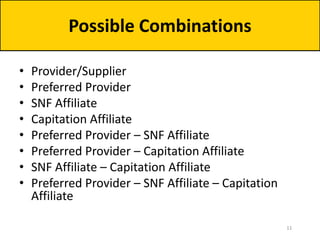
• Provider/Supplier
• Preferred Provider
• SNF Affiliate
• Capitation Affiliate
• Preferred Provider – SNF Affiliate
• Preferred Provider – Capitation Affiliate
• SNF Affiliate – Capitation Affiliate
• Preferred Provider – SNF Affiliate – Capitation
Affiliate
Possible Combinations
11
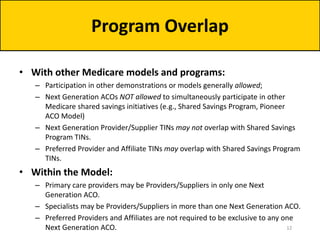
• With other Medicare models and programs:
– Participation in other demonstrations or models generally allowed;
– Next Generation ACOs NOT allowed to simultaneously participate in other
Medicare shared savings initiatives (e.g., Shared Savings Program, Pioneer
ACO Model)
– Next Generation Provider/Supplier TINs may not overlap with Shared Savings
Program TINs.
– Preferred Provider and Affiliate TINs may overlap with Shared Savings Program
TINs.
• Within the Model:
– Primary care providers may be Providers/Suppliers in only one Next
Generation ACO.
– Specialists may be Providers/Suppliers in more than one Next Generation ACO.
– Preferred Providers and Affiliates are not required to be exclusive to any one
Next Generation ACO.
Program Overlap
12
• Preliminary Beneficiary Engagement Timeline
• Beneficiary Engagement Topics
– Next Generation ACO Entities
• Providers/Suppliers
• Preferred Providers
• Affiliates
– Coordinated Care Reward
– Benefit Enhancements
• Telehealth
• Post-Discharge Home Visits
• 3-Day SNF Rule Waiver
• Implementation Plans
– Voluntary Alignment
Coordinated Care Reward
and Benefit Enhancements
13
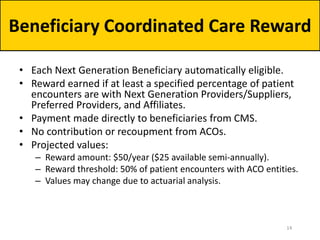
• Each Next Generation Beneficiary automatically eligible.
• Reward earned if at least a specified percentage of patient
encounters are with Next Generation Providers/Suppliers,
Preferred Providers, and Affiliates.
• Payment made directly to beneficiaries from CMS.
• No contribution or recoupment from ACOs.
• Projected values:
– Reward amount: $50/year ($25 available semi-annually).
– Reward threshold: 50% of patient encounters with ACO entities.
– Values may change due to actuarial analysis.
Beneficiary Coordinated Care Reward
14
Types of Next Generation Entities and
Associated Functions1
15
1 This table is a simplified depiction of key design elements with respect to provider and supplier roles. It does not necessarily imply that
this list of capabilities is exhaustive with regards to possible ACO relationships and activities.
2 Providers/Suppliers may NOT also be any of the other three entity types. However, Preferred Providers, Capitation Affiliates, and SNF
Affiliates are not mutually exclusive with respect to each other. For instance, a Preferred Provider may also be a Capitation Affiliate but not
a Provider/Supplier.
3 There are two distinct roles involved in the 3-Day SNF Rule benefit enhancement: (1) admitting practitioners; and (2) SNFs. Admitting
practitioners must either be Next Generation Providers/Suppliers or Preferred Providers. SNFs may be Next Generation Providers/Suppliers
or SNF Affiliates. More information on the benefit enhancement may be found in Section VI.C.2. of the RFA.
• Conditional waivers of certain Medicare
payment rules.
• Goals:
– Emphasize high-value services;
– Support care management and closer care
relationships;
– Allow ACO flexibility;
– Promote communication to beneficiaries;
– Evaluate ACO utilization and impact.
Benefit Enhancements
16
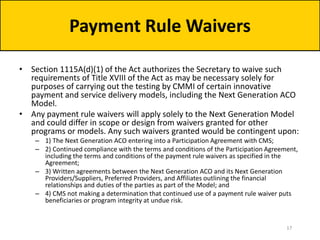
• Section 1115A(d)(1) of the Act authorizes the Secretary to waive such
requirements of Title XVIII of the Act as may be necessary solely for
purposes of carrying out the testing by CMMI of certain innovative
payment and service delivery models, including the Next Generation ACO
Model.
• Any payment rule waivers will apply solely to the Next Generation Model
and could differ in scope or design from waivers granted for other
programs or models. Any such waivers granted would be contingent upon:
– 1) The Next Generation ACO entering into a Participation Agreement with CMS;
– 2) Continued compliance with the terms and conditions of the Participation Agreement,
including the terms and conditions of the payment rule waivers as specified in the
Agreement;
– 3) Written agreements between the Next Generation ACO and its Next Generation
Providers/Suppliers, Preferred Providers, and Affiliates outlining the financial
relationships and duties of the parties as part of the Model; and
– 4) CMS not making a determination that continued use of a payment rule waiver puts
beneficiaries or program integrity at undue risk.
Payment Rule Waivers
17
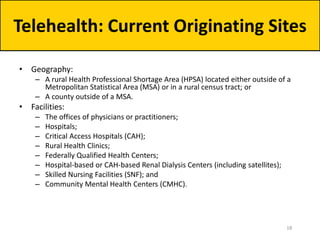
• Geography:
– A rural Health Professional Shortage Area (HPSA) located either outside of a
Metropolitan Statistical Area (MSA) or in a rural census tract; or
– A county outside of a MSA.
• Facilities:
– The offices of physicians or practitioners;
– Hospitals;
– Critical Access Hospitals (CAH);
– Rural Health Clinics;
– Federally Qualified Health Centers;
– Hospital-based or CAH-based Renal Dialysis Centers (including satellites);
– Skilled Nursing Facilities (SNF); and
– Community Mental Health Centers (CMHC).
Telehealth: Current Originating Sites
18
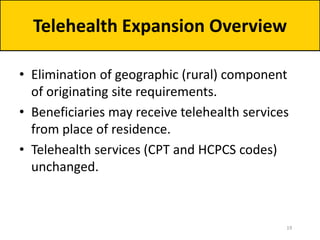
• Elimination of geographic (rural) component
of originating site requirements.
• Beneficiaries may receive telehealth services
from place of residence.
• Telehealth services (CPT and HCPCS codes)
unchanged.
Telehealth Expansion Overview
19
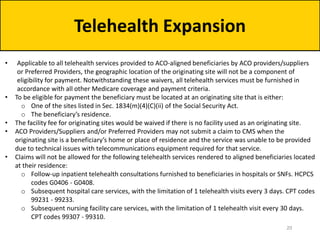
Telehealth Expansion
• Applicable to all telehealth services provided to ACO-aligned beneficiaries by ACO providers/suppliers
or Preferred Providers, the geographic location of the originating site will not be a component of
eligibility for payment. Notwithstanding these waivers, all telehealth services must be furnished in
accordance with all other Medicare coverage and payment criteria.
• To be eligible for payment the beneficiary must be located at an originating site that is either:
o One of the sites listed in Sec. 1834(m)(4)(C)(ii) of the Social Security Act.
o The beneficiary’s residence.
• The facility fee for originating sites would be waived if there is no facility used as an originating site.
• ACO Providers/Suppliers and/or Preferred Providers may not submit a claim to CMS when the
originating site is a beneficiary’s home or place of residence and the service was unable to be provided
due to technical issues with telecommunications equipment required for that service.
• Claims will not be allowed for the following telehealth services rendered to aligned beneficiaries located
at their residence:
o Follow-up inpatient telehealth consultations furnished to beneficiaries in hospitals or SNFs. HCPCS
codes G0406 - G0408.
o Subsequent hospital care services, with the limitation of 1 telehealth visits every 3 days. CPT codes
99231 - 99233.
o Subsequent nursing facility care services, with the limitation of 1 telehealth visit every 30 days.
CPT codes 99307 - 99310.
20
Types of Next Generation Entities and
Associated Functions1
21
1 This table is a simplified depiction of key design elements with respect to provider and supplier roles. It does not necessarily imply that
this list of capabilities is exhaustive with regards to possible ACO relationships and activities.
2 Providers/Suppliers may NOT also be any of the other three entity types. However, Preferred Providers, Capitation Affiliates, and SNF
Affiliates are not mutually exclusive with respect to each other. For instance, a Preferred Provider may also be a Capitation Affiliate but not
a Provider/Supplier.
3 There are two distinct roles involved in the 3-Day SNF Rule benefit enhancement: (1) admitting practitioners; and (2) SNFs. Admitting
practitioners must either be Next Generation Providers/Suppliers or Preferred Providers. SNFs may be Next Generation Providers/Suppliers
or SNF Affiliates. More information on the benefit enhancement may be found in Section VI.C.2. of the RFA.
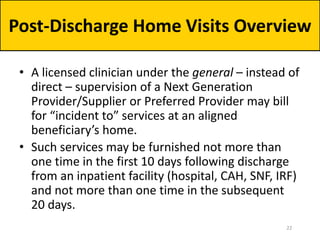
• A licensed clinician under the general – instead of
direct – supervision of a Next Generation
Provider/Supplier or Preferred Provider may bill
for “incident to” services at an aligned
beneficiary’s home.
• Such services may be furnished not more than
one time in the first 10 days following discharge
from an inpatient facility (hospital, CAH, SNF, IRF)
and not more than one time in the subsequent
20 days.
Post-Discharge Home Visits Overview
22
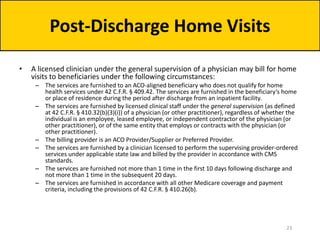
• A licensed clinician under the general supervision of a physician may bill for home
visits to beneficiaries under the following circumstances:
– The services are furnished to an ACO-aligned beneficiary who does not qualify for home
health services under 42 C.F.R. § 409.42. The services are furnished in the beneficiary’s home
or place of residence during the period after discharge from an inpatient facility.
– The services are furnished by licensed clinical staff under the general supervision (as defined
at 42 C.F.R. § 410.32(b)(3)(i)) of a physician (or other practitioner), regardless of whether the
individual is an employee, leased employee, or independent contractor of the physician (or
other practitioner), or of the same entity that employs or contracts with the physician (or
other practitioner).
– The billing provider is an ACO Provider/Supplier or Preferred Provider.
– The services are furnished by a clinician licensed to perform the supervising provider-ordered
services under applicable state law and billed by the provider in accordance with CMS
standards.
– The services are furnished not more than 1 time in the first 10 days following discharge and
not more than 1 time in the subsequent 20 days.
– The services are furnished in accordance with all other Medicare coverage and payment
criteria, including the provisions of 42 C.F.R. § 410.26(b).
Post-Discharge Home Visits
23
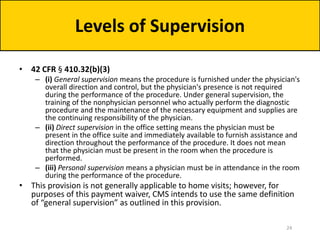
• 42 CFR § 410.32(b)(3)
– (i) General supervision means the procedure is furnished under the physician's
overall direction and control, but the physician's presence is not required
during the performance of the procedure. Under general supervision, the
training of the nonphysician personnel who actually perform the diagnostic
procedure and the maintenance of the necessary equipment and supplies are
the continuing responsibility of the physician.
– (ii) Direct supervision in the office setting means the physician must be
present in the office suite and immediately available to furnish assistance and
direction throughout the performance of the procedure. It does not mean
that the physician must be present in the room when the procedure is
performed.
– (iii) Personal supervision means a physician must be in attendance in the room
during the performance of the procedure.
• This provision is not generally applicable to home visits; however, for
purposes of this payment waiver, CMS intends to use the same definition
of “general supervision” as outlined in this provision.
Levels of Supervision
24
Types of Next Generation Entities and
Associated Functions1
25
1 This table is a simplified depiction of key design elements with respect to provider and supplier roles. It does not necessarily imply that
this list of capabilities is exhaustive with regards to possible ACO relationships and activities.
2 Providers/Suppliers may NOT also be any of the other three entity types. However, Preferred Providers, Capitation Affiliates, and SNF
Affiliates are not mutually exclusive with respect to each other. For instance, a Preferred Provider may also be a Capitation Affiliate but not
a Provider/Supplier.
3 There are two distinct roles involved in the 3-Day SNF Rule benefit enhancement: (1) admitting practitioners; and (2) SNFs. Admitting
practitioners must either be Next Generation Providers/Suppliers or Preferred Providers. SNFs may be Next Generation Providers/Suppliers
or SNF Affiliates. More information on the benefit enhancement may be found in Section VI.C.2. of the RFA.
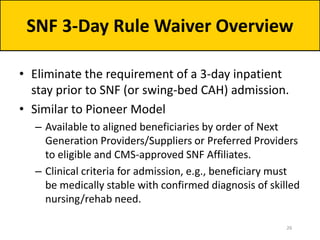
• Eliminate the requirement of a 3-day inpatient
stay prior to SNF (or swing-bed CAH) admission.
• Similar to Pioneer Model
– Available to aligned beneficiaries by order of Next
Generation Providers/Suppliers or Preferred Providers
to eligible and CMS-approved SNF Affiliates.
– Clinical criteria for admission, e.g., beneficiary must
be medically stable with confirmed diagnosis of skilled
nursing/rehab need.
SNF 3-Day Rule Waiver Overview
26
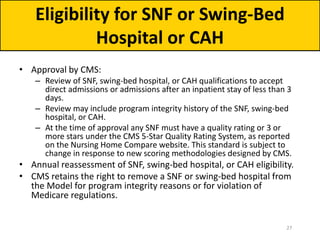
• Approval by CMS:
– Review of SNF, swing-bed hospital, or CAH qualifications to accept
direct admissions or admissions after an inpatient stay of less than 3
days.
– Review may include program integrity history of the SNF, swing-bed
hospital, or CAH.
– At the time of approval any SNF must have a quality rating or 3 or
more stars under the CMS 5-Star Quality Rating System, as reported
on the Nursing Home Compare website. This standard is subject to
change in response to new scoring methodologies designed by CMS.
• Annual reassessment of SNF, swing-bed hospital, or CAH eligibility.
• CMS retains the right to remove a SNF or swing-bed hospital from
the Model for program integrity reasons or for violation of
Medicare regulations.
Eligibility for SNF or Swing-Bed
Hospital or CAH
27
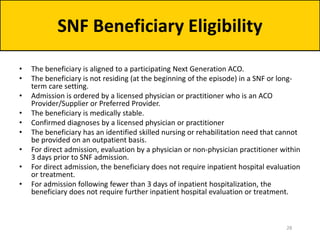
• The beneficiary is aligned to a participating Next Generation ACO.
• The beneficiary is not residing (at the beginning of the episode) in a SNF or long-
term care setting.
• Admission is ordered by a licensed physician or practitioner who is an ACO
Provider/Supplier or Preferred Provider.
• The beneficiary is medically stable.
• Confirmed diagnoses by a licensed physician or practitioner
• The beneficiary has an identified skilled nursing or rehabilitation need that cannot
be provided on an outpatient basis.
• For direct admission, evaluation by a physician or non-physician practitioner within
3 days prior to SNF admission.
• For direct admission, the beneficiary does not require inpatient hospital evaluation
or treatment.
• For admission following fewer than 3 days of inpatient hospitalization, the
beneficiary does not require further inpatient hospital evaluation or treatment.
SNF Beneficiary Eligibility
28
Types of Next Generation Entities and
Associated Functions1
29
1 This table is a simplified depiction of key design elements with respect to provider and supplier roles. It does not necessarily imply that
this list of capabilities is exhaustive with regards to possible ACO relationships and activities.
2 Providers/Suppliers may NOT also be any of the other three entity types. However, Preferred Providers, Capitation Affiliates, and SNF
Affiliates are not mutually exclusive with respect to each other. For instance, a Preferred Provider may also be a Capitation Affiliate but not
a Provider/Supplier.
3 There are two distinct roles involved in the 3-Day SNF Rule benefit enhancement: (1) admitting practitioners; and (2) SNFs. Admitting
practitioners must either be Next Generation Providers/Suppliers or Preferred Providers. SNFs may be Next Generation Providers/Suppliers
or SNF Affiliates. More information on the benefit enhancement may be found in Section VI.C.2. of the RFA.
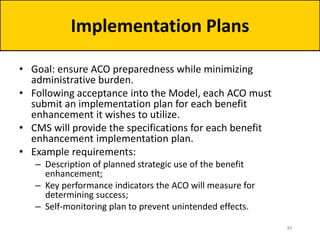
• Goal: ensure ACO preparedness while minimizing
administrative burden.
• Following acceptance into the Model, each ACO must
submit an implementation plan for each benefit
enhancement it wishes to utilize.
• CMS will provide the specifications for each benefit
enhancement implementation plan.
• Example requirements:
– Description of planned strategic use of the benefit
enhancement;
– Key performance indicators the ACO will measure for
determining success;
– Self-monitoring plan to prevent unintended effects.
Implementation Plans
30
• Preliminary Beneficiary Engagement Timeline
• Beneficiary Engagement Topics
– Next Generation ACO Entities
• Providers/Suppliers
• Preferred Providers
• Affiliates
– Coordinated Care Reward
– Benefit Enhancements
• Telehealth
• Post-Discharge Home Visits
• 3-Day SNF Rule Waiver
• Implementation Plans
– Voluntary Alignment
Voluntary Alignment
31
• Augments claims-based alignment by allowing beneficiaries a
decision in their alignment to an ACO.
– Available to currently- or previously-aligned beneficiaries.
– During each PY, beneficiaries will have the opportunity to voluntarily
align for the subsequent PY.
• ACOs may select the mode(s) of beneficiary confirmation.
• Direct provider-beneficiary communication about voluntary
alignment allowed.
• Additional resources for beneficiaries:
– 1-800-MEDICARE;
– Regional offices;
– State Health Insurance Assistance Program counselors.
• Voluntary alignment decisions from other ACO programs/models in
2015 will be grandfathered into the Next Generation Model for PY1.
Voluntary Alignment
32
• In later years of the Model, CMS may:
– Make alignment accessible to a broader group of
Medicare beneficiaries, regardless of current or
previous alignment;
– Include affirmation of a general care relationship
between beneficiaries and ACOs, instead of between
beneficiaries and specific providers; and/or
– Allow beneficiaries to opt out of alignment to a
particular ACO in addition to opting into ACO
alignment.
Potential Refinements
to Voluntary Alignment
33
Next Generation ACO Model Webpage:
http://innovation.cms.gov/initiatives/Next-Generation-
ACO-Model/
E-mail: NextGenerationACOModel@cms.hhs.gov
Questions?
34

Open Door Forum: Next Generation ACO Model - Benefit Enhancements & Beneficiary Care Coordination Reward

  • 1.
    Next Generation ACOModel Open Door Forum: Beneficiary Engagement April 7, 2015
  • 2.
    • Preliminary BeneficiaryEngagement Timeline • Beneficiary Engagement Topics – Next Generation ACO Entities • Providers/Suppliers • Preferred Providers • Affiliates – Coordinated Care Reward – Benefit Enhancements • Telehealth • Post-Discharge Home Visits • 3-Day SNF Rule Waiver • Implementation Plans – Voluntary Alignment Agenda 2
  • 3.
    Milestone Date LOI DueDate May 1, 2015 Application Due Date June 1, 2015 Providers/Suppliers List Submitted June 1, 2015 Preferred Provider List Submitted Early Fall 2015 Agreements Signed Fall 2015 Implementation Plans and SNF Affiliate List Submitted (if applicable) Mid-Late Fall 2015 Start of 1st Performance Year January 1, 2016 Preliminary Beneficiary Engagement Timeline 3
  • 4.
    • Preliminary BeneficiaryEngagement Timeline • Beneficiary Engagement Topics – Next Generation ACO Entities • Providers/Suppliers • Preferred Providers • Affiliates – Coordinated Care Reward – Benefit Enhancements • Telehealth • Post-Discharge Home Visits • 3-Day SNF Rule Waiver • Implementation Plans – Voluntary Alignment ACO Entities 4
  • 5.
    • Next GenerationACOs may be formed by Medicare-enrolled providers and/or suppliers structured as: – Physicians or other practitioners in group practice arrangements – Networks of individual practices of physicians or other practitioners – Hospitals employing physicians or other practitioners – Partnerships or joint venture arrangements between hospitals and physicians or other practitioners – Federally Qualified Health Centers (FQHCs) – Rural Health Clinics (RHCs) – Critical Access Hospitals (CAHs) • Any other Medicare-enrolled providers/suppliers may participate in an ACO formed by one or more of the entities listed above. • ACOs will be required to identify all providers/suppliers participating in the Model. Eligible Providers/Suppliers 5
  • 6.
    • Goal: Contributeto ACO goals by extending and facilitating valuable care relationships beyond the ACO: – ACO-selected set of partners to contribute to ACO goals; – May offer an ACO’s benefit enhancements to aligned beneficiaries; – Services delivered to Next Generation Beneficiaries count toward the coordinated care reward calculation (direct payments made to beneficiaries by CMS); – Preferred Providers will NOT be associated with alignment or used for quality reporting by the ACO; – Preferred Providers may also be Affiliates in order to participate in the capitation payment mechanism or the SNF 3-Day Rule waiver. • ACOs will be required to identify all providers participating as Preferred Providers. Next Generation Preferred Providers 6
  • 7.
    • Goal: extendand advance ACO cost and quality goals. • Two types of ACO partner entities associated with specific Next Generation design elements: – Capitation Affiliates – SNF Affiliates • Affiliate care counts toward the coordinated care reward calculation. • Preferred Providers may also be Affiliates. • ACOs will be required to identify all providers participating as Affiliates. Next Generation Affiliates 7
  • 8.
    Types of NextGeneration Entities and Associated Functions1 8 1 This table is a simplified depiction of key design elements with respect to provider and supplier roles. It does not necessarily imply that this list of capabilities is exhaustive with regards to possible ACO relationships and activities. 2 Providers/Suppliers may NOT also be any of the other three entity types. However, Preferred Providers, Capitation Affiliates, and SNF Affiliates are not mutually exclusive with respect to each other. For instance, a Preferred Provider may also be a Capitation Affiliate but not a Provider/Supplier. 3 There are two distinct roles involved in the 3-Day SNF Rule benefit enhancement: (1) admitting practitioners; and (2) SNFs. Admitting practitioners must either be Next Generation Providers/Suppliers or Preferred Providers. SNFs may be Next Generation Providers/Suppliers or SNF Affiliates. More information on the benefit enhancement may be found in Section VI.C.2. of the RFA.
  • 9.
    Types of NextGeneration Entities and Associated Functions1 9 1 This table is a simplified depiction of key design elements with respect to provider and supplier roles. It does not necessarily imply that this list of capabilities is exhaustive with regards to possible ACO relationships and activities. 2 Providers/Suppliers may NOT also be any of the other three entity types. However, Preferred Providers, Capitation Affiliates, and SNF Affiliates are not mutually exclusive with respect to each other. For instance, a Preferred Provider may also be a Capitation Affiliate but not a Provider/Supplier. 3 There are two distinct roles involved in the 3-Day SNF Rule benefit enhancement: (1) admitting practitioners; and (2) SNFs. Admitting practitioners must either be Next Generation Providers/Suppliers or Preferred Providers. SNFs may be Next Generation Providers/Suppliers or SNF Affiliates. More information on the benefit enhancement may be found in Section VI.C.2. of the RFA.
  • 10.
    Examples of ACORelationships Preferred Provider Capitation Affiliate ACO SNF SNF PCP Specialist This is a sample of some of the many possible relationships an ACO may have with non- Provider/Supplier entities. Each line depicts one type of relationship between the entity and the ACO. 10
  • 11.
    • Provider/Supplier • PreferredProvider • SNF Affiliate • Capitation Affiliate • Preferred Provider – SNF Affiliate • Preferred Provider – Capitation Affiliate • SNF Affiliate – Capitation Affiliate • Preferred Provider – SNF Affiliate – Capitation Affiliate Possible Combinations 11
  • 12.
    • With otherMedicare models and programs: – Participation in other demonstrations or models generally allowed; – Next Generation ACOs NOT allowed to simultaneously participate in other Medicare shared savings initiatives (e.g., Shared Savings Program, Pioneer ACO Model) – Next Generation Provider/Supplier TINs may not overlap with Shared Savings Program TINs. – Preferred Provider and Affiliate TINs may overlap with Shared Savings Program TINs. • Within the Model: – Primary care providers may be Providers/Suppliers in only one Next Generation ACO. – Specialists may be Providers/Suppliers in more than one Next Generation ACO. – Preferred Providers and Affiliates are not required to be exclusive to any one Next Generation ACO. Program Overlap 12
  • 13.
    • Preliminary BeneficiaryEngagement Timeline • Beneficiary Engagement Topics – Next Generation ACO Entities • Providers/Suppliers • Preferred Providers • Affiliates – Coordinated Care Reward – Benefit Enhancements • Telehealth • Post-Discharge Home Visits • 3-Day SNF Rule Waiver • Implementation Plans – Voluntary Alignment Coordinated Care Reward and Benefit Enhancements 13
  • 14.
    • Each NextGeneration Beneficiary automatically eligible. • Reward earned if at least a specified percentage of patient encounters are with Next Generation Providers/Suppliers, Preferred Providers, and Affiliates. • Payment made directly to beneficiaries from CMS. • No contribution or recoupment from ACOs. • Projected values: – Reward amount: $50/year ($25 available semi-annually). – Reward threshold: 50% of patient encounters with ACO entities. – Values may change due to actuarial analysis. Beneficiary Coordinated Care Reward 14
  • 15.
    Types of NextGeneration Entities and Associated Functions1 15 1 This table is a simplified depiction of key design elements with respect to provider and supplier roles. It does not necessarily imply that this list of capabilities is exhaustive with regards to possible ACO relationships and activities. 2 Providers/Suppliers may NOT also be any of the other three entity types. However, Preferred Providers, Capitation Affiliates, and SNF Affiliates are not mutually exclusive with respect to each other. For instance, a Preferred Provider may also be a Capitation Affiliate but not a Provider/Supplier. 3 There are two distinct roles involved in the 3-Day SNF Rule benefit enhancement: (1) admitting practitioners; and (2) SNFs. Admitting practitioners must either be Next Generation Providers/Suppliers or Preferred Providers. SNFs may be Next Generation Providers/Suppliers or SNF Affiliates. More information on the benefit enhancement may be found in Section VI.C.2. of the RFA.
  • 16.
    • Conditional waiversof certain Medicare payment rules. • Goals: – Emphasize high-value services; – Support care management and closer care relationships; – Allow ACO flexibility; – Promote communication to beneficiaries; – Evaluate ACO utilization and impact. Benefit Enhancements 16
  • 17.
    • Section 1115A(d)(1)of the Act authorizes the Secretary to waive such requirements of Title XVIII of the Act as may be necessary solely for purposes of carrying out the testing by CMMI of certain innovative payment and service delivery models, including the Next Generation ACO Model. • Any payment rule waivers will apply solely to the Next Generation Model and could differ in scope or design from waivers granted for other programs or models. Any such waivers granted would be contingent upon: – 1) The Next Generation ACO entering into a Participation Agreement with CMS; – 2) Continued compliance with the terms and conditions of the Participation Agreement, including the terms and conditions of the payment rule waivers as specified in the Agreement; – 3) Written agreements between the Next Generation ACO and its Next Generation Providers/Suppliers, Preferred Providers, and Affiliates outlining the financial relationships and duties of the parties as part of the Model; and – 4) CMS not making a determination that continued use of a payment rule waiver puts beneficiaries or program integrity at undue risk. Payment Rule Waivers 17
  • 18.
    • Geography: – Arural Health Professional Shortage Area (HPSA) located either outside of a Metropolitan Statistical Area (MSA) or in a rural census tract; or – A county outside of a MSA. • Facilities: – The offices of physicians or practitioners; – Hospitals; – Critical Access Hospitals (CAH); – Rural Health Clinics; – Federally Qualified Health Centers; – Hospital-based or CAH-based Renal Dialysis Centers (including satellites); – Skilled Nursing Facilities (SNF); and – Community Mental Health Centers (CMHC). Telehealth: Current Originating Sites 18
  • 19.
    • Elimination ofgeographic (rural) component of originating site requirements. • Beneficiaries may receive telehealth services from place of residence. • Telehealth services (CPT and HCPCS codes) unchanged. Telehealth Expansion Overview 19
  • 20.
    Telehealth Expansion • Applicableto all telehealth services provided to ACO-aligned beneficiaries by ACO providers/suppliers or Preferred Providers, the geographic location of the originating site will not be a component of eligibility for payment. Notwithstanding these waivers, all telehealth services must be furnished in accordance with all other Medicare coverage and payment criteria. • To be eligible for payment the beneficiary must be located at an originating site that is either: o One of the sites listed in Sec. 1834(m)(4)(C)(ii) of the Social Security Act. o The beneficiary’s residence. • The facility fee for originating sites would be waived if there is no facility used as an originating site. • ACO Providers/Suppliers and/or Preferred Providers may not submit a claim to CMS when the originating site is a beneficiary’s home or place of residence and the service was unable to be provided due to technical issues with telecommunications equipment required for that service. • Claims will not be allowed for the following telehealth services rendered to aligned beneficiaries located at their residence: o Follow-up inpatient telehealth consultations furnished to beneficiaries in hospitals or SNFs. HCPCS codes G0406 - G0408. o Subsequent hospital care services, with the limitation of 1 telehealth visits every 3 days. CPT codes 99231 - 99233. o Subsequent nursing facility care services, with the limitation of 1 telehealth visit every 30 days. CPT codes 99307 - 99310. 20
  • 21.
    Types of NextGeneration Entities and Associated Functions1 21 1 This table is a simplified depiction of key design elements with respect to provider and supplier roles. It does not necessarily imply that this list of capabilities is exhaustive with regards to possible ACO relationships and activities. 2 Providers/Suppliers may NOT also be any of the other three entity types. However, Preferred Providers, Capitation Affiliates, and SNF Affiliates are not mutually exclusive with respect to each other. For instance, a Preferred Provider may also be a Capitation Affiliate but not a Provider/Supplier. 3 There are two distinct roles involved in the 3-Day SNF Rule benefit enhancement: (1) admitting practitioners; and (2) SNFs. Admitting practitioners must either be Next Generation Providers/Suppliers or Preferred Providers. SNFs may be Next Generation Providers/Suppliers or SNF Affiliates. More information on the benefit enhancement may be found in Section VI.C.2. of the RFA.
  • 22.
    • A licensedclinician under the general – instead of direct – supervision of a Next Generation Provider/Supplier or Preferred Provider may bill for “incident to” services at an aligned beneficiary’s home. • Such services may be furnished not more than one time in the first 10 days following discharge from an inpatient facility (hospital, CAH, SNF, IRF) and not more than one time in the subsequent 20 days. Post-Discharge Home Visits Overview 22
  • 23.
    • A licensedclinician under the general supervision of a physician may bill for home visits to beneficiaries under the following circumstances: – The services are furnished to an ACO-aligned beneficiary who does not qualify for home health services under 42 C.F.R. § 409.42. The services are furnished in the beneficiary’s home or place of residence during the period after discharge from an inpatient facility. – The services are furnished by licensed clinical staff under the general supervision (as defined at 42 C.F.R. § 410.32(b)(3)(i)) of a physician (or other practitioner), regardless of whether the individual is an employee, leased employee, or independent contractor of the physician (or other practitioner), or of the same entity that employs or contracts with the physician (or other practitioner). – The billing provider is an ACO Provider/Supplier or Preferred Provider. – The services are furnished by a clinician licensed to perform the supervising provider-ordered services under applicable state law and billed by the provider in accordance with CMS standards. – The services are furnished not more than 1 time in the first 10 days following discharge and not more than 1 time in the subsequent 20 days. – The services are furnished in accordance with all other Medicare coverage and payment criteria, including the provisions of 42 C.F.R. § 410.26(b). Post-Discharge Home Visits 23
  • 24.
    • 42 CFR§ 410.32(b)(3) – (i) General supervision means the procedure is furnished under the physician's overall direction and control, but the physician's presence is not required during the performance of the procedure. Under general supervision, the training of the nonphysician personnel who actually perform the diagnostic procedure and the maintenance of the necessary equipment and supplies are the continuing responsibility of the physician. – (ii) Direct supervision in the office setting means the physician must be present in the office suite and immediately available to furnish assistance and direction throughout the performance of the procedure. It does not mean that the physician must be present in the room when the procedure is performed. – (iii) Personal supervision means a physician must be in attendance in the room during the performance of the procedure. • This provision is not generally applicable to home visits; however, for purposes of this payment waiver, CMS intends to use the same definition of “general supervision” as outlined in this provision. Levels of Supervision 24
  • 25.
    Types of NextGeneration Entities and Associated Functions1 25 1 This table is a simplified depiction of key design elements with respect to provider and supplier roles. It does not necessarily imply that this list of capabilities is exhaustive with regards to possible ACO relationships and activities. 2 Providers/Suppliers may NOT also be any of the other three entity types. However, Preferred Providers, Capitation Affiliates, and SNF Affiliates are not mutually exclusive with respect to each other. For instance, a Preferred Provider may also be a Capitation Affiliate but not a Provider/Supplier. 3 There are two distinct roles involved in the 3-Day SNF Rule benefit enhancement: (1) admitting practitioners; and (2) SNFs. Admitting practitioners must either be Next Generation Providers/Suppliers or Preferred Providers. SNFs may be Next Generation Providers/Suppliers or SNF Affiliates. More information on the benefit enhancement may be found in Section VI.C.2. of the RFA.
  • 26.
    • Eliminate therequirement of a 3-day inpatient stay prior to SNF (or swing-bed CAH) admission. • Similar to Pioneer Model – Available to aligned beneficiaries by order of Next Generation Providers/Suppliers or Preferred Providers to eligible and CMS-approved SNF Affiliates. – Clinical criteria for admission, e.g., beneficiary must be medically stable with confirmed diagnosis of skilled nursing/rehab need. SNF 3-Day Rule Waiver Overview 26
  • 27.
    • Approval byCMS: – Review of SNF, swing-bed hospital, or CAH qualifications to accept direct admissions or admissions after an inpatient stay of less than 3 days. – Review may include program integrity history of the SNF, swing-bed hospital, or CAH. – At the time of approval any SNF must have a quality rating or 3 or more stars under the CMS 5-Star Quality Rating System, as reported on the Nursing Home Compare website. This standard is subject to change in response to new scoring methodologies designed by CMS. • Annual reassessment of SNF, swing-bed hospital, or CAH eligibility. • CMS retains the right to remove a SNF or swing-bed hospital from the Model for program integrity reasons or for violation of Medicare regulations. Eligibility for SNF or Swing-Bed Hospital or CAH 27
  • 28.
    • The beneficiaryis aligned to a participating Next Generation ACO. • The beneficiary is not residing (at the beginning of the episode) in a SNF or long- term care setting. • Admission is ordered by a licensed physician or practitioner who is an ACO Provider/Supplier or Preferred Provider. • The beneficiary is medically stable. • Confirmed diagnoses by a licensed physician or practitioner • The beneficiary has an identified skilled nursing or rehabilitation need that cannot be provided on an outpatient basis. • For direct admission, evaluation by a physician or non-physician practitioner within 3 days prior to SNF admission. • For direct admission, the beneficiary does not require inpatient hospital evaluation or treatment. • For admission following fewer than 3 days of inpatient hospitalization, the beneficiary does not require further inpatient hospital evaluation or treatment. SNF Beneficiary Eligibility 28
  • 29.
    Types of NextGeneration Entities and Associated Functions1 29 1 This table is a simplified depiction of key design elements with respect to provider and supplier roles. It does not necessarily imply that this list of capabilities is exhaustive with regards to possible ACO relationships and activities. 2 Providers/Suppliers may NOT also be any of the other three entity types. However, Preferred Providers, Capitation Affiliates, and SNF Affiliates are not mutually exclusive with respect to each other. For instance, a Preferred Provider may also be a Capitation Affiliate but not a Provider/Supplier. 3 There are two distinct roles involved in the 3-Day SNF Rule benefit enhancement: (1) admitting practitioners; and (2) SNFs. Admitting practitioners must either be Next Generation Providers/Suppliers or Preferred Providers. SNFs may be Next Generation Providers/Suppliers or SNF Affiliates. More information on the benefit enhancement may be found in Section VI.C.2. of the RFA.
  • 30.
    • Goal: ensureACO preparedness while minimizing administrative burden. • Following acceptance into the Model, each ACO must submit an implementation plan for each benefit enhancement it wishes to utilize. • CMS will provide the specifications for each benefit enhancement implementation plan. • Example requirements: – Description of planned strategic use of the benefit enhancement; – Key performance indicators the ACO will measure for determining success; – Self-monitoring plan to prevent unintended effects. Implementation Plans 30
  • 31.
    • Preliminary BeneficiaryEngagement Timeline • Beneficiary Engagement Topics – Next Generation ACO Entities • Providers/Suppliers • Preferred Providers • Affiliates – Coordinated Care Reward – Benefit Enhancements • Telehealth • Post-Discharge Home Visits • 3-Day SNF Rule Waiver • Implementation Plans – Voluntary Alignment Voluntary Alignment 31
  • 32.
    • Augments claims-basedalignment by allowing beneficiaries a decision in their alignment to an ACO. – Available to currently- or previously-aligned beneficiaries. – During each PY, beneficiaries will have the opportunity to voluntarily align for the subsequent PY. • ACOs may select the mode(s) of beneficiary confirmation. • Direct provider-beneficiary communication about voluntary alignment allowed. • Additional resources for beneficiaries: – 1-800-MEDICARE; – Regional offices; – State Health Insurance Assistance Program counselors. • Voluntary alignment decisions from other ACO programs/models in 2015 will be grandfathered into the Next Generation Model for PY1. Voluntary Alignment 32
  • 33.
    • In lateryears of the Model, CMS may: – Make alignment accessible to a broader group of Medicare beneficiaries, regardless of current or previous alignment; – Include affirmation of a general care relationship between beneficiaries and ACOs, instead of between beneficiaries and specific providers; and/or – Allow beneficiaries to opt out of alignment to a particular ACO in addition to opting into ACO alignment. Potential Refinements to Voluntary Alignment 33
  • 34.
    Next Generation ACOModel Webpage: http://innovation.cms.gov/initiatives/Next-Generation- ACO-Model/ E-mail: NextGenerationACOModel@cms.hhs.gov Questions? 34