





Michael P. James, JD, MBA, CSSGB
Phone: (517) 377-0823
(313) 237-7300
Email: mjames@fraserlawfirm.com
www.linkedin.com/in/MichaelJamesLaw
© 2015 Fraser Trebilcock
Davis & Dunlap, P.C.
ACCOUNTABLE CARE
ORGANIZATIONS 2.0
Introduction
Medicare Shared
Savings Program (MSSP)
 MSSP designed to improve beneficiary outcomes
and increase value of care by promoting:
 Accountability for patient population;
 Coordination of care for services;
 Investment in infrastructure; and
 Redesign of care processes.
 If Medicare expenditures are lower
than benchmark targets, ACO receives
portion of savings.
What are ACOs?
 ACOs are the vehicles through which
providers/suppliers participate in the MSSP.
 A legal entity designed to manage and coordinate care
for Medicare fee-for-service beneficiaries under the
MSSP.
 Accountable for the costs associated with its
beneficiary population.
 Responsible for the quality of care for its beneficiary
population.
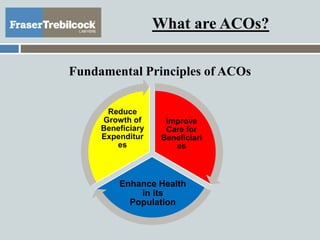
Fundamental Principles of ACOs
Improve
Care for
Beneficiari
es
Enhance Health
in its
Population
Reduce
Growth of
Beneficiary
Expenditur
es
What are ACOs?
New Regulations
 In December 2014, the Department of Health and
Human Services (HHS) issued hundreds of pages of
proposed changes to the MSSP and ACOs.
 Comment period closed on February 6, 2015.
 Unclear when final rule will be issued.
 The proposed rule represent the largest set of
changes to the MSSP and rules governing ACOs
since the implementation of the ACA.
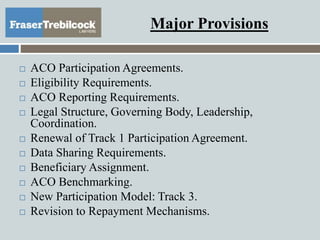
Major Provisions
 ACO Participation Agreements.
 Eligibility Requirements.
 ACO Reporting Requirements.
 Legal Structure, Governing Body, Leadership,
Coordination.
 Renewal of Track 1 Participation Agreement.
 Data Sharing Requirements.
 Beneficiary Assignment.
 ACO Benchmarking.
 New Participation Model: Track 3.
 Revision to Repayment Mechanisms.
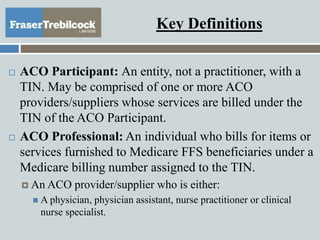
Key Definitions
 ACO Participant: An entity, not a practitioner, with a
TIN. May be comprised of one or more ACO
providers/suppliers whose services are billed under the
TIN of the ACO Participant.
 ACO Professional: An individual who bills for items or
services furnished to Medicare FFS beneficiaries under a
Medicare billing number assigned to the TIN.
 An ACO provider/supplier who is either:
 A physician, physician assistant, nurse practitioner or clinical
nurse specialist.
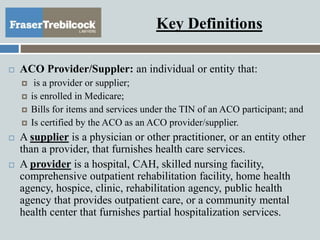
Key Definitions
 ACO Provider/Suppler: an individual or entity that:
 is a provider or supplier;
 is enrolled in Medicare;
 Bills for items and services under the TIN of an ACO participant; and
 Is certified by the ACO as an ACO provider/supplier.
 A supplier is a physician or other practitioner, or an entity other
than a provider, that furnishes health care services.
 A provider is a hospital, CAH, skilled nursing facility,
comprehensive outpatient rehabilitation facility, home health
agency, hospice, clinic, rehabilitation agency, public health
agency that provides outpatient care, or a community mental
health center that furnishes partial hospitalization services.
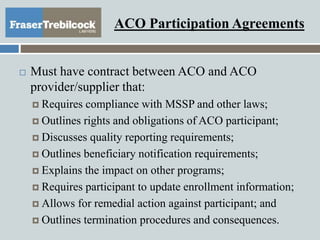
ACO Participation Agreements
 Must have contract between ACO and ACO
provider/supplier that:
 Requires compliance with MSSP and other laws;
 Outlines rights and obligations of ACO participant;
 Discusses quality reporting requirements;
 Outlines beneficiary notification requirements;
 Explains the impact on other programs;
 Requires participant to update enrollment information;
 Allows for remedial action against participant; and
 Outlines termination procedures and consequences.
Eligibility Requirements
 MSSP requires an ACO to have at least 5,000
beneficiaries assigned to it during the 3 year
benchmark period.
 New proposal:
 Use actual data for first 2 years; estimate for 3rd year
based on most recent data available with up to 3-month
claims run out.
 After ACO is accepted into the program, if the final
assignment numbers for 3rd benchmark year are less
than 5,000, ACO is not automatically terminated from
program.
Eligibility Requirements
 Increased flexibility for ACO eligibility.
 If ACO population falls below 5,000 beneficiaries:
 Current: ACO receives warning letter and placed on
Corrective Action Plan (CAP). If ACO does not reach
beneficiary level in next year, terminated.
 Proposed: Provide the ACO with adequate time to complete
CAP. Letter will indicate deadline.
 Allows the ACO to take appropriate action to increase numbers.
 HHS has also proposed making the CAP discretionary.
 Example: If ACO has already submitted a request to add
ACO participants, CAP may not be required.
Reporting Requirements
 Certified list of ACO participants and ACO
providers/suppliers:
 Start of each agreement period and before each
performance year, provide CMS with a complete and
certified list of its ACO participants.
 Report changes in ACO participant and provider/supplier
enrollment status in PECOS within 30 days after change.
 Remain required to certify that list is true, accurate and
complete.
Reporting Requirements
 Managing changes to ACO participants:
 Expect that ACO participant remain is ACO full 3 years.
 Current: must notify CMS within 30 days of addition or removal of
ACO participant.
 Proposed: new procedure for adding and removing:
 1) To add an ACO participant, must submit request to CMS. CMS must
approve addition before effective.
 2) If approved, entity will not be added until beginning of next performance
year – can’t us claims until then.
 3) Must notify CMS within 30 days of termination and submit a notice of
removal.
 Adjustments will be made to benchmark, assignment of
beneficiaries, quality reporting sample and ACO reporting.
 Historic data only; changes do not affect current requirements/system.
Reporting Requirements
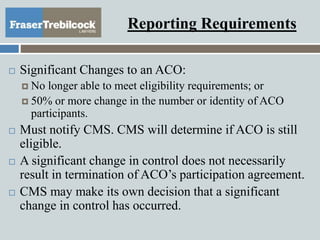
 Significant Changes to an ACO:
 No longer able to meet eligibility requirements; or
 50% or more change in the number or identity of ACO
participants.
 Must notify CMS. CMS will determine if ACO is still
eligible.
 A significant change in control does not necessarily
result in termination of ACO’s participation agreement.
 CMS may make its own decision that a significant
change in control has occurred.
ACO Legal Structures
 Legal structure clarification:
 Must form a legal entity separate from any ACO
participant if the ACO participants have unique TINs.
 Do you form a new entity or can you use an existing
entity for your ACO?
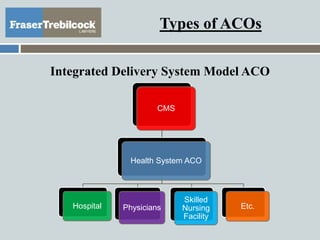
Types of ACOs
Integrated Delivery System Model ACO
CMS
Health System ACO
Hospital Physicians
Skilled
Nursing
Facility
Etc.
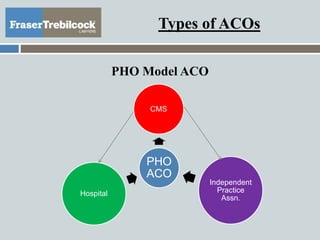
Types of ACOs
PHO Model ACO
PHO
ACO
Hospital
Independent
Practice
Assn.
CMS
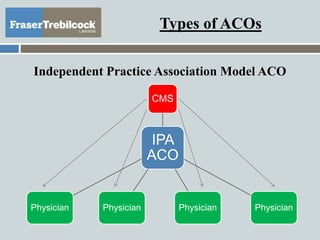
Types of ACOs
Independent Practice Association Model ACO
IPA
ACO
CMS
PhysicianPhysicianPhysicianPhysician
Types of ACOs
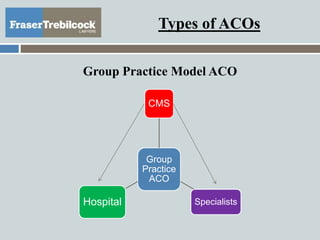
Group Practice Model ACO
Group
Practice
ACO
CMS
SpecialistsHospital
ACO Governance
 3 Criteria for governing body:
 1) governing body of ACO must be same governing
body of the legal entity that is the ACO;
 2) governing body of ACO may not be the same
governing body as any ACO participant; and
 3) governing body must meet other requirements of
ACA, especially the fiduciary duty requirement.
ACO Governance
 Composition of the Governing Body:
 Propose to remove the flexibility for ACOs to deviate
from the requirement that at least 75% control of an
ACO’s governing body must be held by ACO
participants.
 Propose to prohibit an ACO provider/supplier from
serving as the beneficiary representative.
ACO Coordination of Care
 Strong focus in proposed rules on use of
technology.
 Require applicant to describe how it will encourage
and promote use of enabling technologies for
improving care coordination for beneficiaries.
 Require existing ACOs to submit major milestones
or performance targets it will use in each
performance year to assess the progress of its ACO
participation.
 Sought comments on use of telehealth.
Renewal of ACO Agreement
 Proposed extension of Track 1 ACOs:
 Current: After initial, 3 year term under Track 1, ACO
transitions to Track 2, risk model.
 Proposed: Allow Track 1 ACOs to renew Track 1
contract for an additional 3 years if:
 ACO has met quality performance standard in at least 1 of
first 2 years; and
 Have not generated losses that exceed the negative
minimum savings rate in both of first 2 years.
 The maximum shared savings rate drops from 50% to
40% in second term under Track 1.
Data Sharing
 Current:
 ACO must notify beneficiary of data sharing and give
beneficiary opportunity to decline.
 Administrative difficulties, delays, confusion.
 Proposed:
 ACO provides written notification, via signs, regarding
data sharing and opportunity for beneficiary to decline
by calling Medicare.
 Beneficiary communicates directly with CMS, not ACO.
 ACO no longer required to send out letters.
Beneficiary Assignment
 Current:
 Two step process:
 Step 1 – assign beneficiaries by primary care physicians.
 Step 2 – If beneficiary did not receive care from PCP, look
to services provided by other providers/suppliers.
 Proposed:
 Two steps revised:
 Step 1 – include nurse practitioners, physician assistants and
clinical nurse specialists to recognize primary care services.
 Step 2 – remove certain specialty types whose services are
not likely to be indicative of primary care services.
ACO Benchmarking
 Significant changes in benchmarking are being evaluated.
 Alternative methodologies are being considered for
establishing, updating and resetting ACO financial
benchmarks:
 1) Use of Regional FFS expenditures, instead of national FFS
expenditures in establishing and updating benchmark.
 2) Use of regional FFS cost data to make ACO benchmarks
gradually more independent of the ACO’s past performance and
more dependent on the ACO’s success in being more cost
effective relative to its local market.
 3) Resetting benchmarks in subsequent years by equally
weighting three benchmark years and/or accounting for shared
savings payments receive by ACO in prior agreement period.
ACO Benchmarking
 Changes to calculations related to the benchmark
that would support these options:
 Risk adjustment normalization;
 Coding intensity adjustments;
 Comparison group definitions;
 Adjustments for ACO composition changes;
 The timeline for transition to regional FFS costs; and
 Other potential adjustments.
 ACO Benchmarking is a big portion or proposed
rule.
ACO Participation:
Track 3 Model
 Proposed Track 3 performance, risked-based model:
 Prospective assignment of beneficiaries to ACO.
 Assigned prior to start of performance year.
 More narrowly defined target population and greater certainty
about where to focus care redesign processes.
 Sharing Rate: 75%
 Track 1, 50% Track 2, 60%
 Performance payment limit not to exceed 20% of benchmark.
 Track 2 is 15%.
 Downside Cap: 15%
 Fixed minimum savings rate/minimum loss rate of 2%.
Repayment Mechanisms
 Current: ACOs may demonstrate their ability to
repay shared losses by obtaining:
 Reinsurance, placing funds into escrow, obtaining surety
bonds, establishing a line of credit, or establish another
appropriate repayment mechanism that will ensure
ability to repay.
 Proposed: Limit the types of repayment mechanisms
to:
 Placing funds into escrow, obtaining a surety bond, or
establishing a line of credit.
Potential Risk
 ACO agrees to be subject to all statutory and most
regulatory changes that become effective during the
term of its agreement.
 Currently, the only regulatory changes that an ACO will
not be subject to are:
 Eligibility requirements concerning the structure and
governance of the ACO;
 Calculation of the sharing rate; and
 Beneficiary assignment.
 An ACO is subject to regulatory changes related to the
quality performance standard.
Potential Risk
 Proposed Rule:
 Require ACOs to be subject to any regulatory changes
regarding beneficiary assignment that become effective
during an agreement period.
 Would remove the exception currently in place.
 Operational policies enable annual adjustments to ACO
benchmarks to account for changes in beneficiary
assignment resulting from changes in ACO participants.
 Therefore, CMS believes it should also be able to
adjust benchmarks based on regulatory changes to
beneficiary assignment methodology.
Additional Risks
 Fiduciary Duties and Ethical Conflicts
 Corporate Practice of Medicine
 Stark Laws, Anti-Kickback Statute and Civil
Monetary Penalties
Fraser Trebilcock Davis & Dunlap, P.C.
124 W. Allegan Street, Suite 1000
Lansing, Michigan 48933
www.fraserlawfirm.com
Phone: (517) 482-5800
Fax: (517) 482-0887
Fraser Trebilcock Davis & Dunlap, P.C.
One Woodward Avenue, Suite 1550
Detroit, Michigan 48226
www.fraserlawfirm.com
Phone: (313) 237-7300
Fax: (313) 961-1651
Michael P. James, JD, MBA, CSSGB
Phone: (517) 377-0823
(313) 237-7300
Email: mjames@fraserlawfirm.com
www.linkedin.com/in/MichaelJamesLaw
© 2015 Fraser Trebilcock
Davis & Dunlap, P.C.
Fraser Trebilcock
Health Care Reform
www.mihealthcarelaws.com

Accountable Care Organizations 2.0

  • 1.
    Michael P. James,JD, MBA, CSSGB Phone: (517) 377-0823 (313) 237-7300 Email: mjames@fraserlawfirm.com www.linkedin.com/in/MichaelJamesLaw © 2015 Fraser Trebilcock Davis & Dunlap, P.C. ACCOUNTABLE CARE ORGANIZATIONS 2.0
  • 2.
  • 3.
    Medicare Shared Savings Program(MSSP)  MSSP designed to improve beneficiary outcomes and increase value of care by promoting:  Accountability for patient population;  Coordination of care for services;  Investment in infrastructure; and  Redesign of care processes.  If Medicare expenditures are lower than benchmark targets, ACO receives portion of savings.
  • 4.
    What are ACOs? ACOs are the vehicles through which providers/suppliers participate in the MSSP.  A legal entity designed to manage and coordinate care for Medicare fee-for-service beneficiaries under the MSSP.  Accountable for the costs associated with its beneficiary population.  Responsible for the quality of care for its beneficiary population.
  • 5.
    Fundamental Principles ofACOs Improve Care for Beneficiari es Enhance Health in its Population Reduce Growth of Beneficiary Expenditur es What are ACOs?
  • 6.
    New Regulations  InDecember 2014, the Department of Health and Human Services (HHS) issued hundreds of pages of proposed changes to the MSSP and ACOs.  Comment period closed on February 6, 2015.  Unclear when final rule will be issued.  The proposed rule represent the largest set of changes to the MSSP and rules governing ACOs since the implementation of the ACA.
  • 7.
    Major Provisions  ACOParticipation Agreements.  Eligibility Requirements.  ACO Reporting Requirements.  Legal Structure, Governing Body, Leadership, Coordination.  Renewal of Track 1 Participation Agreement.  Data Sharing Requirements.  Beneficiary Assignment.  ACO Benchmarking.  New Participation Model: Track 3.  Revision to Repayment Mechanisms.
  • 8.
    Key Definitions  ACOParticipant: An entity, not a practitioner, with a TIN. May be comprised of one or more ACO providers/suppliers whose services are billed under the TIN of the ACO Participant.  ACO Professional: An individual who bills for items or services furnished to Medicare FFS beneficiaries under a Medicare billing number assigned to the TIN.  An ACO provider/supplier who is either:  A physician, physician assistant, nurse practitioner or clinical nurse specialist.
  • 9.
    Key Definitions  ACOProvider/Suppler: an individual or entity that:  is a provider or supplier;  is enrolled in Medicare;  Bills for items and services under the TIN of an ACO participant; and  Is certified by the ACO as an ACO provider/supplier.  A supplier is a physician or other practitioner, or an entity other than a provider, that furnishes health care services.  A provider is a hospital, CAH, skilled nursing facility, comprehensive outpatient rehabilitation facility, home health agency, hospice, clinic, rehabilitation agency, public health agency that provides outpatient care, or a community mental health center that furnishes partial hospitalization services.
  • 10.
    ACO Participation Agreements Must have contract between ACO and ACO provider/supplier that:  Requires compliance with MSSP and other laws;  Outlines rights and obligations of ACO participant;  Discusses quality reporting requirements;  Outlines beneficiary notification requirements;  Explains the impact on other programs;  Requires participant to update enrollment information;  Allows for remedial action against participant; and  Outlines termination procedures and consequences.
  • 11.
    Eligibility Requirements  MSSPrequires an ACO to have at least 5,000 beneficiaries assigned to it during the 3 year benchmark period.  New proposal:  Use actual data for first 2 years; estimate for 3rd year based on most recent data available with up to 3-month claims run out.  After ACO is accepted into the program, if the final assignment numbers for 3rd benchmark year are less than 5,000, ACO is not automatically terminated from program.
  • 12.
    Eligibility Requirements  Increasedflexibility for ACO eligibility.  If ACO population falls below 5,000 beneficiaries:  Current: ACO receives warning letter and placed on Corrective Action Plan (CAP). If ACO does not reach beneficiary level in next year, terminated.  Proposed: Provide the ACO with adequate time to complete CAP. Letter will indicate deadline.  Allows the ACO to take appropriate action to increase numbers.  HHS has also proposed making the CAP discretionary.  Example: If ACO has already submitted a request to add ACO participants, CAP may not be required.
  • 13.
    Reporting Requirements  Certifiedlist of ACO participants and ACO providers/suppliers:  Start of each agreement period and before each performance year, provide CMS with a complete and certified list of its ACO participants.  Report changes in ACO participant and provider/supplier enrollment status in PECOS within 30 days after change.  Remain required to certify that list is true, accurate and complete.
  • 14.
    Reporting Requirements  Managingchanges to ACO participants:  Expect that ACO participant remain is ACO full 3 years.  Current: must notify CMS within 30 days of addition or removal of ACO participant.  Proposed: new procedure for adding and removing:  1) To add an ACO participant, must submit request to CMS. CMS must approve addition before effective.  2) If approved, entity will not be added until beginning of next performance year – can’t us claims until then.  3) Must notify CMS within 30 days of termination and submit a notice of removal.  Adjustments will be made to benchmark, assignment of beneficiaries, quality reporting sample and ACO reporting.  Historic data only; changes do not affect current requirements/system.
  • 15.
    Reporting Requirements  SignificantChanges to an ACO:  No longer able to meet eligibility requirements; or  50% or more change in the number or identity of ACO participants.  Must notify CMS. CMS will determine if ACO is still eligible.  A significant change in control does not necessarily result in termination of ACO’s participation agreement.  CMS may make its own decision that a significant change in control has occurred.
  • 16.
    ACO Legal Structures Legal structure clarification:  Must form a legal entity separate from any ACO participant if the ACO participants have unique TINs.  Do you form a new entity or can you use an existing entity for your ACO?
  • 17.
    Types of ACOs IntegratedDelivery System Model ACO CMS Health System ACO Hospital Physicians Skilled Nursing Facility Etc.
  • 18.
    Types of ACOs PHOModel ACO PHO ACO Hospital Independent Practice Assn. CMS
  • 19.
    Types of ACOs IndependentPractice Association Model ACO IPA ACO CMS PhysicianPhysicianPhysicianPhysician
  • 20.
    Types of ACOs GroupPractice Model ACO Group Practice ACO CMS SpecialistsHospital
  • 21.
    ACO Governance  3Criteria for governing body:  1) governing body of ACO must be same governing body of the legal entity that is the ACO;  2) governing body of ACO may not be the same governing body as any ACO participant; and  3) governing body must meet other requirements of ACA, especially the fiduciary duty requirement.
  • 22.
    ACO Governance  Compositionof the Governing Body:  Propose to remove the flexibility for ACOs to deviate from the requirement that at least 75% control of an ACO’s governing body must be held by ACO participants.  Propose to prohibit an ACO provider/supplier from serving as the beneficiary representative.
  • 23.
    ACO Coordination ofCare  Strong focus in proposed rules on use of technology.  Require applicant to describe how it will encourage and promote use of enabling technologies for improving care coordination for beneficiaries.  Require existing ACOs to submit major milestones or performance targets it will use in each performance year to assess the progress of its ACO participation.  Sought comments on use of telehealth.
  • 24.
    Renewal of ACOAgreement  Proposed extension of Track 1 ACOs:  Current: After initial, 3 year term under Track 1, ACO transitions to Track 2, risk model.  Proposed: Allow Track 1 ACOs to renew Track 1 contract for an additional 3 years if:  ACO has met quality performance standard in at least 1 of first 2 years; and  Have not generated losses that exceed the negative minimum savings rate in both of first 2 years.  The maximum shared savings rate drops from 50% to 40% in second term under Track 1.
  • 25.
    Data Sharing  Current: ACO must notify beneficiary of data sharing and give beneficiary opportunity to decline.  Administrative difficulties, delays, confusion.  Proposed:  ACO provides written notification, via signs, regarding data sharing and opportunity for beneficiary to decline by calling Medicare.  Beneficiary communicates directly with CMS, not ACO.  ACO no longer required to send out letters.
  • 26.
    Beneficiary Assignment  Current: Two step process:  Step 1 – assign beneficiaries by primary care physicians.  Step 2 – If beneficiary did not receive care from PCP, look to services provided by other providers/suppliers.  Proposed:  Two steps revised:  Step 1 – include nurse practitioners, physician assistants and clinical nurse specialists to recognize primary care services.  Step 2 – remove certain specialty types whose services are not likely to be indicative of primary care services.
  • 27.
    ACO Benchmarking  Significantchanges in benchmarking are being evaluated.  Alternative methodologies are being considered for establishing, updating and resetting ACO financial benchmarks:  1) Use of Regional FFS expenditures, instead of national FFS expenditures in establishing and updating benchmark.  2) Use of regional FFS cost data to make ACO benchmarks gradually more independent of the ACO’s past performance and more dependent on the ACO’s success in being more cost effective relative to its local market.  3) Resetting benchmarks in subsequent years by equally weighting three benchmark years and/or accounting for shared savings payments receive by ACO in prior agreement period.
  • 28.
    ACO Benchmarking  Changesto calculations related to the benchmark that would support these options:  Risk adjustment normalization;  Coding intensity adjustments;  Comparison group definitions;  Adjustments for ACO composition changes;  The timeline for transition to regional FFS costs; and  Other potential adjustments.  ACO Benchmarking is a big portion or proposed rule.
  • 29.
    ACO Participation: Track 3Model  Proposed Track 3 performance, risked-based model:  Prospective assignment of beneficiaries to ACO.  Assigned prior to start of performance year.  More narrowly defined target population and greater certainty about where to focus care redesign processes.  Sharing Rate: 75%  Track 1, 50% Track 2, 60%  Performance payment limit not to exceed 20% of benchmark.  Track 2 is 15%.  Downside Cap: 15%  Fixed minimum savings rate/minimum loss rate of 2%.
  • 30.
    Repayment Mechanisms  Current:ACOs may demonstrate their ability to repay shared losses by obtaining:  Reinsurance, placing funds into escrow, obtaining surety bonds, establishing a line of credit, or establish another appropriate repayment mechanism that will ensure ability to repay.  Proposed: Limit the types of repayment mechanisms to:  Placing funds into escrow, obtaining a surety bond, or establishing a line of credit.
  • 31.
    Potential Risk  ACOagrees to be subject to all statutory and most regulatory changes that become effective during the term of its agreement.  Currently, the only regulatory changes that an ACO will not be subject to are:  Eligibility requirements concerning the structure and governance of the ACO;  Calculation of the sharing rate; and  Beneficiary assignment.  An ACO is subject to regulatory changes related to the quality performance standard.
  • 32.
    Potential Risk  ProposedRule:  Require ACOs to be subject to any regulatory changes regarding beneficiary assignment that become effective during an agreement period.  Would remove the exception currently in place.  Operational policies enable annual adjustments to ACO benchmarks to account for changes in beneficiary assignment resulting from changes in ACO participants.  Therefore, CMS believes it should also be able to adjust benchmarks based on regulatory changes to beneficiary assignment methodology.
  • 33.
    Additional Risks  FiduciaryDuties and Ethical Conflicts  Corporate Practice of Medicine  Stark Laws, Anti-Kickback Statute and Civil Monetary Penalties
  • 34.
    Fraser Trebilcock Davis& Dunlap, P.C. 124 W. Allegan Street, Suite 1000 Lansing, Michigan 48933 www.fraserlawfirm.com Phone: (517) 482-5800 Fax: (517) 482-0887 Fraser Trebilcock Davis & Dunlap, P.C. One Woodward Avenue, Suite 1550 Detroit, Michigan 48226 www.fraserlawfirm.com Phone: (313) 237-7300 Fax: (313) 961-1651 Michael P. James, JD, MBA, CSSGB Phone: (517) 377-0823 (313) 237-7300 Email: mjames@fraserlawfirm.com www.linkedin.com/in/MichaelJamesLaw © 2015 Fraser Trebilcock Davis & Dunlap, P.C. Fraser Trebilcock Health Care Reform www.mihealthcarelaws.com