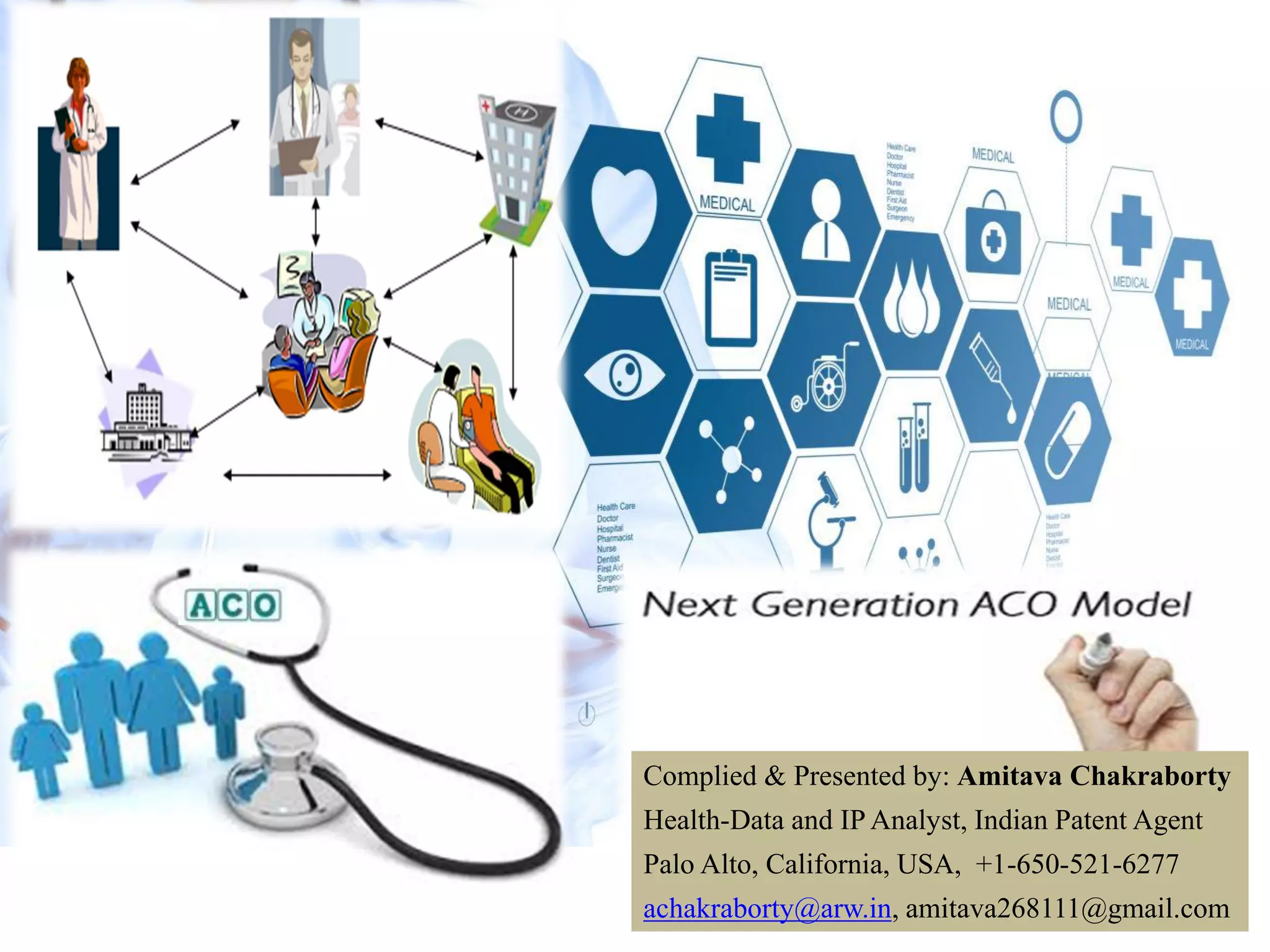
Complied & Presented by: Amitava Chakraborty
Health-Data and IP Analyst, Indian Patent Agent
Palo Alto, California, USA, +1-650-521-6277
achakraborty@arw.in, amitava268111@gmail.com
AGENDA
Accountable Care Organizations
Background: What, Why, Where, How?
Care objectives under basic ACO setup
Purpose of Next gen ACO
Associated NG-ACO wings
Comparison Across Key Design Elements: Traditional vs. Next-Gen ACO
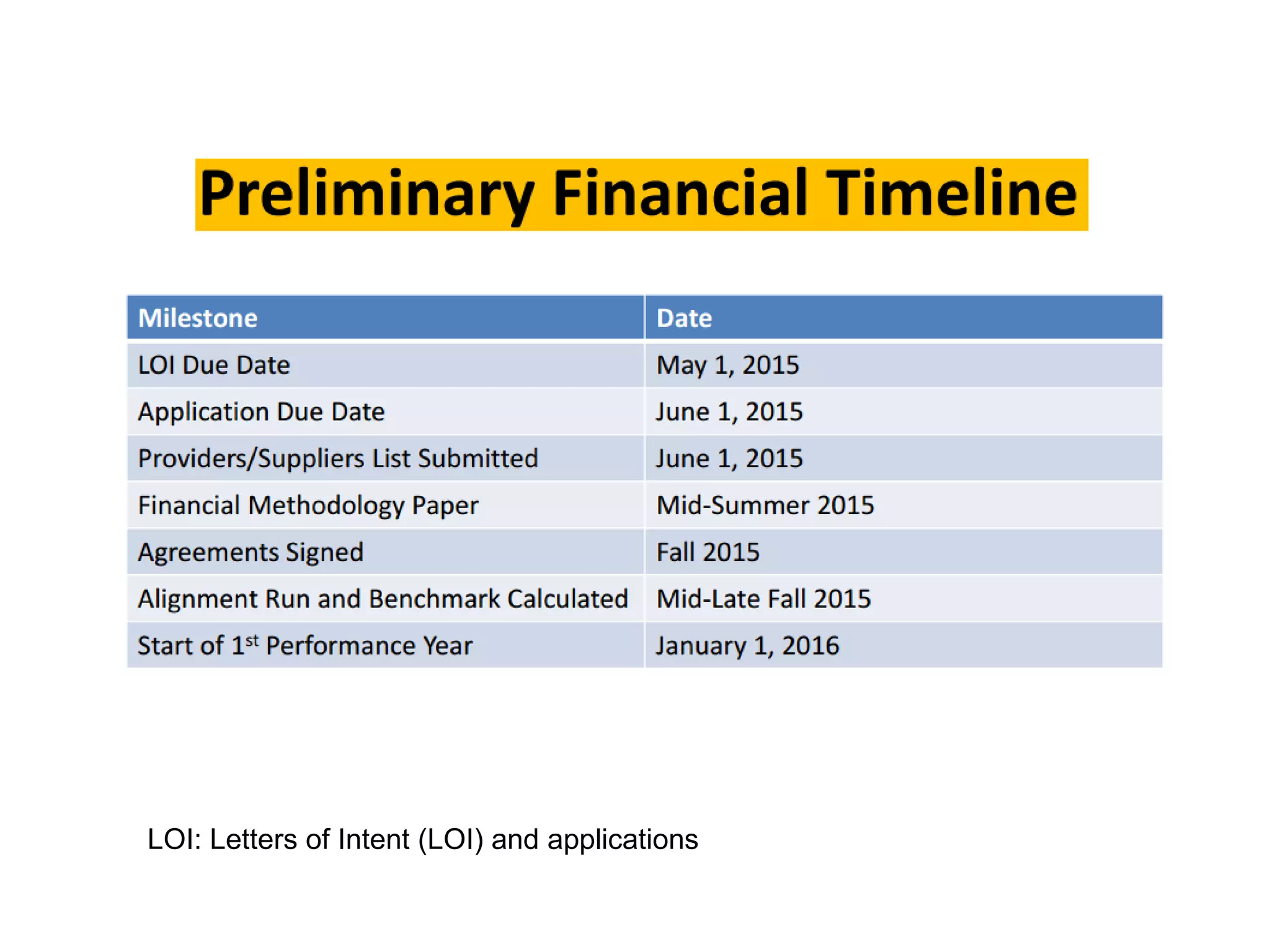
Preliminary Financial Time line
Financial Model Deep Dive
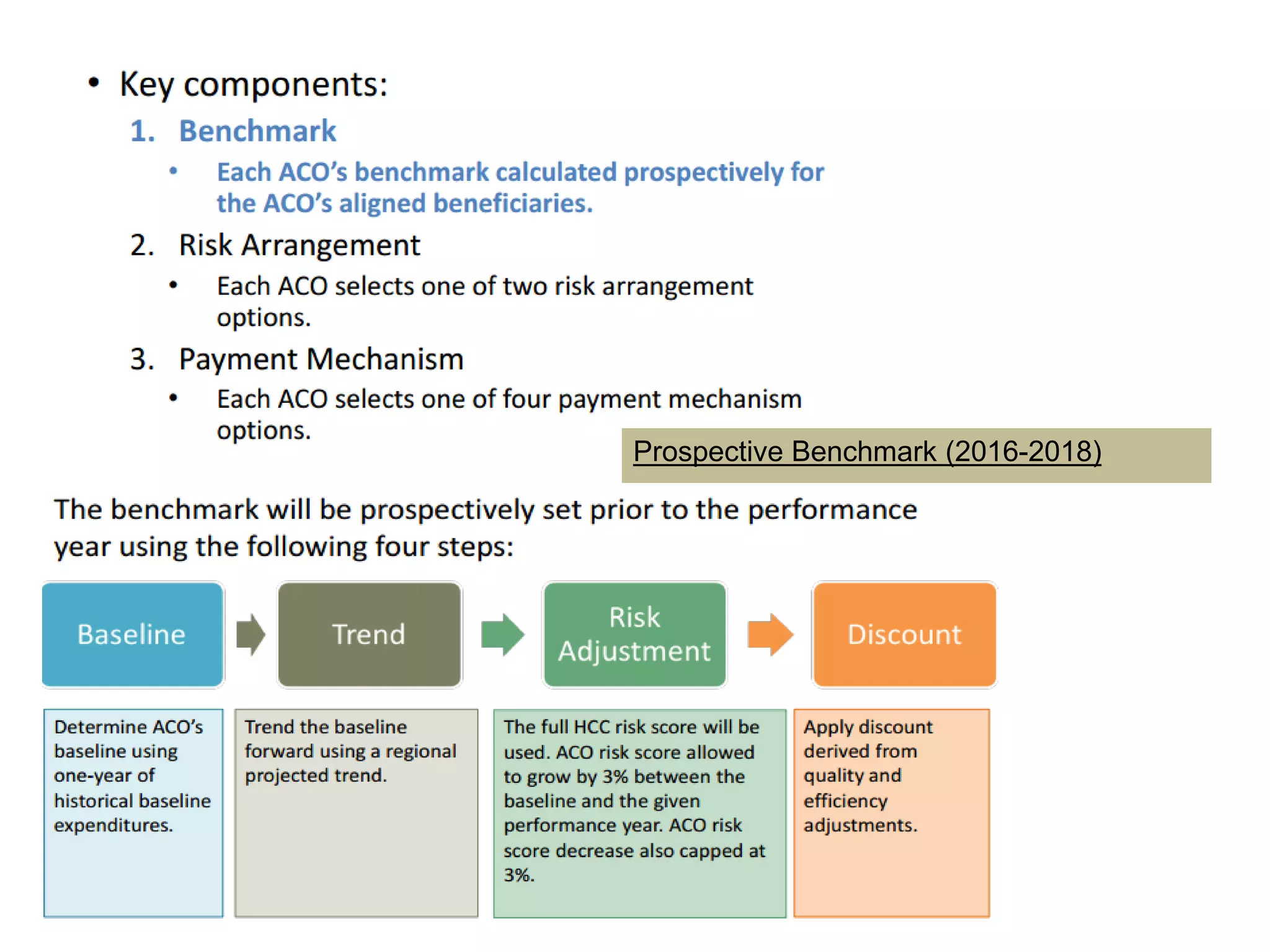
– Benchmark
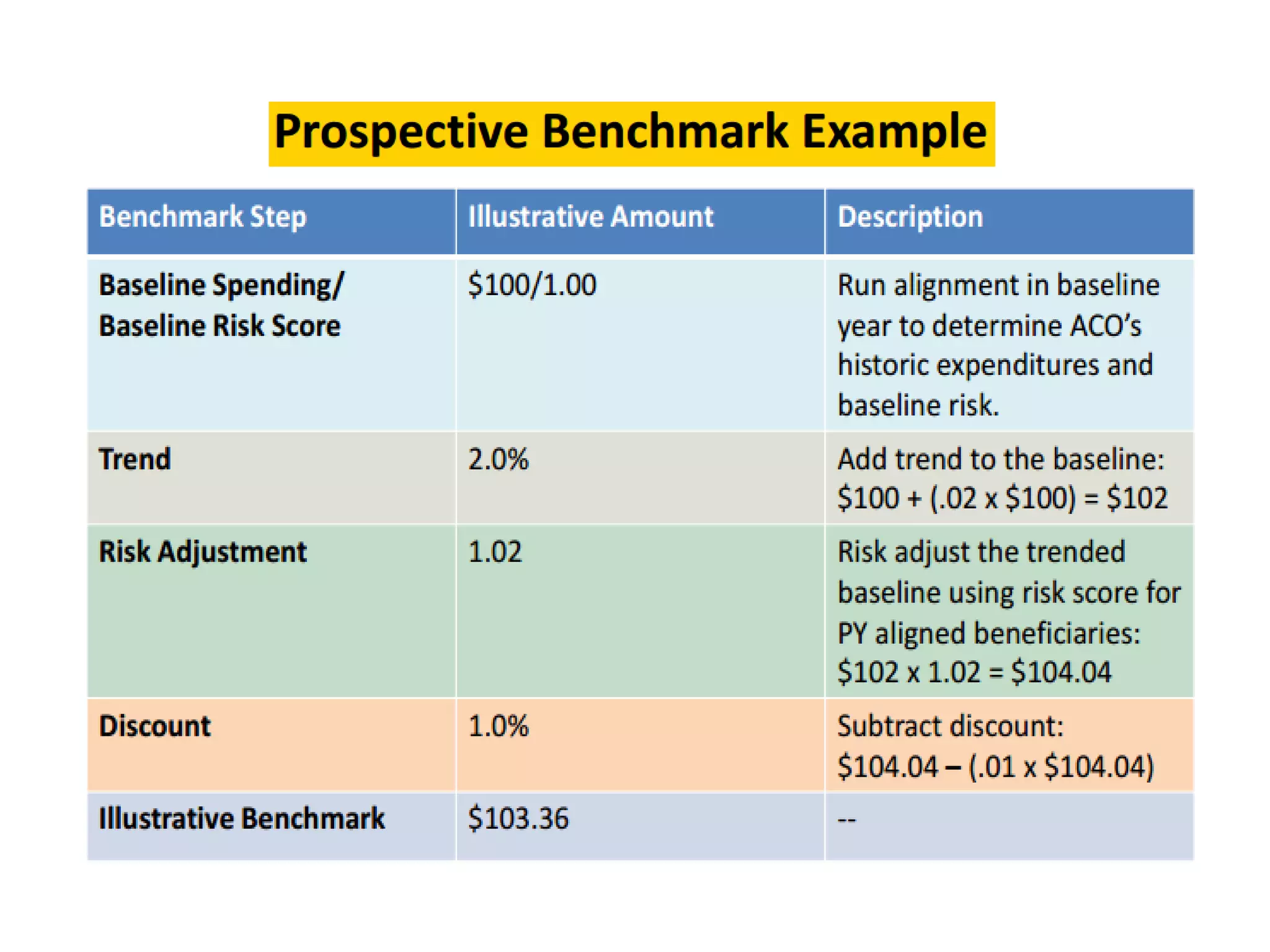
Prospective Benchmark Example
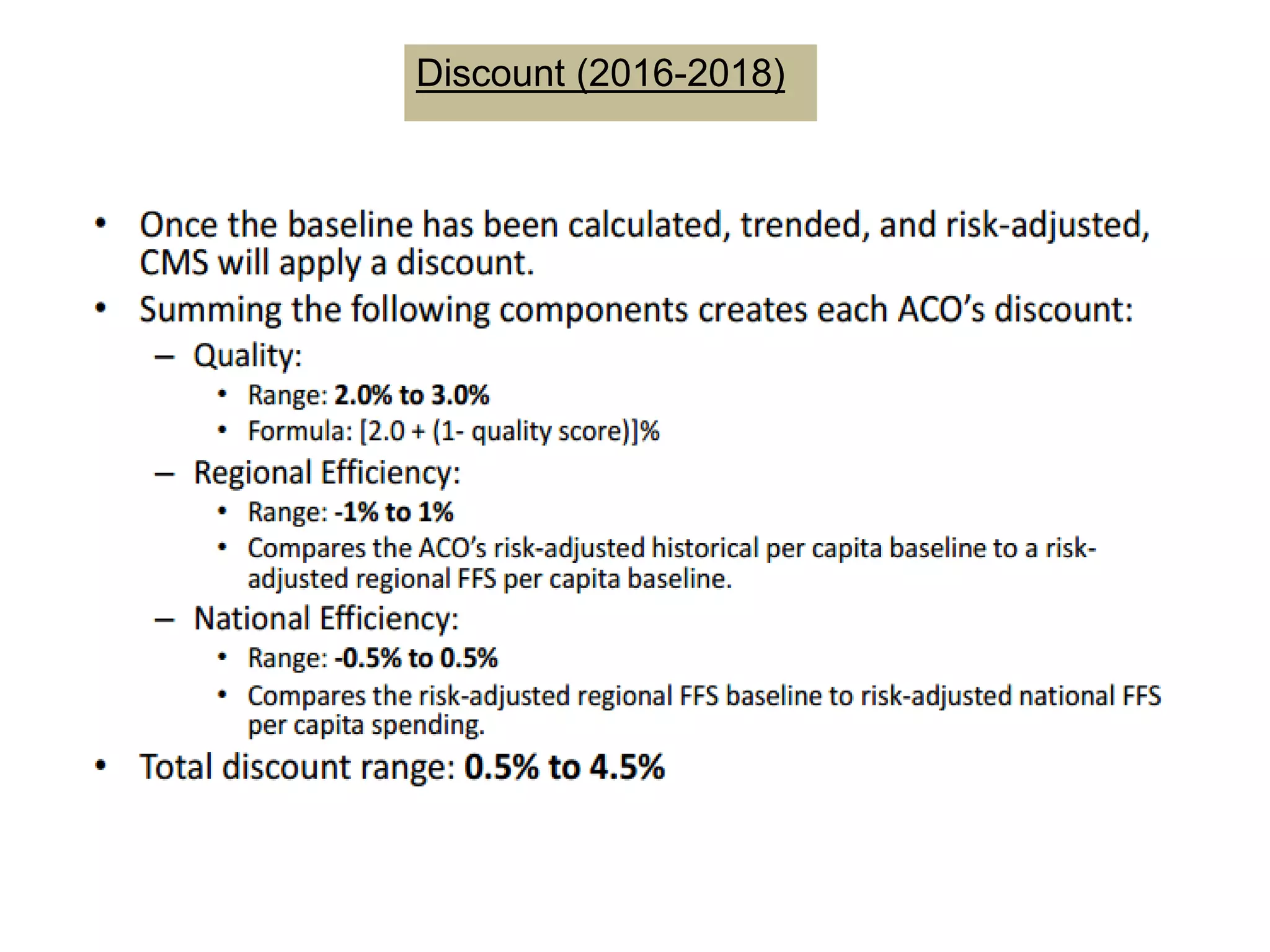
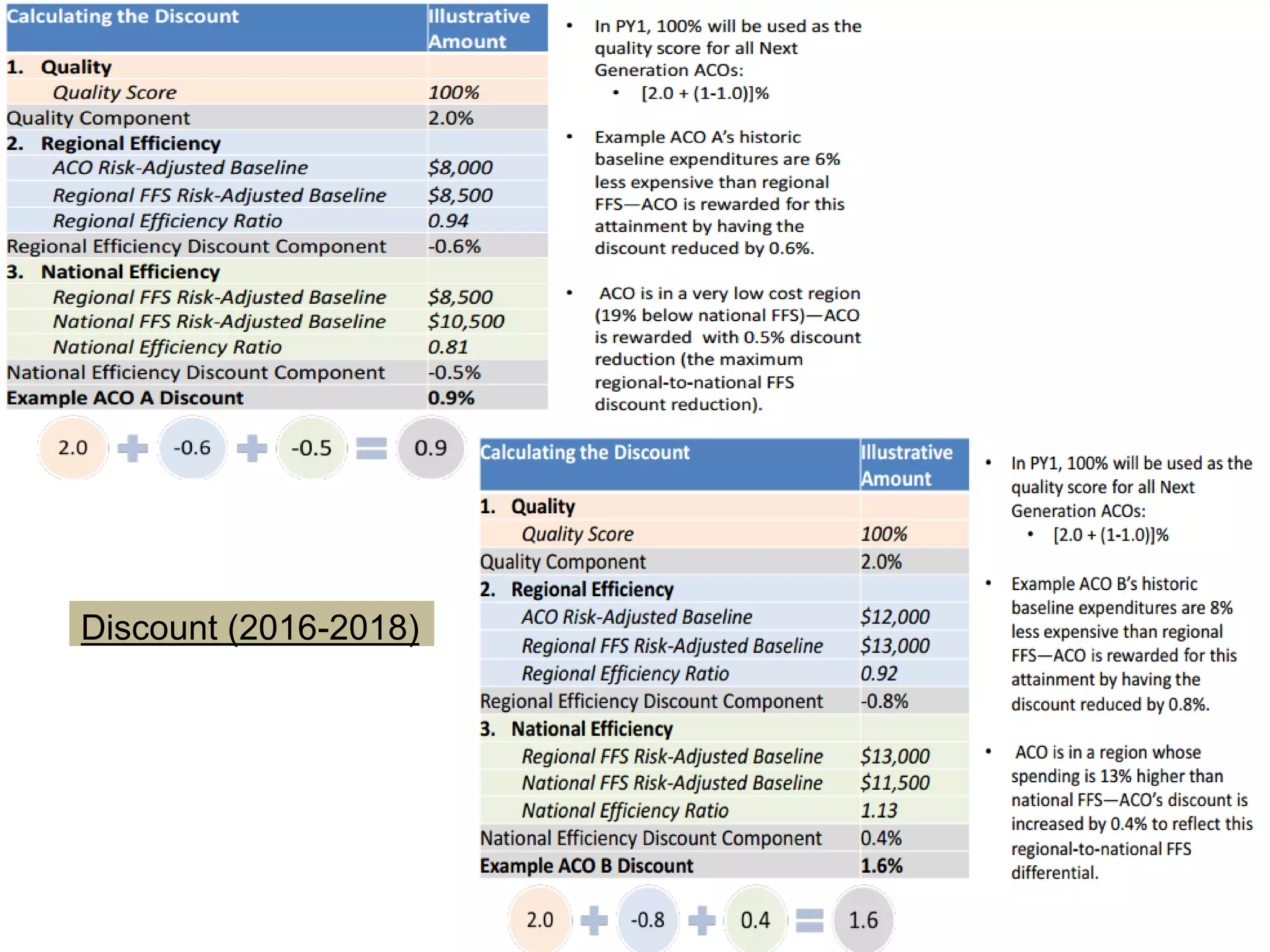
Example Discount Calculations
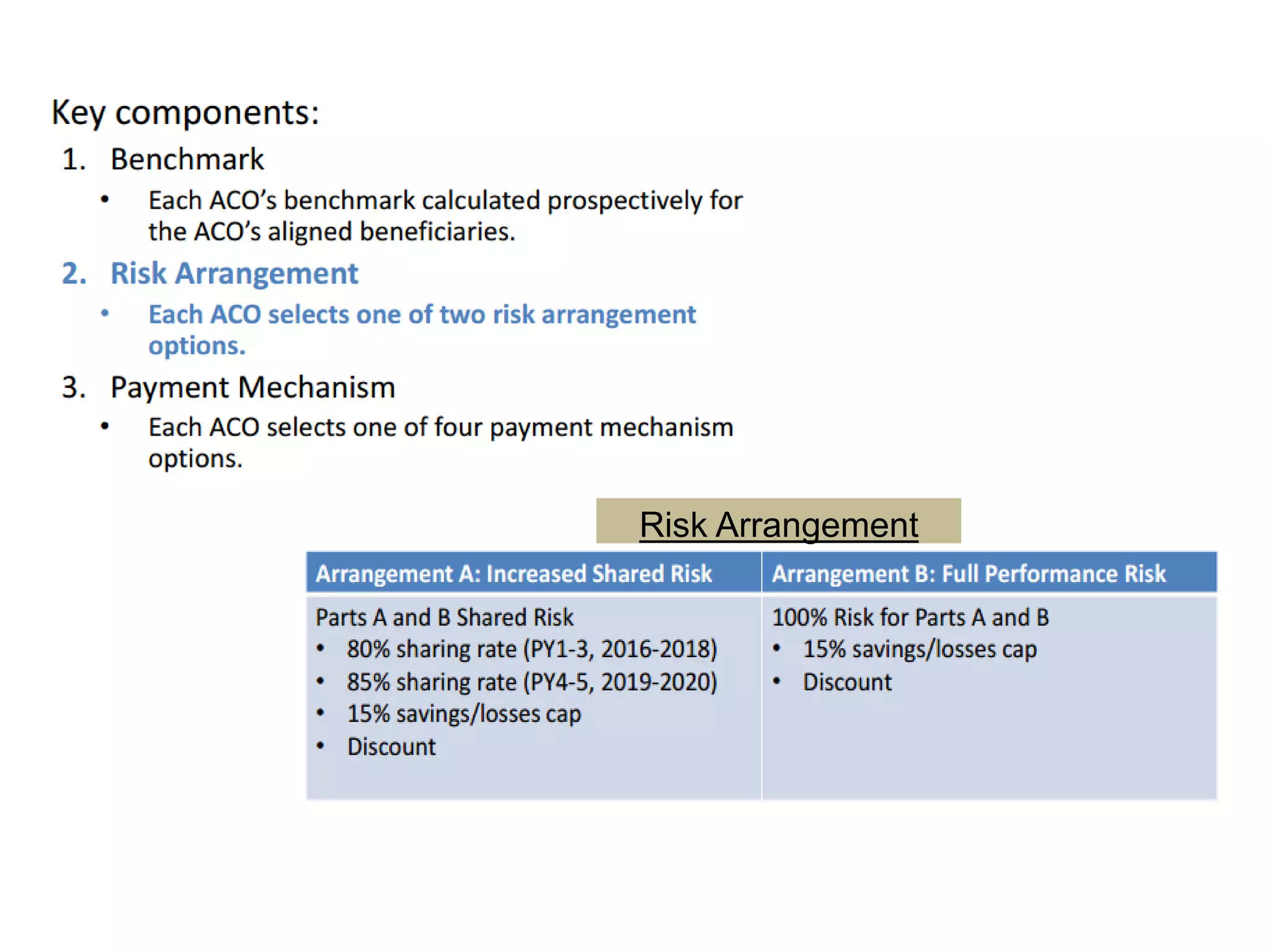
– Risk Arrangements
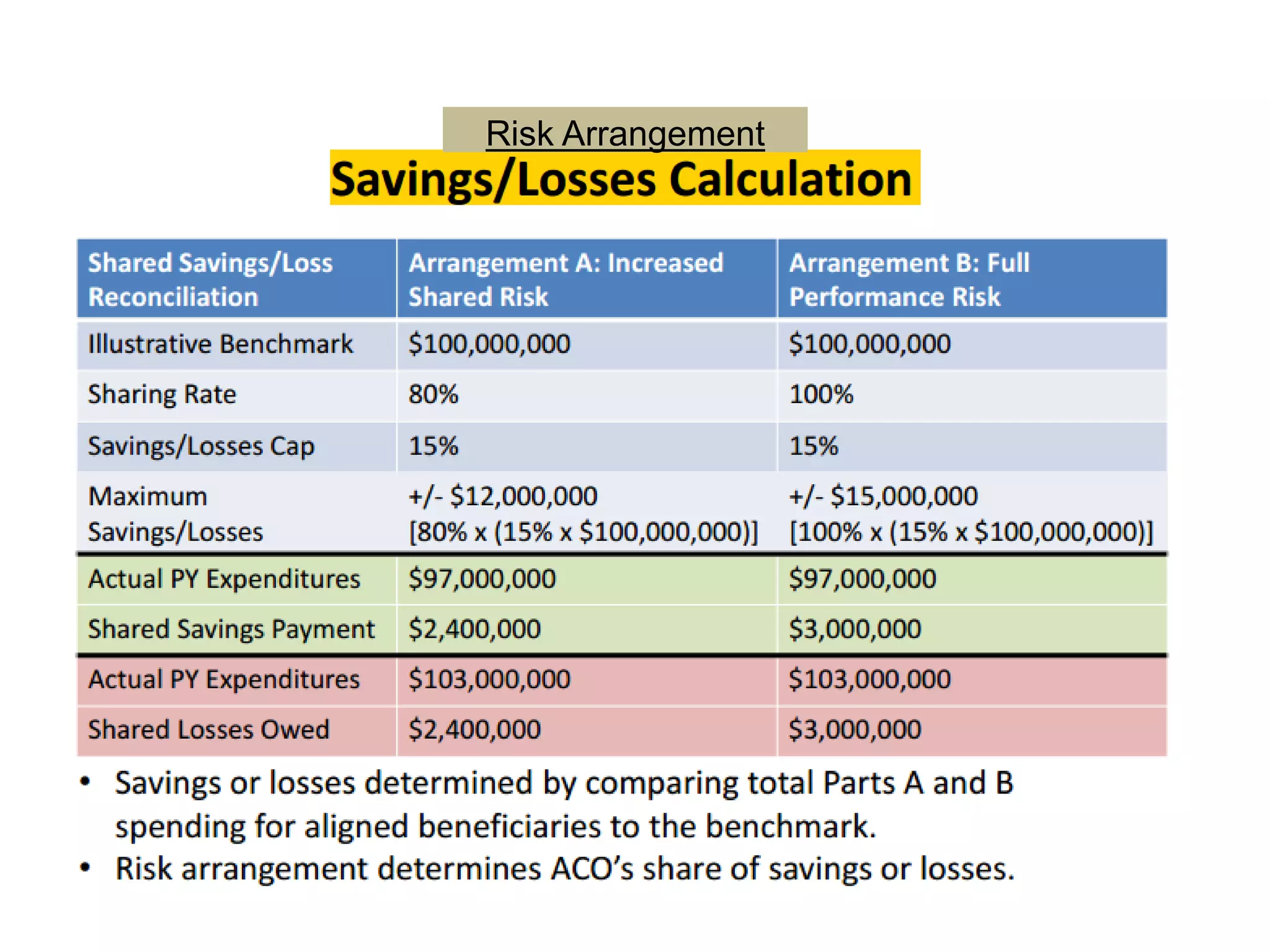
Example Savings/Losses Calculation
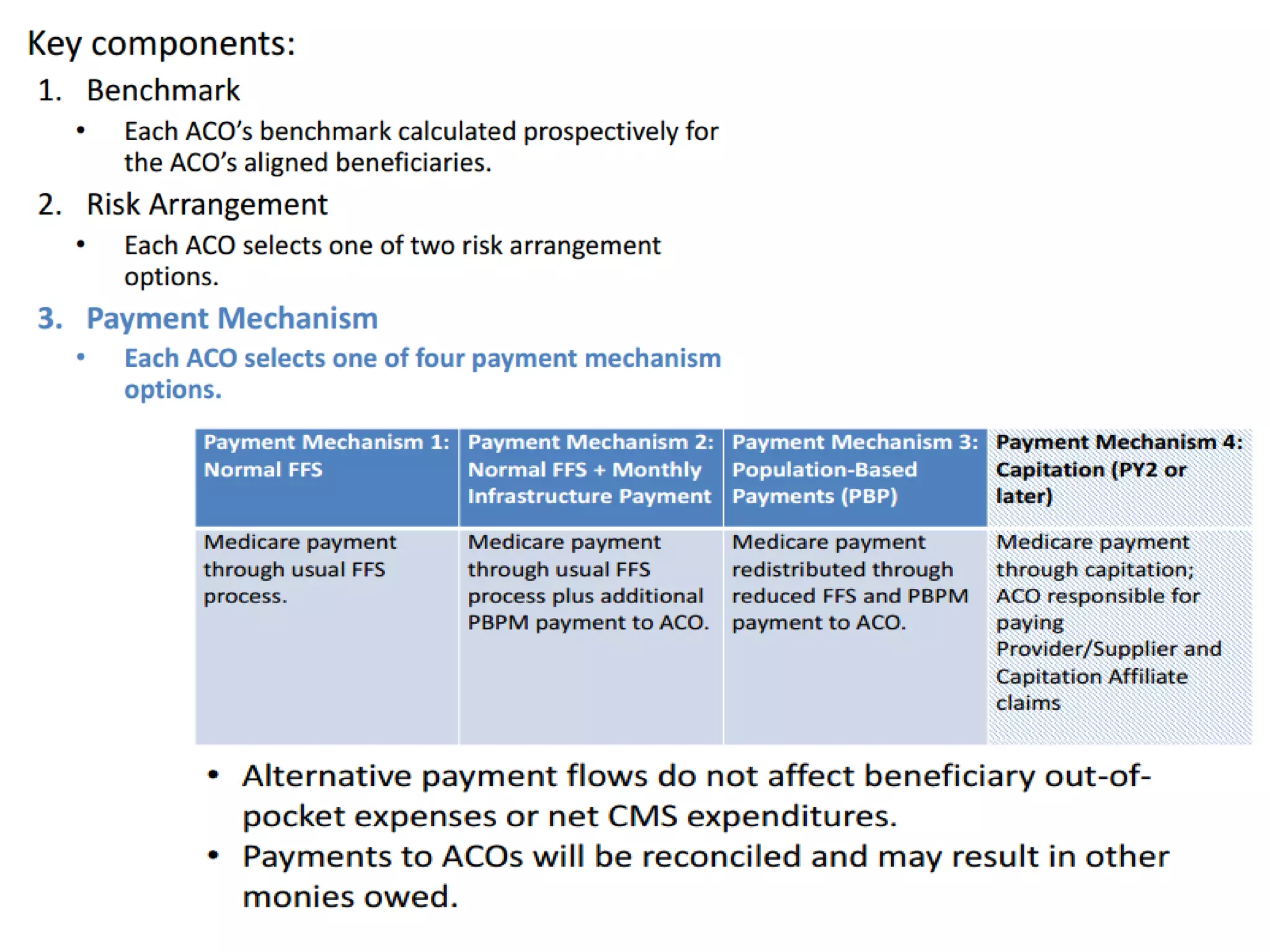
– Payment Mechanisms
Conceptual Diagrams
Example Payment Calculations
Conclusion
Ref: ww.pbgh.org
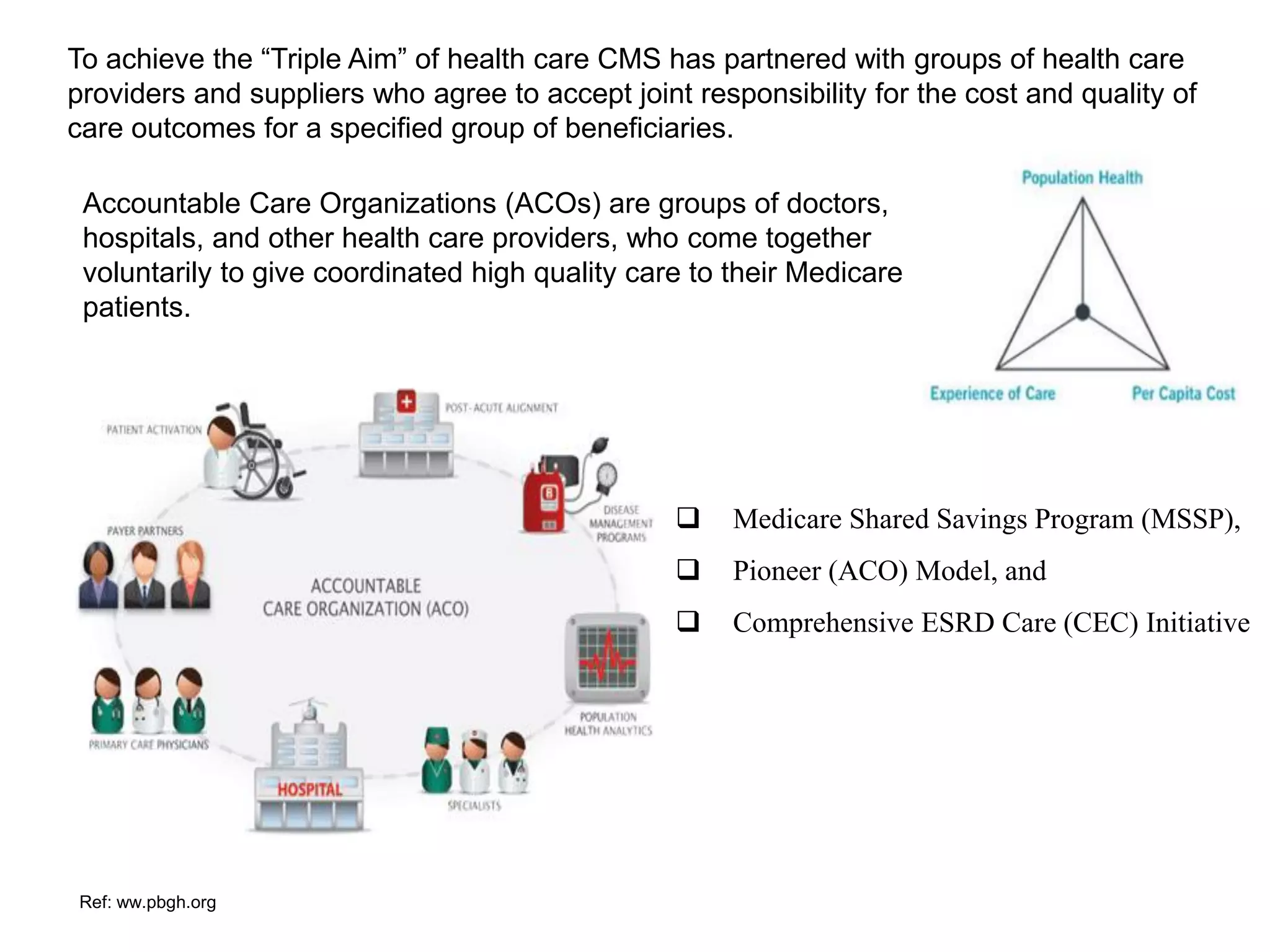
To achieve the “Triple Aim” of health care CMS has partnered with groups of health care
providers and suppliers who agree to accept joint responsibility for the cost and quality of
care outcomes for a specified group of beneficiaries.
Accountable Care Organizations (ACOs) are groups of doctors,
hospitals, and other health care providers, who come together
voluntarily to give coordinated high quality care to their Medicare
patients.
 Medicare Shared Savings Program (MSSP),
 Pioneer (ACO) Model, and
 Comprehensive ESRD Care (CEC) Initiative
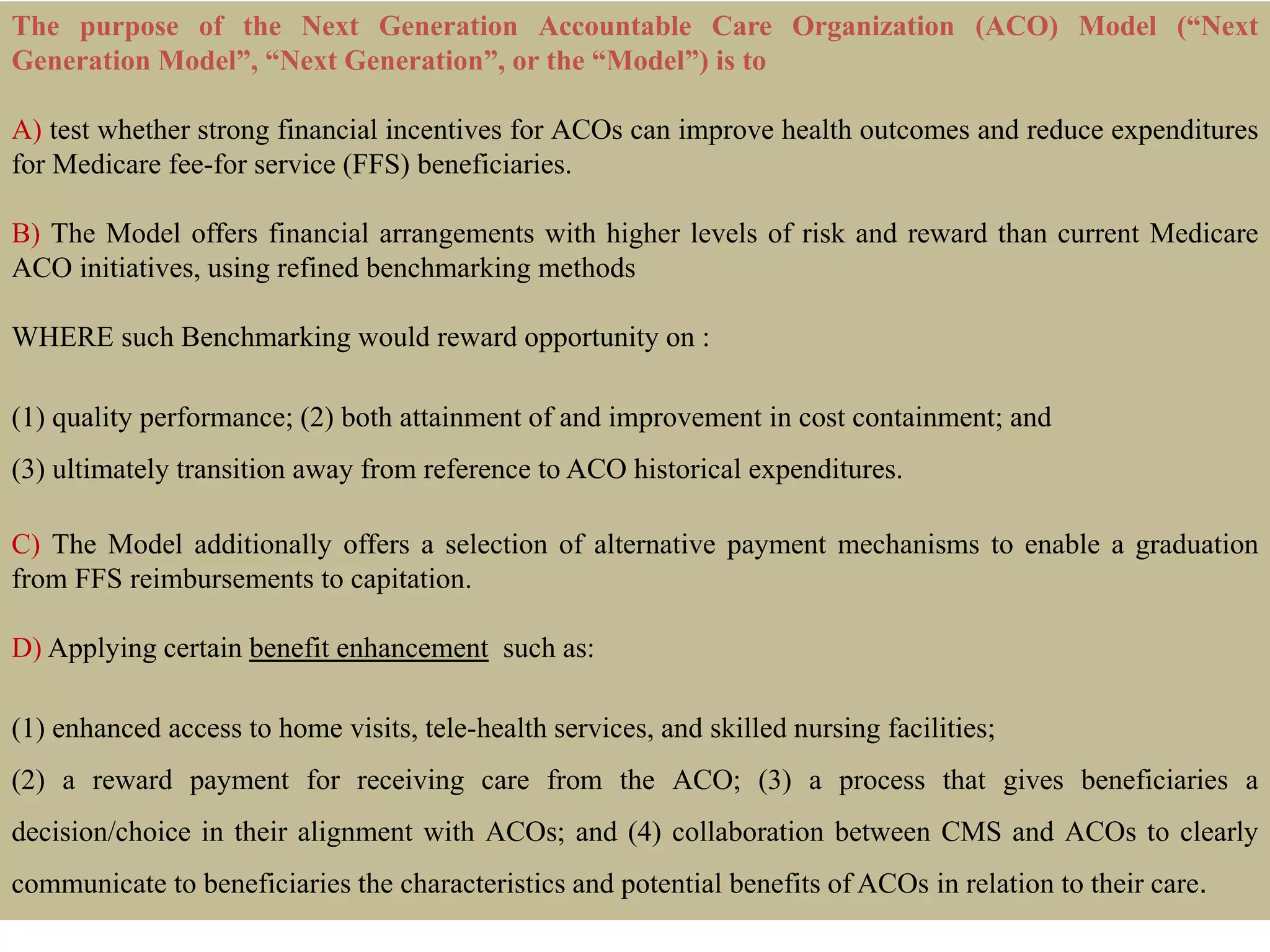
Objectives underlie the overall CMS approach to testing accountable care models, including:
1. Promoting changes in the delivery of care from fragmented to coordinated care systems
2. Improving effective beneficiary engagement and protections against harm;
3. Protecting the Medicare Trust Funds while finding new ways of cost reduction
4. Learning and sharing best practices with providers to assist their pursuits of achieving
'Triple Aim' of health care better care for the Medicare fee-for-service population; and
5. Developing close working partnerships with providers
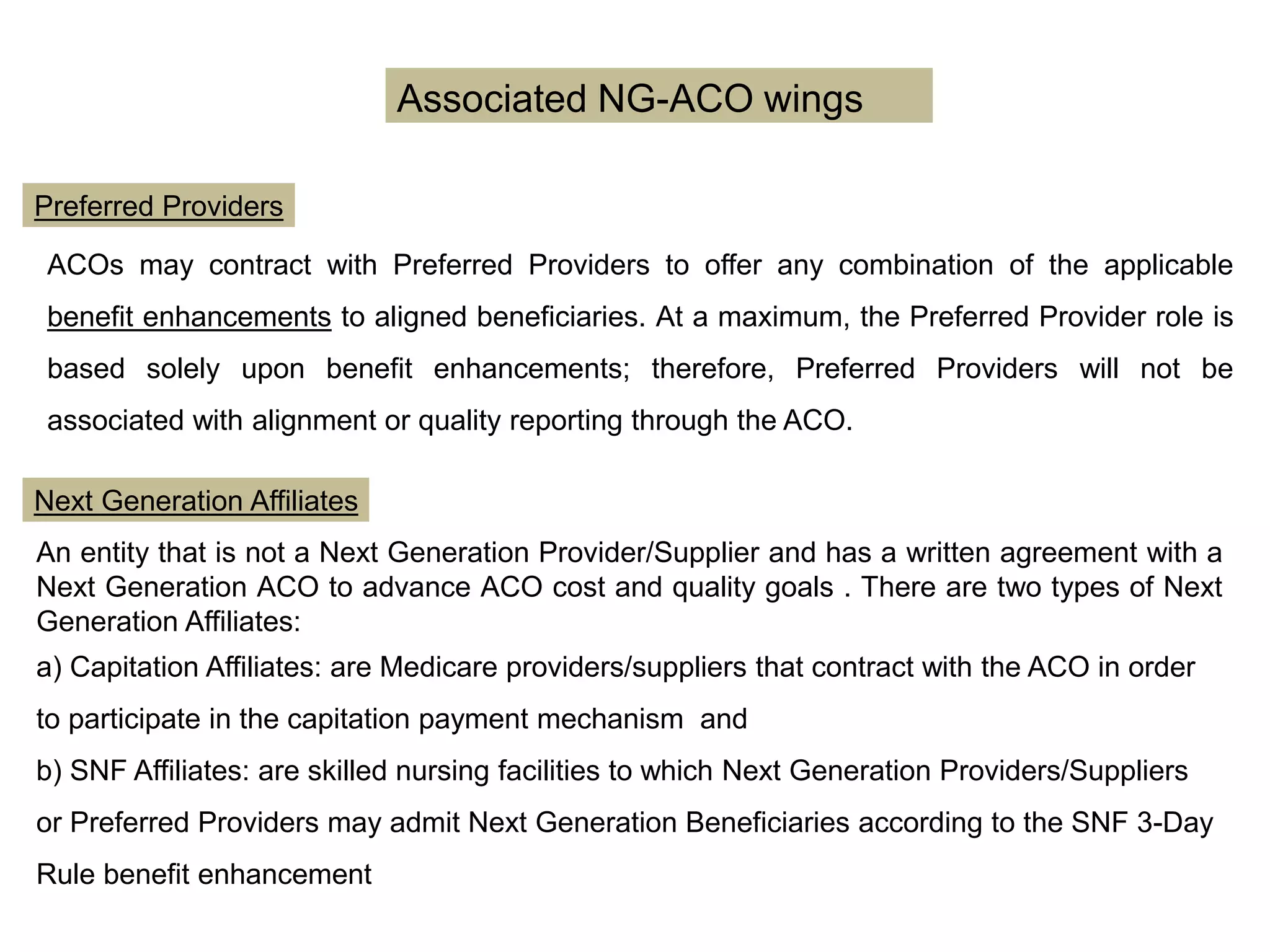
The purpose of the Next Generation Accountable Care Organization (ACO) Model (“Next
Generation Model”, “Next Generation”, or the “Model”) is to
A) test whether strong financial incentives for ACOs can improve health outcomes and reduce expenditures
for Medicare fee-for service (FFS) beneficiaries.
B) The Model offers financial arrangements with higher levels of risk and reward than current Medicare
ACO initiatives, using refined benchmarking methods
WHERE such Benchmarking would reward opportunity on :
(1) quality performance; (2) both attainment of and improvement in cost containment; and
(3) ultimately transition away from reference to ACO historical expenditures.
C) The Model additionally offers a selection of alternative payment mechanisms to enable a graduation
from FFS reimbursements to capitation.
D) Applying certain benefit enhancement such as:
(1) enhanced access to home visits, tele-health services, and skilled nursing facilities;
(2) a reward payment for receiving care from the ACO; (3) a process that gives beneficiaries a
decision/choice in their alignment with ACOs; and (4) collaboration between CMS and ACOs to clearly
communicate to beneficiaries the characteristics and potential benefits of ACOs in relation to their care.
Associated NG-ACO wings
Preferred Providers
Next Generation Affiliates
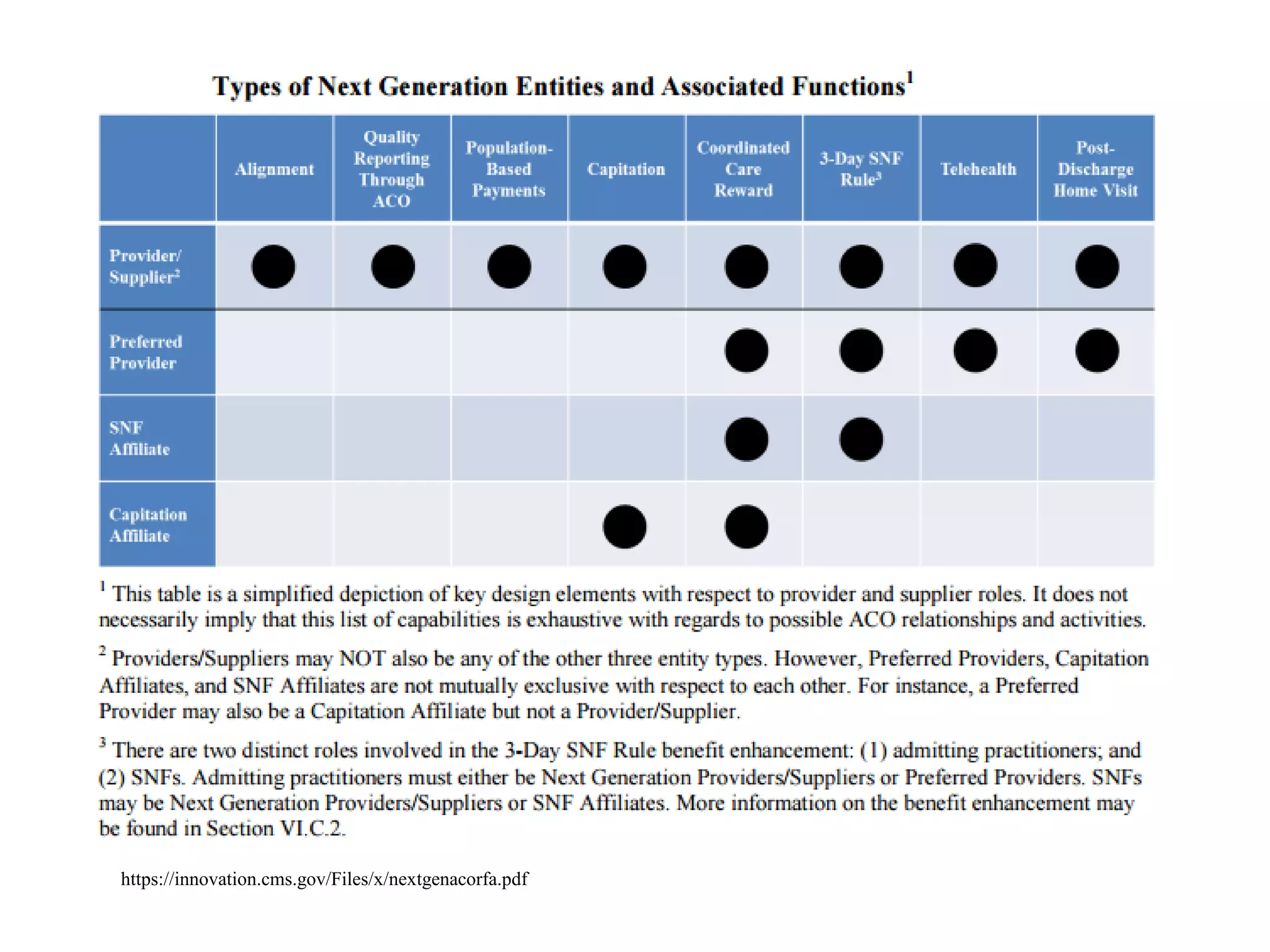
ACOs may contract with Preferred Providers to offer any combination of the applicable
benefit enhancements to aligned beneficiaries. At a maximum, the Preferred Provider role is
based solely upon benefit enhancements; therefore, Preferred Providers will not be
associated with alignment or quality reporting through the ACO.
An entity that is not a Next Generation Provider/Supplier and has a written agreement with a
Next Generation ACO to advance ACO cost and quality goals . There are two types of Next
Generation Affiliates:
a) Capitation Affiliates: are Medicare providers/suppliers that contract with the ACO in order
to participate in the capitation payment mechanism and
b) SNF Affiliates: are skilled nursing facilities to which Next Generation Providers/Suppliers
or Preferred Providers may admit Next Generation Beneficiaries according to the SNF 3-Day
Rule benefit enhancement
https://innovation.cms.gov/Files/x/nextgenacorfa.pdf
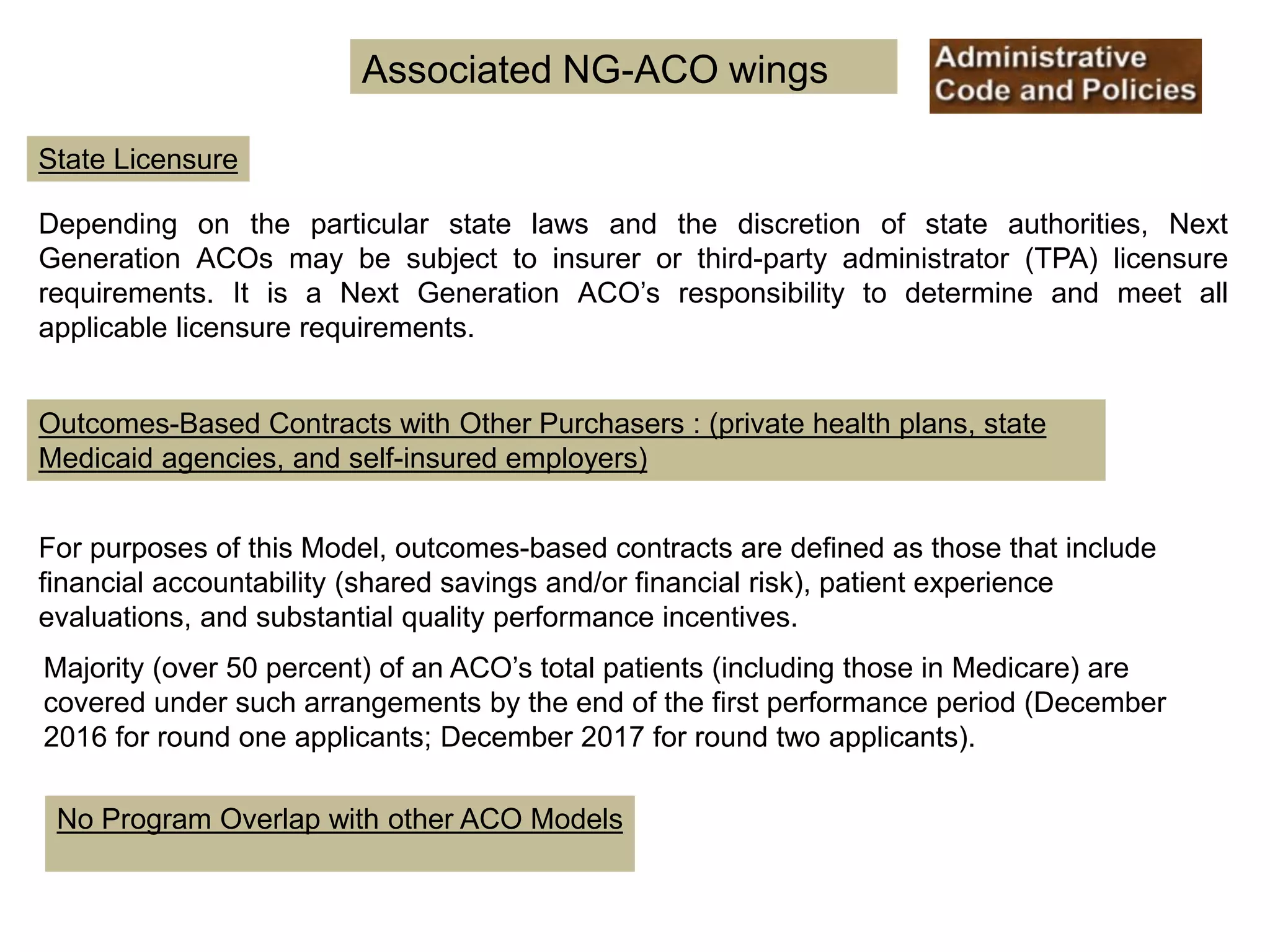
State Licensure
No Program Overlap with other ACO Models
Associated NG-ACO wings
Depending on the particular state laws and the discretion of state authorities, Next
Generation ACOs may be subject to insurer or third-party administrator (TPA) licensure
requirements. It is a Next Generation ACO’s responsibility to determine and meet all
applicable licensure requirements.
Outcomes-Based Contracts with Other Purchasers : (private health plans, state
Medicaid agencies, and self-insured employers)
For purposes of this Model, outcomes-based contracts are defined as those that include
financial accountability (shared savings and/or financial risk), patient experience
evaluations, and substantial quality performance incentives.
Majority (over 50 percent) of an ACO’s total patients (including those in Medicare) are
covered under such arrangements by the end of the first performance period (December
2016 for round one applicants; December 2017 for round two applicants).
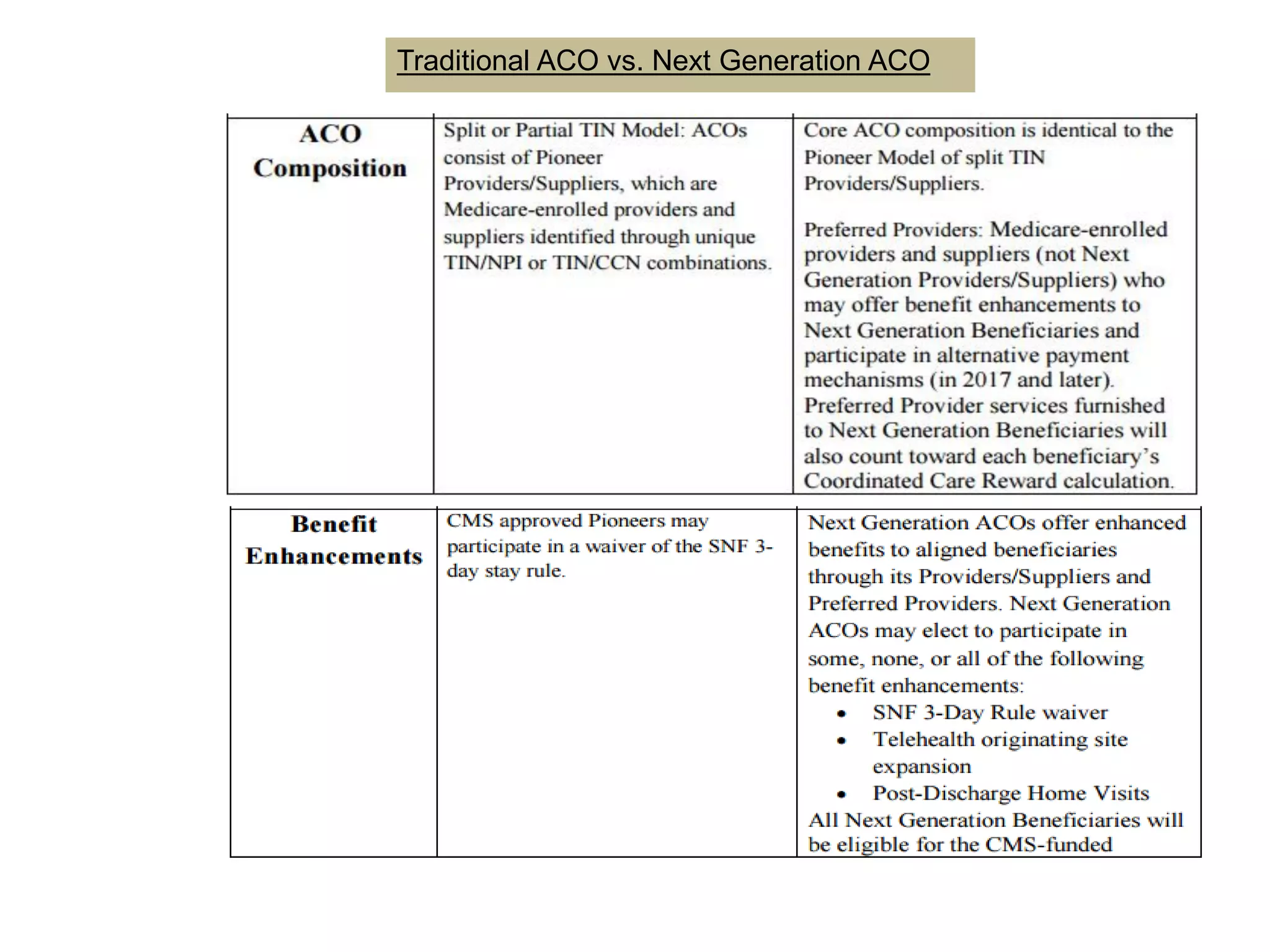
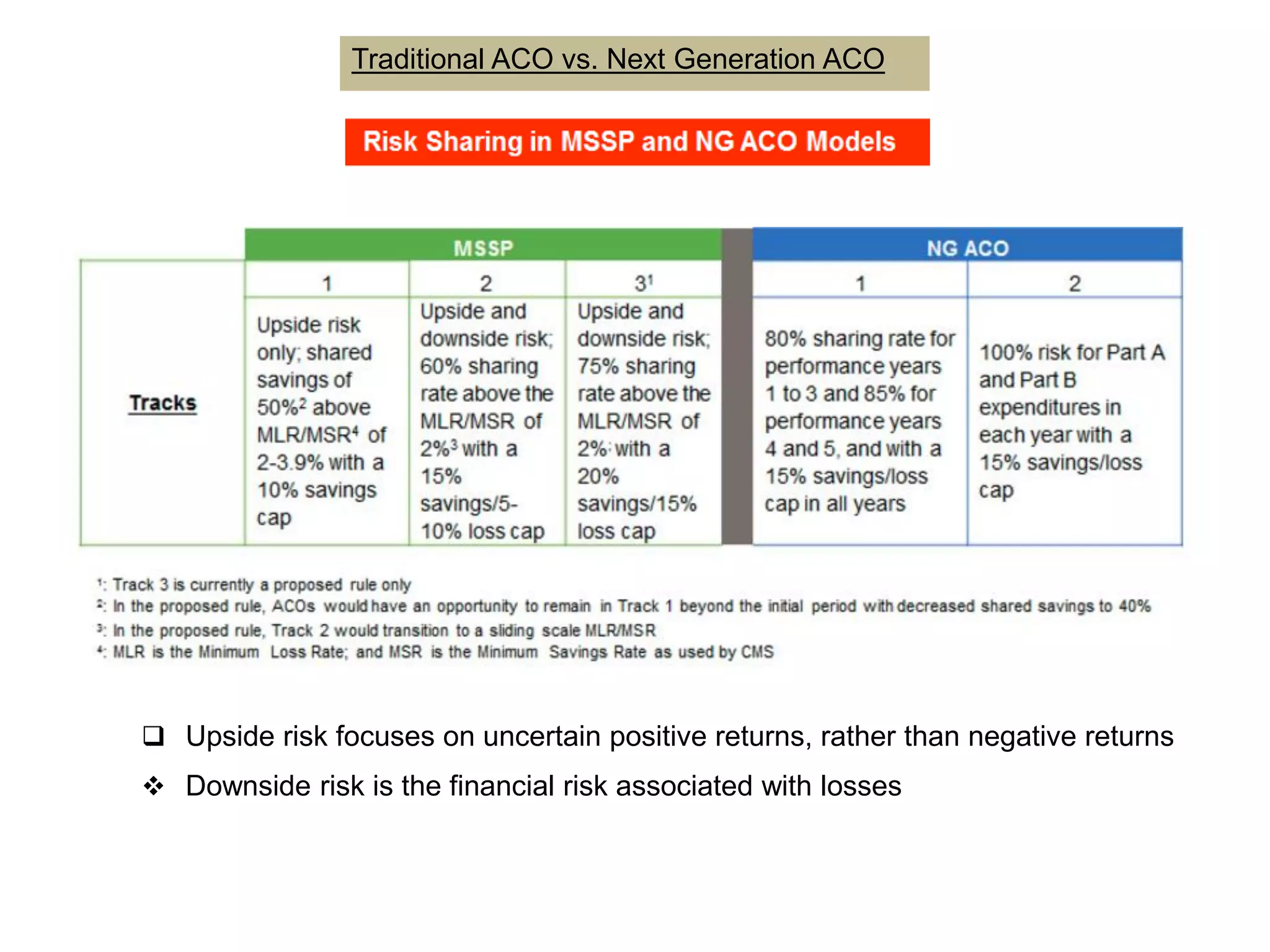
Traditional ACO vs. Next Generation ACO
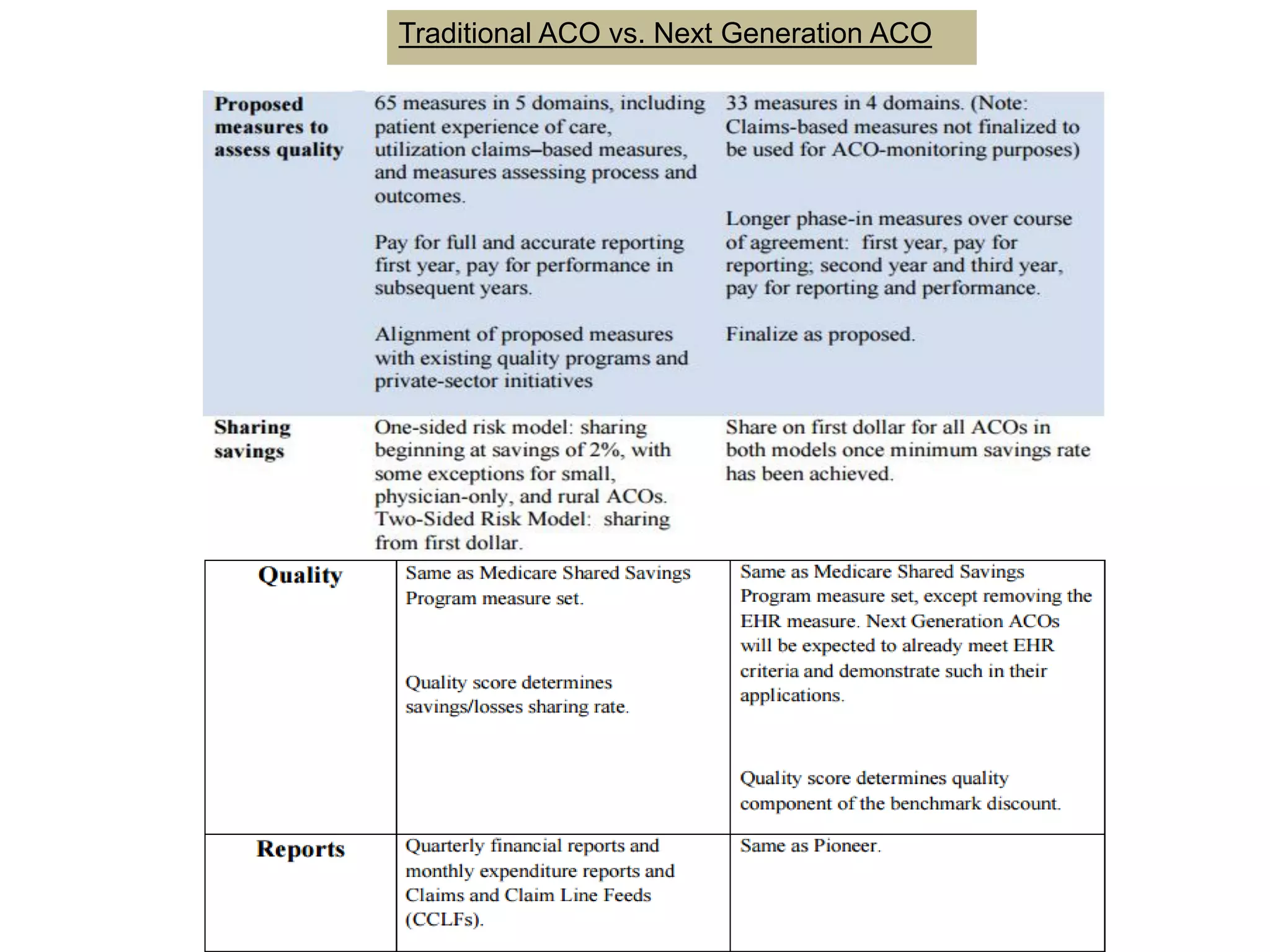
 Upside risk focuses on uncertain positive returns, rather than negative returns
 Downside risk is the financial risk associated with losses
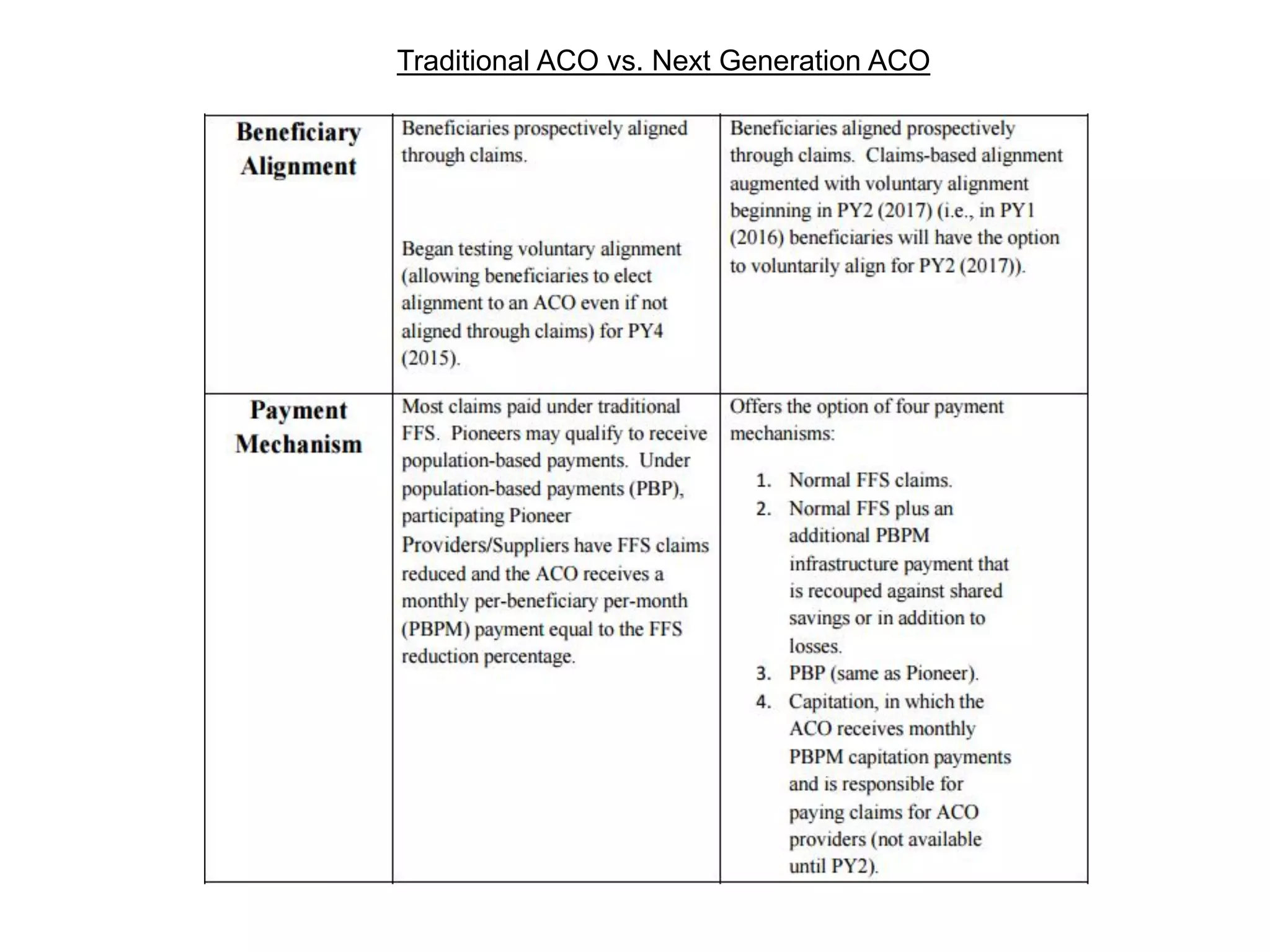
Traditional ACO vs. Next Generation ACO
LOI: Letters of Intent (LOI) and applications
Prospective Benchmark (2016-2018)
Discount (2016-2018)
Risk Arrangement
Risk Arrangement
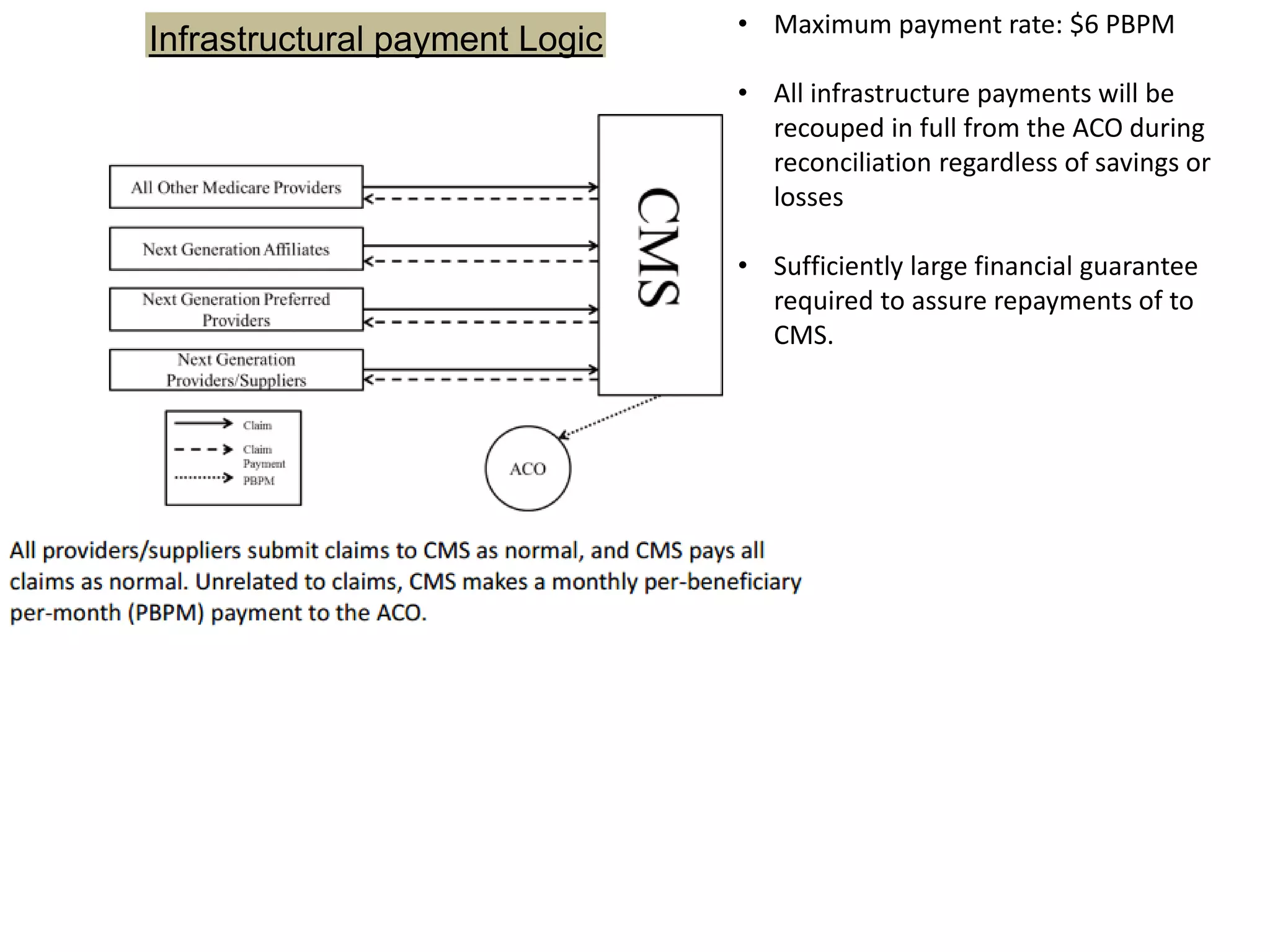
Infrastructural payment Logic
• Maximum payment rate: $6 PBPM
• All infrastructure payments will be
recouped in full from the ACO during
reconciliation regardless of savings or
losses
• Sufficiently large financial guarantee
required to assure repayments of to
CMS.
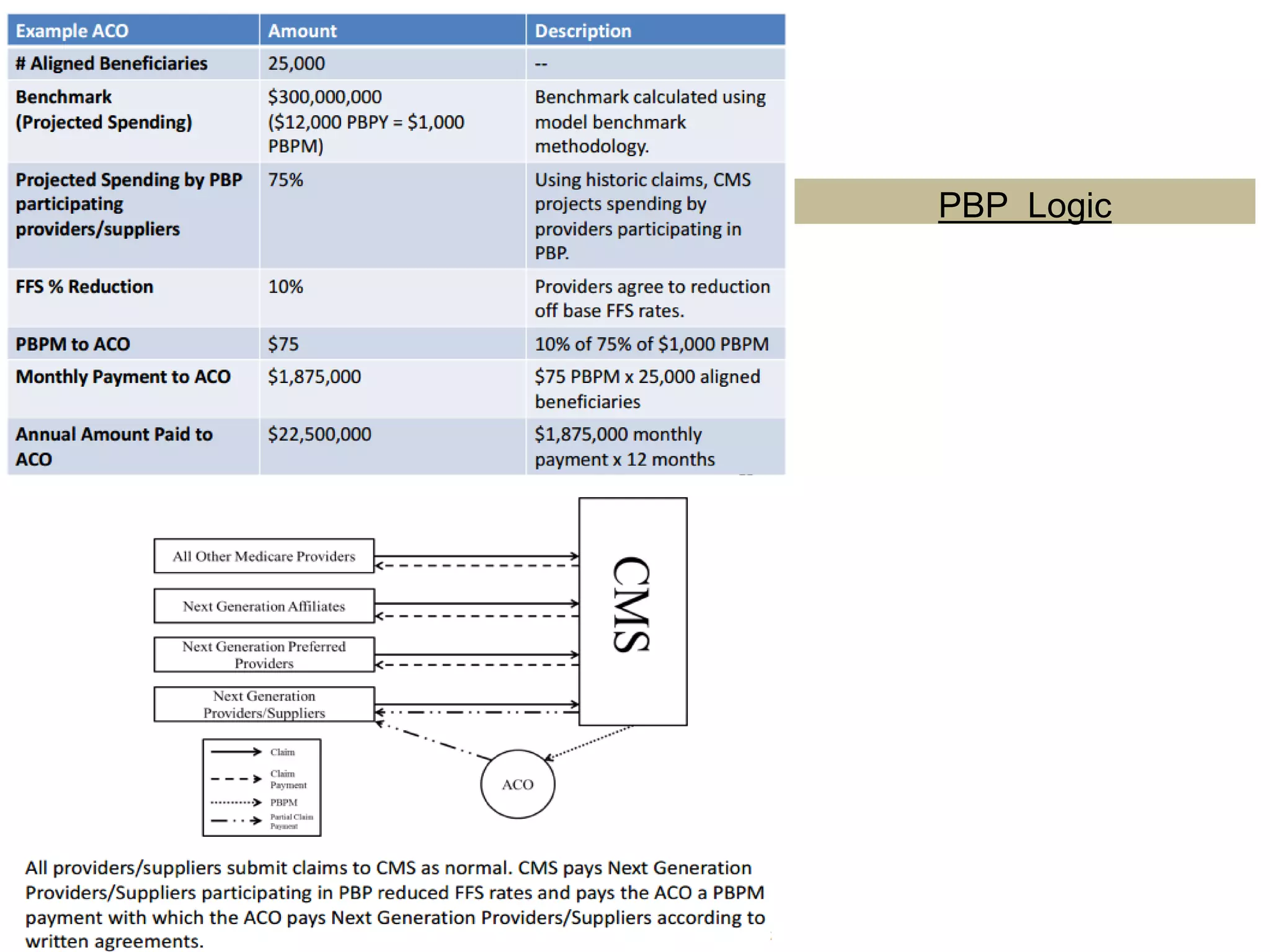
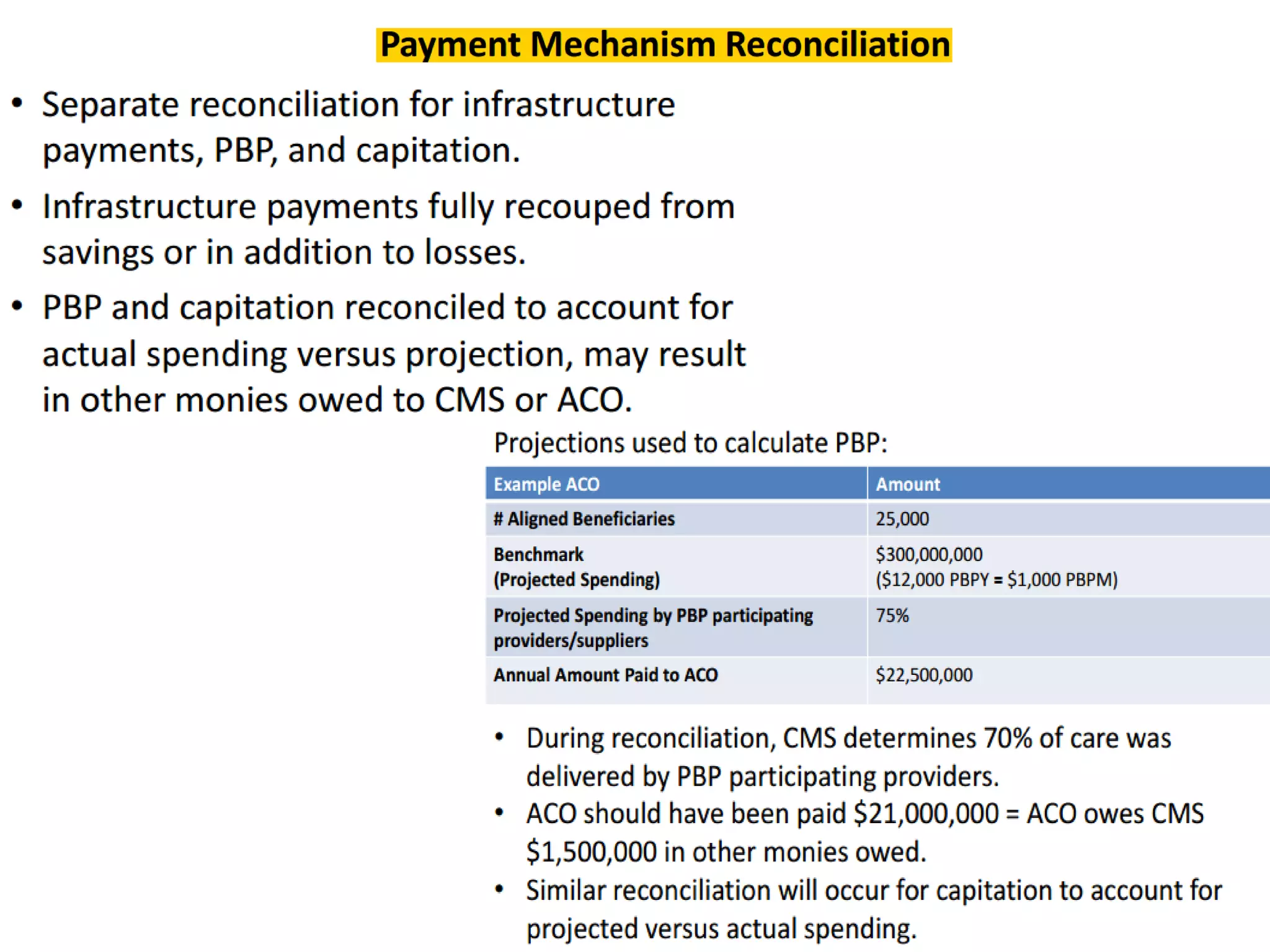
PBP Logic
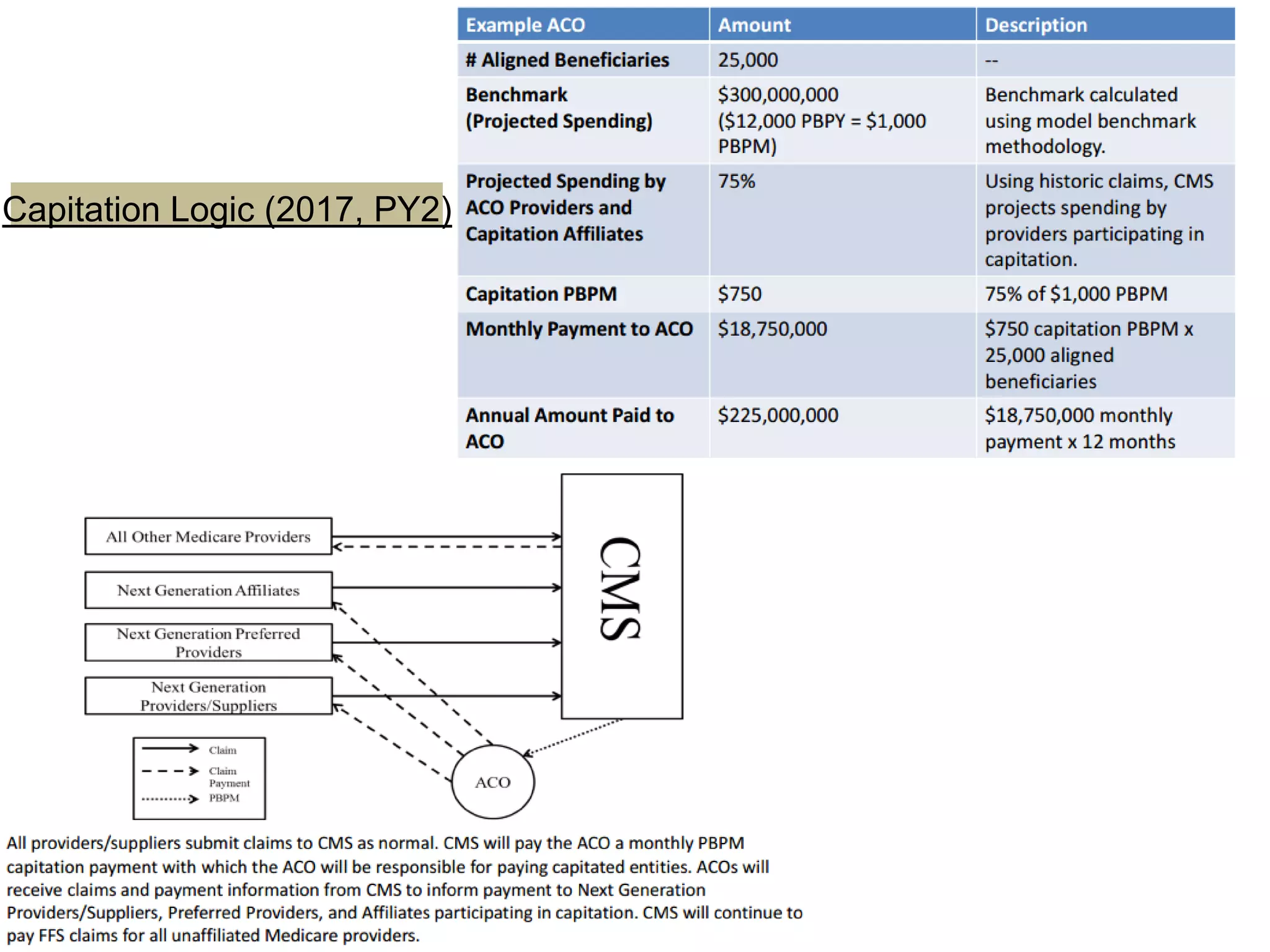
Capitation Logic (2017, PY2)
1. https://innovation.cms.gov/Files/x/nextgenacorfa.pdf
2. https://cms.gov/
3. https://innovation.cms.gov/Files/factsheet/nextgenacocomparefact
sheet.pdf
4. https://www.cms.gov/Medicare/Medicare-Fee-for-Service-
Payment/ACO/downloads/appendix-aco-table.pdf
5. https://www.advisory.com/daily-briefing/2015/04/27/what-acos-
need-to-know-about-cmss-next-generation-model
Contact Co-ordinates: Mr. Amitava Chakraborty
Health-Data and IP Analyst, Indian Patent Agent & IPR Consultant
Palo Alto, California, USA, +1-650-521-6277
achakraborty@arw.in, amitava268111@gmail.com

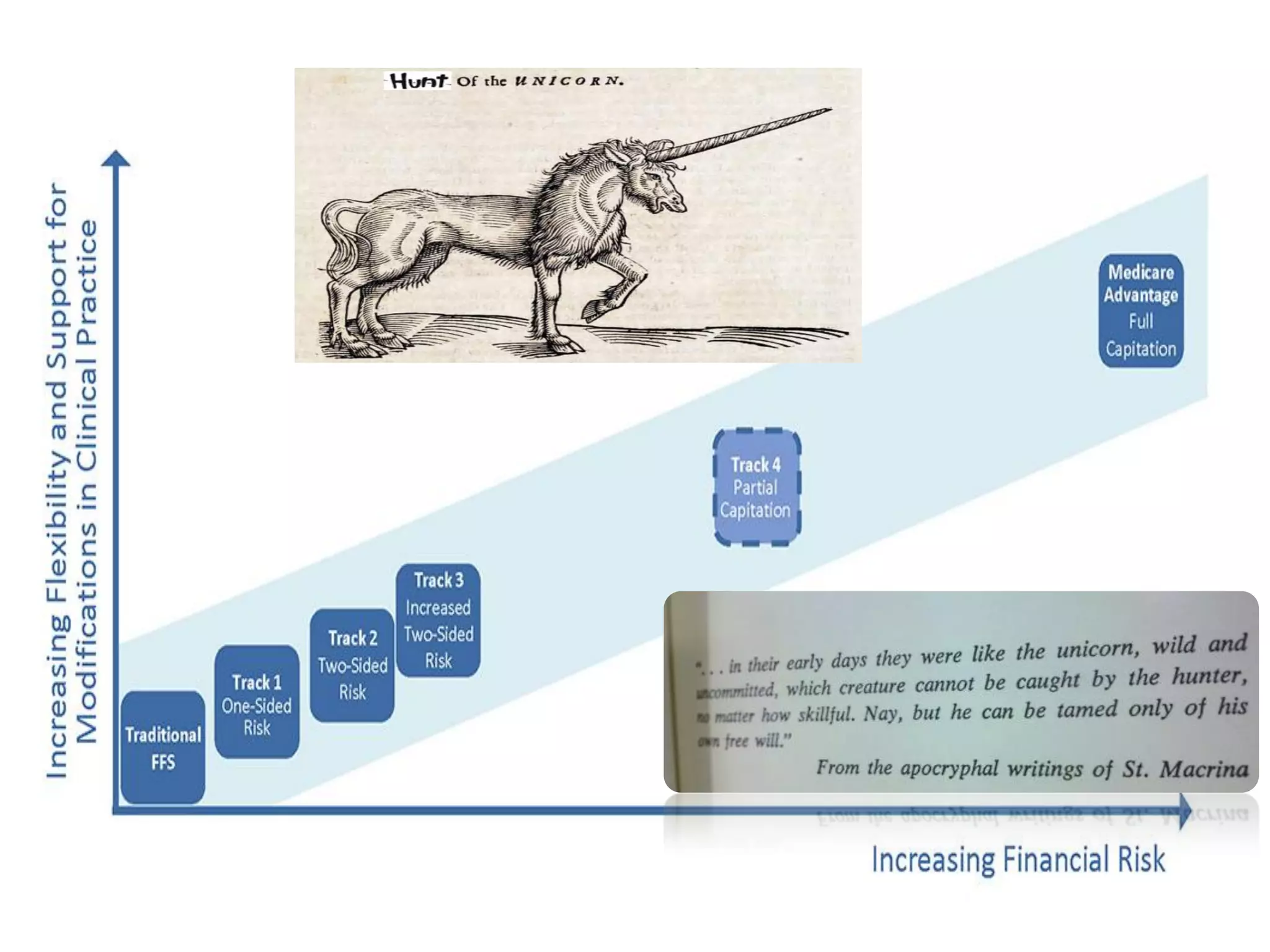
Next Gen ACO_Story of the Unicorn

  • 1.
    Complied & Presentedby: Amitava Chakraborty Health-Data and IP Analyst, Indian Patent Agent Palo Alto, California, USA, +1-650-521-6277 achakraborty@arw.in, amitava268111@gmail.com
  • 2.
    AGENDA Accountable Care Organizations Background:What, Why, Where, How? Care objectives under basic ACO setup Purpose of Next gen ACO Associated NG-ACO wings Comparison Across Key Design Elements: Traditional vs. Next-Gen ACO Preliminary Financial Time line Financial Model Deep Dive – Benchmark Prospective Benchmark Example Example Discount Calculations – Risk Arrangements Example Savings/Losses Calculation – Payment Mechanisms Conceptual Diagrams Example Payment Calculations Conclusion
  • 3.
    Ref: ww.pbgh.org To achievethe “Triple Aim” of health care CMS has partnered with groups of health care providers and suppliers who agree to accept joint responsibility for the cost and quality of care outcomes for a specified group of beneficiaries. Accountable Care Organizations (ACOs) are groups of doctors, hospitals, and other health care providers, who come together voluntarily to give coordinated high quality care to their Medicare patients.  Medicare Shared Savings Program (MSSP),  Pioneer (ACO) Model, and  Comprehensive ESRD Care (CEC) Initiative
  • 5.
    Objectives underlie theoverall CMS approach to testing accountable care models, including: 1. Promoting changes in the delivery of care from fragmented to coordinated care systems 2. Improving effective beneficiary engagement and protections against harm; 3. Protecting the Medicare Trust Funds while finding new ways of cost reduction 4. Learning and sharing best practices with providers to assist their pursuits of achieving 'Triple Aim' of health care better care for the Medicare fee-for-service population; and 5. Developing close working partnerships with providers
  • 6.
    The purpose ofthe Next Generation Accountable Care Organization (ACO) Model (“Next Generation Model”, “Next Generation”, or the “Model”) is to A) test whether strong financial incentives for ACOs can improve health outcomes and reduce expenditures for Medicare fee-for service (FFS) beneficiaries. B) The Model offers financial arrangements with higher levels of risk and reward than current Medicare ACO initiatives, using refined benchmarking methods WHERE such Benchmarking would reward opportunity on : (1) quality performance; (2) both attainment of and improvement in cost containment; and (3) ultimately transition away from reference to ACO historical expenditures. C) The Model additionally offers a selection of alternative payment mechanisms to enable a graduation from FFS reimbursements to capitation. D) Applying certain benefit enhancement such as: (1) enhanced access to home visits, tele-health services, and skilled nursing facilities; (2) a reward payment for receiving care from the ACO; (3) a process that gives beneficiaries a decision/choice in their alignment with ACOs; and (4) collaboration between CMS and ACOs to clearly communicate to beneficiaries the characteristics and potential benefits of ACOs in relation to their care.
  • 7.
    Associated NG-ACO wings PreferredProviders Next Generation Affiliates ACOs may contract with Preferred Providers to offer any combination of the applicable benefit enhancements to aligned beneficiaries. At a maximum, the Preferred Provider role is based solely upon benefit enhancements; therefore, Preferred Providers will not be associated with alignment or quality reporting through the ACO. An entity that is not a Next Generation Provider/Supplier and has a written agreement with a Next Generation ACO to advance ACO cost and quality goals . There are two types of Next Generation Affiliates: a) Capitation Affiliates: are Medicare providers/suppliers that contract with the ACO in order to participate in the capitation payment mechanism and b) SNF Affiliates: are skilled nursing facilities to which Next Generation Providers/Suppliers or Preferred Providers may admit Next Generation Beneficiaries according to the SNF 3-Day Rule benefit enhancement
  • 8.
  • 9.
    State Licensure No ProgramOverlap with other ACO Models Associated NG-ACO wings Depending on the particular state laws and the discretion of state authorities, Next Generation ACOs may be subject to insurer or third-party administrator (TPA) licensure requirements. It is a Next Generation ACO’s responsibility to determine and meet all applicable licensure requirements. Outcomes-Based Contracts with Other Purchasers : (private health plans, state Medicaid agencies, and self-insured employers) For purposes of this Model, outcomes-based contracts are defined as those that include financial accountability (shared savings and/or financial risk), patient experience evaluations, and substantial quality performance incentives. Majority (over 50 percent) of an ACO’s total patients (including those in Medicare) are covered under such arrangements by the end of the first performance period (December 2016 for round one applicants; December 2017 for round two applicants).
  • 10.
    Traditional ACO vs.Next Generation ACO
  • 11.
    Traditional ACO vs.Next Generation ACO
  • 12.
    Traditional ACO vs.Next Generation ACO
  • 13.
     Upside riskfocuses on uncertain positive returns, rather than negative returns  Downside risk is the financial risk associated with losses Traditional ACO vs. Next Generation ACO
  • 14.
    LOI: Letters ofIntent (LOI) and applications
  • 15.
  • 16.
  • 17.
  • 19.
  • 20.
  • 22.
    Infrastructural payment Logic •Maximum payment rate: $6 PBPM • All infrastructure payments will be recouped in full from the ACO during reconciliation regardless of savings or losses • Sufficiently large financial guarantee required to assure repayments of to CMS.
  • 23.
  • 24.
  • 27.
    1. https://innovation.cms.gov/Files/x/nextgenacorfa.pdf 2. https://cms.gov/ 3.https://innovation.cms.gov/Files/factsheet/nextgenacocomparefact sheet.pdf 4. https://www.cms.gov/Medicare/Medicare-Fee-for-Service- Payment/ACO/downloads/appendix-aco-table.pdf 5. https://www.advisory.com/daily-briefing/2015/04/27/what-acos- need-to-know-about-cmss-next-generation-model Contact Co-ordinates: Mr. Amitava Chakraborty Health-Data and IP Analyst, Indian Patent Agent & IPR Consultant Palo Alto, California, USA, +1-650-521-6277 achakraborty@arw.in, amitava268111@gmail.com