Akka Typed
Johan Andrén, Akka Team
Øredev Malmö, 2018-11-20
Next generation
message driven
systems with Akka
Johan Andrén
Akka Team
Stockholm Scala User Group
@apnylle
markatta.com/codemonkey/
johan.andren@lightbend.com
Build powerful reactive, concurrent,
and distributed applications more easily
Akka
What’s in the toolkit?
Actors – simple & high performance concurrency
Cluster, Cluster tools – tools for building distributed
systems
Streams – reactive streams implementation
Persistence – CQRS + Event Sourcing for Actors
HTTP – fully async streaming HTTP Server
Alpakka – Reactive Streams Integrations a’la Camel
Actors – simple & high performance concurrency
Cluster, Cluster tools – tools for building distributed
systems
Streams – reactive streams implementation
Persistence – CQRS + Event Sourcing for Actors
HTTP – fully async streaming HTTP Server
Alpakka – Reactive Streams Integrations a’la Camel
Typed
Typed
Typed
(already type-safe)
(already type-safe)
(already type-safe)
What is coming soon?
(already type-safe)
Languages
Complete APIs for both Java and Scala
Actor
Message
Inbox
MessageMessage
actorRef.tell(message)
Akka Actor fundamentals
The only way for the rest of the
application to interact with the actor
• mutate state (including spawning a child actor)
• send messages to other actors
• change its behavior
Actor
Message
Inbox
MessageMessage
An Actor can…
MVS
(Minimum Viable Sample)
Na-na na-na na-na na-naSample-time!
Also known as “hello world”
import akka.actor.typed.ActorRef;
import akka.actor.typed.ActorSystem;
import akka.actor.typed.Behavior;
import akka.actor.typed.javadsl.Behaviors;
import java.io.IOException;
public class Sample1 {
static class Hello {
public final String who;
public Hello(String who) {
this.who = who;
}
}
final static Behavior<Hello> greetingBehavior =
Behaviors.receive(Hello.class)
.onMessage(Hello.class, (context, message) -> {
context.getLog().info("Hello {}!", message.who);
return Behavior.same();
}).build();
public static void main(String[] args) throws IOException {
ActorSystem<Hello> actorSystem =
ActorSystem.create(greetingBehavior, "my-system");
ActorRef<Hello> rootActor = actorSystem;
rootActor.tell(new Hello("Johan"));
rootActor.tell(new Hello(“Øredev audience"));
System.out.println("Press that any-key to terminate");
System.in.read();
actorSystem.terminate();
}
}
public class Sample1 {
static class Hello {
public final String who;
public Hello(String who) {
this.who = who;
}
}
final static Behavior<Hello> greetingBehavior =
Behaviors.receive(Hello.class)
.onMessage(Hello.class, (context, message) -> {
context.getLog().info("Hello {}!", message.who);
return Behavior.same();
}).build();
public static void main(String[] args) throws IOException {
ActorSystem<Hello> actorSystem =
ActorSystem.create(greetingBehavior, "my-system");
ActorRef<Hello> rootActor = actorSystem;
rootActor.tell(new Hello("Johan"));
public class Sample1 {
static class Hello {
public final String who;
public Hello(String who) {
this.who = who;
}
}
final static Behavior<Hello> greetingBehavior =
Behaviors.receive(Hello.class)
.onMessage(Hello.class, (context, message) -> {
context.getLog().info("Hello {}!", message.who);
return Behavior.same();
}).build();
public static void main(String[] args) throws IOException {
ActorSystem<Hello> actorSystem =
ActorSystem.create(greetingBehavior, "my-system");
ActorRef<Hello> rootActor = actorSystem;
rootActor.tell(new Hello("Johan"));
}
}
final static Behavior<Hello> greetingBehavior =
Behaviors.receive(Hello.class)
.onMessage(Hello.class, (context, message) -> {
context.getLog().info("Hello {}!", message.who);
return Behavior.same();
}).build();
public static void main(String[] args) throws IOException {
ActorSystem<Hello> actorSystem =
ActorSystem.create(greetingBehavior, "my-system");
ActorRef<Hello> rootActor = actorSystem;
rootActor.tell(new Hello("Johan"));
rootActor.tell(new Hello(“Øredev audience"));
System.out.println("Press that any-key to terminate");
System.in.read();
actorSystem.terminate();
}
}
}
}
final static Behavior<Hello> greetingBehavior =
Behaviors.receive(Hello.class)
.onMessage(Hello.class, (context, message) -> {
context.getLog().info("Hello {}!", message.who);
return Behavior.same();
}).build();
public static void main(String[] args) throws IOException {
ActorSystem<Hello> actorSystem =
ActorSystem.create(greetingBehavior, "my-system");
ActorRef<Hello> rootActor = actorSystem;
rootActor.tell(new Hello("Johan"));
rootActor.tell(new Hello(“Øredev audience"));
System.out.println("Press that any-key to terminate");
System.in.read();
actorSystem.terminate();
}
}
import akka.actor.typed.{ActorRef, ActorSystem, Behavior}
import akka.actor.typed.scaladsl.Behaviors
import scala.io.StdIn
object Sample1 {
case class Hello(who: String)
val greetingBehavior: Behavior[Hello] =
Behaviors.receive { (ctx, hello) =>
ctx.log.info(s"Hello ${hello.who}!")
Behaviors.same
}
def main(args: Array[String]): Unit = {
val system = ActorSystem(greetingBehavior, "my-system")
val rootActor: ActorRef[Hello] = system
rootActor ! Hello("Johan")
rootActor ! Hello(“Øredev audience")
println("Press the any-key to terminate")
StdIn.readLine()
system.terminate()
}
}
Let’s do another one
right away
The mystery of the changing state
🔎
interface Command {}
static class ChangeGreeting implements Command {
public final String newGreeting;
public ChangeGreeting(String newGreeting) {
this.newGreeting = newGreeting;
}
}
static class Hello implements Command {
public final String who;
public Hello(String who) {
this.who = who;
}
}
public static Behavior<Command> dynamicGreetingBehavior(String greeting) {
return Behaviors.receive(Command.class)
.onMessage(Hello.class, (context, message) -> {
context.getLog().info(greeting + " " + message.who + "!");
return Behavior.same();
}).onMessage(ChangeGreeting.class, (context, changeGreeting) ->
dynamicGreetingBehavior(changeGreeting.newGreeting)
).build();
}
public static void main(String[] args) throws IOException {
var actorSystem =
ActorSystem.create(dynamicGreetingBehavior("Hello"), "my-system");
actorSystem.tell(new Hello("Johan"));
actorSystem.tell(new ChangeGreeting("Hej"));
actorSystem.tell(new Hello(“Øredev audience"));
}
interface Command {}
static class ChangeGreeting implements Command {
public final String newGreeting;
public ChangeGreeting(String newGreeting) {
this.newGreeting = newGreeting;
}
}
static class Hello implements Command {
public final String who;
public Hello(String who) {
this.who = who;
}
}
public static Behavior<Command> dynamicGreetingBehavior(String greeting) {
return Behaviors.receive(Command.class)
.onMessage(Hello.class, (context, message) -> {
context.getLog().info(greeting + " " + message.who + "!");
return Behavior.same();
}).onMessage(ChangeGreeting.class, (context, changeGreeting) ->
dynamicGreetingBehavior(changeGreeting.newGreeting)
).build();
}
static class Hello implements Command {
public final String who;
public Hello(String who) {
this.who = who;
}
}
public static Behavior<Command> dynamicGreetingBehavior(String greeting) {
return Behaviors.receive(Command.class)
.onMessage(Hello.class, (context, message) -> {
context.getLog().info(greeting + " " + message.who + "!");
return Behavior.same();
}).onMessage(ChangeGreeting.class, (context, changeGreeting) ->
dynamicGreetingBehavior(changeGreeting.newGreeting)
).build();
}
public static void main(String[] args) throws IOException {
var actorSystem =
ActorSystem.create(dynamicGreetingBehavior("Hello"), "my-system");
actorSystem.tell(new Hello("Johan"));
actorSystem.tell(new ChangeGreeting("Hej"));
actorSystem.tell(new Hello(“Øredev audience"));
}
public static Behavior<Command> dynamicGreetingBehavior(String greeting) {
return Behaviors.receive(Command.class)
.onMessage(Hello.class, (context, message) -> {
context.getLog().info(greeting + " " + message.who + "!");
return Behavior.same();
}).onMessage(ChangeGreeting.class, (context, changeGreeting) ->
dynamicGreetingBehavior(changeGreeting.newGreeting)
).build();
}
public static void main(String[] args) throws IOException {
var actorSystem =
ActorSystem.create(dynamicGreetingBehavior("Hello"), "my-system");
actorSystem.tell(new Hello("Johan"));
actorSystem.tell(new ChangeGreeting("Hej"));
actorSystem.tell(new Hello(“Øredev audience"));
}
sealed trait Command
case class Hello(who: String) extends Command
case class ChangeGreeting(newGreeting: String) extends Command
def dynamicGreetingBehavior(greeting: String): Behavior[Command] =
Behaviors.receive { (ctx, message) =>
message match {
case Hello(who) =>
ctx.log.info(s"$greeting ${who}!")
Behaviors.same
case ChangeGreeting(newGreeting) =>
dynamicGreetingBehavior(newGreeting)
}
}
def main(args: Array[String]): Unit = {
val system = ActorSystem(dynamicGreetingBehavior("Hello"), "my-system")
system ! Hello("Johan")
system ! ChangeGreeting("Hej")
system ! Hello(“Øredev audience")
}
But I don’t like it
(the FP style, that is)
static class DynamicGreetingBehavior extends AbstractBehavior<Command> {
private final ActorContext<Command> context;
private String greeting;
public DynamicGreetingBehavior(String initialGreeting, ActorContext<Command> context) {
this.context = context;
greeting = initialGreeting;
}
@Override
public Receive<Command> createReceive() {
return receiveBuilder()
.onMessage(Hello.class, this::onHello)
.onMessage(ChangeGreeting.class, this::onChangeGreeting)
.build();
}
private Behavior<Command> onHello(Hello hello) {
context.getLog().info(greeting + " " + hello.who + "!");
return Behaviors.same();
}
private Behavior<Command> onChangeGreeting(ChangeGreeting changeGreeting) {
greeting = changeGreeting.newGreeting;
return Behaviors.same();
}
}
static class DynamicGreetingBehavior extends AbstractBehavior<Command> {
private final ActorContext<Command> context;
private String greeting;
public DynamicGreetingBehavior(String initialGreeting, ActorContext<Command> contex
this.context = context;
greeting = initialGreeting;
}
@Override
public Receive<Command> createReceive() {
return receiveBuilder()
.onMessage(Hello.class, this::onHello)
.onMessage(ChangeGreeting.class, this::onChangeGreeting)
.build();
}
private Behavior<Command> onHello(Hello hello) {
context.getLog().info(greeting + " " + hello.who + "!");
return Behaviors.same();
}
static class DynamicGreetingBehavior extends AbstractBehavior<Command> {
private final ActorContext<Command> context;
private String greeting;
public DynamicGreetingBehavior(String initialGreeting, ActorContext<Command> contex
this.context = context;
greeting = initialGreeting;
}
@Override
public Receive<Command> createReceive() {
return receiveBuilder()
.onMessage(Hello.class, this::onHello)
.onMessage(ChangeGreeting.class, this::onChangeGreeting)
.build();
}
private Behavior<Command> onHello(Hello hello) {
context.getLog().info(greeting + " " + hello.who + "!");
return Behaviors.same();
}
private String greeting;
public DynamicGreetingBehavior(String initialGreeting, ActorContext<Command> contex
this.context = context;
greeting = initialGreeting;
}
@Override
public Receive<Command> createReceive() {
return receiveBuilder()
.onMessage(Hello.class, this::onHello)
.onMessage(ChangeGreeting.class, this::onChangeGreeting)
.build();
}
private Behavior<Command> onHello(Hello hello) {
context.getLog().info(greeting + " " + hello.who + "!");
return Behaviors.same();
}
private Behavior<Command> onChangeGreeting(ChangeGreeting changeGreeting) {
greeting = changeGreeting.newGreeting;
return Behaviors.same();
}
}
public static void main(String[] args) {
ActorSystem<Command> system = ActorSystem.<Command>create(
Behaviors.setup((context) ->
new DynamicGreetingBehavior("Hello", context)),
"my-system"
);
system.tell(new Hello("Johan"));
system.tell(new ChangeGreeting(“Hej"));
system.tell(new Hello(“Øredev audience"));
}
• Discoverability, how are things related
• More compile time type-safety, less runtime debugging

Types helps productivity!
(and results in more reliable systems in production)
The need for strong/strict typing
“Sending the wrong message to an actor is
actually quite uncommon”
– Myself
Burglar Alarm
• enabled/disabled with a pin code
• accepts notifications about “activity”
• if enabled on activity, sound the alarm
“Realistic” Example
DIY
interface AlarmMessage {}
static class EnableAlarm implements AlarmMessage {
public final String pinCode;
public EnableAlarm(String pinCode) {
this.pinCode = pinCode;
}
}
static class DisableAlarm implements AlarmMessage {
public final String pinCode;
public DisableAlarm(String pinCode) {
this.pinCode = pinCode;
}
}
static class ActivityEvent implements AlarmMessage { }
public static Behavior<AlarmMessage> enabledAlarm(String pinCode) {
return Behaviors.receive(AlarmMessage.class)
.onMessage(
DisableAlarm.class,
// predicate
(disable) -> disable.pinCode.equals(pinCode),
(context, message) -> {
context.getLog().info("Correct pin entered, disabling alarm");
return disabledAlarm(pinCode);
}
).onMessage(ActivityEvent.class, (context, activityEvent) -> {
context.getLog().warning("EOEOEOEOEOE ALARM ALARM!!!");
return Behaviors.same();
}).build();
}
public static Behavior<AlarmMessage> disabledAlarm(String pinCode) {
return Behaviors.receive(AlarmMessage.class)
.onMessage(EnableAlarm.class,
// predicate
(enable) -> enable.pinCode.equals(pinCode),
(context, message) -> {
context.getLog().info("Correct pin entered, enabling alarm");
return enabledAlarm(pinCode);
}
).build();
}
public static void main(String[] args) {
var system = ActorSystem.create(enabledAlarm("0000"), "my-system");
system.tell(new ActivityEvent());
system.tell(new DisableAlarm("1234"));
system.tell(new ActivityEvent());
system.tell(new DisableAlarm("0000"));
system.tell(new ActivityEvent());
system.tell(new EnableAlarm("0000"));
}
sealed trait AlarmMessage
case class EnableAlarm(pinCode: String) extends AlarmMessage
case class DisableAlarm(pinCode: String) extends AlarmMessage
case object ActivityEvent extends AlarmMessage
def enabledAlarm(pinCode: String): Behavior[AlarmMessage] =
Behaviors.receive { (context, message) =>
message match {
case ActivityEvent =>
context.log.warning("EOEOEOEOEOE ALARM ALARM!!!")
Behaviors.same
case DisableAlarm(`pinCode`) =>
context.log.info("Correct pin entered, disabling alarm");
disabledAlarm(pinCode)
case _ => Behaviors.unhandled
}
}
def disabledAlarm(pinCode: String): Behavior[AlarmMessage] =
Behaviors.receivePartial {
case (context, EnableAlarm(`pinCode`)) =>
context.log.info("Correct pin entered, enabling alarm")
enabledAlarm(pinCode)
}
def main(args: Array[String]): Unit = {
val system = ActorSystem.create(enabledAlarm("0000"), "my-system")
system.tell(ActivityEvent)
system.tell(DisableAlarm("1234"))
system.tell(ActivityEvent)
system.tell(DisableAlarm("0000"))
system.tell(ActivityEvent)
system.tell(EnableAlarm("0000"))
system.tell(ActivityEvent)
}
Request-response with other actors
• In untyped actors the sender was
auto-magically available
• In Akka Typed the recipient of
response has to be encoded in
message (why?)
Request-response with other actors
Actor<ProtocolA> Actor<ProtocolB>
RequestForB
ActorRef<ResponseFromB>
ResponseFromBProtocolA
?
Request-response with other actors
Actor<ProtocolA> Actor<ProtocolB>
RequestForB
ActorRef<ResponseFromB>
ResponseFromBProtocolA
ResponseFromB -> ProtocolA
?
One off with Ask
context.ask(
ResponseFromB.class,
actorB,
Timeout.create(Duration.ofSeconds(5)),
(ActorRef<ResponseFromB> respondTo) -> new RequestForB(respondTo),
(ResponseFromB res, Throwable failure) -> {
if (res != null) return new ProtocolAMessage(res);
else throw new RuntimeException("Request failed", failure);
}
);
Long live the adapter
ActorRef<ResponseFromB> adapter = context.messageAdapter(
ResponseFromB.class,
(responseFromB) -> new ProtocolAMessage(responseFromB)
);
actorB.tell(new RequestForB(adapter));
Keeping parts of the protocol to ourselves
ActorRef<ProtocolA> actorRef = …
ActorRef<SubProtocolA> moreNarrowActorRef = actorRef.narrow();
ProtocolA
SubProtocolA SubProtocolA2
Actor Model vs Network
Interaction already modelled as immutable messages

Data travels over the network in packages, changes has to be explicitly
sent back.
At most once

Data reaches a node on the other side at most once, but can be lost,
already part of model!
A recipient of a message can reply directly to sender

Regardless if there were intermediate recipients of the message
Messages not limited to request response

Messages can flow in either direction when two systems are connected.
Local
ActorSystem
Message
Message
Actor
Actor
Actor
JVM 2
JVM 1
Distributed
ActorSystem
ActorSystem
Message
Message
Actor
Actor
Actor
Akka Cluster + Akka Typed
ActorSystem ActorSystem
ActorSystem
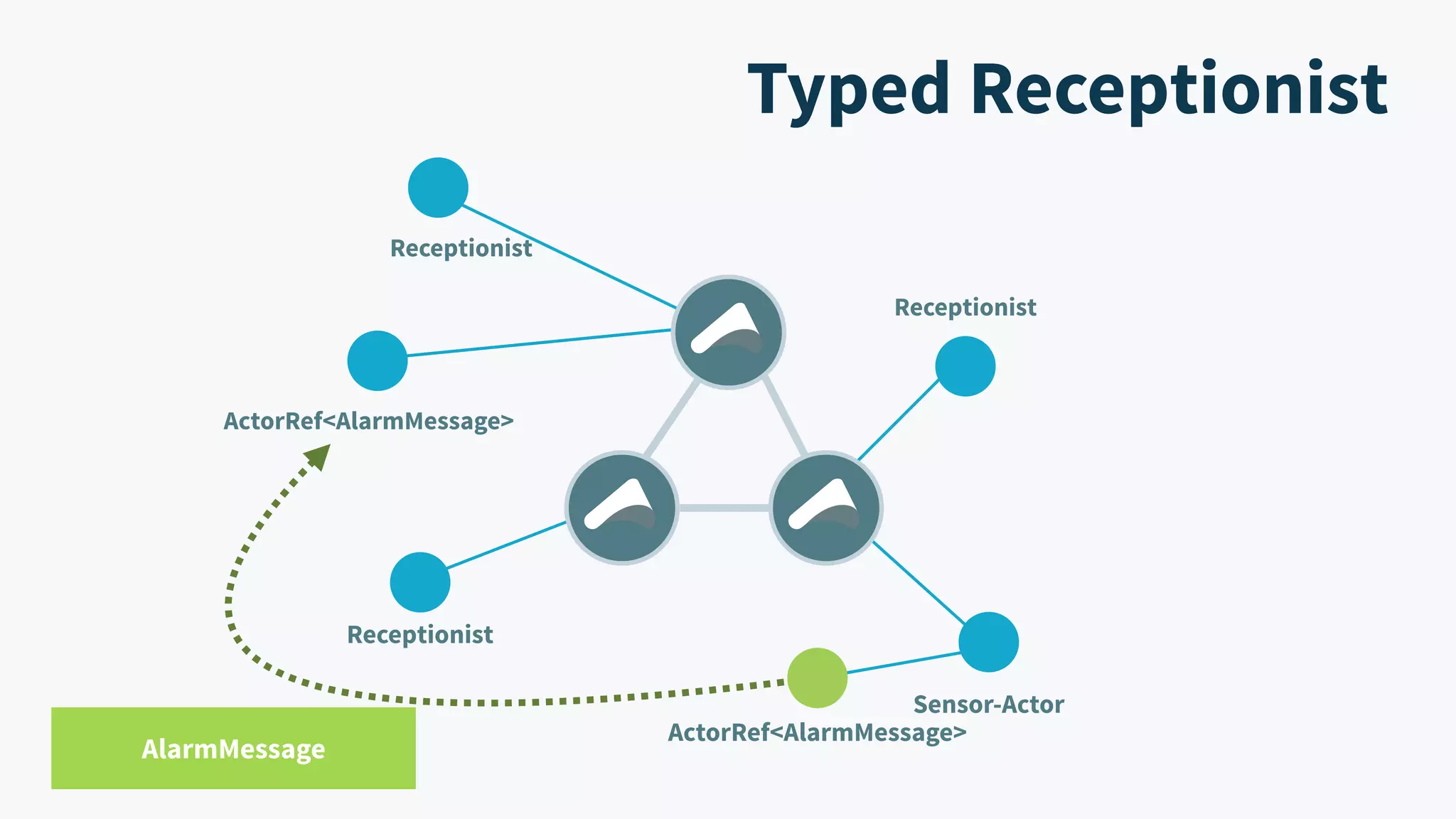
Receptionist
Typed Receptionist
Receptionist
Receptionist
ActorRef<AlarmMessage>
Sensor-Actor
Subscribe(key, actorRef)
Receptionist
Typed Receptionist
Receptionist
Receptionist
Register(Key<AlarmMessage>,
ActorRef<AlarmMessage>)
ActorRef<AlarmMessage>
Sensor-Actor
Receptionist
Typed Receptionist
Receptionist
Receptionist
ActorRef[AlarmMessage]
Sensor-Actor
Listing(key, actorRefs)
Receptionist
Typed Receptionist
Receptionist
Receptionist
ActorRef<AlarmMessage>
Sensor-Actor
ActorRef<AlarmMessage>
AlarmMessage
Distributed Burglar Alarm
• we can have any number of
nodes
• a sensor on any node can
report activity to the alarm
Example
DYI
Distributed
static final ServiceKey<ActivityEvent> serviceKey =
ServiceKey.create(ActivityEvent.class, "alarm");
interface AlarmMessage extends Serializable {}
static class EnableAlarm implements AlarmMessage {
public final String pinCode;
public EnableAlarm(String pinCode) {
this.pinCode = pinCode;
}
}
static class DisableAlarm implements AlarmMessage {
public final String pinCode;
public DisableAlarm(String pinCode) {
this.pinCode = pinCode;
}
}
static class ActivityEvent implements AlarmMessage { }
static final ServiceKey<ActivityEvent> serviceKey =
ServiceKey.create(ActivityEvent.class, "alarm");
interface AlarmMessage extends Serializable {}
static class EnableAlarm implements AlarmMessage {
public final String pinCode;
public EnableAlarm(String pinCode) {
this.pinCode = pinCode;
}
}
static class DisableAlarm implements AlarmMessage {
public final String pinCode;
public DisableAlarm(String pinCode) {
this.pinCode = pinCode;
}
}
static class ActivityEvent implements AlarmMessage { }
public static Behavior<AlarmMessage> alarm(String pinCode) {
return Behaviors.setup((context) -> {
ActorRef<Receptionist.Command> receptionist =
context.getSystem().receptionist();
receptionist.tell(
Receptionist.register(serviceKey, context.getSelf().narrow()));
return enabledAlarm(pinCode);
});
}
public static class SensorBehavior extends AbstractBehavior<TriggerCommand> {
private final ActorContext<TriggerCommand> context;
private Set<ActorRef<ActivityEvent>> alarms = Collections.EMPTY_SET;
public SensorBehavior(ActorContext<TriggerCommand> context) {
this.context = context;
// we need to transform the messages from the receptionist protocol
// into our own protocol:
ActorRef<Receptionist.Listing> adapter = context.messageAdapter(
Receptionist.Listing.class,
(listing) -> new AlarmActorUpdate(listing.getServiceInstances(serviceKey))
);
ActorRef<Receptionist.Command> receptionist = context.getSystem().receptionist();
receptionist.tell(Receptionist.subscribe(serviceKey, adapter));
}
@Override
public Behaviors.Receive<TriggerCommand> createReceive() {
return receiveBuilder()
.onMessage(TriggerSensor.class, this::onTrigger)
.onMessage(AlarmActorUpdate.class, this::onAlarmActorUpdate)
.build();
}
private Behavior<TriggerCommand> onTrigger(TriggerSensor trigger) {
final ActivityEvent activityEvent = new ActivityEvent();
if (alarms.isEmpty()) context.getLog().warning("Saw trigger but no alarms known yet");
alarms.forEach((alarm) ->
alarm.tell(activityEvent)
);
return Behaviors.same();
}
private Behavior<TriggerCommand> onAlarmActorUpdate(AlarmActorUpdate update) {
context.getLog().info("Got alarm actor list update");
alarms = update.alarms;
return Behaviors.same();
}
}
public static class SensorBehavior extends AbstractBehavior<TriggerCommand> {
private final ActorContext<TriggerCommand> context;
private Set<ActorRef<ActivityEvent>> alarms = Collections.EMPTY_SET;
public SensorBehavior(ActorContext<TriggerCommand> context) {
this.context = context;
// we need to transform the messages from the receptionist protocol
// into our own protocol:
ActorRef<Receptionist.Listing> adapter = context.messageAdapter(
Receptionist.Listing.class,
(listing) -> new AlarmActorUpdate(listing.getServiceInstances(serviceKey))
);
ActorRef<Receptionist.Command> receptionist = context.getSystem().receptionist();
receptionist.tell(Receptionist.subscribe(serviceKey, adapter));
}
@Override
public Behaviors.Receive<TriggerCommand> createReceive() {
return receiveBuilder()
.onMessage(TriggerSensor.class, this::onTrigger)
.onMessage(AlarmActorUpdate.class, this::onAlarmActorUpdate)
.build();
}
private Behavior<TriggerCommand> onTrigger(TriggerSensor trigger) {
final ActivityEvent activityEvent = new ActivityEvent();
);
ActorRef<Receptionist.Command> receptionist = context.getSystem().receptionist();
receptionist.tell(Receptionist.subscribe(serviceKey, adapter));
}
@Override
public Behaviors.Receive<TriggerCommand> createReceive() {
return receiveBuilder()
.onMessage(TriggerSensor.class, this::onTrigger)
.onMessage(AlarmActorUpdate.class, this::onAlarmActorUpdate)
.build();
}
private Behavior<TriggerCommand> onTrigger(TriggerSensor trigger) {
final ActivityEvent activityEvent = new ActivityEvent();
if (alarms.isEmpty()) context.getLog().warning("Saw trigger but no alarms known yet");
alarms.forEach((alarm) ->
alarm.tell(activityEvent)
);
return Behaviors.same();
}
private Behavior<TriggerCommand> onAlarmActorUpdate(AlarmActorUpdate update) {
context.getLog().info("Got alarm actor list update");
alarms = update.alarms;
return Behaviors.same();
}
}
public static void main(String[] args) throws Exception {
ActorSystem<AlarmMessage> system1 =
ActorSystem.create(alarm("0000"), "my-cluster");
ActorSystem<TriggerCommand> system2 =
ActorSystem.create(sensorBehavior(), "my-cluster");
ActorSystem<TriggerCommand> system3 =
ActorSystem.create(sensorBehavior(), "my-cluster");
// first join the first node to itself to form a cluster
Cluster node1 = Cluster.get(system1);
node1.manager().tell(Join.create(node1.selfMember().address()));
// then have node 2 and 3 join that cluster
Cluster node2 = Cluster.get(system2);
node2.manager().tell(Join.create(node1.selfMember().address()));
Cluster node3 = Cluster.get(system3);
node3.manager().tell(Join.create(node1.selfMember().address()));
Scanner in = new Scanner(System.in);
while (true) {
// then have node 2 and 3 join that cluster
Cluster node2 = Cluster.get(system2);
node2.manager().tell(Join.create(node1.selfMember().address()));
Cluster node3 = Cluster.get(system3);
node3.manager().tell(Join.create(node1.selfMember().address()));
Scanner in = new Scanner(System.in);
while (true) {
try {
System.out.println("Enter 2 or 3 to trigger activity on that node");
int chosenNode = Integer.parseInt(in.next());
System.out.println("Triggering sensor on node " + chosenNode);
if (chosenNode == 2) system2.tell(new TriggerSensor());
else if (chosenNode == 3) system3.tell(new TriggerSensor());
} catch (Exception ex) {
// we don't care, loop!
}
}
}
Summary
• On message - message another actor, change
state or behavior
• Types gives better guardrails and makes
understanding the system easier
• We can use the same abstraction for local and
distributed
GitHub repo with all samples in this talk
https://bit.ly/2OKRFxD
Akka typed docs
doc.akka.io/docs/akka/2.5/typed/index.html
More resources
blog.akka.io - news and articles
discuss.akka.io - forums
developer.lightbend.com - samples
github.com/akka/akka - sources and getting involved
Further reading
Questions?
GitHub repo with all samples in this talk
https://bit.ly/2OKRFxD
http://akka.io
@apnylle
johan.andren@lightbend.com
Thanks for listening!

Next generation message driven systems with Akka

  • 1.
    Akka Typed Johan Andrén,Akka Team Øredev Malmö, 2018-11-20 Next generation message driven systems with Akka
  • 2.
    Johan Andrén Akka Team StockholmScala User Group @apnylle markatta.com/codemonkey/ johan.andren@lightbend.com
  • 3.
    Build powerful reactive,concurrent, and distributed applications more easily Akka
  • 4.
    What’s in thetoolkit? Actors – simple & high performance concurrency Cluster, Cluster tools – tools for building distributed systems Streams – reactive streams implementation Persistence – CQRS + Event Sourcing for Actors HTTP – fully async streaming HTTP Server Alpakka – Reactive Streams Integrations a’la Camel
  • 5.
    Actors – simple& high performance concurrency Cluster, Cluster tools – tools for building distributed systems Streams – reactive streams implementation Persistence – CQRS + Event Sourcing for Actors HTTP – fully async streaming HTTP Server Alpakka – Reactive Streams Integrations a’la Camel Typed Typed Typed (already type-safe) (already type-safe) (already type-safe) What is coming soon? (already type-safe)
  • 6.
    Languages Complete APIs forboth Java and Scala
  • 7.
    Actor Message Inbox MessageMessage actorRef.tell(message) Akka Actor fundamentals Theonly way for the rest of the application to interact with the actor
  • 8.
    • mutate state(including spawning a child actor) • send messages to other actors • change its behavior Actor Message Inbox MessageMessage An Actor can…
  • 9.
    MVS (Minimum Viable Sample) Na-nana-na na-na na-naSample-time! Also known as “hello world”
  • 10.
    import akka.actor.typed.ActorRef; import akka.actor.typed.ActorSystem; importakka.actor.typed.Behavior; import akka.actor.typed.javadsl.Behaviors; import java.io.IOException; public class Sample1 { static class Hello { public final String who; public Hello(String who) { this.who = who; } } final static Behavior<Hello> greetingBehavior = Behaviors.receive(Hello.class) .onMessage(Hello.class, (context, message) -> { context.getLog().info("Hello {}!", message.who); return Behavior.same(); }).build(); public static void main(String[] args) throws IOException { ActorSystem<Hello> actorSystem = ActorSystem.create(greetingBehavior, "my-system"); ActorRef<Hello> rootActor = actorSystem; rootActor.tell(new Hello("Johan")); rootActor.tell(new Hello(“Øredev audience")); System.out.println("Press that any-key to terminate"); System.in.read(); actorSystem.terminate(); } }
  • 11.
    public class Sample1{ static class Hello { public final String who; public Hello(String who) { this.who = who; } } final static Behavior<Hello> greetingBehavior = Behaviors.receive(Hello.class) .onMessage(Hello.class, (context, message) -> { context.getLog().info("Hello {}!", message.who); return Behavior.same(); }).build(); public static void main(String[] args) throws IOException { ActorSystem<Hello> actorSystem = ActorSystem.create(greetingBehavior, "my-system"); ActorRef<Hello> rootActor = actorSystem; rootActor.tell(new Hello("Johan"));
  • 12.
    public class Sample1{ static class Hello { public final String who; public Hello(String who) { this.who = who; } } final static Behavior<Hello> greetingBehavior = Behaviors.receive(Hello.class) .onMessage(Hello.class, (context, message) -> { context.getLog().info("Hello {}!", message.who); return Behavior.same(); }).build(); public static void main(String[] args) throws IOException { ActorSystem<Hello> actorSystem = ActorSystem.create(greetingBehavior, "my-system"); ActorRef<Hello> rootActor = actorSystem; rootActor.tell(new Hello("Johan"));
  • 13.
    } } final static Behavior<Hello>greetingBehavior = Behaviors.receive(Hello.class) .onMessage(Hello.class, (context, message) -> { context.getLog().info("Hello {}!", message.who); return Behavior.same(); }).build(); public static void main(String[] args) throws IOException { ActorSystem<Hello> actorSystem = ActorSystem.create(greetingBehavior, "my-system"); ActorRef<Hello> rootActor = actorSystem; rootActor.tell(new Hello("Johan")); rootActor.tell(new Hello(“Øredev audience")); System.out.println("Press that any-key to terminate"); System.in.read(); actorSystem.terminate(); } }
  • 14.
    } } final static Behavior<Hello>greetingBehavior = Behaviors.receive(Hello.class) .onMessage(Hello.class, (context, message) -> { context.getLog().info("Hello {}!", message.who); return Behavior.same(); }).build(); public static void main(String[] args) throws IOException { ActorSystem<Hello> actorSystem = ActorSystem.create(greetingBehavior, "my-system"); ActorRef<Hello> rootActor = actorSystem; rootActor.tell(new Hello("Johan")); rootActor.tell(new Hello(“Øredev audience")); System.out.println("Press that any-key to terminate"); System.in.read(); actorSystem.terminate(); } }
  • 15.
    import akka.actor.typed.{ActorRef, ActorSystem,Behavior} import akka.actor.typed.scaladsl.Behaviors import scala.io.StdIn object Sample1 { case class Hello(who: String) val greetingBehavior: Behavior[Hello] = Behaviors.receive { (ctx, hello) => ctx.log.info(s"Hello ${hello.who}!") Behaviors.same } def main(args: Array[String]): Unit = { val system = ActorSystem(greetingBehavior, "my-system") val rootActor: ActorRef[Hello] = system rootActor ! Hello("Johan") rootActor ! Hello(“Øredev audience") println("Press the any-key to terminate") StdIn.readLine() system.terminate() } }
  • 16.
    Let’s do anotherone right away The mystery of the changing state 🔎
  • 17.
    interface Command {} staticclass ChangeGreeting implements Command { public final String newGreeting; public ChangeGreeting(String newGreeting) { this.newGreeting = newGreeting; } } static class Hello implements Command { public final String who; public Hello(String who) { this.who = who; } } public static Behavior<Command> dynamicGreetingBehavior(String greeting) { return Behaviors.receive(Command.class) .onMessage(Hello.class, (context, message) -> { context.getLog().info(greeting + " " + message.who + "!"); return Behavior.same(); }).onMessage(ChangeGreeting.class, (context, changeGreeting) -> dynamicGreetingBehavior(changeGreeting.newGreeting) ).build(); } public static void main(String[] args) throws IOException { var actorSystem = ActorSystem.create(dynamicGreetingBehavior("Hello"), "my-system"); actorSystem.tell(new Hello("Johan")); actorSystem.tell(new ChangeGreeting("Hej")); actorSystem.tell(new Hello(“Øredev audience")); }
  • 18.
    interface Command {} staticclass ChangeGreeting implements Command { public final String newGreeting; public ChangeGreeting(String newGreeting) { this.newGreeting = newGreeting; } } static class Hello implements Command { public final String who; public Hello(String who) { this.who = who; } } public static Behavior<Command> dynamicGreetingBehavior(String greeting) { return Behaviors.receive(Command.class) .onMessage(Hello.class, (context, message) -> { context.getLog().info(greeting + " " + message.who + "!"); return Behavior.same(); }).onMessage(ChangeGreeting.class, (context, changeGreeting) -> dynamicGreetingBehavior(changeGreeting.newGreeting) ).build(); }
  • 19.
    static class Helloimplements Command { public final String who; public Hello(String who) { this.who = who; } } public static Behavior<Command> dynamicGreetingBehavior(String greeting) { return Behaviors.receive(Command.class) .onMessage(Hello.class, (context, message) -> { context.getLog().info(greeting + " " + message.who + "!"); return Behavior.same(); }).onMessage(ChangeGreeting.class, (context, changeGreeting) -> dynamicGreetingBehavior(changeGreeting.newGreeting) ).build(); } public static void main(String[] args) throws IOException { var actorSystem = ActorSystem.create(dynamicGreetingBehavior("Hello"), "my-system"); actorSystem.tell(new Hello("Johan")); actorSystem.tell(new ChangeGreeting("Hej")); actorSystem.tell(new Hello(“Øredev audience")); }
  • 20.
    public static Behavior<Command>dynamicGreetingBehavior(String greeting) { return Behaviors.receive(Command.class) .onMessage(Hello.class, (context, message) -> { context.getLog().info(greeting + " " + message.who + "!"); return Behavior.same(); }).onMessage(ChangeGreeting.class, (context, changeGreeting) -> dynamicGreetingBehavior(changeGreeting.newGreeting) ).build(); } public static void main(String[] args) throws IOException { var actorSystem = ActorSystem.create(dynamicGreetingBehavior("Hello"), "my-system"); actorSystem.tell(new Hello("Johan")); actorSystem.tell(new ChangeGreeting("Hej")); actorSystem.tell(new Hello(“Øredev audience")); }
  • 21.
    sealed trait Command caseclass Hello(who: String) extends Command case class ChangeGreeting(newGreeting: String) extends Command def dynamicGreetingBehavior(greeting: String): Behavior[Command] = Behaviors.receive { (ctx, message) => message match { case Hello(who) => ctx.log.info(s"$greeting ${who}!") Behaviors.same case ChangeGreeting(newGreeting) => dynamicGreetingBehavior(newGreeting) } } def main(args: Array[String]): Unit = { val system = ActorSystem(dynamicGreetingBehavior("Hello"), "my-system") system ! Hello("Johan") system ! ChangeGreeting("Hej") system ! Hello(“Øredev audience") }
  • 22.
    But I don’tlike it (the FP style, that is)
  • 23.
    static class DynamicGreetingBehaviorextends AbstractBehavior<Command> { private final ActorContext<Command> context; private String greeting; public DynamicGreetingBehavior(String initialGreeting, ActorContext<Command> context) { this.context = context; greeting = initialGreeting; } @Override public Receive<Command> createReceive() { return receiveBuilder() .onMessage(Hello.class, this::onHello) .onMessage(ChangeGreeting.class, this::onChangeGreeting) .build(); } private Behavior<Command> onHello(Hello hello) { context.getLog().info(greeting + " " + hello.who + "!"); return Behaviors.same(); } private Behavior<Command> onChangeGreeting(ChangeGreeting changeGreeting) { greeting = changeGreeting.newGreeting; return Behaviors.same(); } }
  • 24.
    static class DynamicGreetingBehaviorextends AbstractBehavior<Command> { private final ActorContext<Command> context; private String greeting; public DynamicGreetingBehavior(String initialGreeting, ActorContext<Command> contex this.context = context; greeting = initialGreeting; } @Override public Receive<Command> createReceive() { return receiveBuilder() .onMessage(Hello.class, this::onHello) .onMessage(ChangeGreeting.class, this::onChangeGreeting) .build(); } private Behavior<Command> onHello(Hello hello) { context.getLog().info(greeting + " " + hello.who + "!"); return Behaviors.same(); }
  • 25.
    static class DynamicGreetingBehaviorextends AbstractBehavior<Command> { private final ActorContext<Command> context; private String greeting; public DynamicGreetingBehavior(String initialGreeting, ActorContext<Command> contex this.context = context; greeting = initialGreeting; } @Override public Receive<Command> createReceive() { return receiveBuilder() .onMessage(Hello.class, this::onHello) .onMessage(ChangeGreeting.class, this::onChangeGreeting) .build(); } private Behavior<Command> onHello(Hello hello) { context.getLog().info(greeting + " " + hello.who + "!"); return Behaviors.same(); }
  • 26.
    private String greeting; publicDynamicGreetingBehavior(String initialGreeting, ActorContext<Command> contex this.context = context; greeting = initialGreeting; } @Override public Receive<Command> createReceive() { return receiveBuilder() .onMessage(Hello.class, this::onHello) .onMessage(ChangeGreeting.class, this::onChangeGreeting) .build(); } private Behavior<Command> onHello(Hello hello) { context.getLog().info(greeting + " " + hello.who + "!"); return Behaviors.same(); } private Behavior<Command> onChangeGreeting(ChangeGreeting changeGreeting) { greeting = changeGreeting.newGreeting; return Behaviors.same(); } }
  • 27.
    public static voidmain(String[] args) { ActorSystem<Command> system = ActorSystem.<Command>create( Behaviors.setup((context) -> new DynamicGreetingBehavior("Hello", context)), "my-system" ); system.tell(new Hello("Johan")); system.tell(new ChangeGreeting(“Hej")); system.tell(new Hello(“Øredev audience")); }
  • 28.
    • Discoverability, howare things related • More compile time type-safety, less runtime debugging
 Types helps productivity! (and results in more reliable systems in production) The need for strong/strict typing “Sending the wrong message to an actor is actually quite uncommon” – Myself
  • 29.
    Burglar Alarm • enabled/disabledwith a pin code • accepts notifications about “activity” • if enabled on activity, sound the alarm “Realistic” Example DIY
  • 30.
    interface AlarmMessage {} staticclass EnableAlarm implements AlarmMessage { public final String pinCode; public EnableAlarm(String pinCode) { this.pinCode = pinCode; } } static class DisableAlarm implements AlarmMessage { public final String pinCode; public DisableAlarm(String pinCode) { this.pinCode = pinCode; } } static class ActivityEvent implements AlarmMessage { }
  • 31.
    public static Behavior<AlarmMessage>enabledAlarm(String pinCode) { return Behaviors.receive(AlarmMessage.class) .onMessage( DisableAlarm.class, // predicate (disable) -> disable.pinCode.equals(pinCode), (context, message) -> { context.getLog().info("Correct pin entered, disabling alarm"); return disabledAlarm(pinCode); } ).onMessage(ActivityEvent.class, (context, activityEvent) -> { context.getLog().warning("EOEOEOEOEOE ALARM ALARM!!!"); return Behaviors.same(); }).build(); }
  • 32.
    public static Behavior<AlarmMessage>disabledAlarm(String pinCode) { return Behaviors.receive(AlarmMessage.class) .onMessage(EnableAlarm.class, // predicate (enable) -> enable.pinCode.equals(pinCode), (context, message) -> { context.getLog().info("Correct pin entered, enabling alarm"); return enabledAlarm(pinCode); } ).build(); }
  • 33.
    public static voidmain(String[] args) { var system = ActorSystem.create(enabledAlarm("0000"), "my-system"); system.tell(new ActivityEvent()); system.tell(new DisableAlarm("1234")); system.tell(new ActivityEvent()); system.tell(new DisableAlarm("0000")); system.tell(new ActivityEvent()); system.tell(new EnableAlarm("0000")); }
  • 34.
    sealed trait AlarmMessage caseclass EnableAlarm(pinCode: String) extends AlarmMessage case class DisableAlarm(pinCode: String) extends AlarmMessage case object ActivityEvent extends AlarmMessage def enabledAlarm(pinCode: String): Behavior[AlarmMessage] = Behaviors.receive { (context, message) => message match { case ActivityEvent => context.log.warning("EOEOEOEOEOE ALARM ALARM!!!") Behaviors.same case DisableAlarm(`pinCode`) => context.log.info("Correct pin entered, disabling alarm"); disabledAlarm(pinCode) case _ => Behaviors.unhandled } } def disabledAlarm(pinCode: String): Behavior[AlarmMessage] = Behaviors.receivePartial { case (context, EnableAlarm(`pinCode`)) => context.log.info("Correct pin entered, enabling alarm") enabledAlarm(pinCode) } def main(args: Array[String]): Unit = { val system = ActorSystem.create(enabledAlarm("0000"), "my-system") system.tell(ActivityEvent) system.tell(DisableAlarm("1234")) system.tell(ActivityEvent) system.tell(DisableAlarm("0000")) system.tell(ActivityEvent) system.tell(EnableAlarm("0000")) system.tell(ActivityEvent) }
  • 35.
    Request-response with otheractors • In untyped actors the sender was auto-magically available • In Akka Typed the recipient of response has to be encoded in message (why?)
  • 36.
    Request-response with otheractors Actor<ProtocolA> Actor<ProtocolB> RequestForB ActorRef<ResponseFromB> ResponseFromBProtocolA ?
  • 37.
    Request-response with otheractors Actor<ProtocolA> Actor<ProtocolB> RequestForB ActorRef<ResponseFromB> ResponseFromBProtocolA ResponseFromB -> ProtocolA ?
  • 38.
    One off withAsk context.ask( ResponseFromB.class, actorB, Timeout.create(Duration.ofSeconds(5)), (ActorRef<ResponseFromB> respondTo) -> new RequestForB(respondTo), (ResponseFromB res, Throwable failure) -> { if (res != null) return new ProtocolAMessage(res); else throw new RuntimeException("Request failed", failure); } );
  • 39.
    Long live theadapter ActorRef<ResponseFromB> adapter = context.messageAdapter( ResponseFromB.class, (responseFromB) -> new ProtocolAMessage(responseFromB) ); actorB.tell(new RequestForB(adapter));
  • 40.
    Keeping parts ofthe protocol to ourselves ActorRef<ProtocolA> actorRef = … ActorRef<SubProtocolA> moreNarrowActorRef = actorRef.narrow(); ProtocolA SubProtocolA SubProtocolA2
  • 41.
    Actor Model vsNetwork Interaction already modelled as immutable messages
 Data travels over the network in packages, changes has to be explicitly sent back. At most once
 Data reaches a node on the other side at most once, but can be lost, already part of model! A recipient of a message can reply directly to sender
 Regardless if there were intermediate recipients of the message Messages not limited to request response
 Messages can flow in either direction when two systems are connected.
  • 42.
  • 43.
  • 44.
    Akka Cluster +Akka Typed ActorSystem ActorSystem ActorSystem
  • 45.
  • 46.
  • 47.
  • 48.
  • 49.
    Distributed Burglar Alarm •we can have any number of nodes • a sensor on any node can report activity to the alarm Example DYI Distributed
  • 50.
    static final ServiceKey<ActivityEvent>serviceKey = ServiceKey.create(ActivityEvent.class, "alarm"); interface AlarmMessage extends Serializable {} static class EnableAlarm implements AlarmMessage { public final String pinCode; public EnableAlarm(String pinCode) { this.pinCode = pinCode; } } static class DisableAlarm implements AlarmMessage { public final String pinCode; public DisableAlarm(String pinCode) { this.pinCode = pinCode; } } static class ActivityEvent implements AlarmMessage { }
  • 51.
    static final ServiceKey<ActivityEvent>serviceKey = ServiceKey.create(ActivityEvent.class, "alarm"); interface AlarmMessage extends Serializable {} static class EnableAlarm implements AlarmMessage { public final String pinCode; public EnableAlarm(String pinCode) { this.pinCode = pinCode; } } static class DisableAlarm implements AlarmMessage { public final String pinCode; public DisableAlarm(String pinCode) { this.pinCode = pinCode; } } static class ActivityEvent implements AlarmMessage { }
  • 52.
    public static Behavior<AlarmMessage>alarm(String pinCode) { return Behaviors.setup((context) -> { ActorRef<Receptionist.Command> receptionist = context.getSystem().receptionist(); receptionist.tell( Receptionist.register(serviceKey, context.getSelf().narrow())); return enabledAlarm(pinCode); }); }
  • 53.
    public static classSensorBehavior extends AbstractBehavior<TriggerCommand> { private final ActorContext<TriggerCommand> context; private Set<ActorRef<ActivityEvent>> alarms = Collections.EMPTY_SET; public SensorBehavior(ActorContext<TriggerCommand> context) { this.context = context; // we need to transform the messages from the receptionist protocol // into our own protocol: ActorRef<Receptionist.Listing> adapter = context.messageAdapter( Receptionist.Listing.class, (listing) -> new AlarmActorUpdate(listing.getServiceInstances(serviceKey)) ); ActorRef<Receptionist.Command> receptionist = context.getSystem().receptionist(); receptionist.tell(Receptionist.subscribe(serviceKey, adapter)); } @Override public Behaviors.Receive<TriggerCommand> createReceive() { return receiveBuilder() .onMessage(TriggerSensor.class, this::onTrigger) .onMessage(AlarmActorUpdate.class, this::onAlarmActorUpdate) .build(); } private Behavior<TriggerCommand> onTrigger(TriggerSensor trigger) { final ActivityEvent activityEvent = new ActivityEvent(); if (alarms.isEmpty()) context.getLog().warning("Saw trigger but no alarms known yet"); alarms.forEach((alarm) -> alarm.tell(activityEvent) ); return Behaviors.same(); } private Behavior<TriggerCommand> onAlarmActorUpdate(AlarmActorUpdate update) { context.getLog().info("Got alarm actor list update"); alarms = update.alarms; return Behaviors.same(); } }
  • 54.
    public static classSensorBehavior extends AbstractBehavior<TriggerCommand> { private final ActorContext<TriggerCommand> context; private Set<ActorRef<ActivityEvent>> alarms = Collections.EMPTY_SET; public SensorBehavior(ActorContext<TriggerCommand> context) { this.context = context; // we need to transform the messages from the receptionist protocol // into our own protocol: ActorRef<Receptionist.Listing> adapter = context.messageAdapter( Receptionist.Listing.class, (listing) -> new AlarmActorUpdate(listing.getServiceInstances(serviceKey)) ); ActorRef<Receptionist.Command> receptionist = context.getSystem().receptionist(); receptionist.tell(Receptionist.subscribe(serviceKey, adapter)); } @Override public Behaviors.Receive<TriggerCommand> createReceive() { return receiveBuilder() .onMessage(TriggerSensor.class, this::onTrigger) .onMessage(AlarmActorUpdate.class, this::onAlarmActorUpdate) .build(); } private Behavior<TriggerCommand> onTrigger(TriggerSensor trigger) { final ActivityEvent activityEvent = new ActivityEvent();
  • 55.
    ); ActorRef<Receptionist.Command> receptionist =context.getSystem().receptionist(); receptionist.tell(Receptionist.subscribe(serviceKey, adapter)); } @Override public Behaviors.Receive<TriggerCommand> createReceive() { return receiveBuilder() .onMessage(TriggerSensor.class, this::onTrigger) .onMessage(AlarmActorUpdate.class, this::onAlarmActorUpdate) .build(); } private Behavior<TriggerCommand> onTrigger(TriggerSensor trigger) { final ActivityEvent activityEvent = new ActivityEvent(); if (alarms.isEmpty()) context.getLog().warning("Saw trigger but no alarms known yet"); alarms.forEach((alarm) -> alarm.tell(activityEvent) ); return Behaviors.same(); } private Behavior<TriggerCommand> onAlarmActorUpdate(AlarmActorUpdate update) { context.getLog().info("Got alarm actor list update"); alarms = update.alarms; return Behaviors.same(); } }
  • 56.
    public static voidmain(String[] args) throws Exception { ActorSystem<AlarmMessage> system1 = ActorSystem.create(alarm("0000"), "my-cluster"); ActorSystem<TriggerCommand> system2 = ActorSystem.create(sensorBehavior(), "my-cluster"); ActorSystem<TriggerCommand> system3 = ActorSystem.create(sensorBehavior(), "my-cluster"); // first join the first node to itself to form a cluster Cluster node1 = Cluster.get(system1); node1.manager().tell(Join.create(node1.selfMember().address())); // then have node 2 and 3 join that cluster Cluster node2 = Cluster.get(system2); node2.manager().tell(Join.create(node1.selfMember().address())); Cluster node3 = Cluster.get(system3); node3.manager().tell(Join.create(node1.selfMember().address())); Scanner in = new Scanner(System.in); while (true) {
  • 57.
    // then havenode 2 and 3 join that cluster Cluster node2 = Cluster.get(system2); node2.manager().tell(Join.create(node1.selfMember().address())); Cluster node3 = Cluster.get(system3); node3.manager().tell(Join.create(node1.selfMember().address())); Scanner in = new Scanner(System.in); while (true) { try { System.out.println("Enter 2 or 3 to trigger activity on that node"); int chosenNode = Integer.parseInt(in.next()); System.out.println("Triggering sensor on node " + chosenNode); if (chosenNode == 2) system2.tell(new TriggerSensor()); else if (chosenNode == 3) system3.tell(new TriggerSensor()); } catch (Exception ex) { // we don't care, loop! } } }
  • 58.
    Summary • On message- message another actor, change state or behavior • Types gives better guardrails and makes understanding the system easier • We can use the same abstraction for local and distributed
  • 59.
    GitHub repo withall samples in this talk https://bit.ly/2OKRFxD Akka typed docs doc.akka.io/docs/akka/2.5/typed/index.html More resources blog.akka.io - news and articles discuss.akka.io - forums developer.lightbend.com - samples github.com/akka/akka - sources and getting involved Further reading
  • 60.
    Questions? GitHub repo withall samples in this talk https://bit.ly/2OKRFxD
  • 61.