Download as PDF, PPTX

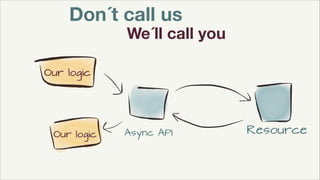

![”Callback Hell”?
1 GMaps.geocode({!
2
address: fromAddress,!
3
callback: function( results, status ) {!
4
if ( status == "OK" ) {!
5
fromLatLng = results[0].geometry.location;!
6
GMaps.geocode({!
7
address: toAddress,!
8
callback: function( results, status ) {!
9
if ( status == "OK" ) {!
10
toLatLng = results[0].geometry.location;!
11
map.getRoutes({!
12
origin: [ fromLatLng.lat(), fromLatLng.lng() ],!
13
destination: [ toLatLng.lat(), toLatLng.lng() ],!
14
travelMode: "driving",!
15
unitSystem: "imperial",!
16
callback: function( e ){!
17
console.log("ANNNND FINALLY here's the directions..." );!
18
// do something with e!
19
}!
20
});!
21
}!
22
}!
23
});!
24
}!
25
}!](https://image.slidesharecdn.com/async-reactdontwait-pingconf-140131041608-phpapp02/85/Async-react-don-t-wait-PingConf-12-320.jpg)

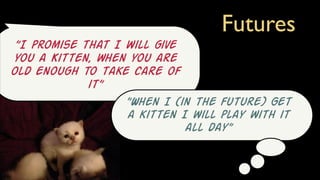
![complete(kitten)
failure(Reason)
Future[Kitten]
Promise[Kitten]
Side effect!!!
onComplete(play)
onFailure(cry)](https://image.slidesharecdn.com/async-reactdontwait-pingconf-140131041608-phpapp02/85/Async-react-don-t-wait-PingConf-16-320.jpg)
![Transforming the future
Future[B]
Future[A]
a
map(f: A => B)
f(a)
b](https://image.slidesharecdn.com/async-reactdontwait-pingconf-140131041608-phpapp02/85/Async-react-don-t-wait-PingConf-17-320.jpg)
![If the future isn’t that bright
Future[A]
Future[B]
Map](https://image.slidesharecdn.com/async-reactdontwait-pingconf-140131041608-phpapp02/85/Async-react-don-t-wait-PingConf-18-320.jpg)
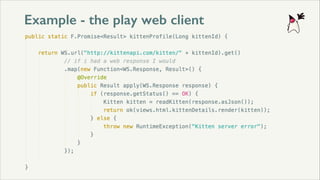
![Example - the play web client
: Future[SimpleResult]](https://image.slidesharecdn.com/async-reactdontwait-pingconf-140131041608-phpapp02/85/Async-react-don-t-wait-PingConf-19-320.jpg)
![Chaining futures
Future[A]
WS Response => model Object
map(A => B)
Future[B]
model Object => HTML
map(B => C)
Future[C]](https://image.slidesharecdn.com/async-reactdontwait-pingconf-140131041608-phpapp02/85/Async-react-don-t-wait-PingConf-21-320.jpg)
![Even more flexibility
flatMap(A => Future[B])
Future[B]
Future[A]
List[Future[A]]
Future[List[A]]
Future.sequence](https://image.slidesharecdn.com/async-reactdontwait-pingconf-140131041608-phpapp02/85/Async-react-don-t-wait-PingConf-22-320.jpg)
![Even more even more flexibility
List[Future[A]]
Future[A]
Future.firstCompletedOf
List[Future[A]]
Future.fold
Future[B]](https://image.slidesharecdn.com/async-reactdontwait-pingconf-140131041608-phpapp02/85/Async-react-don-t-wait-PingConf-23-320.jpg)
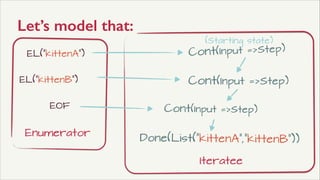
![Let’s model that:
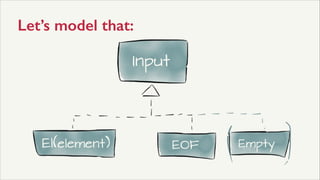
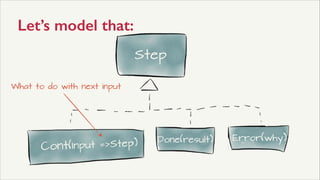
Enumerator[E]
E: The type of the chunks
Iteratee[E, R]](https://image.slidesharecdn.com/async-reactdontwait-pingconf-140131041608-phpapp02/85/Async-react-don-t-wait-PingConf-40-320.jpg)
![Even moar:
Enumeratee[A, B]
Enumerator[A]
Iteratee[B, R]](https://image.slidesharecdn.com/async-reactdontwait-pingconf-140131041608-phpapp02/85/Async-react-don-t-wait-PingConf-41-320.jpg)
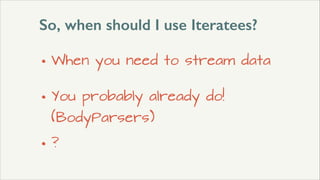
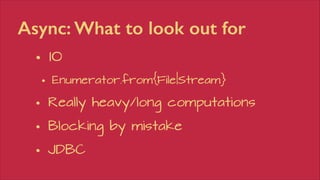
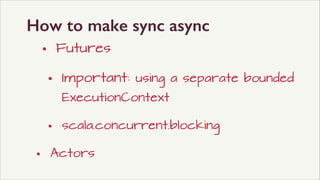
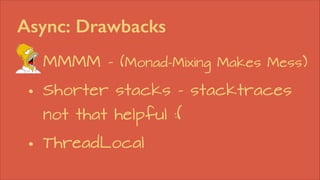
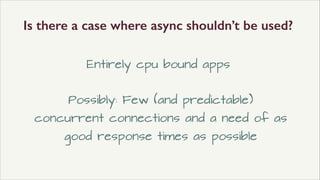
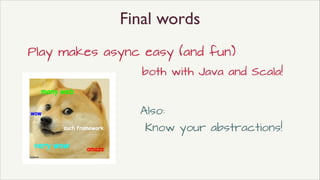


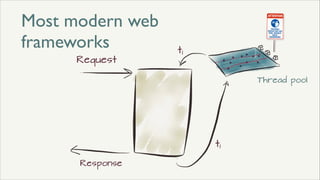
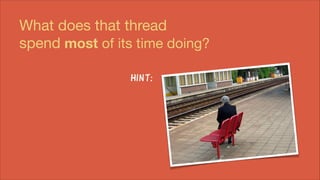
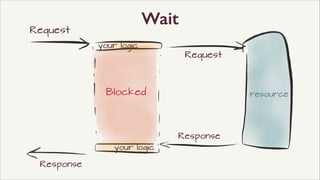
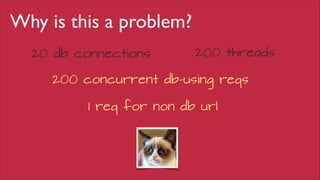
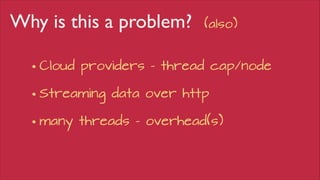
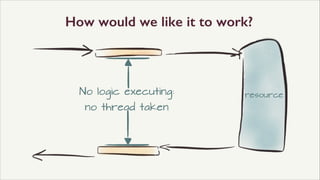
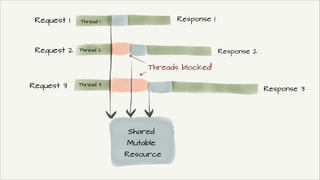
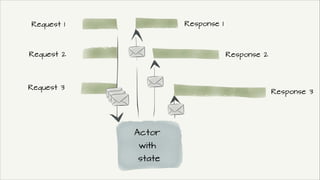
The document discusses asynchronous programming in web frameworks, highlighting the inefficiencies of traditional thread-based handling of requests. It introduces concepts like futures, promises, and actors to manage asynchronous operations effectively while addressing potential pitfalls like callback hell. The author emphasizes the benefits of non-blocking operations for improved scalability and resource management in modern applications.


![[Tokyo Scala User Group] Akka Streams & Reactive Streams (0.7)](https://cdn.slidesharecdn.com/ss_thumbnails/2014-akka-streams-tokyo-140914201812-phpapp01-thumbnail.jpg?width=640&height=640&fit=bounds)


