





hAkking
TIPS 'N TRICKS12th of July 2016
HANDS UP
Akka Actor IS A
POWER TOOL1
1
power tools are fun, but fun can be dangerous!
WARMUP QUIZ
WHATS WRONG
WITH THIS CODE
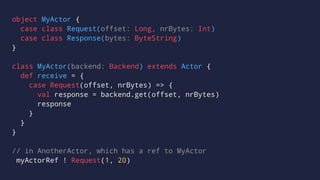
object MyActor {
case class Request(offset: Long, nrBytes: Int)
case class Response(bytes: ByteString)
}
class MyActor(backend: Backend) extends Actor {
def receive = {
case Request(offset, nrBytes) => {
val response = backend.get(offset, nrBytes)
response
}
}
}
// in AnotherActor, which has a ref to MyActor
myActorRef ! Request(1, 20)
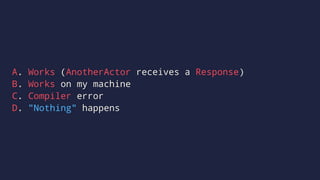
A. Works (AnotherActor receives a Response)
B. Works on my machine
C. Compiler error
D. "Nothing" happens
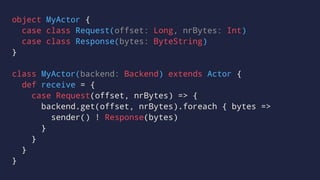
object MyActor {
case class Request(offset: Long, nrBytes: Int)
case class Response(bytes: ByteString)
}
class MyActor(backend: Backend) extends Actor {
def receive = {
case Request(offset, nrBytes) => {
backend.get(offset, nrBytes).foreach { bytes =>
sender() ! Response(bytes)
}
}
}
}
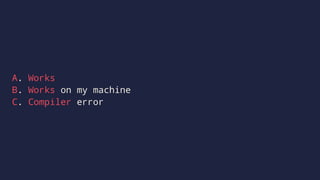
A. Works
B. Works on my machine
C. Compiler error
trait Backend {
def get(offset: Long, nrBytes: Int): Future[ByteString]
}
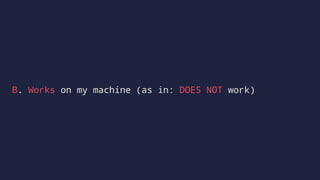
B. Works on my machine (as in: DOES NOT work)
close over sender
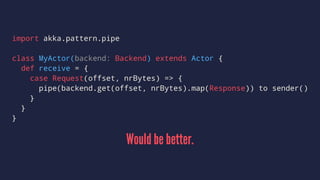
import akka.pattern.pipe
class MyActor(backend: Backend) extends Actor {
def receive = {
case Request(offset, nrBytes) => {
pipe(backend.get(offset, nrBytes).map(Response)) to sender()
}
}
}
Would be better.
ACTOR crashes.
HOW FAST
DOES IT RESTART?
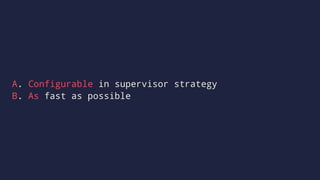
A. Configurable in supervisor strategy
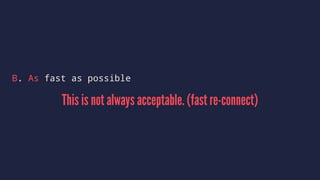
B. As fast as possible
This is not always acceptable. (fast re-connect)
WHAT HAPPENS IF YOU WATCH AN ACTOR
THAT'S ALREADY DEAD?
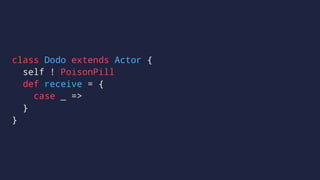
class Dodo extends Actor {
self ! PoisonPill
def receive = {
case _ =>
}
}
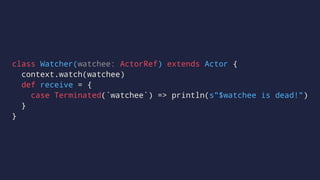
class Watcher(watchee: ActorRef) extends Actor {
context.watch(watchee)
def receive = {
case Terminated(`watchee`) => println(s"$watchee is dead!")
}
}
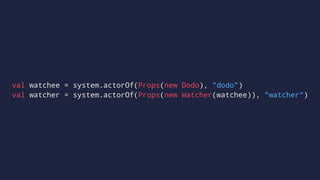
val watchee = system.actorOf(Props(new Dodo), "dodo")
val watcher = system.actorOf(Props(new Watcher(watchee)), "watcher")
A. DeathPactException
B. Prints to console
C. DeadLetters
D. Works on my machine
E. "Nothing" happens
B. Prints to console. (Watcher receives Terminated)
Which is great!
END WARMUP
QUIZ
(Semi-random)
TIPS 'N TRICKS
STRUCTURAL
DEFINE MESSAGES IN companion
DO NOT import Companion._
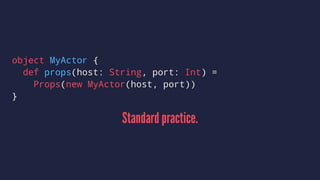
CREATE ACTOR FROM COMPANION 3
3
Standard practice.
object MyActor {
def props(host: String, port: Int) =
Props(new MyActor(host, port))
}
Standard practice.
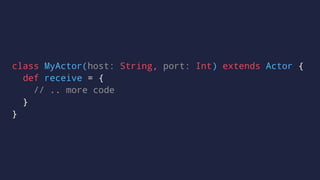
WHAT ABOUT THE ACTOR'S name?
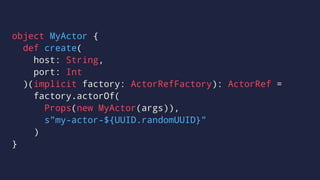
ONE CHILD ACTOR: ONE NAME
MANY CHILD ACTORS: UNIQUE NAMES
class MyActor(host: String, port: Int) extends Actor {
def receive = {
// .. more code
}
}
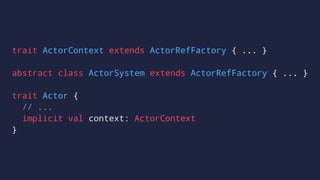
trait ActorContext extends ActorRefFactory { ... }
abstract class ActorSystem extends ActorRefFactory { ... }
trait Actor {
// ...
implicit val context: ActorContext
}
object MyActor {
def create(
host: String,
port: Int
)(implicit factory: ActorRefFactory): ActorRef =
factory.actorOf(
Props(new MyActor(args)),
s"my-actor-${UUID.randomUUID}"
)
}
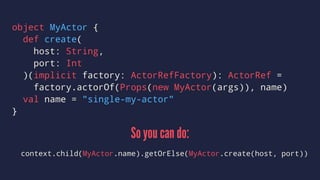
object MyActor {
def create(
host: String,
port: Int
)(implicit factory: ActorRefFactory): ActorRef =
factory.actorOf(Props(new MyActor(args)), name)
val name = "single-my-actor"
}
So you can do:
context.child(MyActor.name).getOrElse(MyActor.create(host, port))
A TERMINATOR
PREVENTS YOUR APP FROM
BECOMING A zombie
RULE 'EM' ALL: Application Supervisor
KILL 'EM ALL: Terminator
object MyApp {
def main(args: Array[String]): Unit = {
val system = ActorSystem("my-app")
val _ = Terminator.supervise(
system,
MyApplicationSupervisor.create()
)
}
}
create has a second parameter list that has a factory parameter. So
what is passed in here is a ActorRefFactory => ActorRef
TERMINATOR
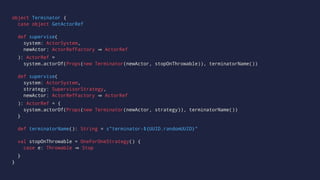
object Terminator {
case object GetActorRef
def supervise(
system: ActorSystem,
newActor: ActorRefFactory ActorRef
): ActorRef =
system.actorOf(Props(new Terminator(newActor, stopOnThrowable)), terminatorName())
def supervise(
system: ActorSystem,
strategy: SupervisorStrategy,
newActor: ActorRefFactory ActorRef
): ActorRef = {
system.actorOf(Props(new Terminator(newActor, strategy)), terminatorName())
}
def terminatorName(): String = s"terminator-${UUID.randomUUID}"
val stopOnThrowable = OneForOneStrategy() {
case e: Throwable Stop
}
}
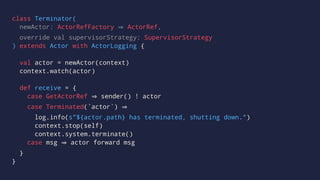
class Terminator(
newActor: ActorRefFactory ActorRef,
override val supervisorStrategy: SupervisorStrategy
) extends Actor with ActorLogging {
val actor = newActor(context)
context.watch(actor)
def receive = {
case GetActorRef sender() ! actor
case Terminated(`actor`)
log.info(s"${actor.path} has terminated, shutting down.")
context.stop(self)
context.system.terminate()
case msg actor forward msg
}
}
Application
Supervisor 2
2
The top level application actor
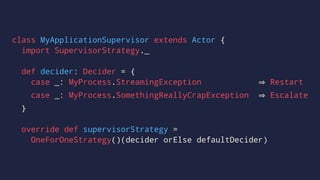
class MyApplicationSupervisor extends Actor {
import SupervisorStrategy._
def decider: Decider = {
case _: MyProcess.StreamingException Restart
case _: MyProcess.SomethingReallyCrapException Escalate
}
override def supervisorStrategy =
OneForOneStrategy()(decider orElse defaultDecider)
MESSAGING
DEBUGGING ASKIF YOU NEED MORE CONTEXT THAN JUST THE MESSAGE TYPE
trait RequestSupport {
def request[T: ClassTag](
actor: ActorRef,
req: Any,
printRequest: Any String = _.toString
)(implicit ec: ExecutionContext, timeout: Timeout): Future[T] = {
val err = s"Request ${printRequest(req)} to ${actor.path} timed out."
actor.ask(req).mapTo[T].recoverWith {
case cause: AskTimeoutException
Future.failed(new RequestTimeoutException(req, err, cause))
}
}
}
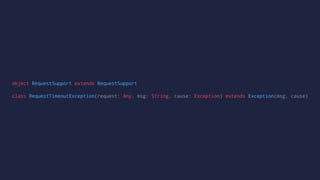
object RequestSupport extends RequestSupport
class RequestTimeoutException(request: Any, msg: String, cause: Exception) extends Exception(msg, cause)
val f: Future[Response] = request[Response](actor, Request(something))
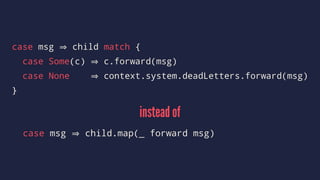
SENDING TO AN Option[ActorRef]?
DON'T blackhole
case msg child match {
case Some(c) c.forward(msg)
case None context.system.deadLetters.forward(msg)
}
instead of
case msg child.map(_ forward msg)
RESILIENCE
ASYNC RESOURCE
QUIZ
AGAIN, WHAT IS WRONG
WITH THE code
class MyActor(uri: String) extends Actor {
self ! Init
def receive = init
def init: Receive = {
case Init =>
pipe(connect(uri)) to self
case Connected(connection) =>
context.become(connected(connection))
}
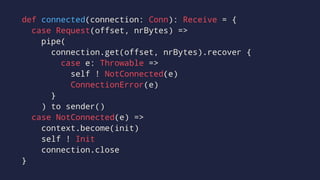
def connected(connection: Conn): Receive = {
case Request(offset, nrBytes) =>
pipe(connection.get(offset, nrBytes)) to sender()
}
// implementation left out
def connect(uri: String): Future[Connected] = ...
}
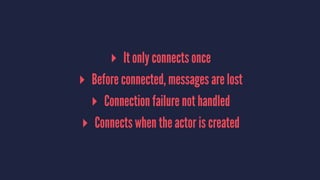
▸ It only connects once
▸ Before connected, messages are lost
▸ Connection failure not handled
▸ Connects when the actor is created
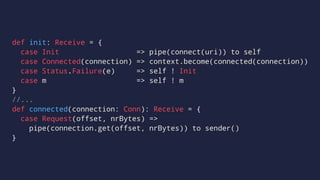
def init: Receive = {
case Init => pipe(connect(uri)) to self
case Connected(connection) => context.become(connected(connection))
case Status.Failure(e) => self ! Init
case m => self ! m
}
//...
def connected(connection: Conn): Receive = {
case Request(offset, nrBytes) =>
pipe(connection.get(offset, nrBytes)) to sender()
}
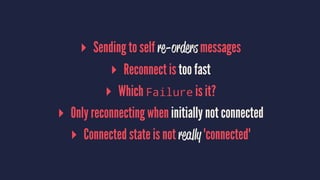
▸ Sending to self re-orders messages
▸ Reconnect is too fast
▸ Which Failure is it?
▸ Only reconnecting when initially not connected
▸ Connected state is not really 'connected'
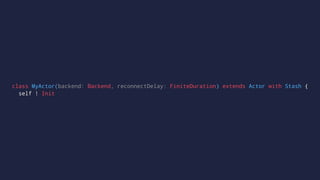
class MyActor(backend: Backend, reconnectDelay: FiniteDuration) extends Actor with Stash {
self ! Init
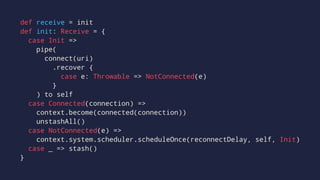
def receive = init
def init: Receive = {
case Init =>
pipe(
connect(uri)
.recover {
case e: Throwable => NotConnected(e)
}
) to self
case Connected(connection) =>
context.become(connected(connection))
unstashAll()
case NotConnected(e) =>
context.system.scheduler.scheduleOnce(reconnectDelay, self, Init)
case _ => stash()
}
def connected(connection: Conn): Receive = {
case Request(offset, nrBytes) =>
pipe(
connection.get(offset, nrBytes).recover {
case e: Throwable =>
self ! NotConnected(e)
ConnectionError(e)
}
) to sender()
case NotConnected(e) =>
context.become(init)
self ! Init
connection.close
}
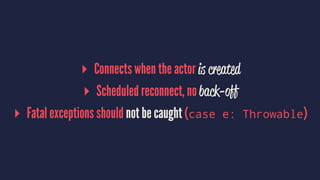
▸ Connects when the actor is created
▸ Scheduled reconnect, no back-off
▸ Fatal exceptions should not be caught (case e: Throwable)
BACK-OFF
supervision
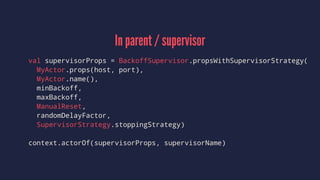
In parent / supervisor
val supervisorProps = BackoffSupervisor.propsWithSupervisorStrategy(
MyActor.props(host, port),
MyActor.name(),
minBackoff,
maxBackoff,
ManualReset,
randomDelayFactor,
SupervisorStrategy.stoppingStrategy)
context.actorOf(supervisorProps, supervisorName)
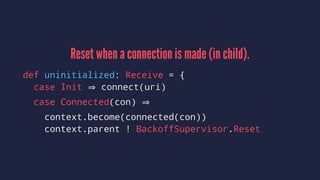
Reset when a connection is made (in child).
def uninitialized: Receive = {
case Init connect(uri)
case Connected(con)
context.become(connected(con))
context.parent ! BackoffSupervisor.Reset
CONNECT ONFIRST MESSAGE RECEIVED
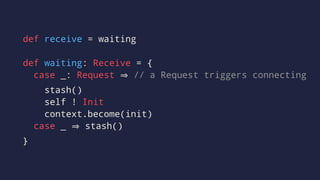
def receive = waiting
def waiting: Receive = {
case _: Request // a Request triggers connecting
stash()
self ! Init
context.become(init)
case _ stash()
}
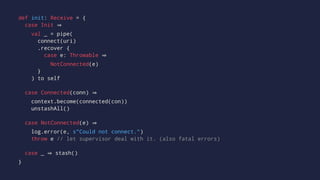
def init: Receive = {
case Init
val _ = pipe(
connect(uri)
.recover {
case e: Throwable
NotConnected(e)
}
) to self
case Connected(conn)
context.become(connected(con))
unstashAll()
case NotConnected(e)
log.error(e, s"Could not connect.")
throw e // let supervisor deal with it. (also fatal errors)
case _ stash()
}
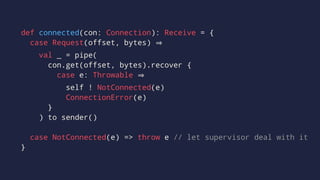
def connected(con: Connection): Receive = {
case Request(offset, bytes)
val _ = pipe(
con.get(offset, bytes).recover {
case e: Throwable
self ! NotConnected(e)
ConnectionError(e)
}
) to sender()
case NotConnected(e) => throw e // let supervisor deal with it
}
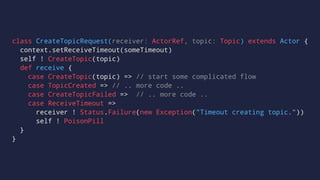
SPAWNED ACTORSReceiveTimeout and PoisonPill
ACTOR FOR A 'SESSION'
ENCOUNTERS ERROR
WAITS FOR A CLOSE
CLOSE MIGHT NOT ARRIVE
class CreateTopicRequest(receiver: ActorRef, topic: Topic) extends Actor {
context.setReceiveTimeout(someTimeout)
self ! CreateTopic(topic)
def receive {
case CreateTopic(topic) => // start some complicated flow
case TopicCreated => // .. more code ..
case CreateTopicFailed => // .. more code ..
case ReceiveTimeout =>
receiver ! Status.Failure(new Exception("Timeout creating topic."))
self ! PoisonPill
}
}
CAPTURE sender
IN PROTOCOL MESSAGES
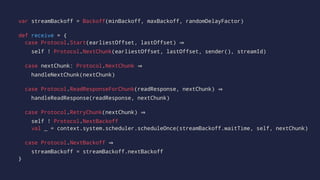
var streamBackoff = Backoff(minBackoff, maxBackoff, randomDelayFactor)
def receive = {
case Protocol.Start(earliestOffset, lastOffset)
self ! Protocol.NextChunk(earliestOffset, lastOffset, sender(), streamId)
case nextChunk: Protocol.NextChunk
handleNextChunk(nextChunk)
case Protocol.ReadResponseForChunk(readResponse, nextChunk)
handleReadResponse(readResponse, nextChunk)
case Protocol.RetryChunk(nextChunk)
self ! Protocol.NextBackoff
val _ = context.system.scheduler.scheduleOnce(streamBackoff.waitTime, self, nextChunk)
case Protocol.NextBackoff
streamBackoff = streamBackoff.nextBackoff
}
def transcoding(streamer: ActorRef): Receive = {
// lots of code
case _: NoData[K, V]
val cancellable = context.system.scheduler.schedule(0 seconds, 1 second, responder, WaitMessage)
context.become(waitingForData(streamer, cancellable))
case ev: ConnectionClosed
context.become(closing)
context.setReceiveTimeout(duration)
}
def waitingForData(streamer: ActorRef, cancellable: Cancellable): Receive = {
case _: NoData[K, V] // nothing to do, scheduler is still sending waits.
case m
stash()
cancellable.cancel()
context.become((transcoding(streamer)))
unstashAll()
}
def closing: Receive = {
case StreamClosed | StreamRequestEnd self ! PoisonPill
case ReceiveTimeout self ! PoisonPill
case _
}
RECAP
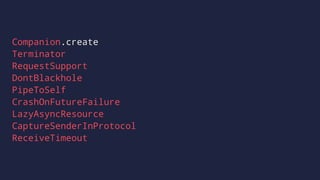
Companion.create
Terminator
RequestSupport
DontBlackhole
PipeToSelf
CrashOnFutureFailure
LazyAsyncResource
CaptureSenderInProtocol
ReceiveTimeout
ENDhttp://manning.com/roestenburg
DISCOUNT CODE 39ROESTENBURG
Akka tips

Akka tips

  • 1.
  • 2.
  • 3.
    Akka Actor ISA POWER TOOL1 1 power tools are fun, but fun can be dangerous!
  • 4.
  • 5.
  • 6.
    object MyActor { caseclass Request(offset: Long, nrBytes: Int) case class Response(bytes: ByteString) } class MyActor(backend: Backend) extends Actor { def receive = { case Request(offset, nrBytes) => { val response = backend.get(offset, nrBytes) response } } } // in AnotherActor, which has a ref to MyActor myActorRef ! Request(1, 20)
  • 7.
    A. Works (AnotherActorreceives a Response) B. Works on my machine C. Compiler error D. "Nothing" happens
  • 8.
  • 9.
    object MyActor { caseclass Request(offset: Long, nrBytes: Int) case class Response(bytes: ByteString) } class MyActor(backend: Backend) extends Actor { def receive = { case Request(offset, nrBytes) => { backend.get(offset, nrBytes).foreach { bytes => sender() ! Response(bytes) } } } }
  • 10.
    A. Works B. Workson my machine C. Compiler error
  • 11.
    trait Backend { defget(offset: Long, nrBytes: Int): Future[ByteString] }
  • 12.
    B. Works onmy machine (as in: DOES NOT work)
  • 13.
  • 14.
    import akka.pattern.pipe class MyActor(backend:Backend) extends Actor { def receive = { case Request(offset, nrBytes) => { pipe(backend.get(offset, nrBytes).map(Response)) to sender() } } } Would be better.
  • 15.
  • 16.
    A. Configurable insupervisor strategy B. As fast as possible
  • 17.
    B. As fastas possible This is not always acceptable. (fast re-connect)
  • 18.
    WHAT HAPPENS IFYOU WATCH AN ACTOR THAT'S ALREADY DEAD?
  • 19.
    class Dodo extendsActor { self ! PoisonPill def receive = { case _ => } }
  • 20.
    class Watcher(watchee: ActorRef)extends Actor { context.watch(watchee) def receive = { case Terminated(`watchee`) => println(s"$watchee is dead!") } }
  • 21.
    val watchee =system.actorOf(Props(new Dodo), "dodo") val watcher = system.actorOf(Props(new Watcher(watchee)), "watcher")
  • 22.
    A. DeathPactException B. Printsto console C. DeadLetters D. Works on my machine E. "Nothing" happens
  • 23.
    B. Prints toconsole. (Watcher receives Terminated) Which is great!
  • 24.
  • 25.
  • 26.
  • 27.
    DEFINE MESSAGES INcompanion DO NOT import Companion._
  • 28.
    CREATE ACTOR FROMCOMPANION 3 3 Standard practice.
  • 29.
    object MyActor { defprops(host: String, port: Int) = Props(new MyActor(host, port)) } Standard practice.
  • 30.
    WHAT ABOUT THEACTOR'S name?
  • 31.
    ONE CHILD ACTOR:ONE NAME MANY CHILD ACTORS: UNIQUE NAMES
  • 32.
    class MyActor(host: String,port: Int) extends Actor { def receive = { // .. more code } }
  • 33.
    trait ActorContext extendsActorRefFactory { ... } abstract class ActorSystem extends ActorRefFactory { ... } trait Actor { // ... implicit val context: ActorContext }
  • 34.
    object MyActor { defcreate( host: String, port: Int )(implicit factory: ActorRefFactory): ActorRef = factory.actorOf( Props(new MyActor(args)), s"my-actor-${UUID.randomUUID}" ) }
  • 35.
    object MyActor { defcreate( host: String, port: Int )(implicit factory: ActorRefFactory): ActorRef = factory.actorOf(Props(new MyActor(args)), name) val name = "single-my-actor" } So you can do: context.child(MyActor.name).getOrElse(MyActor.create(host, port))
  • 36.
    A TERMINATOR PREVENTS YOURAPP FROM BECOMING A zombie
  • 37.
    RULE 'EM' ALL:Application Supervisor KILL 'EM ALL: Terminator
  • 38.
    object MyApp { defmain(args: Array[String]): Unit = { val system = ActorSystem("my-app") val _ = Terminator.supervise( system, MyApplicationSupervisor.create() ) } } create has a second parameter list that has a factory parameter. So what is passed in here is a ActorRefFactory => ActorRef
  • 39.
  • 40.
    object Terminator { caseobject GetActorRef def supervise( system: ActorSystem, newActor: ActorRefFactory ActorRef ): ActorRef = system.actorOf(Props(new Terminator(newActor, stopOnThrowable)), terminatorName()) def supervise( system: ActorSystem, strategy: SupervisorStrategy, newActor: ActorRefFactory ActorRef ): ActorRef = { system.actorOf(Props(new Terminator(newActor, strategy)), terminatorName()) } def terminatorName(): String = s"terminator-${UUID.randomUUID}" val stopOnThrowable = OneForOneStrategy() { case e: Throwable Stop } }
  • 41.
    class Terminator( newActor: ActorRefFactoryActorRef, override val supervisorStrategy: SupervisorStrategy ) extends Actor with ActorLogging { val actor = newActor(context) context.watch(actor) def receive = { case GetActorRef sender() ! actor case Terminated(`actor`) log.info(s"${actor.path} has terminated, shutting down.") context.stop(self) context.system.terminate() case msg actor forward msg } }
  • 42.
    Application Supervisor 2 2 The toplevel application actor
  • 43.
    class MyApplicationSupervisor extendsActor { import SupervisorStrategy._ def decider: Decider = { case _: MyProcess.StreamingException Restart case _: MyProcess.SomethingReallyCrapException Escalate } override def supervisorStrategy = OneForOneStrategy()(decider orElse defaultDecider)
  • 44.
  • 45.
    DEBUGGING ASKIF YOUNEED MORE CONTEXT THAN JUST THE MESSAGE TYPE
  • 46.
    trait RequestSupport { defrequest[T: ClassTag]( actor: ActorRef, req: Any, printRequest: Any String = _.toString )(implicit ec: ExecutionContext, timeout: Timeout): Future[T] = { val err = s"Request ${printRequest(req)} to ${actor.path} timed out." actor.ask(req).mapTo[T].recoverWith { case cause: AskTimeoutException Future.failed(new RequestTimeoutException(req, err, cause)) } } }
  • 47.
    object RequestSupport extendsRequestSupport class RequestTimeoutException(request: Any, msg: String, cause: Exception) extends Exception(msg, cause)
  • 48.
    val f: Future[Response]= request[Response](actor, Request(something))
  • 49.
    SENDING TO ANOption[ActorRef]? DON'T blackhole
  • 50.
    case msg childmatch { case Some(c) c.forward(msg) case None context.system.deadLetters.forward(msg) } instead of case msg child.map(_ forward msg)
  • 51.
  • 52.
  • 53.
  • 54.
    AGAIN, WHAT ISWRONG WITH THE code
  • 55.
    class MyActor(uri: String)extends Actor { self ! Init def receive = init def init: Receive = { case Init => pipe(connect(uri)) to self case Connected(connection) => context.become(connected(connection)) } def connected(connection: Conn): Receive = { case Request(offset, nrBytes) => pipe(connection.get(offset, nrBytes)) to sender() } // implementation left out def connect(uri: String): Future[Connected] = ... }
  • 56.
    ▸ It onlyconnects once ▸ Before connected, messages are lost ▸ Connection failure not handled ▸ Connects when the actor is created
  • 57.
    def init: Receive= { case Init => pipe(connect(uri)) to self case Connected(connection) => context.become(connected(connection)) case Status.Failure(e) => self ! Init case m => self ! m } //... def connected(connection: Conn): Receive = { case Request(offset, nrBytes) => pipe(connection.get(offset, nrBytes)) to sender() }
  • 58.
    ▸ Sending toself re-orders messages ▸ Reconnect is too fast ▸ Which Failure is it? ▸ Only reconnecting when initially not connected ▸ Connected state is not really 'connected'
  • 59.
    class MyActor(backend: Backend,reconnectDelay: FiniteDuration) extends Actor with Stash { self ! Init
  • 60.
    def receive =init def init: Receive = { case Init => pipe( connect(uri) .recover { case e: Throwable => NotConnected(e) } ) to self case Connected(connection) => context.become(connected(connection)) unstashAll() case NotConnected(e) => context.system.scheduler.scheduleOnce(reconnectDelay, self, Init) case _ => stash() }
  • 61.
    def connected(connection: Conn):Receive = { case Request(offset, nrBytes) => pipe( connection.get(offset, nrBytes).recover { case e: Throwable => self ! NotConnected(e) ConnectionError(e) } ) to sender() case NotConnected(e) => context.become(init) self ! Init connection.close }
  • 62.
    ▸ Connects whenthe actor is created ▸ Scheduled reconnect, no back-off ▸ Fatal exceptions should not be caught (case e: Throwable)
  • 63.
  • 64.
    In parent /supervisor val supervisorProps = BackoffSupervisor.propsWithSupervisorStrategy( MyActor.props(host, port), MyActor.name(), minBackoff, maxBackoff, ManualReset, randomDelayFactor, SupervisorStrategy.stoppingStrategy) context.actorOf(supervisorProps, supervisorName)
  • 65.
    Reset when aconnection is made (in child). def uninitialized: Receive = { case Init connect(uri) case Connected(con) context.become(connected(con)) context.parent ! BackoffSupervisor.Reset
  • 66.
  • 67.
    def receive =waiting def waiting: Receive = { case _: Request // a Request triggers connecting stash() self ! Init context.become(init) case _ stash() }
  • 68.
    def init: Receive= { case Init val _ = pipe( connect(uri) .recover { case e: Throwable NotConnected(e) } ) to self case Connected(conn) context.become(connected(con)) unstashAll() case NotConnected(e) log.error(e, s"Could not connect.") throw e // let supervisor deal with it. (also fatal errors) case _ stash() }
  • 69.
    def connected(con: Connection):Receive = { case Request(offset, bytes) val _ = pipe( con.get(offset, bytes).recover { case e: Throwable self ! NotConnected(e) ConnectionError(e) } ) to sender() case NotConnected(e) => throw e // let supervisor deal with it }
  • 70.
  • 71.
    ACTOR FOR A'SESSION' ENCOUNTERS ERROR WAITS FOR A CLOSE CLOSE MIGHT NOT ARRIVE
  • 72.
    class CreateTopicRequest(receiver: ActorRef,topic: Topic) extends Actor { context.setReceiveTimeout(someTimeout) self ! CreateTopic(topic) def receive { case CreateTopic(topic) => // start some complicated flow case TopicCreated => // .. more code .. case CreateTopicFailed => // .. more code .. case ReceiveTimeout => receiver ! Status.Failure(new Exception("Timeout creating topic.")) self ! PoisonPill } }
  • 73.
  • 74.
    var streamBackoff =Backoff(minBackoff, maxBackoff, randomDelayFactor) def receive = { case Protocol.Start(earliestOffset, lastOffset) self ! Protocol.NextChunk(earliestOffset, lastOffset, sender(), streamId) case nextChunk: Protocol.NextChunk handleNextChunk(nextChunk) case Protocol.ReadResponseForChunk(readResponse, nextChunk) handleReadResponse(readResponse, nextChunk) case Protocol.RetryChunk(nextChunk) self ! Protocol.NextBackoff val _ = context.system.scheduler.scheduleOnce(streamBackoff.waitTime, self, nextChunk) case Protocol.NextBackoff streamBackoff = streamBackoff.nextBackoff }
  • 75.
    def transcoding(streamer: ActorRef):Receive = { // lots of code case _: NoData[K, V] val cancellable = context.system.scheduler.schedule(0 seconds, 1 second, responder, WaitMessage) context.become(waitingForData(streamer, cancellable)) case ev: ConnectionClosed context.become(closing) context.setReceiveTimeout(duration) } def waitingForData(streamer: ActorRef, cancellable: Cancellable): Receive = { case _: NoData[K, V] // nothing to do, scheduler is still sending waits. case m stash() cancellable.cancel() context.become((transcoding(streamer))) unstashAll() } def closing: Receive = { case StreamClosed | StreamRequestEnd self ! PoisonPill case ReceiveTimeout self ! PoisonPill case _ }
  • 76.
  • 77.
  • 78.