Next Generation IPNext Generation IP
farhan.mohd@yahoo.co.in 2
Unit 4 : Next Generation IP
 IPv6 Addressing
 IPv6 Protocol
 Transition form IPv4 to IPv6
farhan.mohd@yahoo.co.in 3
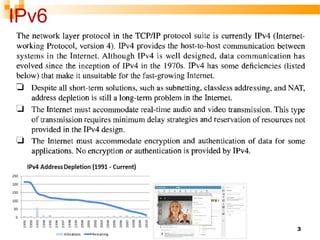
IPv6
4
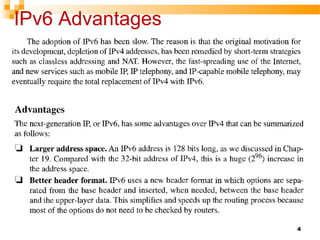
IPv6 Advantages
5
IPv6 Advantages
6
IPv6 Addresses
7
IPv6 Addresses
IPv6 address in binary and hexadecimal colon notation
8
IPv6 Addresses
128-bit IPv6 Address128-bit IPv6 Address
3FFE:085B:1F1F:0000:0000:0000:3FFE:085B:1F1F:0000:0000:0000:00A9:123400A9:1234
groups of 16-bit hexadecimal numbers separated bygroups of 16-bit hexadecimal numbers separated by
3FFE:85B:1F1F::A9:12343FFE:85B:1F1F::A9:1234
= all zeros in one or more group of 16-bit hexadecimal numbe= all zeros in one or more group of 16-bit hexadecimal numbe
Leading zeros canLeading zeros can
be removedbe removed
10
Abbreviated IPv6 addresses
11
Expand the address 0:15::1:12:1213 to its original.
Example
Solution
We first need to align the left side of the double colon to the left of
the original pattern and the right side of the double colon to the
right of the original pattern to find how many 0s we need to replace
the double colon.
This means that the original address is.
12
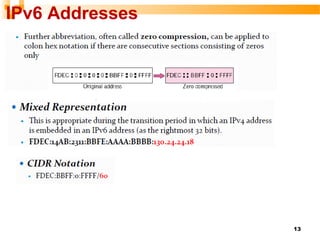
IPv6 Addresses
13
IPv6 Addresses
14
IPv6 Address types
15
16
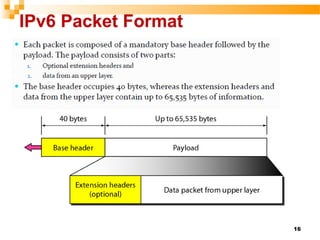
IPv6 Packet Format
17
BASE HEADER
18
BASE HEADER
19
Comparison between IPv4 and IPv6 Headers
20
Transition from IPv4 to IPv6
21
Transition from IPv4 to IPv6
22
Transition from IPv4 to IPv6
23
References
 “Computer Networks”,
Tanenbaum A (PHI)
 “Data Communications and Networking”,
Forouzan B (TMH)
24
.
 .
25

Next generation ip