It’s all about IMPACT


Reviewing Investment Performance
Today’s Conversation Topics
 Your role as an Asset Owner
 Investment Advisor - Trusted Team Member and Service
 Provider
 Overview of Asset Allocation & Performance
 Expectations
 Where are the easy opportunities for Mission Related /
 Impact Investing?
 Where does mission and performance meet for a win-
 win in the road ahead?


                                     © Amplifier Strategies   2
Your role as Asset Owner
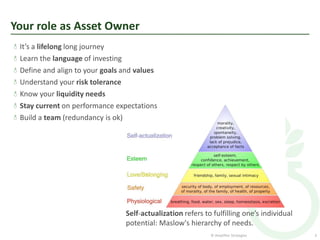
 It’s a lifelong long journey
 Learn the language of investing
 Define and align to your goals and values
 Understand your risk tolerance
 Know your liquidity needs
 Stay current on performance expectations
 Build a team (redundancy is ok)


                                Self-actualization refers to fulfilling one’s individual
                                potential: Maslow's hierarchy of needs.
                                                            © Amplifier Strategies         3
What does this mean
for your investment
strategy?
Investment Advisors –
Trusted Team Member and Service Provider
 It’s a relationship based on trust and transparency
 They are service providers – it’s their job to understand your goals
 They are paid on financial performance (which means this is really their job)
 Create the conversation - send them resources, request review meetings
 Expect Evolution…(require it)
 A source for education – Ask for examples, references, comparisons and plain English
 Manager performance is different from investment performance!!! (more on this)


                                                          © Amplifier Strategies        5
A roadmap allows you
to chart your course
Asset Allocation & Performance Expectations
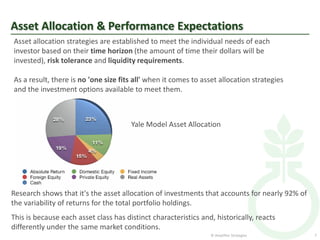
Asset allocation strategies are established to meet the individual needs of each
investor based on their time horizon (the amount of time their dollars will be
invested), risk tolerance and liquidity requirements.

As a result, there is no 'one size fits all' when it comes to asset allocation strategies
and the investment options available to meet them.


                                       Yale Model Asset Allocation


Research shows that it's the asset allocation of investments that accounts for nearly 92% of
the variability of returns for the total portfolio holdings.
This is because each asset class has distinct characteristics and, historically, reacts
differently under the same market conditions.
                                                                 © Amplifier Strategies        7
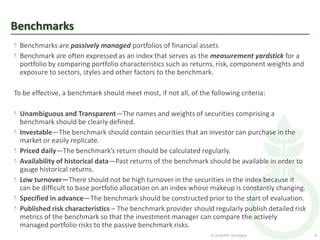
Benchmarks
  Benchmarks are passively managed portfolios of financial assets
  Benchmark are often expressed as an index that serves as the measurement yardstick for a
  portfolio by comparing portfolio characteristics such as returns, risk, component weights and
  exposure to sectors, styles and other factors to the benchmark.

To be effective, a benchmark should meet most, if not all, of the following criteria:

  Unambiguous and Transparent—The names and weights of securities comprising a
  benchmark should be clearly defined.
  Investable—The benchmark should contain securities that an investor can purchase in the
  market or easily replicate.
  Priced daily—The benchmark’s return should be calculated regularly.
  Availability of historical data—Past returns of the benchmark should be available in order to
  gauge historical returns.
  Low turnover—There should not be high turnover in the securities in the index because it
  can be difficult to base portfolio allocation on an index whose makeup is constantly changing.
  Specified in advance—The benchmark should be constructed prior to the start of evaluation.
  Published risk characteristics – The benchmark provider should regularly publish detailed risk
  metrics of the benchmark so that the investment manager can compare the actively
  managed portfolio risks to the passive benchmark risks.
                                                                  © Amplifier Strategies           8
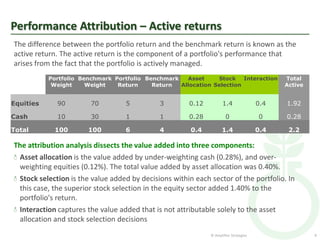
Performance Attribution – Active returns
The difference between the portfolio return and the benchmark return is known as the
active return. The active return is the component of a portfolio's performance that
arises from the fact that the portfolio is actively managed.
           Portfolio Benchmark Portfolio Benchmark   Asset     Stock    Interaction          Total
            Weight     Weight   Return     Return  Allocation Selection                      Active


Equities     90         70         5          3        0.12          1.4               0.4   1.92

Cash         10         30         1          1        0.28           0                0     0.28

Total       100        100         6         4         0.4          1.4                0.4    2.2

The attribution analysis dissects the value added into three components:
 Asset allocation is the value added by under-weighting cash (0.28%), and over-
 weighting equities (0.12%). The total value added by asset allocation was 0.40%.
 Stock selection is the value added by decisions within each sector of the portfolio. In
 this case, the superior stock selection in the equity sector added 1.40% to the
 portfolio's return.
 Interaction captures the value added that is not attributable solely to the asset
 allocation and stock selection decisions
                                                              © Amplifier Strategies                  9
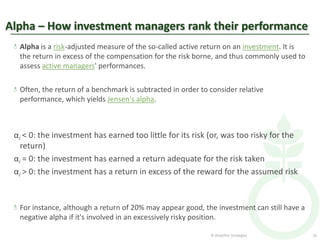
Alpha – How investment managers rank their performance
  Alpha is a risk-adjusted measure of the so-called active return on an investment. It is
  the return in excess of the compensation for the risk borne, and thus commonly used to
  assess active managers' performances.

  Often, the return of a benchmark is subtracted in order to consider relative
  performance, which yields Jensen's alpha.


 αi < 0: the investment has earned too little for its risk (or, was too risky for the
   return)
 αi = 0: the investment has earned a return adequate for the risk taken
 αi > 0: the investment has a return in excess of the reward for the assumed risk


  For instance, although a return of 20% may appear good, the investment can still have a
  negative alpha if it's involved in an excessively risky position.

                                                             © Amplifier Strategies         10
certainty   plan
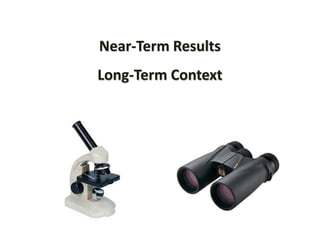
Near-Term Results
Long-Term Context
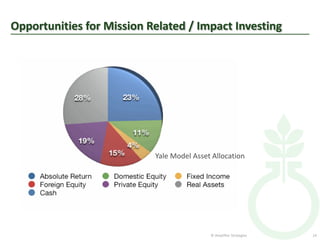
Opportunities for Mission Related / Impact Investing


                           Yale Model Asset Allocation


                                           © Amplifier Strategies   14
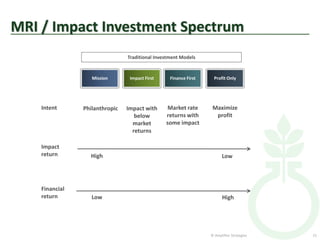
MRI / Impact Investment Spectrum
                                Traditional Investment Models


                   Mission       Impact First     Finance First     Profit Only


    Intent      Philanthropic   Impact with      Market rate       Maximize
                                   below        returns with        profit
                                  market        some impact
                                  returns

    Impact
    return        High                                                  Low


    Financial
    return         Low                                                  High


                                                                  © Amplifier Strategies   15
Working Within
Constraints

Every investment involves a trade-off
Mission and Performance Meet for a Win-Win


                                   © Amplifier Strategies   18
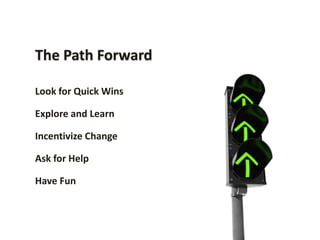
The Path Forward

Look for Quick Wins

Explore and Learn

Incentivize Change

Ask for Help

Have Fun
Creating high-impact, lasting
                results for humanity and the earth


Questions?
Contact Info:

Allison Duncan, CEO
Amplifier Strategies
allison@amplifierstrategies.com
Phone: 510-350-3707

Next gen summer 2011 investment performance

  • 1.
    It’s all aboutIMPACT Reviewing Investment Performance
  • 2.
    Today’s Conversation Topics Your role as an Asset Owner Investment Advisor - Trusted Team Member and Service Provider Overview of Asset Allocation & Performance Expectations Where are the easy opportunities for Mission Related / Impact Investing? Where does mission and performance meet for a win- win in the road ahead? © Amplifier Strategies 2
  • 3.
    Your role asAsset Owner It’s a lifelong long journey Learn the language of investing Define and align to your goals and values Understand your risk tolerance Know your liquidity needs Stay current on performance expectations Build a team (redundancy is ok) Self-actualization refers to fulfilling one’s individual potential: Maslow's hierarchy of needs. © Amplifier Strategies 3
  • 4.
    What does thismean for your investment strategy?
  • 5.
    Investment Advisors – TrustedTeam Member and Service Provider It’s a relationship based on trust and transparency They are service providers – it’s their job to understand your goals They are paid on financial performance (which means this is really their job) Create the conversation - send them resources, request review meetings Expect Evolution…(require it) A source for education – Ask for examples, references, comparisons and plain English Manager performance is different from investment performance!!! (more on this) © Amplifier Strategies 5
  • 6.
    A roadmap allowsyou to chart your course
  • 7.
    Asset Allocation &Performance Expectations Asset allocation strategies are established to meet the individual needs of each investor based on their time horizon (the amount of time their dollars will be invested), risk tolerance and liquidity requirements. As a result, there is no 'one size fits all' when it comes to asset allocation strategies and the investment options available to meet them. Yale Model Asset Allocation Research shows that it's the asset allocation of investments that accounts for nearly 92% of the variability of returns for the total portfolio holdings. This is because each asset class has distinct characteristics and, historically, reacts differently under the same market conditions. © Amplifier Strategies 7
  • 8.
    Benchmarks Benchmarksare passively managed portfolios of financial assets Benchmark are often expressed as an index that serves as the measurement yardstick for a portfolio by comparing portfolio characteristics such as returns, risk, component weights and exposure to sectors, styles and other factors to the benchmark. To be effective, a benchmark should meet most, if not all, of the following criteria: Unambiguous and Transparent—The names and weights of securities comprising a benchmark should be clearly defined. Investable—The benchmark should contain securities that an investor can purchase in the market or easily replicate. Priced daily—The benchmark’s return should be calculated regularly. Availability of historical data—Past returns of the benchmark should be available in order to gauge historical returns. Low turnover—There should not be high turnover in the securities in the index because it can be difficult to base portfolio allocation on an index whose makeup is constantly changing. Specified in advance—The benchmark should be constructed prior to the start of evaluation. Published risk characteristics – The benchmark provider should regularly publish detailed risk metrics of the benchmark so that the investment manager can compare the actively managed portfolio risks to the passive benchmark risks. © Amplifier Strategies 8
  • 9.
    Performance Attribution –Active returns The difference between the portfolio return and the benchmark return is known as the active return. The active return is the component of a portfolio's performance that arises from the fact that the portfolio is actively managed. Portfolio Benchmark Portfolio Benchmark Asset Stock Interaction Total Weight Weight Return Return Allocation Selection Active Equities 90 70 5 3 0.12 1.4 0.4 1.92 Cash 10 30 1 1 0.28 0 0 0.28 Total 100 100 6 4 0.4 1.4 0.4 2.2 The attribution analysis dissects the value added into three components: Asset allocation is the value added by under-weighting cash (0.28%), and over- weighting equities (0.12%). The total value added by asset allocation was 0.40%. Stock selection is the value added by decisions within each sector of the portfolio. In this case, the superior stock selection in the equity sector added 1.40% to the portfolio's return. Interaction captures the value added that is not attributable solely to the asset allocation and stock selection decisions © Amplifier Strategies 9
  • 10.
    Alpha – Howinvestment managers rank their performance Alpha is a risk-adjusted measure of the so-called active return on an investment. It is the return in excess of the compensation for the risk borne, and thus commonly used to assess active managers' performances. Often, the return of a benchmark is subtracted in order to consider relative performance, which yields Jensen's alpha. αi < 0: the investment has earned too little for its risk (or, was too risky for the return) αi = 0: the investment has earned a return adequate for the risk taken αi > 0: the investment has a return in excess of the reward for the assumed risk For instance, although a return of 20% may appear good, the investment can still have a negative alpha if it's involved in an excessively risky position. © Amplifier Strategies 10
  • 11.
  • 13.
  • 14.
    Opportunities for MissionRelated / Impact Investing Yale Model Asset Allocation © Amplifier Strategies 14
  • 15.
    MRI / ImpactInvestment Spectrum Traditional Investment Models Mission Impact First Finance First Profit Only Intent Philanthropic Impact with Market rate Maximize below returns with profit market some impact returns Impact return High Low Financial return Low High © Amplifier Strategies 15
  • 16.
  • 18.
    Mission and PerformanceMeet for a Win-Win © Amplifier Strategies 18
  • 19.
    The Path Forward Lookfor Quick Wins Explore and Learn Incentivize Change Ask for Help Have Fun
  • 20.
    Creating high-impact, lasting results for humanity and the earth Questions? Contact Info: Allison Duncan, CEO Amplifier Strategies allison@amplifierstrategies.com Phone: 510-350-3707