Newsletter
3rd Issue
November 2022
PUBLISHED BY:PROMPT
EDITOR: Maria Hartyányi
Copyright © VETWork Consortium
The European Commission's support for the production of this publication does not constitute an endorsement
of the contents, which reflect the views only of the authors, and the Commission cannot be held responsible for
any use which may be made of the information contained therein.
Digital Culture for the 21st
Century
Vocational Education
Developing and testing workshops for schools
The integration of digital pedagogy into the daily practice of
VET teachers cannot happen without a related vision, an
intention from the school management. Having finished the
Digital Menu Card online training activity (IO2) and having
the development needs identified (in O1), educational
experts, VET school leadership and teachers created specific
action plans for their own school. As the next step, teachers
of the five partner schools participated in a total of 73 on-
site workshops lasting for 120 minutes each in accordance
with the action plan prepared earlier. The required number
of teachers were set to 10 per school but in most cases, they
overruled this number (altogether 744 participations were
registered). Participating in the workshops, they could learn
more about the selected digital tools and the methods from
the experts which can be used best in the teaching-learning
process. During the workshops, the participants developed
their own digital teaching materials, which are going to be
published on the DMC website and be accessible for free for
other VET teachers. IO3 Activities were:
• Create specific action plans for schools based on
needs analysis and Digital Menu Card
• Deliver workshops to teachers
• Community learning content development
• Sharing the digital learning content developed
Process of the workshops
The leader of this IO, Prompt designed the whole process
carefully and got convinced that each partner was aware of
how to perform the task. As part of the Quality Management
plan, they had been provided with templates that served to
design the series of workshops in details, their
documentation and to assessment of the workshops.
Biotehniški izobraževalni center Ljubljana (Slovenia)
BIC implemented 15 workshops between 30/8/2022 and 21/
10/2022 which dealt with the following digital tools: Flipped
Classroom; Geogebra; Classcraft; PhET Interactive
simulations; Gamification; Applications for animation; Book
Creator, Blogger; H5P; Applications for screen recording.
Technical and Business Secondary Vocational School of
József Szakkay (Slovakia)
Teachers participated in 20 workshops all together,
mentored by their peers in the following topics: Kahoot!;
OneNote, WordWall; MSTeams; Quizlet; Redmenta; video
recording; Bandicam; Animoto, Mentimeter; Prezi;
Mindmaster; GeoGebra; Quizzes; Book Creator; Canva;
DrawMind; SpringSuite.
Szent László Roman-Catholic High School (Romania)
15 workshops were organized in the school where teachers
could obtain practice the followings: Project Method;
GeoGebra; H5P; Flipped Classroom; MovieEditor; Google
Forms; Redmenta; Kahoot!; Quizlet
Digital Culture for the 21st
Century Vocational Education
2020-1-HU01-KA202-078760
The European Commission's support for the production of this publication does not constitute an endorsement
of the contents, which reflect the views only of the authors, and the Commission cannot be held responsible for
any use which may be made of the information contained therein.
SZÁMALK-Salesian Post-Secondary Technical School
(Hungary)
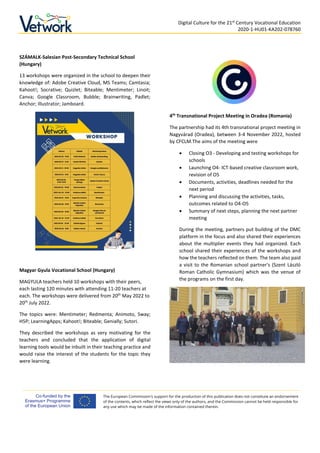
13 workshops were organized in the school to deepen their
knowledge of: Adobe Creative Cloud, MS Teams; Camtasia;
Kahoot!; Socrative; Quizlet; Biteable; Mentimeter; Linoit;
Canva; Google Classroom, Bubble; Brainwriting, Padlet;
Anchor; Illustrator; Jamboard.
Magyar Gyula Vocational School (Hungary)
MAGYULA teachers held 10 workshops with their peers,
each lasting 120 minutes with attending 11-20 teachers at
each. The workshops were delivered from 20th
May 2022 to
20th
July 2022.
The topics were: Mentimeter; Redmenta; Animoto, Sway;
H5P; LearningApps; Kahoot!; Biteable; Genially; Sutori.
They described the workshops as very motivating for the
teachers and concluded that the application of digital
learning tools would be inbuilt in their teaching practice and
would raise the interest of the students for the topic they
were learning.
4th
Transnational Project Meeting in Oradea (Romania)
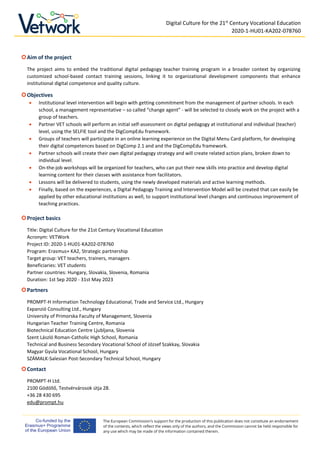
The partnership had its 4th transnational project meeting in
Nagyvárad (Oradea), between 3-4 November 2022, hosted
by CFCLM.The aims of the meeting were
• Closing O3 - Developing and testing workshops for
schools
• Launching O4- ICT-based creative classroom work,
revision of O5
• Documents, activities, deadlines needed for the
next period
• Planning and discussing the activities, tasks,
outcomes related to O4-O5
• Summary of next steps, planning the next partner
meeting
During the meeting, partners put building of the DMC
platform in the focus and also shared their experiences
about the multiplier events they had organized. Each
school shared their experiences of the workshops and
how the teachers reflected on them. The team also paid
a visit to the Romanian school partner's (Szent László
Roman Catholic Gymnasium) which was the venue of
the programs on the first day.
Digital Culture for the 21st
Century Vocational Education
2020-1-HU01-KA202-078760
The European Commission's support for the production of this publication does not constitute an endorsement
of the contents, which reflect the views only of the authors, and the Commission cannot be held responsible for
any use which may be made of the information contained therein.
Aim of the project
The project aims to embed the traditional digital pedagogy teacher training program in a broader context by organizing
customized school-based contact training sessions, linking it to organizational development components that enhance
institutional digital competence and quality culture.
Objectives
• Institutional level intervention will begin with getting commitment from the management of partner schools. In each
school, a management representative – so called “change agent” - will be selected to closely work on the project with a
group of teachers.
• Partner VET schools will perform an initial self-assessment on digital pedagogy at institutional and individual (teacher)
level, using the SELFIE tool and the DigCompEdu framework.
• Groups of teachers will participate in an online learning experience on the Digital Menu Card platform, for developing
their digital competences based on DigComp 2.1 and and the DigCompEdu framework.
• Partner schools will create their own digital pedagogy strategy and will create related action plans, broken down to
individual level.
• On-the-job workshops will be organized for teachers, who can put their new skills into practice and develop digital
learning content for their classes with assistance from facilitators.
• Lessons will be delivered to students, using the newly developed materials and active learning methods.
• Finally, based on the experiences, a Digital Pedagogy Training and Intervention Model will be created that can easily be
applied by other educational institutions as well, to support institutional level changes and continuous improvement of
teaching practices.
Project basics
Title: Digital Culture for the 21st Century Vocational Education
Acronym: VETWork
Project ID: 2020-1-HU01-KA202-078760
Program: Erasmus+ KA2, Strategic partnership
Target group: VET teachers, trainers, managers
Beneficiaries: VET students
Partner countries: Hungary, Slovakia, Slovenia, Romania
Duration: 1st Sep 2020 - 31st May 2023
Partners
PROMPT-H Information Technology Educational, Trade and Service Ltd., Hungary
Expanzió Consulting Ltd., Hungary
University of Primorska Faculty of Management, Slovenia
Hungarian Teacher Training Centre, Romania
Biotechnical Education Centre Ljubljana, Slovenia
Szent László Roman-Catholic High School, Romania
Technical and Business Secondary Vocational School of József Szakkay, Slovakia
Magyar Gyula Vocational School, Hungary
SZÁMALK-Salesian Post-Secondary Technical School, Hungary
Contact
PROMPT-H Ltd.
2100 Gödöllő, Testvérvárosok útja 28.
+36 28 430 695
edu@prompt.hu

Newsletter_3_EN.pdf

  • 1.
    Newsletter 3rd Issue November 2022 PUBLISHEDBY:PROMPT EDITOR: Maria Hartyányi Copyright © VETWork Consortium The European Commission's support for the production of this publication does not constitute an endorsement of the contents, which reflect the views only of the authors, and the Commission cannot be held responsible for any use which may be made of the information contained therein. Digital Culture for the 21st Century Vocational Education Developing and testing workshops for schools The integration of digital pedagogy into the daily practice of VET teachers cannot happen without a related vision, an intention from the school management. Having finished the Digital Menu Card online training activity (IO2) and having the development needs identified (in O1), educational experts, VET school leadership and teachers created specific action plans for their own school. As the next step, teachers of the five partner schools participated in a total of 73 on- site workshops lasting for 120 minutes each in accordance with the action plan prepared earlier. The required number of teachers were set to 10 per school but in most cases, they overruled this number (altogether 744 participations were registered). Participating in the workshops, they could learn more about the selected digital tools and the methods from the experts which can be used best in the teaching-learning process. During the workshops, the participants developed their own digital teaching materials, which are going to be published on the DMC website and be accessible for free for other VET teachers. IO3 Activities were: • Create specific action plans for schools based on needs analysis and Digital Menu Card • Deliver workshops to teachers • Community learning content development • Sharing the digital learning content developed Process of the workshops The leader of this IO, Prompt designed the whole process carefully and got convinced that each partner was aware of how to perform the task. As part of the Quality Management plan, they had been provided with templates that served to design the series of workshops in details, their documentation and to assessment of the workshops. Biotehniški izobraževalni center Ljubljana (Slovenia) BIC implemented 15 workshops between 30/8/2022 and 21/ 10/2022 which dealt with the following digital tools: Flipped Classroom; Geogebra; Classcraft; PhET Interactive simulations; Gamification; Applications for animation; Book Creator, Blogger; H5P; Applications for screen recording. Technical and Business Secondary Vocational School of József Szakkay (Slovakia) Teachers participated in 20 workshops all together, mentored by their peers in the following topics: Kahoot!; OneNote, WordWall; MSTeams; Quizlet; Redmenta; video recording; Bandicam; Animoto, Mentimeter; Prezi; Mindmaster; GeoGebra; Quizzes; Book Creator; Canva; DrawMind; SpringSuite. Szent László Roman-Catholic High School (Romania) 15 workshops were organized in the school where teachers could obtain practice the followings: Project Method; GeoGebra; H5P; Flipped Classroom; MovieEditor; Google Forms; Redmenta; Kahoot!; Quizlet
  • 2.
    Digital Culture forthe 21st Century Vocational Education 2020-1-HU01-KA202-078760 The European Commission's support for the production of this publication does not constitute an endorsement of the contents, which reflect the views only of the authors, and the Commission cannot be held responsible for any use which may be made of the information contained therein. SZÁMALK-Salesian Post-Secondary Technical School (Hungary) 13 workshops were organized in the school to deepen their knowledge of: Adobe Creative Cloud, MS Teams; Camtasia; Kahoot!; Socrative; Quizlet; Biteable; Mentimeter; Linoit; Canva; Google Classroom, Bubble; Brainwriting, Padlet; Anchor; Illustrator; Jamboard. Magyar Gyula Vocational School (Hungary) MAGYULA teachers held 10 workshops with their peers, each lasting 120 minutes with attending 11-20 teachers at each. The workshops were delivered from 20th May 2022 to 20th July 2022. The topics were: Mentimeter; Redmenta; Animoto, Sway; H5P; LearningApps; Kahoot!; Biteable; Genially; Sutori. They described the workshops as very motivating for the teachers and concluded that the application of digital learning tools would be inbuilt in their teaching practice and would raise the interest of the students for the topic they were learning. 4th Transnational Project Meeting in Oradea (Romania) The partnership had its 4th transnational project meeting in Nagyvárad (Oradea), between 3-4 November 2022, hosted by CFCLM.The aims of the meeting were • Closing O3 - Developing and testing workshops for schools • Launching O4- ICT-based creative classroom work, revision of O5 • Documents, activities, deadlines needed for the next period • Planning and discussing the activities, tasks, outcomes related to O4-O5 • Summary of next steps, planning the next partner meeting During the meeting, partners put building of the DMC platform in the focus and also shared their experiences about the multiplier events they had organized. Each school shared their experiences of the workshops and how the teachers reflected on them. The team also paid a visit to the Romanian school partner's (Szent László Roman Catholic Gymnasium) which was the venue of the programs on the first day.
  • 3.
    Digital Culture forthe 21st Century Vocational Education 2020-1-HU01-KA202-078760 The European Commission's support for the production of this publication does not constitute an endorsement of the contents, which reflect the views only of the authors, and the Commission cannot be held responsible for any use which may be made of the information contained therein. Aim of the project The project aims to embed the traditional digital pedagogy teacher training program in a broader context by organizing customized school-based contact training sessions, linking it to organizational development components that enhance institutional digital competence and quality culture. Objectives • Institutional level intervention will begin with getting commitment from the management of partner schools. In each school, a management representative – so called “change agent” - will be selected to closely work on the project with a group of teachers. • Partner VET schools will perform an initial self-assessment on digital pedagogy at institutional and individual (teacher) level, using the SELFIE tool and the DigCompEdu framework. • Groups of teachers will participate in an online learning experience on the Digital Menu Card platform, for developing their digital competences based on DigComp 2.1 and and the DigCompEdu framework. • Partner schools will create their own digital pedagogy strategy and will create related action plans, broken down to individual level. • On-the-job workshops will be organized for teachers, who can put their new skills into practice and develop digital learning content for their classes with assistance from facilitators. • Lessons will be delivered to students, using the newly developed materials and active learning methods. • Finally, based on the experiences, a Digital Pedagogy Training and Intervention Model will be created that can easily be applied by other educational institutions as well, to support institutional level changes and continuous improvement of teaching practices. Project basics Title: Digital Culture for the 21st Century Vocational Education Acronym: VETWork Project ID: 2020-1-HU01-KA202-078760 Program: Erasmus+ KA2, Strategic partnership Target group: VET teachers, trainers, managers Beneficiaries: VET students Partner countries: Hungary, Slovakia, Slovenia, Romania Duration: 1st Sep 2020 - 31st May 2023 Partners PROMPT-H Information Technology Educational, Trade and Service Ltd., Hungary Expanzió Consulting Ltd., Hungary University of Primorska Faculty of Management, Slovenia Hungarian Teacher Training Centre, Romania Biotechnical Education Centre Ljubljana, Slovenia Szent László Roman-Catholic High School, Romania Technical and Business Secondary Vocational School of József Szakkay, Slovakia Magyar Gyula Vocational School, Hungary SZÁMALK-Salesian Post-Secondary Technical School, Hungary Contact PROMPT-H Ltd. 2100 Gödöllő, Testvérvárosok útja 28. +36 28 430 695 edu@prompt.hu