• Our Inspiration
• Making News
(Partners)
• Inbox
• Business Aligned
IT (BAIT) Series
• LOL!
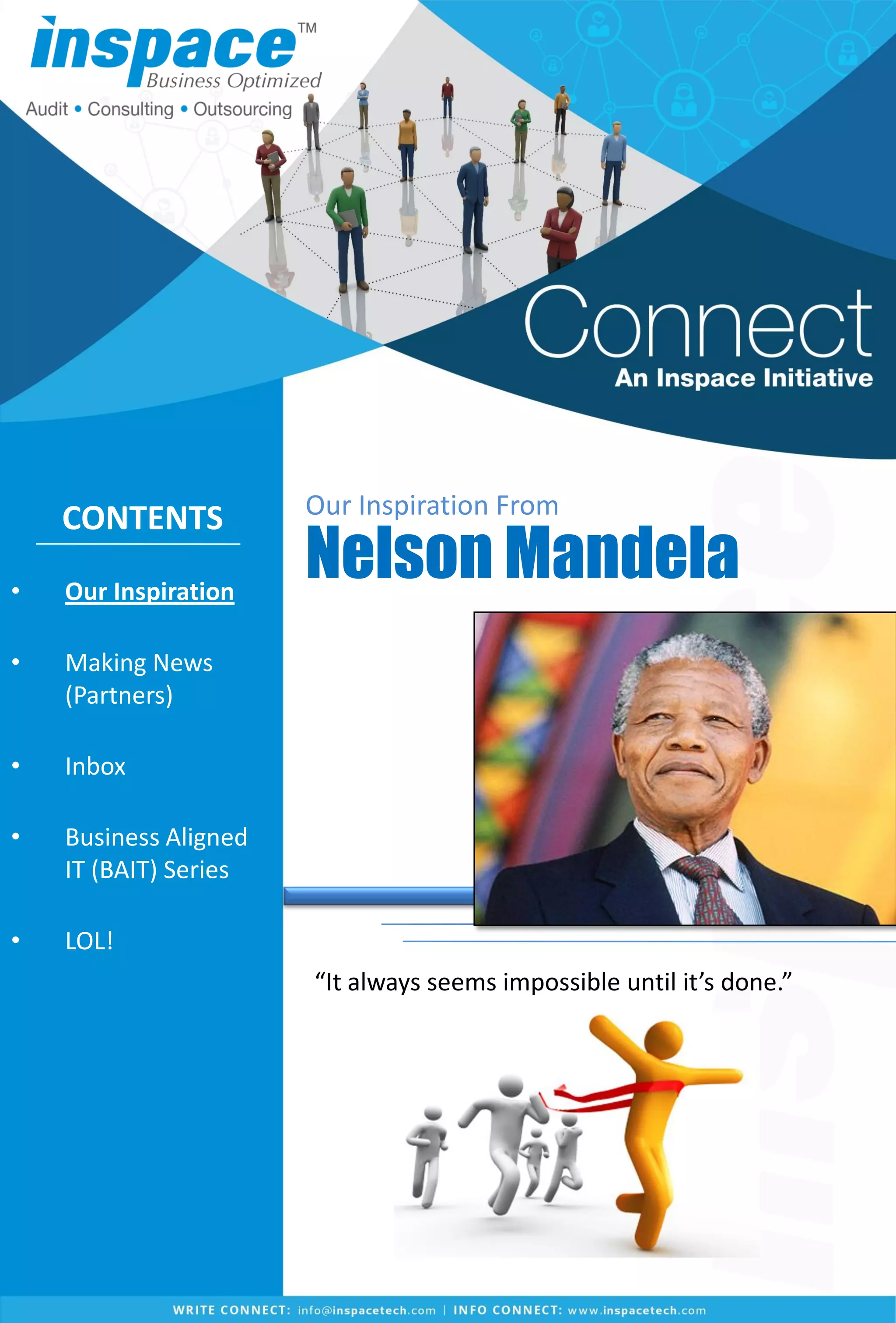
Our Inspiration From
Nelson Mandela
CONTENTS
“It always seems impossible until it’s done.”
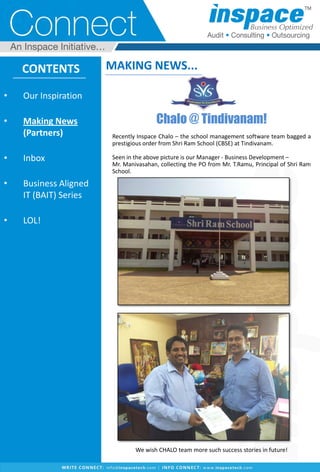
Chalo @ Tindivanam!
Recently Inspace Chalo – the school management software team bagged a
prestigious order from Shri Ram School (CBSE) at Tindivanam.
Seen in the above picture is our Manager - Business Development –
Mr. Manivasahan, collecting the PO from Mr. T.Ramu, Principal of Shri Ram
School.
We wish CHALO team more such success stories in future!
CONTENTS
• Our Inspiration
• Making News
(Partners)
• Inbox
• Business Aligned
IT (BAIT) Series
• LOL!
MAKING NEWS...
CONTENTS
• Our Inspiration
• Making News
(Partners)
• Inbox
• Business Aligned
IT (BAIT) Series
• LOL!
INBOX
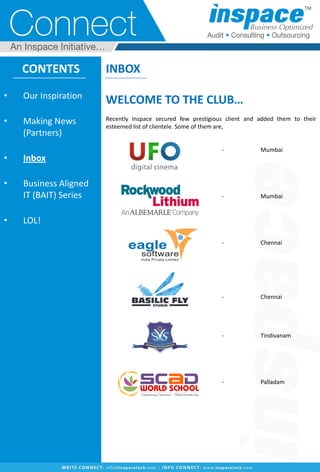
WELCOME TO THE CLUB…
Recently Inspace secured few prestigious client and added them to their
esteemed list of clientele. Some of them are,
- Mumbai
- Mumbai
- Chennai
- Chennai
- Tindivanam
- Palladam
• Our Inspiration
• Making News
(Partners)
• Inbox
• Business Aligned
IT (BAIT) Series
• LOL!
CONTENTS
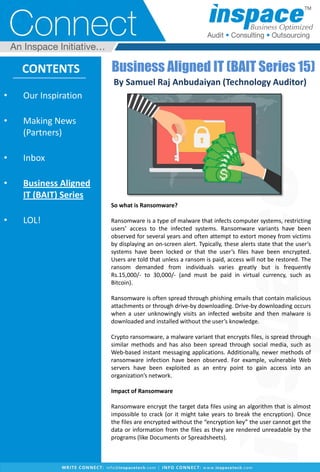
Welcome back to another edition of our BAIT Series, which aims primarily to
align business with technology. This month we would do touch upon a hot IT
topic across all industries – Ransomware!
The United States Department of Homeland Security (DHS), in collaboration
with Canadian Cyber Incident Response Centre (CCIRC), is releasing this Alert
to provide further information on ransomware, specifically its main
characteristics, its prevalence, variants that may be proliferating, and how
users can prevent and mitigate against ransomware.
Recently there has been a lot of clamour about data files being lost across
many companies. Users storing their files on their systems, find that one fine
morning they are not able to open them (after hours of laborious work on
them). Imagine the plight of cumulate data and editing work carried out for
weeks, months or even years’ together, especially for the accounting or
financial purposes!
The background information is that, destructive ransomware variants such as
Locky and Samas were observed to infect computers belonging to individuals
and businesses. Basically, it restricts users’ access to it until a ransom is paid
to unlock it.
Business Aligned IT (BAIT Series 15)
By Samuel Raj Anbudaiyan (Technology Auditor)
PREPARE FOR RANSOMWARE
• Our Inspiration
• Making News
(Partners)
• Inbox
• Business Aligned
IT (BAIT) Series
• LOL!
CONTENTS Business Aligned IT (BAIT Series 15)
By Samuel Raj Anbudaiyan (Technology Auditor)
So what is Ransomware?
Ransomware is a type of malware that infects computer systems, restricting
users’ access to the infected systems. Ransomware variants have been
observed for several years and often attempt to extort money from victims
by displaying an on-screen alert. Typically, these alerts state that the user’s
systems have been locked or that the user’s files have been encrypted.
Users are told that unless a ransom is paid, access will not be restored. The
ransom demanded from individuals varies greatly but is frequently
Rs.15,000/- to 30,000/- (and must be paid in virtual currency, such as
Bitcoin).
Ransomware is often spread through phishing emails that contain malicious
attachments or through drive-by downloading. Drive-by downloading occurs
when a user unknowingly visits an infected website and then malware is
downloaded and installed without the user’s knowledge.
Crypto ransomware, a malware variant that encrypts files, is spread through
similar methods and has also been spread through social media, such as
Web-based instant messaging applications. Additionally, newer methods of
ransomware infection have been observed. For example, vulnerable Web
servers have been exploited as an entry point to gain access into an
organization’s network.
Impact of Ransomware
Ransomware encrypt the target data files using an algorithm that is almost
impossible to crack (or it might take years to break the encryption). Once
the files are encrypted without the “encryption key” the user cannot get the
data or information from the files as they are rendered unreadable by the
programs (like Documents or Spreadsheets).
• Our Inspiration
• Making News
(Partners)
• Inbox
• Business Aligned
IT (BAIT) Series
• LOL!
CONTENTS Business Aligned IT (BAIT Series 15)
By Samuel Raj Anbudaiyan (Technology Auditor)
If the user tries to access the data or the files, they are asked to pay a
ransom amount to get data. These viruses spread through email, internet
and also through local networks. Thus before the user realises, all are
affected. Thus to get the files or data back, either the user is forced to pay-
up the amount specified or to lose their valuable data forever. Most users
end-up paying the amount, since they do not want to lose the data (with
years of work stored in them). The worst part is that even after paying the
amount some users do not get the valid “decryption key” to access their
data or files! And it is next to impossible to trace back the ransoming
parties.
Ransomware not only targets home users; businesses can also become
infected with ransomware, leading to negative consequences, including
• Temporary or permanent loss of sensitive or proprietary information,
• Disruption to regular operations,
• Financial losses incurred to restore systems and files, and
• Potential harm to an organization’s reputation.
As seen earlier, paying the ransom does not guarantee the encrypted files
will be released; it only guarantees that the malicious actors receive the
victim’s money, and in some cases, their banking information. In addition,
decrypting files does not mean the malware infection itself has been
removed.
Proactive Solution for Ransomware
Infections can be devastating to an individual or organization, and recovery
can be a difficult process that may require the services of a reputable data
recovery specialist.
Many security agencies recommend that users and administrators take the
following preventive measures to protect their computer networks from
ransomware infection:
• Employ a data backup and recovery plan for all critical information.
Perform and test regular backups to limit the impact of data or system loss
and to expedite the recovery process. Note that network-connected
backups can also be affected by ransom ware; critical backups should be
isolated from the network for optimum protection.
• Use application white listing to help prevent malicious software and
unapproved programs from running. Application white listing is one of the
best security strategies as it allows only specified programs to run, while
blocking all others, including malicious software.
• Our Inspiration
• Making News
(Partners)
• Inbox
• Business Aligned
IT (BAIT) Series
• LOL!
CONTENTS Business Aligned IT (BAIT Series 15)
By Samuel Raj Anbudaiyan (Technology Auditor)
• Keep your operating system and software up-to-date with the latest
patches. Vulnerable applications and operating systems are the target of
most attacks. Ensuring these are patched with the latest updates greatly
reduces the number of exploitable entry points available to an attacker.
• Maintain up-to-date anti-virus software, and scan all software
downloaded from the internet prior to executing.
• Restrict users’ ability (permissions) to install and run unwanted software
applications, and apply the principle of “Least Privilege” to all systems and
services. Restricting these privileges may prevent malware from running or
limit its capability to spread through the network.
• Avoid enabling macros from email attachments. If a user opens the
attachment and enables macros, embedded code will execute the malware
on the machine. For enterprises or organizations, it may be best to block
email messages with attachments from suspicious sources. Follow safe
practices when browsing the Web.
• Do not follow unsolicited Web links in emails.
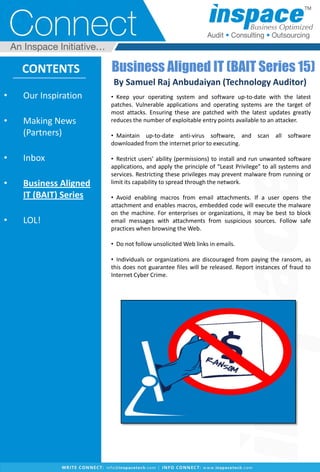
• Individuals or organizations are discouraged from paying the ransom, as
this does not guarantee files will be released. Report instances of fraud to
Internet Cyber Crime.
LOL!
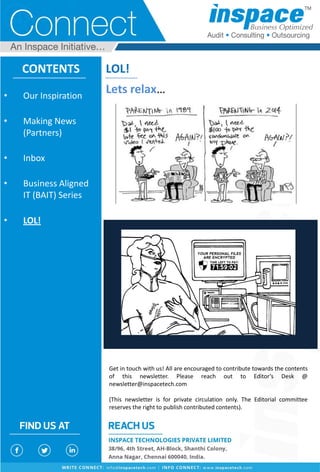
Lets relax…
CONTENTS
Get in touch with us! All are encouraged to contribute towards the contents
of this newsletter. Please reach out to Editor’s Desk @
newsletter@inspacetech.com
(This newsletter is for private circulation only. The Editorial committee
reserves the right to publish contributed contents).
• Our Inspiration
• Making News
(Partners)
• Inbox
• Business Aligned
IT (BAIT) Series
• LOL!

Newsletter connect - June 2016

  • 1.
    • Our Inspiration •Making News (Partners) • Inbox • Business Aligned IT (BAIT) Series • LOL! Our Inspiration From Nelson Mandela CONTENTS “It always seems impossible until it’s done.”
  • 2.
    Chalo @ Tindivanam! RecentlyInspace Chalo – the school management software team bagged a prestigious order from Shri Ram School (CBSE) at Tindivanam. Seen in the above picture is our Manager - Business Development – Mr. Manivasahan, collecting the PO from Mr. T.Ramu, Principal of Shri Ram School. We wish CHALO team more such success stories in future! CONTENTS • Our Inspiration • Making News (Partners) • Inbox • Business Aligned IT (BAIT) Series • LOL! MAKING NEWS...
  • 3.
    CONTENTS • Our Inspiration •Making News (Partners) • Inbox • Business Aligned IT (BAIT) Series • LOL! INBOX WELCOME TO THE CLUB… Recently Inspace secured few prestigious client and added them to their esteemed list of clientele. Some of them are, - Mumbai - Mumbai - Chennai - Chennai - Tindivanam - Palladam
  • 4.
    • Our Inspiration •Making News (Partners) • Inbox • Business Aligned IT (BAIT) Series • LOL! CONTENTS Welcome back to another edition of our BAIT Series, which aims primarily to align business with technology. This month we would do touch upon a hot IT topic across all industries – Ransomware! The United States Department of Homeland Security (DHS), in collaboration with Canadian Cyber Incident Response Centre (CCIRC), is releasing this Alert to provide further information on ransomware, specifically its main characteristics, its prevalence, variants that may be proliferating, and how users can prevent and mitigate against ransomware. Recently there has been a lot of clamour about data files being lost across many companies. Users storing their files on their systems, find that one fine morning they are not able to open them (after hours of laborious work on them). Imagine the plight of cumulate data and editing work carried out for weeks, months or even years’ together, especially for the accounting or financial purposes! The background information is that, destructive ransomware variants such as Locky and Samas were observed to infect computers belonging to individuals and businesses. Basically, it restricts users’ access to it until a ransom is paid to unlock it. Business Aligned IT (BAIT Series 15) By Samuel Raj Anbudaiyan (Technology Auditor) PREPARE FOR RANSOMWARE
  • 5.
    • Our Inspiration •Making News (Partners) • Inbox • Business Aligned IT (BAIT) Series • LOL! CONTENTS Business Aligned IT (BAIT Series 15) By Samuel Raj Anbudaiyan (Technology Auditor) So what is Ransomware? Ransomware is a type of malware that infects computer systems, restricting users’ access to the infected systems. Ransomware variants have been observed for several years and often attempt to extort money from victims by displaying an on-screen alert. Typically, these alerts state that the user’s systems have been locked or that the user’s files have been encrypted. Users are told that unless a ransom is paid, access will not be restored. The ransom demanded from individuals varies greatly but is frequently Rs.15,000/- to 30,000/- (and must be paid in virtual currency, such as Bitcoin). Ransomware is often spread through phishing emails that contain malicious attachments or through drive-by downloading. Drive-by downloading occurs when a user unknowingly visits an infected website and then malware is downloaded and installed without the user’s knowledge. Crypto ransomware, a malware variant that encrypts files, is spread through similar methods and has also been spread through social media, such as Web-based instant messaging applications. Additionally, newer methods of ransomware infection have been observed. For example, vulnerable Web servers have been exploited as an entry point to gain access into an organization’s network. Impact of Ransomware Ransomware encrypt the target data files using an algorithm that is almost impossible to crack (or it might take years to break the encryption). Once the files are encrypted without the “encryption key” the user cannot get the data or information from the files as they are rendered unreadable by the programs (like Documents or Spreadsheets).
  • 6.
    • Our Inspiration •Making News (Partners) • Inbox • Business Aligned IT (BAIT) Series • LOL! CONTENTS Business Aligned IT (BAIT Series 15) By Samuel Raj Anbudaiyan (Technology Auditor) If the user tries to access the data or the files, they are asked to pay a ransom amount to get data. These viruses spread through email, internet and also through local networks. Thus before the user realises, all are affected. Thus to get the files or data back, either the user is forced to pay- up the amount specified or to lose their valuable data forever. Most users end-up paying the amount, since they do not want to lose the data (with years of work stored in them). The worst part is that even after paying the amount some users do not get the valid “decryption key” to access their data or files! And it is next to impossible to trace back the ransoming parties. Ransomware not only targets home users; businesses can also become infected with ransomware, leading to negative consequences, including • Temporary or permanent loss of sensitive or proprietary information, • Disruption to regular operations, • Financial losses incurred to restore systems and files, and • Potential harm to an organization’s reputation. As seen earlier, paying the ransom does not guarantee the encrypted files will be released; it only guarantees that the malicious actors receive the victim’s money, and in some cases, their banking information. In addition, decrypting files does not mean the malware infection itself has been removed. Proactive Solution for Ransomware Infections can be devastating to an individual or organization, and recovery can be a difficult process that may require the services of a reputable data recovery specialist. Many security agencies recommend that users and administrators take the following preventive measures to protect their computer networks from ransomware infection: • Employ a data backup and recovery plan for all critical information. Perform and test regular backups to limit the impact of data or system loss and to expedite the recovery process. Note that network-connected backups can also be affected by ransom ware; critical backups should be isolated from the network for optimum protection. • Use application white listing to help prevent malicious software and unapproved programs from running. Application white listing is one of the best security strategies as it allows only specified programs to run, while blocking all others, including malicious software.
  • 7.
    • Our Inspiration •Making News (Partners) • Inbox • Business Aligned IT (BAIT) Series • LOL! CONTENTS Business Aligned IT (BAIT Series 15) By Samuel Raj Anbudaiyan (Technology Auditor) • Keep your operating system and software up-to-date with the latest patches. Vulnerable applications and operating systems are the target of most attacks. Ensuring these are patched with the latest updates greatly reduces the number of exploitable entry points available to an attacker. • Maintain up-to-date anti-virus software, and scan all software downloaded from the internet prior to executing. • Restrict users’ ability (permissions) to install and run unwanted software applications, and apply the principle of “Least Privilege” to all systems and services. Restricting these privileges may prevent malware from running or limit its capability to spread through the network. • Avoid enabling macros from email attachments. If a user opens the attachment and enables macros, embedded code will execute the malware on the machine. For enterprises or organizations, it may be best to block email messages with attachments from suspicious sources. Follow safe practices when browsing the Web. • Do not follow unsolicited Web links in emails. • Individuals or organizations are discouraged from paying the ransom, as this does not guarantee files will be released. Report instances of fraud to Internet Cyber Crime.
  • 8.
    LOL! Lets relax… CONTENTS Get intouch with us! All are encouraged to contribute towards the contents of this newsletter. Please reach out to Editor’s Desk @ newsletter@inspacetech.com (This newsletter is for private circulation only. The Editorial committee reserves the right to publish contributed contents). • Our Inspiration • Making News (Partners) • Inbox • Business Aligned IT (BAIT) Series • LOL!