PHACOEMULSIFICATION
Definition
 Phacoemulsification is a modern-day cataract
surgery that employs ultrasound energy to
emulsify the nucleus, vacuum to catch the
nuclear material, and irrigation and
aspiration for cortex and viscoelastic
removal.
Introduction
 Introduced by Dr. Charles Kelman in 1962,
phacoemulsification machines have
undergone constant improvement ever
increasing both their complexity & safety.
 In this procedure, an ultrasonically driven tip
is used to emulsify the lens nucleus and
remove the fragments with an automated
aspiration system.
 This paradigm shift allowed cataract surgery
to be performed via smaller corneal incisions,
resulting in a lower incidence of wound-
related and vitreous-related complications
and more rapid
rehabilitation of vision.
Phacomachine
 The machine consists of:
1. Console
2. Handpiece and their connections
3. Foot pedal
1. Console
 The console consists of a
computer which
controls all the function
of machine.
 The computer generates
ultrasonic waveform &
sends it to transducer in
form of electronic
signals.
 The setting for various parameters i.e. power,
vacuum & flow rate are fed in here.
 The settings represent the maximum level of
parameters that will be achievable.
 Setting for different types of cataract can also be
fed into memory.
2. Hand piece
 Two types of hand pieces:
I. Irrigation aspiration handpiece
II. Phaco handpiece
I. I-A handpiece
 This tip differs from
phaco tip in being
smooth & rounded
with single aspiration
port on side of tip &
not at the end.
 Angulation of I-A
handpiece can be
straight, 450
or 900
.
 Aspirating port at one
side is usually 0.75
mm to 1.5 mm away
from tip.
 The opening diameter
can be 0.2 to 0.5 mm.
II. Phaco handpiece
 Phaco handpiece contains piezoelectric crystals
which produce mechanical energy for
phacoemulsification by to & fro occilating
movement.
 The tip is covered by silicon sleeve.
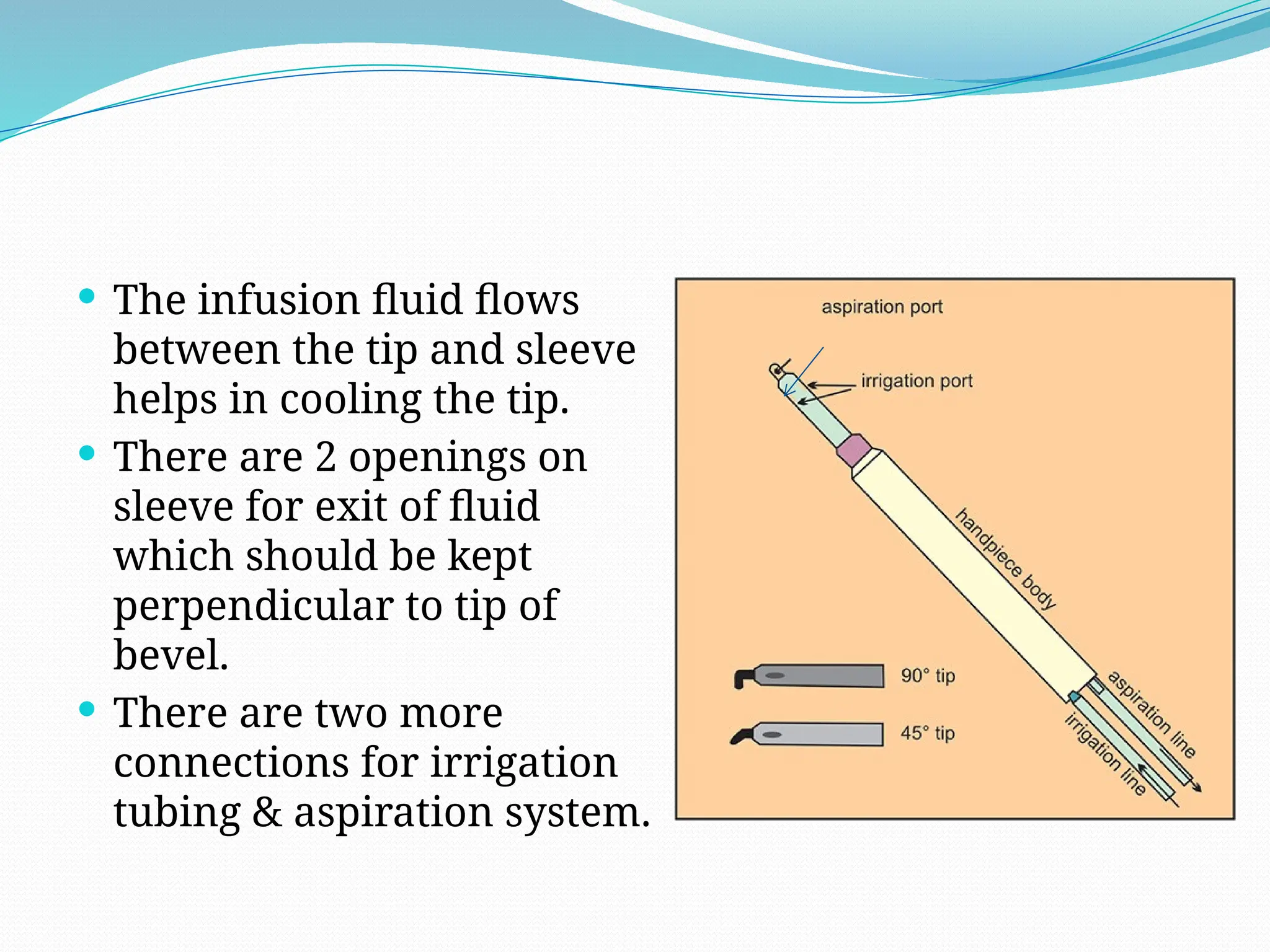
 The infusion fluid flows
between the tip and sleeve
helps in cooling the tip.
 There are 2 openings on
sleeve for exit of fluid
which should be kept
perpendicular to tip of
bevel.
 There are two more
connections for irrigation
tubing & aspiration system.
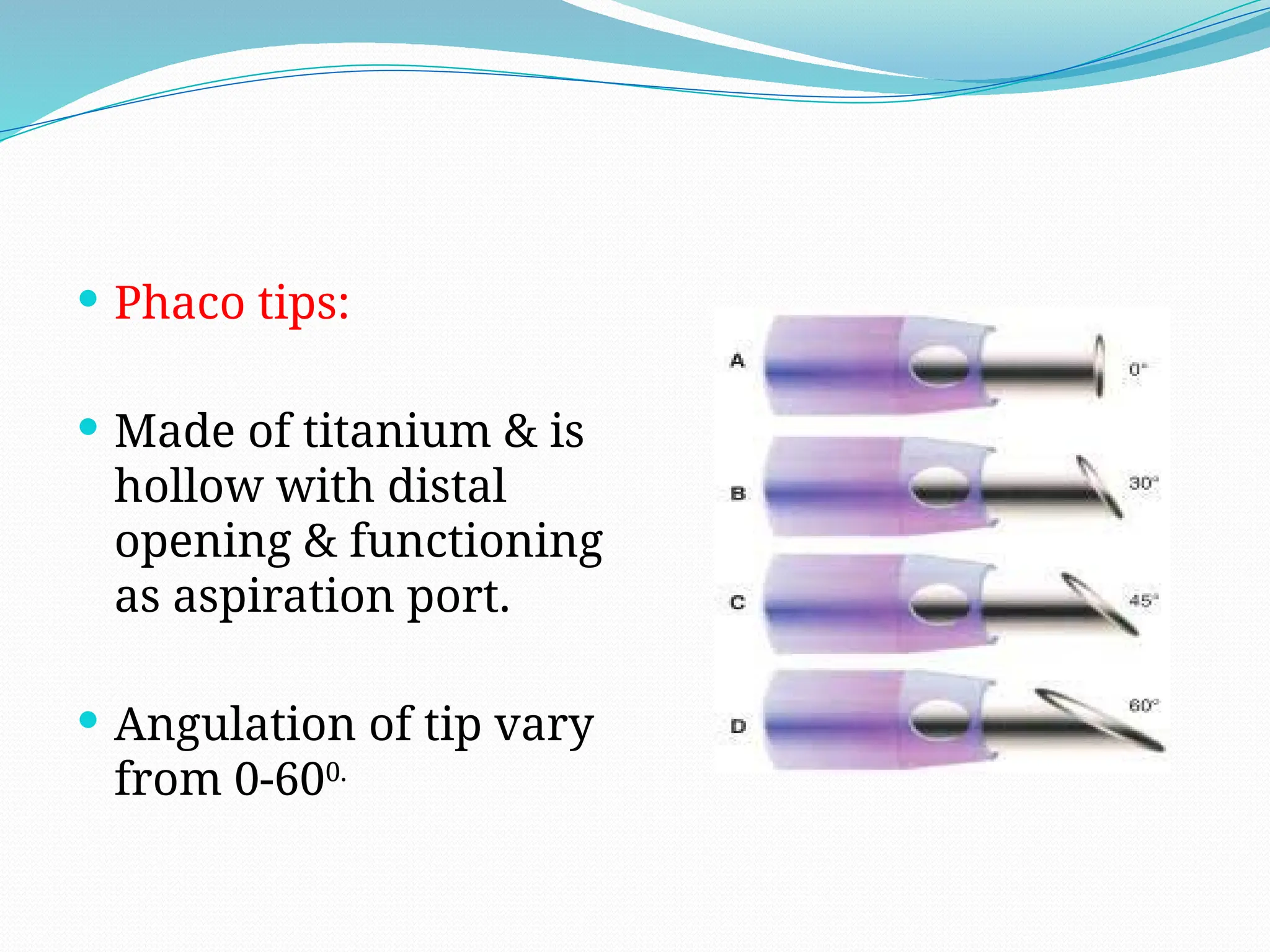
 Phaco tips:
 Made of titanium & is
hollow with distal
opening & functioning
as aspiration port.
 Angulation of tip vary
from 0-600.
 More the angulation, more cutting power but
lesser is the holding power.
 Entering into anterior chamber is easy with 600
tip & harder with 00
tip.
 Most commonly used tips are 300
& 450
phaco
tips.
 Sleeve:
 Made of silicon material
covering phaco tip.
 It protects cornea, iris from
transmitted heat energy by
probe.
 There are 2 openings 1800
apart on sleeve through
which irrigating fluid exits
the sleeve.
 The irrigation
aperture of sleeve
should be aligned to
the side of tip for good
followability.
 Test chamber:
 Made of silicon
 Helpful for machine tuning.
 Helps in having idea about
machine parameter before
starting case.
 If small nucleus is stuck in
aspiration tube, it can be
removed in test chamber.
 Phaco wrench:
 Use to screw phaco
tips in hand piece.
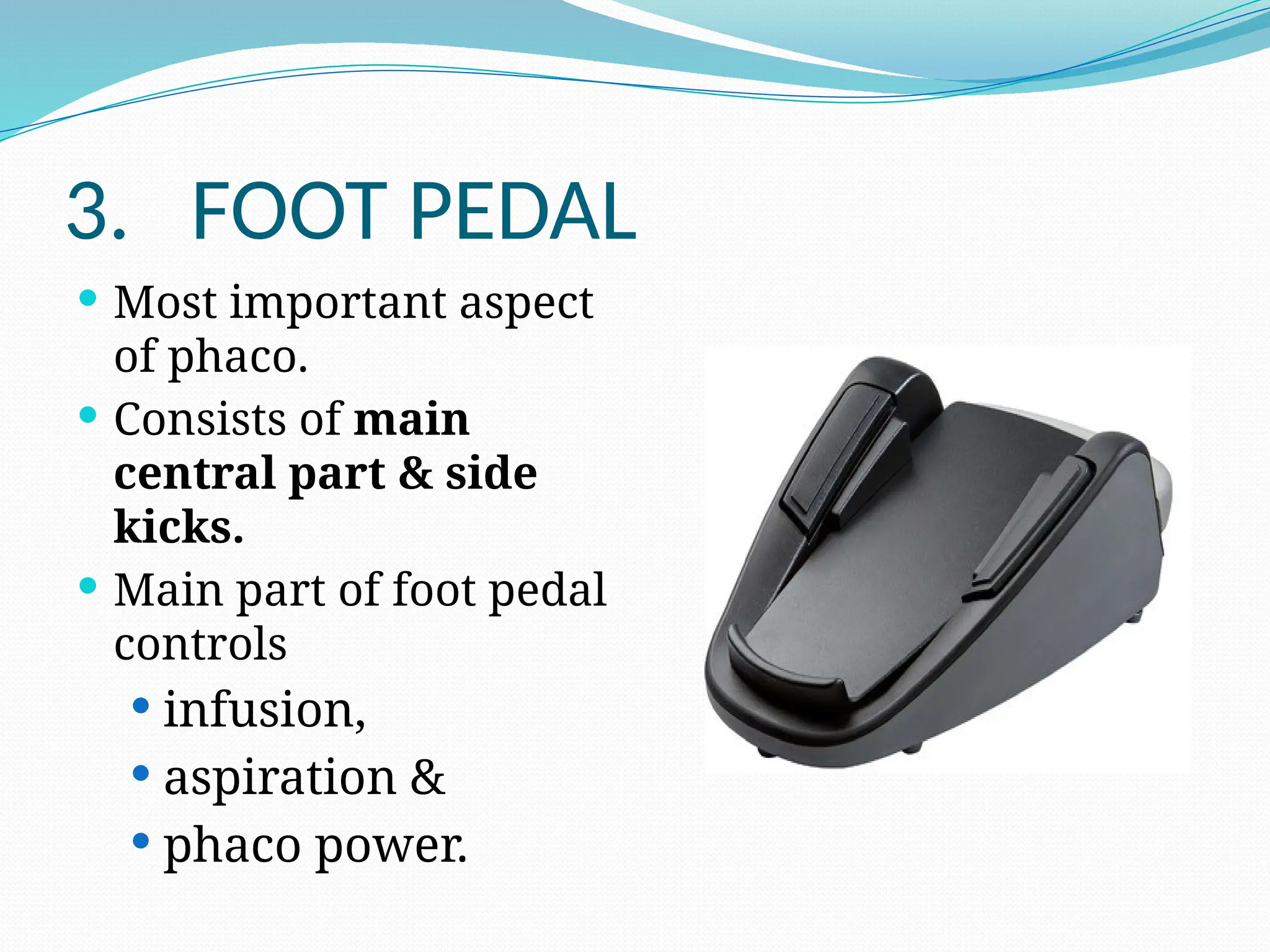
3. FOOT PEDAL
 Most important aspect
of phaco.
 Consists of main
central part & side
kicks.
 Main part of foot pedal
controls
 infusion,
 aspiration &
 phaco power.
 The entire distance
foot pedal transverses
is divided by 2
dentations into 3
excursions.
a) I (irrigation)
b) IA (irrigation &
aspiration)
c) IAP (irrigation,
aspiration & phaco)
 In the I excursion, irrigation is fully on.
 In the IA excursion both irrigation and
aspiration are on.
 In IAP excursion, irrigation is on, aspiration is at
the maximum preset, and phaco power will
depend on the amount of depression
Side kicks of foot pedal
 Most important sidekick of foot pedal is reflux.
 On kicking side switch aspiration flow rate is
inverted & material aspirated is expelled into AC.
 Inadvertent aspiration of wrong tissue ( iris,
capsule) can be released by this function
especially in beginners.
PHACODYANAMICS
 The various functions of phaco machine & their
inter relationship is called Phacodyanamics.
 Two basic function of machine are:
 Ultrasonic power for emulsification.
 Irrigation-aspiration for safe suction of
emulsified material.
 Irrigation aspiration system and the parameters
on which it depends together are called fluidics.
Power
 Phaco power is produced by the ultrasonic
vibrations of the Quartz crystal in the hand
piece.
 Power is created by interaction between
frequency & stroke length.
 The frequency is variable from 30-60 Hz in
different machines.
 Higher frequency ensures a better cutting action
but
more heat is generated.
 In each machine, the
frequency remains
fixed & power is
varied by varying the
stroke length which
is the to and fro
movement of the tip.
Mechanism of Emulsification
 Mechanism of emulsification is combination of
1. Jack hammer phenomenon &
2. Cavitation phenomenon
1. Jack hammer phenomenon
 Bombarding action of
pacho tip on nucleus.
 Jack hammer action
requires that the
nucleus should be
fixed for bombarding
action to be effective.
 This is the action that
is primarily used
during trenching.
2. Cavitation
 Phaco needle moving through liquid medium at
ultrasonic speed gives rise to intense zone of
high & low pressure.
 Backward tip movement creates low pressure &
pulls dissolved gas out of solution forming micro
bubbles.
 Forward tip movement creates equally intense
zone of high pressure which initiates
compression of micro bubbles until they
implode.
 As the micro bubble
implodes they generate
heat & shock wave
causing disintegration
of nuclear material.
 Forward movement of
tip also generates
acoustic wave of fluid
that can disintegrate
the softer lens material.
Cataract material Phaco tip
 The disadvantage of this wave is that it may push
nuclear piece away if the hod is not good & thus
decreases Jack Hammer effect.
 The angle of bevel of phaco needle governs the
direction of generation of shock wave & micro
bubbles.
 .
 Phacoemulsification is most
efficient when both the jack
hammer effect & cavitation
energy are combined.
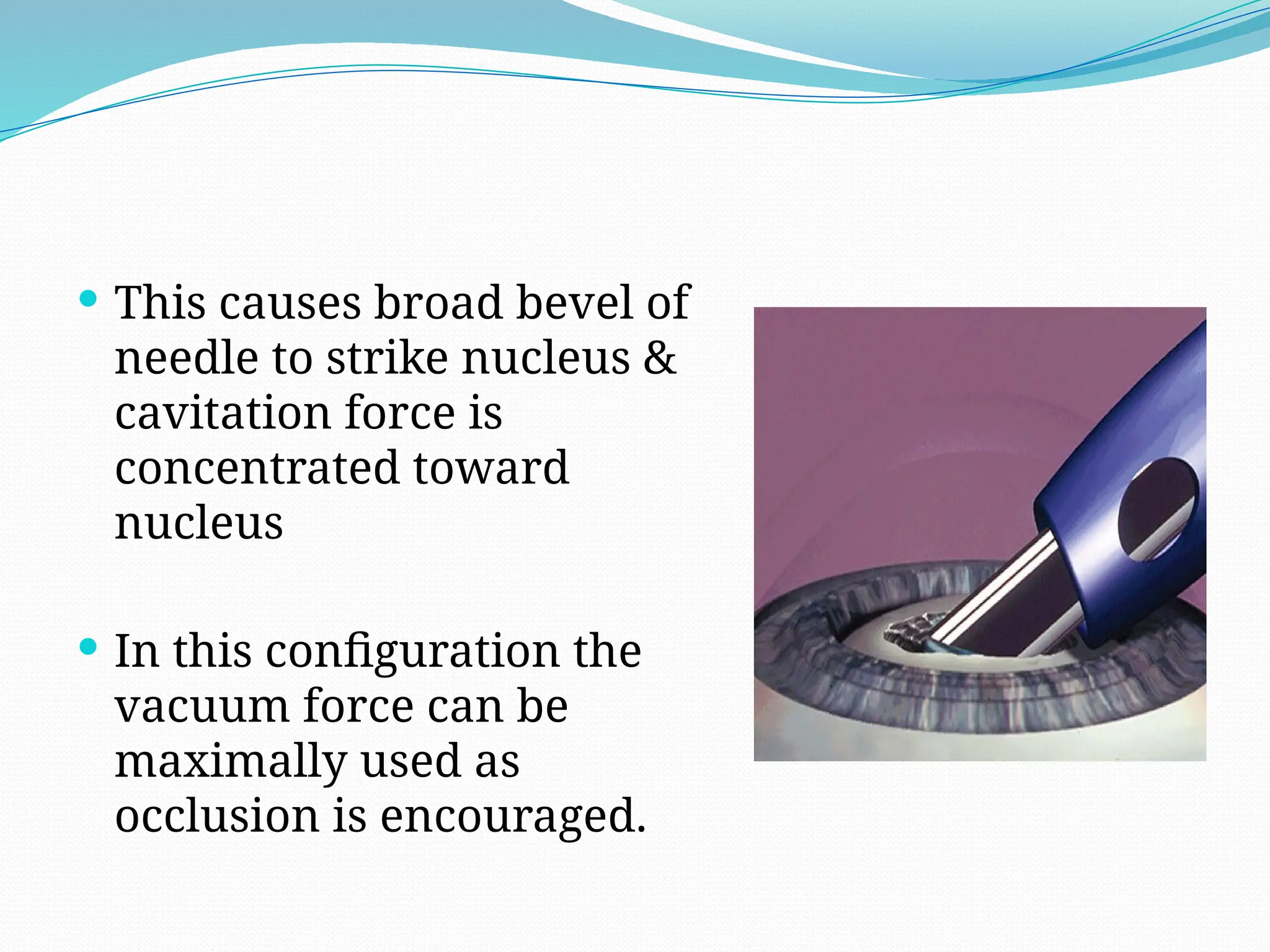
 To accomplish this, the bevel
of needle should be turned
towards nuclear fragments.
 This causes broad bevel of
needle to strike nucleus &
cavitation force is
concentrated toward
nucleus
 In this configuration the
vacuum force can be
maximally used as
occlusion is encouraged.
Control & power delivery
 There are various modes:
a. Surgeon mode:
• In the surgeon mode, the power delivery varies
from O to maximum, by varying the foot pedal in
phaco mode.
• At start of phaco mode (P0) the power will be O
and and full depression (Pmax) power will be
maximum that has been pre set.
• Thus excursion of foot in phaco mode will
determine the amount of power being delivered.
b. Panel mode:
• As soon as surgeon depress the foot pedal into phaco
mode (P0), they will immediately reach max. power
that has been set on panel.
• Here , there is no variation & full power is delivered.
• The only probable indication for the use of panel
mode is in a very hard cataract where the nucleus is
uniformly hard requiring uniformly high power for
emulsification.
c. Pulse mode:
• In pulse mode each pulse of energy is followed
by a gap of equal duration.
• In this mode the frequency of the pulses is fixed
and the phaco energy delivered in each pulse
will depend on the amount of pedal pressed.
• Pulse &
d. Burst mode:
 In this mode maximum power is delivered at
intervals which vary with the amount you depress
the foot pedal.
 In this mode energy is fixed & frequency of phaco
burst will increase with increasing foot pedal
depression in phaco mode.
 At P0 there will be one burst per sec. & at full
depression (Pmax) power delivery is continuous.
FLUIDICS
 The fluidics refer to integrated function
performed by infusion & aspiration system by
which stable AC is maintained.
 It consists of :
 Infusion system
 Aspiration system
Infusion system
 It consists of bottle, the
height of which provides
gradient for flow.
 Tube from bottle is run
through pinch valve which is
controlled by foot pedal.
 Bottle height of 45 cm
maintains safe IOP with
sufficient fluid entering the
eye.
 Raising the bottle height too much can have
undesirable effects like
 Fluctuation of the lens iris diaphragm resulting in
irritation to the iris and miosis.
 Repeated iris prolapse, especially if wound is
large.
Aspiration system
 The 2 function of aspiration system is:
a. Lavage of ant. Chamber
b. Creation of hold for emulsification
 Lavage is governed by flow rate
 Hold of emulsification is due to vacuum
generated by system.
 Flow rate is quantity of fluid pulled from eye
per mint.
 The aspiration systems consist of a pump that is
either flow based or vacuum based
1. Peristaltic pump (flow based)
2. Venturi pump (vacuum based)
1. Peristaltic pump
 Most commonly used pump in
phaco.
 Principle: in peristaltic pump
the rotation of rollers by
pump pinches the soft silicon
tubing which creates negative
pressure by squeezing fluid
out of tube.
 In this system vacuum is build
only when tip is occluded.
2. Venturi pump
 Here vacuum &
aspiration flow rate both
are working together.
 Principle: Compressed
gas creates negative
suction force that is
inside closed chamber
which is directly
transmitted to
handpiece.
 The advantage of this system is that the vacuum
is directly transmitted to the tip from the system
ensuring a better followability.
 Disadvantage is
 The incidence 0f iris trauma & post. Capsular rent
has been reported much higher.
 Only the level of vacuum can be controlled and not
the flow rate.
Followability
 The tendency of nuclear fragments/cortical
matter to come into the tip.
 The positive pressure due to the infusion and the
negative pressure created by the aspiration
pump are responsible for the creation of a
pressure gradient at the tip.
 This in turn leads to eddy currents from the
infusion orifice to the phaco tip.
 Area encompassed by these eddy currents is
known as Zone of followability.
 The area just in front
of the tip is the area of
highest followability.
 The area just in front
of the tip is the area
of highest
followability.
 All the fragments in
this area will be
attracted towards the
tip.
Good
followability
Poor
followability
No
followability
Surge
 Sudden withdrawal of fluid from AC after
occlusion breaks is called surge.
 Beyond a certain limit it may cause collapse of
chamber, jeopardizing the vital structures of eyes
and making the surgery filled with
complications.
Prevention of surge
 By machine:
I. Venting:
 Sensors in machine
detects occlusion
break & release fluid
in system to fill
volume of expanding
tube.
 Prevents fluid being
drawn out of AC.
II. Delay in start of the
motor following
occlusion break.
 By surgeons:
 Decreasing effective
flow rate.
 Increasing the
infusion.
 Increased viscosity of
the AC contents.
 Proper wound
construction.
 Proper Foot control.
Outline of the
Phacoemulsification Procedure
Eye Marking
 Use marking pen to identify the operative eye to
prevent errors in surgical site (eg, wrong eye).
Exposure of the Globe
 After the anesthesia has been administered and
the eye has been prepared and draped in sterile
method the eyelids are held apart with an eyelid
speculum.
Paracentesis
 The paracentesis incision is used for multiple
purposes, including insertion of a second
instrument and placement of iris hooks.
 A small sharp blade, such as a 15° blade is used
to create 1 or 2 paracentesis incisions
approximately 2 or 3 clock-hours away from the
site where an incision will be made for the phaco
handpiece.
Clear Corneal Incision
 These small incisions are
typically 2.2–3.2 mm wide,
just large enough to
accommodate the phaco
handpiece and allow
insertion of the IOL.
 Types of clear corneal
incisions:
I. Biplanar
II. Multiplanar
 Biplanar incision:
 The blade is advanced
tangentially to the
corneal surface until the
shoulders of blade is
deep in corneal stroma.
 Then redirected
posteriorly so that the
blade enter the anterior
chamber parallel to the
iris.
 Multiplanar incision:
 A diamond or metal blade
is used to create a 0.3-mm
deep groove perpendicular
to the corneal surface.
 Another blade is inserted
into the groove, and its tip
is then directed
tangentially to the corneal
surface, creating a tunnel
through clear cornea into
the anterior chamber.
 Regardless of which type of clear corneal
incision is used, an important objective is to
create a stable, watertight incision to minimize
the risk of wound leak.
Continuous Curvilinear Capsulorrhexis
 A capsulorrhexis is
initiated with a
puncture into the
anterior capsule,
which is then
extended radially, and
a flap turned over.
 A cystotome or forceps
is then used to grasp
this flap and tear
circumferentially.
Hydrodissection
 Hydrodissection is
performed to separate
the peripheral and
posterior cortex from
the underlying
posterior lens capsule.
Nucleus Rotation
 If hydrodissection has succeeded in breaking the
attachments between posterior cortex and the
posterior capsule, the surgeon should be able to
rotate the nucleus within the capsular bag.
 Difficulty in nucleus rotation may suggest
inadequate hydrodissection, loose zonular fibers,
or posterior capsule rupture.
Nucleus Disassembly and Removal
 Nucleus disassembly and removal consist of
several distinct steps:
a. Sculpt
b. Chop
c. Segment removal
a. Sculpt
 Divide & conquer technique.
 Central nucleus is debulked.
 In this method the phaco tip is
never fully occluded in order
to generate minimal vacuum.
 The portion of the phaco
needle that is in contact with
the lens passes through it
without grabbing, and the
lens material can be
emulsified and aspirated in a
controlled fashion.
b. Chop
 Chopping technique.
 The chop setting is
used to impale and
hold the nucleus with
the fully occluded
phacotip, allowing for
mechanical chopping
of the nucleus with a
second instrument.
c. Segment removal
 Once the nucleus has been divided the resulting
fragments are grasped & pulled centrally for
emulsification.
 Full occlusion of the phaco tip is required to
build vacuum of desired level.
 Once this level has been reached, ultrasound
power may be applied for nucleus
emulsification.
 After the nucleus has been emulsified, the
epinuclear material may be removed with a
lower aspiration flow rate with either the phaco
handpiece or the irrigation/aspiration (I/A)
instrument.
Location of emulsification
 The nucleus may be emulsified at following
locations:
1. Posterior chamber
2. Iris plane
3. Anterior chamber
1. Posterior chamber:
 Common location for nucleus disassembly and
emulsification.
 Advantages:
 reduce risk of corneal endothelial trauma.
 ability to minimize the size of the capsulorrhexis
 opening, which is helpful with suboptimal pupil
dilation.
 Disadvantage:
 Greater stress placed on the capsule and zonular
fibers when the nucleus is being manipulated.
 Increased risk of complications because
emulsification takes place closer to the posterior
capsule
2. Iris plane
 One piece (or pole) of the nucleus is prolapsed
anteriorly.
 Once prolapsed, the nucleus can be manipulated
with less stress on the posterior capsule and
zonular fibers.
 Advantage:
 Reduce risk of damage to corneal endothelium &
post. chamber.
 Safer in patients with small pupil & loose zonules.
 Disadvantage:
 Difficulty prolapsing the nucleus
3. Anterior chamber
 This supracapsular approach involves prolapsing
the nucleus through the capsulorrhexis during
hydrodissection.
 Advantage:
 Reduces the stress on the zonular fibers.
 Reduce risk of PCR.
 Excellent visibility
 Disadvantage:
 Chance of aspirating the iris in the phaco tip
 Damaging the corneal endothelium.
Cortical aspiration
 A complete cortical clean up is essential to
decrease the incidence of early and late uveitis
and posterior capsular opacification.
 Techniques:
 Co-axial irrigation & aspiration
 Bimanual irrigation & aspiration
 Co axial I/A technique:
 Aspirate any air bubbles or fluffy material that is
lying loose in the AC.
 Keeping the aspiration orifice facing forward, go
close to and underneath the anterior capsule and
create a vacuum seal by occluding port with the
cortical fibres.
 A triangular of anterior and posterior cortical fibres
will be visible.
 After creating 1st
triangle peel off the fibres in an
area just adjacent to the one aspirated. It is better to
completely clean up one area before moving onto the
next.
 Bimanual I/A technique:
 For this 2 side port incisions are made
approximately 150 degrees from each other; one
for infusion and the other for aspiration.
 By interchanging the irrigation and aspiration
cannulas one can ensure that all areas are cleaned
up especially the sub-incisional area.
Insertion of IOL
 SINGLE PIECE PMMA LENSES
 FOLDABLE IOLs :
 Holder-Folder method
 Injecting systems
Complications
 Intraoperative:
 Detachment of descemet memb.
 Retrobulbar hemorrhage.
 Suprachoroidal hemorrhage
 Surgical trauma - hyphaema
 Phaco burn
 Post operative:
 shallow or flat anterior chamber
 postoperative inflammation
 wound leak, vitreous incarceration in wound,
 induced astigmatism,
 anterior capsule fibrosis and phimosis,
 posterior capsule opacification, Nd:YAG laser
posterior capsulotomy,
 IOL decentration and dislocation
 incorrect IOL power.
THANK YOU

PHACOEMULSIFICATION in Ophthalmology.pptx

  • 1.
  • 2.
    Definition  Phacoemulsification isa modern-day cataract surgery that employs ultrasound energy to emulsify the nucleus, vacuum to catch the nuclear material, and irrigation and aspiration for cortex and viscoelastic removal.
  • 3.
    Introduction  Introduced byDr. Charles Kelman in 1962, phacoemulsification machines have undergone constant improvement ever increasing both their complexity & safety.  In this procedure, an ultrasonically driven tip is used to emulsify the lens nucleus and remove the fragments with an automated aspiration system.
  • 4.
     This paradigmshift allowed cataract surgery to be performed via smaller corneal incisions, resulting in a lower incidence of wound- related and vitreous-related complications and more rapid rehabilitation of vision.
  • 5.
    Phacomachine  The machineconsists of: 1. Console 2. Handpiece and their connections 3. Foot pedal
  • 6.
    1. Console  Theconsole consists of a computer which controls all the function of machine.  The computer generates ultrasonic waveform & sends it to transducer in form of electronic signals.
  • 7.
     The settingfor various parameters i.e. power, vacuum & flow rate are fed in here.  The settings represent the maximum level of parameters that will be achievable.  Setting for different types of cataract can also be fed into memory.
  • 8.
    2. Hand piece Two types of hand pieces: I. Irrigation aspiration handpiece II. Phaco handpiece
  • 9.
    I. I-A handpiece This tip differs from phaco tip in being smooth & rounded with single aspiration port on side of tip & not at the end.  Angulation of I-A handpiece can be straight, 450 or 900 .
  • 10.
     Aspirating portat one side is usually 0.75 mm to 1.5 mm away from tip.  The opening diameter can be 0.2 to 0.5 mm.
  • 11.
    II. Phaco handpiece Phaco handpiece contains piezoelectric crystals which produce mechanical energy for phacoemulsification by to & fro occilating movement.  The tip is covered by silicon sleeve.
  • 12.
     The infusionfluid flows between the tip and sleeve helps in cooling the tip.  There are 2 openings on sleeve for exit of fluid which should be kept perpendicular to tip of bevel.  There are two more connections for irrigation tubing & aspiration system.
  • 13.
     Phaco tips: Made of titanium & is hollow with distal opening & functioning as aspiration port.  Angulation of tip vary from 0-600.
  • 14.
     More theangulation, more cutting power but lesser is the holding power.  Entering into anterior chamber is easy with 600 tip & harder with 00 tip.  Most commonly used tips are 300 & 450 phaco tips.
  • 15.
     Sleeve:  Madeof silicon material covering phaco tip.  It protects cornea, iris from transmitted heat energy by probe.  There are 2 openings 1800 apart on sleeve through which irrigating fluid exits the sleeve.
  • 16.
     The irrigation apertureof sleeve should be aligned to the side of tip for good followability.
  • 17.
     Test chamber: Made of silicon  Helpful for machine tuning.  Helps in having idea about machine parameter before starting case.  If small nucleus is stuck in aspiration tube, it can be removed in test chamber.
  • 18.
     Phaco wrench: Use to screw phaco tips in hand piece.
  • 19.
    3. FOOT PEDAL Most important aspect of phaco.  Consists of main central part & side kicks.  Main part of foot pedal controls  infusion,  aspiration &  phaco power.
  • 20.
     The entiredistance foot pedal transverses is divided by 2 dentations into 3 excursions. a) I (irrigation) b) IA (irrigation & aspiration) c) IAP (irrigation, aspiration & phaco)
  • 21.
     In theI excursion, irrigation is fully on.  In the IA excursion both irrigation and aspiration are on.  In IAP excursion, irrigation is on, aspiration is at the maximum preset, and phaco power will depend on the amount of depression
  • 22.
    Side kicks offoot pedal  Most important sidekick of foot pedal is reflux.  On kicking side switch aspiration flow rate is inverted & material aspirated is expelled into AC.  Inadvertent aspiration of wrong tissue ( iris, capsule) can be released by this function especially in beginners.
  • 23.
  • 24.
     The variousfunctions of phaco machine & their inter relationship is called Phacodyanamics.  Two basic function of machine are:  Ultrasonic power for emulsification.  Irrigation-aspiration for safe suction of emulsified material.  Irrigation aspiration system and the parameters on which it depends together are called fluidics.
  • 25.
    Power  Phaco poweris produced by the ultrasonic vibrations of the Quartz crystal in the hand piece.  Power is created by interaction between frequency & stroke length.  The frequency is variable from 30-60 Hz in different machines.  Higher frequency ensures a better cutting action but more heat is generated.
  • 26.
     In eachmachine, the frequency remains fixed & power is varied by varying the stroke length which is the to and fro movement of the tip.
  • 27.
    Mechanism of Emulsification Mechanism of emulsification is combination of 1. Jack hammer phenomenon & 2. Cavitation phenomenon
  • 28.
    1. Jack hammerphenomenon  Bombarding action of pacho tip on nucleus.  Jack hammer action requires that the nucleus should be fixed for bombarding action to be effective.  This is the action that is primarily used during trenching.
  • 29.
    2. Cavitation  Phaconeedle moving through liquid medium at ultrasonic speed gives rise to intense zone of high & low pressure.  Backward tip movement creates low pressure & pulls dissolved gas out of solution forming micro bubbles.  Forward tip movement creates equally intense zone of high pressure which initiates compression of micro bubbles until they implode.
  • 30.
     As themicro bubble implodes they generate heat & shock wave causing disintegration of nuclear material.  Forward movement of tip also generates acoustic wave of fluid that can disintegrate the softer lens material. Cataract material Phaco tip
  • 31.
     The disadvantageof this wave is that it may push nuclear piece away if the hod is not good & thus decreases Jack Hammer effect.  The angle of bevel of phaco needle governs the direction of generation of shock wave & micro bubbles.  .
  • 32.
     Phacoemulsification ismost efficient when both the jack hammer effect & cavitation energy are combined.  To accomplish this, the bevel of needle should be turned towards nuclear fragments.
  • 33.
     This causesbroad bevel of needle to strike nucleus & cavitation force is concentrated toward nucleus  In this configuration the vacuum force can be maximally used as occlusion is encouraged.
  • 34.
    Control & powerdelivery  There are various modes: a. Surgeon mode: • In the surgeon mode, the power delivery varies from O to maximum, by varying the foot pedal in phaco mode. • At start of phaco mode (P0) the power will be O and and full depression (Pmax) power will be maximum that has been pre set. • Thus excursion of foot in phaco mode will determine the amount of power being delivered.
  • 35.
    b. Panel mode: •As soon as surgeon depress the foot pedal into phaco mode (P0), they will immediately reach max. power that has been set on panel. • Here , there is no variation & full power is delivered. • The only probable indication for the use of panel mode is in a very hard cataract where the nucleus is uniformly hard requiring uniformly high power for emulsification.
  • 36.
    c. Pulse mode: •In pulse mode each pulse of energy is followed by a gap of equal duration. • In this mode the frequency of the pulses is fixed and the phaco energy delivered in each pulse will depend on the amount of pedal pressed. • Pulse &
  • 37.
    d. Burst mode: In this mode maximum power is delivered at intervals which vary with the amount you depress the foot pedal.  In this mode energy is fixed & frequency of phaco burst will increase with increasing foot pedal depression in phaco mode.  At P0 there will be one burst per sec. & at full depression (Pmax) power delivery is continuous.
  • 38.
  • 39.
     The fluidicsrefer to integrated function performed by infusion & aspiration system by which stable AC is maintained.  It consists of :  Infusion system  Aspiration system
  • 40.
    Infusion system  Itconsists of bottle, the height of which provides gradient for flow.  Tube from bottle is run through pinch valve which is controlled by foot pedal.  Bottle height of 45 cm maintains safe IOP with sufficient fluid entering the eye.
  • 41.
     Raising thebottle height too much can have undesirable effects like  Fluctuation of the lens iris diaphragm resulting in irritation to the iris and miosis.  Repeated iris prolapse, especially if wound is large.
  • 42.
    Aspiration system  The2 function of aspiration system is: a. Lavage of ant. Chamber b. Creation of hold for emulsification  Lavage is governed by flow rate  Hold of emulsification is due to vacuum generated by system.  Flow rate is quantity of fluid pulled from eye per mint.
  • 43.
     The aspirationsystems consist of a pump that is either flow based or vacuum based 1. Peristaltic pump (flow based) 2. Venturi pump (vacuum based)
  • 44.
    1. Peristaltic pump Most commonly used pump in phaco.  Principle: in peristaltic pump the rotation of rollers by pump pinches the soft silicon tubing which creates negative pressure by squeezing fluid out of tube.  In this system vacuum is build only when tip is occluded.
  • 45.
    2. Venturi pump Here vacuum & aspiration flow rate both are working together.  Principle: Compressed gas creates negative suction force that is inside closed chamber which is directly transmitted to handpiece.
  • 46.
     The advantageof this system is that the vacuum is directly transmitted to the tip from the system ensuring a better followability.  Disadvantage is  The incidence 0f iris trauma & post. Capsular rent has been reported much higher.  Only the level of vacuum can be controlled and not the flow rate.
  • 47.
    Followability  The tendencyof nuclear fragments/cortical matter to come into the tip.  The positive pressure due to the infusion and the negative pressure created by the aspiration pump are responsible for the creation of a pressure gradient at the tip.  This in turn leads to eddy currents from the infusion orifice to the phaco tip.  Area encompassed by these eddy currents is known as Zone of followability.
  • 48.
     The areajust in front of the tip is the area of highest followability.  The area just in front of the tip is the area of highest followability.  All the fragments in this area will be attracted towards the tip. Good followability Poor followability No followability
  • 49.
    Surge  Sudden withdrawalof fluid from AC after occlusion breaks is called surge.  Beyond a certain limit it may cause collapse of chamber, jeopardizing the vital structures of eyes and making the surgery filled with complications.
  • 51.
    Prevention of surge By machine: I. Venting:  Sensors in machine detects occlusion break & release fluid in system to fill volume of expanding tube.  Prevents fluid being drawn out of AC. II. Delay in start of the motor following occlusion break.  By surgeons:  Decreasing effective flow rate.  Increasing the infusion.  Increased viscosity of the AC contents.  Proper wound construction.  Proper Foot control.
  • 52.
  • 53.
    Eye Marking  Usemarking pen to identify the operative eye to prevent errors in surgical site (eg, wrong eye).
  • 54.
    Exposure of theGlobe  After the anesthesia has been administered and the eye has been prepared and draped in sterile method the eyelids are held apart with an eyelid speculum.
  • 55.
    Paracentesis  The paracentesisincision is used for multiple purposes, including insertion of a second instrument and placement of iris hooks.  A small sharp blade, such as a 15° blade is used to create 1 or 2 paracentesis incisions approximately 2 or 3 clock-hours away from the site where an incision will be made for the phaco handpiece.
  • 56.
    Clear Corneal Incision These small incisions are typically 2.2–3.2 mm wide, just large enough to accommodate the phaco handpiece and allow insertion of the IOL.  Types of clear corneal incisions: I. Biplanar II. Multiplanar
  • 57.
     Biplanar incision: The blade is advanced tangentially to the corneal surface until the shoulders of blade is deep in corneal stroma.  Then redirected posteriorly so that the blade enter the anterior chamber parallel to the iris.
  • 58.
     Multiplanar incision: A diamond or metal blade is used to create a 0.3-mm deep groove perpendicular to the corneal surface.  Another blade is inserted into the groove, and its tip is then directed tangentially to the corneal surface, creating a tunnel through clear cornea into the anterior chamber.
  • 59.
     Regardless ofwhich type of clear corneal incision is used, an important objective is to create a stable, watertight incision to minimize the risk of wound leak.
  • 60.
    Continuous Curvilinear Capsulorrhexis A capsulorrhexis is initiated with a puncture into the anterior capsule, which is then extended radially, and a flap turned over.  A cystotome or forceps is then used to grasp this flap and tear circumferentially.
  • 61.
    Hydrodissection  Hydrodissection is performedto separate the peripheral and posterior cortex from the underlying posterior lens capsule.
  • 62.
    Nucleus Rotation  Ifhydrodissection has succeeded in breaking the attachments between posterior cortex and the posterior capsule, the surgeon should be able to rotate the nucleus within the capsular bag.  Difficulty in nucleus rotation may suggest inadequate hydrodissection, loose zonular fibers, or posterior capsule rupture.
  • 63.
    Nucleus Disassembly andRemoval  Nucleus disassembly and removal consist of several distinct steps: a. Sculpt b. Chop c. Segment removal
  • 64.
    a. Sculpt  Divide& conquer technique.  Central nucleus is debulked.  In this method the phaco tip is never fully occluded in order to generate minimal vacuum.  The portion of the phaco needle that is in contact with the lens passes through it without grabbing, and the lens material can be emulsified and aspirated in a controlled fashion.
  • 65.
    b. Chop  Choppingtechnique.  The chop setting is used to impale and hold the nucleus with the fully occluded phacotip, allowing for mechanical chopping of the nucleus with a second instrument.
  • 66.
    c. Segment removal Once the nucleus has been divided the resulting fragments are grasped & pulled centrally for emulsification.  Full occlusion of the phaco tip is required to build vacuum of desired level.  Once this level has been reached, ultrasound power may be applied for nucleus emulsification.
  • 67.
     After thenucleus has been emulsified, the epinuclear material may be removed with a lower aspiration flow rate with either the phaco handpiece or the irrigation/aspiration (I/A) instrument.
  • 68.
    Location of emulsification The nucleus may be emulsified at following locations: 1. Posterior chamber 2. Iris plane 3. Anterior chamber
  • 69.
    1. Posterior chamber: Common location for nucleus disassembly and emulsification.  Advantages:  reduce risk of corneal endothelial trauma.  ability to minimize the size of the capsulorrhexis  opening, which is helpful with suboptimal pupil dilation.  Disadvantage:  Greater stress placed on the capsule and zonular fibers when the nucleus is being manipulated.  Increased risk of complications because emulsification takes place closer to the posterior capsule
  • 70.
    2. Iris plane One piece (or pole) of the nucleus is prolapsed anteriorly.  Once prolapsed, the nucleus can be manipulated with less stress on the posterior capsule and zonular fibers.  Advantage:  Reduce risk of damage to corneal endothelium & post. chamber.  Safer in patients with small pupil & loose zonules.  Disadvantage:  Difficulty prolapsing the nucleus
  • 71.
    3. Anterior chamber This supracapsular approach involves prolapsing the nucleus through the capsulorrhexis during hydrodissection.  Advantage:  Reduces the stress on the zonular fibers.  Reduce risk of PCR.  Excellent visibility  Disadvantage:  Chance of aspirating the iris in the phaco tip  Damaging the corneal endothelium.
  • 72.
    Cortical aspiration  Acomplete cortical clean up is essential to decrease the incidence of early and late uveitis and posterior capsular opacification.  Techniques:  Co-axial irrigation & aspiration  Bimanual irrigation & aspiration
  • 73.
     Co axialI/A technique:  Aspirate any air bubbles or fluffy material that is lying loose in the AC.  Keeping the aspiration orifice facing forward, go close to and underneath the anterior capsule and create a vacuum seal by occluding port with the cortical fibres.  A triangular of anterior and posterior cortical fibres will be visible.  After creating 1st triangle peel off the fibres in an area just adjacent to the one aspirated. It is better to completely clean up one area before moving onto the next.
  • 74.
     Bimanual I/Atechnique:  For this 2 side port incisions are made approximately 150 degrees from each other; one for infusion and the other for aspiration.  By interchanging the irrigation and aspiration cannulas one can ensure that all areas are cleaned up especially the sub-incisional area.
  • 75.
    Insertion of IOL SINGLE PIECE PMMA LENSES  FOLDABLE IOLs :  Holder-Folder method  Injecting systems
  • 76.
    Complications  Intraoperative:  Detachmentof descemet memb.  Retrobulbar hemorrhage.  Suprachoroidal hemorrhage  Surgical trauma - hyphaema  Phaco burn
  • 77.
     Post operative: shallow or flat anterior chamber  postoperative inflammation  wound leak, vitreous incarceration in wound,  induced astigmatism,  anterior capsule fibrosis and phimosis,  posterior capsule opacification, Nd:YAG laser posterior capsulotomy,  IOL decentration and dislocation  incorrect IOL power.
  • 78.