Newborn Screening:
Kuwait’s Expanded Screening
Program
Prepared by:
Dr . Amir Abdelazim Ahmed
clinical pathology specialist
at Kuwait medical Genetic Center
Newborn Screening – What’s
new?
 Previously:
◦ PKU, congenital hypothyroidism
 At 31 October 2014 :
◦ Progressive expansion to 22 primary disorders
◦ NBS includes metabolic and endocrine conditions
Expanded NBS – 22 conditions
 18 inborn errors of metabolism
 2 endocrine disorders
◦ Congenital hypothyroidism
◦ Congenital adrenal hyperplasia
 2 other metabolic disorders
◦ Galactosemia
◦ Biotinidase deficiency
Benefits of NBS
Identification
Early intervention
Reduced morbidity & mortality
Family planning
Risks of NBS
 Parental anxiety (false positives)
 Missed diagnosis (false negatives)
 The right ‘not to know’
 Unanticipated outcomes
 Labelling – diagnosis of benign
conditions
NBS: how & where is it done?
 Method: Heel prick
 Sample collection: newborn screening card
collected by staff of each hospital
 Testing Location: Newborn Screening
laboratory at KMGC
 Transportation: NBS cards are sent from
all hospitals via special drivers
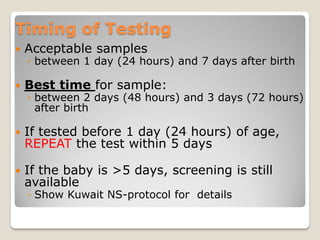
Timing of Testing
 Acceptable samples
◦ between 1 day (24 hours) and 7 days after birth
 Best time for sample:
◦ between 2 days (48 hours) and 3 days (72 hours)
after birth
 If tested before 1 day (24 hours) of age,
REPEAT the test within 5 days
 If the baby is >5 days, screening is still
available
◦ Show Kuwait NS-protocol for details
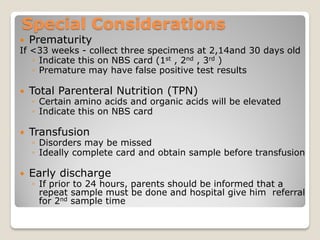
Special Considerations
 Prematurity
If <33 weeks - collect three specimens at 2,14and 30 days old
◦ Indicate this on NBS card (1st , 2nd , 3rd )
◦ Premature may have false positive test results
 Total Parenteral Nutrition (TPN)
◦ Certain amino acids and organic acids will be elevated
◦ Indicate this on NBS card
 Transfusion
◦ Disorders may be missed
◦ Ideally complete card and obtain sample before transfusion
 Early discharge
◦ If prior to 24 hours, parents should be informed that a
repeat sample must be done and hospital give him referral
for 2nd sample time
The Heel Test
Sample
qualitative
validity
NBS
Report
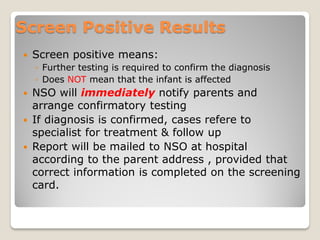
Screen Positive Results
 Screen positive means:
◦ Further testing is required to confirm the diagnosis
◦ Does NOT mean that the infant is affected
 NSO will immediately notify parents and
arrange confirmatory testing
 If diagnosis is confirmed, cases refere to
specialist for treatment & follow up
 Report will be mailed to NSO at hospital
according to the parent address , provided that
correct information is completed on the screening
card.
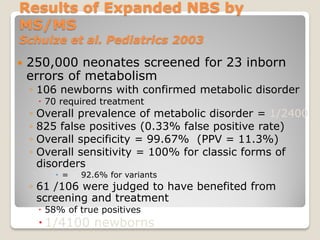
Results of Expanded NBS by
MS/MS
Schulze et al. Pediatrics 2003
 250,000 neonates screened for 23 inborn
errors of metabolism
◦ 106 newborns with confirmed metabolic disorder
 70 required treatment
◦ Overall prevalence of metabolic disorder = 1/2400
◦ 825 false positives (0.33% false positive rate)
◦ Overall specificity = 99.67% (PPV = 11.3%)
◦ Overall sensitivity = 100% for classic forms of
disorders
 = 92.6% for variants
◦ 61 /106 were judged to have benefited from
screening and treatment
 58% of true positives
 1/4100 newborns
Negative Results
 Results will go to:
◦ Submitting health care professional/hospital
 If you suspect that an infant or child has
symptoms of a screened condition and their
NBS results are negative – please refer to
the appropriate specialist for evaluation
◦ NBS panel does not screen for every metabolic condition
◦ NBS is a screening test – not diagnostic
Expanded NBS – 22 conditions
 18 inborn errors of metabolism
◦ 7 organic acid disorders
◦ 5 fatty acid oxidation disorders
◦ 6 amino acid disorders
 2 endocrine disorders
 2 other metabolic disorders
Inborn errors of metabolism
 Rare
 Usually autosomal recessive inheritance
◦consanguinity is more common
 Symptoms secondary to a problem in the
metabolic pathway
 Usually not significant dysmorphism
 Early recognition and intervention can be
lifesaving
Organic Acid Disorders
 Isovaleric acidemia (IVA)
 Glutaric acidemia type 1 (GA1)
 Multiple carboxylase deficiency (MCD)
 Methylmalonic acidemia (MMA)
 3-methylcrotonyl-CoA carboxylase (3MCC)
deficiency
 Propionic acidemia (PA)
 Β-ketothiolase deficiency (BKT)
Organic Acid Disorders
 What are organic acid disorders?
◦ Body cannot metabolize certain amino acids and fats
◦ Accumulation of organic acids in blood and urine
◦ Serious potentially preventable effects on health and
development, including death
 Symptoms
◦ acute encephalopathy, vomiting, metabolic acidosis,
ketosis, hyperammonemia, hypoglycemia, coma
◦ dehydration, failure to thrive, hypotonia, global
developmental delay
◦ sepsis, death
 Treatment
◦ Low protein diet / restrict amino acids,
◦ Supplements: carnitine, biotin, riboflavin, glycine
◦ Avoid fasting
Fatty Acid Oxidation Disorders
 Medium-chain acyl-CoA dehydrogenase
(MCAD) deficiency
 Very long-chain acyl-CoA dehydrogenase
deficiency (VLCAD)
 Long-chain L-3-OH acyl-CoA
dehydrogenase deficiency (LCHAD)
 Trifunctional protein deficiency (TFP)
◦ catalyzes 3 steps in mitochondrial beta-
oxidation of fatty acids
 3-Hydroxy-3-methylglutaryl-CoA lyase
def.(3HMG)
Disorders of Fatty Acid Oxidation
 What are disorders of fatty acid oxidation?
◦ Breakdown of fatty acids in mitochondria is an essential
part of body’s ability to produce energy
◦ Disorder: inability to break down fatty acids
 Symptoms
◦ Decompensate with any catabolic stress
 fever, fasting, intercurrent illness
◦ Hypoketotic hypoglycemia, liver, muscle, heart disease
◦ Lethargy, seizures, coma, sudden death (SIDS)
 Treatment
◦ Avoid fasting
◦ IV glucose when ill to prevent hypoglycemia
◦ Frequent feeding
Amino Acid Disorders
 Phenylketonuria (PKU)
 Maple syrup urine disease
(MSUD)
 Tyrosinemia type 1 (TYR 1)
◦Common in French Canadians
 Homocystinuria (HCY)
 Citrullinemia (CIT)
 Argininosuccinic acidemia (ASA)
Amino Acid Disorders
 What are amino acid disorders?
◦ Occur when the body cannot either metabolize or
produce certain amino acids
◦ Result in toxic accumulation of substances
◦ Serious potentially preventable effects on health and
development including death
 Symptoms (untreated) example PKU
◦ Hyperphenylalaninemia (neurotoxic)
◦ Microcephaly, epilepsy, mental retardation, behaviour
problems
 Treatment
◦ Diet: reduce phenylalanine, low protein, supplement
cofactors or essential amino acids
Expanded NBS – 22 conditions
 18 inborn errors of metabolism
◦ 7 organic acid disorders
◦ 5 fatty acid oxidation disorders
◦ 6 amino acid disorders
 2 endocrine disorders
 2 other metabolic disorders
Endocrine Disorders: CH
Congenital Hypothyroidism (CH)
 What is CH?
◦ inadequate thyroid hormone production
◦ Anatomic defect in gland, dyshormogenesis, iodine
deficiency
 Symptoms
◦ MR, ↓ growth & bone maturation, neurologic problems:
spasticity, gait abn, dysarthria, autistic behaviour
 Treatment
◦ Diagnosis made before 13 days to prevent symptoms
◦ Thyroid hormone replacement
Endocrine Disorders: CAH
Congenital Adrenal Hyperplasia (CAH)
 What is CAH?
◦ Impaired synthesis of cortisol by the adrenal cortex leads to
↑↑↑ androgen biosynthesis
◦ Inability to maintain adequate energy & blood glucose level
to meet stress of injury & illness
 Symptoms
◦ Virilization (♀ ambiguous genitalia), precocious puberty,
infertility, short stature
◦ Renal salt wasting leads to FTT, vomiting, dehydration,
hypotension, hyponatremia, & hyperkalemia
 Treatment
◦ Glucocorticoid replacement therapy
Expanded NBS – 22 conditions
 18 inborn errors of metabolism
◦ 7 organic acid disorders
◦ 5 fatty acid oxidation disorders
◦ 6 amino acid disorders
 2 endocrine disorders
 2 other metabolic disorders
Other Disorders:
Biotinidase deficiency
 What is biotinidase deficiency?
◦ Biotinidase is responsible for recycling biotin – a cofactor for
4 dependant carboxylases
 Symptoms
◦ Metabolic ketoacidosis, organic aciduria, mild
hyperammonemia
◦ Seizures, hypotonia, ataxia, developmental delay, vision
problems, hearing loss, cutaneous abnormalities
 Treatment
◦ 5-10mg of oral biotin per day, long term treatment prevents
all symptoms
Other Disorders: Galactosemia
 What is galactosemia?
◦ Lactose is main sugar in breast milk & infant formulas
◦ Metabolized into glucose and galactose in the intestine
◦ Unable to break down galactose
 Symptoms
◦ Feeding problems, FTT, bleeding, infection, liver failure,
cataracts, mental retardation, death
 Treatment
◦ Lactose-galactose-restricted diet
 must be started in first 10 days of life to prevent symptoms
◦ Even with treatment - ↑ developmental delay, speech
problems, abn motor function, premature ovarian failure
References
Ontario newborn screening guideline protocol
National Newborn Screening & Global Resource Center
http://genes-r-us.uthscsa.edu/
Newborn screening kuwait

Newborn screening kuwait

  • 1.
    Newborn Screening: Kuwait’s ExpandedScreening Program Prepared by: Dr . Amir Abdelazim Ahmed clinical pathology specialist at Kuwait medical Genetic Center
  • 2.
    Newborn Screening –What’s new?  Previously: ◦ PKU, congenital hypothyroidism  At 31 October 2014 : ◦ Progressive expansion to 22 primary disorders ◦ NBS includes metabolic and endocrine conditions
  • 3.
    Expanded NBS –22 conditions  18 inborn errors of metabolism  2 endocrine disorders ◦ Congenital hypothyroidism ◦ Congenital adrenal hyperplasia  2 other metabolic disorders ◦ Galactosemia ◦ Biotinidase deficiency
  • 4.
    Benefits of NBS Identification Earlyintervention Reduced morbidity & mortality Family planning
  • 5.
    Risks of NBS Parental anxiety (false positives)  Missed diagnosis (false negatives)  The right ‘not to know’  Unanticipated outcomes  Labelling – diagnosis of benign conditions
  • 6.
    NBS: how &where is it done?  Method: Heel prick  Sample collection: newborn screening card collected by staff of each hospital  Testing Location: Newborn Screening laboratory at KMGC  Transportation: NBS cards are sent from all hospitals via special drivers
  • 7.
    Timing of Testing Acceptable samples ◦ between 1 day (24 hours) and 7 days after birth  Best time for sample: ◦ between 2 days (48 hours) and 3 days (72 hours) after birth  If tested before 1 day (24 hours) of age, REPEAT the test within 5 days  If the baby is >5 days, screening is still available ◦ Show Kuwait NS-protocol for details
  • 8.
    Special Considerations  Prematurity If<33 weeks - collect three specimens at 2,14and 30 days old ◦ Indicate this on NBS card (1st , 2nd , 3rd ) ◦ Premature may have false positive test results  Total Parenteral Nutrition (TPN) ◦ Certain amino acids and organic acids will be elevated ◦ Indicate this on NBS card  Transfusion ◦ Disorders may be missed ◦ Ideally complete card and obtain sample before transfusion  Early discharge ◦ If prior to 24 hours, parents should be informed that a repeat sample must be done and hospital give him referral for 2nd sample time
  • 9.
  • 10.
  • 11.
  • 12.
    Screen Positive Results Screen positive means: ◦ Further testing is required to confirm the diagnosis ◦ Does NOT mean that the infant is affected  NSO will immediately notify parents and arrange confirmatory testing  If diagnosis is confirmed, cases refere to specialist for treatment & follow up  Report will be mailed to NSO at hospital according to the parent address , provided that correct information is completed on the screening card.
  • 13.
    Results of ExpandedNBS by MS/MS Schulze et al. Pediatrics 2003  250,000 neonates screened for 23 inborn errors of metabolism ◦ 106 newborns with confirmed metabolic disorder  70 required treatment ◦ Overall prevalence of metabolic disorder = 1/2400 ◦ 825 false positives (0.33% false positive rate) ◦ Overall specificity = 99.67% (PPV = 11.3%) ◦ Overall sensitivity = 100% for classic forms of disorders  = 92.6% for variants ◦ 61 /106 were judged to have benefited from screening and treatment  58% of true positives  1/4100 newborns
  • 14.
    Negative Results  Resultswill go to: ◦ Submitting health care professional/hospital  If you suspect that an infant or child has symptoms of a screened condition and their NBS results are negative – please refer to the appropriate specialist for evaluation ◦ NBS panel does not screen for every metabolic condition ◦ NBS is a screening test – not diagnostic
  • 15.
    Expanded NBS –22 conditions  18 inborn errors of metabolism ◦ 7 organic acid disorders ◦ 5 fatty acid oxidation disorders ◦ 6 amino acid disorders  2 endocrine disorders  2 other metabolic disorders
  • 16.
    Inborn errors ofmetabolism  Rare  Usually autosomal recessive inheritance ◦consanguinity is more common  Symptoms secondary to a problem in the metabolic pathway  Usually not significant dysmorphism  Early recognition and intervention can be lifesaving
  • 17.
    Organic Acid Disorders Isovaleric acidemia (IVA)  Glutaric acidemia type 1 (GA1)  Multiple carboxylase deficiency (MCD)  Methylmalonic acidemia (MMA)  3-methylcrotonyl-CoA carboxylase (3MCC) deficiency  Propionic acidemia (PA)  Β-ketothiolase deficiency (BKT)
  • 18.
    Organic Acid Disorders What are organic acid disorders? ◦ Body cannot metabolize certain amino acids and fats ◦ Accumulation of organic acids in blood and urine ◦ Serious potentially preventable effects on health and development, including death  Symptoms ◦ acute encephalopathy, vomiting, metabolic acidosis, ketosis, hyperammonemia, hypoglycemia, coma ◦ dehydration, failure to thrive, hypotonia, global developmental delay ◦ sepsis, death  Treatment ◦ Low protein diet / restrict amino acids, ◦ Supplements: carnitine, biotin, riboflavin, glycine ◦ Avoid fasting
  • 19.
    Fatty Acid OxidationDisorders  Medium-chain acyl-CoA dehydrogenase (MCAD) deficiency  Very long-chain acyl-CoA dehydrogenase deficiency (VLCAD)  Long-chain L-3-OH acyl-CoA dehydrogenase deficiency (LCHAD)  Trifunctional protein deficiency (TFP) ◦ catalyzes 3 steps in mitochondrial beta- oxidation of fatty acids  3-Hydroxy-3-methylglutaryl-CoA lyase def.(3HMG)
  • 20.
    Disorders of FattyAcid Oxidation  What are disorders of fatty acid oxidation? ◦ Breakdown of fatty acids in mitochondria is an essential part of body’s ability to produce energy ◦ Disorder: inability to break down fatty acids  Symptoms ◦ Decompensate with any catabolic stress  fever, fasting, intercurrent illness ◦ Hypoketotic hypoglycemia, liver, muscle, heart disease ◦ Lethargy, seizures, coma, sudden death (SIDS)  Treatment ◦ Avoid fasting ◦ IV glucose when ill to prevent hypoglycemia ◦ Frequent feeding
  • 21.
    Amino Acid Disorders Phenylketonuria (PKU)  Maple syrup urine disease (MSUD)  Tyrosinemia type 1 (TYR 1) ◦Common in French Canadians  Homocystinuria (HCY)  Citrullinemia (CIT)  Argininosuccinic acidemia (ASA)
  • 22.
    Amino Acid Disorders What are amino acid disorders? ◦ Occur when the body cannot either metabolize or produce certain amino acids ◦ Result in toxic accumulation of substances ◦ Serious potentially preventable effects on health and development including death  Symptoms (untreated) example PKU ◦ Hyperphenylalaninemia (neurotoxic) ◦ Microcephaly, epilepsy, mental retardation, behaviour problems  Treatment ◦ Diet: reduce phenylalanine, low protein, supplement cofactors or essential amino acids
  • 23.
    Expanded NBS –22 conditions  18 inborn errors of metabolism ◦ 7 organic acid disorders ◦ 5 fatty acid oxidation disorders ◦ 6 amino acid disorders  2 endocrine disorders  2 other metabolic disorders
  • 24.
    Endocrine Disorders: CH CongenitalHypothyroidism (CH)  What is CH? ◦ inadequate thyroid hormone production ◦ Anatomic defect in gland, dyshormogenesis, iodine deficiency  Symptoms ◦ MR, ↓ growth & bone maturation, neurologic problems: spasticity, gait abn, dysarthria, autistic behaviour  Treatment ◦ Diagnosis made before 13 days to prevent symptoms ◦ Thyroid hormone replacement
  • 25.
    Endocrine Disorders: CAH CongenitalAdrenal Hyperplasia (CAH)  What is CAH? ◦ Impaired synthesis of cortisol by the adrenal cortex leads to ↑↑↑ androgen biosynthesis ◦ Inability to maintain adequate energy & blood glucose level to meet stress of injury & illness  Symptoms ◦ Virilization (♀ ambiguous genitalia), precocious puberty, infertility, short stature ◦ Renal salt wasting leads to FTT, vomiting, dehydration, hypotension, hyponatremia, & hyperkalemia  Treatment ◦ Glucocorticoid replacement therapy
  • 26.
    Expanded NBS –22 conditions  18 inborn errors of metabolism ◦ 7 organic acid disorders ◦ 5 fatty acid oxidation disorders ◦ 6 amino acid disorders  2 endocrine disorders  2 other metabolic disorders
  • 27.
    Other Disorders: Biotinidase deficiency What is biotinidase deficiency? ◦ Biotinidase is responsible for recycling biotin – a cofactor for 4 dependant carboxylases  Symptoms ◦ Metabolic ketoacidosis, organic aciduria, mild hyperammonemia ◦ Seizures, hypotonia, ataxia, developmental delay, vision problems, hearing loss, cutaneous abnormalities  Treatment ◦ 5-10mg of oral biotin per day, long term treatment prevents all symptoms
  • 28.
    Other Disorders: Galactosemia What is galactosemia? ◦ Lactose is main sugar in breast milk & infant formulas ◦ Metabolized into glucose and galactose in the intestine ◦ Unable to break down galactose  Symptoms ◦ Feeding problems, FTT, bleeding, infection, liver failure, cataracts, mental retardation, death  Treatment ◦ Lactose-galactose-restricted diet  must be started in first 10 days of life to prevent symptoms ◦ Even with treatment - ↑ developmental delay, speech problems, abn motor function, premature ovarian failure
  • 30.
    References Ontario newborn screeningguideline protocol National Newborn Screening & Global Resource Center http://genes-r-us.uthscsa.edu/