
BY
WHAT IS NEWBORN SCREENING ?
Newborn screening is a public health program
designed to screen infants shortly after birth
for a list of conditions that are treatable but
not clinically evident in newborn period.
WHAT FOR NEWBORN SCREENING ?
• “The goal of newborn screening is early
detection of children at increased risk for
selected metabolic or genetic diseases so that
medical treatment can be promptly initiated
to avert metabolic crises and prevent
irreversible neurological and developmental
sequelae.”
HISTORY OF NEW BORN SCREENING
• 1930’s George Jervis at NY identified 50 clients
with metal retardation attributed to PKU
• 1963 Robert Guthrie, microbiologist-
pediatrician at State University of New York
devised simple inexpensive which allowed
screening for PKU
• 1965 New York State law for newborn
screening, Public Health Law 2500
• 1970 -1980s: congenital
hypothyroidism, congenital adrenal
hyperplasia, galactosemia
• 1990s:DNA tests used as second tier – Sickle
Cell Disease screening, Cystic Fibrosis
screening
• 2000s : Tandem Mass Spectrometer (MS/MS)
Many diseases, one test
CARDINAL PRINCIPLES OF SCREENING
• The disorder has a relatively high incidence so that the
cost per diagnosed individual is reasonable
• An effective and not overly expensive treatment is
available.
• A relatively inexpensive screening test that is suitable
for high volume testing (preferably automatable)
• The screening test has a very high sensitivity (very low
false negatives) and high specificity (low false positives
which require expensive follow-up)
CRITERIA FOR NEWBORN SCREENING
• Disorder produces irreversible damage before
onset of symptoms
• Treatment is effective if begun early
• Natural history of disorder is known
SCREENING PROCEDURE
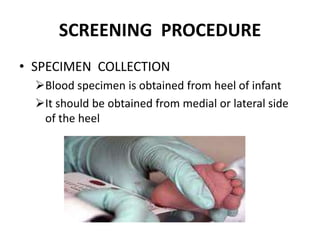
• SPECIMEN COLLECTION
Blood specimen is obtained from heel of infant
It should be obtained from medial or lateral side
of the heel
TIMING OF COLLECTION
• Normal Term Newborn: Before nursery
discharge or 3rd day of life whichever is earlier.
• Preterm or LBW: 2 wks of age or at discharge
whichever is earlier.
• Newborn who is to receive blood transfusion,
One specimen collected before transfusion &
second specimen 2 days after transfusion.
SCREENING TESTS
• BACTERIAL ASSAYS:
Punching of small disc from Guthrie specimen
Disc are place in agar or silica gel & contain
bacteria growth media & other necessary factors
Each bacterial plate are specified for response to a
particular metabolite.
The amount of growth around the disc is directly
proportional to the concentration of metabolite in
blood.
They are used to screen for amino acid disorders.
• IMMUNOASSAYS
RADIOIMMUNOASSAY
FLUOROASSAY
ELISA
USED TO TEST
Endocrinopathies: Congenital Hypothyroidism &
CAH
Infectious disease: Congenital toxoplasmosis, HIV
Cystic Fibrosis
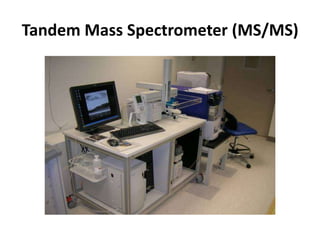
Tandem Mass Spectrometer (MS/MS)
Tandem Mass Spectrometry (MS/MS) High
Impact and High Throughput
• One disease, one test is not cost-effective
• Many diseases, one test is cost-effective
• MS/MS allows for rapid, simultaneous analysis
and detection of many disorders of amino
acid, organic acid, and fatty acid metabolism
• Sample set up determines which masses and
therefore which compounds are detected
• 2 minute analysis time
• Automated data processing for results
MS/MS Methodology – continued
Compounds analyzed are amino acids and
acylcarnitines
–Amino acids – to identify
PKU, MSUD, homocystinuria
–Acylcarnitine – carnitine (vehicle) + fatty
acid for identification of organic acidurias
and fatty acid oxidation disorders
SECONDARY TEST
• An abnormal finding on newborn screening
test is not diagnostic of a disorder.
• Additional tests should be performed to
substantiate the original finding.
• Also the original specimen is retested for the
analyte that is abnormal.
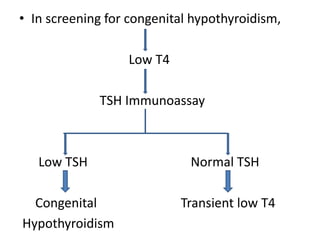
• In screening for congenital hypothyroidism,
Low T4
TSH Immunoassay
Low TSH Normal TSH
Congenital Transient low T4
Hypothyroidism
DISORDERS MOST COMMONLY
SCREENED
• PHENYLKETONURIA
• CONGENITAL HYPOTHYROIDISM
• GALACTOSEMIA
• HOMOCYSTINURIA
• MAPLE SYRUP URINE DISEASE
• CONGENITAL ADRENAL HYPERPLASIA
• SICKLE CELL DISEASE
PHENYLKETONURIA
• INCIDENCE: 1 IN 12000 live births
• Untreated: Mental retardation & neurological
abnormalities
• Screening is done by MS/MS
• Screening test is positive if phenylalanine level
is > 6mg/dl
• Liver disease, Galactosemia & Tyrosinemia
type 1 can also produce phenylalanine levels.
CONGENITAL HYPOTHYROIDISM
• INCIDENCE: 1 in 3000 to 5000 newborn
• UNTREATED: Growth retardation & delayed
cognitive development
• Two Screening approaches are used
Primary screening for low T4 with secondary
screening for high TSH
Primary screening for high TSH
• FALSE POSITIVE
Low T4: Premature infants, Thyroxin binding
globulin deficiency
High TSH: Perinatal stress
• FALSE NEGATIVE
Normal T4: In first 24hrs of life.
Normal TSH: In premature infants with CH it may
take 2 or more wks for TSH elevation to develop
GALACTOSEMIA
• INCIDENCE: 1 in 62000
• MANIFESTATIONS: Failure to
thrive, vomiting, Liver disease & death from
sepsis due to E.Coli
• 2 Screening Test
SPECIFIC ENZYME ASSAY
Measures activity of Galactose 1 Phosphate Uridyl
Transferrase
Identifies only galactosemia
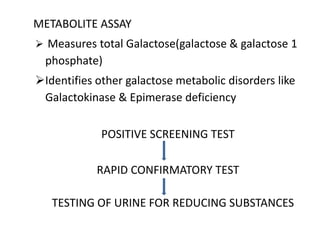
METABOLITE ASSAY
 Measures total Galactose(galactose & galactose 1
phosphate)
Identifies other galactose metabolic disorders like
Galactokinase & Epimerase deficiency
POSITIVE SCREENING TEST
RAPID CONFIRMATORY TEST
TESTING OF URINE FOR REDUCING SUBSTANCES
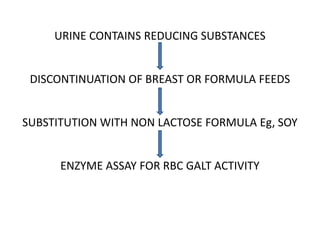
URINE CONTAINS REDUCING SUBSTANCES
DISCONTINUATION OF BREAST OR FORMULA FEEDS
SUBSTITUTION WITH NON LACTOSE FORMULA Eg, SOY
ENZYME ASSAY FOR RBC GALT ACTIVITY
HOMOCYSTINURIA
• INCIDENCE: 1 IN 344,000 births
• UNTREATED: Ectopia lentis, Osteoporosis
Thromboembolism, Mental Retardation
• SCREENING MARKER: Plasma Methionine
levels.
• MS/MS is used for screening
• Isolated Hypermethioninemia may occur in
MAT Deficiency,
Tyrosinemia type 1
Liver disease
• HOMOCYSTINURIA
Homocysteine is detectable in plasma & urine
Plasma total Homocysteine & Methionine
Plasma cysteine is reduced
• ISOLATED HYPERMETHIONINEMIA
Plasma Methione markedly
No detectable homocysteine in plasma or urine
Normal plasma cysteine levels
MAPLE SYRUP URINE DISEASE
• INCIDENCE: 1 IN 185,000 births
• FULMINANT DISEASE: Severe
Ketoacidosis, Vomiting & lethargy & may
progress to coma & death
• SCREENING MARKER: 4 fold elevation of
plama leucine in NB
• Confirmatory plasma & urine specimens
obtained
• Plasma shows marked increase in leucine,
isoleucine & valine (branched chain amino
acids)
• Urine is strongly positive for ketones
• Maple syrup odor appears earliest in cerumen
& later in urine. Can be detected by cotton
tipped swab inserted into infant’s ear.
• CONGENITAL ADRENAL HYPERPLASIA
Screening Marker: Increased levels of 17OHP
• SICKLE CELL DISEASE
Screening is by means of Hemoglobin
electrophoresis.
It also identifies sickle cell trait & other abnormal
hemoglobins.
OTHER DISORDERS DETECTED BY
NEWBORN SCREENING
• BIOTINIDASE DEFICIENCY
• OTHER AMINO ACID DISORDERS: Eg
Citrullinemia
• LONG CHAIN & MEDIUM CHAIN ACYL CoA
DEHYDROGENASE DEFICIENCY
• CYSTIC FIBROSIS
• NEUROBLASTOMA
Newborn Screening

Newborn Screening

  • 1.
  • 2.
    WHAT IS NEWBORNSCREENING ? Newborn screening is a public health program designed to screen infants shortly after birth for a list of conditions that are treatable but not clinically evident in newborn period.
  • 3.
    WHAT FOR NEWBORNSCREENING ? • “The goal of newborn screening is early detection of children at increased risk for selected metabolic or genetic diseases so that medical treatment can be promptly initiated to avert metabolic crises and prevent irreversible neurological and developmental sequelae.”
  • 4.
    HISTORY OF NEWBORN SCREENING • 1930’s George Jervis at NY identified 50 clients with metal retardation attributed to PKU • 1963 Robert Guthrie, microbiologist- pediatrician at State University of New York devised simple inexpensive which allowed screening for PKU • 1965 New York State law for newborn screening, Public Health Law 2500
  • 5.
    • 1970 -1980s:congenital hypothyroidism, congenital adrenal hyperplasia, galactosemia • 1990s:DNA tests used as second tier – Sickle Cell Disease screening, Cystic Fibrosis screening • 2000s : Tandem Mass Spectrometer (MS/MS) Many diseases, one test
  • 6.
    CARDINAL PRINCIPLES OFSCREENING • The disorder has a relatively high incidence so that the cost per diagnosed individual is reasonable • An effective and not overly expensive treatment is available. • A relatively inexpensive screening test that is suitable for high volume testing (preferably automatable) • The screening test has a very high sensitivity (very low false negatives) and high specificity (low false positives which require expensive follow-up)
  • 7.
    CRITERIA FOR NEWBORNSCREENING • Disorder produces irreversible damage before onset of symptoms • Treatment is effective if begun early • Natural history of disorder is known
  • 8.
    SCREENING PROCEDURE • SPECIMENCOLLECTION Blood specimen is obtained from heel of infant It should be obtained from medial or lateral side of the heel
  • 9.
    TIMING OF COLLECTION •Normal Term Newborn: Before nursery discharge or 3rd day of life whichever is earlier. • Preterm or LBW: 2 wks of age or at discharge whichever is earlier. • Newborn who is to receive blood transfusion, One specimen collected before transfusion & second specimen 2 days after transfusion.
  • 10.
    SCREENING TESTS • BACTERIALASSAYS: Punching of small disc from Guthrie specimen Disc are place in agar or silica gel & contain bacteria growth media & other necessary factors Each bacterial plate are specified for response to a particular metabolite. The amount of growth around the disc is directly proportional to the concentration of metabolite in blood. They are used to screen for amino acid disorders.
  • 11.
    • IMMUNOASSAYS RADIOIMMUNOASSAY FLUOROASSAY ELISA USED TOTEST Endocrinopathies: Congenital Hypothyroidism & CAH Infectious disease: Congenital toxoplasmosis, HIV Cystic Fibrosis
  • 12.
  • 13.
    Tandem Mass Spectrometry(MS/MS) High Impact and High Throughput • One disease, one test is not cost-effective • Many diseases, one test is cost-effective • MS/MS allows for rapid, simultaneous analysis and detection of many disorders of amino acid, organic acid, and fatty acid metabolism • Sample set up determines which masses and therefore which compounds are detected • 2 minute analysis time • Automated data processing for results
  • 14.
    MS/MS Methodology –continued Compounds analyzed are amino acids and acylcarnitines –Amino acids – to identify PKU, MSUD, homocystinuria –Acylcarnitine – carnitine (vehicle) + fatty acid for identification of organic acidurias and fatty acid oxidation disorders
  • 15.
    SECONDARY TEST • Anabnormal finding on newborn screening test is not diagnostic of a disorder. • Additional tests should be performed to substantiate the original finding. • Also the original specimen is retested for the analyte that is abnormal.
  • 16.
    • In screeningfor congenital hypothyroidism, Low T4 TSH Immunoassay Low TSH Normal TSH Congenital Transient low T4 Hypothyroidism
  • 17.
    DISORDERS MOST COMMONLY SCREENED •PHENYLKETONURIA • CONGENITAL HYPOTHYROIDISM • GALACTOSEMIA • HOMOCYSTINURIA • MAPLE SYRUP URINE DISEASE • CONGENITAL ADRENAL HYPERPLASIA • SICKLE CELL DISEASE
  • 18.
    PHENYLKETONURIA • INCIDENCE: 1IN 12000 live births • Untreated: Mental retardation & neurological abnormalities • Screening is done by MS/MS • Screening test is positive if phenylalanine level is > 6mg/dl • Liver disease, Galactosemia & Tyrosinemia type 1 can also produce phenylalanine levels.
  • 19.
    CONGENITAL HYPOTHYROIDISM • INCIDENCE:1 in 3000 to 5000 newborn • UNTREATED: Growth retardation & delayed cognitive development • Two Screening approaches are used Primary screening for low T4 with secondary screening for high TSH Primary screening for high TSH
  • 20.
    • FALSE POSITIVE LowT4: Premature infants, Thyroxin binding globulin deficiency High TSH: Perinatal stress • FALSE NEGATIVE Normal T4: In first 24hrs of life. Normal TSH: In premature infants with CH it may take 2 or more wks for TSH elevation to develop
  • 21.
    GALACTOSEMIA • INCIDENCE: 1in 62000 • MANIFESTATIONS: Failure to thrive, vomiting, Liver disease & death from sepsis due to E.Coli • 2 Screening Test SPECIFIC ENZYME ASSAY Measures activity of Galactose 1 Phosphate Uridyl Transferrase Identifies only galactosemia
  • 22.
    METABOLITE ASSAY  Measurestotal Galactose(galactose & galactose 1 phosphate) Identifies other galactose metabolic disorders like Galactokinase & Epimerase deficiency POSITIVE SCREENING TEST RAPID CONFIRMATORY TEST TESTING OF URINE FOR REDUCING SUBSTANCES
  • 23.
    URINE CONTAINS REDUCINGSUBSTANCES DISCONTINUATION OF BREAST OR FORMULA FEEDS SUBSTITUTION WITH NON LACTOSE FORMULA Eg, SOY ENZYME ASSAY FOR RBC GALT ACTIVITY
  • 24.
    HOMOCYSTINURIA • INCIDENCE: 1IN 344,000 births • UNTREATED: Ectopia lentis, Osteoporosis Thromboembolism, Mental Retardation • SCREENING MARKER: Plasma Methionine levels. • MS/MS is used for screening
  • 25.
    • Isolated Hypermethioninemiamay occur in MAT Deficiency, Tyrosinemia type 1 Liver disease • HOMOCYSTINURIA Homocysteine is detectable in plasma & urine Plasma total Homocysteine & Methionine Plasma cysteine is reduced
  • 26.
    • ISOLATED HYPERMETHIONINEMIA PlasmaMethione markedly No detectable homocysteine in plasma or urine Normal plasma cysteine levels
  • 27.
    MAPLE SYRUP URINEDISEASE • INCIDENCE: 1 IN 185,000 births • FULMINANT DISEASE: Severe Ketoacidosis, Vomiting & lethargy & may progress to coma & death • SCREENING MARKER: 4 fold elevation of plama leucine in NB
  • 28.
    • Confirmatory plasma& urine specimens obtained • Plasma shows marked increase in leucine, isoleucine & valine (branched chain amino acids) • Urine is strongly positive for ketones • Maple syrup odor appears earliest in cerumen & later in urine. Can be detected by cotton tipped swab inserted into infant’s ear.
  • 29.
    • CONGENITAL ADRENALHYPERPLASIA Screening Marker: Increased levels of 17OHP • SICKLE CELL DISEASE Screening is by means of Hemoglobin electrophoresis. It also identifies sickle cell trait & other abnormal hemoglobins.
  • 30.
    OTHER DISORDERS DETECTEDBY NEWBORN SCREENING • BIOTINIDASE DEFICIENCY • OTHER AMINO ACID DISORDERS: Eg Citrullinemia • LONG CHAIN & MEDIUM CHAIN ACYL CoA DEHYDROGENASE DEFICIENCY • CYSTIC FIBROSIS • NEUROBLASTOMA